Seneca Wing Shot MKII: Versatile .50 Caliber PCP Air Shotgun
Exceptional field versatility is delivered by the Seneca Wing Shot MKII, a precharged pneumatic platform through which shotgun patterns, big-bore slugs, and Air Bolts can be launched from a single smoothbore action. Consequently, upland birds, small game, and medium quarry can be pursued without a second firearm being carried. Moreover, classic shotgun handling is combined with modern PCP power so that confident, ethical shots can be taken by hunters of every experience level.
Design Features That Support Fast Target Work
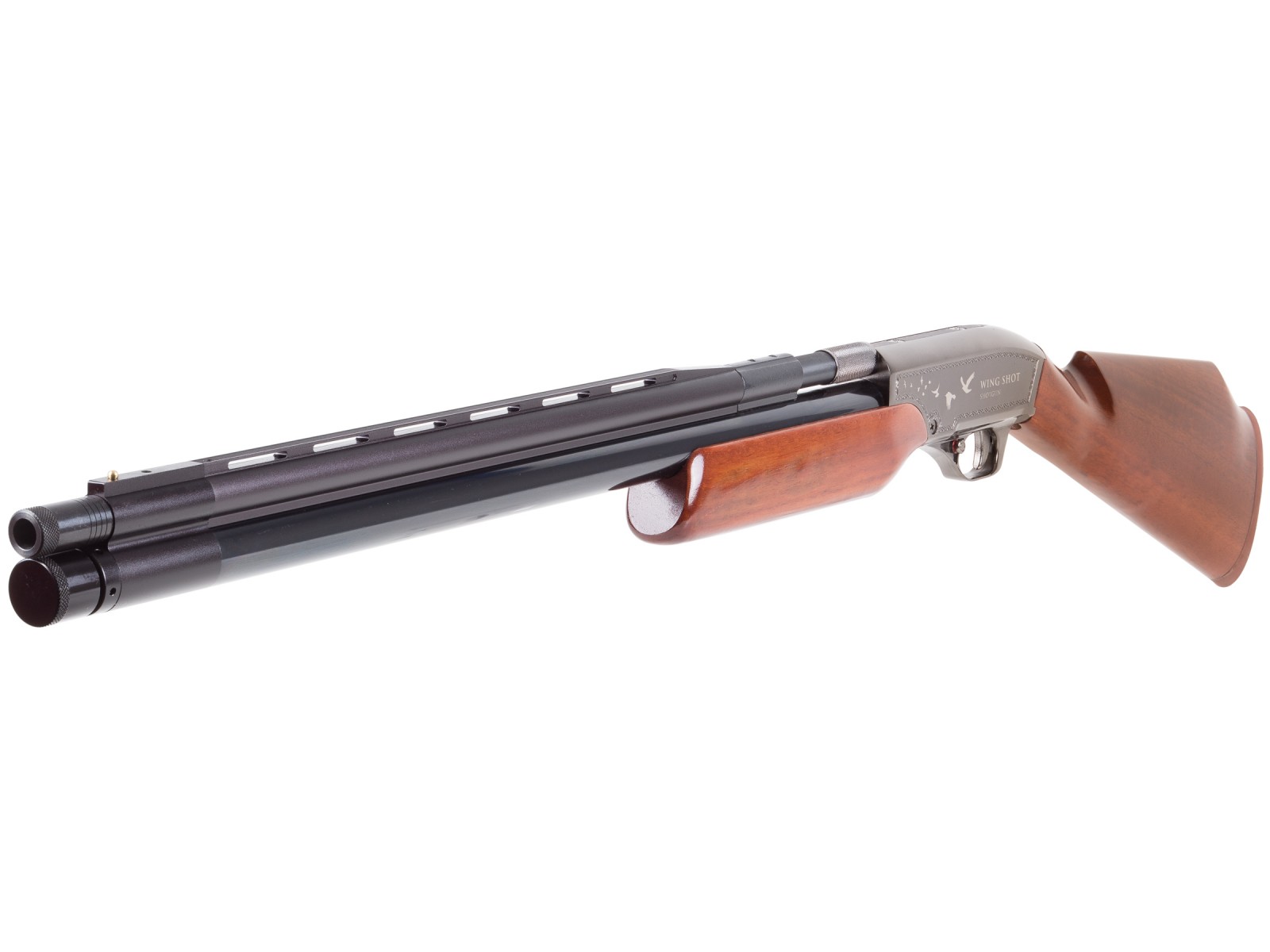
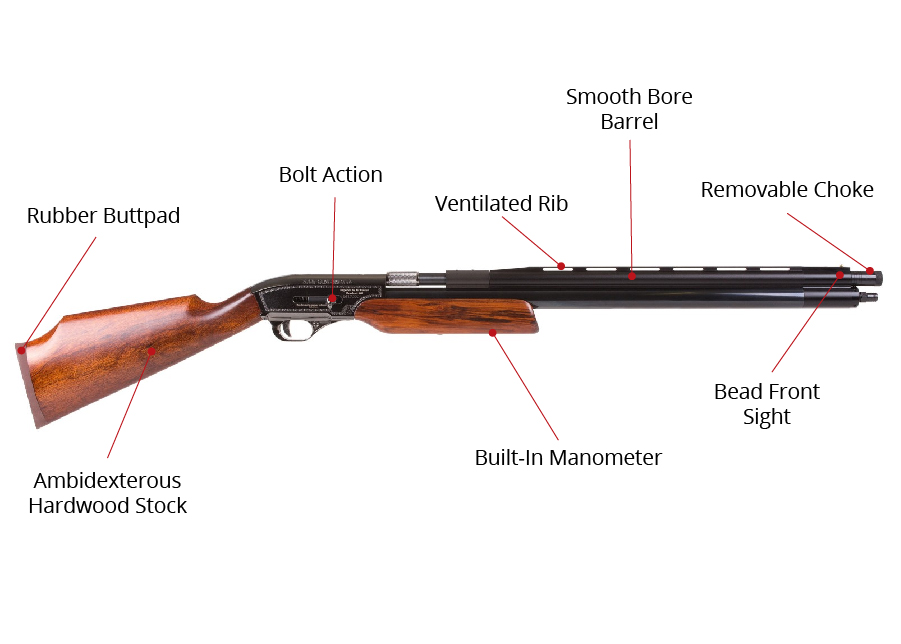
An over-under profile is paired with a sliding bolt reminiscent of a familiar autoloader, so instinctive mounting is encouraged. Meanwhile, a ventilated rib is fitted along the 22.5-inch barrel, and a brass bead is placed at the muzzle; as a result, moving targets can be tracked with a traditional shotgun sight picture. In addition, an ambidextrous hardwood stock and a rubber buttpad are provided, therefore recoil energy is absorbed and comfortable shouldering is enjoyed by both left- and right-handed shooters.
Barrel, Choke, and Sighting System
A smooth 12.47 mm bore is employed so that shotshells and slugs can be sent through the same tube. Subsequently, a removable choke is threaded at the muzzle; when the choke is installed, the inner diameter is reduced from .494″ to .486″, and a consistent pattern of approximately 12 inches at 20 yards is produced. Conversely, the choke must be unscrewed before slugs or Air Bolts are loaded, otherwise barrel damage can occur. Furthermore, a built-in manometer is integrated into the forearm, so reservoir pressure can be monitored at a glance before each string of shots.
Three Modes of Power From One Platform
Remarkable flexibility is offered because three projectile types can be chambered in the same single-shot bolt action.
Shotgun mode. Air Venturi shotshells charged with #6 or #8 shot can be loaded through the unscrewing breech. Thereafter, velocities approaching 1,130 fps and energies near 360 foot-pounds can be generated. Consequently, upland birds, squirrels, rabbits, and close-range pests can be engaged with a pattern that remains useful out to roughly 20–30 yards when the choke is fitted.
Slug mode. After the choke has been removed, .50-caliber lead bullets can be seated. In this configuration, velocities near 760 fps and energies exceeding 245 FPE are typically recorded. Therefore, well-placed shots on coyote, javelina, and similar medium game can be delivered at modest hunting distances.
Air Bolt mode. Dedicated .50-caliber Air Bolts can also be launched. Speeds around 500 fps and energies near 238 FPE are commonly achieved, so a hard-hitting arrow option is added without a second platform being required.
Because the action remains single-shot, each projectile is loaded deliberately. As a result, shot placement is emphasized and responsible hunting habits are reinforced.
Highlighted Specifications of the Seneca Wing Shot MKII
- Caliber: .50 (shotshells, slugs, and Air Bolts)
- Powerplant: Precharged pneumatic (PCP), unregulated
- Action: Bolt-action, single-shot
- Barrel: 22.5″ smoothbore with ventilated rib and removable choke
- Air reservoir: 244 cc, filled to approximately 3,000 PSI / 206 BAR
- Useful shots per fill: About 5 consistent full-power shots
- Claimed performance: Up to 1,130 fps / 360 FPE with #8 shotshells; 245+ FPE with slugs
- Overall length: 43″
- Weight: 7.4 lb
- Stock: Ambidextrous hardwood with rubber buttpad
- Sights: Brass bead front; no factory rear sight (optional 11 mm rail sold separately)
- Trigger: Two-stage, non-adjustable (approximately 5 lb pull)
- Safety: Manual / crossbolt
- Pressure gauge: Integrated manometer
- Loudness: High (typical unshrouded big-bore PCP report)
- Warranty: One-year limited manufacturer coverage
Field Handling, Fill Discipline, and Ethical Use
A relatively light 7.4-pound package is carried, so all-day walks through cover can be completed without excessive fatigue. Nevertheless, the 244 cc tube is air-hungry; therefore a high-pressure tank or compressor should be kept nearby if extended strings are planned. After a fill to working pressure, five reliable shots are customarily obtained before velocity and pattern quality begin to fall. Accordingly, pressure should be checked on the onboard gauge after every few shots, and a top-off should be performed before the next hunt begins.
Because the report is loud and the projectiles are powerful, hearing protection is strongly recommended and backstops must be confirmed. Likewise, local airgun and hunting regulations must be verified before any live-game use, since legal status, energy limits, and permitted species vary by jurisdiction. Inclusive, ethical hunting is supported when shots are limited to distances at which clean, humane kills can be reasonably expected—typically inside 20–30 yards for shot and similarly conservative ranges for slugs and bolts from a smoothbore.
Maintenance remains straightforward. After each outing, the bore can be wiped, the choke threads can be inspected, and O-rings can be checked during regular fills. Empty shotshells can be reloaded by many owners, so ammunition cost can be managed over time.
Why the Seneca Wing Shot MKII Earns a Place in the Field
Few production airguns allow shotgun patterns, heavy slugs, and Air Bolts to be selected from one hardwood stock. Consequently, a compact hunting kit can be assembled around a single 43-inch PCP. Moreover, the ventilated rib and bead encourage instinctive pointing, while the ambidextrous furniture welcomes every shooter. In addition, the integrated gauge and Foster-style fill system keep air management simple once a tank or compressor is available.
When a distinctive, high-power air shotgun is required for birds, small game, or carefully chosen medium quarry, the Seneca Wing Shot MKII can be considered a purpose-built solution. Responsible owners who pair it with proper fill equipment, the correct choke setting, and disciplined shot selection will find a rare combination of tradition and modern pneumatic power waiting in the same gun.
Air Venturi, Seneca and Modern Pneumatic Airgun Platforms
Modern pneumatic shooting equipment now covers everything from compact target platforms to large-calibre sporting systems. One of the most recognizable models in this category is the air venturi avenger, which combines adjustable PCP technology with practical ergonomics and a versatile configuration. Shooters researching more modular designs may instead consider the air venturi avenge-x, while searches for avenger x, avenge x, avenge-x, and avenge x tactical often reflect interest in newer configurations built around adaptability.
Calibre is another major consideration. Someone researching a rifle pcp avenger 6.35 may be interested in a larger pellet option, while the less common search variation avenge xx can lead buyers toward the same general product family. Regardless of terminology, choosing the correct rifle should depend on shooting discipline, preferred calibre, physical dimensions, available filling equipment, and local regulations.
Exploring the Dragon Claw Big-Bore Family
The dragon claw air rifle represents a substantially different category from conventional small-bore pneumatic equipment. Searches for a dragon claw 50 caliber air gun generally come from users exploring large-calibre compressed-air platforms designed for specialized sporting applications.
Alternative search terminology such as dragonclaw gun, dragon claw airgun 50 cal, and dragon claw air gun can also appear when buyers are comparing models, ammunition options, accessories, and availability. Shoppers researching dragon claw 50 caliber air rifle price should pay attention not only to purchase cost but also to filling equipment, appropriate projectiles, maintenance requirements, and applicable laws.
The phrase dragon claw 50 cal is commonly associated with this powerful pneumatic category. Within the manufacturer’s lineup, the seneca dragon claw is particularly well known, while the seneca dragon claw 50 caliber designation helps distinguish its calibre from smaller pneumatic rifles. A more specialized configuration may be found through searches for the seneca dragon claw 2 tactical.
Understanding the Wider Airgun Market
The spelling air ventura occasionally appears during online product searches even though buyers are often looking for Air Venturi equipment. The broad term air gun encompasses several operating systems, including PCP, CO2, spring-piston, gas-ram, and multi-pump pneumatic designs.
Other variations such as air rifle com, aventuri, and airrifle regularly appear in search data. Regardless of spelling, shoppers should distinguish between different powerplants before comparing specifications.
Modern pcp air rifles store compressed air in an onboard reservoir. By comparison, pneumatic air rifles is a broader description that may also include multi-pump and other compressed-air systems. Unusual search wording such as airbun air may appear alongside more conventional product terminology.
An air hunting rifle should always be selected according to the lawful quarry, calibre requirements, accuracy, projectile performance, and permitted energy level in the shooter’s jurisdiction.
Seneca Airgun Platforms
The broader seneca air rifles catalogue contains several types of pneumatic equipment rather than one single operating system. Someone looking for a seneca dragonfly mk2 is researching a considerably different platform from a large-bore Dragon Claw.
A general search for seneca air rifle may produce PCP, multi-pump, and specialized sporting models. Likewise, seneca air is sometimes used as shorthand when users are trying to locate the brand or its product range.
The seneca dragonfly emphasizes a self-contained pneumatic design, making it particularly appealing to shooters who do not want to depend entirely on an external high-pressure filling source. Buyers searching seneca dragonfly mk2 for sale should verify calibre, condition, warranty, and exact generation before ordering.
The simplified term dragonfly mk2 is another common product query. Meanwhile, the seneca dragon claw ii refers users back toward the company’s big-bore category, and searches for seneca guns can cover its wider pneumatic catalogue.
Air Venturi Alpha Series
The air venturi alpha provides another option for users exploring PCP technology. Its design is aimed at shooters who want practical pneumatic performance without immediately moving into highly specialized big-bore equipment.
A more maneuverable alternative can be found in the air venturi alpha compact. Compact dimensions may be attractive for shooters who value reduced overall length, although specifications should still be compared carefully.
Search terms such as alphagun airx, alphapure, alpha airx, alpha pri, and alpha air can sometimes appear in related search results. Because these terms can refer to different products or even unrelated categories, confirming the exact manufacturer’s model name is important before purchasing accessories or replacement parts.
Someone searching air venturi alpha for sale should examine included equipment, calibre, fill requirements, product condition, warranty, and regional specification. The air venturi alpha air rifle can then be evaluated based on intended recreational or sporting use rather than advertised specifications alone.
Air Venturi MicroStrike
Compact PCP development continues with the air venturi microstrike, a platform designed around reduced dimensions and pneumatic operation. Some users may search for it as the air venturi micro strike, particularly when comparing listings across different online marketplaces.
The phrase microstrike pcp emphasizes its operating system, while microstrike air venturi combines the product and manufacturer names in reverse order. A general search for micro rifle may also lead buyers toward compact pneumatic equipment from several manufacturers.
Compactness should never be mistaken for a lack of capability. Pressure ratings, calibre, energy, ammunition compatibility, and safe handling requirements remain important regardless of overall dimensions.
High-Powered Pneumatic Rifles and Maintenance
People researching the best high powered air rifles for hunting should compare far more than muzzle velocity. Accuracy, retained projectile energy, calibre, shot consistency, rifle balance, ethical shooting distance, and local hunting legislation all influence whether a platform is appropriate.
Owners occasionally search airventure avenger disassembly instructions when maintenance becomes necessary. Because high-pressure reservoirs can contain substantial stored energy, internal servicing should follow official manufacturer documentation and appropriate depressurization procedures.
Specialized projectile systems also appear within the pneumatic market. An air bolt gun uses compressed-air technology with a projectile system different from an ordinary pellet rifle. Searches for airbolt gun, air bolt, airbolt, and airbolt rifle illustrate the variety of wording customers use when researching this category.
The phrase pax bolt may also appear among specialized projectile-related searches. Exact compatibility should always be confirmed directly against the intended launcher or rifle before accessories are purchased.
Pneumatic Shotgun Systems
Another specialized category is the air shotgun for hunting, which uses compressed air rather than conventional firearm propellant. These platforms are niche products that should be evaluated according to local hunting regulations and manufacturer-approved ammunition.
The wingshot is associated with pneumatic shotgun technology, while the alternative spacing wing shot is frequently used during online searches. Such designs demonstrate how compressed-air technology can extend beyond traditional pellet rifles.
Understanding 12-Gram CO2 Cartridges
CO2-powered airguns use a different energy source from high-pressure PCP systems. Small pistols and recreational platforms frequently depend on 12g co2 actuation cartridges for their operating gas.
A standard 12g co2 cartridge is a small disposable cylinder containing compressed carbon dioxide. Buyers may also search for a 12 gram co2 cartridge, 12gram co2 cartridge, or simply co2 12g when purchasing replacements.
The search term 12grams is sometimes entered without reference to CO2, while co2 cartridges 12g clearly identifies the intended accessory. Other variations include 12-gram co2 cartridge, co2 12 gram, and 12 g co2 cartridges.
Although these terms describe the same general cartridge format, users should check the equipment manufacturer’s specifications before installation because seals, dimensions, piercing mechanisms, and compatibility can vary.
PCP Air Rifle Technology Explained
A pcp air rifle is powered using compressed air stored inside an onboard cylinder or bottle. The misspelling air rifel can sometimes appear in customer searches but generally refers to the same broader equipment category.
People asking what is a pcp air rifle are essentially asking how pre-charged pneumatic technology differs from spring-powered or CO2-based systems. In PCP equipment, the reservoir is filled beforehand and subsequently meters compressed air during firing.
An ar15 air rifle normally describes a pneumatic platform that uses modern sporting-rifle-inspired styling or ergonomics. Its appearance does not mean that its internal operating mechanism is the same as a firearm.
Similarly, marketing descriptions such as high powered air gun and high velocity air rifle should be evaluated alongside energy, calibre, accuracy, intended role, and legal restrictions rather than being used as the sole basis for a purchase.
Large-calibre equipment may be found through the unusual combined search phrase big bore pcp air riflespcp shotgun, which overlaps two specialized pneumatic categories.
Seneca Double Shot and Wingshot Systems
The seneca double shot .50 cal double barrel shotgun is a distinctive pneumatic platform that differs considerably from conventional pellet rifles. Its double-barrel arrangement makes it one of the more unusual products within the compressed-air sporting market.
A shorter search for seneca double shot generally leads toward the same family. The designation seneca double shot .50 cal highlights its large-calibre format and helps distinguish it from smaller recreational equipment.
Another search for wingshot products may lead users toward pneumatic shotgun-style equipment capable of using manufacturer-approved projectiles or shot loads, depending on the specific model.
A double barrel air gun differs operationally from ordinary repeating pellet rifles. Likewise, the phrase shotgun air rifle is commonly used by shoppers attempting to describe hybrid pneumatic designs.
The simpler term double shot gun may produce broader results, so confirming the exact product before ordering parts or accessories remains important.
Avenger Components and Modular PCP Configurations
One component researched by existing owners is the air venturi avenger rear barrel support. Parts compatibility can depend on production generation, stock configuration, barrel arrangement, and other dimensional considerations.
The term avenge x pcp is commonly used by users specifically interested in the pre-charged pneumatic version of the modular platform. Understanding reservoir volume, regulator settings, fill pressure, stock design, and calibre availability is more useful than relying exclusively on headline velocity figures.
Air Venturi V10 and Precision Air Pistols
The air venturi v10 belongs to a different shooting category from larger pneumatic rifles. It is associated with precision pistol shooting and is therefore more relevant to shooters interested in balance, trigger feel, grip ergonomics, and controlled target performance.
Someone searching for a strong bb pistol may have different requirements because BB pistols are commonly designed for recreational shooting rather than formal precision disciplines.
A 10m air pistol is normally optimized for target competition at a standardized distance. Such equipment emphasizes repeatability and shooter control rather than maximum projectile velocity.
For beginners asking what is an air pistol, the term describes a handgun-format device powered by compressed air, CO2, spring mechanisms, or related airgun technologies.
An air metal gun usually refers informally to an air-powered pistol or replica featuring significant metal construction. A .50 cal air pistol, by contrast, belongs to a much more specialized large-calibre pneumatic category.
Searches for a 1000 fps pellet pistol frequently focus heavily on advertised velocity, although actual performance depends on pellet weight, test conditions, barrel design, and the specific platform.
The discipline of shooting air pistol can range from informal recreational practice to organized competition. A conventional air pellet pistol fires shaped pellets rather than spherical BB ammunition.
Competitive users interested in target shooting air pistol equipment should prioritize consistent sights, suitable grips, predictable triggers, and repeatable shot behavior.
The alternative question what is a air pistol means essentially the same thing as the grammatically standard wording but appears frequently in search queries. Meanwhile, a 22 air pistol refers to a platform chambered for .22-calibre airgun projectiles.
Choosing the Right Pneumatic Platform
Modern pneumatic equipment provides buyers with an exceptionally broad selection. Some platforms emphasize affordability and straightforward recreational use, while others focus on modularity, compact dimensions, precision competition, specialized projectiles, or large-calibre sporting performance.
The most suitable option should therefore be selected according to practical requirements. Buyers should consider calibre, reservoir capacity, pressure requirements, intended shooting discipline, rifle dimensions, ammunition availability, filling equipment, accessory compatibility, maintenance support, warranty coverage, and applicable legislation.
A carefully selected pneumatic platform can provide excellent consistency and a smooth shooting cycle when operated according to manufacturer specifications. More importantly, appropriate eye protection, secure storage, a reliable backstop, proper handling, and compliance with local laws should remain part of responsible ownership regardless of power level or platform style.
Calibers, FAC Considerations, Power Output, and Accessories for the Seneca Wing Shot MKII
A single .50-caliber smoothbore is employed by the Seneca Wing Shot MKII, yet three distinct projectile families can be chambered so that shotgun patterns, heavy slugs, and Air Bolts are all supported. Consequently, caliber choice is not a barrel swap; instead, ammunition selection is used to match the quarry. Moreover, legal classification, fill pressure, and supporting accessories must be understood before the first hunt is planned, because power far exceeds typical backyard airgun limits.
Caliber and Projectile Options
Only the .50 bore is offered. Nevertheless, remarkable flexibility is created because shotshells, lead slugs, and dedicated Air Bolts share the same 22.5-inch tube.
Shotshells. Plastic Air Venturi hulls charged with #6 or #8 shot can be loaded through the unscrewing breech. Thereafter, a spreading pattern is produced when the removable choke is left in place. As a result, flying or running small game can be engaged at close to moderate range. Empty hulls can also be purchased so that custom shot charges may be assembled by experienced users.
Lead slugs and round balls. After the choke has been removed, .50-caliber bullets can be seated. In this mode a single, heavy projectile is launched, and grouping suitable for ethical shots on medium quarry can be obtained inside conservative hunting distances. Importantly, slugs must never be fired with the choke installed, or barrel damage can occur.
Air Bolts. Purpose-built .50 Air Venturi Air Bolts can likewise be chambered. Subsequently, an arrow-like projectile is driven at high energy, so a third hunting method is added without a second airgun being carried.
Because the action remains single-shot, each load is chosen deliberately. Therefore, the same platform can be adapted from upland cover to close-range pest work or selected medium-game shots.
FAC, Legal Status, and Responsible Ownership
High muzzle energy is generated by the Seneca Wing Shot MKII. Consequently, legal status varies widely and must be confirmed locally before purchase or use.
In the United Kingdom, air rifles that produce more than 12 ft-lbs of energy are classified as firearms. Because published figures for this model reach approximately 245 FPE with slugs and up to 360 FPE with shotshells, an FAC is required for lawful possession and use. Application, secure storage, and permitted hunting conditions are then governed by certificate conditions. In many other jurisdictions the platform is treated as an airgun rather than a powder firearm, and no FFL transfer is required; even so, hunting seasons, species, and energy or caliber restrictions may still apply.
Furthermore, import, transport, and shipping rules differ by country and carrier. Therefore, destination regulations, customs documentation, and age limits should be verified in advance. Inclusive, lawful ownership is supported when local statutes are read in full and when the airgun is stored unloaded, with air dumped or secured according to best practice.
Hearing protection is strongly recommended. In addition, a safe backstop must be confirmed for every shot, because unshrouded big-bore PCP reports are loud and projectiles retain dangerous energy well beyond typical plinking distances.
Power, Fill Pressure, and Shot Count
An unregulated 244 cc reservoir is filled to approximately 3,000 PSI / 206 BAR. After a full charge, about five consistent, full-power shots are customarily obtained before velocity and pattern quality decline. Subsequently, the onboard manometer should be checked so that a top-off can be scheduled before the next outing.
Published performance figures are typically cited as follows:
- Shotshells (#8): up to about 1,130 fps and near 360 FPE
- .50 slugs: around 760 fps and 245-plus FPE
- Air Bolts: approximately 500 fps and near 238 FPE
Because the system is unregulated, each successive shot is slightly milder than the last. Accordingly, the first shots in a string are preferred for game, and pressure is monitored rather than guessed. A high-capacity carbon-fiber tank or a dedicated PCP compressor is therefore treated as essential field support rather than an optional extra. Foster-style quick-connect filling is used, so standard hoses and probes can be employed once compatible fittings are confirmed.
Pattern and point of impact also change as pressure falls. For that reason, patterning with the intended shotshell and choke setting should be completed at 10, 20, and 30 yards before any hunt. Slug groups from the smoothbore are best confirmed at the distances actually intended for use.
Accessories That Complete the Seneca Wing Shot MKII
Reliable performance in the field is supported when the correct supporting items are assembled.
Ammunition
- Preloaded #6 and #8 Air Venturi shotshells (commonly sold in packs of 50)
- Empty reloadable shotshells for custom loads
- .50-caliber lead slugs or round balls specified for this smoothbore
- Air Venturi .50 Air Bolts
Barrel and sighting
- Factory removable choke (must be fitted for shot and removed for slugs or bolts)
- Optional 11 mm dovetail rail (sold separately) when a low-power optic is preferred over the brass bead
- Spare choke or thread protector if frequent mode changes are planned
Air supply
- 3,000–4,500 PSI tank or electric PCP compressor
- Foster-compatible fill whip and probe
- Moisture filter and burst-disk protection as recommended by the fill-equipment maker
Field and safety kit
- Hearing protection rated for high-report PCP use
- Soft or hard case sized for a 43-inch shotgun-profile airgun
- Bore wipes, choke-thread lubricant, and spare O-rings
- Manometer cross-check gauge for periodic verification of the onboard readout
Additionally, a bipod is rarely needed for winged or running game, yet a simple sling can be fitted if long walks are expected. Because weight is already a modest 7.4 lb, extra furniture should be kept light so that instinctive mounting is not lost.
When caliber is understood as a family of .50 projectiles, when FAC or local licensing is settled in advance, and when power is paired with a proper fill source and the right choke setting, the Seneca Wing Shot MKII can be used as a focused hunting tool rather than a curiosity. Careful accessory choice then keeps patterns tight, slugs on course, and every outing within both legal and ethical limits.
Practical Use in Cover, Timber, and Open Edges
Field work with this .50 smoothbore PCP shotgun is shaped by three facts that cannot be ignored. First, a spreading shot charge is useful only at modest range. Second, a slug or Air Bolt becomes a single, heavy projectile that must be placed with care. Third, the 244 cc reservoir yields only a short string of full-power shots. Consequently, every outing is planned around patterning, fill discipline, and ethical distance rather than around volume of fire.
Inclusive hunting is supported when partners of every experience level agree on roles before the first cover is entered. Hearing protection is worn. Local seasons, species, and energy rules are confirmed. A safe backstop is identified for every possible shot angle. After those conditions are met, the gun can be used as a close-range hunting tool rather than as a curiosity.
Pre-Hunt Preparation That Determines Success
A full charge to working pressure is completed at home or at the truck. Subsequently, the onboard gauge is read and compared with a known-good fill whip so that a false reading is not trusted. Meanwhile, the choke is inspected. When birds or close small game are expected, the choke is left threaded so that a tighter pattern can be produced. When slugs or Air Bolts are planned, the choke is removed and stored where it cannot be lost in grass.
Ammunition is sorted in the pocket or vest by type. Shotshells are kept separate from slugs. Empty hulls, if reloadable loads will be assembled later, are bagged so that litter is not left in the field. In addition, a spare O-ring kit and a small bottle of thread lubricant are carried, because a seized choke at first light ends the morning before it begins.
Clothing is chosen for quiet movement. Brush-resistant trousers and a vest with a large game pouch are preferred when rabbits or squirrels will be packed out. A simple sling may be fitted for long walks; nevertheless, the gun is carried in the hands when cover is thick so that a flush can be mounted without a scramble.
Upland Edges, Hedgerows, and Flushed Birds
Hedgerows, overgrown field edges, and low brush are walked slowly. Birds are expected to rise close. Therefore, the gun is kept just below the line of sight, muzzle controlled, safety engaged until the decision to shoot is made. When a flush occurs, the ventilated rib and brass bead are used in the same way a conventional shotgun is pointed. The head is not lifted off the stock. The muzzle is swung through the target, and the trigger is pressed only when the bead is ahead of the bird and a safe background has been confirmed.
Because energy and pattern both fall as reservoir pressure drops, the first two or three shots of a fill are reserved for flying game. A 12-inch pattern at twenty yards is useful; beyond that distance, gaps open and wounded birds become more likely. Accordingly, passing shots at the edge of range are refused. A second shot is taken only when the bird is still in the effective cone and the background remains safe.
Retrieving is done immediately. A downed bird is marked, approached on a line, and examined. If a follow-up is required, it is taken from a stable position rather than from a hurried mount. After the retrieve, pressure is glanced at on the gauge. If the needle has fallen into the lower working band, a top-off at the truck is planned before the next field is entered.
Timber, Brushpiles, and Small Game
Squirrels and rabbits present a different problem. Movement is slower. Shots are often taken at ten to twenty yards through gaps in limbs or along a trail. A shotshell with the choke installed remains the first choice for a running rabbit or a squirrel that is about to leap. The pattern forgives a small error in lead. Conversely, a sitting squirrel against a solid trunk may be taken with a slug after the choke has been removed, provided the distance is short and the bullet’s path ends in dirt or wood rather than a neighboring property.
Still-hunting is favored over long sits. A few steps are taken, then a pause is held while the woods are watched. When game is seen, the gun is raised only after the feet are set. Because the platform is single-shot, there is no second barrel. The first shot must be the planned shot. If a miss occurs, the bolt is worked, a fresh load is seated, and the animal is given time to stop before a hurried second attempt is made.
Brushpiles and fallen tops are circled rather than charged. Rabbits often sit tight and then break at the last step. The muzzle is kept low and safe during the approach so that a sudden flush is not met by an unsafe swing. After a successful shot, the game is field-dressed away from the trail when local custom and temperature require it, and the hands are cleaned before the next cover is walked.
Slug Work on Medium Quarry at Short Range
Coyote, javelina, and similar animals can be considered only where law allows and only where a clean, close shot can be guaranteed. The choke is removed well before the stand or stalk begins. A slug is chambered. The bead is used as a coarse reference; if an optional low-power optic has been fitted to a separate rail, it is confirmed against a known point of impact from an earlier range session.
Stalking is kept inside distances that have already been grouped on paper or steel. A smoothbore is not a long-range rifle. Groups that were acceptable at twenty yards are not assumed at forty. Therefore, patience is used to close the gap or the opportunity is passed. A quartering-away or broadside angle is preferred. The shot is taken from a rest if one can be found without alerting the animal—a pack, a fence post, or a kneeling position against a tree.
After the shot, the animal is watched. If it goes down in sight, time is given before the approach. If it leaves the lane, the line is marked, a follow-up slug is loaded, and tracking is begun only when it is safe to do so. Blood, hair, and direction of travel are noted. A second shot is fired only when a clear, ethical opportunity is presented. High energy does not replace shot placement.
Air Bolt Use in Thick Cover
An Air Bolt is selected when a heavy, single projectile with a different wound channel is wanted and when local rules permit that projectile on the species being hunted. The choke remains off. The bolt is seated with care so that the nock or tail is not damaged on the breech. Flight is slower than a slug, and trajectory is more arched. Consequently, range is estimated conservatively and practice from field positions is completed before any live hunt.
Thick creek bottoms and mesquite or thorn edges are typical settings. The hunter moves into the wind when possible. When the animal presents, the same ethical limits used with slugs are applied. Recovery is planned in advance because a bolt may not exit, and tracking may depend on a shorter blood trail. Extra bolts are carried in a rigid protector so that vanes or shafts are not bent in the vest.
Patterning, Confirmation, and the First Hour at the Range
No hunt is started until the chosen shotshell and choke combination have been patterned. Paper or cardboard is set at ten, twenty, and thirty yards. Several shots are fired from a full reservoir, then from a partially depleted reservoir, so that the widening of the pattern with falling pressure is seen rather than guessed. Pellet holes are counted in a twelve-inch circle. If the pattern is patchy at twenty yards, a different shot size is tried or the hunter accepts a shorter maximum range.
Slug confirmation is done on the same day. Three-shot clusters are fired at twenty yards from a rest. Point of impact relative to the bead is noted. If an optic is used, it is adjusted to that load only. Mixing slugs and shot without reconfirming the hold is avoided.
Dry runs of the choke change are practiced at the bench. Threads are kept clean. A dropped choke in wet grass is a common failure; a small pouch on the belt prevents that loss.
Managing Air on a Working Hunt
Five useful shots per fill sound adequate until two misses and a follow-up are spent on the first flush. Therefore, a tank or compressor is kept at the vehicle, not at home. After a bird is bagged, the gauge is read. If two shots remain in the sweet part of the curve, the next small field may be walked. If the needle is low, a walk back to the truck is made before pride insists on “one more cover.”
Jumper-cable or DC compressor options exist for some pumps; even so, time and noise at the tailgate must be accepted. Hunting partners are warned before a compressor is started so that game is not pushed out of the next draw by the sound. Foster connections are kept clean and capped. Moisture in the line is managed with a filter, especially on humid mornings, because water in a high-pressure tube shortens seal life and can affect the next string.
Weather, Terrain, and Shared Days Afield
Rain does not stop the outing if seals are sound and the choke threads are wiped. The hardwood stock is dried at the truck so that swelling at the action is avoided over a long season. Extreme cold reduces gauge reliability and can stiffen the trigger; gloves that allow a clean press are worn, and extra time is given for the first shot of the day.
Hills and creek crossings are taken with the muzzle in a safe direction and the action unloaded if a fall is possible. Partners walk offset so that no one is in another’s swing. Inclusive language and clear hand signals are used when a flush is expected, so that a new hunter is never surprised by a shot from an unexpected angle.
Heat requires water for people and a shaded place for harvested game. A cooler in the truck is treated as part of the kit, not an afterthought.
Ethics, Recovery, and Ending the Day
A shot is fired only when a clean kill is the likely result. Cripples are followed. Night tracking lights are packed if legal and if the country requires them. Game is respected in the open and in conversation afterward. Photographs, if taken, wait until the animal is arranged with dignity.
At the truck, the reservoir may be left with working pressure or dumped according to the owner’s storage habit and the manufacturer’s guidance. The bore is wiped. The choke is either installed loosely for storage or bagged so that it is found tomorrow. Shotshells are counted. Spent hulls are saved or packed out.
A short note is made of pressure at the start of the last string, of pattern performance, and of any hold that printed high or low. That note becomes the plan for the next morning. Over a season, those small records turn a powerful, short-string shotgun into a predictable tool.
When preparation, range work, and field manners are treated as part of the same craft, this platform rewards hunters who accept its limits. Close birds can be folded. Small game can be taken cleanly. Selected medium quarry can be addressed at short range with a slug or bolt. None of that happens by accident. It happens because the first shot of the day was already decided at the patterning board, because air was managed like ammunition, and because the chance that looked a little too far was allowed to walk.




 Click here for California’s Proposition 65 warning.


Reviews
There are no reviews yet.