EKOL VOLTRAN ESP 1450H/1550H PCP
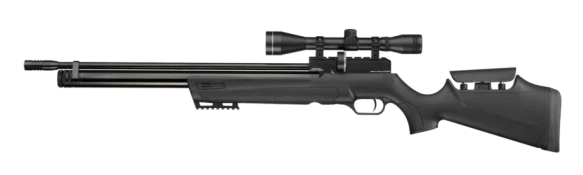
The EKOL VOLTRAN ESP 1450H/1550H PCP is a compressed-air rifle manufactured under the EKOL VOLTRAN brand. The model family is identified by two calibre variants, with the ESP 1450H listed in 4.5 mm (.177) and the ESP 1550H listed in 5.5 mm (.22).
The PCP designation refers to a pre-charged pneumatic system. In this category, compressed air is stored in a dedicated reservoir, and the equipment is designed to operate according to the manufacturer’s specified requirements.
Furthermore, the ESP 1450H/1550H is listed with a synthetic stock and a multi-shot bolt-action configuration. However, exact specifications, included components and regional versions should be confirmed before the product is listed.
Model Identification and General Construction
EKOL VOLTRAN ESP 1450H
The ESP 1450H is identified as the 4.5 mm variant. Its model designation should be retained exactly in product catalogues, invoices and warranty documentation to avoid confusion with other EKOL products.
EKOL VOLTRAN ESP 1550H
The ESP 1550H is identified as the 5.5 mm variant. It belongs to the same general model family, although specifications and regulatory classifications should not automatically be assumed to be identical to the 1450H.
Stock and External Components
A synthetic stock is reported for the model family. Product listings also describe an adjustable cheekpiece and polymer construction.
These details should be checked against the particular version being supplied because colour, finish and package contents may vary between markets.
Product Information and Catalogue Features
The following information can be used as a preliminary identification reference:
-
Manufacturer: EKOL VOLTRAN
-
-
Model variants: ESP 1450H and ESP 1550H
-
Power system: Pre-charged pneumatic (PCP)
-
ESP 1450H calibre: 4.5 mm (.177)
-
ESP 1550H calibre: 5.5 mm (.22)
-
Stock material: Synthetic/polymer, as reported by retailers
-
Configuration: Multi-shot bolt-action, as reported by retailers
-
Product documentation: Manufacturer instructions and warranty information should accompany the applicable version.
Responsible Ownership and Maintenance
Manufacturer Documentation
The original manufacturer’s documentation should always be consulted before any inspection, maintenance or handling is undertaken. In particular, the specified inspection intervals and approved servicing requirements should be followed.
Safe Storage
The equipment should be stored securely, inaccessible to children and unauthorized individuals. Furthermore, applicable local regulations should be observed, including requirements concerning transportation, storage and ownership.
Professional Inspection
Any suspected damage, unusual condition or defect should be referred to a qualified service professional. Unapproved modifications should be avoided because they may compromise product safety and regulatory compliance.
Frequently Asked Product Questions
1. Who manufactures the EKOL VOLTRAN ESP 1450H/1550H PCP?
The product is associated with EKOL VOLTRAN, a Turkish manufacturer of airguns and related products.
2. What is the difference between the 1450H and 1550H?
The principal catalogue distinction is the listed calibre: 4.5 mm for the 1450H and 5.5 mm for the 1550H.
3. What does PCP mean?
PCP stands for Pre-Charged Pneumatic. It describes an air-powered system using compressed air stored in a reservoir.
4. Is the stock synthetic?
Retailer specifications identify synthetic or polymer stock construction. Confirm the precise finish with the supplier.
5. Does the product include additional components?
Package contents vary between listings and markets. The supplied invoice and manufacturer’s packaging documentation should be used to establish exactly what is included.
6. Is a warranty provided?
Warranty coverage depends on the seller, country and applicable manufacturer arrangements. Buyers should request written warranty terms before purchase.
7. Are there legal requirements for ownership?
Yes. Requirements vary by jurisdiction and may depend on the model’s classification and certified power level. Buyers should confirm applicable regulations with the relevant authorities before acquiring or transporting the product.
Product Information Disclaimer
The EKOL VOLTRAN ESP 1450H/1550H PCP should be identified by its exact model number and verified manufacturer specifications. Conflicting retailer specifications should not be combined into one product listing.
Gamo Air Rifles, PCP Airguns, Pellet Pistols and Modern Airgun Systems
Choosing the right gamo air rifle depends on how the rifle will be used, the preferred caliber, the powerplant, and the shooter’s experience level. Gamo produces a broad range of recreational, target, and sporting airguns, so buyers searching for a gamo pellet gun, gamo air rifles, or a traditional gamo pellet rifle can compare several operating systems before deciding which configuration best fits their needs.
One of the most familiar designs is the break barrel air rifle. This platform remains popular because it combines straightforward operation with a self-contained powerplant. Shooters comparing high powered air rifles or a high power air rifle should consider much more than headline velocity. Pellet weight, caliber, barrel length, trigger quality, consistency, and shooting conditions all affect practical performance.
Models chambered as a gamo 177 configuration are frequently selected for target shooting and recreational use because .177 pellets generally offer a flatter trajectory than heavier calibers. Likewise, a gamo break barrel rifle provides the simplicity many shooters want without the need for a separate compressed-air charging system.
Break-Barrel Rifles and Pistols
People researching the best air rifles frequently encounter spring-powered and gas-piston break-barrel platforms. Search terms such as brake barrel bb gun are also common, although pellet rifles and BB guns are technically different categories and may use different ammunition and barrel designs.
Compact airguns include the break barrel pellet pistol, break barrel air pistol, and break barrel pistol. Larger-caliber searches may include a 22 caliber break barrel air pistol, while buyers may also look for a break action pellet pistol, the best break barrel pellet pistol, or a 22 pellet pistol for recreational shooting.
Power-oriented shoppers sometimes search for the most powerful break barrel pellet gun. However, raw velocity should never be the only specification considered. Accuracy, appropriate ammunition, safe handling, and local laws are equally important. A phrase such as bee bee gun pistol may be used informally by shoppers, but users should confirm whether a particular handgun actually fires steel BBs, lead pellets, or another compatible projectile.
Gamo Swarm Multi-Shot Air Rifles
Gamo’s magazine-fed break-barrel systems have helped popularize multi-shot operation in a category that historically required a pellet to be loaded manually after every shot.
The gamo swarm magnum 10x gen3i is closely associated with this concept, while searches for the gamo swarm magnum, gamo swarm maxxim gen 3, and swarm magnum gen3i reflect interest in different Swarm generations and configurations. Another commonly researched model is the gamo swarm magnum pro 10x gen3i.
The broader gamo magnum gen3i category appeals to shooters who want high-energy break-barrel performance together with magazine-fed convenience. Gamo’s multi-shot technology is also frequently found through searches for gamo 10x, multi shot pellet gun, gamo swarm, gamo swarm 10x, and pellet gun with magazine.
A magazine system can make repeated target sessions more convenient because pellets can be prepared before shooting begins. Nevertheless, users should always verify magazine compatibility, pellet length, pellet diameter, and model generation before ordering replacements.
Gamo Arrow PCP Air Rifles
Shooters interested in pre-charged pneumatic technology may encounter the gamo arrow range. The gamo arrow pcp combines a PCP powerplant with a lightweight sporting format, while the full term gamo arrow pcp air rifle is commonly used when comparing it with conventional spring or gas-piston rifles.
Related searches include pcp arrow guns, arrow rifle, pcp arrow gun, arrow rifles, and arrow air rifle. These phrases generally reflect interest in compact PCP-style sporting rifles rather than traditional break-barrel platforms.
Caliber-specific buyers may search for a gamo arrow .22, while the gamo arrow classic may appeal to shooters looking for another Arrow-series configuration.
PCP technology uses stored compressed air rather than relying on a spring or piston being compressed for each shot. This can produce a smooth firing cycle, reduced mechanical movement, and consistent shot-to-shot performance when the rifle is properly filled and maintained.
Understanding PCP Airguns
A pcp air rifle uses a reservoir filled with high-pressure air. PCP stands for precharged pneumatic, and the technology is widely used in modern sporting and precision airguns.
Searches for pcp air rifles, pcp rifle, pcp guns, pcp rifles, and pcp air gun generally refer to this same basic operating principle. Some buyers describe the platform as an air rifle compressed air system, while others search for a pcp pellet rifle or use the reversed phrase rifle pcp.
PCP rifles usually require additional filling equipment such as a suitable hand pump, compressor, or certified high-pressure cylinder. Users should follow the manufacturer’s recommended fill pressure because overfilling a reservoir can be unsafe and may also reduce performance.
Gas-Piston and Lever-Operated Airguns
A common beginner question is what is a gas piston air rifle. Instead of using a traditional coiled steel spring, a gas-piston system compresses gas inside a sealed cylinder. When the trigger is released, the piston moves rapidly and compresses air behind the pellet.
Other mechanical airgun designs include under lever air rifles, the singular underlever air rifle, and the alternative spelling under lever air rifle. In these designs, a separate lever positioned beneath the barrel is used to cock the mechanism.
Shooters may also research a side lever air gun or side lever air rifle, where the cocking lever operates from the side of the receiver. These fixed-barrel layouts can provide a different shooting experience compared with conventional break-barrel systems.
Search terms such as lever action pellet gun, air gun thumb lever, and lever action air rifle can refer to several different mechanisms, so buyers should check the specific manufacturer’s action type rather than assuming every lever-operated airgun works identically.
Gamo Shadow and High-Velocity Searches
Long-running Gamo product lines continue to generate searches including gamo shadow 1000, shadow 1000 gamo, and gamo 1000 shadow. Another associated search phrase is 1000/4.5, which is often used by shoppers researching 4.5 mm or .177-class air rifles.
Velocity-focused buyers may also search for a gamo 1800 fps air rifle. Advertised velocity can vary according to pellet composition and weight, so actual shooting performance may differ when standard lead pellets are used.
Likewise, shoppers researching gamo 1800 fps air rifle price should compare the exact model number, caliber, powerplant, bundled optic, warranty, and regional specification rather than relying solely on a velocity figure.
Other unusual search terms such as shotgun pellet gun may describe an airgun with styling inspired by a shotgun rather than a conventional pellet rifle. Searches for pellet guns that can kill should be approached from a safety perspective: airguns are not toys, and even relatively modest-powered models can cause severe or fatal injuries. Every airgun should therefore be handled with the same disciplined muzzle and trigger control expected of potentially dangerous sporting equipment.
Air Pistols, Pellet Pistols and CO2 Systems
The air pistol category includes many different operating systems, and modern air pistols may use springs, gas pistons, CO2 cartridges, or pre-charged pneumatic reservoirs.
For pellet-firing handguns, common searches include pellet pistols, pellet pistol, pistol pellet gun, pellet handgun, pellet gun pistol, pellet gun pistols, pistol air, and air pellet pistol.
CO2-powered handguns form another major category. A co2 pistol typically uses a disposable carbon-dioxide cartridge to propel BBs or pellets. Buyers may also search for pistol co2, co2 pistols, or the commonly mistyped c02 pistol.
Related searches include co2 air pistols, co2 gun, c02 guns, guns co2, and co 2 gen. Regardless of spelling, the key consideration is ammunition compatibility and the correct cartridge type specified by the manufacturer.
CO2 performance can be affected by ambient temperature because pressure changes as the cartridge becomes warmer or colder. For that reason, shooters should expect some variation in velocity during different environmental conditions.
Target Shooting and 10-Meter Airgun Use
Precision shooting requires appropriate targets and a safe backstop. A 10m rifle is generally associated with structured 10-meter air-rifle shooting, where accuracy, repeatability, shooting position, and trigger control are emphasized.
Recreational shooters may use pellet gun targets, while rifle users commonly search for air rifle targets, targets for air rifle, and airgun targets. The term air gun targets is another broad variation covering both rifle and pistol applications.
Dedicated practice setups can include air rifle shooting targets and airgun shooting targets designed to provide clear aiming points and easy scoring. Depending on the shooting discipline, an air rifle target may use small scoring rings intended for precision practice.
Handgun shooters may choose air pistol targets, whereas a pellet rifle target should be paired with a backstop capable of safely containing the pellets used by the particular rifle.
Airgun Cleaning and Maintenance
Regular airgun maintenance helps preserve reliability, accuracy, and safe function. Although airguns generally require less bore cleaning than many powder-burning firearms, seals, external metalwork, fasteners, magazines, and moving components still need periodic inspection.
A pellet rifle cleaning kit can contain cleaning rods, pull-through systems, suitable patches, and other airgun-safe tools. Likewise, a pellet gun cleaning kit can help remove accumulated debris when cleaning is genuinely required.
Proper air gun maintenance also involves checking stock screws, inspecting seals, keeping optics securely mounted, and following the manufacturer’s lubrication guidance. Excessive oil should be avoided because unsuitable lubricants can damage seals or cause unwanted combustion inside some spring-piston airguns.
For PCP equipment, reservoir condition, fill fittings, O-rings, and pressure gauges should also be inspected periodically. Magazine-fed models should be kept clean so pellets feed smoothly without deformation.
Ultimately, the best choice depends on the intended use. A traditional break-barrel rifle offers simplicity, a Gamo Swarm platform adds multi-shot convenience, and a PCP system provides a smoother firing cycle with an external filling requirement. Comparing caliber, powerplant, ergonomics, ammunition, maintenance demands, and safe target equipment makes it much easier to select an airgun that delivers dependable performance for responsible recreational or target shooting.
Frequently Asked Questions (FAQs)
General Product Questions
1. What type of product is this?
This is a pre-charged pneumatic (PCP) airgun. PCP equipment uses compressed air stored in a dedicated reservoir. It is manufactured as part of the EKOL VOLTRAN product range and is intended to be identified by its exact model designation and manufacturer documentation.
2. What does PCP mean?
PCP stands for Pre-Charged Pneumatic. Unlike conventional spring-powered airguns, this category uses previously compressed air as its operating energy source. The system contains specialised components that must be inspected and maintained according to manufacturer instructions.
3. Who manufactures this product?
The product is associated with EKOL VOLTRAN, a Turkish manufacturer known for producing airguns and related equipment. Manufacturer identification is important when checking product authenticity, documentation, warranty coverage and replacement-component compatibility.
4. What distinguishes the two model variants?
The two variants are identified by different model numbers and reported calibre classifications. However, buyers should consult the exact manufacturer’s specification sheet before assuming that other dimensions, operating characteristics or components are shared.
5. Is this product suitable for beginners?
New owners should first become familiar with the manufacturer’s safety instructions, applicable legislation and responsible handling requirements. Furthermore, appropriate supervision and professional guidance should be obtained where required.
Construction and Design Questions
6. What material is used for the stock?
Retailer descriptions identify synthetic or polymer stock construction. Such materials are commonly used in sporting equipment because they can offer practical durability and relatively straightforward cleaning. Nevertheless, the exact material and finish should be confirmed for the particular production version.
7. Does the stock have an adjustable cheekpiece?
Some retailer descriptions refer to an adjustable cheekpiece. Buyers should verify its presence and adjustment characteristics using photographs and the manufacturer’s documentation for the specific version being purchased.
8. Is the exterior finish durable?
Exterior durability depends on the materials, manufacturing quality, environmental exposure and maintenance. Regular visual inspections are recommended. In addition, harsh chemicals and unsuitable cleaning products should be avoided unless specifically approved by the manufacturer.
9. Are the external components replaceable?
Replacement-component availability depends on the manufacturer and regional distributor. Before purchasing replacement parts, owners should confirm compatibility using the exact model identification and consult an authorised service provider.
10. Is the product available in different finishes?
Finish availability may vary by production batch, distributor and geographical market. Therefore, the actual supplied product should be checked against the seller’s photographs and written description.
Technical Information Questions
11. What is the difference between 4.5 mm and 5.5 mm versions?
These measurements identify different projectile calibre categories. They are important for product identification and compatibility with the manufacturer’s approved specifications. The correct version should always be established through the original product documentation.
12. How can buyers confirm the exact calibre?
The calibre should be verified using the manufacturer’s markings and official documentation. Buyers should not rely exclusively on photographs or descriptions copied from another retailer because similar model names can create confusion.
13. What does the multi-shot description mean?
The term describes a product configuration that is reported to accommodate multiple projectiles within its designated loading system. Exact configuration details should be confirmed through the manufacturer’s documentation.
14. Is the product supplied with a manual?
Documentation availability depends on the distributor and packaging arrangement. Buyers should request the original instruction manual, warranty information and relevant safety documentation when purchasing.
15. Are all advertised specifications guaranteed?
No. Retailer specifications may contain errors or refer to different regional versions. Consequently, the manufacturer’s current documentation should be treated as the primary reference for technical information.
Safety and Responsible Ownership
16. What safety precautions should owners understand?
Every owner should read the original instructions before handling the equipment. It should always be treated as potentially dangerous, even when its operating condition is uncertain.
Furthermore, it should never be pointed at another person or animal. Secure storage, responsible supervision and compliance with applicable legislation are essential.
17. How should the product be stored?
Secure storage should be provided in a locked location that cannot be accessed by children or unauthorised individuals. Storage conditions should also be consistent with the manufacturer’s recommendations.
18. Can children access or handle the product?
Access should be prevented unless applicable legislation and appropriate adult supervision expressly permit a particular activity. Children should never be allowed unsupervised access to airguns or associated equipment.
19. Can it be transported in a vehicle?
Transportation requirements vary according to local legislation. Owners should verify the applicable rules before travelling and use secure transportation arrangements that prevent unauthorised access.
20. Can the product be modified?
Unapproved modifications should be avoided. Changes to pressure-containing components or other safety-critical assemblies can introduce serious hazards and may invalidate warranty coverage or affect legal classification.
Maintenance and Care Questions
21. Does the product require regular maintenance?
Yes. PCP equipment requires maintenance in accordance with the manufacturer’s instructions. Regular professional inspection can help identify wear, damage and other conditions requiring attention.
22. Can ordinary household cleaning products be used?
Not necessarily. Some household cleaning products can damage protective finishes, seals or other materials. Only manufacturer-approved products and cleaning procedures should be used.
23. What should owners do if they notice damage?
The equipment should be taken out of service and assessed by a qualified professional. Damaged pressure-containing components should never be repaired through improvised methods.
24. How can owners preserve the exterior finish?
A clean, dry and appropriate storage environment is recommended. Owners should also avoid unnecessary exposure to moisture, corrosive substances and extreme environmental conditions.
25. When should professional servicing be requested?
Professional servicing should be requested whenever a defect, leak, unusual condition or other suspected malfunction is identified. Manufacturer-recommended inspection intervals should also be respected.
Purchasing and Warranty Questions
26. What should buyers check before purchasing?
Buyers should confirm:
-
Exact model identification.
-
Manufacturer and distributor details.
-
Verified calibre classification.
-
Original product documentation.
-
Physical condition and completeness.
-
Warranty terms and exclusions.
-
Applicable ownership regulations.
-
Seller contact and return policies.
These checks can reduce misunderstandings and help ensure that the supplied product matches the advertised description.
27. Does the product come with a warranty?
Warranty arrangements depend on the seller and regional distributor. Written confirmation should be requested before purchase. Buyers should also establish whether servicing and replacement components are covered.
28. Can the product be returned?
Returns are governed by the retailer’s published policy and applicable consumer protection laws. Before completing a purchase, buyers should review the return period, eligibility conditions and procedure for reporting defects.
29. Are replacement components available?
Availability varies by market and distributor. An authorised supplier should be contacted with the exact model identification before any replacement component is ordered.
30. How can buyers establish product authenticity?
The manufacturer’s identification, serial markings, original packaging and supporting documentation should be checked. Where uncertainty remains, confirmation should be obtained directly from the manufacturer or an authorised distributor.
Legal and Regulatory Questions
31. Are there legal restrictions on ownership?
Yes. Airgun regulations differ between countries and sometimes between individual regions. Requirements may include minimum-age restrictions, licensing, registration, power classifications or transportation conditions.
32. Can the product be imported internationally?
International importation is subject to the laws of both the exporting and importing countries. Customs authorities may require permits, declarations and supporting documentation. Written confirmation should be obtained before arranging international transportation.
33. Does the product require registration?
This depends on its certified classification and the regulations in the owner’s jurisdiction. Buyers should obtain accurate information from the relevant licensing or regulatory authority rather than relying on assumptions.
34. Can it be shipped directly to a residential address?
Delivery eligibility depends on the carrier’s policies, local legislation and the product’s legal classification. The seller should confirm that the proposed delivery arrangement is lawful before accepting an order.
35. What documents should accompany an international purchase?
Depending on the destination, documentation may include an invoice, customs declaration, proof of origin, import authorisation and product classification documents. The applicable requirements should be confirmed with customs authorities.
Final Buyer Information
36. Why is the exact model number important?
Exact identification helps distinguish between similar product variants. It also supports accurate warranty claims, servicing enquiries and documentation checks.
37. Should buyers rely on online reviews?
Reviews can provide useful information about customer experiences. However, they should not replace official technical specifications, professional assessments or legal guidance.
38. What should be checked upon delivery?
The package should be checked against the invoice and order confirmation. Any missing documentation, visible damage or discrepancy should be reported to the seller promptly. Safety-critical components should not be inspected through unauthorised disassembly.
39. Where can additional product information be obtained?
The best sources are the manufacturer’s official documentation, authorised distributors and qualified service professionals. These sources can provide more reliable information than copied third-party listings.
40. What is the most important consideration before purchasing?
The most important consideration is ensuring that the product is correctly identified, legally permitted in the intended location and accompanied by appropriate documentation. Responsible ownership, secure storage and adherence to manufacturer instructions should remain priorities throughout its ownership.
Practical Use Scenarios and Everyday Ownership Considerations
1. Understanding the Product in Everyday Ownership
Owning a PCP airgun involves more than simply understanding its external appearance. Consideration should also be given to its construction, manufacturer documentation, storage requirements and applicable regulations.
The EKOL VOLTRAN ESP 1450H/1550H product family can be approached as a specialised sporting-equipment purchase that requires responsible ownership. Consequently, buyers should become familiar with the supplied documentation before making decisions about handling, transportation or maintenance.
Furthermore, the distinction between the two model variants should always be respected. Exact identification is particularly important when requesting servicing, checking warranty eligibility or contacting a distributor.
2. Product Identification and Inspection
One of the most important practical considerations is ensuring that the delivered product matches the original purchase description.
When receiving an order, the following information should be reviewed:
-
Manufacturer identification.
-
-
Serial-number documentation, where applicable.
-
Original instruction manual.
-
-
Supplied accessories and packaging.
-
Relevant compliance documentation.
Additionally, any discrepancy should be reported to the retailer before the product is accepted for use.
A documented inspection also helps establish the condition in which the equipment was received. This can be particularly valuable when warranty or after-sales support is subsequently required.
3. Responsible Sporting-Equipment Ownership
Responsible ownership should be considered an essential part of purchasing specialised sporting equipment.
Before undertaking any permitted activity, owners should understand the relevant legislation, manufacturer restrictions and safety requirements. Moreover, any activity should take place only where legally permitted and under appropriate supervision.
The equipment should never be treated as a toy. Its ownership carries responsibilities concerning other people, animals, property and the surrounding environment.
4. Storage in a Residential Environment
A suitable storage arrangement is important for preserving the condition of the equipment and preventing unauthorised access.
A locked storage cabinet or another appropriately secured location should be used. In addition, the storage area should be kept separate from children’s belongings and ordinary household equipment.
Environmental conditions should also be considered. Excessive moisture, extreme temperatures and unsuitable storage environments may contribute to deterioration of external materials.
A responsible storage arrangement should provide:
-
-
Protection from accidental damage.
-
A clean and dry environment.
-
Separation from unauthorised users.
-
Compliance with local storage legislation.
These considerations help support responsible long-term ownership.
5. Understanding Manufacturer Documentation
Manufacturer documentation provides essential information about the product’s intended classification, limitations and care requirements.
Rather than relying exclusively on online descriptions, owners should refer to the original documentation supplied with their particular model.
This is especially important because retailer listings may contain incomplete or inconsistent specifications.
The instruction manual should therefore be retained in a safe place. Furthermore, warranty papers, purchase receipts and servicing records should be organised together for convenient reference.
6. Maintenance and Long-Term Product Care
Long-term ownership should be supported by appropriate maintenance and professional inspection.
External surfaces should be kept clean using products approved by the manufacturer. Likewise, unsuitable chemicals and improvised cleaning methods should be avoided.
Any suspected damage, abnormal condition or defect should be referred to a qualified service professional.
Particular care should be taken with pressure-containing components. These should never be opened, modified or repaired through improvised procedures.
A maintenance record can also be useful. Recording professional inspections, reported defects and authorised servicing helps create a clear history of the equipment’s condition.
7. Purchasing and After-Sales Support
The buying experience should not end when payment has been completed.
A reliable retailer should provide accurate product identification, clear commercial terms and appropriate after-sales assistance.
Before purchasing, customers should establish whether the seller can provide the relevant documentation and whether authorised servicing is available in their region.
Furthermore, buyers should understand the warranty period, return conditions and procedure for reporting defects.
For international purchases, additional attention should be given to customs requirements and transportation restrictions.
8. Transportation and Travel Considerations
Transportation requirements can differ significantly between jurisdictions.
An owner planning to travel with sporting equipment should first establish whether possession and transportation are permitted along the intended route.
Carrier policies should also be reviewed before a shipment is arranged. In some locations, specialised documentation or prior authorisation may be required.
The product should never be transported in a way that creates unnecessary access or safety risks.
Where international transportation is being considered, confirmation should be obtained from the relevant customs authorities and licensed carriers before making arrangements.
9. Practical Considerations for Outdoor Environments
Outdoor environments can expose sporting equipment to different environmental conditions.
Moisture, dust, direct sunlight and accidental impacts may affect external finishes and materials over time.
Consequently, owners should follow the manufacturer’s environmental-care recommendations and avoid leaving the equipment exposed to unsuitable conditions.
After permitted outdoor activities, an appropriate visual inspection and manufacturer-approved cleaning routine should be followed.
Additionally, owners should respect private property, environmental regulations and restrictions concerning the presence of sporting equipment in public spaces.
10. Family and Household Safety
Household safety deserves particular attention when specialised equipment is kept in a residential environment.
All family members should understand that the equipment is not a toy and must not be accessed without appropriate authorisation.
Children should never be allowed unsupervised access. Similarly, visitors and other household members should be prevented from accessing the storage location.
A secure storage arrangement should be maintained consistently rather than depending on temporary precautions.
11. Professional Inspection and Technical Support
Professional support can help owners address concerns without introducing additional safety risks.
If an unusual condition is noticed, the equipment should be taken out of service until it has been assessed by an appropriately qualified professional.
The owner should provide the technician with the exact model identification and a description of the issue.
Moreover, only authorised service providers and manufacturer-approved replacement components should be considered where repairs are necessary.
This approach supports product integrity and helps prevent damage caused by unsuitable repairs.
12. Legal Compliance Across Different Markets
Legal compliance is an important consideration because airgun classifications are not identical worldwide.
Requirements may depend on the country, regional legislation, certified classification and other applicable restrictions.
For this reason, buyers should not assume that a product legally available in one country can automatically be purchased, possessed or transported in another.
Before completing an international transaction, the relevant authorities should be consulted regarding:
-
-
Licensing or registration requirements.
-
-
-
Transportation restrictions.
-
Applicable storage requirements.
Written confirmation is preferable whenever the legal classification is uncertain.
13. Evaluating Product Condition Before Purchase
Condition assessment is another important part of the buying process, especially when a pre-owned example is being considered.
The seller should provide an accurate description of the product’s condition and disclose any known damage, previous repairs or missing documentation.
Photographs can help establish the external condition, although they cannot replace an appropriate professional inspection.
Buyers should also request confirmation of the exact model variant and verify that the supplied documentation corresponds with the item being purchased.
14. Value of Accurate Product Information
Accurate information supports better purchasing decisions and reduces the possibility of misunderstandings.
A well-prepared product listing should distinguish between verified manufacturer specifications and information that has only been reported by third-party retailers.
This distinction matters because different regional versions may have different classifications or supplied components.
Retailers should therefore avoid presenting unverified figures as guaranteed specifications.
15. Final Thoughts on Practical Ownership
The ownership experience should be based on informed purchasing, responsible storage, proper documentation and professional maintenance.
The EKOL VOLTRAN product family should be identified through its exact model designation, with all technical and regulatory information confirmed for the particular version supplied.





Reviews
There are no reviews yet.