We Deliver Airguns Directly To Your Door
SKU N/A Category

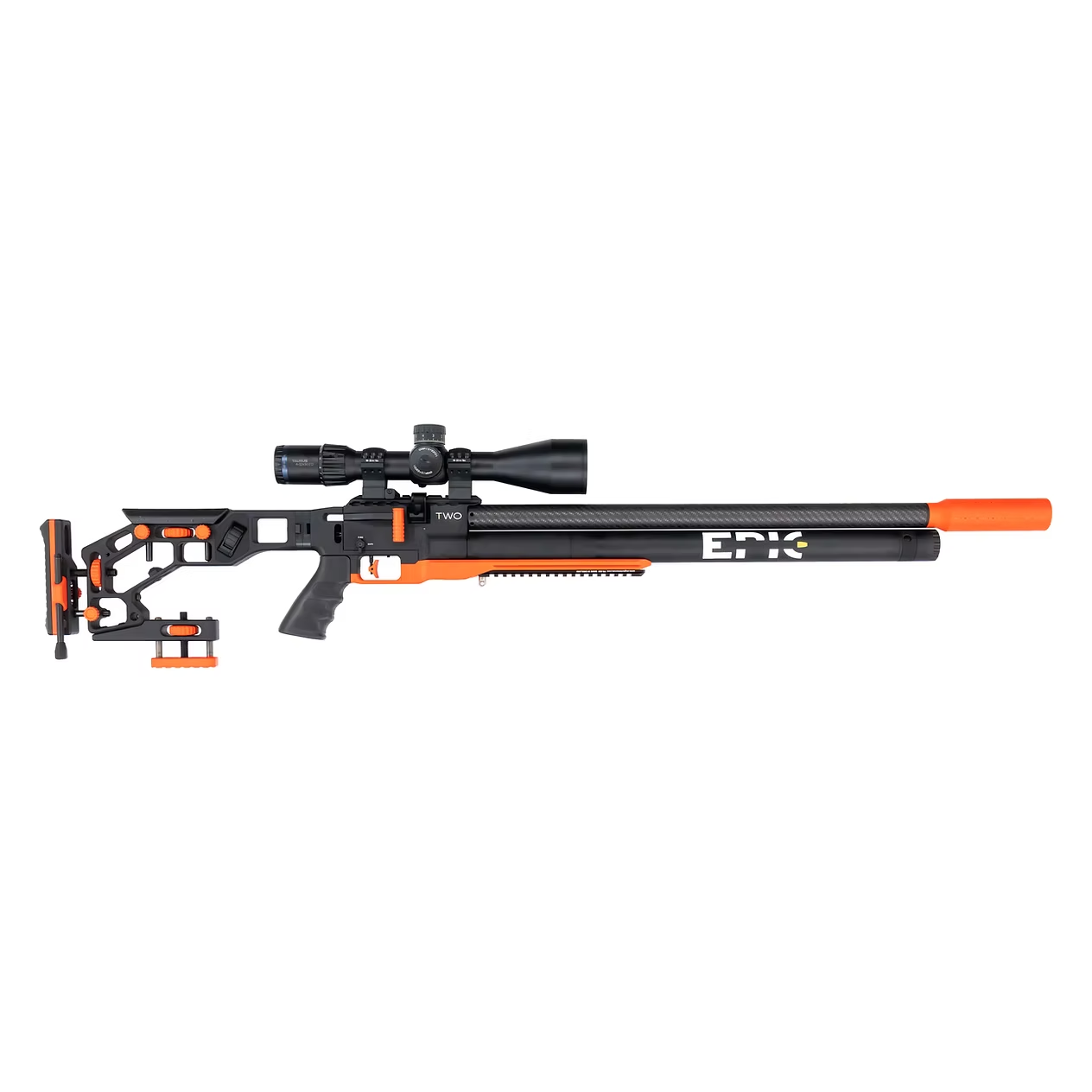
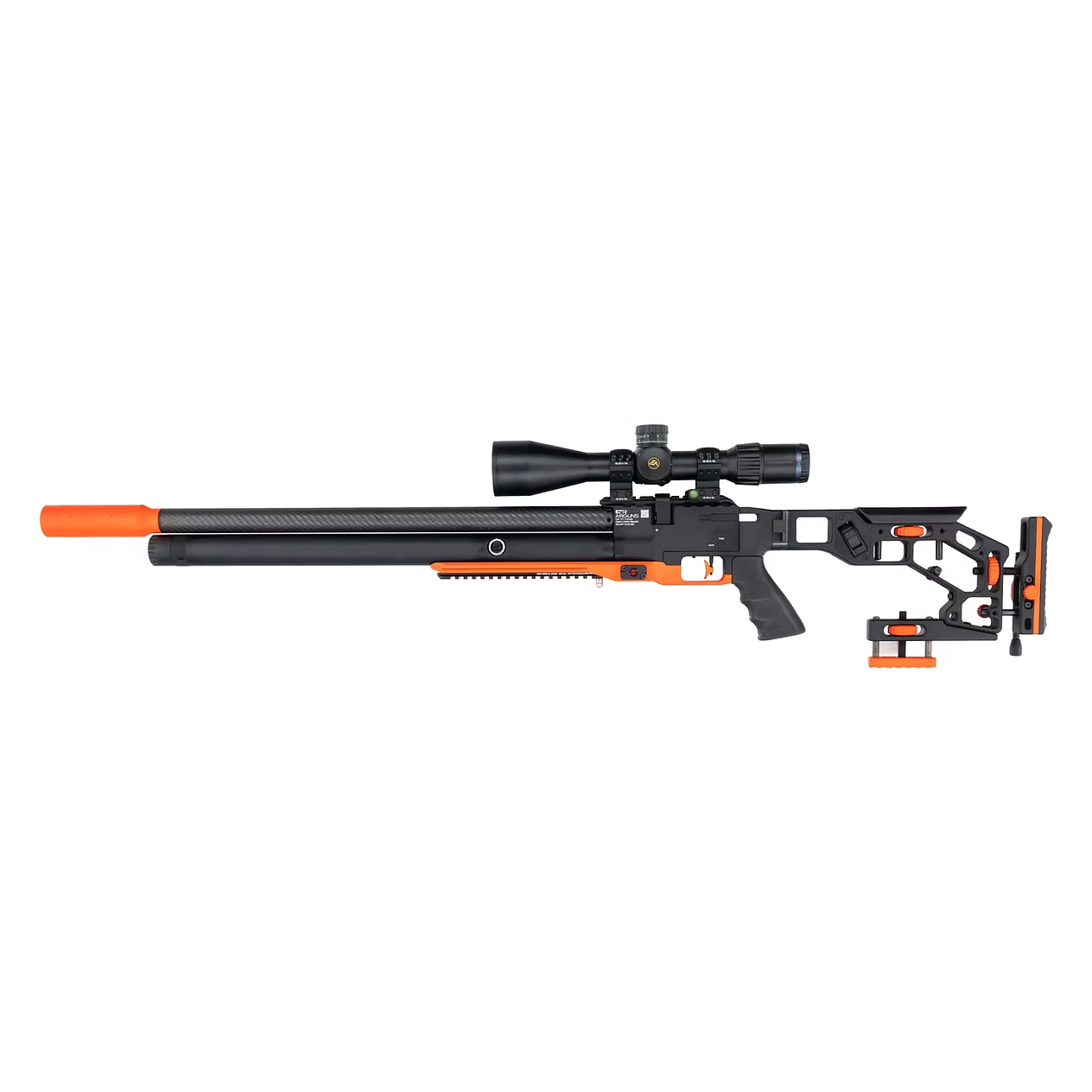
EPIC TWO Target Edition PCP Target Air Rifle

€1,550.00

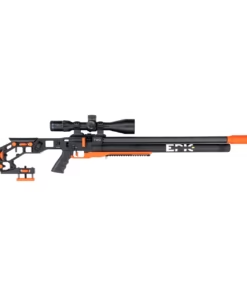
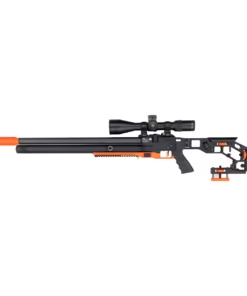
The EPIC TWO Target Edition is about as fully stacked as an EPIC TWO gets. Built as an homage to the extreme benchrest competition rifle used in 2024, this is a mid-to-high-end target setup that takes the standard EPIC TWO and adds virtually every optional upgrade available.


It features the EPIC folding target stock, adjustable bag rest, rear monopod with blaze orange accents, EPIC silencer and muzzle brake, along with a HUMA Raptor regulator for consistent shot delivery. Add the Taurus Gen2 4-32×56 FFP scope and Vector Optics X-Accu mounts, and you’ve got a very serious target rifle straight out of the case.


The rifle is in great overall condition, although it has clearly been used rather than simply displayed. There are marks on the magazine and single-shot tray, along with a few marks on the ARCA rail from mounting accessories. It has been tested at approximately 15.7 Joules.


What’s Included

EPIC TWO Target Edition accessories:

  • EPIC silencer
  • EPIC muzzle brake
  • Adjustable bag rest
  • Rear monopod


Additional equipment:

  • 2x EPIC TWO magazines
  • Eagle Vision T-slot to Picatinny rail (PR-200) with stud mount
  • EPIC TWO magazine holder, fitted in stock
  • EPIC TWO single-shot tray
  • Vector Optics Taurus Gen2 4-32×56 FFP scope
  • Vector Optics X-Accu mounts
  • Vector Optics Picatinny ACD


Condition: Grade B

  • Great overall condition
  • Genuine EPIC TWO Target Edition configuration
  • Folding target stock
  • Adjustable bag rest
  • Rear monopod with blaze orange accents
  • HUMA Raptor regulator
  • Marks on magazines and single-shot tray from use
  • Minor marks on ARCA rail from accessory mounting
  • Tested at approximately 15.7 Joules
  • Clearly used, rather than a collector/display example


The Important Bit

This is a Pre-Fired rifle, and unlike some of our Pre-Fired stock, this one has definitely been shot.

The marks on the magazines and single-shot tray show actual use, while there are also some marks on the ARCA rail from mounting accessories. None of this detracts from what is otherwise a very good-condition rifle, but we’re mentioning it because we’d rather tell you what you’re getting than pretend it’s never left the cabinet

We’ve tested the rifle at approximately 15.7 Joules, but our inspection isn’t a warranty. The condition grade is our assessment of the rifle and its included equipment as they stand, and minor marks or signs of previous use may not all be individually listed.


EPIC TWO Target Edition PCP Target Air Rifle

Precision target shooting is elevated by the EPIC TWO Target Edition PCP Target Air Rifle, a fully modular platform engineered for consistency, adaptability, and long-range performance. Consequently, every configuration is designed so that barrel length, air reservoir type, caliber, and furniture can be tailored without compromise. Moreover, the rifle is built around a high-power balanced valve and an externally adjustable regulator, so shot-to-shot stability is maintained across a wide energy spectrum.

A Modular Platform Built for Target Discipline

Complete customization is enabled by the EPIC TWO architecture. Therefore, barrels in 300 mm, 550 mm, or 700 mm lengths can be selected according to the intended discipline, whether compact bench work or extended-range precision. In addition, CZUB non-choked barrels with 12 grooves and a 17.7-inch twist rate are offered alongside optional Lothar Walther polygonal barrels, so projectile compatibility and harmonic behavior can be optimized. Furthermore, calibers of .177, .22, and .25 are interchangeable through simple barrel, transfer-port, and magazine swaps, allowing the same action to serve multiple target programs.

Harmonic barrel tuning is accomplished by adjusting shroud tension, so barrel vibration is brought into a favorable node for the chosen pellet or slug. As a result, group size is reduced and point-of-impact shift is minimized. Meanwhile, magazines are designed to accept projectiles up to 14 mm in length, so heavy slugs required for high-energy target work can be loaded without modification.

Regulator, Valve, and Air System Consistency

Stable power delivery is provided by an externally adjustable regulator operating across a broad pressure range, typically 40–190 bar depending on configuration. Consequently, the 70 cc plenum receives a consistent charge, and velocity variation is kept low even as tank pressure declines. Additionally, a high-power balanced valve is fitted so air flow can be matched to ammunition weight and desired energy, whether modest match settings or higher-output slug work approaching 155 J in .25 caliber on longer barrels.

Fill pressure of 300 bar (4,350 psi) is supported by both aluminum tubes and carbon-fiber bottles. Therefore, reservoir capacity can be chosen from compact 90–300 cc options for lighter handling up to 580–700 cc bottles for extended shot strings. Dual manometers are mounted so both regulated pressure and remaining tank pressure can be monitored at a glance. In this way, fill decisions and regulator adjustments are made with clear visual feedback.

Ergonomics and Adjustability for Every Shooter

An ambidextrous side-lever cocking system is incorporated so left- and right-handed shooters can operate the action with equal efficiency; the lever can be relocated to the opposite side without specialized tools. Likewise, a fully adjustable trigger mechanism featuring a rotary blade is provided, so first-stage weight, second-stage break, and blade position can be set to individual preference. Moreover, a convertible AR-15-style grip and an ambidextrous, height-adjustable cheek piece allow the interface to be refined for different shooting positions and body types.

A folding tactical stock with adjustable length of pull and butt-pad height is fitted on many Target Edition configurations, so the rifle can be compacted for transport yet remain stable when deployed. In addition, an integrated monopod and QD sling swivel are built in, while an Arca-Swiss rail plus a 30 MOA Picatinny top rail accept bipods, tripods, and optics without adapters. Consequently, the rifle can be set up for bench rest, prone, or supported positional work with minimal extra hardware.

Key Product Features

  • Fully modular, interchangeable-caliber platform (.177 / .22 / .25)
  • CZUB or Lothar Walther non-choked barrels in 300 mm, 550 mm, and 700 mm lengths
  • Externally adjustable regulator and high-power balanced valve
  • Harmonic barrel-tuning capability via shroud tension
  • Ambidextrous side lever and fully adjustable trigger with rotary blade
  • 30 MOA Picatinny rail and integrated Arca-Swiss accessory rail
  • Folding or fixed adjustable tactical stock with cheek riser and monopod
  • Dual manometers, 300 bar maximum fill, carbon-fiber or alloy reservoirs
  • Magazines engineered for slugs up to 14 mm
  • ½ UNF muzzle thread for moderators
  • Convertible AR-15 grip and safety provisions

Performance Across Target Applications

Match-grade consistency is pursued through the combination of a regulated plenum, balanced valve, and precision barrel. Therefore, the platform is suited to 10-meter and 25-meter precision work as well as longer-range field-target and bench-rest disciplines when longer barrels and heavier projectiles are selected. Furthermore, energy can be tuned from modest legal-limit settings up to high-output configurations (approximately 80 J in .177, 125 J in .22, and 155 J in .25 on appropriate barrels and valve settings), so the same rifle can serve training, competition, and extended-range practice.

Pre-Fired EPIC TWO Target Edition .177 PCP Target Air Rifle

Because the action, regulator, and furniture are designed as a system rather than a fixed package, future upgrades—different barrel lengths, larger plenums, or alternative stocks—can be added without replacing the core rifle. As a result, the EPIC TWO Target Edition functions as a long-term platform rather than a single-purpose tool.

Responsible use, local regulations, and proper maintenance remain essential. Fill equipment rated for 300 bar, quality pellets or slugs matched to the barrel, and regular inspection of O-rings and regulator settings are recommended so performance and safety are preserved. Inclusive design features—ambidextrous controls, fully adjustable furniture, and modular caliber options—ensure the rifle can be configured for a wide range of shooters and shooting styles.

When a target rifle that can evolve with changing disciplines and ammunition choices is required, the EPIC TWO Target Edition PCP Target Air Rifle supplies a coherent, high-precision foundation. Precision is delivered, adaptability is built in, and every major subsystem can be refined to the shooter’s exact requirements.

Calibres, FAC Classification, Power Delivery and Accessories

Calibre selection, legal power classification and accessory compatibility are determined by the modular architecture of the EPIC TWO Target Edition PCP Target Air Rifle. Consequently, a single action can be configured for different target programmes, energy requirements and mounting needs. Moreover, interchangeable barrels, transfer ports and magazines allow calibre changes to be completed without replacement of the core platform. Therefore, the rifle can be adapted as shooting goals evolve.

Available Calibres and Projectile Compatibility

Three primary calibres are supported: .177 (4.5 mm), .22 (5.5 mm) and .25 (6.35 mm). In addition, magazines are engineered to accept slugs up to 14 mm in length, so both conventional match pellets and heavier slugs can be used. Furthermore, CZUB non-choked barrels with a 12-groove, 17.7-inch twist or optional Lothar Walther polygonal barrels can be fitted, allowing twist and bore characteristics to be matched to the chosen projectile.

In .177, lighter match pellets and mid-weight slugs are typically employed for 10-metre and 25-metre precision work. As a result, high shot counts and modest recoil are obtained when the regulator and valve are set for lower energy. Meanwhile, .22 is frequently selected for a balance of trajectory, energy and magazine capacity (commonly 11 rounds). Consequently, this calibre is widely used for field-target practice and mid-range bench work. Likewise, .25 is preferred when heavier slugs and higher downrange energy are required; magazine capacity is typically 10 rounds, and energy figures approaching 155 J have been recorded on longer barrels with appropriate valve and regulator settings.

Because barrels, probes and magazines are interchangeable, a change of calibre does not require a second complete rifle. Therefore, the same action, stock and regulator can serve multiple disciplines. Additionally, harmonic shroud tension can be adjusted after a barrel swap so that vibration behaviour remains favourable for the new projectile.

FAC Requirements and Power Tuning

Power output is governed by barrel length, regulator pressure, valve jet selection and hammer-spring tension. Consequently, the rifle can be configured from modest legal-limit settings up to high-energy FAC levels. In many jurisdictions, including the United Kingdom, air rifles exceeding 12 ft-lbs (approximately 16.3 J) require a Firearm Certificate (FAC). Therefore, factory or dealer-set configurations are commonly offered in both sub-12 ft-lbs and FAC variants.

On shorter 300 mm barrels, factory settings often fall in the 45–85 J range depending on calibre and ammunition, while 550 mm and 700 mm barrels permit substantially higher output when the balanced valve is opened and the regulator is raised. Moreover, an externally adjustable regulator (typically 40–190 bar) and an external hammer-spring adjuster allow energy to be refined without disassembly. As a result, a single rifle can be detuned for indoor or club use and later returned to higher FAC power for outdoor target or long-range practice, provided local law is observed.

Fill pressure of 300 bar is supported across aluminium tubes and carbon-fibre bottles. Consequently, shot count and consistency remain high when the plenum (commonly 70 cc) is supplied with stable regulated air. Dual manometers display both tank and regulated pressure, so fill decisions and power adjustments can be made with clear visual confirmation. Inclusive language and design are maintained: power settings and furniture adjustments can be tailored so that shooters of varying strength and experience can operate the rifle safely within the legal category that applies to them.

Responsible ownership requires that the rifle remain within the power class for which it is licensed. Therefore, any increase above the local limit must be accompanied by the appropriate certificate, and periodic chronograph checks are recommended after valve or regulator changes.

Accessory Integration and Expansion Options

A 30 MOA Picatinny rail is fitted as standard so that high-magnification target optics can be mounted with sufficient elevation for long-range zeroing. In addition, an integrated Arca-Swiss rail, lower Picatinny sections and, on some variants, M-LOK slots accept bipods, tripods, monopods and slings without extra adapters. Furthermore, a ½ UNF muzzle thread allows a sound moderator to be fitted, reducing report for club and range use.

The folding or fixed tactical stock includes an adjustable cheek piece, length-of-pull adjustment and a built-in monopod. Consequently, the rifle can be stabilised in prone, bench or supported positions. Likewise, a convertible AR-15-style grip and ambidextrous side lever permit left- and right-handed operation. Spare magazines, fill probes and travel cases are commonly supplied or available separately, so range sessions can be extended without interruption.

Optional upgrades include longer or shorter barrels, larger carbon bottles (up to 580–700 cc), alternative plenums and walnut or laminate furniture on selected Target Edition configurations. Therefore, the platform can be expanded as accuracy goals or shooting positions change. Because all major interfaces are standardised, aftermarket optics, rests and slings from a wide range of manufacturers can be used.

Highlighted accessory and configuration options include:

  • Interchangeable .177, .22 and .25 barrel kits with matching magazines and probes
  • 300 mm, 550 mm and 700 mm CZUB or Lothar Walther barrels
  • Carbon-fibre bottles (300 / 580 / 700 cc) or aluminium tubes
  • Externally adjustable regulator and balanced-valve jet sets
  • 30 MOA Picatinny + Arca-Swiss mounting system
  • ½ UNF moderator thread and shrouded barrel
  • Adjustable folding or fixed stock, monopod and QD sling points
  • Convertible AR-15 grip and ambidextrous side lever
  • Dual manometers and 300 bar fill capability

When calibre, legal power class and accessory layout are chosen together, the EPIC TWO Target Edition functions as a coherent target system rather than a collection of separate parts. Precision is supported by regulated air, a tunable valve and match-grade barrels; compliance is maintained by correct FAC classification; and expandability is provided by standardised rails and modular components. In this way, the rifle can be specified for present needs while remaining ready for future disciplines and ammunition choices.

Epic Airguns, Hatsan, Bintac and High-Performance PCP Air Rifles

Modern epic airguns continue to attract shooters who want advanced PCP technology, adaptable configurations, precision, and high-capacity air systems. Whether someone searches for epic air, epic 1, epic one, epic1, or the epic one air rifle, the interest generally centers on premium compressed-air platforms built for accurate shooting. The growing Epic lineup also includes searches for epic 2, the epic 2, epic 2.0, epic two lite, and epic two walnut, giving enthusiasts several terms to explore when comparing configurations, materials, and performance.

Shooters researching an air rifle com resource or a specialized pcp air gun shop may also encounter terms such as epicair, airgun one incorporated, 30 epic, epic optics, epic eagle, epic vision, airpne, and pist2 while comparing manufacturers, accessories, optics, and PCP platforms. Other searches, including pellet gun yeeps, kalibrgun snipe 2, air gun makers, and compressed air rifles, reflect how broad the modern airgun market has become.

For larger-caliber and tactical PCP enthusiasts, products associated with bintac aea harpoon, bintac t9 full auto, bintac mcar 457, and aea terminator have generated interest among buyers looking beyond conventional sporting rifles. Shooters researching anti air tanks may instead be looking for filling equipment and high-pressure storage solutions, while searches for bintac t9 price often come from buyers comparing premium PCP platforms before making a purchase.

Interest in a bee bee gun rifle can range from recreational plinking to entry-level target shooting, whereas searches such as zeus 72 cal air rifle price focus on extremely large-bore PCP technology. A suitable air tank for pcp airguns is particularly important for shooters who want convenient refilling away from a compressor or dive shop.

Large-caliber PCP platforms are also reflected in searches such as aea harpoon air gun, airgun shotgun, automatic air gun, air powered 50 cal rifle, and aea megalodon for sale. These terms demonstrate how air-powered technology has expanded far beyond the traditional pellet rifle and into increasingly specialized shooting platforms.

Hatsan Air Rifles, PCP Models and Popular Configurations

Among established manufacturers, hatsan blitz remains one of the most recognizable search terms for shooters interested in rapid-fire PCP designs. The wider hatsan air rifle lineup covers numerous shooting applications, while models such as the hatsan sortie, hatsan model 95, hatsan harpoon, hatsan hercules, and hatsan piledriver appeal to different sections of the airgun market.

Buyers searching hatsanusa or hatsan usa are often looking for Hatsan products, specifications, service information, accessories, or replacement components available within the American market. Meanwhile, the hatsan sortie tact semi-auto pcp offers a semiautomatic-style platform, and interest in hatsan sortie accessories gives owners options for refining their setup.

Traditional spring-powered enthusiasts frequently research the hatsan 135, hatsan 125, hatsan mod 95, and the shorter mod 95 search phrase. PCP shooters may instead consider the hatsan bullboss, hatsan hercules bully, hatsan flash, hatsan invader, or hatsan flashpup qe.

Value-conscious customers can also explore hatsan refurbished products and other refurbished air rifles when available. Models such as the hatsan airtact air rifle, hatsan neutron star, hatsan zada, and hatsan 135 carnivore broaden the selection even further.

Because terminology varies among shoppers, searches may include air rifle, air rifles, airguns, hatsun blitz, hatzan blitz, or the broader phrase hatsan air guns. Likewise, shooters researching PCP-specific options frequently use hatsan pcp when comparing regulated systems, air cylinders, magazines, power levels, and available calibers.

Hatsan Blitz, Big-Bore PCP and Semi-Automatic Options

The hatsan blitz full automatic platform is especially notable among buyers interested in fast cycling and high-capacity PCP technology. Searches such as hatsan blitz 30 cal and hatsan blitz .30 cal commonly focus on the larger-caliber Blitz configuration, while terms such as blitz guns and blitz 777 may appear during broader product research.

For shooters interested in other compact pneumatic platforms, the hatsan velox and hatsan jet 2 offer additional choices. Searches for jet ii may refer to the same general family, while hatsan jet 2 accessories can help owners locate compatible components and upgrades.

Additional Hatsan searches include hatsan sortie tact, hatsan airtact, hatsan factor rc, and hatsan 135 vortex air rifle. Buyers seeking larger projectiles and increased energy may also investigate the hatsan big bore carnivore rifle or related big-bore configurations.

The bullmaster provides another PCP platform for shooters comparing bullpup-style layouts, while invader auto attracts interest from users researching semiautomatic air rifle designs.

Calibers, Pellets, Optics and Shooting Accessories

Choosing the correct caliber remains an important part of selecting an airgun. A 30 cal air rifle can offer considerably more projectile mass than a traditional .177 caliber rifle, although the best choice depends on intended use, legal requirements, shooting distance, and available ammunition.

A quality air pellet gun should be paired with ammunition suited to its barrel and power output. Some users may type pallet gun when searching for pellet-powered equipment, while competitive shooters might research premium ammunition such as h&n field target trophy bleifrei.

Optics are equally important for accurate shooting. A basic 4×20 optic may be sufficient for recreational use at modest distances, whereas more advanced scopes can provide adjustable magnification, parallax correction, and improved reticles for longer-range shooting.

Searches involving econ ii may relate to specific airgun equipment or components, while crow magnum remains another term encountered by enthusiasts researching established airgun products.

PCP Air Supply, Range and Specialized Shooting Equipment

Unlike spring-powered rifles, PCP systems rely on compressed air stored at high pressure. Therefore, shooters comparing compressed air rifles should consider cylinder capacity, regulator performance, fill pressure, shot count, and refill equipment alongside muzzle performance.

A dependable air tank for pcp airguns can simplify field refilling, while suitable fill adapters and rated high-pressure equipment should always be used according to manufacturer specifications.

The practical range of air rifle performance varies considerably according to caliber, projectile design, muzzle energy, weather conditions, optics, and shooter ability. Consequently, there is no single universal air rifle range that applies to every platform.

Some shooters also explore an arrow launcher configuration, which uses air pressure to propel compatible arrows or bolts rather than conventional pellets. This specialized equipment demonstrates the versatility available across today’s airgun market.

From epic one and epic two walnut configurations to hatsan blitz, aea terminator, and large-bore PCP platforms, today’s market includes recreational rifles, precision systems, semiautomatic designs, tactical configurations, and specialized high-powered airguns. Comparing construction quality, caliber, air capacity, ammunition compatibility, intended shooting application, and available accessories can help buyers identify the platform that best matches their needs.
Practical Use Scenarios

Practical application is shaped by modular barrel lengths, regulated air delivery and fully adjustable furniture. Consequently, the same action can be prepared for indoor precision work, club-distance paper punching, supported field positions and longer-range slug practice. Moreover, calibre changes, regulator adjustments and stock settings allow the rifle to be matched to the session rather than forcing the session to match a fixed configuration. Therefore, a wide range of target programmes can be pursued with one platform.

Indoor and Short-Range Precision Sessions

Ten-metre and twenty-five-metre work is supported when a shorter barrel and modest regulator pressure are selected. In this setting, a light match pellet in .177 is typically chambered so that recoil remains low and shot count remains high. Furthermore, the adjustable trigger is refined until first-stage travel and second-stage break feel identical from shot to shot. As a result, hold and follow-through can be practised without distraction from inconsistent release.

A folding stock is often left extended and the cheek piece raised so that a consistent cheek weld is obtained behind a compact target optic. Meanwhile, the built-in monopod or a light bench rest is used to isolate shooter error from mechanical variation. Consequently, group size can be evaluated honestly and small changes in pellet batch or regulator setting can be observed immediately. Additionally, a moderator threaded to the ½ UNF muzzle reduces report inside a club building, so neighbouring lanes are disturbed less.

Inclusive setup is straightforward: length of pull and grip angle are altered so that shooters of different stature and shoulder width can maintain the same point of aim. Likewise, the side lever can be moved to the opposite side, allowing left-handed participants to complete an entire string without awkward reach. In this way, a shared club rifle can be made comfortable for successive users within a few minutes.

Club Bench and Supported Paper Targets

At twenty-five to fifty metres, a mid-length barrel and .22 calibre are frequently chosen. Therefore, a balance of trajectory and energy is obtained while magazine capacity remains practical for extended strings. Moreover, the 30 MOA rail permits a high-magnification scope to be zeroed with enough elevation remaining for longer distances later in the day. Dual manometers are consulted before each magazine so that regulated pressure is confirmed and tank pressure is known.

Harmonic shroud tension is adjusted after the chosen pellet is selected, so barrel vibration is brought into a favourable node. As a result, vertical stringing is reduced and point of impact remains stable as the tank slowly empties. Furthermore, an Arca-Swiss or lower Picatinny section accepts a quality bipod, allowing the rifle to be locked onto a bench without improvisation. Consequently, the shooter can concentrate on trigger control and wind reading rather than equipment stability.

When several shooters share the same lane, furniture is reset between turns. The cheek piece, butt pad and length of pull are returned to marked positions so that each participant starts from a known baseline. In addition, spare magazines loaded with the same batch of pellets keep the pace of fire even. Thus, a club evening can move from zeroing to scored targets without lengthy interruptions.

Field-Target Style and Positional Practice

Unsupported and lightly supported positions are practised when the folding stock is deployed and the monopod is used as a rear support. Consequently, sitting, kneeling and prone sequences can be rehearsed with the same rifle that is used on the bench. Moreover, the ambidextrous lever and adjustable trigger remain consistent across positions, so muscle memory developed on the bench transfers to the field.

A .22 or .25 barrel of 550 mm is often fitted for this work, because a slightly flatter trajectory and higher remaining energy at 40–55 metres help with small kill zones. Meanwhile, regulator pressure is set so that a comfortable number of shots is obtained from a carbon bottle without excessive blast. Additionally, a compact moderator keeps the report neighbour-friendly on outdoor ranges that sit near housing.

Wind flags and a spotting scope are typically placed beside the firing point. Therefore, each shot can be called and the next hold-over or hold-off applied immediately. Because the platform accepts standard slings and QD swivels, a shooting sling can be added for standing practice without permanent modification. Inclusive adjustments again matter: a shorter length of pull and a higher comb can be set for a younger or smaller-framed shooter, while a longer pull and lower comb suit a taller adult, all on the same stock.

Extended-Range Slug and High-Energy Practice

Longer distances and heavier projectiles are addressed when a 700 mm barrel and .25 calibre are installed. Consequently, slugs up to 14 mm in length can be used and energy can be raised, subject to local licensing. The externally adjustable regulator and balanced valve are then tuned so that velocity remains consistent across a magazine. As a result, drop charts become reliable and corrections can be applied with confidence.

A 30 MOA rail is essential at these distances; sufficient elevation is available so that a 100-metre or 150-metre zero does not exhaust turret travel. Furthermore, a sturdy bipod or tripod is attached to the Arca-Swiss rail, because even small angular movement is magnified at range. Dual gauges are checked after every few magazines so that both tank and plenum pressure remain inside the intended window.

Harmonic tuning is repeated after the barrel change, because a longer tube and heavier slug produce a different vibration pattern. Therefore, shroud tension is altered until groups tighten again. In addition, a larger carbon bottle extends the number of high-energy shots before a refill is required, allowing a complete long-range session to be completed from a single fill when the regulator is set efficiently.

Safety and legal compliance remain central. Power is verified with a chronograph after any valve or regulator change, and the rifle is kept within the class for which it is certificated. Inclusive practice continues: the same adjustable furniture that served indoor work now supports a prone or bench position at distance, so a shooter who trains at 25 metres can progress to longer ranges without buying a second rifle.

Transport, Storage and Rapid Reconfiguration

A folding stock reduces overall length for car or case transport. Consequently, the rifle can be carried in a compact hard case together with spare magazines, a fill probe and a small tool kit. Moreover, barrel and calibre kits can be stored in the same case, so a change from indoor .177 to outdoor .25 can be completed at the range rather than at home.

Reconfiguration follows a short, repeatable sequence. The barrel is swapped, the matching probe and magazine are fitted, shroud tension is reset, and the regulator is returned to a previously recorded setting. As a result, a morning of 10-metre practice can be followed by an afternoon of 50-metre positional work without a second complete firearm. Dual manometers confirm that the new setup is charged correctly before the first shot is fired.

Maintenance between sessions is straightforward. O-rings and the fill probe are inspected, the moderator is removed and dried if used in damp conditions, and the stock adjustments are left at the most common setting or marked for the primary user. Therefore, the next outing begins with a known, serviceable rifle rather than an unknown collection of parts.

Shared Use and Progressive Training

Because furniture, trigger and lever side can be altered quickly, the platform is well suited to family or club programmes in which several people of different sizes and experience levels shoot the same rifle. A new shooter can begin with a low-energy .177 setup, a light trigger and a high comb; later the same action can be fitted with a longer barrel and a heavier calibre as skill and licensing allow. Consequently, progression occurs on familiar controls rather than on an entirely new firearm.

Highlighted practical configurations include:

  • Short barrel, .177, low regulator pressure and moderator for indoor 10-metre and 25-metre precision
  • Mid-length barrel, .22, bipod and 30 MOA optic for club bench and 40–50 metre paper
  • Folding stock, monopod and sling for sitting, kneeling and prone field-target practice
  • Long barrel, .25 slugs, high-capacity bottle and tripod for extended-range work
  • Spare magazine sets and recorded regulator settings for rapid calibre or power changes
  • Marked stock positions so successive shooters can return the rifle to a known fit

Across all of these settings, consistency is obtained from the regulated plenum, the balanced valve and the ability to tune barrel harmonics. Adaptability is obtained from interchangeable barrels, ambidextrous controls and fully adjustable furniture. Safety and legality are obtained by matching power output to the applicable certificate and by verifying velocity after every significant change. In this manner, a single modular PCP can serve indoor training, club competition, positional practice and longer-range slug work without forcing the shooter to own a separate rifle for each discipline. Practical use is therefore limited less by the hardware than by the time available on the range and the care taken in setup and maintenance.

Caliber

.177, .22, .25

Reviews

There are no reviews yet.

Be the first to review “EPIC TWO Target Edition PCP Target Air Rifle”

Related Products

FAQ

  • Spring-Piston (Break-Barrel or Underlever): Cock by compressing a spring. Reliable, no external air source needed, but can have more recoil (“spring twang”) and require technique to shoot accurately.
  • Pre-Charged Pneumatic (PCP): Filled from a scuba tank, compressor, or pump. High power, low recoil, multiple shots per fill. Popular for precision and hunting.
  • CO₂: Powered by disposable cartridges. Good for pistols and semi-auto/repeaters, but performance drops in cold weather.
  • Multi-Pump Pneumatic: Hand-pumped to build pressure. Versatile but requires effort.
  • Gas Ram (Nitro Piston): Uses compressed gas instead of a metal spring. Smoother than traditional springers.

Calibers: Most common are .177 (4.5mm) for speed/flat trajectory and general use, and .22 (5.5mm) for better hunting knockdown power. Larger “big bore” (.25, .30, .357+) exist for hunting bigger game where legal.

Yes, many modern PCP and springers deliver enough energy for small game (rabbits, squirrels, birds) and even larger game in some areas. Muzzle energy (in ft-lbs or joules) matters more than velocity alone. Always match caliber, pellet weight, and energy to the game and check local hunting regs.

Treat every airgun as if it is loaded.

  • Always point the muzzle in a safe direction.
  • Keep your finger off the trigger until ready to shoot.
  • Know your target and what is beyond it (pellets can ricochet or travel far).
  • Wear eye protection.
  • Store unloaded, out of reach of children/untrained users, and ideally locked.
  • Never shoot at hard surfaces or in areas where pellets could escape your property.

Follow these rules strictly—airguns cause real injuries.

Laws differ dramatically by country, state/province, and even city. Always verify current local laws before buying, owning, transporting, or using an airgun. Age restrictions (often 18+) are common.

Examples (summaries only; check official sources):

  • UK: Air rifles ≤12 ft-lbs (16.3 joules) and pistols ≤6 ft-lbs generally do not require a license (FAC needed above that).
  • USA: Varies by state. Some treat powerful airguns as firearms; others do not. Many states now allow big-game hunting with air rifles.
  • Canada: Some airguns classified as firearms if they exceed velocity/energy thresholds.
  • Australia: Often treated as firearms; licensing/registration required in most states.
  • EU/France/Belgium/etc.: Varies; many allow low-power (<20J) guns freely to adults, with higher power needing permits. Germany has strict ~7.5J limits in some contexts.
  • Other countries: Some have no restrictions below certain energies; others ban or heavily regulate them.

Resources: Wikipedia “Air gun laws”, airgun forums, or official government sites. For travel, research transit laws carefully.

Consider:

  • Purpose: Plinking/backyard → lower power springer or CO₂. Hunting/precision → PCP.
  • Budget: Entry-level springers are affordable; PCPs need a fill system (extra cost).
  • .177 vs .22: .177 easier for beginners/targets; .22 better for hunting.
  • Power source: Convenience vs performance.
  • Test pellets in your gun—accuracy varies.

Buy from reputable dealers and consider warranties.

  • Clean barrel periodically (especially if accuracy drops) with patches and appropriate tools/solvents. Avoid over-oiling.
  • Lubricate moving parts and seals with airgun-specific oil (not general gun oil). Springers need piston seal oil occasionally.
  • Check screws, seals for leaks (PCP), and safety mechanisms regularly.
  • Store in a cool, dry place, ideally in a case. Avoid leaving cocked for long periods.

Follow your model’s manual. Basic care extends life significantly.

International shipping may be available for select products. Customers are responsible for understanding and complying with their local import laws and regulations before ordering.

Yes. Customers are required to confirm their order number through WhatsApp or Live Chat before orders are processed and shipped.

If local laws prevent shipment to your area, your order may be canceled and refunded according to our store policy.

Processing typically takes 1–3 business days after payment confirmation. Delivery times vary depending on destination, carrier, and product availability.


  • Wrong pellets for your barrel/caliber.
  • “Death grip” or poor shooting form (especially with springers—let the gun recoil naturally).
  • Loose scopes or mounts.
  • Ignoring safety or local laws.
  • Over-oiling or shooting with obstructions.


Pellets are the most common projectile (lead or lead-free). Match them to your gun, caliber, and purpose—test several brands as accuracy varies by barrel.

  • Domed (Round-Head): Best all-rounder. Excellent accuracy, ballistic coefficient, and energy retention. Ideal for target shooting, field target, and general hunting (e.g., JSB Exact, Air Arms Diabolo Field, H&N Field Target Trophy).
  • Wadcutter (Flat-Head): Clean holes in paper. Best for close-range target/plinking (under 20-25 yards).
  • Hollow Point: Expands on impact for better energy dump. Good for small game hunting (e.g., Predator Polymag, H&N Terminator).
  • Pointed: More penetration, but often less accurate than domed.
  • Slugs: Heavier, more aerodynamic for high-power PCPs at longer ranges (better for big game where legal).

Tips: Heavier pellets in .22/.25 for hunting (better momentum). Lighter in .177 for speed/flat trajectory. Always check head size fit (e.g., 4.51-4.53mm variants).

Muzzle energy (ft-lbs or joules) matters more than velocity. Ethical shots require precise placement (head/heart-lung) within effective range.

Rough Guidelines (adjust for distance, pellet, and local laws):

  • Small game (squirrels, rabbits, birds): 9-20+ FPE, .177/.22.
  • Medium (raccoons, etc.): 25+ FPE, .22/.25 recommended.
  • Larger game: 40-100+ FPE in .30+ calibers (up to big bore for deer/hogs where permitted).

PCPs dominate serious hunting due to power and shot count. Springers/gas rams work well for small game but require skill. Always prioritize clean kills and check seasons/species rules.

  • Barrel Cleaning: Use a pull-through kit or rod with patches. Avoid brushes that could damage rifling. Clean when accuracy drops or after 500-1000 shots.
  • Lubrication: Airgun-specific silicone oil for seals/O-rings (sparingly—excess causes dieseling in springers). Springers may need piston lube periodically.
  • PCP Specific: Check for leaks (soapy water test), monitor regulator/hammer settings, and keep fill systems clean. Don’t exceed rated pressure.
  • General: Tighten stock screws, inspect for wear, store properly. Chronograph shots to track consistency.

Common Issues:

  • Inconsistent velocity → dirty barrel, bad pellets, or seal problems.
  • Spring “twang” → tuning or proper hold.
  • Low power → worn seals or under/over-pumping.

Toggle Content

  • Scopes: Airgun-rated (hold zero under recoil). 3-9x or 4-12x common.
  • Fill Systems: Hand pumps, compressors, or tanks for PCPs.
  • Safety Gear: Eye/ear protection, targets with backstops.
  • Noise: Airguns quieter than firearms, but moderators help further.

Budget Tip: Start with a quality springer (~$150-400) before investing in PCP setup.

Airgunning offers endless depth—from backyard plinking to precision competition and ethical hunting. Prioritize safety, legality, and practice. If you want specifics (e.g., recommendations for a country, budget, hunting small game, or a particular type like PCP vs springer), let me know for more targeted info! Shoot responsibly.

Tuning improves accuracy, reduces noise/recoil, or increases power (within legal limits).

  • Springers: Lighter springs, guides, seals, or custom tuning kits for smoother shot cycle. “V-Mach” or similar professional tunes popular.
  • PCPs: Regulator tuning, hammer spring adjustments, valve work for efficiency and shot count. Some add electronic systems.
  • Accessories: Suppressors (often unregulated on airguns), better triggers, stocks, and scopes.

Caution: Check laws—power increases may reclassify your gun. DIY only if experienced; professional tuners recommended.

You must be at least 18 years old to purchase any airgun or related accessories from our store. By placing an order, you confirm that you meet the legal age requirements in your state or country.

Yes. Orders may require age verification before processing and shipping. In some cases, we may request a valid government-issued ID to confirm eligibility.


Translate »