AGT Vixen 2 – Compact, Accurate and Highly Adaptable PCP Air Rifle
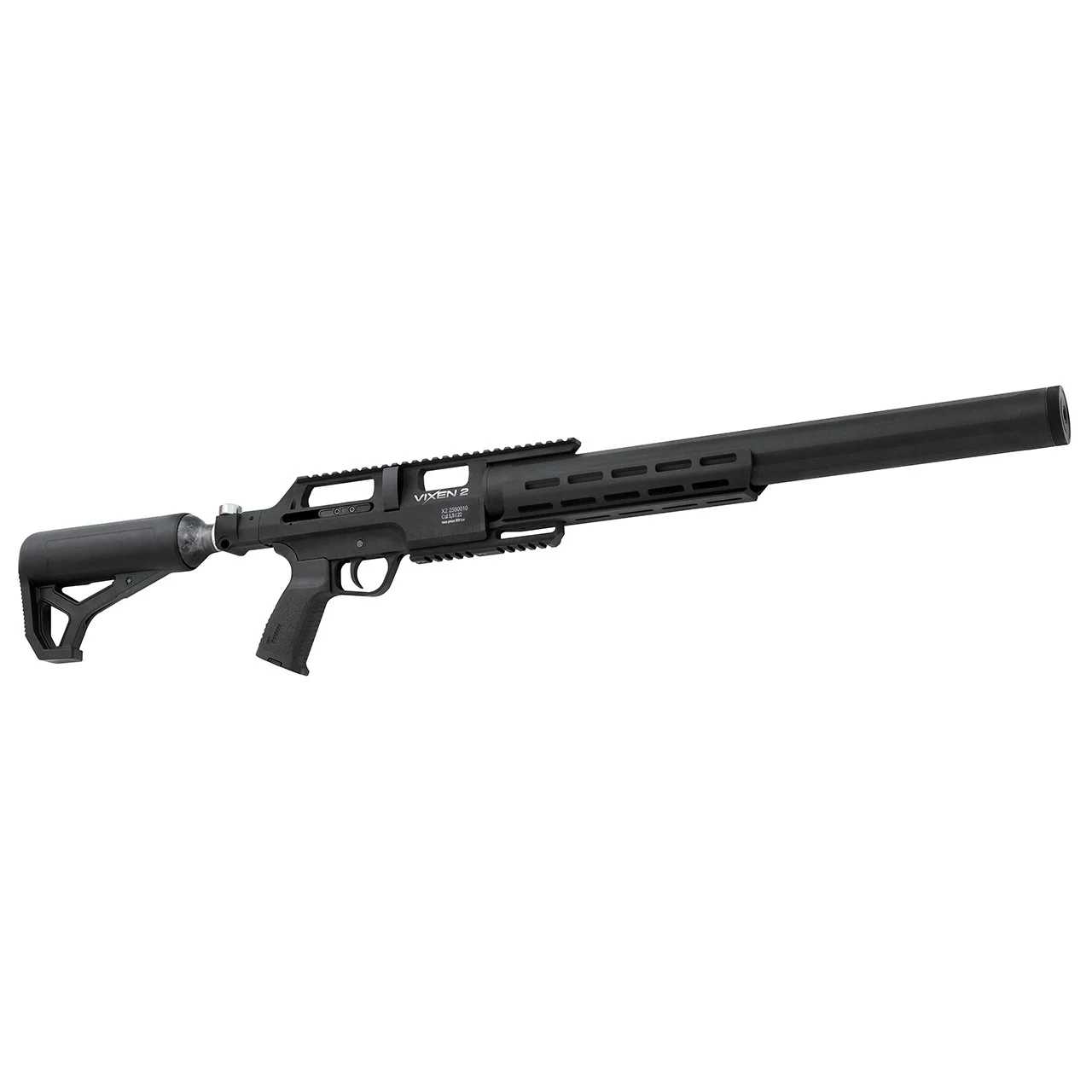
The AGT Vixen 2 has been developed for shooters who value compact handling, precision engineering, modern ergonomics, and extensive accessory compatibility. Building upon the successful Vixen platform, this second-generation PCP air rifle has been refined with an upgraded handguard, improved mounting options, a redesigned bottle stock, an enlarged power system, and a highly practical ambidextrous cocking arrangement.
Rather than unnecessary bulk being added, a streamlined and highly functional configuration has been retained. Consequently, excellent manoeuvrability can be enjoyed during target shooting, range sessions, field use, and other lawful air-rifle activities.
Accuracy is supported by a quality CZ-made barrel, while dependable velocity consistency is encouraged by the regulated pneumatic operating system. Meanwhile, considerable flexibility is provided through the modern ARCA and M-LOK mounting arrangement.
For shooters wanting an air rifle that can be configured around their individual requirements, the AGT Vixen 2 provides a particularly versatile foundation.
AGT Vixen 2 Precision Engineering
Consistency has been placed at the centre of the Vixen 2 design. A precision-manufactured barrel is combined with a regulated PCP action so that repeatable performance can be maintained throughout the usable pressure range.
Because compressed air is regulated before each shot is released, large variations in velocity are reduced. As a result, predictable pellet behaviour can be encouraged when an appropriate pellet is matched with the rifle.
Furthermore, a larger plenum has been incorporated into the Vixen 2 platform. Sufficient regulated air can therefore be stored close to the firing valve and released efficiently whenever the rifle is discharged.
Different configurations are available according to market and specification. The standard Vixen 2 uses a compact 310 mm barrel, while the Vixen 2 Long uses a 500 mm barrel. Therefore, shooters can select compact manoeuvrability or additional barrel length depending on their preferred setup.
Compact and Long Configurations
Versatility is increased by the availability of two principal configurations.
With its shorter barrel and compact dimensions, the standard AGT Vixen 2 is particularly easy to handle. It can therefore feel comfortable when shooting from supported positions or moving between different shooting locations.
By comparison, the Vixen 2 Long has been fitted with a 500 mm barrel and an overall length of approximately 997 mm. A more conventional full-length shooting profile is consequently provided without sacrificing the lightweight character for which the Vixen platform has become known.
Published specifications place the short version at approximately 2.35 kg and the long version at approximately 2.75 kg, although individual market configurations and fitted accessories may affect final weight.
Modern ARCA and M-LOK Handguard
One of the most noticeable upgrades incorporated into the AGT Vixen 2 is its modern aluminium handguard.
An integrated ARCA interface has been provided, allowing compatible shooting supports and tripod systems to be attached conveniently. In addition, M-LOK mounting points have been incorporated so that compatible accessories can be positioned according to each shooter’s preferred configuration.
Instead of being restricted to a single fixed accessory layout, the rifle can therefore be adapted around different applications.
Highlighted AGT Vixen 2 Features
- Available in .177, .22 and .25 calibre configurations in applicable markets
- 310 mm barrel on the compact Vixen 2
- 500 mm barrel on the Vixen 2 Long
- Precision CZ-made barrel
- Regulated PCP operating system
- Approximately 250 cc air reservoir
- Approximately 43 cc power plenum on published specifications
- Ambidextrous biathlon-style side-lever cocking system
- ARCA-compatible aluminium handguard
- Integrated M-LOK mounting points
- Extended Weaver/Picatinny-style optics mounting provision
- Fully adjustable trigger system
- Moulded bottle-stock arrangement
- Threaded shroud for compatible sound-moderation equipment where lawful
- Dedicated safety mechanism
- Lightweight and manoeuvrable construction
- Short and Long configurations available
Ambidextrous Side-Lever Operation
Ease of operation has also been prioritised.
A biathlon-style side lever is used to cycle the action, and importantly, the system has been designed for ambidextrous use. Consequently, both left-handed and right-handed shooters can configure the rifle according to their preferred operating style.
Smooth cocking becomes particularly useful during longer shooting sessions because unnecessary hand movement can be reduced. At the same time, the shooter’s position behind the optic can be maintained more naturally.
Moreover, magazine-fed operation allows follow-up shots to be prepared quickly without manually inserting an individual pellet after every discharge.
Magazine capacities vary according to calibre. Published full-power specifications commonly list capacities of approximately 16 rounds in .177, 13 rounds in .22, and 11 rounds in .25.
Regulated PCP Performance
Compressed air is stored within the rear reservoir and supplied through the regulated firing system. Therefore, the rifle’s operating characteristics can remain considerably more consistent than those of a basic unregulated pneumatic design.
A 250 cc reservoir has been specified for current Vixen 2 configurations, while published maximum pressure figures can vary by regional version and manufacturer or distributor specification. Users should therefore follow the pressure rating supplied with their individual rifle rather than relying solely on general product-page figures.
That distinction is particularly important because UK sub-12 ft-lb configurations and higher-powered versions sold in other jurisdictions may be tuned differently.
Consistency Where It Matters
Reliable precision is influenced by far more than maximum velocity.
Regulator behaviour, barrel quality, pellet selection, trigger control, optic setup, and shooter technique must all work together. For this reason, the AGT Vixen 2 has been designed as a complete shooting platform rather than simply as a PCP capable of producing high muzzle energy.
A fully adjustable trigger allows the release characteristics to be configured according to personal preference and applicable manufacturer guidance. Meanwhile, the rigid mounting platform helps optics remain securely positioned.
Consequently, a controlled and repeatable shooting experience can be developed.
Designed Around Practical Ergonomics
Good ergonomics are immediately important whenever an air rifle is used for extended periods.
Weight has therefore been kept relatively low, while the rear bottle has been incorporated into the shoulder-support arrangement. A moulded bottle stock replaces the simpler covering used on earlier configurations, giving the Vixen 2 a more integrated appearance and a more structured shoulder interface.
At the front, the aluminium handguard provides a secure location for the supporting hand.
Meanwhile, the pistol-grip layout promotes a natural wrist position and familiar control arrangement.
Because the platform is relatively compact, repositioning can also be performed without the cumbersome feeling sometimes associated with heavier PCP rifles.
Optics and Accessory Compatibility
Modern shooting platforms are frequently customised, and the AGT Vixen 2 has been designed with that requirement in mind.
A Weaver/Picatinny-style mounting area is provided for compatible optics. Therefore, an appropriate riflescope can be selected according to the shooter’s preferred application and local regulations.
Additionally, the ARCA and M-LOK handguard provides substantial flexibility for compatible support equipment.
The barrel shroud has also been redesigned, while threaded muzzle provision is incorporated on current versions. Compatible moderation equipment can therefore be installed where possession and use are permitted by local law.
Why Choose the AGT Vixen 2?
What distinguishes the AGT Vixen 2 is the way compact dimensions, precision components, modern mounting interfaces, and user-friendly controls have been combined into one platform.
Rather than forcing shooters to choose between portability and adaptability, both qualities are provided.
The short configuration offers excellent manoeuvrability, whereas the Long version provides the additional 500 mm barrel length preferred by some shooters. Furthermore, several calibre choices allow the rifle to be matched with different lawful shooting disciplines and regional requirements.
Above all, a highly configurable foundation is provided.
Whether precision target shooting, recreational range use, supported shooting, or another lawful application is intended, the Vixen 2 can be configured around the shooter’s needs rather than forcing the shooter around the rifle.
With its regulated PCP action, CZ-made barrel, ambidextrous side lever, adjustable trigger, ARCA/M-LOK handguard, lightweight construction, and refined ergonomics, the AGT Vixen 2 represents a substantial evolution of the original Vixen concept.
For shooters seeking modern engineering, adaptable handling, consistent operation, and a distinctive compact PCP platform, the AGT Vixen 2 deserves serious consideration.
Air Arms, PCP Air Rifles, Pellet Guns and Airgun Shooting Guide
The modern air arms market includes everything from precision target rifles to powerful hunting platforms, compact pistols, PCP systems, break-barrel rifles, and specialist big-bore models. Whether someone is researching what is an air gun, what is an air rifle, what is air rifle, what is a air rifle, or what is a airgun, understanding how different power systems, calibers, and configurations work makes choosing suitable equipment much easier.
An air arm or airarm typically launches a projectile by using compressed air, gas, or a spring-powered mechanism instead of traditional firearm propellant. People asking what are airguns, how do air guns work, how does an air gun work, how does air gun work, how does an air rifle work, how does air rifle work, or how do air rifle work are generally comparing the mechanisms used by PCP, CO2, spring-piston, and other pneumatic platforms.
Air Arms Rifles and Popular Models
Air Arms has earned substantial recognition among target shooters and airgun enthusiasts. Popular searches include air arms s510, s510, air arms s410, aa s400, tx 200, tx200, pro sport air arms, and prosport air arms. Shooters looking specifically for regulated UK-power configurations also frequently search for air arms s510 ultimate sporter .177 sub 12.
The Air Arms S510 family combines a PCP operating system with refined handling and dependable shot consistency. Meanwhile, TX200 and Pro Sport designs appeal to shooters who prefer spring-powered rifles without depending on an external filling system.
Consequently, enthusiasts comparing an Air Arms PCP with a traditional break barrel system should consider how each design will be used. PCP platforms often provide reduced recoil and convenient follow-up shots, whereas spring-powered rifles remain attractive because they can operate independently of scuba tanks or compressors.
Understanding PCP Air Rifles
Many new shooters ask what is a pcp air rifle, what is pcp air rifle, what are pcp air rifles, what is a pcp airgun, what is a pcp air gun, what is a pcp rifle, or what is pcp rifle. PCP stands for pre-charged pneumatic.
Therefore, pcp air rifle meaning, pcp rifle meaning, and pcp gun meaning all relate to an airgun that stores compressed air inside a reservoir before the shot is fired. Another common question, what is a pre charged pneumatic air rifle, describes the same fundamental technology.
A PCP can normally be filled using a pcp hand pump, pcp air compressor, dedicated air tank for pcp airguns, or another suitable high-pressure filling source. Because compressed air is stored before shooting, a PCP can deliver multiple consistent shots without requiring the shooter to cock a heavy spring before every shot.
Related searches such as air compressed gun and air compressor rifle are often used when people are learning how compressed-air rifles operate.
A pcp bb gun follows similar pneumatic principles, although ammunition type and magazine configuration depend on the individual model.
.177 Caliber vs .22 Pellet Performance
Caliber selection remains one of the most researched aspects of airgun ownership. Common searches include .177 caliber, 177 air rifle, 177 bullet, 177 cal darts, 177 or 22, 177 cal vs 22, 177 caliber vs 22, .177 caliber vs .22, .177 pellet vs .22 pellet, and .22 vs .177 pellet.
A .177 projectile generally offers a flatter trajectory at typical airgun distances because it is lighter. For this reason, .177 is widely associated with recreational and competitive target disciplines. By comparison, .22 pellets are heavier and commonly selected where additional retained energy is desirable.
However, caliber alone does not determine performance. Projectile weight, muzzle velocity, barrel characteristics, energy output, atmospheric conditions, and shooting distance all influence the trajectory.
Shooters should also understand bb gun pellet sizes, since BBs and diabolo pellets are not automatically interchangeable. Correct ammunition must always match the manufacturer’s specifications.
Pellet Pistols and Recreational Airguns
A pellet pistol provides a compact platform for recreational shooting, training, and controlled target practice. Searches for air pistol uses and pellet gun uses often involve informal target shooting, marksmanship practice, and recreational plinking.
Some shooters also research models such as the gamo pellet gun, while broader searches for pelet guns, bee bee gun rifle, or other pellet and BB platforms reflect the wide variety of recreational airguns available.
Learning how to load pellet gun equipment correctly is important because loading methods vary considerably between break-barrel rifles, rotary-magazine PCP rifles, single-shot platforms, CO2 guns, and other designs. Manufacturer instructions should always be followed to prevent damaged seals, incorrect pellet orientation, or unsafe operation.
Break-Barrel Air Rifles
Questions such as what is a break barrel air rifle and what is a break barrel pellet gun refer to one of the most established airgun mechanisms.
With a break-barrel rifle, the barrel normally pivots downward to cock the powerplant and expose the breech for loading. Once the pellet has been inserted and the barrel returned to its locked position, the rifle is ready for the appropriate firing sequence.
Because everything needed to generate the shot is integrated into the rifle, a break-barrel model does not normally require a separate compressor or external air bottle.

This simplicity makes the format appealing to shooters who want a self-contained airgun.
Target Shooting With Air Rifles
Target shooting with air rifles, air guns for target shooting, airgun target practice, and airgun for target practice cover a huge range of recreational and competitive shooting activities.
Precision PCP rifles are particularly popular because their low recoil can help users concentrate on breathing, trigger control, sight alignment, and consistent shooting technique.
Models such as the Air Arms S400, S410, and S510 are frequently associated with precision shooting, while rifles such as the TX200 and Pro Sport offer a different shooting experience for people who enjoy spring-powered equipment.
The range of air rifle equipment varies according to caliber, muzzle energy, projectile type, atmospheric conditions, and the shooter’s intended purpose. Rather than relying on a single universal range figure, users should establish safe distances within an appropriate shooting environment and follow applicable regulations.
Hunting Air Rifles
Searches for air rifles for hunting, hunting air rifles, best air rifle for hunting, and pellet gun for rabbits show how commonly pneumatic rifles are researched for pest-control and lawful hunting applications.
Where permitted, suitable airgun selection should be based on local laws, adequate projectile energy, appropriate ammunition, and the species involved. Hunters should also prioritize accurate shot placement and humane practices.
Some searches extend into much larger platforms, including big game hunting with air rifle, 72 caliber air rifle, air powered 50 cal rifle, and zeus 72 cal air rifle price. Big-bore PCP rifles operate at energy levels far beyond ordinary recreational pellet rifles, so their legal classification and permitted uses can vary substantially between jurisdictions.
The bluegrass big bore category is another example of the specialist interest surrounding large-caliber pneumatic rifles.
Questions such as can a bb gun kill a fox, air rifles for deer hunting, or searches for a rats gun demonstrate why caliber and application should never be considered without local hunting regulations, sufficient energy, and humane-use requirements.
Air Rifle Licensing and UK Regulations
Legal requirements depend heavily on location. Searches such as do you need a licence for air rifle, air rifle certificate uk, and 22 rifle uk license should therefore be answered according to the shooter’s jurisdiction rather than through a universal rule.
In the UK, different rules can apply depending on power level, firearm classification, age, and whether the user is located in England, Wales, Scotland, or Northern Ireland. Consequently, owners should verify current requirements with the relevant authorities before purchasing or using an airgun.
CO2 and Other Airgun Power Systems
A co2 powered pellet rifle stores carbon dioxide rather than high-pressure compressed air. CO2 systems are popular for recreational shooting because cartridges can make operation convenient.
However, CO2 performance may be affected by temperature, whereas PCP systems typically operate using compressed air stored at substantially higher pressures.
Some shooters search for an automatic air gun or airgun shotgun, illustrating how broad the pneumatic-gun category has become.
Popular High-Performance PCP Platforms
Beyond Air Arms, the modern market includes numerous advanced PCP systems.
The fx maverick is frequently researched by shooters interested in adjustable PCP technology. Other specialist platforms include the aea terminator, aea harpoon air gun, aea megalodon for sale, and the hatsan blitz.
Bintac-related searches are also increasingly common, including bintac aea harpoon, bintac t9 full auto, bintac mcar 457, and bintac t9 price.
These products represent a very different category from ordinary sub-12 ft-lb sporting rifles. Therefore, users should check power levels, caliber options, filling requirements, magazine systems, and legal restrictions before selecting a high-output PCP platform.
PCP Filling Equipment and Compressed-Air Accessories
A PCP rifle depends on a reliable source of clean, dry, high-pressure air. Consequently, equipment such as a pcp air compressor, pcp hand pump, and air tank for pcp airguns can become an important part of the overall setup.
A compressor may be convenient for frequent shooting because it reduces the amount of manual pumping required. By contrast, hand pumps can provide a portable solution for smaller reservoirs or users who do not want to depend on electrical equipment.
High-pressure filling equipment should always be rated for the pressures specified by the airgun manufacturer.
Although terms such as anti air tanks occasionally appear in airgun-related searches, users should distinguish ordinary high-pressure PCP filling cylinders from equipment designed for unrelated industrial, military, or specialist applications.
Choosing the Best Airgun for Your Needs
There is no single model that defines the best air guns for every user. Someone focused on precision targets may prioritize consistency and an adjustable stock, whereas a recreational shooter may value simplicity and lower operating costs.
Likewise, hunting users may prioritize projectile energy, reliability, accuracy, and practical handling.
Before choosing a rifle, consider:
- Caliber: compare .177, .22, and larger projectiles according to intended use.
- Power system: decide between PCP, spring-powered, CO2, and other pneumatic designs.
- Filling equipment: determine whether a compressor, tank, or hand pump will be required.
- Purpose: distinguish target practice, recreational plinking, competition, and lawful hunting.
- Weight and balance: ensure the rifle is comfortable during realistic shooting positions.
- Magazine capacity: consider whether a single-shot or repeating system is preferable.
- Legal requirements: confirm local licensing, power, possession, and hunting restrictions.
- Maintenance: keep seals, barrels, magazines, and filling connections properly maintained.
From established rifles such as the air arms s510 and air arms s410 to specialist PCP platforms such as the FX Maverick, Hatsan Blitz, AEA models, and Bintac systems, today’s airgun market provides an extensive range of configurations.
Understanding what is an airgun, how pneumatic systems operate, how caliber influences performance, and how PCP filling systems function makes it easier to compare available equipment and select a platform suited to its intended use.
Practical Use Scenarios
A modern regulated PCP rifle becomes most valuable when its design translates into practical advantages during real shooting sessions. Lightweight construction, compact dimensions, smooth operation, adjustable controls, and multiple mounting interfaces allow the rifle to adapt comfortably to a broad range of lawful sporting and recreational activities. Rather than being limited to one shooting style, the platform can be configured for precision practice, supported range shooting, informal target sessions, field-position training, and extended days at the range.
Precision Target Shooting at the Range
One of the most natural applications for this platform is precision target shooting. A regulated pneumatic system helps maintain consistent air delivery across the usable portion of the fill, which is particularly useful when shooters are concentrating on group size and repeatability.
When shooting from a bench, the rifle can be positioned securely on a front rest, shooting bag, or compatible bipod. Meanwhile, the relatively light overall construction makes small positional adjustments easy. Instead of fighting against excessive rifle weight, the shooter can concentrate on breathing, sight alignment, trigger control, and follow-through.
A suitable optic can also be mounted according to the distance and target size being used. Magnification can then be adjusted for paper targets, reactive targets, or small aiming points.
Because the trigger system can be adjusted within manufacturer specifications, individual preferences can be accommodated more effectively. Some shooters prefer a clearly defined first stage followed by a predictable break, while others prioritise a different feel. Whichever setup is selected, consistent trigger operation can contribute substantially to repeatable shot placement.
Furthermore, magazine-fed operation makes longer target sessions more convenient. Several shots can be taken before the magazine requires reloading, reducing interruptions between groups.
For shooters who prefer a slower and more methodical approach, each shot can still be carefully prepared. The magazine does not require rapid shooting; instead, it simply allows the next pellet to be chambered efficiently whenever the shooter is ready.
Benchrest and Supported Shooting
Benchrest-style practice is another environment where the rifle’s design can be used effectively.
The modern front handguard provides a solid platform for supported shooting. Depending on the chosen accessories, the rifle can be used with an ARCA-compatible support, tripod interface, shooting rest, or suitable bipod.
With the rifle supported properly, unnecessary movement can be reduced. This allows the shooter to evaluate pellet performance, optic settings, regulator consistency, and personal technique more accurately.
For example, a shooter testing several pellet types can fire controlled groups under similar conditions. Each group can then be compared for accuracy and consistency.
This approach is particularly useful when setting up a new rifle. Instead of immediately making assumptions about the best pellet, several appropriate options can be tested safely on an established range.
Once a consistent pellet has been identified, optic zero can be refined further. Small adjustments to elevation and windage can then be made while the rifle remains firmly supported.
The compact configuration may be particularly convenient on smaller shooting benches because less forward space is required. By comparison, shooters who prefer the longer configuration may appreciate its extended barrel length and slightly different balance.
Neither version automatically guarantees better accuracy for every shooter. Instead, the most suitable configuration depends on personal handling preference, shooting position, equipment, and intended application.
Recreational Plinking Sessions
Not every range visit needs to involve detailed group measurement.
For recreational shooting, the rifle provides a fast and enjoyable operating experience while still retaining the accuracy expected from a regulated PCP system.
Suitable reactive targets can make informal practice more engaging. Metal targets designed specifically for airgun use, paper targets, spinners, and other approved range targets can all provide immediate feedback.
The side-lever action becomes especially convenient during these sessions. After each shot, the action can be cycled smoothly without requiring large movements or major changes in shooting position.
As a result, the shooter can maintain a comfortable position while working through a magazine.
Ambidextrous operation is also valuable when the rifle is shared between shooters with different dominant hands. The controls can be configured more conveniently, making the platform accessible to a broader range of users.
Nevertheless, every shooter should receive appropriate instruction before using the rifle. Safe muzzle direction, trigger discipline, suitable backstops, eye protection, and local range rules remain essential regardless of experience level.
Shooting from a Tripod or Stable Field Rest
The integrated ARCA-style mounting interface provides useful options for shooters who prefer a tripod-supported position.
A compatible clamp can secure the rifle to suitable support equipment, creating a stable platform without requiring the shooter to hold the full weight continuously.
This arrangement can be valuable during extended target sessions where fatigue would otherwise affect stability. It can also help shooters practise standing, kneeling, or seated supported positions.
Once the tripod height has been adjusted correctly, the shooter can focus on body alignment rather than supporting the rifle entirely through muscular effort.
For standing practice, a tripod may reduce vertical movement. When seated, it can provide an additional point of support. During kneeling exercises, the support can be adjusted to match the required position.
Importantly, supported shooting should still involve correct technique. A tripod cannot compensate completely for poor trigger control, inconsistent cheek placement, or incorrect optic alignment.
Therefore, it should be viewed as a practical shooting aid rather than a substitute for skill development.
Training for Different Shooting Positions
Because the platform remains relatively light, it can be used to practise several traditional air-rifle positions.
Standing practice can help develop balance, breathing control, and trigger discipline. Since no bench is supporting the rifle, small errors become more noticeable.
Kneeling introduces another challenge because body position and joint support affect stability. A shooter can experiment with safe, approved positions until a repeatable stance is developed.
Seated shooting provides additional stability and can be useful for longer practice sessions. Depending on the environment, shooting sticks or another approved support may also be incorporated.
Prone shooting can offer excellent stability where range rules and terrain permit. However, rifle and magazine clearance should always be considered so that the action is not obstructed.
Moving between these positions helps develop broader shooting competence. Rather than becoming dependent on one benchrest position, the shooter learns how balance and point of impact can change with body position.
Pellet Testing and Accuracy Evaluation
Every barrel can show preferences for particular pellet designs, weights, or head sizes. Consequently, structured pellet testing can be an important part of setting up the rifle.
Testing should begin under controlled conditions with a reliable backstop.
Several groups can be fired using one pellet type before changing to another. Group size, point of impact, and overall consistency can then be recorded.
The regulated action is particularly useful during this process because pressure management is designed to provide relatively consistent shot-to-shot performance throughout the effective portion of the fill.
However, air pressure should still be monitored.
Rather than continuing to shoot well below the recommended operating range, the reservoir should be refilled according to the manufacturer’s instructions. Likewise, only compatible charging equipment rated for the required pressure should be used.
Once a suitable pellet has been identified, more detailed testing can be performed at several lawful range distances. This allows the shooter to understand trajectory changes and establish dependable aiming references.
Optic Setup and Zero Confirmation
Installing an optic is only the first stage of creating a reliable shooting system.
Mounts should be correctly fitted and tightened according to the manufacturer’s instructions. Eye relief must then be established so that a full sight picture can be obtained naturally from the shooting position.
After installation, initial zeroing should be conducted at a safe range.
A large target can be used first to confirm that shots are landing safely within the target area. Windage and elevation adjustments can then gradually move the group toward the intended point of impact.
Once a basic zero has been established, confirmation groups should be fired.
This step is important because a single shot does not prove that the rifle is correctly zeroed. Several carefully executed shots provide a much better indication.
Afterwards, zero can be checked at additional distances if required.
A shooter who understands the relationship between zero distance and pellet trajectory is better prepared to use the rifle accurately during lawful range activities.
Long Shooting Sessions
Comfort becomes increasingly important during extended sessions.
A heavy rifle may become tiring when repeatedly lifted, repositioned, or carried between firing points. By comparison, a lightweight PCP configuration can reduce unnecessary physical strain.
The bottle-stock arrangement also contributes to the overall balance of the platform.
When the rifle is shouldered, the shooter can adjust their position until the eye aligns naturally with the optic. Consistent head placement should then be maintained from shot to shot.
During long sessions, regular pauses are still beneficial. Fatigue can cause trigger control and concentration to deteriorate, even when the rifle itself remains comfortable.
Air supply management should also be planned.
A suitable charging source can be kept available according to range rules. Before filling, the shooter should verify that all equipment is compatible with the rifle’s specified pressure limits.
Slow and controlled filling is generally preferable to unnecessarily rapid charging, while all manufacturer safety guidance should be followed.
Compact Transport and Storage
The short configuration offers practical advantages when storage space is limited.
A properly fitted hard or padded rifle case can protect the rifle, optic, magazine, and accessories during lawful transport.
Before transport, the rifle should be made safe according to applicable law and manufacturer instructions. Pellets should be stored securely, and compressed-air equipment should also be handled correctly.
Because the rifle has a relatively streamlined profile, an appropriately sized case does not need to be excessively large.
Accessories can often be stored separately in organised compartments. Spare magazines, optic tools, cleaning supplies, protective equipment, and charging components can therefore be kept together without placing loose items directly against the rifle.
Proper storage at home is equally important.
The rifle should be kept securely and away from unauthorised access. Local requirements regarding locks, cabinets, certificates, transportation, and ammunition or pellet storage should always be followed.
Accessory-Based Range Configuration
Another practical advantage is the ability to adapt the rifle before each shooting session.
A lightweight range configuration might consist of the rifle, compact optic, and magazine.
For bench shooting, a bipod or compatible front support could be added.
During tripod-supported practice, the ARCA interface can be used with suitable equipment.
Additional M-LOK-compatible accessories may also be fitted where appropriate and lawful. However, accessories should be selected because they improve the shooting setup rather than simply increasing equipment weight.
Too many attachments can alter the rifle’s balance and make an otherwise lightweight platform unnecessarily cumbersome.
Therefore, shooters should consider the actual purpose of each accessory before installation.
Introducing a New Shooter to PCP Shooting
Under appropriate supervision and where permitted by law, the platform can also serve as an introduction to regulated PCP operation.
A new shooter can first be taught the basic controls without firing.
The instructor can demonstrate the safety mechanism, side lever, magazine system, trigger, optic, and correct charging procedures.
Afterwards, dry handling exercises can reinforce safe muzzle direction and trigger discipline.
Live firing should begin only once the shooter understands the fundamental safety rules.
A stable bench and large paper target can provide a controlled starting point. By reducing unnecessary movement, the beginner can focus on correct shoulder placement, sight picture, breathing, and trigger operation.sportsman 900
As confidence develops, additional shooting positions and more challenging targets can gradually be introduced.
A Flexible Platform for Regular Range Use
Perhaps the greatest practical advantage is adaptability.
One shooter may configure the rifle as a lightweight recreational setup, while another may prefer a supported precision arrangement with a larger optic and tripod. Someone else may concentrate primarily on benchrest-style pellet testing and group shooting.
Because the basic platform supports several configurations, the rifle does not need to remain permanently set up for one particular activity.
Accessories can be changed, shooting supports can be added or removed, and optic choices can be adapted to the intended session.
That flexibility makes the rifle particularly suitable for enthusiasts who enjoy experimenting with different shooting disciplines while retaining one familiar action and control layout.air guns for home defense
Ultimately, practical performance comes from the combination of consistent air delivery, suitable pellets, a properly fitted optic, careful maintenance, safe handling, and disciplined shooting technique. When these elements are brought together, the platform can provide an adaptable, comfortable, and highly capable foundation for a wide variety of lawful recreational and precision air-rifle activities.
Frequently Asked Questions
What type of air rifle is this?
This is a regulated pre-charged pneumatic air rifle designed around a lightweight, modern and highly adaptable platform. Compressed air is stored inside the onboard reservoir and is released through a regulated firing system each time a shot is taken.
Because the system is regulated, air delivery is controlled more consistently across the usable pressure range. Consequently, shooters can benefit from predictable performance, smoother shot-to-shot behaviour and a refined shooting experience when the rifle is correctly set up.
The rifle also uses a magazine-fed side-lever action, making it suitable for recreational target shooting, precision range sessions and other lawful sporting applications.
Which calibres are available?
Current specifications list the rifle in .177, .22 and .25 calibre versions.
Each calibre offers slightly different characteristics.
The .177 option is commonly selected by shooters who value a relatively flat trajectory and high magazine capacity. Meanwhile, .22 provides a popular balance between pellet weight, trajectory and overall versatility.
The .25 version uses a heavier projectile and is generally associated with higher-energy configurations in markets where such power levels are permitted.
Before purchasing, buyers should confirm which calibre best suits their intended shooting discipline and local legal requirements.
How many pellets does the magazine hold?
Magazine capacity depends on calibre.
Published specifications list approximately:
- 16 shots in .177
- 13 shots in .22
- 11 shots in .25
These capacities are the same for the standard and Long configurations according to current distributor data.
A multi-shot magazine can be particularly useful during longer target sessions because repeated manual single loading is reduced.
Is there a shorter and longer version?
Yes.
The standard configuration uses a 310 mm barrel and has an overall length of approximately 803 mm.
The Long version uses a 500 mm barrel and measures approximately 997 mm overall.
The shorter setup prioritises compact handling and reduced overall length, while the longer configuration offers a more extended shooting profile.
Neither layout is automatically better for every shooter. Personal preference, balance, available shooting space and intended use should all be considered.
How much does the rifle weigh?
The standard model is listed at approximately 2.35 kg, while the Long version weighs approximately 2.75 kg before additional equipment is considered.
Final shooting weight will depend on the optic, mounts and other accessories fitted.
This relatively lightweight construction can be useful during extended sessions because less effort is required when repositioning or carrying the rifle between firing points.
Is the rifle regulated?
Yes.
A pressure regulator forms part of the pneumatic system. Current specifications also list a 43 cm³ power plenum.
The regulator helps control the pressure supplied to the firing valve. Therefore, the rifle is designed to produce more consistent air delivery throughout the effective shot string.
Regulation does not eliminate every variable affecting accuracy, however. Pellet quality, barrel condition, air pressure, environmental conditions and shooter technique remain important.
What size is the air reservoir?
The onboard air reservoir is listed at approximately 250 cm³ for both standard and Long configurations.
That reservoir supplies the compressed air required for operation.
Shot count varies according to calibre, tune, pellet weight, regulator setting and other factors. Published full-power figures list different shot counts for each calibre, so buyers should consider manufacturer or distributor figures as configuration-specific rather than universal.
How many shots can I expect from one fill?
Current distributor specifications list approximately 145 shots in .177, 60 shots in .22 and 50 shots in .25 for the published configuration.
Real-world results can vary.
Power setting, pellet choice, temperature, regulator setup and the pressure at which shooting is stopped can all influence the final number of useful shots.
For that reason, owners should monitor the pressure gauge and refill the rifle according to the manufacturer’s instructions.
What fill pressure does it use?
Published distributor specifications list a maximum working pressure of approximately 300 bar, with calibre-specific regulated pressure figures shown separately.
However, the markings and documentation supplied with the individual rifle should always take priority over general online specifications.
Only compatible high-pressure filling equipment should be used. In addition, filling should always be performed according to the manufacturer’s safety instructions.


Reviews
There are no reviews yet.