We Deliver Airguns Directly To Your Door
SKU N/A Category

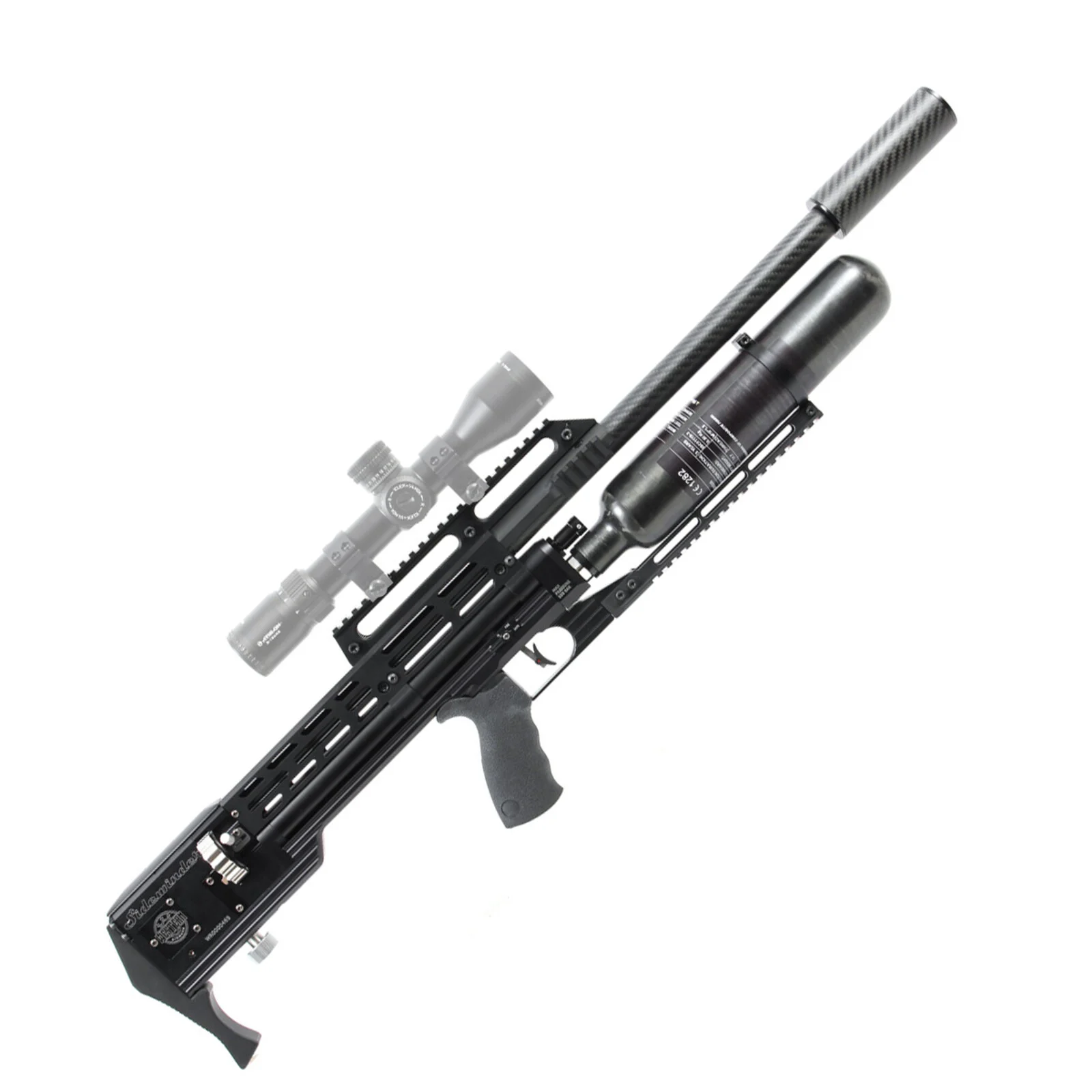
Western Airguns Sidewinder Full-/Semi Automatic PCP Rifle

€2,600.00

Looking for a high quality airgun that offers precision and adjustable power in a compact package?
Do you want to top that off with a semi- and fully-automatic loading system?

Look no further than the Western Airguns Sidewinder!


The Western Sidewinder’s unique air delivery system combines a blend of high power and accuracy with fast rate of fire in semi-automatic or full-automatic with the flip of a switch at the back of the breech block.
The all new Western Sidewinder rifle’s velocity control wheel can regulate pellet or slug speeds from quiet back yard target shooting to power levels capable of Coyote size game depending on the caliber choice.

The Sidewinder incorporates a newly designed, removable magazine system that holds 15 shots in .22 and .25 caliber, and 12 shots in .30 caliber.
This magazine is machined out of titanium and combined with the automatic fire modes, offer a quick follow-up shot.

The Sidewinder’s picatinny scope rail is mounted on top of the rifle and has side rails for accessories like lasers, red dots or lights.
A bottom rail for bipod mounting is rigidly mounted beneath the 580cc bottle.

Accuracy with both slug and pellet ammo is provided by a regulated action and a USA-made TJ hammer forged barrel.
The AR compatible grip allows for shooter customization for a comfortable fit.

Just like the snake, the Western Sidewinder air rifle is fast, light and hits hard!

Power source: Pre compressed pneumatic (PCP)
Caliber: 5.5mm (.22) | 6.35mm (.25) | 7.62mm (.30)
Muzzle energy: (Max joules) 95J in 5.5 | 120J in 6.35 | 170J in 7.62
Fill pressure: 300 bar
Air capacity: 580cc
Regulator: Yes, adjustable
Operating system: Semi and full automatic
Magazine: 5.5mm & 6.35mm = 15 shots | 7.62mm = 12 shots
Max. projectile length: 10.9mm
Optic mounting: 22mm picatinny/weaver
Weight: 3.5kg
Length: 902mm
Barrel length: 580mm
Muzzle:
Accessories:

Western Airguns Sidewinder Full-/Semi Automatic PCP Rifle

Precision, speed, and controlled power are delivered by the Western Airguns Sidewinder Full-/Semi Automatic PCP Rifle for hunters, target shooters, and pest-control enthusiasts. Compact handling is combined with regulated consistency, so backyard sessions and field work can both be approached with confidence. Responsible ownership and local airgun laws are expected to be followed at all times.

Why the Western Airguns Sidewinder Full-/Semi Automatic PCP Rifle Is Chosen

Selective-fire capability is offered by few premium PCP platforms. Consequently, a rare mix of rapid follow-up shots and match-grade accuracy is provided by the Western Airguns Sidewinder Full-/Semi Automatic PCP Rifle. Furthermore, quiet plinking or higher-energy hunting loads can be selected with a simple velocity-control wheel. In addition, both pellets and slugs are supported by a USA-made TJ hammer-forged barrel and an adjustable regulator.

Therefore, versatility is built into every fill. Meanwhile, a 580 cc carbon-fiber bottle charged to 300 bar keeps sessions long. As a result, fewer interruptions are experienced at the range or in the field.

Core Advantages at a Glance

  • Selective fire is engaged by a primary safety/selector so semi-automatic or full-automatic operation can be chosen instantly.
  • Removable rotary magazines are loaded quickly: 15 shots in .22 and .25, 12 shots in .30.
  • Velocity control is adjusted so backyard target work or coyote-class power can be dialed in.
  • Regulated shot strings are produced for consistent point of impact.
  • Picatinny rails are fitted on top, sides, and under the bottle so optics, lights, lasers, and bipods can be mounted.
  • AR-compatible grip is accepted so custom pistol grips can be fitted for a comfortable hold.
  • Lightweight package is carried easily: approximately 7.7 lb (3.5 kg) and 35.5 in (902 mm) overall.

Design and Handling of the Western Airguns Sidewinder Full-/Semi Automatic PCP Rifle

A compact bullpup layout is used so a 23-inch (580 mm) barrel can be housed in a short overall length. Consequently, offhand shooting is made practical. Moreover, a carbon-fiber barrel shroud and built-in suppressor housing help keep the report manageable. In addition, a rigid bottom rail is mounted beneath the bottle so a bipod can be attached without flex.

Meanwhile, two safeties are provided. The trigger safety is located on the right side, while the primary safety and fire-mode selector sit on the left rear of the breech. Therefore, unintended discharge can be prevented before a shot is taken. Likewise, an AR-style grip allows aftermarket grips to be installed so a wide range of hand sizes can be accommodated.

A two-piece metal magazine is held together magnetically. After pellets or slugs are dropped into the chambers, the cover is snapped on and the magazine is locked into the well with a knurled lever. As a result, reloads can be completed in seconds and a “clear” condition can be shown easily.

Power, Calibers, and Shot Count

Three calibers are offered so the Western Airguns Sidewinder Full-/Semi Automatic PCP Rifle can be matched to the intended task.

Performance Range

  • .22 (5.5 mm): up to approximately 72 ft-lbs / 95 J is available; 30–300 regulated shots per fill can be obtained depending on power setting.
  • .25 (6.35 mm): up to approximately 88 ft-lbs / 120 J is available; 30–265 shots per fill can be expected.
  • .30 (7.62 mm): up to approximately 125 ft-lbs / 170 J is available; 30–200 shots per fill can be obtained.

Factory “as-shipped” settings typically produce mid-range energy with generous shot counts. Subsequently, the velocity-control wheel and regulator can be used (within manufacturer limits) so quieter backyard velocities or maximum hunting energy can be selected. Heavy pellets and slugs are stabilized by the TJ hammer-forged barrel, while lighter pellets can be run at higher speed when accuracy is verified.

Independent tests have shown tight groups even in full-automatic bursts at short range, provided a firm hold is maintained. Therefore, both precision and volume of fire can be enjoyed from the same platform.

Practical Uses and Field Tips

Quiet target practice is supported when the power wheel is turned down. Conversely, pest control and small-to-medium game hunting can be undertaken when legal energy levels are set. Moreover, rapid follow-up shots are available if a second opportunity appears.

A chronograph is recommended whenever power or regulator settings are changed, because velocity and shot count are closely linked. In addition, clean, dry high-pressure air or nitrogen only should be used, and 300 bar / 4,350 psi must never be exceeded. Spare magazines can be pre-loaded so time on target is maximized.

Inclusive shooting is supported by the ambidextrous fire controls and AR-grip standard, although the factory cheek piece is typically oriented for right-side use. Aftermarket pads and grips can be fitted so left-handed and smaller-stature shooters can be accommodated more comfortably.

Who Benefits Most

Experienced PCP owners who want selective fire without sacrificing accuracy will find the Western Airguns Sidewinder Full-/Semi Automatic PCP Rifle especially appealing. Likewise, hunters who need a compact, rail-ready rifle with high shot count will appreciate the 580 cc bottle and regulated action. Target shooters who enjoy both single shots and controlled bursts are equally well served.

Legal requirements vary by country and region. Therefore, FAC or equivalent licensing, energy limits, and hunting seasons must be confirmed before purchase or use. Safe handling, eye protection, and a proper backstop are required for every session.

Ready to Add the Western Airguns Sidewinder Full-/Semi Automatic PCP Rifle?

A rare combination of full-/semi-automatic fire, removable magazines, regulated consistency, and a proven TJ barrel is offered in a lightweight tactical package. Consequently, the Western Airguns Sidewinder Full-/Semi Automatic PCP Rifle stands out among premium PCP rifles. Optics, bipods, and spare magazines can be added so a complete field-ready setup is created.

Browse available calibers and accessories, then place an order while stock lasts. Precision, speed, and versatility are waiting to be put to work—responsibly and legally.

Western Airguns, Benjamin PCP Rifles and Big-Bore Airgun Guide

People searching for air guns near me or comparing air gun dealers near me increasingly look beyond conventional pellet rifles toward PCP platforms, compact bullpups, hunting configurations, and American-designed big-bore systems. Whether the search begins with airguns usa, air rifle dealers, air rifle online, or airguns online, understanding the major platforms, calibers, operating systems, and intended applications makes it easier to compare available models responsibly.

Western Airguns and Big-Bore PCP Platforms

Among modern PCP manufacturers, western airguns has attracted considerable attention for compact designs and larger-caliber platforms. Searches such as western air guns, western air gun, western rifles, western firearm, western firearms, and western arms are commonly associated with people researching the Western Airguns product family.

Popular models include the western rattler, western rattler air gun, and western rattler bullpup. Buyers researching larger calibers may also encounter the western rattler 357, 357 rattler, 357 air rifle, .35 cal air rifle, western rattler 45, and western big bore bushbuck 45. These searches generally relate to powerful PCP platforms designed around larger projectiles rather than conventional small-caliber recreational pellet rifles.

The term western rattler bullpup for sale is frequently used by shoppers comparing availability, while western rattler bullpup amazon may appear in searches from users attempting to determine whether the platform is offered through major marketplaces. Availability, shipping rules, age restrictions, and licensing requirements should always be verified for the buyer’s jurisdiction.

Another recognizable Western platform is the western mordax. Related searches include western mordax pcp, western airguns mordax, western mordax venom, mordax venom, mordax airgun, mordax air gun, and mordax air gun price. People using these phrases are generally researching specifications, configurations, pricing, and availability rather than a traditional spring-powered rifle.

The western sidewinder is another platform frequently associated with the brand. Search phrases include western sidewinder compact, sidewinder gun, sidewiner, sidewinder length, and even technical searches such as sidewinder k7a-00008 manual. Product dimensions, magazine systems, air-cylinder capacity, operating pressure, and manufacturer documentation should be checked against the exact version because specifications can vary.

For customers researching very large-caliber Western models, bush buck and bushbuck air rifle price are common search phrases. Big-bore platforms are sometimes described broadly as a big bore pellet gun, big air rifle, big game airgun, or big game air guns. Their intended use, permissible energy level, and legal hunting applications vary significantly between regions.

Bullpup and PCP Air Rifle Technology

A bullpup air rifle places much of the action behind the trigger, allowing a comparatively long barrel to be packaged into a shorter overall platform. This layout has become particularly popular with pcp guns, pcp rifle, and pcp air rifles because compressed-air cylinders and magazines can be incorporated into relatively compact designs.

A compressed air rifle stores high-pressure air and releases a controlled amount during each shot. This system differs substantially from a break barrel pellet gun, where the barrel is typically used to cock a spring or gas-ram mechanism.

People researching an accurate pellet rifle or long range air rifle often compare regulator performance, barrel quality, projectile consistency, trigger characteristics, stock fit, shot count, and optics compatibility. Accuracy depends on the complete system rather than power alone.

Calibers, FAC, Power and Accessories for the Western Airguns Sidewinder Full-/Semi Automatic PCP Rifle

Legal compliance, power flexibility, and accessory readiness are built into the Western Airguns Sidewinder Full-/Semi Automatic PCP Rifle. Consequently, backyard plinking, pest control, and hunting roles can all be supported when local laws are respected. Furthermore, three factory calibers, an adjustable regulator, and a velocity-control wheel allow energy and shot count to be matched to the task. In addition, a full rail system and AR-compatible grip mean optics and support gear can be added without guesswork.

Calibers Offered on the Western Airguns Sidewinder Full-/Semi Automatic PCP Rifle

Three chamberings are supplied so a single platform can serve different distances and quarry. Therefore, a caliber can be chosen before purchase rather than after.

.22 / 5.5 mm

A high shot count and flatter trajectory are typically delivered by .22. As a result, target work and small-pest duties are often assigned to this chambering. Moreover, a 15-round removable magazine is used. Meanwhile, maximum energy of approximately 72 ft-lbs (about 95 J) can be reached at the top power setting. Conversely, quieter backyard velocities can be selected when the velocity wheel is turned down. Subsequently, 30 to 300 regulated shots per 580 cc fill can be obtained depending on regulator pressure and pellet weight.

.25 / 6.35 mm

A balance of energy and magazine capacity is provided by .25. Consequently, mid-size pests and many hunting applications are commonly served. Likewise, a 15-round magazine is retained. In addition, up to approximately 88 ft-lbs (about 120 J) can be produced. Furthermore, 30 to 265 shots per fill are available across the power range. Heavy pellets and slugs are stabilized well by the TJ hammer-forged barrel in this caliber.

.30 / 7.62 mm

Maximum impact is prioritized by .30. Therefore, larger pests and coyote-class game (where legal) are the intended use. A 12-round magazine is fitted instead of 15. Meanwhile, up to approximately 125 ft-lbs (about 170 J) can be generated at peak settings. Shot count is reduced to roughly 30–200 per fill as energy rises. Nonetheless, regulated consistency is still maintained when the factory guidance on regulator limits is followed.

Pellet and slug compatibility is shared across all three calibers, provided projectile length stays within the magazine limit (approximately 10.9 mm). Accuracy with both ammo types is supported by the USA-made TJ hammer-forged barrel and the regulated action.

FAC, Legal Power and Responsible Use

Power output is adjustable, so the Western Airguns Sidewinder Full-/Semi Automatic PCP Rifle can fall below or above local airgun limits. Accordingly, Firearm Certificate (FAC) or equivalent licensing must be confirmed before a high-power configuration is used. In many UK and EU jurisdictions, energy above the local threshold requires FAC or a comparable permit. Export models in some markets are limited (for example, certain Mexico-spec units are capped near 97 ft-lbs). Therefore, the exact configuration sold in a given country should be verified with the retailer.

Factory “as-shipped” settings typically sit in a mid-power band so a useful shot count is preserved. Subsequently, the velocity-control wheel can be used for day-to-day changes. Regulator pressure may also be adjusted, but manufacturer limits must be respected: operation below about 140 bar or above about 190 bar is discouraged and may void warranty or cause malfunction. A chronograph is strongly recommended whenever settings are changed, because advertised maxima are reached only with specific pellet or slug weights.

Inclusive, responsible ownership is expected. Local hunting seasons, minimum energy rules, age restrictions, and transport laws must be observed. Eye protection, a safe backstop, and treatment of the rifle as loaded at all times remain mandatory. Full-automatic fire is intended only where it is legal and only with a firm hold and a clear range.

Western Airguns Sidewinder PCP

Power Adjustment in Practice

Two user controls are provided. First, the velocity-control wheel at the rear of the action is rotated so pellet or slug speed can be raised or lowered without tools. Second, the regulator adjuster can be used for coarser energy changes, preferably with the rifle degassed when pressure is reduced. As a result, quiet target sessions and high-energy hunting strings can be selected from the same 300 bar / 4,350 psi fill.

Approximate published bands include:

  • Minimum / low power: up to ~15–40 ft-lbs depending on caliber, with the highest shot counts (up to ~300 in .22).
  • As-shipped: mid-band energy (often ~47 ft-lbs in .22, ~60 ft-lbs in .25, ~80 ft-lbs in .30) with generous regulated strings.
  • Maximum: up to ~72 / 88 / 125 ft-lbs respectively, with fewer shots (around 30 at the top end).

Independent tests have recorded 160+ consistent .22 shots from a full 580 cc bottle at factory-like settings. Therefore, real-world efficiency often meets or exceeds the published “up to” figures when pellets are matched to the tune.

Accessories That Complete the Western Airguns Sidewinder Full-/Semi Automatic PCP Rifle

A tactical rail layout is fitted so a complete field setup can be built quickly.

Optics and Sighting

A full-length Picatinny/Weaver rail is mounted on the barrel cover. Consequently, scopes, red dots, and thermal or night-vision units can be attached. Side rails accept lights and lasers. A compact LPVO or a dedicated airgun scope with adjustable parallax is commonly chosen because both pellets and slugs are used.

Support and Stability

A rigid bottom rail sits under the 580 cc bottle. Therefore, a bipod can be mounted without flex. Aftermarket butt pads are frequently added because the factory pad is fixed. AR-compatible pistol grips can be swapped so smaller hands, larger hands, and left- or right-side preference can be accommodated more comfortably. An adjustable cheek piece is not standard; aftermarket options may be considered for consistent eye alignment.

Magazines, Air and Sound

Spare removable magazines allow a “clear” rifle to be shown and rapid reloads to be made. A quality PCP compressor or scuba/HPA fill station rated to 300 bar is required. Only clean, dry air or nitrogen may be used. A more efficient aftermarket suppressor can be fitted on some setups where the muzzle interface allows it; the factory shroud already includes a suppressor housing.

Recommended Add-On List

  • Spare 15-round (.22/.25) or 12-round (.30) magazines
  • Picatinny-mounted scope or red-dot with airgun-rated rings
  • Bipod on the under-bottle rail
  • Aftermarket AR grip and improved butt pad
  • Chronograph for power and regulator checks
  • 300 bar fill whip / compressor and spare fill probe
  • Slug- and pellet-specific ammo in the chosen caliber
  • Soft case with magazine pockets

When these accessories are combined with a legally appropriate caliber and power setting, the Western Airguns Sidewinder Full-/Semi Automatic PCP Rifle becomes a complete, conversion-ready platform for target, pest, and hunting use—always within the law and always with safety first.

Some shoppers also search for a semi automatic pellet gun or full auto air gun. These terms describe different cycling mechanisms and should not be treated as interchangeable. Regulations governing semi-automatic or fully automatic air-powered platforms may also differ from regulations covering manually cycled rifles.

Search phrases such as lethal air guns and steel penetrating full auto airgun sometimes appear online, but airguns should never be treated as toys or casually tested against unsafe targets. High-energy models can cause severe injury and should be used only with suitable backstops, eye protection, safe handling procedures, and full compliance with local law.

People also ask where do bullets land when shot in air. Projectiles fired upward eventually return toward the ground, and their landing point cannot be safely predicted. For that reason, an airgun or firearm should never be discharged vertically or in any direction without a verified safe impact area and backstop.

Other Western-Style and Specialty Airgun Searches

A number of additional terms appear alongside Western Airguns searches, including serpent arms, venom arms, desert scorpion pistol, atlas airguns, and lindstradt air gun. Similar searches may also include edgun west, edgunwest, and ed gun west, which are spelling variations commonly entered by people researching EDgun-related products and U.S. availability.

Search terms such as az air guns can relate to retailers, regional airgun communities, or businesses associated with Arizona. Because similar names can refer to different organizations, buyers should verify the manufacturer, retailer, warranty provider, and exact product before ordering.

A double barrel air gun or shotgun air rifle represents another specialized category that differs considerably from the typical single-barrel PCP rifle. Likewise, searches for a western arms shotgun may refer to products from a different manufacturer than Western Airguns, so model identification remains important.

Benjamin Air Rifles and PCP Platforms

Benjamin has a long history in the airgun market, which is why searches for a benjamin air rifle, benjamin air rifles, benjamin pellet gun, and benjamin pellet remain common among recreational shooters and hunters.

One of the best-known PCP families is the benjamin marauder. Search variations include benjamin marauder pcp and benjamin marauder air rifle. The Marauder platform is often researched by users comparing PCP rifles for target use, recreational shooting, and lawful pest-control applications.

Another widely searched model is the benjamin bulldog, a larger-caliber PCP platform. Queries such as benjamin bulldog 457 20 joules may refer to specific regional configurations, energy-restricted versions, or product information. Because power specifications can differ by market, purchasers should verify the manufacturer’s specifications and applicable regulations.

The benjamin prowler represents another area of interest for users comparing more traditional air-rifle configurations. Meanwhile, benjamin air rifle 22 break barrel is frequently searched by shoppers specifically looking for .22-caliber break-barrel designs.

Older or heavily used rifles may lead owners to search for benjamin air rifle repair. Seal condition, valves, pressure systems, triggers, barrels, stocks, and other components should be inspected or serviced according to manufacturer recommendations, particularly when dealing with high-pressure PCP equipment.

Airbows, Arrow Rifles and Alternative Air-Powered Platforms

Not every compressed-air hunting platform uses pellets. Searches for air bow, airbow, air bow rifle, arrow gun, benjamin airbow, and benjamin bow refer to systems designed to propel arrows using compressed air.

These products differ fundamentally from ordinary air pellet gun systems and should be selected according to their intended purpose and applicable local hunting regulations. Buyers should also confirm compatible arrows, pressure requirements, filling equipment, optics mounting options, and manufacturer-recommended accessories.

Air Pistols and Hunting-Oriented Searches

An air rifle and air pistol can serve very different roles depending on caliber, energy, operating system, and regional law. Searches such as hunting air pistol, air pistols for hunting, and co2 pellet guns often involve very different products.

CO2-powered models typically use replaceable carbon-dioxide cartridges, whereas PCP pistols rely on pre-charged compressed air. Local regulations determine whether either type can lawfully be used for hunting.

The term m357 can also appear when shoppers research revolver-style air pistols or products carrying similar model designations. Because this phrase can refer to multiple items, checking the manufacturer’s full model number is important before selecting accessories or replacement components.

Additional Airgun Types and Search Categories

The broader airgun market includes everything from a basic bb gun rifle and traditional spring-powered designs to sophisticated regulated PCP systems. Some buyers search for a pellet gun with silencer, although suppressor, moderator, and sound-reduction laws vary significantly between jurisdictions.

Others look for a hunting air rifle, big game air guns, or other high-powered platforms. The appropriate caliber and energy level depend on local law, target species where hunting is legal, shooting distance, projectile selection, and manufacturer recommendations.

A search such as air gun for semi truck may refer to an air-powered accessory, cleaning tool, pneumatic device, or another product entirely rather than an air rifle. Clarifying the intended equipment category is therefore important before purchasing anything based solely on that phrase.

Choosing Between Western, Benjamin and Other Airgun Platforms

Comparing products from western airguns, Benjamin, EDgun-related brands, and other PCP manufacturers requires more than comparing advertised power figures. Consider overall length, weight, caliber availability, magazine capacity, fill pressure, regulator design, shot count, trigger system, stock configuration, warranty coverage, parts availability, and manufacturer support.american made air rifles

A compact western sidewinder, larger western rattler, western mordax pcp, traditional benjamin marauder, big-bore benjamin bulldog, or another pcp air rifles platform may suit very different users and applications.

Responsible selection should therefore begin with the intended lawful use, followed by caliber, dimensions, power level, filling equipment, ammunition availability, service support, and local regulatory requirements. Whether someone begins their search with air guns near me, air gun dealers near me, air rifle dealers, or airguns online, careful comparison helps distinguish between recreational airguns, precision PCP rifles, hunting-oriented systems, specialty bullpups, and big-bore platforms.

Practical Use Scenarios

A compact, regulated, selective-fire PCP is most useful when the setting, the quarry, and the legal energy limit are matched before the first shot is fired. Consequently, quiet backyard practice, structured range work, pest control, and lawful hunting can all be supported from the same platform. Furthermore, semi-automatic fire is reserved for precise placement, while full-automatic fire is used only where it is legal, only on a safe range or approved field, and only with a firm hold. In addition, caliber, pellet or slug weight, and the velocity wheel are chosen together so point of impact and remaining air are predictable.

Inclusive shooting is assumed throughout. Therefore, left- and right-handed users, smaller-stature shooters, and those who prefer aftermarket grips or pads can be accommodated by the AR-style grip interface and accessory rails. Meanwhile, local licensing, FAC or equivalent permits, hunting seasons, and energy caps must be confirmed before any high-power string is attempted.

Backyard and Informal Target Practice

Low power is selected first when neighbors, livestock, or thin backstops are nearby. As a result, the velocity-control wheel is turned down so report and pellet energy remain modest. Subsequently, a full 580 cc fill can yield a very high shot count, which is ideal for form work and trigger familiarization. Moreover, a paper plate or reactive spinner at 15–25 yards is sufficient for learning the two safeties and the magazine lock.

A bipod is optional at these distances. Nevertheless, a solid rest is recommended while the selector is being learned, because a short burst in full-automatic mode can move the muzzle if the hold is loose. Likewise, a chronograph is useful even at low power so the same pellet is not later mixed with a high-power hunting load. Spare magazines are pre-loaded at the bench so the action is not left open in dust or grass.

Light pellets in .22 are commonly chosen for this role. Conversely, heavy slugs are left in the box until a proper range and backstop are available. Eye protection is worn by every person on the line. After the session, the rifle is degassed or left at a known fill, magazines are emptied, and both safeties are engaged before the case is closed.

Typical backyard checklist

  • Low velocity setting is confirmed with a chronograph
  • A safe backstop and no ricochet surfaces are verified
  • Semi-automatic is selected until the trigger is familiar
  • Magazines are loaded only at the firing point
  • Neighbors and pets are considered before any shot is taken

Structured Range Work and Zeroing

A known-distance range is used when a new optic is mounted or when a caliber is changed. Consequently, the Picatinny rail is given a quality airgun-rated scope with adjustable parallax. Furthermore, groups are shot from a bipod on the under-bottle rail so barrel harmonics and regulator consistency can be judged fairly. In addition, both pellets and slugs are tested, because twist and velocity that suit one projectile may scatter the other.

Semi-automatic fire is employed for five- and ten-shot groups. Meanwhile, a brief full-automatic string may be fired only after the zero is established and only if the range officer permits it. Accuracy in burst fire has been shown at short range when the rifle is held firmly; however, longer distances still favor single, well-aimed shots. Therefore, full-automatic mode is treated as a controlled tool, not a default.

.22 is often zeroed first because trajectory is flatter and shot count is highest. Subsequently, .25 or .30 can be zeroed on a second visit if hunting energy is required. Dope for each pellet weight is written down, because a change of the velocity wheel moves impact. A second magazine of the same ammo is kept ready so a flyer is not blamed on a mixed lot.

Weather is noted. Cold air reduces pressure and can shrink shot count; heat can raise velocity slightly. As a result, a quick chrono string at the start of the day is more useful than a memory of last month’s numbers.

Pest Control Around Buildings and Outbuildings

Legal pest species and legal energy limits are confirmed before the rifle is carried outside. Consequently, a mid-power setting is usually chosen so humane dispatch is possible without excess penetration through sheds or fences. Furthermore, .22 or .25 with a well-tested heavy pellet is frequently preferred for rats, pigeons, and similar quarry at modest range. In addition, a compact red-dot or low-power variable optic is mounted so a fast sight picture can be taken in barns and yards.

Semi-automatic fire is the default. A second shot can be delivered immediately if the first is not conclusive, yet the muzzle is never swept across people, livestock, or glass. Full-automatic fire is almost never appropriate in this environment because follow-up placement and ricochet risk cannot be controlled as tightly.

The removable magazine is an advantage when the rifle must be made safe while a building is entered. The magazine is removed, the chamber is verified empty, and both safeties are applied. Afterwards, the same magazine can be reinserted without a lengthy reload. A light on a side rail is useful at dusk, provided local rules on illuminated hunting or pest work are followed.

Shot placement is practiced on paper first. Head and chest zones on small pests are small; therefore, rest or supported offhand is used whenever possible. After the work is finished, unused pellets are accounted for and the bottle pressure is checked so the next outing does not begin on a near-empty tank.

Field habits that keep pest work clean

  • Legal species and energy caps are verified in writing
  • Semi-automatic is kept selected inside built-up areas
  • A magazine-out carry is used when doors and aisles are crossed
  • A light and a quiet setting are chosen for dusk work
  • Every pellet is counted in and out of the magazine

Lawful Hunting and Longer-Range Field Use

Where hunting with a PCP is legal and where FAC or equivalent authority has been granted for the energy level in use, the same rifle can be set for game of appropriate size. Consequently, .25 and .30 with slugs or heavy pellets are more often chosen, and the velocity wheel and regulator are raised only within the manufacturer’s published band. Furthermore, a bipod or pack rest is used for the first shot, because ethical hunting favors one well-placed projectile over volume of fire.

Full-automatic mode is generally left off. A follow-up in semi-automatic can be taken if the animal is still visible and the background is safe. Meanwhile, a 12- or 15-round magazine is treated as a reserve, not an invitation to dump the cylinder. Shot count at high power is lower; therefore, a spare filled bottle or a plan to return to the truck for a refill is part of the hunt plan.

Stalking is helped by the relatively short overall length and modest weight. Offhand shots are possible, yet a kneeling or sitting position is preferred when time allows. Side rails accept a rangefinder mount or a small light where regulations permit. An aftermarket butt pad can be fitted so recoil sensation and shoulder weld stay consistent in cold clothing.

Western Airguns Sidewinder PCP

Slugs are tested at the intended distance before the season. Some slugs group tightly at one velocity and open or keyhole at another. As a result, a dedicated hunting magazine is marked and kept separate from plinking loads. Wind calls matter more with slower, heavier projectiles; a simple dope card in the stock or case saves guesswork.

Inclusive field practice includes a partner who can spot and who understands the two safeties. Left-handed hunters may add a more neutral cheek piece if the factory comb is not ideal. Everyone on the party wears blaze or the local required color and agrees on a safe direction before the first magazine is inserted.

Training New Shooters and Shared Use

A low-power .22 setting and semi-automatic mode are used when a new shooter is introduced. Consequently, recoil and report stay mild, and the lesson can focus on sight picture, breathing, and the two safeties. Furthermore, the removable magazine allows the coach to keep ammunition under control: the rifle can be shown clear in seconds. In addition, an aftermarket grip of smaller circumference can be fitted so a wider range of hands can reach the trigger without strain.

Full-automatic fire is demonstrated only after the student can place five aimed shots on demand and only on a range that allows it. A short burst is enough to show muzzle rise; then the selector is returned to semi. Trigger weight is light on many examples, so a deliberate finger placement is taught before any string is fired.

Written local rules and the owner’s manual are reviewed together. Fill pressure, the ban on CO2 or mixed gases, and the 300 bar maximum are stated clearly. A shared log of regulator setting and pellet brand prevents one user from leaving the rifle on a hunting tune that surprises the next person at the club.

Air, Maintenance, and End-of-Day Routine

Clean, dry high-pressure air or nitrogen only is used. Therefore, a compressor with a moisture filter or a known-good fill station is part of every serious kit. Overfill beyond 300 bar is never attempted. After a dusty pest outing, the magazine well and rails are wiped; grit in a rotary magazine is a common cause of a failed feed.

Regulator adjustments, when they are made at all, are kept inside the published window and are checked with a chronograph. Power is increased by turning the appropriate adjuster in the direction given by the maker; power is reduced only after the system is depressurized if the manual requires it. A sticker on the case listing “current tune / pellet / date” prevents confusion.

At the end of the day the rifle is made safe, magazines are emptied, and the bottle pressure is noted. If the rifle will be stored for weeks, local advice on leaving a partial fill versus an empty bottle is followed. Optics are capped, and the soft case is used so the carbon shroud and rails are not scarred in a vehicle.

Putting the Scenarios Together

A single regulated, rail-ready, selective-fire PCP can cover quiet practice, pest work, and licensed hunting if the velocity wheel, caliber, and magazine are treated as part of the plan rather than afterthoughts. Semi-automatic fire remains the working default. Full-automatic fire is reserved for legal ranges and controlled demonstrations. Pellets and slugs are tested, not assumed. Accessories—bipod, spare magazines, chronograph, light, and a grip that fits the shooter—are added so the same rifle can be shared safely by different users.

When those habits are followed, practical use stays predictable: more shots where they are needed, enough energy where the law and the quarry require it, and a clear, unloaded rifle whenever people, vehicles, or buildings are close. Responsible, inclusive shooting is the standard that makes every scenario above possible.airrifle

Frequently Asked Questions

Answers below are written so a first-time buyer, a licensed hunter, and a club shooter can all find a clear next step. Consequently, legal limits, power settings, magazines, and accessories are explained without assuming prior ownership of this platform. Furthermore, inclusive use is assumed: left- and right-handed shooters, smaller-stature users, and those who prefer aftermarket grips can be accommodated. In addition, every high-energy configuration must be checked against local FAC or equivalent rules before it is used.

Buying, Calibers and Intended Use

Which caliber should be chosen first?

A first rifle is often specified in .22 when high shot count, a flatter trajectory, and inexpensive practice ammo are the priority. As a result, backyard work and small-pest duties are commonly assigned to that chambering. Meanwhile, .25 is selected when a balance of energy and a 15-round magazine is wanted for mid-size pests. Conversely, .30 is reserved for maximum impact and a 12-round magazine where larger quarry and higher energy are legal. Therefore, the intended distance and the local energy cap should be decided before the carton is opened.

Can pellets and slugs both be used?

Both projectile types are supported by the hammer-forged barrel and the regulated action, provided overall length stays within the magazine limit. Subsequently, each lot should be grouped at the intended distance, because a velocity that suits a wadcutter pellet may scatter a long slug. Moreover, a dedicated magazine can be marked for hunting slugs so plinking loads are not mixed in the field. A chronograph remains the simplest way to confirm that a new slug has not been pushed past a stable speed.

Is this platform only for experts?

A low-power setting and semi-automatic mode allow a new shooter to be introduced safely. Consequently, recoil and report can be kept mild while the two safeties and the magazine lock are learned. Furthermore, an AR-style grip can be swapped for a smaller or more vertical aftermarket grip so a wider range of hands can reach the trigger. Full-automatic fire, however, should be demonstrated only after aimed semi-automatic groups are consistent and only where the range allows it.

Power, Regulator, FAC and Shot Count

How is power changed without tools?

A velocity-control wheel is provided so pellet or slug speed can be raised or lowered at the bench. In addition, regulator pressure can be altered within the maker’s published window when a coarser change is required. Power increases are usually made with air in the system; reductions may require the rifle to be depressurized first. As a result, a written note of “current tune / pellet / date” should be kept in the case so the next user is not surprised.

When is a Firearm Certificate or similar permit required?

Energy can be set below or above many national airgun limits. Therefore, FAC or the local equivalent must be confirmed whenever the rifle will be used above the unlicensed threshold. Export specifications in some markets are capped by the factory. Local hunting seasons, age rules, and transport laws still apply even when the velocity wheel is turned down. Inclusive, lawful use means the permit is obtained before the high-power magazine is loaded—not after.

How many shots can be expected from one fill?

A 580 cc bottle filled to 300 bar can produce a very high shot count at minimum power and far fewer shots at maximum energy. Approximate published bands run from roughly 30 shots at the top of the power curve to several hundred at the quietest backyard setting, depending on caliber and projectile weight. Independent tests at factory-like settings have often recorded well over a hundred consistent .22 shots. Weather, elevation, and regulator pressure all move those numbers, so a chrono string at the start of the day is more reliable than a memory of last season.

Can the regulator be set outside the recommended band?

Operation below about 140 bar or above about 190 bar is discouraged by the manufacturer. Damage, poor cycling, or a voided warranty can follow. Consequently, adjustments are kept inside that window and are always verified with a chronograph. If cycling becomes erratic after a change, the factory setting should be restored before further shooting.

Fire Modes, Safeties and Magazines

How do semi-automatic and full-automatic modes differ in practice?

Semi-automatic fire is the working default for zeroing, pest control, and hunting. A single, well-placed shot can be followed immediately if the background remains safe. Full-automatic fire dumps a magazine in a few seconds and is intended only where it is legal and only with a firm hold. Muzzle rise is real; a short burst on a known-distance range is enough to learn it. After any demonstration, the selector is returned to semi and the primary safety is applied.

Where are the safeties located?

Two safeties are fitted. A trigger safety sits on the right side of the action. A primary safety and fire-mode selector sit on the left rear of the breech. Both must be off before a shot can be fired. New users should be walked through the positions with an empty magazine well so muscle memory is built before live ammunition is introduced.

Western Airguns Sidewinder PCP

How is the removable magazine loaded and locked?

A two-piece metal magazine is separated, chambers are filled with pellets or slugs, and the cover is snapped back on—often held by magnets. The magazine is then seated in the well and locked with the knurled lever. A brief learning curve is normal. Afterwards, reloads are fast and a “clear” rifle can be shown by removing the magazine entirely. Spare magazines can be pre-loaded at home so time in the field is spent shooting, not filling chambers with cold fingers.

What happens if the trigger is held after the magazine is empty in full-automatic mode?

The action may continue to cycle on an empty well until the trigger is released. A change in sound is the usual cue. Immediate release prevents unnecessary wear and wasted air. This behavior is another reason full-automatic mode is kept for controlled settings.

Accessories, Optics and Fit

Which optic is recommended?

A Picatinny rail on the barrel cover accepts scopes, red dots, and many clip-on devices. An airgun-rated scope with adjustable parallax is the usual choice because both pellets and slugs are used and because close zeros are common. A compact LPVO suits mixed pest and hunting work. Rings must clear the shroud and any side-rail accessories. Zero is confirmed again after the velocity wheel is moved.

Can a bipod, light, or laser be added?

A rigid rail under the bottle accepts a bipod without flexing the reservoir. Side rails on the shroud accept lights and lasers where local rules allow illuminated hunting or pest work. Inclusive setups often add a light for dusk barn work and a bipod for seated hunting shots. Cable routing should not interfere with the magazine lever or the selector.
Caliber

.22, .25, .30

Reviews

There are no reviews yet.

Be the first to review “Western Airguns Sidewinder Full-/Semi Automatic PCP Rifle”

FAQ

  • Spring-Piston (Break-Barrel or Underlever): Cock by compressing a spring. Reliable, no external air source needed, but can have more recoil (“spring twang”) and require technique to shoot accurately.
  • Pre-Charged Pneumatic (PCP): Filled from a scuba tank, compressor, or pump. High power, low recoil, multiple shots per fill. Popular for precision and hunting.
  • CO₂: Powered by disposable cartridges. Good for pistols and semi-auto/repeaters, but performance drops in cold weather.
  • Multi-Pump Pneumatic: Hand-pumped to build pressure. Versatile but requires effort.
  • Gas Ram (Nitro Piston): Uses compressed gas instead of a metal spring. Smoother than traditional springers.

Calibers: Most common are .177 (4.5mm) for speed/flat trajectory and general use, and .22 (5.5mm) for better hunting knockdown power. Larger “big bore” (.25, .30, .357+) exist for hunting bigger game where legal.

Yes, many modern PCP and springers deliver enough energy for small game (rabbits, squirrels, birds) and even larger game in some areas. Muzzle energy (in ft-lbs or joules) matters more than velocity alone. Always match caliber, pellet weight, and energy to the game and check local hunting regs.

Treat every airgun as if it is loaded.

  • Always point the muzzle in a safe direction.
  • Keep your finger off the trigger until ready to shoot.
  • Know your target and what is beyond it (pellets can ricochet or travel far).
  • Wear eye protection.
  • Store unloaded, out of reach of children/untrained users, and ideally locked.
  • Never shoot at hard surfaces or in areas where pellets could escape your property.

Follow these rules strictly—airguns cause real injuries.

Laws differ dramatically by country, state/province, and even city. Always verify current local laws before buying, owning, transporting, or using an airgun. Age restrictions (often 18+) are common.

Examples (summaries only; check official sources):

  • UK: Air rifles ≤12 ft-lbs (16.3 joules) and pistols ≤6 ft-lbs generally do not require a license (FAC needed above that).
  • USA: Varies by state. Some treat powerful airguns as firearms; others do not. Many states now allow big-game hunting with air rifles.
  • Canada: Some airguns classified as firearms if they exceed velocity/energy thresholds.
  • Australia: Often treated as firearms; licensing/registration required in most states.
  • EU/France/Belgium/etc.: Varies; many allow low-power (<20J) guns freely to adults, with higher power needing permits. Germany has strict ~7.5J limits in some contexts.
  • Other countries: Some have no restrictions below certain energies; others ban or heavily regulate them.

Resources: Wikipedia “Air gun laws”, airgun forums, or official government sites. For travel, research transit laws carefully.

Consider:

  • Purpose: Plinking/backyard → lower power springer or CO₂. Hunting/precision → PCP.
  • Budget: Entry-level springers are affordable; PCPs need a fill system (extra cost).
  • .177 vs .22: .177 easier for beginners/targets; .22 better for hunting.
  • Power source: Convenience vs performance.
  • Test pellets in your gun—accuracy varies.

Buy from reputable dealers and consider warranties.

  • Clean barrel periodically (especially if accuracy drops) with patches and appropriate tools/solvents. Avoid over-oiling.
  • Lubricate moving parts and seals with airgun-specific oil (not general gun oil). Springers need piston seal oil occasionally.
  • Check screws, seals for leaks (PCP), and safety mechanisms regularly.
  • Store in a cool, dry place, ideally in a case. Avoid leaving cocked for long periods.

Follow your model’s manual. Basic care extends life significantly.

International shipping may be available for select products. Customers are responsible for understanding and complying with their local import laws and regulations before ordering.

Yes. Customers are required to confirm their order number through WhatsApp or Live Chat before orders are processed and shipped.

If local laws prevent shipment to your area, your order may be canceled and refunded according to our store policy.

Processing typically takes 1–3 business days after payment confirmation. Delivery times vary depending on destination, carrier, and product availability.


  • Wrong pellets for your barrel/caliber.
  • “Death grip” or poor shooting form (especially with springers—let the gun recoil naturally).
  • Loose scopes or mounts.
  • Ignoring safety or local laws.
  • Over-oiling or shooting with obstructions.


Pellets are the most common projectile (lead or lead-free). Match them to your gun, caliber, and purpose—test several brands as accuracy varies by barrel.

  • Domed (Round-Head): Best all-rounder. Excellent accuracy, ballistic coefficient, and energy retention. Ideal for target shooting, field target, and general hunting (e.g., JSB Exact, Air Arms Diabolo Field, H&N Field Target Trophy).
  • Wadcutter (Flat-Head): Clean holes in paper. Best for close-range target/plinking (under 20-25 yards).
  • Hollow Point: Expands on impact for better energy dump. Good for small game hunting (e.g., Predator Polymag, H&N Terminator).
  • Pointed: More penetration, but often less accurate than domed.
  • Slugs: Heavier, more aerodynamic for high-power PCPs at longer ranges (better for big game where legal).

Tips: Heavier pellets in .22/.25 for hunting (better momentum). Lighter in .177 for speed/flat trajectory. Always check head size fit (e.g., 4.51-4.53mm variants).

Muzzle energy (ft-lbs or joules) matters more than velocity. Ethical shots require precise placement (head/heart-lung) within effective range.

Rough Guidelines (adjust for distance, pellet, and local laws):

  • Small game (squirrels, rabbits, birds): 9-20+ FPE, .177/.22.
  • Medium (raccoons, etc.): 25+ FPE, .22/.25 recommended.
  • Larger game: 40-100+ FPE in .30+ calibers (up to big bore for deer/hogs where permitted).

PCPs dominate serious hunting due to power and shot count. Springers/gas rams work well for small game but require skill. Always prioritize clean kills and check seasons/species rules.

  • Barrel Cleaning: Use a pull-through kit or rod with patches. Avoid brushes that could damage rifling. Clean when accuracy drops or after 500-1000 shots.
  • Lubrication: Airgun-specific silicone oil for seals/O-rings (sparingly—excess causes dieseling in springers). Springers may need piston lube periodically.
  • PCP Specific: Check for leaks (soapy water test), monitor regulator/hammer settings, and keep fill systems clean. Don’t exceed rated pressure.
  • General: Tighten stock screws, inspect for wear, store properly. Chronograph shots to track consistency.

Common Issues:

  • Inconsistent velocity → dirty barrel, bad pellets, or seal problems.
  • Spring “twang” → tuning or proper hold.
  • Low power → worn seals or under/over-pumping.

Toggle Content

  • Scopes: Airgun-rated (hold zero under recoil). 3-9x or 4-12x common.
  • Fill Systems: Hand pumps, compressors, or tanks for PCPs.
  • Safety Gear: Eye/ear protection, targets with backstops.
  • Noise: Airguns quieter than firearms, but moderators help further.

Budget Tip: Start with a quality springer (~$150-400) before investing in PCP setup.

Airgunning offers endless depth—from backyard plinking to precision competition and ethical hunting. Prioritize safety, legality, and practice. If you want specifics (e.g., recommendations for a country, budget, hunting small game, or a particular type like PCP vs springer), let me know for more targeted info! Shoot responsibly.

Tuning improves accuracy, reduces noise/recoil, or increases power (within legal limits).

  • Springers: Lighter springs, guides, seals, or custom tuning kits for smoother shot cycle. “V-Mach” or similar professional tunes popular.
  • PCPs: Regulator tuning, hammer spring adjustments, valve work for efficiency and shot count. Some add electronic systems.
  • Accessories: Suppressors (often unregulated on airguns), better triggers, stocks, and scopes.

Caution: Check laws—power increases may reclassify your gun. DIY only if experienced; professional tuners recommended.

You must be at least 18 years old to purchase any airgun or related accessories from our store. By placing an order, you confirm that you meet the legal age requirements in your state or country.

Yes. Orders may require age verification before processing and shipping. In some cases, we may request a valid government-issued ID to confirm eligibility.


Translate »