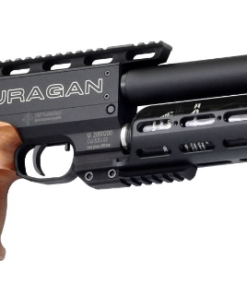
WALTHER REIGN M2 Calibres, FAC Power and Accessories
The WALTHER REIGN M2 AIR RIFLE is available in several calibre and power configurations, allowing the platform to serve different shooting requirements and legal markets. Because the Reign M2 has been designed as a regulated pre-charged pneumatic bullpup, excellent power can be delivered from a compact rifle while consistent shot-to-shot performance is maintained. Furthermore, calibre choice can be matched to the intended shooting discipline, preferred pellet weight, permitted energy level, and local airgun legislation.
WALTHER REIGN M2 .177 Calibre
In .177 / 4.5 mm, the WALTHER Reign M2 provides a particularly useful option for shooters who prioritize a relatively flat trajectory, high pellet velocity, economical ammunition, and precision-oriented target shooting.
An 11-shot rotary magazine is used with the .177 configuration, giving it the highest magazine capacity of the three principal calibre options. Therefore, longer shooting strings can be completed before the magazine must be reloaded.
Depending on the country-specific configuration, the manufacturer’s technical data lists energy output of up to approximately 30 joules for .177 versions. Lower-powered variants can also be supplied for markets where specific legal limits apply.
Because .177 pellets are generally lighter than equivalent .22 or .25 ammunition, a relatively fast and flat trajectory can be achieved. Consequently, range estimation errors may have less effect across typical air-rifle distances when the rifle has been correctly zeroed.
WALTHER REIGN M2 .22 Calibre
For shooters wanting a versatile balance between trajectory, pellet mass, energy retention, and magazine capacity, .22 / 5.5 mm is an attractive Reign M2 configuration.
A 10-shot magazine is provided in this calibre. Moreover, the manufacturer’s Reign M2 manual lists versions capable of producing up to approximately 50 joules, although individual country specifications can vary.
Higher-powered Reign M2 L configurations have also appeared in certain markets. For example, Umarex documentation has listed a 600 mm-barrel .22 version at approximately 60 joules, demonstrating why the exact model and national specification should always be checked rather than assuming that every Reign M2 delivers identical energy.
The .22 calibre is particularly appealing because heavier pellets can be used while a manageable trajectory is retained. As a result, it provides a practical middle ground for shooters who want more energy than .177 without moving directly to the larger .25 configuration.
WALTHER REIGN M2 .25 Calibre
Maximum factory power is generally associated with the .25 / 6.35 mm version.
A 9-shot rotary magazine is fitted to this configuration, while official technical information lists energy levels of up to approximately 70 joules.
Additionally, Umarex has documented a Reign M2 L .25 configuration using a 600 mm barrel and producing approximately 70 joules.
Because .25 pellets possess greater mass, they can retain considerably more energy than lighter alternatives. However, pellet trajectory, air consumption, magazine capacity, and ammunition cost should also be considered when selecting this calibre.
For that reason, .25 is generally chosen when maximum legal energy and heavier projectile performance are considered more important than obtaining the flattest possible trajectory.
FAC and High-Power WALTHER Reign M2 Versions
The term FAC is most commonly encountered in the United Kingdom, where higher-powered air rifles exceeding the normal non-FAC rifle energy threshold require the appropriate firearm authority.
Consequently, an FAC-rated Reign M2 should not be confused with a standard sub-limit configuration. Power specifications vary according to calibre, barrel configuration, market, and national legislation.
Potential high-power figures include:
- .177 / 4.5 mm – up to approximately 30 joules
- .22 / 5.5 mm – up to approximately 50 joules in documented standard specifications
- .22 / 5.5 mm – approximately 60 joules on certain Reign M2 L versions
- .25 / 6.35 mm – up to approximately 70 joules
- 500 mm and 600 mm barrel configurations are available depending on model
- Country-specific energy restrictions can substantially alter factory output
These values should be regarded as configuration-dependent rather than universal specifications because Walther’s documentation specifically notes that national variants may differ.
Before purchasing an FAC or otherwise high-energy model, buyers should therefore verify the exact rifle specification and applicable licensing requirements within their jurisdiction.
Regulated PCP Power Delivery
Power alone does not define the Reign M2. Equally important is how compressed air is delivered.
The regulated PCP system is designed to meter compressed air consistently between shots. Consequently, pellet velocity can remain comparatively stable throughout the rifle’s optimal pressure range.
This consistency can contribute to improved vertical grouping, predictable trajectories, and more dependable point-of-impact behavior.
Furthermore, higher-energy configurations benefit significantly from efficient air management because more compressed air is required for each shot. Proper filling equipment and correct charging pressure should therefore be used according to the manufacturer’s instructions.
WALTHER Reign M2 Accessories
Accessory compatibility is another major advantage of the Reign M2 platform.
A Picatinny optics rail allows a suitable riflescope and compatible mounts to be installed. In addition, accessory mounting provision is available beneath the fore-end, giving users flexibility when configuring the rifle for bench, supported, or recreational shooting.
Useful accessories can include:
- WALTHER Reign rotary magazine – .177, 11-shot
- WALTHER Reign rotary magazine – .22, 10-shot
- WALTHER Reign rotary magazine – .25, 9-shot
- Compatible riflescope and Picatinny scope mounts
- Walther 11 mm prism rail adaptor
- Walther short Picatinny accessory rail
- PCP filling adaptor
- High-pressure filling hose
- PCP hand pump
- Compressed-air charging cylinder
- Dry-pack system for compatible filling pumps
- Suitable gun slip or hard rifle case
- Compatible sling and quick-detach sling fittings
- Pellet storage and spare magazines
- Cleaning and maintenance accessories
Umarex documentation specifically lists dedicated .177, .22 and .25 magazines alongside a filling adaptor, filling tube, hand pump, compressed-air cylinder, 11 mm rail, and short Picatinny rail among the available Reign accessories.
Scope and Mounting Accessories
Because the Reign M2 is designed primarily around optical sights, selecting an appropriate scope is especially important.
A compact variable-power optic can preserve the rifle’s maneuverable bullpup character, whereas larger optics may be preferred when precision from a supported position is prioritized.
The factory Picatinny rail also simplifies mount selection because a broad range of compatible scope mounts is available.
Filling Equipment and Spare Magazines
Reliable PCP charging equipment should form part of any complete Reign M2 setup.
A suitable high-pressure pump or certified compressed-air cylinder can be used according to manufacturer requirements. Likewise, spare magazines can reduce interruptions during longer range sessions.
Walther/Umarex accessory documentation provides dedicated magazine part options for all three Reign calibres, ensuring that shooters can select a magazine matched correctly to their rifle.
Ultimately, the WALTHER REIGN M2 AIR RIFLE provides considerable flexibility through its .177, .22, and .25 calibre options, multiple power configurations, compact barrel choices, and comprehensive accessory compatibility. Whether a lower-powered legal-limit rifle or an appropriately licensed FAC/high-energy version is selected, the platform can be configured around individual shooting preferences while retaining the compact ergonomics and regulated PCP performance that define the Reign M2.
Practical Use Scenarios
The compact bullpup configuration makes this rifle especially practical in situations where maneuverability, balance, repeatable accuracy, and efficient handling are important. Rather than forcing the shooter to manage the length and forward weight of a traditional full-size platform, the action is positioned farther rearward. As a result, the overall package remains comparatively short while useful barrel length can still be retained.

Because the rifle is powered by a regulated pre-charged pneumatic system, performance can remain consistent across extended shooting sessions when the reservoir is maintained within its recommended operating range. Moreover, the multi-shot magazine, reversible sidelever, ambidextrous stock, adjustable trigger, and optics-ready mounting system create a platform that can be adapted to many lawful recreational and sporting situations.
Precision Target Shooting at the Range
One of the most natural applications is precision target shooting.
At a shooting range, consistency is essential because every small difference in hold, trigger control, pellet selection, and sight picture can affect the final group. Since regulated air delivery is used, a relatively stable amount of compressed air can be released from shot to shot. Consequently, velocity variation may be reduced when compared with an unregulated system operating through a wider pressure curve.
For the shooter, this consistency can make the rifle easier to evaluate and tune. If groups begin to open, attention can be directed toward technique, pellet choice, optic setup, or environmental conditions rather than immediately questioning whether pressure fluctuations are responsible.
Furthermore, the bullpup architecture can be advantageous when shooting from a bench. Less rifle length extends beyond the front of the rest, so repositioning may feel easier. Balance is also concentrated closer to the body, which can reduce the sensation of a heavy muzzle during repeated target strings.
A properly mounted variable-power scope can further improve the experience. Magnification can be kept moderate for general range use and increased when smaller targets are being engaged from a supported position. Because the rifle is equipped for optical sight mounting, the user can select an optic according to target size, preferred distance, and personal eyesight.
Benchrest and Supported Accuracy Practice
Supported shooting is another environment in which the rifle can perform effectively.
When a front rest, shooting bag, or compatible bipod is used, much of the instability caused by unsupported handling can be reduced. Therefore, the shooter can concentrate more closely on trigger release, breathing, follow-through, and point-of-impact consistency.
The compact chassis can also make the rifle easier to position on a crowded shooting bench. Instead of requiring substantial clearance around a long conventional stock and barrel, a shorter overall package occupies less space.
For pellet testing, this becomes particularly useful. Several pellet designs and weights can be compared under similar conditions, while group size, impact location, and consistency are recorded. Through this process, the ammunition that performs most accurately in a specific barrel can be identified.
Because different barrels can show individual pellet preferences, testing should always be undertaken rather than assuming that the most expensive or heaviest projectile will automatically provide the smallest group.
Moreover, a regulated PCP platform can support meaningful comparison because the same approximate power delivery is maintained across a useful portion of the fill.
Informal Garden and Backyard Target Practice
Where local law, available space, suitable backstops, and safety conditions allow, the rifle can also be used for informal target shooting on private property.
In such an environment, the compact dimensions can be especially convenient. The rifle is easier to carry through doorways, sheds, covered shooting areas, and confined practice positions than many full-length alternatives.
However, safe range construction becomes particularly important. A suitable pellet trap or backstop must be capable of safely containing the energy of the specific rifle configuration being used. High-powered versions should never be treated as though they have the same requirements as low-energy recreational airguns.
Targets should also be positioned so that missed shots cannot leave the controlled shooting area. Furthermore, hard surfaces that may create dangerous ricochets should be avoided.
When those conditions have been addressed, informal practice can be useful for refining fundamental skills such as:
- Consistent shoulder placement
- Natural point of aim
- Scope alignment
- Trigger control
- Breathing rhythm
- Follow-through
- Loading technique
- Safe manipulation of the sidelever
- Magazine changes
- Shooting-position transitions
Because repetition can be performed without the recoil characteristics associated with many powder-burning rifles, the shooter can focus closely on technique.
Standing and Unsupported Shooting
Although bench-supported shooting may provide the smallest groups, unsupported practice presents a different challenge.
When firing from a standing position, rifle balance becomes extremely noticeable. A long, muzzle-heavy platform can fatigue the support arm quickly. By contrast, a bullpup design places more of the mass closer to the shoulder.
Consequently, the rifle can feel more manageable during shorter unsupported strings.
The shooter’s support hand can be positioned beneath the fore-end, while the butt is kept firmly but comfortably against the shoulder. Because unnecessary muscular tension can increase movement, the goal should be to establish a balanced stance rather than attempting to hold the rifle completely still through force.
The compact format can also make transitions between multiple paper or reactive targets more controlled during recreational practice. Nevertheless, muzzle awareness must always be maintained when moving from one target to another.
For new shooters, unsupported sessions can be kept relatively short until correct technique has been established. Fatigue can otherwise encourage poor posture, rushed trigger release, and inconsistent sight alignment.
Kneeling and Seated Shooting Positions
Kneeling and seated positions can provide a useful compromise between benchrest stability and unsupported standing practice.
When kneeling, the shooter can lower the center of gravity and create additional skeletal support. The compact architecture helps because less barrel length projects forward, making the rifle easier to control in a reduced-height position.
Similarly, seated shooting can be comfortable during longer practice sessions. Depending on body shape and flexibility, elbows may be supported against the knees or positioned in another stable arrangement.
These positions are especially useful for learning how the rifle behaves away from a fixed bench.
Since field shooting rarely provides a perfectly level table and sandbag, practicing several positions can improve adaptability. Different scope magnifications can also be tested to determine which settings provide the most usable combination of target visibility and field of view.
Left-Handed and Right-Handed Operation
The reversible operating layout provides practical value for households, clubs, or shooting groups in which different people may use the same rifle.
A conventional sidelever positioned permanently on one side may be less convenient for a shooter using the opposite shoulder. However, the reversible design allows the action to be configured more appropriately.
This feature can also be useful for shooters who prefer operating the lever with the support hand while keeping the firing hand closer to the trigger and grip.
Because the stock is designed around ambidextrous use, switching shoulders does not require purchasing an entirely different stock profile.
Therefore, the rifle can be shared more easily between right-handed and left-handed users, provided that every user understands the controls and safe operating procedures before shooting begins.

Extended Range Sessions
Long shooting sessions place different demands on a rifle compared with a short zeroing session.
Magazine capacity becomes more important, air consumption becomes noticeable, and ergonomic details can influence comfort over time.
A multi-shot rotary magazine reduces the need to manually insert a pellet into the breech for every discharge. Consequently, practice can proceed with fewer interruptions.
Spare magazines can further improve convenience. One magazine may be used while others remain loaded and stored safely nearby.
However, magazines should still be handled carefully. Pellets should be inserted correctly, and damaged or distorted ammunition should not be forced into the mechanism.

Reviews
There are no reviews yet.