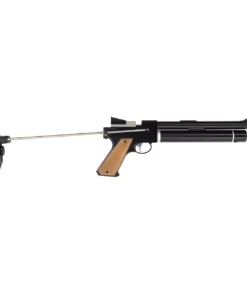
Snowpeak PP750 PCP Air Pistol – Compact PCP Performance and Versatile Design
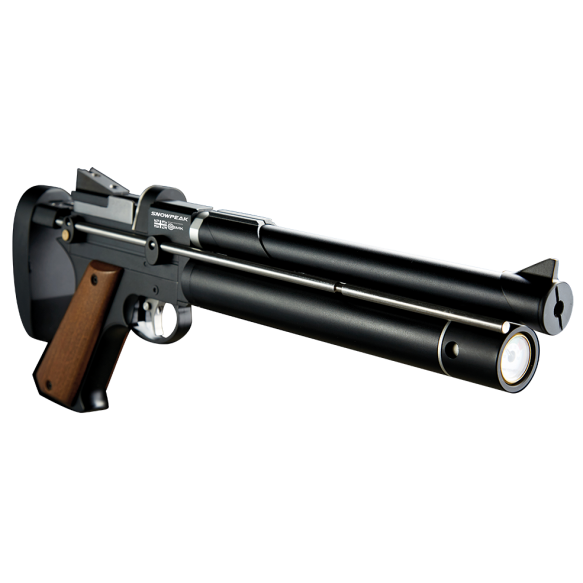
The Snowpeak PP750 PCP Air Pistol has been designed for shooters who want the compact handling of an air pistol combined with the consistency and flexibility of a pre-charged pneumatic platform. A practical combination of portability, adjustable features, multi-shot capability, and regulated air delivery has been incorporated into this model, making it suitable for recreational range shooting, target practice, and general sporting use where permitted.
Rather than being limited to a conventional fixed pistol configuration, the PP750 has been fitted with an adjustable rear stock. Consequently, additional support can be obtained whenever a steadier shooting position is preferred. The platform can therefore be adapted to different users and shooting styles while its relatively compact dimensions are maintained.
A regulated air system has also been included. Because pressure delivery is controlled, more consistent performance can be achieved across the usable air charge. Snowpeak lists a maximum fill pressure of 25 MPa, an air capacity of approximately 66 cc, and more than 30 shots per charge for the current PP750 specification.
Why Choose the Snowpeak PP750 PCP Air Pistol?
A strong balance between portability and useful PCP features has been created with the Snowpeak PP750 PCP Air Pistol. Unlike larger rifles that may be inconvenient for compact storage or transportation, this model has been built around a substantially smaller format.
At the same time, important features commonly associated with full-size PCP platforms have not been overlooked. A regulator, multi-shot magazine, adjustable trigger, side-lever action, and dovetail mounting rail are all provided according to Snowpeak’s published specification.
As a result, the PP750 can be considered by shooters who value:
- Compact PCP construction for convenient handling
- Available .177 and .22 calibre configurations
- Regulated air delivery for improved consistency
- Multi-shot magazine capability
- Adjustable rear stock for additional support
- Side-lever operation for smooth cycling
- Adjustable trigger system
- 12 mm dovetail accessory rail
- Approximately 66 cc air capacity
- More than 30 shots per charge under the manufacturer’s stated specification
- Maximum fill pressure of 25 MPa
- Manageable 1.47 kg listed weight
Available .177 and .22 Calibres
Versatility has been built into the Snowpeak PP750 PCP Air Pistol through two commonly used pellet calibres. Both 4.5 mm (.177) and 5.5 mm (.22) versions are listed by Snowpeak.
Snowpeak PP750 .177
For shooters who prioritize flatter pellet trajectories and target-oriented use, the .177 configuration can be particularly attractive. Snowpeak currently lists a nominal velocity of up to 800 fps for its standard PP750 specification, although actual performance can vary according to pellet weight, individual configuration, market restrictions, and local legislation.
A 9-pellet magazine is specified for the .177 version. Therefore, repeated target shooting can be carried out without requiring a pellet to be manually loaded after every shot.
Snowpeak PP750 .22
Alternatively, the 5.5 mm (.22) version can be selected by users who prefer the characteristics of a heavier pellet. Snowpeak lists a nominal velocity of approximately 700 fps for the current standard specification. Again, real-world velocity can vary according to ammunition, atmospheric conditions, model version, and legally required power restrictions.
Magazine capacity is listed at 7 pellets for the .22 configuration.
Regulated PCP Air System
One of the most important characteristics of the Snowpeak PP750 PCP Air Pistol is its regulated air system.
Inside a PCP platform, compressed air is stored within an onboard reservoir. With a regulator or consistent valve incorporated, pressure delivered to the firing system can be controlled more effectively as reservoir pressure gradually decreases.
Consequently, improved consistency can be supported throughout a shooting session.
Snowpeak specifies approximately 66 cc of air capacity and states that more than 30 shots per charge can be obtained. A maximum filling pressure of 25 MPa is also listed.
Because PCP equipment operates at very high pressure, only compatible charging equipment should be used, and all manufacturer safety instructions should be followed.
Compact Dimensions With Adjustable Support
Portability has clearly been prioritized in the PP750 design.
Overall dimensions are listed at approximately 406 × 157 × 32 mm, while weight is stated at approximately 1.47 kg.
However, compact dimensions have not prevented additional stability features from being incorporated. An adjustable rear butt section has been fitted so that greater support can be obtained when required.
For this reason, the PP750 occupies an interesting position between a traditional compact air pistol and a more supported PCP sporting platform.
Comfortable Handling
A balanced layout helps the pistol remain manageable during range sessions. Furthermore, because unnecessary bulk has been reduced, carrying and storing the unit can be made easier than with many full-length PCP rifles.
Different shooting positions can also be accommodated more naturally through the adjustable rear section.
Smooth Side-Lever Operation
A side-lever cocking system has been incorporated into the Snowpeak PP750.
Instead of requiring a traditional rear bolt to be manipulated, cycling is performed from the side of the action. Consequently, follow-up operation can feel straightforward and convenient.
When combined with the supplied magazine system, the side lever creates an efficient multi-shot setup for organized target sessions.
Every shot should, nevertheless, be taken only after the surrounding area, target, and backstop have been confirmed safe.
Adjustable Trigger for Greater Control
Trigger preference can vary significantly between shooters. Therefore, an adjustable trigger system has been included.
Snowpeak lists an adjustable trigger range of 0–5 lbf for the standard PP750.
Because adjustments can influence safe operation, trigger settings should remain within the manufacturer’s specifications and should be changed only in accordance with the product manual.
A manual safety system is also incorporated into the PP750 platform, providing an additional handling safeguard when the pistol is being prepared or carried in an appropriate environment.
12 mm Dovetail Rail for Optics
Greater flexibility is provided through the integrated 12 mm dovetail rail.
Compatible sighting equipment can therefore be mounted according to user preference and local regulations. A compact optic can be selected for precision-oriented target shooting, while simpler configurations can be maintained by users who prefer minimal additional equipment.
Correctly matched mounts should always be used so that accessories remain stable without damaging the rail.
Magazine-Fed Convenience
Repeated target practice can be made considerably more convenient by the PP750 magazine system.
Snowpeak lists:
- .177 / 4.5 mm – 9-shot magazine
- .22 / 5.5 mm – 7-shot magazine
Therefore, several pellets can be prepared within the magazine before shooting begins rather than each pellet needing to be individually positioned between shots.
Nevertheless, safe muzzle direction and proper handling practices should always be maintained whenever the air pistol is loaded.
Built for Recreational and Target Shooting
The Snowpeak PP750 PCP Air Pistol is particularly well suited to controlled sporting and recreational environments.
For informal target practice, its compact dimensions can be appreciated. During longer range sessions, meanwhile, regulated air delivery and multi-shot capability can make operation more convenient.
Because the adjustable rear support can be repositioned, the platform can also be adapted to different shooting positions.
Furthermore, users who are transitioning into PCP equipment may appreciate the PP750 because major PCP concepts—compressed-air charging, regulated operation, magazine loading, and accessory mounting—have been incorporated into a relatively compact package.
Snowpeak PP750 PCP Air Pistol Specifications
Model: Snowpeak PP750
Power system: Pre-Charged Pneumatic (PCP)
Calibres: 4.5 mm (.177) / 5.5 mm (.22)
Listed velocity: Up to 800 fps (.177) / 700 fps (.22)
Magazine capacity: 9 shots (.177) / 7 shots (.22)
Air capacity: Approximately 66 cc
Shots per fill: More than 30 listed by manufacturer
Maximum fill pressure: 25 MPa
Regulator / consistent valve: Yes
Rail: 12 mm dovetail
Trigger: Adjustable, listed at 0–5 lbf
Dimensions: Approximately 406 × 157 × 32 mm
Weight: Approximately 1.47 kg
Rear support: Adjustable
Specifications can differ between production runs, export versions, distributors, and jurisdictions, so the exact configuration supplied should always be confirmed before purchase.
A Compact and Feature-Rich PCP Platform
Overall, the Snowpeak PP750 PCP Air Pistol combines several desirable PCP characteristics within a portable platform. Regulated air delivery has been provided, magazine-fed operation has been incorporated, and both .177 and .22 calibre options are available.
Additionally, an adjustable rear stock, side-lever action, adjustable trigger, and dovetail accessory rail have been included to increase adaptability.
For recreational shooters and target enthusiasts seeking a compact PCP platform, the PP750 therefore offers a practical combination of portability, adjustability, air efficiency, and straightforward handling.
Whether it is being selected as a first compact PCP or added alongside larger airguns, the Snowpeak PP750 PCP Air Pistol provides a versatile configuration that can be adapted to different sporting environments.
Always check applicable airgun laws, permitted power limits, storage requirements, age restrictions, and range rules in your jurisdiction before purchasing, transporting, modifying, or using any airgun.
Snowpeak Airguns, PCP Rifles, Air Pistols and Umarex Airguns
For shooters researching Snowpeak airguns, Snowpeak Sports, and the wider Snowpeaks product range, there are many PCP rifles, air pistols, and shooting accessories to consider. Popular searches include the Snowpeak AP900, Snowpeak AP900B PCP air rifle, Snowpeak MAX 1, Snowpeak MAX 1 price, Snowpeak PP750, PP750, Snow Peak PP750, and PP750 air pistol. Buyers also regularly compare models such as the Snowpeak P35, P35, P 35, PCP P 35, Snowpeak P35X, P35X, P35X PCP, and Snowpeak P35 vs P35X.
Other Snowpeak models attracting attention include the Snow Peak PP20, Snowpeak PP20, Snowpeak M25, M25 rifle, M-25, M25 weapon, Snowpeak M60, Snowpeak M60B, M 60B, rifle M60, rifle M50, and M50 rifle. Searches such as Snow Peak brand origin are also common among buyers who want to understand the manufacturer before choosing a rifle or pistol.
Snowpeak PCP Models and Related Airgun Searches
The PCP category covers everything from compact pistols to full-size hunting and target rifles. Searches frequently include PR900 Gen 3, CR650, SR 1000X, T Rex 6000, and pistolet PCP Arcea-Snowpeak Onix Sport. People comparing pneumatic platforms may also search what is a PCP airgun, air gun, air rifle, pellet pistol, air gun accessories, 9mm pellet, and pellet 9mm.
Some search phrases overlap with firearm terminology even when shoppers are researching airgun products. These include rifle M60, how much did the M60 weigh, rifle M50, M50 rifle, M25 weapon, and snowfall gun. Therefore, model specifications should always be checked carefully so that a historical firearm search is not confused with a modern sporting airgun product.
Umarex Airguns, Air Rifles, Pistols and PCP Platforms
Alongside Snowpeak products, Umarex USA, UmarexUSA, Umarex airguns, and Umarex air rifles are widely searched by recreational shooters, target shooters, and PCP enthusiasts. The Umarex range includes PCP rifles, CO₂-powered platforms, break-barrel pistols, BB guns, airsoft replicas, and large-caliber airgun systems.
Popular PCP searches include Umarex Notos, Umarex Notos Carbine, Umarex Gauntlet, Umarex Gauntlet 2, Umarex Gauntlet 30, Umarex Zelos, Umarex Origin, Umarex Komplete, and Umarex Komplete NCR .22. Hunters researching larger airgun platforms may also encounter the Umarex Hammer, Umarex Hammer .50 caliber, Umarex Hammer Carbine, Umarex Primal 20, and Umarex AirSaber.
Umarex Pistols, BB Guns and T4E Models
For handgun-style platforms, popular searches include Umarex BB gun, BBgun, BB gun pistol, metal BB gun, Umarex TR50, Umarex HDR 50, Umarex T4E, Umarex T4E Smith, Umarex Smith, and Umarex P2P DR50 how many joules.
Glock-style replicas remain another major category. Search terms include Glock BB gun, Glock 19 BB gun, Umarex Glock 19, Umarex Glock 19X, Umarex Glock 19 Gen3 .177 caliber BB gun air pistol, Umarex Glock 17, Umarex Glock 17 Gen 5, Umarex Glock, airsoft Glock, airsoft Glock 19, Glock 17 airsoft, and Glock airsoft gun.
Other replica and recreational searches include Umarex MP40, Umarex MP5, Umarex Legends, Umarex HK Heckler, Umarex shotgun, and airsoft pistol.Umarex DX17.
Break-Barrel and Sporting Umarex Airguns
Shooters looking for spring or gas-piston platforms frequently research the Umarex Trevox, loading Umarex Trevox break barrel .177, Umarex pistol break barrel, Umarex Fusion 2, Umarex Synergis Elite, and Amazon Umarex Browning 800 Express. These platforms provide alternatives for people who want an airgun without relying on a high-pressure PCP charging system.
Additional searches across the Umarex catalog include Umarex H, while broader terms such as air rifle, pellet pistol, air gun, and air gun accessories help buyers compare platforms, ammunition, optics, filling equipment, targets, cases, and other shooting equipment.
Whether the focus is a Snowpeak M60, Snowpeak M25, Snowpeak P35X, Snowpeak PP750, Snowpeak MAX 1, Umarex Notos, Umarex Gauntlet 2, Umarex Origin, or Umarex Hammer Carbine, buyers should compare caliber, operating system, power level, dimensions, intended use, and local regulations before selecting an airgun.
Snowpeak PP750 PCP Air Pistol Calibres, FAC, Power and Accessories
The Snowpeak PP750 PCP Air Pistol is offered in two popular pellet calibres, allowing buyers to select a configuration that matches their preferred style of target shooting, recreational use, and local legal requirements. According to Snowpeak’s current published specification, the standard PP750 is available in 4.5 mm (.177) and 5.5 mm (.22). Both versions share the same compact PCP platform, regulated air system, adjustable rear support, magazine-fed action, and maximum 25 MPa fill pressure.
.177 Calibre Snowpeak PP750
The .177 calibre Snowpeak PP750 PCP Air Pistol is the smaller-calibre version and is particularly attractive to shooters who prefer relatively light pellets and a flatter trajectory.
Snowpeak lists the standard .177 model at a nominal velocity of approximately 800 fps. The .177 magazine holds 9 pellets, which provides useful capacity for controlled target sessions without requiring a pellet to be individually loaded for every shot.
Because .177 pellets are generally lighter than comparable .22 pellets, they can provide a relatively flat flight path at sensible airgun distances. Consequently, this calibre is commonly associated with paper targets, reactive targets, informal plinking, and precision-oriented recreational shooting.
Actual muzzle energy, however, cannot be determined from velocity alone. Pellet weight must also be considered. Therefore, customers should not assume that every .177 PP750 produces exactly the same energy simply because an advertised velocity is quoted.
Different pellets, regulator settings, production variants, and legally restricted versions can all affect final performance.
.22 Calibre Snowpeak PP750
For shooters who prefer a larger and heavier pellet, the 5.5 mm (.22) Snowpeak PP750 PCP Air Pistol provides another practical option.
Snowpeak publishes a nominal velocity of approximately 700 fps for the standard .22 version. Magazine capacity is listed at 7 pellets.
Although the quoted velocity is lower than the .177 specification, .22 pellets normally carry greater mass. As a result, calibre selection should not be based on velocity figures alone.
For recreational shooters, the .22 version can provide a different shooting feel while retaining the same compact PP750 operating system. However, the appropriate calibre should always be selected according to the intended lawful use, available range facilities, local legislation, and personal preferences.
Snowpeak PP750 Power and PCP Performance
Power is delivered through the PP750’s pre-charged pneumatic system. Compressed air is stored inside the approximately 66 cc reservoir, while Snowpeak specifies a maximum filling pressure of 25 MPa.
A consistent valve or regulated system is also incorporated. Furthermore, the manufacturer states that more than 30 shots per charge can be available under its standard specification.
The regulator is especially important because a PCP reservoir gradually loses pressure as shots are fired. By managing the pressure supplied to the firing system, more repeatable performance can be supported throughout the useful portion of the fill.
Nevertheless, shot count and velocity should always be regarded as approximate manufacturer specifications rather than guaranteed results for every pellet and every individual pistol.
Temperature, pellet weight, reservoir pressure, maintenance condition, and specific market configuration can influence actual performance.
FAC and Legal Power Considerations
The term FAC is commonly encountered in the UK airgun market, particularly in relation to airguns that exceed certain statutory power thresholds.
However, whether a specific PP750 configuration requires a firearm certificate, another type of licence, registration, or no additional firearms licensing depends entirely on the jurisdiction and the exact energy output of that individual gun.
For that reason, a seller should avoid describing every Snowpeak PP750 as either “FAC” or “non-FAC” without checking the actual configuration.
Different markets can receive different power versions. Snowpeak itself publishes a separate lower-power PP750 version for Taiwan, demonstrating that PP750 specifications can be adapted for regional legal requirements. That lower-power model is listed at approximately 80 m/s in 4.5 mm and 70 m/s in 5.5 mm, rather than the substantially higher velocities published for the standard version.
Therefore, buyers should confirm the actual muzzle energy, market specification, proof or test information where applicable, and local licensing rules before purchase.
Any adjustment intended to change the factory power output should only be performed where lawful and by a suitably qualified person.
Accessories for the Snowpeak PP750 PCP Air Pistol
One of the strengths of the Snowpeak PP750 PCP Air Pistol is the range of practical accessories that can be paired with the platform.
A 12 mm dovetail rail is fitted to the standard PP750, allowing compatible optical equipment to be mounted.
Depending on the intended lawful use, suitable accessories can include:
- Compatible red-dot sight for fast target acquisition
- Compact airgun scope with suitable 12 mm dovetail mounts
- Spare magazines in the correct .177 or .22 calibre
- Approved PCP filling equipment
- Compatible fill adaptor or charging connector
- High-pressure hand pump designed for PCP airguns
- Certified PCP charging cylinder and appropriate regulator
- Protective gun case or padded storage bag
- Quality airgun pellets matched to the selected calibre
- Cleaning equipment suitable for airgun maintenance
- Protective eyewear for range use
- Pellet storage tins or organised ammunition cases
- Replacement seals and manufacturer-approved service parts
Choosing Compatible Optics and Mounts
Because the standard PP750 uses a 12 mm dovetail rail, mounting hardware should be checked carefully before an optic is purchased.
Not every Picatinny or Weaver accessory will attach directly to a dovetail rail. Therefore, compatible rings or an appropriate adaptor may be required.
A lightweight sight is generally well matched to the PP750’s compact character because excessive accessory weight can change the balance of the pistol.
A Flexible Two-Calibre PCP Platform
Ultimately, the Snowpeak PP750 PCP Air Pistol provides a useful combination of calibre choice, regulated PCP operation, compact dimensions, and accessory compatibility.
The .177 version offers a 9-shot magazine and a manufacturer-listed velocity of around 800 fps, while the .22 version provides a 7-shot magazine and a listed velocity of around 700 fps. Both versions use the same approximately 66 cc reservoir and 25 MPa maximum fill specification.
With appropriate optics, spare magazines, approved charging equipment, protective storage, and suitable pellets, the PP750 can be configured into a practical recreational or target-shooting package.
Most importantly, calibre, power level, and any FAC or licensing implications should always be verified against the exact pistol being supplied and the laws that apply in the buyer’s location.
Practical Use Scenarios
A compact pre-charged pneumatic platform can be useful in several controlled sporting environments because it combines portability, repeatable operation, and flexible handling. Rather than being limited to one narrow purpose, this type of airgun can be incorporated into recreational target sessions, club practice, accuracy development, equipment familiarisation, and other lawful sporting activities.
Its relatively compact dimensions also make transportation and storage easier than with many full-length air rifles. At the same time, a regulated air system, multi-shot magazine, adjustable rear support, and accessory rail provide enough flexibility for different shooting styles.
Because laws vary significantly between countries and regions, every practical use should be carried out only where airgun ownership and operation are permitted. Suitable backstops, designated shooting areas, eye protection, safe handling procedures, and local range rules should always be observed.
Recreational Target Shooting
One of the most straightforward applications is recreational target shooting.
Paper targets can be positioned at appropriate distances within an approved range or suitably controlled private shooting area. Because compressed air rather than a spring mechanism is used, operation can feel smooth and consistent between shots.
For new recreational shooters, this can make practice sessions easier to organise. A magazine can be loaded before a string begins, while the side-lever action allows the next pellet to be prepared without repeatedly handling loose ammunition.
The adjustable rear section can also be used when additional support is preferred. As a result, shooters can experiment with different positions while learning which setup feels most comfortable.
Target shooting can also be structured around simple accuracy exercises. For example, shooters can compare groups produced from supported and unsupported positions, test different approved pellets, or monitor consistency over a full air charge.
Such activities should remain focused on controlled sporting practice rather than unsafe informal shooting.
Indoor Range Practice
Where local rules and range design permit airgun use indoors, a compact PCP platform can be particularly convenient.
Its overall size can make movement around a bench or firing point easier. Additionally, less physical space may be required for storage compared with longer rifles.
Indoor environments also reduce variables such as strong wind. Consequently, shooters can concentrate more closely on fundamentals including sight alignment, trigger control, grip consistency, and repeatable positioning.
A suitable pellet trap or engineered backstop remains essential. Ordinary household materials should never be assumed to stop pellets safely.
When using an indoor facility, range ventilation, approved target systems, protective equipment, and the instructions of range staff should always take priority.
For club shooters, indoor sessions can provide a repeatable environment in which equipment changes are evaluated gradually. A new optic, for example, can be checked for correct mounting and zero retention under controlled conditions.
Outdoor Range Sessions
Outdoor shooting introduces additional environmental variables and can therefore provide a different type of practice.
Wind direction, lighting, temperature, and target visibility may affect the experience. These conditions can be useful for learning how equipment behaves outside an indoor range while remaining within safe, approved distances.
A regulated PCP system can be especially useful during repeated target strings because predictable air delivery supports consistency.
Shooters may use a formal bench, supported position, or other range-approved stance. However, targets should always be placed in front of a suitable backstop, and the area beyond the target must be confirmed safe.
Outdoor practice can also help users understand how pellets behave under changing conditions without turning the activity into an unsafe attempt to maximise distance.
Practical accuracy is usually better developed by maintaining realistic target distances and concentrating on repeatability.
Benchrest-Style Accuracy Practice
Another useful application is supported bench shooting.
A stable rest can reduce some of the movement caused by holding an airgun unsupported. Therefore, attention can be focused more directly on equipment consistency, pellet selection, sight adjustment, and group size.
When testing from a bench, shooters can compare several pellet types while keeping other variables as consistent as possible.
Groups can then be measured and recorded. Over time, this creates a useful reference showing which pellet performs most consistently in the individual barrel.
A notebook or digital shooting log may also be used to record fill pressure, pellet type, range distance, weather conditions, and group results.
The objective should not be to increase mechanical power. Instead, testing should be centred on safe accuracy, repeatable equipment configuration, and reliable operation within the manufacturer’s intended specification.
Developing Trigger Control
Trigger technique plays an important role in accurate target shooting.
A smooth trigger press can help prevent unnecessary movement immediately before a shot is released. Because many PCP platforms have comparatively low mechanical movement during firing, poor trigger technique can become easier to identify.
During supervised practice, shooters can concentrate on applying pressure gradually while maintaining correct sight alignment.
Dry-firing should never be assumed to be safe for a particular model unless the manufacturer specifically allows it. Therefore, any trigger practice should follow the owner’s manual.
Adjustable trigger systems should also remain within manufacturer recommendations. Extremely light or altered trigger settings can create safety concerns, especially if adjustments are made incorrectly.
For most recreational users, consistent technique provides greater practical benefit than attempting aggressive mechanical modifications.
Sight and Optic Familiarisation
A compact accessory rail allows compatible sighting systems to be used when appropriate.
For recreational target shooting, a compact optic can make sight acquisition easier for some users. Others may prefer simpler sight arrangements.
A practical range session can therefore be dedicated to learning how a chosen sight behaves.
The shooter can confirm that mounts remain secure, verify alignment, and make small adjustments using a safe target and controlled backstop.
Once a stable point of impact has been established, further adjustments should generally be minimal.
Constantly altering optics without recording previous settings can make it difficult to understand whether changes in accuracy are caused by the sight, pellet selection, technique, or environmental conditions.
Pellet Comparison Sessions
Different airguns can show clear preferences for particular pellet designs and weights.
For this reason, controlled pellet comparison can be a useful practical exercise.
Several suitable pellet types can be tested at the same distance. Equal numbers of shots should ideally be fired for each group, while the same support position and sight settings are maintained.
Group consistency can then be compared rather than relying on one particularly good or bad shot.
Pellets should always match the correct calibre and manufacturer recommendations.
Damaged, severely deformed, incorrectly sized, or contaminated pellets should not be used.
This form of testing can help shooters select ammunition based on actual results rather than advertising claims alone.
Club and Supervised Training
Airgun clubs can provide an appropriate environment for learning correct range discipline.
A relatively compact PCP platform can be useful in these settings because loading, charging, sighting, and basic maintenance procedures can be demonstrated under supervision.
New users can learn safe muzzle direction, trigger discipline, loading procedures, firing-line commands, and correct use of eye protection.
Experienced shooters can also help identify simple technique problems such as inconsistent grip pressure or poor sight alignment.
Formal instruction is particularly valuable for anyone who has never handled a compressed-air system before.
High-pressure reservoirs require respect, and users should understand proper charging procedures before attempting to fill the airgun independently.
Familiarisation With PCP Systems
For someone moving from a spring-powered airgun to PCP equipment, a compact model can provide an introduction to pre-charged pneumatic operation.
Several new concepts must usually be learned.
Reservoir pressure needs to be monitored. Compatible charging equipment must be used. Fill connectors must be attached correctly. Seals must remain clean and undamaged. The reservoir should never be filled beyond its approved working pressure.
These procedures are straightforward once understood, but they should not be improvised.
Manufacturer instructions provide the correct reference for charging and maintenance.
A practical familiarisation session can therefore begin without firing at all. Users can learn how the magazine fits, how the safety functions, how the fill system connects, and how pressure is checked.
Only after these steps have been understood should normal range operation begin.
Short Recreational Sessions
Not every range visit needs to involve several hours of shooting.
A compact PCP platform can work well for shorter practice sessions because equipment preparation can remain relatively simple once the user is familiar with the system.
A shooter may decide to fire only several controlled groups, confirm that an optic remains correctly adjusted, or practise a specific technique.
These shorter sessions can actually be valuable because they encourage concentrated practice rather than large volumes of unfocused shooting.
Before leaving the range, equipment should be checked, magazines should be removed, and the airgun should be stored safely according to applicable rules.
Extended Practice Sessions
Longer target sessions are another possible use.
A magazine-fed system reduces the need to handle individual pellets between every shot, while regulated air delivery can help maintain consistent operation through the usable pressure range.
However, users should avoid rushing through magazines simply because repeated shots are available.
A deliberate rhythm generally improves both safety and useful practice.
Between target strings, shooters can review their groups, check equipment, and allow themselves time to reset their position.
Reservoir pressure should also be monitored so that operation remains within the recommended working range.
Transport to Shooting Facilities
Compact dimensions can make transport easier, but secure storage remains important.
The airgun should be carried in a suitable case or bag rather than transported openly.
Pellets, magazines, optics, and charging equipment can be organised separately to reduce the chance of damage.
Where legislation requires a specific transport method, locked case, documentation, or licence, those requirements must be followed.
A portable setup can be particularly convenient for shooters who regularly visit clubs or ranges, but convenience should never replace secure handling.
Equipment Setup and Accessory Testing
Range sessions can also be used to evaluate accessories.
A new optic, storage case, magazine, charging connector, or other compatible component can be checked gradually.
Accessories should be verified for proper fit before firing begins.
Loose mounts or incorrectly fitted components can affect accuracy and, in some cases, create safety issues.
A controlled target environment makes it easier to identify whether an accessory provides a practical benefit.
If a component does not fit correctly, forcing it into position should be avoided. Manufacturer-approved or correctly specified alternatives should be used instead.
Introducing Responsible Shooters to Airgun Sports
Under appropriate supervision and where local age requirements permit, airgun target shooting can also introduce new participants to range discipline.
Instruction should begin with safety rather than accuracy.
Participants should understand that every airgun must be treated as capable of causing serious injury.
Safe direction, trigger discipline, correct loading, suitable targets, protective equipment, and range commands should all be explained before shooting begins.
A compact platform may be easier for some people to handle physically, particularly when the adjustable rear support is used.
Nevertheless, suitability should always be judged by the supervising adult, instructor, range officer, and applicable regulations.
Accuracy Tracking Over Time
Another practical use involves monitoring improvement.
Shooters can keep dated records of group size, shooting position, pellet type, distance, optic configuration, and environmental conditions.
After several sessions, these records can reveal patterns.
For example, accuracy may improve when a particular grip is used consistently, or one pellet may repeatedly produce tighter groups.
Such information can make future practice more productive.
Instead of changing several variables simultaneously, one adjustment can be tested at a time.
This approach encourages methodical target shooting and provides clearer evidence of what actually improves performance.
General Maintenance Checks
Controlled shooting sessions also provide opportunities to monitor equipment condition.
Before use, obvious damage, loose screws, damaged seals, unusual sounds, or air leaks should be investigated.
After shooting, external surfaces can be wiped down and the airgun can be stored according to the manufacturer’s recommendations.
Only maintenance specifically approved by the manufacturer should normally be performed by the owner.
Internal pressure components require particular caution because compressed air stores significant energy.
If a fault cannot be diagnosed through normal user-level checks, inspection by a qualified technician is preferable to experimental disassembly.
A Versatile Platform for Controlled Sporting Use
Taken together, these scenarios show how a compact PCP platform can serve several legitimate sporting purposes without depending on excessive power or complicated modification.
Recreational target practice, bench shooting, club training, pellet testing, optic familiarisation, accuracy tracking, and PCP-system education can all be carried out within a carefully controlled environment.
Its portability makes range transport convenient, while magazine operation can support efficient target sessions. Furthermore, an adjustable rear support can provide greater stability when required.
The most important factor, however, remains responsible use.
Every shooting session should take place where the activity is lawful and where a safe target area has been established. Appropriate backstops, eye protection, secure transport, careful charging procedures, and adherence to local regulations should be treated as essential parts of the activity.
When those principles are followed, the platform can provide a practical and adaptable foundation for recreational target shooting, skills development, and regular range practice.
Frequently Asked Questions
What type of airgun is this model?
This model is a pre-charged pneumatic airgun, commonly referred to as a PCP. Compressed air is stored inside an onboard reservoir and is then used to propel each pellet when the trigger is operated. Unlike spring-powered airguns, no large spring needs to be compressed before every shot. As a result, the shooting cycle can feel smoother and more consistent.
The platform also includes a regulated air system, a magazine-fed action, an adjustable rear support, and a compact overall layout. Because these features are combined within a relatively small platform, it can be suitable for recreational target shooting, range practice, and other lawful sporting applications.
Which calibres are available?
Two common pellet calibres are available: 4.5 mm (.177) and 5.5 mm (.22).
The .177 version is generally chosen by shooters who prefer lighter pellets, a flatter trajectory, and target-oriented use. In contrast, the .22 version uses heavier pellets and can provide a different shooting feel.
The correct choice depends on personal preference, the intended lawful use, pellet availability, and any local legal requirements.
How many pellets does the magazine hold?
Magazine capacity depends on calibre.
The .177 version uses a 9-shot magazine, while the .22 version uses a 7-shot magazine.
This multi-shot arrangement allows several pellets to be prepared before a shooting string begins. Therefore, repeated target practice can be carried out more conveniently than with a single-shot loading system.
However, the magazine should always be handled safely, and the airgun should remain pointed in a safe direction during loading and operation.
Can it also be used as a single-shot airgun?
Depending on the exact supplied configuration and accessories, some users may prefer single-shot loading for slow target practice or pellet testing.
However, owners should always follow the manufacturer’s instructions and use only compatible loading components.
Single-shot operation can be useful when comparing different pellet types because each pellet can be loaded individually without filling an entire magazine.
For regular recreational shooting, however, the magazine-fed system is usually more convenient.
What is the maximum fill pressure?
The listed maximum filling pressure is 25 MPa, which is equivalent to approximately 250 bar.
Because this is a high-pressure compressed-air system, compatible PCP charging equipment must always be used.
The reservoir should never be filled above the manufacturer’s stated limit. Overfilling a PCP reservoir can create a serious safety risk and may damage seals, valves, or other internal components.
Only approved filling equipment, correct connectors, and properly maintained pressure gauges should be used.
How large is the air reservoir?
The air reservoir is approximately 66 cc.
Although this is smaller than the reservoirs found on many full-size PCP rifles, the compact capacity contributes to the portable design.
A smaller reservoir can also make the overall platform lighter and easier to handle.
Actual shot count will depend on factors such as calibre, pellet weight, regulator setting, operating pressure, temperature, and the exact market specification.
How many shots can be obtained from one fill?
The manufacturer lists more than 30 shots per fill under its standard specification.
Real-world shot count can vary.
For example, heavier pellets, different power configurations, lower starting pressure, cold temperatures, or regulator settings may affect how many consistent shots are available.
Rather than focusing only on the maximum number of shots, users should also monitor consistency and reservoir pressure during a session.
Is the air system regulated?
Yes. A regulated or consistent-valve system is incorporated into the platform.
The purpose of regulation is to control the pressure delivered to the firing system as reservoir pressure gradually drops.
This can help produce more consistent shot-to-shot performance through the useful portion of the air charge.
Regulation is particularly valuable during target shooting because large changes in velocity can affect point of impact and group consistency.
What velocity does the .177 version produce?
The standard .177 version is commonly listed at approximately 800 fps.
However, this figure should be treated as a nominal manufacturer specification.
Actual velocity can vary according to pellet weight, atmospheric conditions, manufacturing tolerances, local power restrictions, and the particular version being sold.
A chronograph should be used where accurate velocity and muzzle-energy measurements are required.
What velocity does the .22 version produce?
The standard .22 version is commonly listed at approximately 700 fps.
Although this is lower than the nominal .177 velocity, .22 pellets are generally heavier.
Therefore, velocity alone should never be used to compare overall performance between the two calibres.
Muzzle energy depends on both pellet weight and velocity.
Is higher velocity always better?
No. Higher velocity does not automatically mean better accuracy or a better shooting experience.
Pellet stability, consistency, barrel preference, pellet quality, and shooter technique can all be more important than maximum speed.
For target shooting, consistent groups are generally more useful than the highest possible velocity figure.
Different barrels may also perform better with different pellet weights.
Is this model FAC rated?
FAC status depends on the jurisdiction and the exact power output of the individual airgun.
In the UK, the term FAC is commonly associated with airguns that exceed certain legal power thresholds. However, regulations differ between air pistols and air rifles, and they also vary between different parts of the UK.
Other countries may use completely different licensing systems.
For that reason, buyers should confirm the exact muzzle energy and local legal requirements before purchasing or using the airgun.
Can the power be adjusted?
Some PCP systems can be serviced or configured differently for specific markets, but power adjustment should not be treated as a casual user modification.
Changing factory settings can affect safety, consistency, warranty coverage, and legal classification.
Any change to the firing system should only be carried out where lawful and by a suitably qualified person.
Users should also remember that a legal airgun can become subject to different regulations if its power output is increased beyond a statutory threshold.
Is the trigger adjustable?
Yes. An adjustable trigger system is provided.
Adjustability allows the trigger feel to be tailored within the manufacturer’s approved range.
However, extremely light settings should be avoided unless they are specifically supported by the manufacturer.
Incorrect trigger adjustment can create unsafe operating conditions.
After any permitted adjustment, safe operation should be checked before live firing.
Does it have a safety?
Yes, a manual safety system is incorporated.
Nevertheless, a mechanical safety should never replace proper handling.
The muzzle should always remain pointed in a safe direction, the finger should remain outside the trigger guard until the shooter is ready to fire, and the airgun should be treated as loaded whenever its status is uncertain.
What type of cocking system is used?
A side-lever operating system is used.
The side lever is cycled between shots to cock the action and prepare the next pellet from the magazine.
This arrangement can make repeated target shooting smooth and convenient.
The action should never be forced if unusual resistance is felt. Resistance may indicate an incorrectly seated pellet, magazine problem, or other mechanical issue.

Reviews
There are no reviews yet.