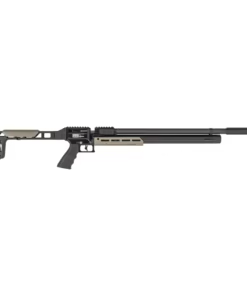
Snowpeak PP700W Air Pistol – Compact PCP Precision and Practical Performance
The Snowpeak PP700W Air Pistol has been designed for shooters who appreciate compact dimensions, straightforward operation, PCP efficiency, and accurate pellet placement in one practical package. Instead of unnecessary complexity being added, the essential elements required for enjoyable target shooting have been brought together within a lightweight and manageable platform.
Powered by pre-charged pneumatic technology, the Snowpeak PP700W Air Pistol provides the smooth shooting characteristics for which PCP airguns are widely appreciated. Because compressed air is stored within the onboard cylinder, recoil is kept extremely low. Consequently, sight alignment can be maintained more easily, while consistent shooting technique can be developed without the movement normally associated with spring-powered systems.
Moreover, a single-shot loading arrangement has been incorporated. Each pellet is therefore loaded individually, allowing careful pellet placement and deliberate shot preparation to be encouraged. For target shooters, recreational users, and those developing their shooting technique, this uncomplicated arrangement can be particularly appealing.
Calibres, FAC, Power and Accessories
The Snowpeak PP700W Air Pistol combines compact PCP performance with a straightforward calibre choice, practical power levels, and compatibility with several useful shooting accessories. Depending on the country and exact market configuration, specifications can vary, so buyers should always check the version being supplied before purchase. Current listings consistently show the PP700 family in .177 / 4.5 mm and .22 / 5.5 mm, while power figures vary significantly between regional versions.
Available Calibres
.177 / 4.5 mm
The .177 calibre version is particularly well suited to precision target shooting, paper targets, pellet testing, and recreational range use. Because .177 pellets are generally lighter than .22 pellets, a flatter trajectory can often be achieved at typical air-pistol distances when comparable energy levels are used.
For shooters who mainly want to practise accuracy, trigger control, sight alignment, and grouping, .177 remains a highly practical choice. Pellet availability is also excellent, with numerous wadcutter, domed, and match-style designs offered by established ammunition manufacturers.
Another advantage is that lighter projectiles can provide a responsive shooting experience without requiring excessive power. Consequently, this calibre can work especially well for controlled indoor or outdoor target practice where permitted.
.22 / 5.5 mm
The .22 calibre version provides a larger and heavier pellet. Many recreational shooters prefer the heavier projectile because it produces a different firing characteristic while still benefiting from the low-recoil nature of a PCP system.
At equivalent energy levels, .22 pellets normally travel more slowly than .177 pellets. Nevertheless, their additional mass can make them appealing for shooters who prefer larger pellet holes on paper or simply enjoy shooting the larger calibre.
As with any air pistol, the correct ammunition should be selected carefully. Pellet weights and head sizes vary, and some combinations may group noticeably better than others. Therefore, testing several reputable pellet types is recommended when seeking the best accuracy from an individual pistol.
Power and Velocity
Published performance figures for the PP700 platform vary according to model, calibre, region, and legal specification.
For example, one technical database lists the PP700 at approximately 8–11 ft-lb, depending on calibre and configuration. Meanwhile, a UK review of the PP700W recorded an average of approximately 5.4 ft-lb, placing that particular pistol close to the UK air-pistol legal limit.
Snowpeak’s current PP700S-A specification lists factory velocity figures of approximately 800 fps in .177 and 700 fps in .22, although those figures relate to that specific variant and should not automatically be assumed for every PP700W sold worldwide.
Actual muzzle energy depends on several factors, including:
- Pellet weight
- Calibre
- Factory configuration
- Reservoir pressure
- Valve setup
- Regulator or valve characteristics
- Temperature
- Pellet fit
- Regional power restrictions
Because of these variables, velocity alone should not be used to judge performance. Muzzle energy and accuracy are often more meaningful indicators for practical target shooting.
FAC and Legal Power Considerations
The term FAC, meaning Firearm Certificate, is mainly relevant in jurisdictions such as the United Kingdom, where specific airgun power thresholds determine whether additional licensing requirements apply.
For UK users, an important distinction exists between air pistols and air rifles. Air pistols are generally subject to a lower unrestricted power threshold than rifles. Therefore, a PP700W sold for the UK market is normally configured accordingly.
The tested UK PP700W cited above averaged approximately 5.4 ft-lb, which reflects the type of power level expected from a compliant UK-market air pistol.
However, buyers should not assume that an imported pistol has the same specification. Different countries receive different versions, and some international configurations may produce substantially higher velocities.
For this reason, purchasers should verify the legal status of the exact pistol within their jurisdiction before acquiring, transporting, modifying, or using it. Power-increasing modifications should never be carried out where doing so could change the firearm’s legal classification.
PCP Air System
The PP700 platform uses pre-charged pneumatic power, meaning compressed air is stored within an onboard reservoir.
This system eliminates the heavy spring movement associated with conventional spring-piston airguns. Consequently, recoil and vibration remain low, which can benefit precision shooting.
Published figures for the family vary, but current sources identify reservoir capacities in the region of 65–72 cc, with maximum fill-pressure specifications differing by exact version. Shooterfy lists the PP700 at about 65 cc, while Snowpeak lists the PP700S-A at 72 cc with a maximum pressure of 25 MPa.
Always follow the pressure marking and manual supplied with the actual pistol rather than relying solely on specifications from another version.
Optics and Sight Accessories
One of the most useful upgrades for precision shooting is a suitable optic.
Depending on the specific PP700W configuration, a compact red-dot sight can be installed using a compatible rail or adapter. The PP700 family is commonly listed with dovetail mounting provision, although reported rail dimensions vary between versions and sellers. Snowpeak currently specifies a 12 mm dovetail on its PP700S-A, while other databases refer to approximately 11 mm systems.
Therefore, mount compatibility should always be confirmed before ordering an optic.
Useful sighting accessories can include:
- Compact red-dot sight
- Dovetail-compatible optic mounts
- Adjustable open sights where compatible
- Lightweight pistol scope where appropriate
- Protective optic covers
A red-dot sight is particularly attractive for recreational target shooting because it provides a simple aiming reference without adding excessive bulk.
Filling Equipment
PCP ownership also requires suitable charging equipment.
Depending on the shooter’s needs, the pistol may be filled using:
- PCP hand pump
- High-pressure compressor
- Diving cylinder or charging tank
- Correct fill adapter
- Compatible high-pressure hose
Snowpeak itself lists pumps, compressors, and high-capacity air tanks among its official airgun accessory categories.
Only clean, dry compressed air should be used, and the manufacturer’s maximum filling pressure must never be exceeded.
Additional Accessories
A well-equipped setup can also include several supporting accessories that improve convenience, maintenance, or target-shooting enjoyment.
Useful additions include:
- Quality .177 or .22 pellets
- Padded pistol case or gun bag
- Protective eyewear
- Paper targets
- Pellet trap designed for airguns
- Cleaning kit
- Spare seals and O-rings
- Chronograph for lawful performance checking
- PCP filling equipment
- Compatible sights or optics
Snowpeak’s official accessory catalogue includes pellets, pumps and compressors, gun bags, scopes, cleaning kits, air tanks, and targets, covering most of the basic equipment needed for regular PCP ownership.
Aftermarket accessories have also historically been offered for the PP700 family, including sight components, adapters, stocks, servicing tools, and replacement parts. Compatibility should be checked carefully because the PP700W and PP700S-A are not identical in every detail.
Choosing the Right Configuration
For precision paper shooting, .177 is likely to appeal to users who value a flatter trajectory and broad pellet selection. Meanwhile, .22 offers a heavier projectile and a different shooting feel.
Power should be selected according to the legal configuration available in the buyer’s country rather than simply choosing the highest possible output. In a compact PCP pistol, predictable behaviour, accuracy, and shot-to-shot consistency are usually more valuable than excessive muzzle energy.
Combined with the correct pellets, filling equipment, optic, protective case, targets, and maintenance accessories, the PP700W can be configured as a compact and highly practical recreational target-shooting package.
Why Choose the Snowpeak PP700W Air Pistol?
A strong combination of simplicity, versatility, and PCP technology is offered by the Snowpeak PP700W Air Pistol. Rather than being designed around rapid-fire operation, the pistol has been focused on controlled shooting and precision.
As a result, every shot can be approached deliberately. Trigger control can be refined, breathing techniques can be practised, and consistent grip placement can be developed over repeated shooting sessions.
Furthermore, the compact overall format makes the PP700W easier to handle than a full-size PCP rifle. It can therefore be considered by shooters who want a portable target-shooting platform without giving up the benefits of compressed-air operation.
Key Features at a Glance
- Single-shot PCP operation for controlled and deliberate shooting
- Available in .177 and .22 configurations in various markets
- Regulated PCP design for improved shot-to-shot consistency
- Rifled barrel designed to support accurate pellet flight
- Integrated pressure gauge for convenient air-pressure monitoring
- Compact air cylinder suited to a lightweight pistol platform
- Adjustable trigger characteristics for improved shooter control
- Optics mounting provision for compatible red-dot sights or compact optics
- Low-recoil firing behaviour associated with PCP operation
- Compact dimensions for convenient handling and storage
- Manual cocking system that keeps operation simple
- Ergonomic pistol format designed for comfortable shooting sessions
PCP Performance in a Compact Platform
One of the strongest characteristics of the Snowpeak PP700W Air Pistol is its PCP power system. Compressed air is stored in the pistol’s reservoir and released in a controlled amount whenever a shot is fired.
Because there is no heavy spring moving during the firing cycle, very little mechanical disturbance is introduced. Therefore, the sight picture can remain comparatively stable throughout the shot.
Accuracy is not created by the pistol alone, of course. Pellet selection, shooter technique, optics, environmental conditions, and the individual gun’s setup all contribute. Nevertheless, the PP700W provides a platform on which consistent shooting habits can be developed.
A pressure gauge is also incorporated into the system. Consequently, remaining cylinder pressure can be checked before or during a shooting session instead of being estimated.
Regulated Air Delivery for Greater Consistency
Consistency is particularly valuable in precision airgun shooting. Accordingly, regulated versions of the Snowpeak PP700W are designed so that air delivery can remain more uniform across the useful pressure range.
Rather than velocity changing dramatically as reservoir pressure gradually falls, air is managed before being released for each shot. As a result, variations between consecutive shots can be reduced.
This characteristic becomes especially useful when groups are being shot on paper targets. When the mechanical system remains consistent, changes in point of impact can be evaluated more effectively and shooter technique can be refined with greater confidence.
Snowpeak documentation identifies the PP700W/PP700 family as a regulated PCP design, although specifications should always be confirmed for the exact regional model being purchased.
.177 and .22 Calibre Options
Different versions of the Snowpeak PP700W Air Pistol have been offered in both .177 / 4.5 mm and .22 / 5.5 mm.
.177 / 4.5 mm
For many target shooters, .177 is an attractive option because lighter pellets can generally achieve a flatter trajectory at appropriate airgun distances. A wide selection of match and recreational pellets is also available in this calibre.
Consequently, .177 can be particularly useful for paper-target practice, informal range shooting, pellet testing, and accuracy-focused sessions.
.22 / 5.5 mm
Alternatively, the .22 version uses a larger and typically heavier pellet. Some shooters prefer the different handling characteristics and pellet behaviour provided by this calibre.
However, muzzle energy and velocity can differ according to regional specification, factory configuration, pellet weight, and local legal restrictions. Therefore, advertised figures should always be checked for the particular pistol being supplied.
Rifled Barrel for Precision Shooting
Reliable pellet stabilisation is an important part of airgun accuracy. For that reason, a rifled barrel is used on the Snowpeak PP700W.
As the pellet travels through the bore, rifling helps stabilise it for flight. When suitable ammunition is selected, tighter and more predictable groups can therefore be achieved.
Pellet testing remains worthwhile. Even pellets sharing the same calibre can differ in head diameter, skirt design, weight, alloy, and overall geometry. Consequently, several quality pellet types may be tested before the most suitable option for an individual pistol is identified.
Single-Shot Loading for Deliberate Shooting
Instead of a multi-shot magazine being fitted, the Snowpeak PP700W Air Pistol uses a single-shot loading system.
For some users, that simplicity is a major advantage.
Each pellet must be loaded before the next shot is taken. As a result, the shooter is naturally encouraged to slow down and concentrate on the fundamentals of accurate shooting.
Position can be checked. Grip pressure can be corrected. Sight alignment can be confirmed. Trigger control can then be applied deliberately.
Because of this process, the PP700W can work particularly well as a recreational target pistol or training platform.
Adjustable Trigger Characteristics
Trigger behaviour has an important influence on practical accuracy.
Accordingly, adjustment capability is incorporated into the PP700W design. Snowpeak’s PCP documentation specifically identifies an adjustment for the first-stage length on the PP700W/PP700S-A trigger system.
Through an appropriate setup, the trigger can therefore be configured more closely to the shooter’s preference.
Any adjustment should, however, be performed cautiously and in accordance with the manufacturer’s instructions. Reliable engagement and safe operation should always be maintained.
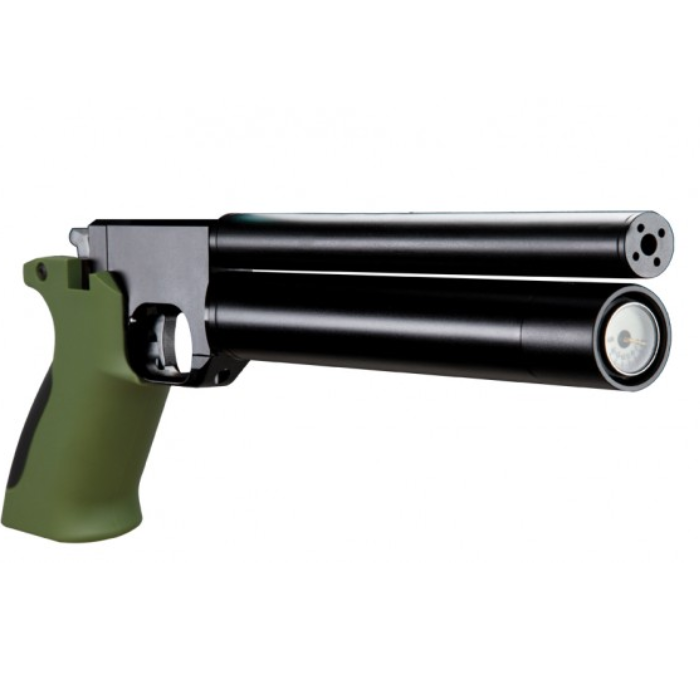
Ready for an Optical Sight
Compatible optics can be mounted to the pistol’s rail system. This is particularly useful because certain PP700W configurations are sold without conventional open sights.
A compact red-dot sight can provide a fast and uncluttered aiming reference. Alternatively, where appropriate, a suitable compact pistol optic may be selected.
For target shooting, the addition of a quality sight can make precise aiming significantly easier. Furthermore, a consistent aiming point can help shooters evaluate pellet performance and grouping more accurately.
Before purchasing an optic, however, its mounting system should be checked against the rail specification of the exact pistol version.
Compact and Practical Design
Another major advantage is portability.
Compared with a conventional PCP rifle, the Snowpeak PP700W Air Pistol requires considerably less storage space. Consequently, it can be transported and stored more conveniently where legally permitted and appropriately secured.
The compact reservoir also means that filling can remain relatively manageable. A suitable PCP hand pump, compressor, or properly regulated charging cylinder may be used according to manufacturer requirements.
Meanwhile, the integrated pressure gauge allows reservoir condition to be monitored before refilling.
Ideal for Target and Recreational Shooting
Paper targets, reactive targets designed for airguns, controlled backyard ranges where lawful, and formal shooting facilities can all provide suitable environments for the PP700W.
Because recoil is minimal, the shooter’s attention can remain focused on:
- Sight alignment
- Trigger technique
- Grip consistency
- Breathing control
- Follow-through
- Pellet selection
- Group analysis
- Shooting-position development
Therefore, both developing and experienced airgun users can find practical value in the platform.
A Straightforward PCP Pistol With Excellent Versatility
Rather than being overloaded with complicated mechanisms, the Snowpeak PP700W Air Pistol has been kept relatively straightforward.
A regulated air system, rifled barrel, single-shot action, pressure gauge, optics mounting provision, and adjustable trigger characteristics are brought together in one compact package.
For shooters who value deliberate target shooting and the smooth firing behaviour associated with PCP technology, this combination can be particularly attractive.
Additionally, both .177 and .22 versions have been offered, enabling the configuration to be selected according to intended use, local availability, and applicable regulations.
Snowpeak PP700W Air Pistol – Built for Enjoyable Precision
Ultimately, the Snowpeak PP700W Air Pistol offers a practical entry into compact PCP shooting while retaining features normally associated with larger pre-charged pneumatic platforms.
Low recoil helps the shooting position remain stable. A rifled barrel supports pellet stability. Regulated air delivery assists consistency. Meanwhile, the single-shot mechanism encourages careful ammunition loading and disciplined shot preparation.
Furthermore, pressure monitoring is made straightforward through the integrated gauge, while compatible optics can be added to create a more personalised target setup.
Whether practice is being carried out on paper, groups are being evaluated with different pellets, or an accessible PCP pistol is simply wanted for recreational shooting, the PP700W presents a versatile option.
For the best results, suitable pellets should be selected carefully, safe filling equipment should always be used, and the pistol should be operated within the manufacturer’s specifications and all applicable local airgun laws.
Choose the Snowpeak PP700W Air Pistol for compact PCP handling, controlled single-shot operation, adjustable shooting characteristics, and a platform designed around accurate, enjoyable target shooting.
Practical Use Scenarios
A compact PCP pistol can serve many useful purposes when it is used in a controlled, lawful, and safety-conscious environment. Rather than being limited to one type of shooting, this style of air pistol can be used for target practice, accuracy development, pellet testing, technique improvement, recreational shooting, and structured training. Because the platform is lightweight and comparatively simple to operate, it can also suit shooters who prefer a more deliberate shooting experience instead of a fast multi-shot system.
One of the strongest advantages in practical use is the combination of low recoil, compact handling, and single-shot operation. Together, these characteristics make every shot more intentional. Instead of rushing through a magazine, the shooter is encouraged to load carefully, aim precisely, control breathing, and focus on trigger movement. Consequently, the platform becomes useful not only for recreation but also for developing better shooting habits.
Paper Target Practice
Paper target shooting is one of the most natural applications for this type of PCP pistol. When a target is placed at a safe and appropriate distance, the shooter can work on grouping, consistency, and point-of-impact control.
Because recoil is minimal, movement during the firing cycle is reduced. This makes it easier to identify whether a shot was affected by poor trigger technique, inconsistent grip pressure, or incorrect sight alignment.
For beginners, paper targets provide clear visual feedback. A wide group can reveal inconsistent technique, while a tighter pattern can indicate improvement. Experienced shooters can use the same method to fine-tune their performance by comparing different pellets, aiming points, or shooting positions.
The single-shot system also supports a slower rhythm. Each pellet is loaded individually, which naturally creates a pause between shots. During that pause, posture can be checked, grip can be reset, and breathing can be controlled before the next shot is taken.
Over time, this type of repetition can help create a more stable and disciplined shooting routine.
Indoor Range Shooting
Where a properly designed indoor airgun range is available, the pistol can provide an excellent training platform.
Indoor shooting removes many environmental variables. Wind, changing weather, and uneven outdoor lighting are reduced or eliminated. Therefore, the shooter can focus more directly on technique and equipment performance.
A controlled range is especially useful when testing accuracy. If a group begins to spread, the cause is easier to investigate because environmental conditions remain comparatively stable.
Additionally, indoor ranges often use fixed shooting distances. This allows progress to be measured more accurately from one session to another.
For example, a shooter may record five-shot groups during one session and compare them with groups produced several weeks later. Such comparisons can provide meaningful evidence of improvement.
Recreational Plinking
Recreational plinking can be another enjoyable use when suitable targets and a safe backstop are used.
Purpose-made airgun targets, spinning targets, and other approved reactive targets can make practice more engaging. Instead of concentrating exclusively on group size, the shooter can focus on consistent hits.
This type of practice can be useful because it adds variety to a shooting session.
However, target materials should always be appropriate for airguns. Hard surfaces, glass, stones, and other materials that may produce unpredictable ricochets should be avoided.
When suitable equipment is used, recreational shooting can combine entertainment with skill development.
Building Trigger-Control Skills
Trigger control is one of the most important elements in accurate shooting.
A shooter can have excellent sights and high-quality pellets, yet poor trigger movement can still pull a shot away from the intended point of impact.
Because a PCP pistol produces relatively little recoil, trigger errors can often be noticed more easily.
During practical training, the shooter can concentrate on moving the trigger smoothly without disturbing the aim.
A common exercise involves placing the sights on a small target and increasing trigger pressure gradually while maintaining alignment.
If the muzzle moves as the shot is released, grip or trigger technique may need to be adjusted.
Repeated carefully, this exercise can help improve consistency.
Developing Grip Consistency
Grip pressure can have a major effect on pistol shooting.
If the pistol is held differently from one shot to the next, the relationship between the shooter, trigger, and sights may also change.
Therefore, one practical training scenario involves intentionally developing a repeatable grip.
The shooter can start by placing the hand in the same position each time. Finger placement can then be checked, followed by thumb position and overall grip pressure.
Because the pistol is relatively compact, these small changes can be evaluated easily.
Once a comfortable grip has been found, it can be repeated during future sessions.
Consistency generally becomes more important than simply applying maximum grip force.
Sight Alignment Practice
Accurate shooting requires a repeatable sight picture.
Whether an optical sight or another compatible aiming system is used, the aiming reference should be positioned consistently.
During structured practice, the shooter can spend time developing the ability to acquire the aiming point quickly and steadily.
This can be done without rushing.
Each shot should begin with the pistol positioned safely. The aiming system can then be brought onto the target, alignment can be confirmed, and the trigger can be pressed only when the sight picture is stable.
Such practice can gradually make aiming feel more natural.
Red-Dot Training
A compact red-dot sight can be particularly useful for recreational target shooting.
Instead of aligning front and rear sights, the shooter typically concentrates on placing the dot over the intended target area.
This can simplify the visual process, especially for users who prefer optical aiming systems.
At a range, the optic can first be adjusted carefully so that the point of aim corresponds appropriately with the point of impact at the selected distance.
Afterward, different exercises can be performed.
Large targets may be used initially, followed by progressively smaller aiming points as confidence improves.
The goal should remain consistency rather than speed.
Pellet Testing
Different pellets can perform differently even when they share the same nominal calibre.
Weight, head diameter, skirt design, manufacturing tolerance, and pellet shape can all influence performance.
As a result, practical pellet testing can become an important part of ownership.
A simple testing method involves shooting several groups with one pellet type before changing to another.
The same target distance, fill pressure, shooting position, and aiming method should be maintained where possible.
By keeping the conditions consistent, performance differences can be compared more fairly.
Pellets that produce smaller and more repeatable groups can then be selected for future use.
This process can also improve the shooter’s understanding of how ammunition affects accuracy.
Benchrest Practice
Although a pistol is commonly fired from the hands, supported shooting can also be useful.
When the pistol is rested safely on an appropriate support, some of the movement caused by the shooter can be reduced.
This makes benchrest-style testing valuable when evaluating equipment.
For example, if inaccurate groups are produced while shooting unsupported, it may be unclear whether the cause is the pistol, the pellet, the optic, or the shooter.
Using a stable rest can reduce some of those variables.
If the pistol groups well from a support but poorly when held unsupported, the shooter may need to concentrate more on technique.
Therefore, supported shooting can serve as a useful diagnostic exercise.
Standing Target Practice
Standing shooting introduces additional difficulty because the pistol must be supported entirely by the shooter.
Movement naturally increases, and the aiming point may move around the target.
Instead of trying to stop all movement completely, the shooter can learn to control it.
A comfortable stance should be adopted, breathing should remain steady, and the trigger should be pressed when the sights move through the desired aiming area.
Over time, the amount of movement may decrease as strength, balance, and technique improve.
Short practice sessions can be particularly effective because fatigue can quickly reduce consistency.
Seated Shooting
For some shooters, a seated position provides a useful balance between unsupported shooting and full benchrest support.
The body can remain stable while the pistol is still being controlled primarily by the hands.
This can make seated shooting suitable for longer practice sessions.
It may also help shooters who find prolonged standing uncomfortable.
When using a seated position, posture should still remain consistent. The shooter should avoid leaning or twisting excessively because changing body position can affect aim.
Breathing-Control Training
Breathing can influence pistol movement more than many new shooters expect.
As the chest expands and contracts, the arms may also move slightly.
Consequently, breathing control can be practised during target shooting.
One common method is to inhale normally, exhale partially, and take the shot during a comfortable natural pause.
The breath should not be held for an excessive period.
If the shot does not feel ready, the shooter can simply lower the pistol safely, breathe normally, and begin again.
This approach encourages calm, controlled shooting.
Follow-Through Development
The shooting process does not end the instant the trigger releases.
Good follow-through involves maintaining grip, sight alignment, and body position immediately after the shot.
Because recoil is limited in a PCP system, this stage can be easier to observe.
The shooter can watch the aiming point and notice how much movement occurs after the shot.
If the pistol suddenly drops or shifts, this may indicate anticipation or poor technique.
Practising follow-through can therefore improve overall consistency.
Accuracy Progress Tracking
Practical shooting becomes more useful when progress is measured.
Targets can be dated and saved so that groups can be compared over time.
The shooter may also record:
- Shooting distance
- Pellet type
- Pellet weight
- Number of shots
- Air pressure
- Sight setting
- Shooting position
- Weather conditions
- Group size
These notes can provide valuable information.
Instead of relying on memory, the shooter can identify which equipment combinations produce the best results.
Optic Zero Confirmation
Whenever an optic is installed, removed, adjusted, or accidentally knocked, its zero should be confirmed.
A safe range provides the ideal environment for this task.
Several shots can be fired at a fixed aiming point.
If the group forms consistently away from the intended impact location, the optic can be adjusted according to its manufacturer’s instructions.
Small adjustments should normally be made gradually.
Once the group is centred appropriately, additional shots can confirm that the setting remains stable.
PCP Pressure Management
Another practical aspect of ownership involves learning to manage reservoir pressure properly.
Before shooting, the pressure gauge can be checked.
The pistol should be filled only with compatible equipment and only within the manufacturer’s stated pressure limits.
During a session, pressure can be monitored periodically.
As the reservoir becomes depleted, performance may eventually change.
Learning where the pistol performs most consistently can help the shooter plan filling intervals more effectively.
Short Practice Sessions
Not every shooting session needs to be long.
Because the pistol is compact, short and focused practice sessions can be extremely productive.
For example, a shooter may dedicate one session entirely to trigger control.
Another session might focus only on grip consistency.
A later session could concentrate on sight alignment or pellet testing.
By separating skills in this way, specific weaknesses can be identified and improved more efficiently.
Recreational Accuracy Challenges
Friendly accuracy challenges can make shooting practice more engaging.
Participants can use identical target sizes and distances while recording their scores.
Rather than encouraging speed, the challenge can reward careful accuracy.
Examples include:
- Smallest group challenge
- Highest paper-target score
- Five-shot consistency challenge
- Ten-shot precision challenge
- Supported versus unsupported group comparison
These activities can make structured practice feel more enjoyable.
Introducing New Shooters
A lightweight PCP pistol may also be used to introduce a responsible new shooter to basic airgun technique where lawful and appropriately supervised.
Before any shooting begins, safe handling principles should be explained clearly.
The shooter should understand muzzle direction, trigger discipline, safe target placement, and the importance of checking what lies behind the target.
Because operation is relatively straightforward, attention can then be directed toward technique.
Sessions should remain controlled and unhurried.
Equipment Familiarisation
Regular practice also helps owners become familiar with their equipment.
Over time, the shooter learns how the trigger feels, how the pressure gauge changes, which pellets load smoothly, and how the optic behaves.
This familiarity can improve confidence and consistency.
However, routine inspection should still be carried out.
Seals, screws, mounts, and accessories should be checked according to manufacturer recommendations.
Portable Range Use
Compact dimensions can make transportation more convenient when travelling to an approved shooting range.
A secure case should be used, and all local transportation requirements should be followed.
Pellets, filling equipment, eye protection, targets, and basic tools can be packed separately as needed.
Once at the range, setup can be comparatively simple.
The pistol can be filled, the optic checked, and target practice started without the bulk of a full-size rifle system.
A Versatile Training Platform
Ultimately, the greatest practical strength of this type of pistol lies in versatility.
It can be used for relaxed recreational shooting one day and structured accuracy training the next.
A beginner can practise fundamental skills, while a more experienced shooter can experiment with pellet selection, optics, pressure consistency, and group analysis.
Because every pellet is loaded individually, the shooting process naturally encourages patience.
Low recoil helps reduce mechanical disturbance.
Meanwhile, compact handling makes the platform convenient for range use and regular practice.
For shooters who value accuracy, controlled handling, and a deliberate shooting rhythm, these practical scenarios provide many ways to make each session productive.
Used responsibly, maintained correctly, and operated within local laws and manufacturer guidelines, the pistol can serve as a dependable platform for developing shooting skills, testing equipment, improving consistency, and enjoying precision-focused recreational target shooting.
Snowpeak Airguns, PCP Rifles, Air Pistols and Umarex Airguns
For shooters researching Snowpeak airguns, Snowpeak Sports, and the wider Snowpeaks product range, there are many PCP rifles, air pistols, and shooting accessories to consider. Popular searches include the Snowpeak AP900, Snowpeak AP900B PCP air rifle, Snowpeak MAX 1, Snowpeak MAX 1 price, Snowpeak PP750, PP750, Snow Peak PP750, and PP750 air pistol. Buyers also regularly compare models such as the Snowpeak P35, P35, P 35, PCP P 35, Snowpeak P35X, P35X, P35X PCP, and Snowpeak P35 vs P35X.
Other Snowpeak models attracting attention include the Snow Peak PP20, Snowpeak PP20, Snowpeak M25, M25 rifle, M-25, M25 weapon, Snowpeak M60, Snowpeak M60B, M 60B, rifle M60, rifle M50, and M50 rifle. Searches such as Snow Peak brand origin are also common among buyers who want to understand the manufacturer before choosing a rifle or pistol.
Snowpeak PCP Models and Related Airgun Searches
The PCP category covers everything from compact pistols to full-size hunting and target rifles. Searches frequently include PR900 Gen 3, CR650, SR 1000X, T Rex 6000, and pistolet PCP Arcea-Snowpeak Onix Sport. People comparing pneumatic platforms may also search what is a PCP airgun, air gun, air rifle, pellet pistol, air gun accessories, 9mm pellet, and pellet 9mm.
Some search phrases overlap with firearm terminology even when shoppers are researching airgun products. These include rifle M60, how much did the M60 weigh, rifle M50, M50 rifle, M25 weapon, and snowfall gun. Therefore, model specifications should always be checked carefully so that a historical firearm search is not confused with a modern sporting airgun product.
Umarex Airguns, Air Rifles, Pistols and PCP Platforms
Alongside Snowpeak products, Umarex USA, UmarexUSA, Umarex airguns, and Umarex air rifles are widely searched by recreational shooters, target shooters, and PCP enthusiasts. The Umarex range includes PCP rifles, CO₂-powered platforms, break-barrel pistols, BB guns, airsoft replicas, and large-caliber airgun systems.
Popular PCP searches include Umarex Notos, Umarex Notos Carbine, Umarex Gauntlet, Umarex Gauntlet 2, Umarex Gauntlet 30, Umarex Zelos, Umarex Origin, Umarex Komplete, and Umarex Komplete NCR .22. Hunters researching larger airgun platforms may also encounter the Umarex Hammer, Umarex Hammer .50 caliber, Umarex Hammer Carbine, Umarex Primal 20, and Umarex AirSaber.
Umarex Pistols, BB Guns and T4E Models
For handgun-style platforms, popular searches include Umarex BB gun, BBgun, BB gun pistol, metal BB gun, Umarex TR50, Umarex HDR 50, Umarex T4E, Umarex T4E Smith, Umarex Smith, and Umarex P2P DR50 how many joules.
Glock-style replicas remain another major category. Search terms include Glock BB gun, Glock 19 BB gun, Umarex Glock 19, Umarex Glock 19X, Umarex Glock 19 Gen3 .177 caliber BB gun air pistol, Umarex Glock 17, Umarex Glock 17 Gen 5, Umarex Glock, airsoft Glock, airsoft Glock 19, Glock 17 airsoft, and Glock airsoft gun.
Other replica and recreational searches include Umarex MP40, Umarex MP5, Umarex Legends, Umarex HK Heckler, Umarex shotgun, and airsoft pistol.Umarex DX17.
Break-Barrel and Sporting Umarex Airguns
Shooters looking for spring or gas-piston platforms frequently research the Umarex Trevox, loading Umarex Trevox break barrel .177, Umarex pistol break barrel, Umarex Fusion 2, Umarex Synergis Elite, and Amazon Umarex Browning 800 Express. These platforms provide alternatives for people who want an airgun without relying on a high-pressure PCP charging system.
Additional searches across the Umarex catalog include Umarex H, while broader terms such as air rifle, pellet pistol, air gun, and air gun accessories help buyers compare platforms, ammunition, optics, filling equipment, targets, cases, and other shooting equipment.
Whether the focus is a Snowpeak M60, Snowpeak M25, Snowpeak P35X, Snowpeak PP750, Snowpeak MAX 1, Umarex Notos, Umarex Gauntlet 2, Umarex Origin, or Umarex Hammer Carbine, buyers should compare caliber, operating system, power level, dimensions, intended use, and local regulations before selecting an airgun.

Reviews
There are no reviews yet.