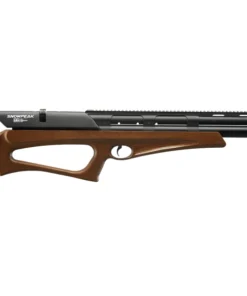
Snowpeak M25 PCP Air Rifle – Regulated Multi-Caliber PCP Performance
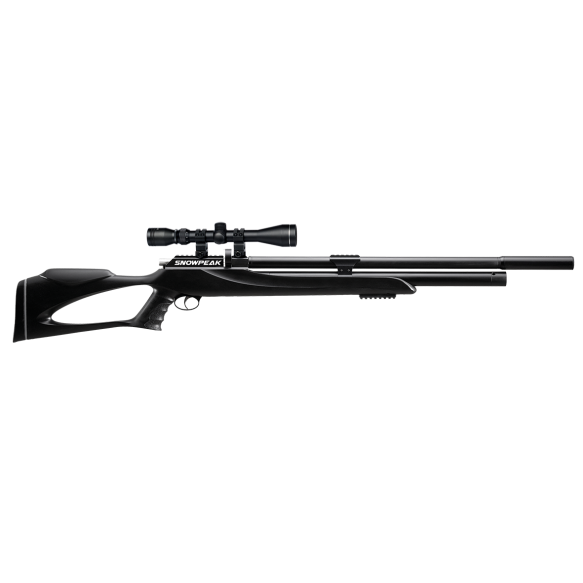
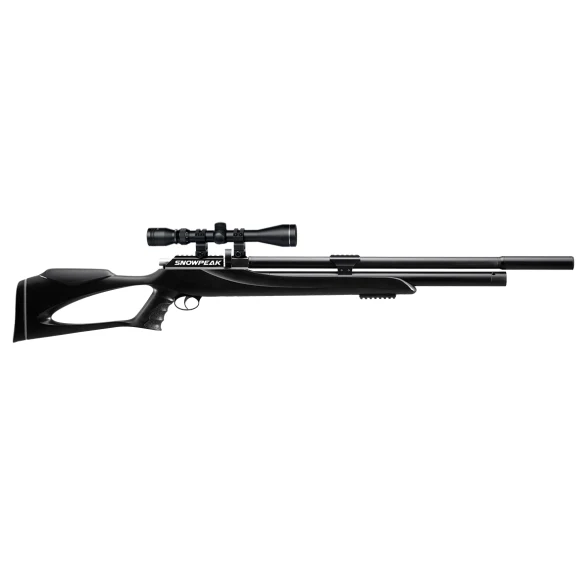
The Snowpeak M25 PCP Air Rifle combines a full-length rifle platform, regulated compressed-air technology, multi-shot operation, and several caliber choices in one versatile design. Built around Snowpeak’s M-series PCP architecture, the rifle offers a substantial 245 cc air reservoir, a 550 mm barrel, an adjustable two-stage trigger, and a Picatinny rail for compatible optics. Consequently, the M25 provides a practical foundation for recreational target shooting and structured range use.
Rather than relying on spring-powered operation, the rifle is powered by pre-charged pneumatic technology. Therefore, compressed air is stored inside the integrated cylinder and released in a controlled manner during operation. A regulator is also incorporated into the platform, helping manage pressure delivery throughout the usable air charge. As a result, consistency can be supported across a shooting session when suitable ammunition and proper setup are used.
Snowpeak M25 PCP Air Rifle Design and Construction
A substantial yet straightforward design is offered by the Snowpeak M25 PCP Air Rifle. Its overall dimensions are listed by Snowpeak at approximately 1230 × 185 × 65 mm, while published weight varies between approximately 3.8 and 4.0 kg depending on configuration. A polypropylene stock is fitted to the standard model, providing a durable exterior that can tolerate regular handling.
Meanwhile, the long 550 mm barrel contributes to the rifle’s full-size proportions. Because a stable shooting platform can be important during target sessions, the rifle has been designed with enough overall mass to provide a planted feel when correctly supported.
Additionally, a bolt-action cocking lever is incorporated into the design. A multi-shot magazine can therefore be used without manually loading every pellet directly into the breech between shots. Magazine capacity varies according to caliber, allowing the system to accommodate different projectile diameters while maintaining an organized repeating mechanism.
Integrated Picatinny Rail
Optical accessories can be mounted using the supplied Picatinny rail system. Consequently, compatible scopes and other appropriate sighting equipment can be selected according to the intended legal use of the rifle.
Because the mounting platform follows a widely used rail format, owners are not restricted to one proprietary optic design. Nevertheless, correct mounting dimensions, eye relief, and local regulations should always be considered before an accessory is installed.
Regulated PCP Air System
Compressed-air consistency forms an important part of the M25 design. A 245 cc air cylinder is fitted, while maximum pressure is listed at 25 MPa, equivalent to approximately 250 bar. Moreover, Snowpeak lists the M25 as a regulated PCP platform.
Pressure regulation can help maintain more controlled air delivery as reservoir pressure changes. Therefore, a properly maintained rifle can provide a more predictable shooting experience than an unregulated platform in comparable circumstances.
However, actual performance should never be assumed purely from the maximum pressure rating. Projectile weight, caliber, atmospheric conditions, rifle configuration, regulator setup, and regional power restrictions can all influence real-world results.
Available Snowpeak M25 Calibers
One of the distinguishing characteristics of the Snowpeak M25 PCP Air Rifle is its broad caliber range.
Manufacturer information currently lists the following options:
- 4.5 mm / .177 caliber
- 5.5 mm / .22 caliber
- 6.35 mm / .25 caliber
- 7.62 mm / .30 caliber
- 9 mm / .35 caliber
- 245 cc integrated air capacity
- Maximum operating pressure: 25 MPa
- 550 mm barrel
- Regulated PCP system
- Bolt-action cocking mechanism
- Two-stage adjustable trigger
- Manual safety
- Picatinny accessory rail
- Approximate weight: 3.8–4.0 kg
- Polypropylene stock
These published specifications are based on Snowpeak’s current product information. Market-specific versions may differ, so the markings and documentation supplied with an individual rifle should take precedence.
Magazine Capacity by Caliber
Magazine capacity also changes with projectile diameter. According to Snowpeak’s current specifications, capacities are listed as 12 shots in 4.5 mm, 10 shots in 5.5 mm, 9 shots in 6.35 mm, 8 shots in 7.62 mm, and 6 shots in 9 mm.
Therefore, buyers comparing caliber variants should look beyond caliber designation alone. Magazine capacity, ammunition availability, permitted power level, and intended lawful application should all be evaluated together.
Adjustable Two-Stage Trigger
Trigger characteristics can significantly affect the way an air rifle feels during deliberate target shooting. For that reason, a two-stage adjustable trigger has been incorporated into the M25 platform.
Snowpeak lists a trigger-pull adjustment range of approximately 0.5–5 lbf. Accordingly, the setup may be adjusted within the manufacturer’s permitted range to suit individual preferences and applicable requirements.
A manual safety mechanism is also included. Nevertheless, mechanical safety devices should always be treated as supplementary measures rather than substitutes for safe handling practices.
Full-Length PCP Configuration
Unlike compact bullpup-style PCP platforms, the Snowpeak M25 PCP Air Rifle retains a more conventional full-length profile. Consequently, users who prefer a familiar rifle-shaped layout may find its dimensions straightforward to work with during controlled range sessions.
The longer architecture also provides space for the large air cylinder, full-length barrel, magazine system, receiver, and optic mounting area without compressing them into a short chassis.
Furthermore, the synthetic stock requires relatively straightforward exterior care compared with unfinished natural wood. This can be particularly useful where equipment is handled regularly or used in changing environmental conditions.
Practical Range-Oriented Features
Several characteristics have been brought together to make the M25 suitable for organized recreational shooting.
Firstly, repeated manual pellet insertion is reduced by the multi-shot magazine. Secondly, the regulator helps manage air delivery. Thirdly, the Picatinny rail provides an adaptable mounting platform. Finally, multiple caliber options allow different compliant versions of the rifle to be offered in different markets.
Because legislation governing air rifles varies considerably between countries and regions, permitted caliber, muzzle energy, licensing requirements, transport rules, storage requirements, and lawful uses must always be checked locally.
Why the Snowpeak M25 Stands Out Within the M-Series
Versatility is one of the defining characteristics of the Snowpeak M25 PCP Air Rifle. Rather than being restricted to one small-caliber configuration, the platform is officially offered across a particularly broad range of calibers. At the same time, its regulated pneumatic system, 245 cc reservoir, adjustable trigger, manual safety, and 550 mm barrel provide a substantial technical foundation.
Moreover, the M25 combines traditional rifle proportions with modern PCP functionality. A synthetic stock keeps the exterior relatively practical, while the accessory rail enables compatible optics to be fitted where legally permitted.
For range users comparing full-sized regulated PCP platforms, the Snowpeak M25 PCP Air Rifle therefore represents a feature-rich option with several factory caliber configurations, generous air capacity, repeating operation, and a straightforward full-length layout.
Actual performance, velocity, muzzle energy, magazine specification, and supplied accessories can differ by caliber and regional version. Consequently, the specifications marked on the individual rifle and provided by the authorized manufacturer or distributor should always be confirmed before use.
Snowpeak Airguns, PCP Rifles, Air Pistols and Umarex Airguns
For shooters researching Snowpeak airguns, Snowpeak Sports, and the wider Snowpeaks product range, there are many PCP rifles, air pistols, and shooting accessories to consider. Popular searches include the Snowpeak AP900, Snowpeak AP900B PCP air rifle, Snowpeak MAX 1, Snowpeak MAX 1 price, Snowpeak PP750, PP750, Snow Peak PP750, and PP750 air pistol. Buyers also regularly compare models such as the Snowpeak P35, P35, P 35, PCP P 35, Snowpeak P35X, P35X, P35X PCP, and Snowpeak P35 vs P35X.
Other Snowpeak models attracting attention include the Snow Peak PP20, Snowpeak PP20, Snowpeak M25, M25 rifle, M-25, M25 weapon, Snowpeak M60, Snowpeak M60B, M 60B, rifle M60, rifle M50, and M50 rifle. Searches such as Snow Peak brand origin are also common among buyers who want to understand the manufacturer before choosing a rifle or pistol.
Snowpeak PCP Models and Related Airgun Searches
The PCP category covers everything from compact pistols to full-size hunting and target rifles. Searches frequently include PR900 Gen 3, CR650, SR 1000X, T Rex 6000, and pistolet PCP Arcea-Snowpeak Onix Sport. People comparing pneumatic platforms may also search what is a PCP airgun, air gun, air rifle, pellet pistol, air gun accessories, 9mm pellet, and pellet 9mm.
Some search phrases overlap with firearm terminology even when shoppers are researching airgun products. These include rifle M60, how much did the M60 weigh, rifle M50, M50 rifle, M25 weapon, and snowfall gun. Therefore, model specifications should always be checked carefully so that a historical firearm search is not confused with a modern sporting airgun product.
Umarex Airguns, Air Rifles, Pistols and PCP Platforms
Alongside Snowpeak products, Umarex USA, UmarexUSA, Umarex airguns, and Umarex air rifles are widely searched by recreational shooters, target shooters, and PCP enthusiasts. The Umarex range includes PCP rifles, CO₂-powered platforms, break-barrel pistols, BB guns, airsoft replicas, and large-caliber airgun systems.
Popular PCP searches include Umarex Notos, Umarex Notos Carbine, Umarex Gauntlet, Umarex Gauntlet 2, Umarex Gauntlet 30, Umarex Zelos, Umarex Origin, Umarex Komplete, and Umarex Komplete NCR .22. Hunters researching larger airgun platforms may also encounter the Umarex Hammer, Umarex Hammer .50 caliber, Umarex Hammer Carbine, Umarex Primal 20, and Umarex AirSaber.
Umarex Pistols, BB Guns and T4E Models
For handgun-style platforms, popular searches include Umarex BB gun, BBgun, BB gun pistol, metal BB gun, Umarex TR50, Umarex HDR 50, Umarex T4E, Umarex T4E Smith, Umarex Smith, and Umarex P2P DR50 how many joules.
Glock-style replicas remain another major category. Search terms include Glock BB gun, Glock 19 BB gun, Umarex Glock 19, Umarex Glock 19X, Umarex Glock 19 Gen3 .177 caliber BB gun air pistol, Umarex Glock 17, Umarex Glock 17 Gen 5, Umarex Glock, airsoft Glock, airsoft Glock 19, Glock 17 airsoft, and Glock airsoft gun.
Other replica and recreational searches include Umarex MP40, Umarex MP5, Umarex Legends, Umarex HK Heckler, Umarex shotgun, and airsoft pistol.Umarex DX17.
Break-Barrel and Sporting Umarex Airguns
Shooters looking for spring or gas-piston platforms frequently research the Umarex Trevox, loading Umarex Trevox break barrel .177, Umarex pistol break barrel, Umarex Fusion 2, Umarex Synergis Elite, and Amazon Umarex Browning 800 Express. These platforms provide alternatives for people who want an airgun without relying on a high-pressure PCP charging system.
Additional searches across the Umarex catalog include Umarex H, while broader terms such as air rifle, pellet pistol, air gun, and air gun accessories help buyers compare platforms, ammunition, optics, filling equipment, targets, cases, and other shooting equipment.
Whether the focus is a Snowpeak M60, Snowpeak M25, Snowpeak P35X, Snowpeak PP750, Snowpeak MAX 1, Umarex Notos, Umarex Gauntlet 2, Umarex Origin, or Umarex Hammer Carbine, buyers should compare caliber, operating system, power level, dimensions, intended use, and local regulations before selecting an airgun.
Snowpeak M25 PCP Air Rifle Calibers, FAC Power and Accessories
The Snowpeak M25 PCP Air Rifle is offered in an unusually broad selection of calibers, allowing different versions of the platform to serve different sporting and recreational shooting requirements. According to Snowpeak, the M25 is currently listed in 4.5 mm (.177), 5.5 mm (.22), 6.35 mm (.25), 7.62 mm (.30), and 9 mm (.35) configurations. Furthermore, each caliber is paired with a corresponding magazine capacity and published velocity specification.
Because caliber directly influences pellet weight, trajectory, magazine capacity, air consumption, and potential muzzle energy, the correct version should be selected according to the intended lawful use and local regulations.
Snowpeak M25 .177 / 4.5 mm
The .177 caliber Snowpeak M25 represents the smallest caliber in the range. Snowpeak lists a magazine capacity of approximately 12 shots for this configuration, making it the highest-capacity magazine option in the M25 family.
Due to the smaller projectile diameter, .177 pellets are commonly associated with flatter trajectories and relatively economical ammunition. Therefore, this caliber can be particularly practical for recreational target shooting, paper targets, training sessions, and other lawful sporting applications.
Snowpeak publishes a nominal velocity of up to approximately 1050 fps for the .177 configuration. However, actual velocity can change substantially according to pellet weight, rifle setup, regulator condition, environmental conditions, and market-specific power restrictions.
Snowpeak M25 .22 / 5.5 mm
Moving upward in caliber, the 5.5 mm or .22 Snowpeak M25 PCP Air Rifle provides a balance between projectile size, magazine capacity, and potential energy.
A 10-shot magazine is listed for this version. Meanwhile, Snowpeak publishes a nominal velocity figure of approximately 1000 fps, although real-world results will depend heavily on the ammunition being used and the specific regional configuration.
Because .22 pellets are normally heavier than comparable .177 ammunition, they can retain more momentum while still offering widely available pellet choices. Consequently, .22 remains a popular general-purpose caliber in the PCP category.
Snowpeak M25 .25 / 6.35 mm
Greater projectile mass is provided by the 6.35 mm or .25 caliber version.
Snowpeak specifies a 9-shot magazine for this configuration together with a published maximum velocity figure around 1000 fps.
Naturally, ammunition selection becomes increasingly important as projectile weight rises. Heavier projectiles require more compressed air to reach higher velocities, so shot count and air consumption may differ from smaller-caliber versions.
Snowpeak M25 .30 / 7.62 mm
For buyers looking at the larger-caliber end of the M25 platform, a 7.62 mm/.30 caliber version is also listed.
Its magazine holds approximately 8 shots, while Snowpeak publishes a nominal maximum velocity of around 1000 fps.
Because .30-caliber pellets can carry considerably more energy than conventional small-caliber airgun ammunition, applicable licensing and power restrictions become particularly important. Buyers should therefore verify the legal status of the exact rifle configuration before purchase or use.
Snowpeak M25 .35 / 9 mm
At the upper end of the standard M25 lineup sits the 9 mm/.35 caliber version.
Its larger ammunition results in a reduced magazine capacity of approximately 6 shots. Snowpeak lists a nominal velocity of around 850 fps for this caliber.
Although the numerical velocity is lower than the figures published for smaller calibers, velocity alone does not determine muzzle energy. Projectile weight is equally important. For that reason, large-caliber PCP rifles can generate substantially different energy levels even when their velocity figures appear lower.
Snowpeak M25 FAC and Power Considerations
The term FAC is particularly relevant to the UK market. In England and Wales, current government guidance states that an air rifle capable of producing more than 12 ft-lb of muzzle energy must be held on a Firearm Certificate. Air pistols are treated differently, with a 6 ft-lb threshold.
Therefore, buyers should never assume that every Snowpeak M25 has the same legal classification simply because the model name is identical. Government guidance specifically notes that firing capability can vary between individual examples of the same airgun model.
Some markets may consequently receive reduced-power versions, while others may offer higher-powered configurations subject to licensing or certification. Local rules should always be checked before purchase, possession, transport, modification, or use.
The M25 itself uses a 245 cc compressed-air reservoir with a published maximum filling pressure of 25 MPa, or approximately 250 bar. Snowpeak also lists a consistent-valve system, helping manage air delivery as reservoir pressure changes.
Recommended Snowpeak M25 Accessories
A major advantage of the Snowpeak M25 platform is the ability to configure it with appropriate supporting equipment.
Useful accessory categories can include:
- Compatible rifle scope for target acquisition and precision shooting
- Picatinny-compatible scope mounts and rings
- Spare caliber-specific magazines
- Suitable pellets matched to the rifle’s caliber
- High-pressure PCP hand pump
- PCP compressor
- Diving cylinder or charging bottle with suitable filling equipment
- Correct fill adaptor and charging hose
- Protective rifle case or padded gun bag
- Pellet storage tins or organizers
- Target equipment for controlled range practice
- Chronograph for lawful performance verification by experienced users
- Cleaning supplies suitable for PCP air rifles
- Replacement seals and manufacturer-approved service components
Picatinny Optics Compatibility
A Picatinny rail is incorporated into the M25 design, providing a standardized mounting interface for compatible optics.
As a result, users can choose an appropriate scope according to their preferred shooting distance and application rather than being tied to one proprietary mounting system. Correct ring height, scope dimensions, and eye relief should nevertheless be checked before installation.
Choosing the Right M25 Configuration
Ultimately, the ideal Snowpeak M25 PCP Air Rifle caliber depends on ammunition preference, applicable legislation, shooting environment, desired magazine capacity, and legal power limits.
The smaller .177 and .22 configurations provide greater magazine capacities, while .25, .30, and .35 options progressively accommodate larger projectiles. Meanwhile, the regulated PCP system, 245 cc reservoir, 250-bar maximum operating pressure, adjustable trigger, and Picatinny rail remain key characteristics of the overall platform.
For the best result, buyers should choose a factory configuration that already complies with their local regulations rather than assuming that every Snowpeak M25 specification is permitted in every jurisdiction.
Practical Use Scenarios
A full-size regulated PCP rifle becomes most useful when its features are matched to realistic shooting situations rather than viewed only through specification numbers. In practice, air capacity, caliber choice, magazine capacity, trigger feel, rifle weight, optic compatibility, and overall balance all affect how comfortably the platform can be used. Therefore, understanding where the rifle fits best can help buyers choose an appropriate configuration and use it more effectively within local laws and established safety rules.
Recreational Target Shooting
One of the most straightforward applications is recreational target shooting. A controlled range, private shooting facility, or other legally approved environment provides an opportunity to become familiar with the rifle’s handling characteristics while shooting at paper or reactive targets designed for airguns.
Because compressed air is used instead of a spring-powered action, the firing cycle can feel comparatively smooth. This characteristic can make repeated target sessions more comfortable, particularly when the rifle is supported correctly and paired with a suitable optic.
The multi-shot magazine also becomes useful during this type of session. Rather than manually inserting a pellet after every shot, several rounds can be prepared in advance. As a result, the shooter can concentrate more consistently on breathing, trigger control, body position, and sight picture.
For beginners, short-distance target sessions may provide a sensible starting point. Familiarity with loading procedures, the safety mechanism, charging equipment, and sight adjustment can be developed gradually. Meanwhile, more experienced users may prefer progressively smaller targets or longer distances, provided the environment is appropriate and the rifle remains within its intended performance envelope.
Benchrest and Supported Shooting
Benchrest-style practice is another environment where a full-length PCP design can be particularly comfortable.
When the rifle is supported on a suitable front rest, shooting bag, or range bench, much of its weight is removed from the shooter’s arms. Consequently, attention can be directed toward consistency rather than simply holding the rifle steady.
This type of shooting can also be helpful when evaluating pellet performance. Different pellet weights and designs may produce different results, even when they share the same caliber. Therefore, controlled bench shooting makes it easier to compare group size under relatively repeatable conditions.
A regulated air system can be especially relevant here because consistency is important when groups are being compared. Nevertheless, ammunition quality, shooter technique, wind, optic setup, and barrel condition can still influence the final result.
For that reason, a careful shooter may keep notes on ammunition type, air pressure, environmental conditions, and target results. Over time, these records can provide a clearer understanding of which combination performs most consistently in that particular rifle.
Informal Plinking
Not every shooting session needs to be highly technical. Informal plinking can provide a relaxed way to enjoy the platform when conducted in a safe and lawful setting.
Purpose-built airgun targets, metal spinners designed for suitable energy levels, and other approved reactive targets can make practice more engaging. However, the backstop and surrounding environment remain critical. Hard surfaces, unsuitable improvised targets, and areas where pellets could leave the intended shooting zone should be avoided.
A repeating magazine can make this style of shooting convenient because it reduces interruptions between shots. At the same time, the rifle should still be handled with the same discipline used during formal range sessions.
Plinking can also be useful for building familiarity with the rifle’s dimensions, balance, and controls. Because the activity tends to involve varied target sizes and positions, it can highlight differences between supported and unsupported shooting.
Precision Practice at Known Distances
Another practical application involves shooting at clearly measured distances.
Known-distance shooting provides a more structured way to understand trajectory and sight settings without turning the session into guesswork. Targets can be placed at authorized distances, and the shooter can observe how point of impact changes as range increases.
This process is especially useful when using an optical sight. Once the optic has been mounted correctly and zeroed within a lawful shooting environment, repeatable target distances can be used to build familiarity with the setup.
Different calibers will behave differently. Smaller and lighter pellets may provide one trajectory profile, while heavier projectiles may behave differently at the same distance. Environmental conditions such as crosswind can also affect results.
Rather than assuming that published velocity figures automatically translate into identical field performance, actual target testing should be used to understand a specific setup.
Club and Range Use
The rifle can also fit well into regular shooting-club activity where PCP airguns are permitted.
A club environment offers several advantages. Established firing points, designated target areas, appropriate backstops, and experienced members can make practice more structured. In addition, range rules can help reinforce correct handling procedures.
Because PCP rifles require high-pressure charging equipment, clubs may also provide practical experience with safe filling procedures and equipment checks. However, each charging system should be used according to its manufacturer’s instructions.
Magazine-fed operation can make longer practice sessions convenient, while the adjustable trigger and optic rail allow the rifle to be configured around individual preferences where permitted.
For shooters who attend regularly, a hard or padded case, spare magazines, pellets, eye protection where required, and appropriate charging equipment can become part of a routine range kit.
Training New Shooters
Under appropriate supervision, a PCP rifle can also serve as a useful platform for introducing new adult shooters to structured target shooting.
The relatively smooth firing cycle can allow attention to remain on basic fundamentals. Those fundamentals include safe muzzle direction, correct loading procedures, trigger discipline, stance, sight alignment, and awareness of the target area.
Initial sessions should remain simple. Short distances, larger targets, and low-pressure expectations can make the experience more manageable. As confidence develops, more demanding exercises can be introduced gradually.
The safety mechanism should also be explained clearly. However, it should never replace correct handling practices. A mechanical safety is only one part of a broader safety routine.
Supervised sessions can also help new users understand compressed-air management. Pressure gauges, fill limits, charging connectors, and approved filling equipment should all be treated carefully.
Optic Setup and Sight-In Sessions
The integrated rail system makes dedicated optic setup another realistic use scenario.
After a compatible sight has been installed correctly, the rifle can be taken to an approved range for sight-in. Initial shots are generally used to establish where the rifle is grouping relative to the point of aim.
Once a stable group is produced, adjustments can be made according to the optic manufacturer’s instructions. The goal is not simply to move individual shots but to align the average group with the intended point of aim.
A supported shooting position can make this process easier because human movement is reduced. Furthermore, the same ammunition should normally be used throughout the sight-in process so that unnecessary variables are not introduced.
After the optic has been zeroed, periodic confirmation sessions can be useful, particularly if the rifle has been transported or the optic has been removed and reinstalled.
Pellet Testing and Ammunition Selection
A further practical scenario involves identifying which pellet type performs consistently in a particular barrel.
Even pellets of the same nominal caliber can vary in weight, head size, profile, and manufacturing characteristics. Consequently, one rifle may group better with one pellet design than another.
A simple testing session can be conducted by shooting separate groups with several compatible pellet types under the same controlled conditions. Equal distances and similar environmental conditions should be used wherever possible.
The purpose is not to chase the highest possible velocity. Instead, the emphasis should be placed on reliable feeding and repeatable accuracy.
For magazine-fed rifles, proper fit inside the magazine should also be checked. Some unusually long projectiles may not be suitable for every magazine design.
Longer Range Recreational Practice
Where sufficient space, a secure backstop, and applicable regulations allow, longer-distance target shooting can provide another enjoyable use case.
At increased distances, environmental effects become more noticeable. Wind, pellet stability, shooter movement, and small sighting errors can have a greater influence on impact location.
Therefore, this type of practice rewards patience and consistency rather than rapid shooting.
A stable bench or supported position is often helpful during early long-distance sessions. Once the shooter understands the rifle’s behavior, unsupported shooting can be practiced if appropriate.
The advantage of a regulated PCP system in this environment is that relatively consistent air delivery can support repeatable shooting conditions. Even so, no mechanical system can compensate completely for changing weather or inconsistent technique.
Different Calibers for Different Recreational Roles
Multiple caliber availability allows the same general platform concept to be matched with different shooting preferences.
Smaller calibers may appeal to users who prioritize economical ammunition, flatter trajectories, and higher magazine capacity. Mid-sized calibers can offer a balance between projectile mass and general-purpose usability. Larger calibers, meanwhile, may be available for users whose legal jurisdiction and approved shooting facilities permit higher-energy configurations.
However, choosing a larger caliber should not automatically be interpreted as choosing a better version. Ammunition cost, air consumption, available range facilities, licensing rules, and intended use all matter.
For many owners, the most appropriate configuration will be the one that matches the shooting they actually do rather than the most powerful version available.
Regular Practice and Skill Development
Consistent practice represents perhaps the most important long-term use scenario.
A shooter who uses the same rifle regularly can become familiar with its trigger, balance, optic position, magazine operation, and charging routine. That familiarity can make each range session more predictable.
Structured practice can include supported groups, standing positions, timed but controlled magazine changes, sight confirmation, and accuracy drills that remain within normal sporting use.
Progress can also be measured by recording group sizes or target scores. This provides a more useful indication of improvement than simply firing large numbers of pellets.
Regular cleaning and inspection should form part of the same routine. External surfaces, seals, magazines, screws, and charging components should be checked according to manufacturer guidance.
Transport and Organized Shooting Days
The rifle can also be prepared for organized shooting days or club events.
A suitable protective case can help protect the optic and rifle during transport. Pellets, magazines, charging equipment, documentation where required, and other accessories can then be packed separately.
Before leaving for a range, the shooter should confirm that the chosen facility allows the specific rifle configuration and caliber being brought.
Local transport, storage, licensing, and energy-limit requirements should also be observed. These rules can vary significantly between regions, particularly for higher-powered air rifles.
A Versatile Platform for Regular Sporting Use
Taken as a complete system, the rifle is best viewed as a configurable sporting platform rather than a tool suited to only one activity.
Target shooting, benchrest practice, plinking, club use, pellet testing, optic setup, known-distance practice, and supervised training can all make practical use of its core features.
The magazine system supports convenient repeated shooting, while the adjustable trigger can improve comfort during deliberate target work. A standardized rail provides flexibility when selecting compatible optics, and the compressed-air system supports a smooth firing cycle.
Most importantly, the appropriate use scenario should always match the rifle’s caliber, power level, local law, available shooting space, and the experience of the person operating it.
When those factors are considered together, the platform can provide an adaptable foundation for regular recreational and sporting airgun use across a wide range of controlled shooting environments.
Frequently Asked Questions
What type of air rifle is this?
This model is a pre-charged pneumatic air rifle, commonly referred to as a PCP. Instead of relying on a spring or gas ram for every shot, compressed air is stored inside an onboard reservoir and released during firing. That design generally produces a smoother firing cycle, lower mechanical movement, and a shooting feel that many recreational and target shooters prefer.
Because the system relies on compressed air, the rifle must periodically be refilled with suitable high-pressure charging equipment. Depending on the setup, this may include a PCP hand pump, compressor, or properly rated charging cylinder. Users should always follow the manufacturer’s pressure limits and charging instructions.
Which calibers are available?
The platform is commonly offered in several caliber options, including .177, .22, .25, .30, and .35. Availability can vary depending on the market, distributor, and local regulations.
Each caliber provides different characteristics. Smaller calibers generally offer lighter ammunition, higher magazine capacity, and flatter trajectories. Larger calibers use heavier projectiles and may produce considerably higher muzzle energy.
Therefore, the best choice depends on the type of lawful shooting being planned, ammunition availability, local regulations, and personal preference.
Which caliber is best for target shooting?
For general target practice, .177 is often selected because of its relatively flat trajectory and widely available ammunition. The smaller projectile diameter also allows a higher magazine capacity compared with larger configurations.
However, .22 can also be suitable for recreational target shooting, particularly for users who prefer heavier pellets. Ultimately, accuracy depends on far more than caliber alone. Pellet quality, optic setup, shooter technique, wind conditions, barrel characteristics, and rifle condition can all influence results.
Testing several compatible pellet types is usually more useful than assuming that one caliber will automatically provide the best grouping.
Is the rifle regulated?
Yes, the platform is designed around a regulated PCP system. A regulator helps control the pressure supplied from the air reservoir to the firing system.
This can support more consistent shot-to-shot performance across the useful portion of an air fill. Nevertheless, real-world consistency can still be influenced by ammunition, fill pressure, maintenance, temperature, and individual rifle setup.
A regulator does not eliminate the need for proper maintenance or careful ammunition selection. Instead, it provides a more controlled foundation for repeated shooting.
How much air does the reservoir hold?
The rifle is commonly listed with an integrated air cylinder of approximately 245 cc.
This capacity provides a useful balance between overall rifle dimensions and available compressed air. However, the number of usable shots from a fill will vary depending on caliber, power setting, regulator configuration, projectile weight, and other variables.
Larger-caliber versions usually require more air per shot than lower-powered small-caliber configurations. Therefore, users should not expect every version to produce the same shot count.
What is the maximum fill pressure?
The maximum working pressure is commonly listed at approximately 25 MPa, which is roughly 250 bar.
Only charging equipment specifically designed for high-pressure PCP use should be connected to the rifle. The rated pressure should never be exceeded.
During filling, connections should be inspected carefully, and manufacturer-approved procedures should be followed. Damaged hoses, seals, fittings, or gauges should not be used.
Can it be filled with a normal workshop air compressor?
No. A standard low-pressure workshop compressor is not designed to fill a PCP reservoir to the pressures required by this type of rifle.
A dedicated high-pressure PCP compressor, suitable hand pump, or correctly rated charging cylinder should be used instead.
Using unsuitable equipment can create serious safety risks and may damage the rifle. Therefore, all charging components should be rated for the required pressure and used according to the manufacturer’s instructions.
Does it use a magazine?
Yes. The platform uses detachable multi-shot magazines, with capacity depending on caliber.
Smaller calibers generally provide higher magazine capacity because the projectiles occupy less space. As projectile diameter increases, fewer pellets can be accommodated in the magazine.
Spare magazines can be useful during range sessions because they reduce the need to reload a single magazine repeatedly. However, replacement magazines should always match the exact caliber and model specification.
Can it also be used as a single-shot rifle?
Some users may prefer single-loading methods for certain types of target shooting, particularly when carefully testing pellets. Whether a dedicated single-shot tray or compatible loading accessory is available depends on the exact version and market.
Users should verify compatibility before purchasing any aftermarket loading accessory.
The magazine system remains the standard method for repeated shooting and is particularly convenient for recreational range sessions.
Is a scope included?
Supplied equipment can vary between sellers and regional packages. Therefore, buyers should not assume that a scope is included unless it is specifically listed with the product.
The rifle provides an optic mounting rail designed to accept compatible mounting hardware.
A suitable scope can be selected according to shooting distance, target size, eye relief, and personal preference. Ring height and mount compatibility should be checked before installation.
What type of scope can be mounted?
A compatible optic designed for the rifle’s rail system can be fitted.
For general target shooting, variable-magnification scopes are commonly chosen because they allow the shooter to adapt magnification to different distances. Fixed-power scopes can also work well where shooting conditions remain consistent.
The most expensive optic is not automatically the best option. Clear glass, secure mounting, suitable eye relief, repeatable adjustments, and appropriate magnification are often more important.
Does the rifle have an adjustable trigger?
Yes. A two-stage adjustable trigger is one of the platform’s key features.
Trigger adjustment can allow users to tailor the feel of the first and second stages within the limits permitted by the manufacturer. This can be useful during deliberate target shooting where predictable trigger movement contributes to consistency.
Trigger adjustments should be carried out carefully. Excessively light or incorrectly adjusted settings can affect safe operation, so manufacturer guidance should always be followed.
Does it have a manual safety?
Yes. A manual safety mechanism is included.
However, the safety should never be treated as a substitute for correct firearm handling. The muzzle should always remain pointed in a safe direction, the trigger should not be touched until the shooter is ready to fire, and the rifle should be treated as loaded until personally verified otherwise.
Mechanical safeties can fail, so safe handling habits remain essential.
Is it suitable for beginners?
It can be suitable for newer shooters when used under proper supervision and in an appropriate shooting environment.
The relatively smooth PCP firing cycle, magazine system, adjustable trigger, and optic mounting capability can make the platform approachable.
However, the rifle is still a high-pressure sporting airgun. New users should first learn safe handling, filling procedures, loading, unloading, use of the safety, and correct range discipline.
Higher-powered variants may also be subject to licensing or age restrictions depending on location.
Is it suitable for experienced shooters?
Yes. Experienced users may appreciate the ability to experiment with different pellet types, optics, shooting positions, and regulated PCP performance.
The platform can be used for benchrest practice, recreational range sessions, sight-in work, group testing, and general sporting use where permitted.
Because several caliber configurations are available, more experienced users can also select a version that better matches their preferred type of shooting.
How accurate is it?
Accuracy cannot be reduced to a single guaranteed number.
A well-maintained PCP rifle paired with suitable pellets, a properly mounted optic, and consistent technique can provide strong recreational accuracy. However, individual rifles may prefer different ammunition.
Wind, shooting distance, shooter movement, barrel condition, regulator performance, scope quality, and pellet consistency can all affect group size.
For the best results, users should test several compatible pellet types from a stable shooting position.
What pellets should be used?
Only ammunition that matches the exact caliber of the rifle should be used.
Within that caliber, different pellet weights and shapes can be tested to identify which performs consistently. Domed pellets are frequently used for general target shooting because they offer a practical balance between aerodynamics and stability.
Users should avoid forcing oversized, damaged, or inappropriate ammunition into the magazine or breech.
Are slugs compatible?
Compatibility with airgun slugs should not be assumed.
Some PCP barrels and magazines can work with selected slug designs, while others may perform better with conventional pellets. Projectile length is particularly important because some slugs may be too long for the magazine.
Before using slugs, owners should confirm that the manufacturer or an authorized distributor considers them suitable for the specific configuration.
How often does it need to be refilled?
Refill frequency depends on the caliber, power level, starting pressure, regulator setup, and number of shots fired.
Smaller-caliber or lower-powered configurations generally use less air per shot. Larger-caliber or higher-energy versions normally consume more.
The pressure gauge should be monitored during shooting, and the rifle should be refilled according to manufacturer recommendations rather than waiting until the reservoir is completely exhausted.
Can the rifle be stored with air in the cylinder?
PCP storage recommendations can vary, so the manufacturer’s manual should take priority.
Many PCP systems are normally stored with some pressure remaining in the reservoir because internal pressure can help keep certain seals seated. However, the rifle should never be stored above its rated pressure or in conditions where excessive heat could raise internal pressure.
A cool, dry, secure storage location is preferable.
What maintenance is required?
Routine maintenance is generally straightforward.
External surfaces should be kept clean and dry, while charging connections and seals should be inspected periodically. Magazine movement should remain smooth, and loose mounting screws should be corrected as appropriate.
Only lubricants recommended for high-pressure PCP systems should be used. Ordinary petroleum-based oils should never be introduced into high-pressure air components unless specifically approved by the manufacturer.
Internal regulator or valve servicing is normally best handled by a qualified technician.
How should the barrel be cleaned?
Airgun barrels generally require less frequent cleaning than many powder-burning firearms.
If accuracy begins to deteriorate, an appropriate airgun-safe cleaning method may be used. Abrasive tools, oversized brushes, and aggressive chemicals should be avoided.
Cleaning should be performed carefully so that the crown, barrel surface, seals, and other components are not damaged.
Can a moderator or sound-reduction accessory be fitted?
Accessory compatibility depends on the specific muzzle configuration and local law.
Some markets tightly regulate suppressors, moderators, or similar devices. Therefore, ownership and installation should be checked against local legal requirements before purchasing any such accessory.
Only correctly threaded and compatible equipment should be used.
Is the power adjustable?
Power characteristics may vary between regional versions, and users should not assume that a particular adjustment feature exists unless confirmed for that exact rifle.
In jurisdictions with legal muzzle-energy limits, unauthorized modifications can change the rifle’s legal classification.
For that reason, power-related servicing or adjustment should be performed only in accordance with manufacturer guidance and applicable regulations.
What does FAC mean?
FAC commonly refers to a Firearm Certificate in the United Kingdom.
For air rifles in England and Wales, rifles producing more than the applicable legal threshold require the appropriate certification. Scotland and Northern Ireland operate different licensing frameworks.
Because laws differ between jurisdictions and can change over time, owners should verify the current requirements where they live rather than relying solely on product descriptions.
Is the largest caliber automatically the best choice?
No. A larger caliber is not automatically better.
Smaller calibers can offer higher magazine capacity, cheaper ammunition, reduced air consumption, and flatter trajectories. Larger projectiles may offer more energy but can also increase ammunition cost and air usage.
The most suitable caliber is the one that matches the intended legal shooting activity, available range facilities, ammunition supply, and local regulations.
Can it be used for hunting?
Whether any air rifle may legally be used for hunting depends on local law, species regulations, minimum power requirements, land permissions, and other jurisdiction-specific rules.
Prospective users should check all applicable regulations before considering any hunting application.
Where hunting is not permitted, the rifle remains suitable for lawful target shooting and recreational range use.
What accessories are worth buying first?
For most owners, the most practical starting accessories are a suitable optic, compatible scope mounts, quality pellets, a secure gun case, suitable charging equipment, and at least one spare magazine.
A chronograph may also be useful for lawful performance verification, particularly where muzzle-energy limits apply.
Additional accessories can be added gradually once the user understands how the rifle will actually be used.
What should be checked before purchasing?
Buyers should confirm the exact caliber, regional power specification, included accessories, magazine capacity, charging equipment requirements, warranty conditions, and local legal requirements.
It is also worth confirming whether the package includes a fill adaptor, spare seals, magazine, optic, or carrying case.
Finally, the specification printed on the actual rifle and its accompanying manufacturer documentation should always take priority over generalized online listings, since configurations can differ between markets.

Reviews
There are no reviews yet.