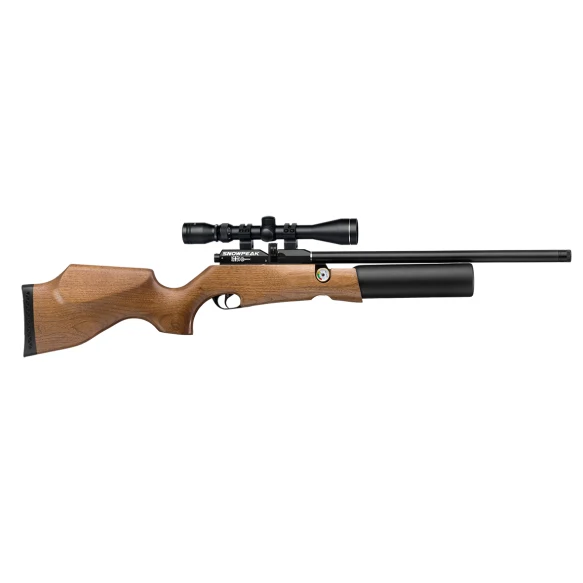
Snowpeak M16A PCP Air Rifle – Regulated Performance with Classic Beech-Wood Styling
The Snowpeak M16A PCP Air Rifle combines traditional rifle styling with a regulated pre-charged pneumatic platform designed around consistency, practical handling, and repeat-shot convenience. With its German beech stock, side-lever action, detachable air reservoir, integrated regulator, and multi-shot magazine system, the M16A brings together classic appearance and modern PCP engineering.
Rather than relying on a spring-powered mechanism, compressed air is stored within the rifle’s reservoir and released in controlled amounts during operation. Consequently, recoil characteristics are different from those associated with conventional spring-powered air rifles. Moreover, the regulated system has been incorporated to support more consistent air delivery throughout the usable pressure range.
Snowpeak currently lists the M16A in 4.5 mm (.177), 5.5 mm (.22), and 6.35 mm (.25) configurations. Published maximum velocity figures are approximately 1000 FPS, 900 FPS, and 800 FPS respectively, although actual performance can vary according to pellet weight, local-market configuration, environmental conditions, and applicable power restrictions.
Key Features of the Snowpeak M16A PCP Air Rifle
A balanced combination of pneumatic engineering and traditional materials is offered by the M16A. In addition, several features have been incorporated to improve everyday operation and consistency.
Product highlights include:
- Regulated PCP operating system for controlled air delivery
- 350cc removable air reservoir
- Side-lever cocking mechanism
- Multi-shot magazine system
- 4.5 mm, 5.5 mm and 6.35 mm calibre options
- German beech wooden stock
- Approximately 960 mm overall length
- Approximately 3.1 kg published weight
- 460 mm barrel
- Adjustable manual safety
- Adjustable trigger-pull specification
- Moderator/silencer configuration listed by the manufacturer where legally permitted
- Maximum published pressure of 25 MPa
These specifications are based on Snowpeak’s current M16A product information. Local versions should always be checked before use because individual-market specifications can differ.
Regulated PCP Air System
Consistent Air Management
One of the defining features of the Snowpeak M16A PCP Air Rifle is its regulated pneumatic system. Air is held under high pressure in the reservoir before being metered through the rifle’s operating system.
Because regulation is incorporated, variations in pressure can be managed more predictably through the rifle’s useful pressure range. Consequently, more consistent shot-to-shot behaviour can be supported when suitable pellets and correct operating pressures are used.
For recreational target shooting, consistency is particularly important because changes in velocity can affect the point of impact. Therefore, the regulator serves an important role within the overall M16A platform.
350cc Removable Air Reservoir
A 350cc air capacity is specified for the Snowpeak M16A. The tank has also been designed to be removable.
The relatively generous reservoir capacity complements the regulated system, particularly during shooting sessions in which repeated refilling would otherwise interrupt the experience.
Nevertheless, high-pressure air systems should always be filled and maintained according to the manufacturer’s instructions. The M16A is listed with a maximum pressure of 25 MPa, and the pressure rating of the rifle must never be exceeded.
Smooth Side-Lever Action
Practical Multi-Shot Operation
A side-lever action is fitted to the Snowpeak M16A PCP Air Rifle, providing a straightforward mechanism for cycling the action between shots.
Snowpeak specifically identifies the side-lever system as an easier-to-operate feature of the M16A.
Combined with its detachable magazine, the action allows the rifle to be operated without manually loading an individual pellet before every shot. That feature can be particularly convenient during controlled target sessions where several shots are taken consecutively.
Depending on calibre, Snowpeak currently publishes magazine capacities of approximately 13 shots in 4.5 mm, 11 shots in 5.5 mm, and 9 shots in 6.35 mm.
German Beech Stock and Traditional Styling
Although much of the M16A’s internal design is based around modern PCP technology, its exterior maintains a traditional sporting-rifle character.
A German beech stock is specified by Snowpeak. Beech has long been used for sporting stocks because it can provide a solid structure while retaining the appearance associated with classic wooden rifles.
Furthermore, the natural appearance of wood gives each rifle a somewhat individual character because grain patterns and tones can vary.
The overall dimensions are listed at approximately 960 × 190 × 63 mm, while published weight is around 3.1 kg.
As a result, the rifle maintains a full-sized configuration without becoming excessively long.
Barrel and Accuracy-Oriented Design
A 460 mm barrel is specified on Snowpeak’s current product page.
Accuracy, however, should never be evaluated from barrel length alone. Pellet selection, pressure consistency, barrel condition, optic setup, shooting technique, wind, and distance can all influence practical grouping performance.
Nevertheless, the combination of a regulated PCP mechanism, solid stock, side-lever action, and purpose-designed barrel gives the M16A a platform oriented toward repeatable shooting.
For best results, different suitable pellets can be tested safely on a controlled range because individual barrels can show preferences for particular pellet weights and profiles.
Adjustable Trigger and Manual Safety
Trigger characteristics play an important role in controlled shooting. Snowpeak specifies a trigger-pull range of approximately 1–5 lbf for the M16A. A manually operated adjustable safety system is also listed.
However, a mechanical safety should never replace correct handling practices.
The manufacturer’s PCP manual states that the rifle is intended for adult use and emphasizes fundamental precautions such as treating the rifle as loaded and never pointing it toward another person.
Three Calibre Options
4.5 mm / .177
The 4.5 mm configuration is published with a maximum velocity of approximately 1000 FPS. Its magazine capacity is listed at 13 rounds.
5.5 mm / .22
The 5.5 mm version is listed at approximately 900 FPS, together with an 11-round magazine capacity.
6.35 mm / .25
For users whose local regulations permit this configuration, the 6.35 mm version is listed at approximately 800 FPS with a nine-round magazine.
Actual muzzle energy cannot be determined from velocity alone because pellet mass must also be considered. Furthermore, regional versions may be restricted to lower power levels to comply with local law.
Why the Snowpeak M16A Platform Stands Out
The Snowpeak M16A PCP Air Rifle brings several useful design elements together within one platform. A substantial removable reservoir is paired with regulated air delivery, while a side-lever mechanism is combined with a multi-shot magazine. Meanwhile, the German beech stock preserves the traditional appearance preferred by shooters who may not want an entirely synthetic or tactical-style rifle.
Equally importantly, its three common calibre configurations allow the platform to be adapted to different lawful recreational applications and local requirements.
Whether the rifle is being evaluated for controlled target practice, range use, or another lawful purpose permitted in the owner’s jurisdiction, the M16A offers a feature set centred on repeatability, manageable operation, and traditional styling.
Snowpeak M16A PCP Air Rifle Specifications
Manufacturer: Snowpeak
Model: M16A
Operating system: Pre-Charged Pneumatic (PCP)
Action: Side lever
Regulator: Yes
Calibres: 4.5 mm / .177, 5.5 mm / .22, 6.35 mm / .25
Published velocities: Up to 1000 / 900 / 800 FPS depending on calibre
Magazine capacity: 13 / 11 / 9 shots depending on calibre
Air capacity: 350cc
Maximum published pressure: 25 MPa
Barrel length: 460 mm
Overall dimensions: Approximately 960 × 190 × 63 mm
Weight: Approximately 3.1 kg
Stock: German beech
Safety: Adjustable manual safety
Trigger pull: Approximately 1–5 lbf
Specifications can vary between production generations and regional configurations. Local legislation concerning air-rifle ownership, calibre, power, moderators, transportation, and use should always be checked before acquisition or operation.
Snowpeak Airguns, PCP Rifles, Air Pistols and Umarex Airguns
For shooters researching Snowpeak airguns, Snowpeak Sports, and the wider Snowpeaks product range, there are many PCP rifles, air pistols, and shooting accessories to consider. Popular searches include the Snowpeak AP900, Snowpeak AP900B PCP air rifle, Snowpeak MAX 1, Snowpeak MAX 1 price, Snowpeak PP750, PP750, Snow Peak PP750, and PP750 air pistol. Buyers also regularly compare models such as the Snowpeak P35, P35, P 35, PCP P 35, Snowpeak P35X, P35X, P35X PCP, and Snowpeak P35 vs P35X.
Other Snowpeak models attracting attention include the Snow Peak PP20, Snowpeak PP20, Snowpeak M25, M25 rifle, M-25, M25 weapon, Snowpeak M60, Snowpeak M60B, M 60B, rifle M60, rifle M50, and M50 rifle. Searches such as Snow Peak brand origin are also common among buyers who want to understand the manufacturer before choosing a rifle or pistol.

Snowpeak M16A PCP Air Rifle Calibres, FAC, Power and Accessories
The Snowpeak M16A PCP Air Rifle is available in several calibre configurations, allowing buyers to choose a version that better matches their preferred shooting style, local regulations, and intended lawful use. Because the rifle is built around a regulated PCP platform, power delivery is designed to remain controlled and consistent throughout its normal operating pressure range. In addition, compatible accessories can be fitted to improve aiming, handling, storage, and general usability.
Available Calibres for the Snowpeak M16A
Snowpeak lists the M16A in 4.5 mm (.177), 5.5 mm (.22), and 6.35 mm (.25) calibres. Each calibre provides a different balance between pellet weight, trajectory, velocity, and energy.
The 4.5 mm (.177) version is generally selected by shooters who prefer a flatter trajectory and higher pellet velocity. Because .177 pellets are normally lighter than larger-calibre alternatives, they can travel at higher speeds when used within an equivalent power range. Consequently, this calibre can be well suited to recreational target shooting, practice sessions, and precision-oriented applications where permitted by local law.
Meanwhile, the 5.5 mm (.22) configuration provides a popular middle ground. Heavier pellets can be used, while practical velocity remains strong. As a result, the .22 version is frequently chosen by shooters who want a balance between trajectory, pellet mass, and retained energy.
For those looking for a larger calibre, the 6.35 mm (.25) M16A provides the heaviest pellet option among the standard configurations. Because larger pellets usually carry more mass, they can retain useful energy differently from lighter calibres. However, trajectory characteristics will also differ, so suitable pellet selection and correct optic adjustment remain important.
Regardless of calibre, only ammunition of the correct specification should be used. Furthermore, pellet weight and shape can influence velocity, accuracy, pressure consumption, and practical performance.
Snowpeak M16A FAC and Regulated Power Versions
Understanding FAC Configurations
Depending on the country or market, the Snowpeak M16A PCP Air Rifle may be offered in unrestricted, full-power, or legally limited configurations.
The term FAC is commonly used in some markets, particularly the United Kingdom, when referring to air rifles that exceed the statutory power limit for non-certificate ownership. However, licensing requirements differ significantly between jurisdictions. Therefore, the exact legal classification of any M16A should always be confirmed according to the buyer’s local laws.
An FAC or higher-power M16A should not be assumed to have one universal muzzle-energy figure. Different calibre versions, regulator settings, pellet weights, valve configurations, and regional specifications can produce different results.
For that reason, buyers should confirm the manufacturer’s stated specification for the exact rifle being purchased rather than relying solely on model-name information.
Power Characteristics
Snowpeak currently publishes maximum velocity figures of approximately:
- 4.5 mm / .177 – up to 1000 FPS
- 5.5 mm / .22 – up to 900 FPS
- 6.35 mm / .25 – up to 800 FPS
These figures should be understood as manufacturer reference values rather than guaranteed real-world results.
Actual performance can change according to pellet weight, air pressure, temperature, barrel condition, regulator setup, and regional power restriction. Furthermore, velocity alone does not provide a complete measurement of power because muzzle energy depends on both pellet velocity and pellet mass.
Therefore, two pellets travelling at similar speeds can still produce different energy figures if their weights differ.
Regulated PCP Performance
The M16A uses a regulated pre-charged pneumatic system, meaning compressed air is metered before it is released to propel each pellet.
Because a regulator is incorporated, pressure delivery can remain more stable throughout a significant portion of the usable air charge. Consequently, shot-to-shot consistency can be improved compared with an unregulated system operating across a broad pressure curve.
A 350cc removable air reservoir is fitted to the platform, providing a substantial supply of compressed air for extended shooting sessions.
However, shot count varies considerably depending on calibre, power level, pellet selection, regulator settings, and atmospheric conditions.
For safety, the rifle should only be filled within the manufacturer’s stated pressure specifications.
Accessories for the Snowpeak M16A PCP Air Rifle
A wide range of accessories can be paired with the M16A to create a more practical shooting setup.
Recommended accessory categories include:
- Rifle scope for precision aiming
- Compatible scope mounts or rings
- Spare magazines
- Correct-calibre quality pellets
- PCP hand pump
- High-pressure charging bottle
- Suitable fill adapter
- Pellet storage case
- Protective rifle bag or hard case
- Cleaning equipment designed for air rifles
- Shooting rest or support
- Protective eyewear
- Pressure-rated charging accessories
An optic is one of the most commonly selected additions. Because PCP rifles are frequently used for precision shooting, a suitable scope can make aiming and target identification considerably easier.
Scope selection should be based on intended distance, magnification requirements, mounting compatibility, and personal preference.
Spare Magazines and Ammunition
The M16A uses a multi-shot magazine system, so carrying additional magazines can improve convenience during extended range sessions.
Magazine capacity varies by calibre, with Snowpeak listing approximately 13 shots for .177, 11 shots for .22, and 9 shots for .25.
Using correctly sized pellets is equally important. Different pellet brands, weights, and head sizes can behave differently in a specific barrel. Therefore, accuracy testing with several appropriate pellets may help identify the combination that performs best in an individual rifle.
Choosing the Right M16A Configuration
The ideal Snowpeak M16A PCP Air Rifle configuration depends on intended use, legal restrictions, calibre preference, and desired power level.
A .177 version may appeal to users prioritising flatter trajectory and target work, while .22 provides a versatile middle-ground option. Meanwhile, .25 offers a larger and heavier projectile where that configuration is lawful.
Whatever version is selected, local licensing rules, energy limits, transport regulations, and permitted uses should always be checked before purchase or operation. When matched with the correct calibre, lawful power specification, and compatible accessories, the Snowpeak M16A provides a versatile PCP platform suitable for a wide range of recreational shooting requirements.
Snowpeak PCP Models and Related Airgun Searches
The PCP category covers everything from compact pistols to full-size hunting and target rifles. Searches frequently include PR900 Gen 3, CR650, SR 1000X, T Rex 6000, and pistolet PCP Arcea-Snowpeak Onix Sport. People comparing pneumatic platforms may also search what is a PCP airgun, air gun, air rifle, pellet pistol, air gun accessories, 9mm pellet, and pellet 9mm.
Some search phrases overlap with firearm terminology even when shoppers are researching airgun products. These include rifle M60, how much did the M60 weigh, rifle M50, M50 rifle, M25 weapon, and snowfall gun. Therefore, model specifications should always be checked carefully so that a historical firearm search is not confused with a modern sporting airgun product.
Umarex Airguns, Air Rifles, Pistols and PCP Platforms
Alongside Snowpeak products, Umarex USA, UmarexUSA, Umarex airguns, and Umarex air rifles are widely searched by recreational shooters, target shooters, and PCP enthusiasts. The Umarex range includes PCP rifles, CO₂-powered platforms, break-barrel pistols, BB guns, airsoft replicas, and large-caliber airgun systems.
Popular PCP searches include Umarex Notos, Umarex Notos Carbine, Umarex Gauntlet, Umarex Gauntlet 2, Umarex Gauntlet 30, Umarex Zelos, Umarex Origin, Umarex Komplete, and Umarex Komplete NCR .22. Hunters researching larger airgun platforms may also encounter the Umarex Hammer, Umarex Hammer .50 caliber, Umarex Hammer Carbine, Umarex Primal 20, and Umarex AirSaber.
Umarex Pistols, BB Guns and T4E Models
For handgun-style platforms, popular searches include Umarex BB gun, BBgun, BB gun pistol, metal BB gun, Umarex TR50, Umarex HDR 50, Umarex T4E, Umarex T4E Smith, Umarex Smith, and Umarex P2P DR50 how many joules.
Glock-style replicas remain another major category. Search terms include Glock BB gun, Glock 19 BB gun, Umarex Glock 19, Umarex Glock 19X, Umarex Glock 19 Gen3 .177 caliber BB gun air pistol, Umarex Glock 17, Umarex Glock 17 Gen 5, Umarex Glock, airsoft Glock, airsoft Glock 19, Glock 17 airsoft, and Glock airsoft gun.
Other replica and recreational searches include Umarex MP40, Umarex MP5, Umarex Legends, Umarex HK Heckler, Umarex shotgun, and airsoft pistol.Umarex DX17.
Break-Barrel and Sporting Umarex Airguns
Shooters looking for spring or gas-piston platforms frequently research the Umarex Trevox, loading Umarex Trevox break barrel .177, Umarex pistol break barrel, Umarex Fusion 2, Umarex Synergis Elite, and Amazon Umarex Browning 800 Express. These platforms provide alternatives for people who want an airgun without relying on a high-pressure PCP charging system.
Additional searches across the Umarex catalog include Umarex H, while broader terms such as air rifle, pellet pistol, air gun, and air gun accessories help buyers compare platforms, ammunition, optics, filling equipment, targets, cases, and other shooting equipment.
Whether the focus is a Snowpeak M60, Snowpeak M25, Snowpeak P35X, Snowpeak PP750, Snowpeak MAX 1, Umarex Notos, Umarex Gauntlet 2, Umarex Origin, or Umarex Hammer Carbine, buyers should compare caliber, operating system, power level, dimensions, intended use, and local regulations before selecting an airgun.
Frequently Asked Questions
What type of air rifle is the Snowpeak M16A?
The Snowpeak M16A is a pre-charged pneumatic air rifle that uses compressed air stored inside an onboard reservoir. Instead of relying on a spring-piston mechanism, the rifle releases a controlled quantity of compressed air each time it is fired. This design helps reduce the characteristic recoil associated with spring-powered rifles while also supporting smoother operation and consistent shot delivery.
Because a regulated air system is incorporated, pressure can be managed more predictably throughout a substantial portion of the usable fill. As a result, the platform is designed to provide repeatable performance during recreational target shooting and other lawful applications.
Which calibres are available?
The rifle is commonly offered in 4.5 mm (.177), 5.5 mm (.22), and 6.35 mm (.25) configurations.
Each calibre has different characteristics. The .177 version normally produces the highest pellet velocity and can provide a relatively flat trajectory. Meanwhile, .22 offers a balance between pellet mass, velocity, and trajectory. The .25 version uses a larger and heavier projectile and is generally selected by shooters who prefer increased projectile mass where that calibre is legally permitted.
Available versions can vary between distributors and countries, so the exact specification should always be confirmed before purchasing.
How powerful is the rifle?
Power varies according to calibre, regional specification, pellet weight, regulator configuration, and local legal restrictions.
Manufacturer-published velocity figures can reach approximately 1000 FPS in .177, 900 FPS in .22, and 800 FPS in .25, depending on configuration. Nevertheless, these figures should be treated as reference values rather than guaranteed performance.
Velocity alone should also not be confused with muzzle energy. A heavier pellet travelling more slowly may still produce greater energy than a very light pellet travelling faster. Therefore, exact energy should be determined from the specific pellet weight and measured velocity of the rifle being used.
Is an FAC version available?
Higher-power configurations may be available in certain markets. However, the term FAC is jurisdiction-specific and is most commonly associated with licensing requirements in the United Kingdom.
Where a rifle exceeds the locally permitted non-certificate power limit, additional licensing or registration requirements may apply. In other countries, different terminology and limits may be used.
Consequently, buyers should check the laws applying in their location before purchasing, modifying, transporting, or using a higher-power version.
Is the rifle regulated?
Yes. A regulator is incorporated into the pneumatic operating system.
The regulator is intended to control the pressure delivered to the firing system so that each shot receives a more consistent supply of air while the reservoir remains within its useful operating range.
This can contribute to improved shot-to-shot consistency. However, accuracy and velocity are still influenced by pellet selection, air pressure, barrel condition, weather, shooting technique, and the condition of the rifle.
What is the air-cylinder capacity?
The rifle is equipped with a 350cc air reservoir according to the manufacturer’s published specification.
This relatively substantial capacity allows a useful number of shots to be produced from one fill. Nevertheless, an exact shot count cannot be guaranteed because air consumption changes according to calibre, power level, pellet weight, regulator configuration, temperature, and other variables.
Lower-power configurations will generally use less compressed air per shot than higher-energy setups.
What is the maximum filling pressure?
The published maximum working pressure is approximately 25 MPa, which is equivalent to around 250 bar.
Only suitable high-pressure filling equipment should be used. The manufacturer’s pressure limits should never be exceeded, and the cylinder, seals, filling connector, and charging equipment should be inspected regularly.
Because PCP systems operate under very high pressure, damaged or incompatible charging equipment should not be used.
How can the air reservoir be filled?
Depending on the equipment available, the reservoir can typically be filled using a suitable high-pressure hand pump, diving cylinder, carbon-fibre charging bottle, or compatible compressor designed specifically for PCP equipment.
The correct fill adapter must be used, and pressure should be monitored carefully during charging.
The rifle should be filled gradually rather than rapidly because excessive heat can be produced when compressed air enters the cylinder quickly. Following the manufacturer’s filling procedure helps protect seals and other pneumatic components.
Is the air cylinder removable?
Yes. The design incorporates a removable air reservoir.
This can simplify maintenance or replacement where compatible components are available. However, the cylinder should only be removed, installed, or serviced according to the manufacturer’s instructions.
High-pressure components should never be dismantled while they remain pressurised.
How many shots does the magazine hold?
Magazine capacity depends on calibre.
The .177 version is generally listed with a capacity of approximately 13 pellets, while the .22 version typically holds around 11 pellets. The .25 version is commonly listed with approximately 9 pellets.
Capacity can vary slightly between production versions, so the magazine supplied with the individual rifle should be checked.
Does the rifle use a side-lever action?
Yes. A side-lever cocking mechanism is incorporated.
The lever is used to cycle the action and index the magazine between shots. Compared with manually loading one pellet directly into the breech before every shot, the magazine and side-lever arrangement can provide faster and more convenient operation during a controlled shooting session.
The lever should always be operated smoothly rather than forced.
Can the rifle be used as a single-shot setup?
Depending on the accessories available for the particular version, a compatible single-shot tray may be used.
Some shooters prefer single loading when testing pellets, zeroing an optic, or conducting precision target work because each pellet can be handled individually.
Compatibility should be confirmed before purchasing a single-shot tray because dimensions can differ between models and production generations.
What type of stock does it have?
A wooden stock made from German beech is specified for the platform.
Beech provides a solid structure while maintaining the traditional appearance many shooters associate with sporting air rifles.
Because natural wood varies, grain pattern, colour, and small cosmetic details may differ from one rifle to another. Proper care should also be taken to protect the stock from prolonged moisture, excessive heat, and harsh cleaning chemicals.
How heavy is the rifle?
Published weight is approximately 3.1 kg, although mounted optics and other accessories will increase total weight.
The weight gives the rifle a substantial feel while still allowing it to remain practical for bench shooting, supported standing positions, and other controlled range applications.
Balance can change depending on the size of the scope, mounts, moderator, or other accessories fitted.
How long is the barrel?
The barrel is listed at approximately 460 mm.
Barrel length forms only one part of the rifle’s performance characteristics. Practical accuracy also depends on barrel condition, pellet compatibility, regulator consistency, trigger control, optic setup, and environmental factors.
A longer barrel should therefore not automatically be interpreted as being more accurate than a shorter one.
What pellets should be used?
Only pellets of the correct calibre should be used.
High-quality lead or manufacturer-approved alternatives are normally preferred because poorly formed or incorrectly sized ammunition can reduce accuracy and may affect feeding.
Different barrels may perform better with different pellet weights and head diameters. Consequently, testing several suitable pellet types on a controlled range can be useful when determining which ammunition groups most consistently.
Can heavy pellets be used?
Heavier pellets can generally be used as long as they are the correct calibre and are suitable for the rifle’s magazine and barrel.
However, pellet weight changes velocity and muzzle energy. A heavier pellet normally travels slower than a lighter pellet under the same operating conditions, although retained energy and trajectory may differ.
Very long projectiles should also be checked for magazine compatibility before regular use.
Is a scope included?
Package contents can differ between distributors.
Some sellers may supply only the rifle, magazine, fill equipment, and basic accessories, while others may offer packages containing a scope, mounts, case, or additional magazines.
Therefore, customers should review the exact product listing before ordering instead of assuming that an optic is automatically included.
What scope works well with the rifle?
A quality air-rifle-compatible scope can be selected according to the distances and type of target shooting planned.
Moderate magnification is sufficient for many recreational applications, while higher magnification may be preferred for more precise bench or range shooting.
Correct rings or mounts must also be selected for the rifle’s mounting system. The optic should be mounted securely and properly zeroed before serious accuracy testing is performed.
Can a moderator or silencer be fitted?
Some configurations may be supplied with sound-moderating equipment or may allow compatible devices to be installed where legally permitted.
Laws covering moderators vary significantly between countries. In certain jurisdictions they are freely available for airguns, while elsewhere licensing, registration, or complete prohibition may apply.
Compatibility and legality should therefore be confirmed before installing any sound-moderating accessory.
Is the trigger adjustable?
The platform is listed with an adjustable trigger system.
Trigger adjustment can allow the feel of the firing mechanism to be tailored within the manufacturer’s permitted range. Nevertheless, trigger components should not be modified beyond the approved specification.
An excessively light or improperly adjusted trigger can create a safety risk. If adjustment is required, the manufacturer’s manual should be followed carefully.
Does the rifle have a safety?
Yes. A manually operated safety mechanism is incorporated.
However, mechanical safety devices should always be considered secondary to responsible handling. The muzzle should remain pointed in a safe direction, the trigger should not be touched until a shot is intended, and the rifle should be treated as loaded until it has been positively checked.
Is it suitable for beginners?
The operating system can be approachable for responsible adult beginners who receive appropriate instruction.
The side lever, magazine system, regulated air supply, and relatively low recoil can make the shooting experience straightforward. Nevertheless, PCP rifles also require familiarity with high-pressure air filling, safe handling, storage, and local legal requirements.
Professional instruction or supervised range practice is recommended for inexperienced users.
Is it suitable for target shooting?
Yes. The regulated PCP system, multi-shot magazine, adjustable trigger, and compatibility with optical sights make the platform well suited to recreational target shooting.
Users can practice from supported positions, shooting benches, or other controlled range setups.
For best results, the rifle should be zeroed carefully, and a suitable pellet should be selected through controlled accuracy testing.
How accurate is it?
Practical accuracy depends on several variables and cannot be represented by a single universal group size.
Pellet quality, barrel condition, fill pressure, regulator performance, optic quality, distance, wind, shooting support, and shooter technique all influence results.
With a suitable pellet and properly maintained equipment, the regulated platform is designed to support consistent shooting. However, each individual rifle should be tested to determine its preferred ammunition.
How should it be stored?
The rifle should be unloaded before storage and kept in a secure location that prevents unauthorised access.
A dry gun cabinet, lockable hard case, or another legally compliant storage solution can help protect the rifle.
Pellets should be stored separately where required by local regulations. Excessive humidity should also be avoided because moisture can affect metal surfaces, wooden components, and optical equipment.
How often should the rifle be cleaned?
Cleaning frequency depends on how heavily the rifle is used and the conditions in which it is operated.
PCP barrels generally do not require aggressive cleaning after every shooting session. Excessive cleaning can sometimes cause more problems than it solves.
Instead, external surfaces can be wiped regularly, while the bore can be cleaned carefully when accuracy begins to deteriorate or when contamination is suspected. Only cleaning products suitable for air rifles should be used.
What maintenance does a PCP rifle require?
Routine maintenance includes checking O-rings, seals, filling connectors, magazines, stock screws, scope mounts, and the air reservoir.
The exterior should be kept dry and clean. In addition, seals should be replaced when necessary using compatible parts.
Internal regulator or valve repairs should preferably be performed by a qualified technician unless the owner has appropriate technical knowledge and the work is legally permitted.
Can the power be adjusted?
Power configurations may differ between markets, but owners should not assume that unrestricted adjustment is appropriate or legal.
Changes to regulator pressure, valve settings, hammer systems, or other internal components can alter muzzle energy, reliability, and safety characteristics.
Such changes may also move the rifle into a different legal classification. Consequently, power modifications should only be performed by qualified professionals and within applicable law.
Why can velocity differ from the advertised figure?
Advertised velocity is normally measured under specific test conditions using particular ammunition.
Actual velocity can change because of pellet weight, head size, ambient temperature, pressure level, regulator behaviour, barrel condition, seal condition, and manufacturing tolerances.
Therefore, two rifles of the same model may not produce exactly identical chronograph readings.
What should be checked before buying?
Buyers should confirm the exact calibre, regional power specification, package contents, magazine capacity, fill equipment compatibility, warranty terms, and local legal requirements.
The intended use should also be considered before selecting a calibre.
By confirming those details in advance, the most suitable configuration can be selected while avoiding unnecessary accessories or incompatible equipment.
Practical Use Scenarios
The Snowpeak M16A is designed around a versatile PCP platform, which makes it suitable for a broad range of lawful recreational shooting environments. Its regulated air system, multi-shot magazine, side-lever action, traditional wooden stock, and multiple calibre options allow the rifle to be adapted to different shooting preferences without requiring an entirely different platform.
Rather than being limited to one narrow type of use, the rifle can be configured around recreational target practice, bench shooting, controlled range sessions, accuracy testing, training, and other lawful sporting applications. In every case, the rifle should be used only in locations where airgun shooting is legally permitted and where a proper backstop, safe direction, and appropriate supervision are available.
Recreational Target Shooting
One of the most natural environments for this rifle is recreational target shooting.
A regulated PCP system can be particularly useful during repeated target practice because pressure is managed before each shot is released. As a result, the rifle is designed to provide more predictable shot-to-shot behaviour across the useful portion of the air charge.
When paper targets are being used, consistency becomes especially important. Small differences in point of impact are easier to notice when several groups are compared over the course of a session. Therefore, a stable pneumatic system can help users evaluate their technique, optic setup, and ammunition choice more effectively.
The multi-shot magazine also adds convenience. Instead of manually loading an individual pellet before every shot, several pellets can be prepared in advance. Consequently, the shooting session can continue with fewer interruptions.
For casual range users, this can make the overall experience more comfortable and enjoyable.
Practising from a Shooting Bench
Bench shooting provides a controlled environment in which the rifle’s consistency can be assessed without introducing as much movement from the shooter.
When the rifle is supported correctly on a suitable rest, attention can be placed on trigger control, breathing, sight picture, and repeatability.
A bench setup is also useful when a new optic has been fitted. The stable position allows adjustments to be made more systematically while reducing the effects of unnecessary movement.
Furthermore, different pellets can be compared more fairly from a supported shooting position.
Because every barrel can respond differently to changes in pellet weight, shape, and dimensions, testing ammunition from a stable bench can help identify which options produce the most consistent groups.
Scope Zeroing and Optic Setup
Another practical use scenario involves setting up and confirming an optical sight.
PCP rifles are commonly paired with telescopic sights because scopes can provide a clear aiming reference during precision-oriented recreational shooting.
After a suitable optic and compatible mounts have been installed, zeroing should be completed on an authorised range or another lawful shooting facility with a safe backstop.
The process can begin at a conservative distance so that the point of impact can be confirmed safely. Once the optic has been aligned, additional groups can be fired to verify that the adjustment remains consistent.
Because the rifle uses a regulated air system, repeated shots can be taken while the user concentrates on evaluating the sight rather than compensating for large changes in air pressure.
A properly mounted scope should remain secure throughout the session. Mounting screws and rings should therefore be checked according to the manufacturer’s recommendations.
Pellet Testing and Accuracy Evaluation
Not every pellet performs identically in every barrel.
For this reason, controlled pellet testing can be one of the most useful activities undertaken with the rifle.
A shooter may compare several suitable pellet designs of the correct calibre while using identical targets, distances, and shooting supports. The objective is not simply to determine which pellet produces the highest velocity. Instead, consistency and grouping behaviour can be observed.
A pellet that travels slightly slower may still produce more consistent results than a lighter alternative.
Additionally, differences in projectile shape can influence how smoothly pellets load into the magazine and chamber.
Testing should always remain within the ammunition types approved for the rifle. Damaged, deformed, incorrectly sized, or unsuitable projectiles should not be used.
Extended Range Sessions
The combination of a 350cc air reservoir and multi-shot magazine makes the rifle practical for longer recreational sessions.
Instead of repeatedly stopping after only a few shots, users can concentrate on maintaining technique and monitoring groups over a longer period.
However, the exact number of shots available from a fill can vary considerably. Calibre, operating power, temperature, regulator configuration, and pellet weight can all influence air consumption.
For that reason, shooters should monitor the rifle’s pressure gauge and avoid allowing the system to fall outside the manufacturer’s recommended operating range.
A longer range session is also a good opportunity to monitor how the rifle behaves as air pressure gradually decreases.
If the point of impact or shot consistency changes noticeably, the rifle should be checked and refilled according to the manufacturer’s instructions.
Skills Development for New PCP Users
The platform can also serve as an introduction to PCP rifle ownership for responsible adults who are unfamiliar with compressed-air systems.
Unlike a conventional spring-powered rifle, a PCP requires the user to understand filling pressure, reservoir management, charging equipment, magazines, and regulator behaviour.
Therefore, supervised range sessions can help a new owner become familiar with each stage of operation.
The learning process should begin with safe handling rather than accuracy.
Users should become comfortable with checking whether the rifle is loaded, operating the safety, removing the magazine, understanding the pressure gauge, and storing the rifle correctly.
Once those fundamentals have been established, attention can gradually move toward shooting position, trigger discipline, sight alignment, and group consistency.

Reviews
There are no reviews yet.