Rather than being built around an ultra-compact tactical layout, the M11 has been given a conventional full-length configuration. As a result, familiar handling characteristics are provided while modern PCP technology is retained.
Consistency is further supported by the rifle’s integrated regulator. Because the pressure supplied for each shot is controlled, more uniform performance can be maintained throughout the usable portion of an air fill. For shooters who place importance on repeatability, this regulated system represents one of the most notable characteristics of the platform.
The rifle’s balanced layout can be particularly appreciated when it is being used from a supported shooting position. At the same time, the full-sized stock provides substantial contact between the rifle and shooter.
Consequently, the M11 can be considered by users who prefer a traditional rifle shape instead of a short bullpup-style PCP.
Because air delivery is regulated, pressure can be managed more consistently between shots. This characteristic is particularly relevant during target shooting, where repeatability is often valued more highly than simply achieving the highest possible velocity.
Unlike a spring-powered air rifle, the firing cycle is driven by stored compressed air. Therefore, the heavy movement associated with a spring or gas ram is avoided. A calmer firing cycle can consequently be experienced, which may make sight-picture management more straightforward for experienced users.
Proper filling equipment rated for the rifle’s specified working pressure should always be used, and all manufacturer procedures should be followed when the reservoir is being charged.
Different calibre configurations allow the same basic M11 platform to be supplied for different lawful shooting requirements.
The .177 configuration is commonly associated with recreational and precision-oriented target use because smaller pellets and flatter trajectories can be selected. Meanwhile, .22 and .25 versions provide alternative pellet choices for users whose local regulations and intended activities permit them.
However, calibre should never be selected from velocity figures alone. Pellet weight, local legislation, intended use, energy limits, shooting distance, and the exact specification of the rifle should all be considered.
Repeated manual pellet insertion is reduced by the M11’s removable multi-shot magazine arrangement.
Published Snowpeak documentation lists magazine capacities that vary by calibre and manual revision. For this reason, the magazine supplied with an individual rifle should be checked before exact capacity is advertised.
Nevertheless, the multi-shot design remains an important characteristic of the M11 platform.
During an organised target session, several pellets can be prepared in advance. The shooting process can then be continued without a pellet having to be manually positioned for every shot.
Convenience is therefore improved without moving away from a conventional bolt-operated PCP format.
Technical specifications should always be confirmed against the exact rifle and manufacturer’s documentation before use.
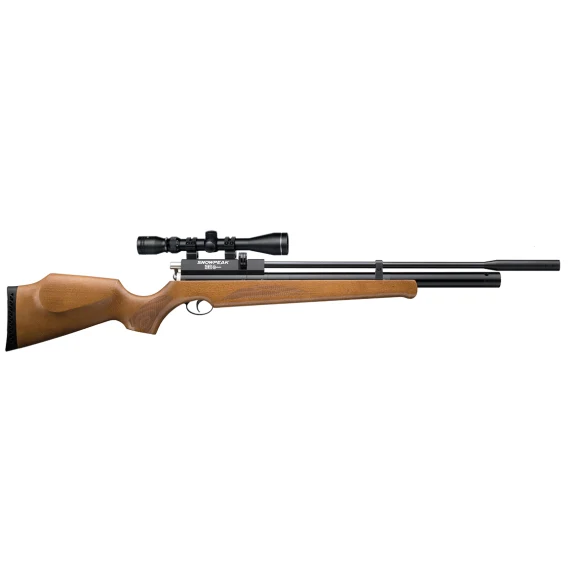
A major visual feature of the M11 is its European beech stock.
Instead of a polymer chassis, natural wood has been used to produce a more traditional appearance. Because grain pattern and density vary naturally between wooden stocks, small differences between individual rifles should be expected.
Snowpeak’s documentation has also noted that rifle weight can vary slightly because of differences in wood density.
This wooden construction can appeal particularly to shooters who prefer established sporting-rifle aesthetics but still want a PCP powerplant.
Furthermore, the conventional stock layout provides clearly defined contact points for the shoulder, cheek and supporting hand. A familiar shooting position can consequently be established without requiring the user to adapt to an unusually compact action layout.
For recreational target use, repeatability is one of the strongest practical advantages offered by the M11’s design.
A regulated air supply has been incorporated, while the 250 cc reservoir provides stored compressed air for a shooting session. The long barrel and traditional stock arrangement complete a platform that has been configured around steady handling rather than extreme compactness.
Naturally, practical accuracy will still be affected by pellet selection, shooting technique, environmental conditions, optic setup, maintenance and the individual rifle.
For that reason, different suitable pellets can be tested responsibly to determine which performs consistently in a particular barrel. Manufacturer-approved maintenance procedures should also be followed so seals, magazines and other components remain in appropriate operating condition.
It can be particularly relevant where a full-size rifle is preferred for range or recreational target shooting. Likewise, the multi-shot magazine system can make extended target sessions more convenient, while the regulated action can help maintain predictable operation.
Its appeal is therefore created by the combination of several characteristics rather than a single specification.
Traditional styling is provided by the beech stock. Modern air management is supplied through the regulated PCP system. Practical capacity is provided through the 250 cc cylinder, and repeated shooting is supported through the removable magazine arrangement.
Together, these elements give the M11 a distinctive position within Snowpeak’s PCP range.
Correct PCP maintenance should always be regarded as part of ownership.
Only suitable high-pressure filling equipment should be connected to the rifle, and pressure limits specified by the manufacturer must not be exceeded. Before maintenance is performed, the rifle should be made safe according to its operating instructions.
The barrel should be protected against obstruction, while seals and filling components should periodically be inspected in accordance with manufacturer guidance.
Safe storage is equally important. The rifle should be unloaded, secured against unauthorised access and stored according to applicable local legislation. Pellets and filling equipment should also be managed responsibly.
Because airgun power and licensing rules vary significantly between countries and jurisdictions, the legal requirements applying to ownership, transport, storage and use should always be checked before the rifle is acquired or operated.
Its design has been centred on conventional handling while the benefits of a modern regulated pneumatic action have been retained. Consequently, users who favour the appearance and feel of a wooden sporting rifle are not required to give up the convenience associated with contemporary PCP technology.
For recreational range sessions and other lawful applications, the combination of regulated air delivery, magazine-fed operation and familiar ergonomics provides a practical foundation.
Ultimately, the M11 is best understood as a traditional-looking PCP platform built around consistency, usable air capacity and straightforward multi-shot operation. When the correct calibre and locally compliant specification are selected, the rifle can serve as a capable platform for responsible adult airgun use.
Snowpeak Airguns, PCP Rifles, Air Pistols and Umarex Airguns
For shooters researching Snowpeak airguns, Snowpeak Sports, and the wider Snowpeaks product range, there are many PCP rifles, air pistols, and shooting accessories to consider. Popular searches include the Snowpeak AP900, Snowpeak AP900B PCP air rifle, Snowpeak MAX 1, Snowpeak MAX 1 price, Snowpeak PP750, PP750, Snow Peak PP750, and PP750 air pistol. Buyers also regularly compare models such as the Snowpeak P35, P35, P 35, PCP P 35, Snowpeak P35X, P35X, P35X PCP, and Snowpeak P35 vs P35X.
Other Snowpeak models attracting attention include the Snow Peak PP20, Snowpeak PP20, Snowpeak M25, M25 rifle, M-25, M25 weapon, Snowpeak M60, Snowpeak M60B, M 60B, rifle M60, rifle M50, and M50 rifle. Searches such as Snow Peak brand origin are also common among buyers who want to understand the manufacturer before choosing a rifle or pistol.
Snowpeak PCP Models and Related Airgun Searches
The PCP category covers everything from compact pistols to full-size hunting and target rifles. Searches frequently include PR900 Gen 3, CR650, SR 1000X, T Rex 6000, and pistolet PCP Arcea-Snowpeak Onix Sport. People comparing pneumatic platforms may also search what is a PCP airgun, air gun, air rifle, pellet pistol, air gun accessories, 9mm pellet, and pellet 9mm.
Some search phrases overlap with firearm terminology even when shoppers are researching airgun products. These include rifle M60, how much did the M60 weigh, rifle M50, M50 rifle, M25 weapon, and snowfall gun. Therefore, model specifications should always be checked carefully so that a historical firearm search is not confused with a modern sporting airgun product.
Umarex Airguns, Air Rifles, Pistols and PCP Platforms
Alongside Snowpeak products, Umarex USA, UmarexUSA, Umarex airguns, and Umarex air rifles are widely searched by recreational shooters, target shooters, and PCP enthusiasts. The Umarex range includes PCP rifles, CO₂-powered platforms, break-barrel pistols, BB guns, airsoft replicas, and large-caliber airgun systems.
Popular PCP searches include Umarex Notos, Umarex Notos Carbine, Umarex Gauntlet, Umarex Gauntlet 2, Umarex Gauntlet 30, Umarex Zelos, Umarex Origin, Umarex Komplete, and Umarex Komplete NCR .22. Hunters researching larger airgun platforms may also encounter the Umarex Hammer, Umarex Hammer .50 caliber, Umarex Hammer Carbine, Umarex Primal 20, and Umarex AirSaber.
Umarex Pistols, BB Guns and T4E Models
For handgun-style platforms, popular searches include Umarex BB gun, BBgun, BB gun pistol, metal BB gun, Umarex TR50, Umarex HDR 50, Umarex T4E, Umarex T4E Smith, Umarex Smith, and Umarex P2P DR50 how many joules.
Glock-style replicas remain another major category. Search terms include Glock BB gun, Glock 19 BB gun, Umarex Glock 19, Umarex Glock 19X, Umarex Glock 19 Gen3 .177 caliber BB gun air pistol, Umarex Glock 17, Umarex Glock 17 Gen 5, Umarex Glock, airsoft Glock, airsoft Glock 19, Glock 17 airsoft, and Glock airsoft gun.
Other replica and recreational searches include Umarex MP40, Umarex MP5, Umarex Legends, Umarex HK Heckler, Umarex shotgun, and airsoft pistol.Umarex DX17.
Break-Barrel and Sporting Umarex Airguns
Shooters looking for spring or gas-piston platforms frequently research the Umarex Trevox, loading Umarex Trevox break barrel .177, Umarex pistol break barrel, Umarex Fusion 2, Umarex Synergis Elite, and Amazon Umarex Browning 800 Express. These platforms provide alternatives for people who want an airgun without relying on a high-pressure PCP charging system.
Additional searches across the Umarex catalog include Umarex H, while broader terms such as air rifle, pellet pistol, air gun, and air gun accessories help buyers compare platforms, ammunition, optics, filling equipment, targets, cases, and other shooting equipment.
Whether the focus is a Snowpeak M60, Snowpeak M25, Snowpeak P35X, Snowpeak PP750, Snowpeak MAX 1, Umarex Notos, Umarex Gauntlet 2, Umarex Origin, or Umarex Hammer Carbine, buyers should compare caliber, operating system, power level, dimensions, intended use, and local regulations before selecting an airgun.
Snowpeak M11 PCP Air Rifle Calibres, FAC Power and Accessories
The Snowpeak M11 PCP Air Rifle is offered in several calibre configurations, allowing the rifle to be matched more closely to different target-shooting preferences, local power restrictions, and regional airgun regulations. Depending on the market and exact production version, the M11 can be supplied in 4.5 mm (.177), 5.5 mm (.22), and 6.35 mm (.25) calibre. Because each calibre produces different ballistic characteristics, pellet availability, trajectory behaviour, and energy potential should be considered before a particular version is selected.
Furthermore, the M11 is built around a regulated PCP system. Therefore, compressed air is delivered in a controlled manner rather than being released solely according to declining cylinder pressure. This regulated configuration can support more consistent performance throughout the usable portion of a fill.
.177 / 4.5 mm Snowpeak M11
The 4.5 mm (.177) version provides the smallest calibre offered for the M11 platform.
This configuration can be particularly suitable for recreational target shooting, general range use, and applications where economical pellet consumption is preferred. Because .177 pellets are widely available in numerous weights and designs, users are provided with a broad selection from which an appropriate pellet can be chosen.
According to published Snowpeak specifications, the full-power 4.5 mm version is listed at velocities of up to approximately 1000 fps, although actual velocity will depend on pellet weight, individual rifle configuration, environmental conditions, and the legal specification supplied in a particular country.
Therefore, published velocity should be regarded as a manufacturer specification rather than a guaranteed result with every pellet.
.22 / 5.5 mm Snowpeak M11
For shooters who prefer a larger pellet, the 5.5 mm (.22) configuration provides another popular option.
A broader and generally heavier pellet can be used, while the regulated PCP system continues to support controlled air delivery. Snowpeak documentation also lists approximately 1000 fps for some unrestricted 5.5 mm M11 specifications.
However, velocity alone should not be used to compare different calibres. Pellet mass changes significantly between .177 and .22, which means muzzle energy can differ even when nominal velocity figures appear similar.
Consequently, buyers should confirm the actual factory energy level of the rifle being purchased rather than calculating suitability from calibre alone.
For recreational target shooting, the .22 version can provide a comfortable balance between pellet size, energy and handling. Nevertheless, every use should remain within applicable local legislation and approved shooting environments.
.25 / 6.35 mm Snowpeak M11
The largest commonly documented M11 calibre is 6.35 mm (.25).
Snowpeak documentation lists unrestricted versions at approximately 900 fps, although once again, actual results will vary according to ammunition and rifle specification.
Because .25 pellets are substantially heavier than typical .177 pellets, this configuration is generally associated with higher potential muzzle energy. Therefore, particular attention should be paid to licensing requirements and local power limits before a 6.35 mm model is purchased.
The larger calibre can also require different pellet selection and magazine capacity. Manufacturer manuals list the M11 magazine according to calibre, although different manual revisions show slightly different capacities. For that reason, the magazine supplied with the exact rifle should always be checked instead of relying solely on a generic specification sheet.
FAC and Power Configurations
The term FAC is commonly used in markets such as the United Kingdom to describe air rifles that exceed the power threshold allowed without a firearm certificate.
Consequently, an M11 advertised as an FAC model should not automatically be assumed to have one universal power output. Different distributors and countries may receive versions configured to different energy levels.
The rifle’s manufacturer documentation confirms that the M11 uses a regulated PCP action, a 250 cc air cylinder, and a maximum operating pressure of 20 MPa. These specifications provide the foundation for the rifle’s pneumatic system, while factory power can be altered according to the version supplied for a particular market.
For this reason, customers should always verify the stated muzzle energy of the exact rifle before ordering.
Where a jurisdiction imposes an energy limit, the locally compliant version should be selected. Likewise, where higher-powered air rifles require certification, registration, permits or other legal authorization, those requirements must be satisfied before ownership or use.
Why the Regulator Matters
Consistency represents an important characteristic of the M11 design.
Rather than allowing firing pressure to change dramatically as the cylinder becomes depleted, the regulator controls the pressure delivered to the firing system. Therefore, shot-to-shot behaviour can remain more predictable during the regulated portion of the air charge.
This can be particularly useful during target shooting because a more stable firing cycle makes equipment setup and pellet testing easier to evaluate.
Furthermore, the 250 cc reservoir provides a practical supply of compressed air while retaining the traditional proportions of the rifle.
Recommended Accessories for the Snowpeak M11 PCP Air Rifle
A suitable accessory package can make the M11 easier to operate, transport, maintain and configure for range use.
Useful accessories can include:
- PCP hand pump rated for the required working pressure
- High-pressure air compressor suitable for PCP charging
- Compatible fill adaptor or filling equipment
- Rifle scope selected for the intended shooting distance
- Suitable scope mounts or rings
- Spare M11 magazines in the correct calibre
- Manufacturer-compatible pellets
- Rifle cleaning kit
- Protective gun bag or rifle case
- Shooting targets and target holders
- Eye protection
- Pellet storage containers
- Approved PCP air tank or charging bottle
Snowpeak itself lists pellets, pumps and compressors, gun bags, rifle scopes, cleaning kits, high-capacity air tanks and targets within its airgun accessory range.
Choosing the Right M11 Setup
The most suitable Snowpeak M11 PCP Air Rifle configuration ultimately depends on calibre preference, local law, intended target use, permitted power level and accessory requirements.
A .177 model can provide an accessible target-oriented setup, while .22 offers a larger pellet format. Meanwhile, .25 provides the largest commonly listed M11 calibre and normally carries greater energy potential.

Regardless of calibre, the regulated PCP action, 250 cc cylinder and 20 MPa maximum pressure remain central characteristics of the platform. By combining the correct legally compliant rifle specification with quality pellets, an appropriate optic, safe filling equipment and proper maintenance accessories, the M11 can be configured as a practical and well-supported PCP system for responsible adult shooting.
Practical Use Scenarios
The Snowpeak M11 can fit naturally into several responsible shooting environments because its full-length layout, regulated PCP system, multi-shot format, and traditional stock design provide a versatile combination for adult users. Rather than being limited to one narrow purpose, the rifle can be adapted to structured target practice, recreational range sessions, equipment familiarisation, controlled accuracy testing, and lawful field-oriented use where local regulations permit.
Because different shooters place different demands on an air rifle, practical value is often determined by how easily the platform can be incorporated into real shooting routines. In this respect, the rifle offers a useful balance between traditional ergonomics and modern pneumatic operation.
Recreational Target Shooting
One of the most natural uses for the rifle is recreational target shooting.
At a private range or approved shooting facility, the regulated PCP system can help provide a consistent shooting experience across a session. Instead of dealing with the pronounced mechanical movement associated with some spring-powered rifles, the shooter can work with a comparatively calm firing cycle.
This can make repeated practice more comfortable, particularly when attention is being placed on trigger control, body position, breathing, and sight alignment.
For example, a shooter may begin a session at shorter distances to confirm zero and general rifle function. Once the rifle is performing consistently, targets can be moved farther away within the safe and legal limits of the shooting environment.
Such progression allows technique to be developed gradually rather than forcing the shooter to begin immediately at more challenging distances.
The multi-shot magazine also adds convenience during this type of use. Several pellets can be loaded before a shooting string begins, which means less time is spent handling individual ammunition between shots.
As a result, concentration can remain focused on technique, grouping consistency, and target observation.
Supported Bench Shooting
Benchrest-style practice is another practical scenario where the rifle can be used effectively.
From a supported bench position, the shooter can rest the rifle properly while concentrating on precision and repeatability. A front rest, shooting bag, or other suitable support can be used in accordance with normal range practice.
This environment can be particularly useful when a new optic is being set up.
Instead of trying to evaluate the scope while shooting from an unstable position, the rifle can be supported so that sight adjustments are easier to assess. Small changes in point of impact can then be observed more clearly.
Bench shooting is also useful for comparing different pellet types.
Even pellets of the same calibre can vary in weight, shape, manufacturing tolerance, and how well they match a particular barrel. Therefore, several suitable pellet types can be tested under the same conditions.
Groups can be compared objectively, while obvious variables such as shooting position and target distance are kept as consistent as possible.
The regulated action can support this process because consistent air delivery helps reduce one source of variation.
Scope Zeroing and Optic Familiarisation
A newly installed scope normally requires careful zeroing before regular target use begins.
The rifle provides a useful platform for this process because its traditional stock layout can make a repeatable cheek position easier to establish. Once scope mounts have been correctly installed and checked, a safe target can be positioned at an appropriate distance.
Initial shots can then be taken to determine where the pellet is landing in relation to the point of aim.
Adjustments should be made gradually rather than randomly. After each change, another controlled group can be fired.
This process continues until the desired zero has been achieved for the intended lawful shooting application.
Once zeroing has been completed, the same session can be used to practise using magnification, understanding reticle references, and maintaining a consistent head position.
The result is a more familiar and predictable shooting setup.
Pellet Testing and Performance Evaluation
A practical air rifle should not be judged with only one random pellet type.
Pellet testing can therefore become an important part of ownership.
Different pellets can produce noticeably different group sizes even when the rifle itself remains unchanged. Consequently, an organised test can help identify which ammunition performs best with a specific barrel and power configuration.
A useful approach is to test several reputable pellets of the correct calibre.
Each pellet type can be fired at the same distance from the same supported position. Similar shot counts should be used for each group, while environmental conditions should be kept as consistent as reasonably possible.
The smallest and most repeatable groups can then be identified.
This process is especially valuable before larger quantities of one pellet are purchased.
It can also help separate ammunition-related variation from shooter technique.
Regular Range Training
For someone who visits an airgun range regularly, the rifle can become part of a structured training routine.
A typical session may begin with several warm-up shots, followed by controlled groups at known distances. The shooter can then practise positional shooting, target transitions, or timed strings where permitted by the range.
However, speed should never replace safe handling.
Even during casual recreation, muzzle direction, target awareness, trigger discipline, and range rules should remain the priority.
The magazine-fed action simply reduces interruptions between shots and allows a smoother rhythm to be maintained.
Because the rifle uses compressed air, reservoir pressure should also be monitored throughout the session.
The rifle should not be operated outside the manufacturer’s specified pressure range, and only suitable filling equipment should be used.
Learning PCP Rifle Ownership
For shooters moving from spring-powered air rifles to PCP equipment, the M11 can also serve as an introduction to the routines associated with pre-charged pneumatic ownership.
PCP systems introduce several additional responsibilities.
The user must understand filling pressure, air-source compatibility, filling connectors, safe charging procedures, seal condition, and pressure monitoring.
Therefore, ownership is not limited to simply loading pellets and firing.
A responsible user should become familiar with the complete air system before regular shooting begins.
For example, the correct fill adapter should be identified, the cylinder should be charged gradually, and the gauge should be monitored during filling.
Excessive pressure should never be introduced.
The rifle can then be disconnected correctly from the filling system before use.
By following these procedures consistently, safe equipment habits can become part of the normal shooting routine.
Backyard or Private-Property Target Practice
In some jurisdictions, airgun use on private property may be permitted when local laws, boundaries, noise considerations, and safe backstops are properly respected.
Where it is legal, the rifle can be used for controlled recreational target shooting on suitable private land.
However, simply owning the property does not automatically make every location appropriate for shooting.
A reliable backstop is essential.
The target area must be positioned so pellets cannot leave the designated shooting zone. Nearby homes, roads, people, animals, buildings, vehicles, and hard surfaces should all be considered.
Ricochet risk must also be managed.
A secure pellet trap or professionally designed backstop can therefore be an important part of the setup.
Before shooting begins, local laws should always be checked because regulations can differ significantly between countries, regions, municipalities, and rifle power levels.
Informal Accuracy Challenges
Recreational shooting does not always need to involve formal competition.
Informal accuracy challenges can make practice more engaging while still remaining controlled.
Paper targets with different scoring zones can be used, for example.
Shooters can compare group sizes, total scores, or consistency across a fixed number of shots.
Small reactive airgun targets may also be used where they are appropriate for the rifle’s power and installed safely.
This type of practice can help maintain interest while encouraging careful shot placement.
Because the rifle is magazine-fed, repeated strings can be completed efficiently without excessive interruptions.
Nevertheless, each shot should still be taken deliberately rather than rushed.
Positional Shooting Practice
Bench shooting is useful, but many shooters also want to become comfortable using different shooting positions.
Standing, kneeling, seated, and supported positions can all be practised in a suitable range environment.
Each position introduces different stability challenges.
When standing, for instance, the shooter must manage the rifle’s weight with less support.
A kneeling or seated position can provide additional stability while still requiring good body control.
Supported positions may allow greater precision.
By alternating between these positions, the shooter can learn how stock fit, balance, optic height, and overall rifle dimensions affect handling.
The traditional full-length stock can be particularly familiar to users who have experience with conventional sporting rifles.
Chronograph and Consistency Testing
Experienced PCP owners may wish to evaluate consistency using a chronograph.
A chronograph measures pellet velocity, allowing the shooter to observe how consistently the rifle performs across a series of shots.
This can be useful for maintenance monitoring, pellet comparison, and confirming that the rifle remains within any applicable legal power limit.
The purpose should be measurement and verification rather than unsafe modification.
A string of readings can reveal whether performance remains stable as cylinder pressure falls.
Because a regulator is incorporated into the platform, users may expect a relatively consistent regulated portion of the fill, although actual results depend on the individual rifle, pellet, maintenance condition, and factory setup.
Any unexpected change should be investigated using manufacturer guidance or a qualified airgun technician.
Club and Social Shooting
The rifle can also be used in organised airgun clubs where the model and power level are permitted.
Club environments provide several practical benefits.
Safe range infrastructure is normally already established, experienced shooters may be available to provide general guidance, and distances can often be measured accurately.
For someone developing technique, this can be more useful than practising without feedback.
Different target formats may also be available.
A shooter can therefore use one session for paper grouping, another for supported precision work, and another for position training.
Regular club use can make it easier to observe improvement over time.
Controlled Field Use Where Lawful
Depending on calibre, factory power specification, local law, and the activity involved, the rifle may also be used for lawful field-oriented airgun applications.
However, suitability cannot be determined from the model name alone.
Local licensing requirements, minimum or maximum power rules, landowner permission, permitted species, seasons, shooting distances, and animal-welfare regulations must all be considered where pest control or hunting is legally allowed.
The shooter also needs to understand their own realistic accuracy limitations.
A rifle capable of good mechanical accuracy does not automatically make every field shot responsible.
Only shots that can be taken safely and humanely within the user’s proven ability should ever be considered.
Where such use is not permitted, the rifle should remain restricted to lawful target shooting.
Training New Adult Shooters
Under appropriate supervision and where legally permitted, the rifle may also be introduced to adult shooters who are new to PCP equipment.
A controlled range environment is preferable.
Before live shooting begins, the new user can be shown how the safety system works, how the magazine is handled, how the rifle should be carried, where the muzzle should point, and how the trigger should be approached.
The first shots can then be taken from a supported position.
This reduces the difficulty associated with holding the full rifle weight while the user is still learning basic sight alignment.
As confidence develops, greater independence can be introduced gradually.
The objective should be safe competence rather than speed.

Reviews
There are no reviews yet.