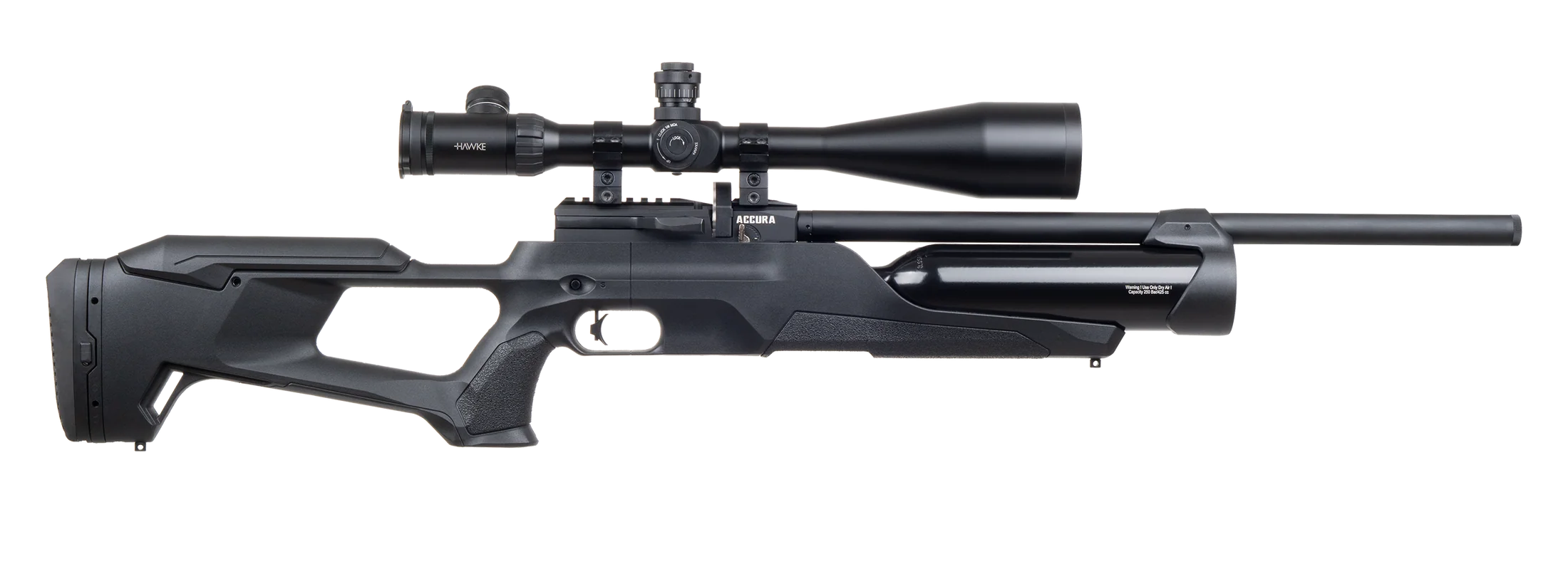
REXIMEX ACCURA SYNTHETIC – Modern PCP Air Rifle with Practical Performance
The REXIMEX ACCURA SYNTHETIC has been designed for shooters who value modern styling, dependable construction, comfortable handling, and consistent PCP performance. A practical synthetic stock has been combined with a well-balanced action, while an adjustable shooting platform has been incorporated to improve comfort across different shooting positions.
Rather than relying purely on appearance, the rifle has been developed around usability. Consequently, it can be considered by recreational shooters, target enthusiasts, and experienced airgun users who require an adaptable platform for responsible sporting use.
Durability has also been prioritized. Because a synthetic stock is fitted, everyday handling, transportation, and changing outdoor conditions can be managed without the maintenance generally associated with traditional wooden furniture.
Why Choose the REXIMEX ACCURA SYNTHETIC?
A combination of practicality and refinement is offered by the REXIMEX ACCURA SYNTHETIC. Although the rifle maintains a contemporary appearance, useful ergonomic features have also been incorporated throughout the design.
Comfort is supported by the stock profile, while control can be maintained through a stable shooting position. Furthermore, the PCP operating system allows shots to be produced without the movement associated with a conventional spring-powered mechanism.
As a result, greater attention can be placed on sight alignment, trigger control, and consistent technique.
Practical Synthetic Stock Construction
One of the most noticeable characteristics is its synthetic furniture. The material has been selected to provide a practical alternative to wood, particularly when the rifle is expected to be transported or regularly used outdoors.
Minor changes in temperature and humidity are generally handled more easily by a synthetic stock. Additionally, less routine cosmetic maintenance is usually required.
For shooters who prefer equipment that can simply be prepared, used responsibly, cleaned, and stored, this approach can be especially attractive.
Key REXIMEX ACCURA SYNTHETIC Features
Important characteristics of the rifle include:
- Durable synthetic stock designed for practical everyday handling
- PCP operating system for smooth and consistent shooting characteristics
- Ergonomic configuration created to encourage comfortable positioning
- Modern tactical-inspired appearance with functional styling
- Multi-shot configuration for convenient recreational and target shooting
- Adjustable elements incorporated to help the rifle suit different users
- Optics-ready design for compatible sighting equipment
- Balanced construction intended to support stable handling
- Integrated pressure monitoring for easier management of the air supply
- Robust external finish suited to regular responsible use
Specifications and supplied accessories can vary according to calibre, market, and distributor. Therefore, the exact configuration should always be checked before ordering.
Consistent PCP Shooting Experience
Pre-charged pneumatic technology has become popular because smooth operation can be provided without the pronounced recoil cycle associated with spring-powered rifles.
Within the REXIMEX ACCURA SYNTHETIC, compressed air is stored in the rifle’s reservoir and is subsequently used to propel each pellet. Because the system operates efficiently, a predictable shooting experience can be achieved when the rifle is correctly filled and maintained.
Moreover, less mechanical movement can allow a stable sight picture to be retained.
Designed Around Repeatable Shooting
Consistency remains particularly important during target shooting. When technique is repeated correctly, equipment should avoid introducing unnecessary movement or distraction.
For that reason, the rifle’s PCP architecture can be beneficial. Trigger control, breathing, positioning, and sight alignment can therefore receive greater attention.
Nevertheless, performance will always depend on several factors, including the selected ammunition, rifle condition, pressure level, weather conditions, and the shooter’s technique.
Ergonomics That Support Comfortable Handling
A rifle can possess strong mechanical characteristics while still being uncomfortable to use. Accordingly, ergonomics have been considered throughout the REXIMEX ACCURA SYNTHETIC platform.
The stock has been shaped to encourage a natural hold, while its overall configuration is intended to provide appropriate support during responsible recreational shooting.
Furthermore, adjustable components may allow the setup to be refined around individual preferences.
Modern Styling with Functional Purpose
Although the rifle possesses a modern appearance, the design is not purely cosmetic. Different contours, gripping surfaces, and adjustment points have been incorporated because each feature can contribute to improved handling.
At the same time, the synthetic construction gives the rifle a distinctive contemporary character.
Consequently, buyers who prefer modern PCP styling without the additional care associated with polished hardwood may find this configuration particularly appealing.
Optics and Accessory Compatibility
An appropriate optic can make a considerable difference to a target-focused setup. Therefore, the REXIMEX ACCURA SYNTHETIC has been designed to accommodate compatible sighting equipment.
A suitable airgun-rated scope can be selected according to the intended shooting environment and permitted use.
For short and medium recreational target distances, excessive magnification is not always necessary. Instead, clear glass, reliable adjustment, comfortable eye relief, and a useful reticle should be prioritized.
Compatible accessories may also be added where appropriate, provided they are fitted according to manufacturer instructions and local law.
Easy Maintenance and Everyday Practicality
Convenience does not end when shooting has finished. Because synthetic furniture has been used, cleaning can remain comparatively straightforward.
Dust and surface dirt can usually be removed carefully, while the metal components should be protected according to the manufacturer’s recommendations. Meanwhile, seals and other PCP components should be maintained with suitable products rather than general-purpose lubricants.
The air system should also be treated correctly. Only approved filling equipment and the pressure limits stated by the manufacturer should be followed.
By observing these precautions, reliable operation can be preserved while unnecessary wear is reduced.
Suitable for Different Shooting Environments
Versatility is another strength offered by the platform. The rifle can be adapted to several lawful recreational applications depending on its calibre, energy level, configuration, and the regulations applying in the user’s jurisdiction.
For example, it may be considered for organized target practice, informal range sessions on approved premises, or other permitted sporting applications.
However, power limits and licensing requirements differ significantly between countries and sometimes between regions. Accordingly, buyers should verify all applicable laws before purchasing, possessing, transporting, or using any air rifle.
A Balanced Choice for Modern Airgun Enthusiasts
A successful PCP rifle should combine more than specifications alone. Comfort, reliability, construction quality, ease of maintenance, and overall usability should work together.
That philosophy is reflected throughout the REXIMEX ACCURA SYNTHETIC.
While the synthetic stock provides everyday practicality, the PCP system delivers smooth operation. Meanwhile, ergonomic features contribute to comfortable handling, and optics compatibility provides flexibility when creating a personalized sporting setup.
Therefore, the rifle can represent an attractive option for users moving into PCP shooting as well as experienced enthusiasts seeking a modern synthetic-stock platform.
REXIMEX ACCURA SYNTHETIC – Final Overview
Ultimately, the REXIMEX ACCURA SYNTHETIC brings together durable materials, contemporary styling, comfortable ergonomics, and the smooth operating characteristics expected from a modern PCP air rifle.
Because its design has been focused on practical usability, the rifle can fit naturally into a variety of lawful recreational and target-shooting environments. Moreover, the synthetic furniture reduces maintenance demands while maintaining a purposeful appearance.
For buyers seeking a modern air rifle that combines adjustability, manageable handling, and robust construction, the REXIMEX ACCURA SYNTHETIC deserves serious consideration.
Exact calibre options, muzzle-energy specifications, magazine capacity, included accessories, and regional configurations should always be confirmed from the specific model listing before purchase.
Calibres, FAC, Power, Recommended Scope and Accessories
Choosing the correct calibre, legal power configuration, optic, and supporting equipment can make a major difference to the overall shooting experience. Because this PCP platform is offered in several configurations, buyers should consider how and where the rifle will be used before selecting a particular version.
The manufacturer currently lists .177, .22, and .25 calibre options. Factory specifications also show a 425cc air reservoir, 250-bar maximum fill pressure, side-lever action, adjustable power control, and an 11/22mm optics rail.
Available Calibres
.177 Calibre – 4.5mm
The .177 calibre version is particularly attractive for target shooting and users who prefer a relatively flat pellet trajectory. Reximex lists a maximum factory specification of approximately 350 m/s or 1,150 fps, producing up to about 33.6 joules or 24.8 ft-lb in unrestricted configurations. Actual output depends on the market version, pellet weight, setup, and local regulations.
Magazine capacity is listed at 14 pellets, making it the highest-capacity option in the range. The manufacturer also lists up to 168 shots within its stated optimal pressure range under its test conditions.
For target-focused users, .177 can be an excellent choice because its smaller projectile generally offers a relatively flat flight path and makes precise aiming straightforward at appropriate distances.
.22 Calibre – 5.5mm
The .22 calibre configuration offers an excellent middle ground between pellet size, energy, shot count, and general versatility.
According to factory specifications, unrestricted examples may reach approximately 290 m/s or 950 fps, with energy figures around 49.3 joules or 36.3 ft-lb. Magazine capacity is listed at 12 shots, while the manufacturer’s published optimal shot figure is approximately 144 under its test conditions.
Because .22 pellets are heavier than typical .177 ammunition, they can carry more momentum while still providing manageable trajectories. Consequently, this calibre is commonly considered by users who want a balanced PCP configuration for lawful sporting and target applications.
For many buyers who are uncertain which calibre to select, .22 can provide the most versatile compromise.
.25 Calibre – 6.35mm
Shooters who require a heavier projectile may prefer the .25 calibre configuration.
Reximex publishes a maximum velocity of approximately 260 m/s or 850 fps, with energy reaching around 55.2 joules or 40.7 ft-lb in unrestricted factory specification. The magazine holds 10 pellets, while approximately 120 optimal-velocity shots are listed under the manufacturer’s testing parameters.
Due to its larger and heavier pellet, .25 calibre generally emphasizes energy and momentum rather than the flatter trajectory normally associated with .177.
However, ammunition consumption, projectile cost, trajectory, and local licensing requirements should all be considered before selecting this version.
Power and FAC Considerations
Power specifications require particular attention because the same rifle can be supplied differently depending on the destination market.
Although Reximex publishes unrestricted figures reaching 24.8 ft-lb in .177, 36.3 ft-lb in .22, and 40.7 ft-lb in .25, UK dealers also offer versions configured below the UK non-FAC threshold. For example, current UK listings describe the model in sub-12 ft-lb form.
What Does FAC Mean?
Within Great Britain, FAC refers to a Firearm Certificate. An air rifle that exceeds the applicable non-FAC muzzle-energy threshold is generally treated differently under firearms law and requires the appropriate authorization.
Therefore, a factory specification showing more than 12 ft-lb should not be interpreted as meaning every retail rifle is supplied at that output.
A UK-market example may instead be configured around approximately 11–11.5 ft-lb, depending on the retailer and exact version.
Buyers should always confirm the specific rifle’s stated muzzle energy before ordering and comply with the licensing requirements applying in their jurisdiction. Power should never be altered simply to bypass legal restrictions.
Recommended Scope Options
A suitable riflescope can complement the rifle’s adjustable cheekpiece and stable PCP action particularly well.
For general recreational target shooting, a 3-12×40, 4-12×44, or similar variable optic can provide a useful balance between field of view and magnification.
For shooters who regularly work with smaller targets or longer permitted distances, a 4-16×44, 4-16×50, or 5-20×50 class optic may provide additional aiming precision.
Features Worth Prioritizing
Rather than choosing a scope purely by magnification, buyers should look for:
- Adjustable objective or side-focus parallax adjustment
- Clear multi-coated lenses
- Repeatable elevation and windage turrets
- A practical MIL or MOA reticle
- Comfortable eye relief
- Strong mounting construction
- Appropriate low-light performance
- Airgun-compatible mounting dimensions
Because the rifle incorporates an 11/22mm rail system, compatible mounts or Picatinny-style mounting solutions can be selected according to the optic. Reximex specifically lists the dual-purpose rail as part of the platform’s accessory system.
A good-quality mid-range optic is generally more useful than excessive magnification with poor glass quality.
Recommended Accessories
Several accessories can improve convenience, maintenance, and practical use.
PCP filling equipment should be considered essential. Because the rifle uses a 425cc reservoir and fills to a maximum of 250 bar, buyers should select an appropriately rated PCP compressor, certified air cylinder, or suitable high-pressure hand pump.
A pellet selection pack can also be extremely useful. Different pellet weights and head dimensions may produce noticeably different grouping performance, so testing several reputable options is preferable to assuming one projectile will automatically perform best.
A protective rifle case should be used for storage and transport where permitted. A padded case can protect the scope, stock, barrel, and adjustment components from accidental knocks.
A quality scope-mount set is equally important. Even an expensive optic can perform poorly when mounted with weak or incorrectly sized rings.
Other worthwhile additions can include:
- Spare magazines in the correct calibre
- Appropriate eye protection
- Secure storage equipment
- Approved PCP fill adapters
- Moisture-controlled filling equipment
- Airgun-rated cleaning products
- Suitable target holders and safe backstops
- Shooting bags or rests for supported target practice
- A sling where compatible and legally appropriate
Creating a Balanced Setup
A well-balanced configuration should match the calibre, power level, optic, and accessories to the user’s intended lawful activity.
For precision-oriented recreational target shooting, .177 with a moderate variable scope provides a highly manageable setup. For a broader balance of pellet weight and trajectory, .22 paired with a 3-12× or 4-16× optic can be an excellent all-round combination. Meanwhile, the .25 version is better suited to users who specifically require the characteristics of a heavier projectile and whose local regulations allow the relevant power level.
Above all, the exact regional specification should be checked before purchase. Reximex notes that velocity and energy can vary according to pellet weight, pellet shape, temperature, elevation, and other factors, so published figures should be treated as manufacturer test values rather than guaranteed results from every individual rifle.
Element Optics Riflescopes: Complete Guide to THEOS, HELIX, TITAN, NEXUS, Prism Optics, Rangefinders and Mounting Accessories
Discover Element Optics: Precision, Clarity and Advanced Optical Technology
When premium riflescope technology is considered, element scopes are frequently explored by shooting enthusiasts seeking optical clarity, reliable adjustment systems and dependable construction. Developed around practical shooting requirements, element theos, element helix, element titan and element nexus scopes represent different approaches to magnification, reticle functionality and optical performance.
As an established optic scope manufacturer, Element Optics provides optical equipment designed for sporting applications. Buyers researching element tactical, element vision, spectrum element, op element, element 3.0 or element ll may also encounter related search terminology while comparing optical products.
A comprehensive scopes website should explain the differences between magnification ranges, objective lenses, focal planes and mounting systems. Consequently, selecting suitable optics becomes easier when technical information is presented clearly.
Element THEOS Scopes: Advanced Long-Range Optical Performance
The element theos series is associated with premium precision optics. In particular, the theos scope attracts interest from enthusiasts seeking detailed reticles, sophisticated adjustment systems and high-magnification capabilities.
The element theos 6-36, also searched as element theos 6 36×56, features a 6–36× magnification configuration with a 56mm objective lens. The 36×56 specification identifies the maximum magnification and objective diameter, making it important when comparing high-powered optical systems.
Meanwhile, searches involving element theos 2-10, element theos 2 10, theos 2-10 and theos 2-10×42 ffp indicate interest in more compact magnification configurations. These terms should be distinguished from confirmed manufacturer model names before purchasing.
Interest in a 10 optic, 2-10 optic, 2-10x scope, element 2-10 or element 2-10 scope commonly reflects a preference for versatile lower magnification.
Similarly, customers searching for an element 2 10 scope or element optics 2-10 should compare verified product specifications rather than assume every search phrase describes an existing THEOS configuration.
Understanding Magnification and Optical Versatility
A 2-12 scope or 2×12 scope provides a broad magnification range for observation at varying distances. Furthermore, a 2-12 scope ffp uses a first focal plane reticle whose subtensions remain consistent throughout magnification changes.
Search expressions such as fffp 2, 12×4/2, 10×40 and .10×40 may appear in optical comparisons, although individual terms should be verified against actual product specifications.
Element HELIX: Reliable Optics and Practical Magnification
The element helix collection offers multiple configurations designed around dependable optical adjustment and functional reticle systems.
For example, the helix scope is frequently researched by customers comparing magnification flexibility and overall value.
The element optics 6-24×50, also described through searches such as element helix 6 24×50, combines 6–24× magnification with a 50mm objective lens. Depending on the specific model, first or second focal plane configurations may be available.
Buyers investigating helix hd 2 16×50 and hdlr should also examine the appropriate HELIX HD or HDLR product specifications. Different optical configurations can affect field of view, reticle behavior and shooting preferences.
Importantly, rifle scope reticles should be evaluated for legibility, subtension consistency and compatibility with the intended sporting discipline.
Comparing HELIX Models
When evaluating HELIX optics, several considerations deserve attention:
- Magnification flexibility and optical clarity.
- First versus second focal plane reticles.
- Turret adjustment repeatability.
- Objective lens diameter and eye relief.
- Weather resistance and mounting compatibility.
- Manufacturer warranty and accessory availability.
By comparing these features carefully, buyers can distinguish between individual configurations without relying exclusively on magnification figures.
Element TITAN: Precision Optics With Versatile Magnification
The element titan family occupies an important position within premium sporting optics. In particular, the titan scope collection includes configurations suited to different magnification preferences.
The element titan 3 18×50, alternatively written as element titan 3-18×50, provides a 3–18× magnification range and 50mm objective lens.
Searches for 3-18 scopes, 3-18, 3×18, 3×18 scope and 3:18 often concern this general category.
Additionally, comparisons involving nightforce 3-18 and best 3-18 scopes may help researchers identify differences in optical quality, reticle systems, adjustment mechanisms and overall dimensions.
The TITAN family also includes a 5–25×56 configuration, which explains searches for 5-25 scope, 25/56, titan 5 and titan25.
For more detailed comparisons, element titan 5 25×56 ffp review is a relevant research phrase associated with first focal plane performance, image quality and adjustment precision.
Neither magnification nor objective diameter alone determines optical quality. Lens coatings, mechanical consistency and viewing conditions must also be considered.
Element NEXUS and NEXUS GEN 2: Premium Precision Optics
The nexus scope family has attracted attention among enthusiasts interested in premium optical construction.
Across the nexus scopes range, optical quality and mechanical precision remain central comparison points.
The element nexus gen 2 is particularly relevant to buyers investigating modern first focal plane designs.
Searches for nexus 4-25×50 refer to a configuration offering a 4–25× magnification range and 50mm objective lens.
Additionally, terms such as nexus tactical often appear in discussions about precision-oriented optics, robust turret systems and specialized reticle designs.
Before selecting any model, specifications should be checked for tube diameter, adjustment range, parallax capability and supported mounting accessories.
Element Prism Optics and Alternative Optical Designs
The element prism category introduces another approach to optical viewing.
Unlike conventional variable riflescopes, a prismatic scope uses a prism-based optical arrangement, often allowing a compact optical design.
Customers asking what is a prismatic scope generally want to understand the difference between prism optics, traditional riflescopes and other sighting technologies.
Search phrases such as prismatic scale of the elements should not be confused with official optical specifications or reticle calibration systems.
The Element Optics element hyper 7 search commonly relates to the HYPR-7 hybrid optic. Likewise, hqp7-rf-2 specifications details should be verified against an actual manufacturer product designation before being treated as a confirmed model.
Other searches, including 14×50, relate to fixed-magnification optical configurations.
Meanwhile, chromatic aberration scope comparisons concern unwanted colored fringes that may appear around high-contrast objects. Optical coatings, lens design and glass quality can influence how effectively this effect is controlled.
Element RF: Rangefinding Technology and Ballistic Information
Accurate distance measurement is an important part of modern optical equipment evaluation.
The phrases element rf and element range are associated with searches for rangefinding solutions and related optical technology.
A ballistic rangefinder combines distance information with ballistic calculation features when supported by the specific device.
Other common search terms include rifle rangefinder, rifle range finder, laser range finder for rifle, rangefinder scope for rifle and rangefinding rifle scope.
Customers may also compare scopes with rangefinders built in against separate rangefinding instruments.
Specialized accessory research frequently includes picatinny mounted rangefinder, picatinny range finder, weapon mounted range finder and wmlrf.
For integrated electronic calculations, searches involving weapon mounted ballistic calculator and arken wmlrf refer to a broader category of rangefinding and ballistic-support equipment.
Importantly, individual devices differ in measurement capability, electronic features and mounting requirements. Product documentation should therefore be consulted before assuming compatibility.
Scope Mounts, Picatinny Rails and Dovetail Accessories
A secure element mount or other compatible mounting system is essential for maintaining consistent optical alignment.
Common accessories include a dovetail scope mount, dovetail rings and dovetail scope mounts, each intended for appropriately matched mounting interfaces.
Alternatively, picatinny scope mounts, picatinny scope rings, 30mm scope mount picatinny and 30mm picatinny scope rings are relevant when selecting accessories for Picatinny rail systems.
For dovetail configurations, 30mm dovetail scope rings should be matched carefully to both the optic’s tube diameter and the available rail dimensions.
Specialized accessory searches also include 34mm diving board mount, 34mm scope mount with diving board, diving board scope mount, 30mm diving board mount and scope diving board.
Such terminology commonly describes mounting arrangements incorporating an additional platform above or near the main optic.
Protective Scope Covers and Optical Maintenance
Protective accessories contribute to equipment longevity by reducing exposure to dust, debris and accidental surface contact.
Products such as tenebraex scope caps and tenebraex scope covers are frequently considered by owners seeking lens protection.
Similarly, an allen neoprene scope cover can offer general protective coverage during storage or transportation.
Before purchasing covers, buyers should verify the precise scope model and external lens-housing dimensions.
Choosing Element Optics With Confidence
Selecting among THEOS, HELIX, TITAN, NEXUS and prism-based optics requires more than comparing magnification alone.
Optical clarity, eye relief, reticle configuration, mechanical reliability, mounting compatibility and product authenticity should all be assessed together.
By researching verified product specifications, reviewing the available accessory options and selecting equipment suited to individual sporting requirements, customers can make more informed decisions.
Ultimately, the Element Optics range provides several distinct optical configurations, allowing enthusiasts to compare premium precision scopes, versatile mid-range designs, compact prism systems and compatible accessories within one broader optical product category.
Frequently Asked Questions
What type of air rifle is this?
This model is a pre-charged pneumatic air rifle, commonly referred to as a PCP. Instead of using a spring or gas ram, compressed air is stored inside an onboard reservoir. When the trigger is operated, a controlled amount of air is released to propel the pellet.
Because this system produces relatively little mechanical movement during the shot cycle, a smooth shooting experience can be achieved. That characteristic is one reason PCP rifles are widely chosen for target shooting and other lawful sporting applications.
Is this model suitable for beginners?
It can be suitable for beginners who are prepared to learn the correct procedures for filling, handling, storing, and maintaining a PCP air rifle. The absence of a strong spring-powered recoil cycle can make the shooting experience easier to manage.
However, new users should become familiar with safe pressure limits, approved filling equipment, magazine loading, and local airgun laws before use. Proper supervision and professional instruction are also recommended where appropriate.
What is the advantage of a synthetic stock?
A synthetic stock offers durability, reduced maintenance, and practical resistance to everyday environmental conditions. Unlike traditional wood, it is less likely to require regular cosmetic treatment or react noticeably to moderate changes in humidity.
This makes the rifle particularly appealing for users who expect to transport it frequently or use it in outdoor environments. Cleaning is generally straightforward, while minor marks are often less noticeable than they would be on highly polished wood.
Is a synthetic stock weaker than a wooden stock?
Not necessarily. Modern synthetic stocks can be extremely durable and are often chosen specifically because of their toughness and practical nature.
Wood may provide a traditional appearance and distinctive feel, while synthetic materials are often preferred for resistance to moisture, scratches, and routine handling. The better choice ultimately depends on personal preference and intended use.
Does this rifle produce heavy recoil?
PCP rifles generally produce very little traditional recoil compared with spring-powered air rifles. Because no large spring or piston moves rapidly inside the action during firing, the shot cycle tends to feel smoother.
Although some movement may still be felt, it is usually mild. This can help users maintain a more stable sight picture and concentrate on consistent trigger technique.
Is it suitable for target shooting?
Yes. A PCP platform can be well suited to recreational and organized target shooting because the firing cycle is smooth and predictable.
When the rifle is paired with suitable pellets and an appropriate optic, consistent results can be achieved. Nevertheless, accuracy depends on many factors, including ammunition quality, filling pressure, maintenance, environmental conditions, and shooting technique.
How accurate can it be?
Accuracy cannot be represented by one universal figure because results vary according to calibre, pellet choice, distance, wind conditions, optic setup, barrel condition, and the skill of the shooter.
However, modern PCP rifles are generally capable of very good precision when properly maintained and paired with compatible ammunition. Testing several high-quality pellet types is often the best way to determine which option performs most consistently in an individual rifle.
Does pellet choice make a difference?
Yes, pellet selection can have a significant effect on consistency and grouping.
Different pellet shapes, weights, head sizes, and manufacturing tolerances can behave differently through the same barrel. For this reason, experienced users often test several reputable pellet options before deciding which one provides the best results.
A pellet that performs extremely well in one rifle may not necessarily produce identical results in another.
How should pellets be stored?
Pellets should be kept clean, dry, and protected from deformation. Their containers should remain closed when not in use, particularly in dusty or humid environments.
Damaged pellets should normally be avoided because distorted skirts or heads can negatively affect consistency. Careful storage also reduces the risk of contamination entering the barrel or magazine.
Does it use a magazine?
Depending on the exact configuration supplied in a particular market, a multi-shot magazine may be included or available.
Magazine systems can make repeated target shooting more convenient because several pellets can be loaded in advance. However, users should always follow the manufacturer’s loading procedure and avoid forcing pellets or rotating components.
Can it also be used as a single-shot rifle?
This depends on the specific package and accessories available for the model. Some PCP rifles support single-shot trays or adapters, while others are primarily designed around their magazine system.
A single-shot setup may be preferred by some target shooters because each pellet is manually loaded and inspected before firing.
How is the air reservoir filled?
The reservoir is normally filled using approved high-pressure equipment compatible with the rifle’s filling system.
Common filling sources include PCP hand pumps, high-pressure compressors, and certified compressed-air cylinders. Only equipment rated for the required operating pressure should be used.
The manufacturer’s stated maximum fill pressure must never be exceeded.
Can a normal workshop compressor be used?
A standard low-pressure workshop compressor should not be used unless it has been specifically designed and rated for PCP filling pressures.
PCP systems operate at much higher pressures than conventional household or workshop air tools. Using unsuitable equipment can be ineffective and potentially dangerous.
Dedicated PCP filling equipment should therefore be used.
Is a hand pump practical?
A quality PCP hand pump can provide a practical filling solution, particularly for users who do not shoot very large numbers of shots during each session.
However, pumping becomes physically demanding as pressure increases. Moisture management is also important, so a pump equipped with an appropriate filtration system is generally preferable.
For frequent use, some owners may prefer a suitable high-pressure compressor or certified air cylinder.
How often does the rifle need to be refilled?
Refill frequency depends on the size of the air reservoir, operating pressure, calibre, power level, and number of shots fired.
A rifle configured at a lower energy level may generally provide more shots from a fill than a higher-powered version. Users should monitor the pressure gauge and follow the recommended operating range.
It is usually unnecessary to refill after every short shooting session unless pressure has fallen below the preferred working range.
Should the reservoir always be filled to maximum pressure?
Not necessarily. The correct filling procedure should follow the manufacturer’s specifications.
Some PCP rifles perform most consistently within a particular pressure range rather than from maximum pressure all the way to minimum pressure. Overfilling should always be avoided.
Pressure gauges should therefore be monitored carefully during filling.
What maintenance does a PCP rifle require?
Routine maintenance is generally straightforward. External metal surfaces can be wiped carefully after handling, while the stock can be cleaned with a suitable soft cloth.
The barrel should be maintained according to manufacturer guidance rather than cleaned excessively. Seals and filling components should also be inspected periodically.
Only lubricants suitable for high-pressure pneumatic equipment should be used where lubrication is specifically recommended.
Should ordinary gun oil be used inside the air system?
General-purpose oils should not be introduced into a high-pressure air reservoir unless the manufacturer specifically approves them.
Certain petroleum-based products can be unsuitable around high-pressure compressed air. Therefore, only recommended products should be used on seals, filling probes, and other pneumatic components.
When uncertain, the safest approach is to follow the manufacturer’s maintenance instructions.
How should it be stored?
The rifle should be stored unloaded, secure, and inaccessible to unauthorized persons. Local storage laws should always be followed.
A dry environment is preferable because excessive moisture can affect metal components and accessories. The optic, magazine, and filling equipment should also be protected from dirt and physical damage.
Whether pressure should remain in the reservoir during long-term storage should be determined from the manufacturer’s instructions.
Can it be left fully pressurized for long periods?
The recommended storage pressure can vary by manufacturer and design.
Many PCP systems are intended to retain some pressure to help keep seals properly seated, while prolonged storage at maximum pressure may not always be necessary. The official manual should therefore be followed for long-term storage.
Is the rifle loud?
Noise level depends on power, calibre, projectile, barrel configuration, surroundings, and any factory-installed sound-management features.
PCP rifles may produce a sharp muzzle report, particularly in higher-power configurations. Indoor environments can make the sound appear significantly louder because of reflection from walls and hard surfaces.
Hearing protection may be appropriate depending on the shooting environment.
Can a moderator or silencer be fitted?
Compatibility varies according to barrel design, threading, regional configuration, and local law.
Where legally permitted, only correctly specified accessories should be installed. Users should verify the correct thread type and ensure that any accessory is intended for the specific platform.
Local restrictions regarding sound moderators can be different from regulations governing the rifle itself.
What type of scope is suitable?
The best scope depends on shooting distance, target size, lighting conditions, and personal preference.
For general recreational target shooting, moderate magnification is often sufficient. A clear optic with reliable adjustment, suitable eye relief, and an appropriate reticle can be more useful than simply choosing the highest available magnification.
Mount compatibility should also be checked before purchase.

Reviews
There are no reviews yet.