KRAL KNIGHT SYNTHETIC – High-Performance PCP Air Rifle with Precision Engineering and Modern Tactical Design
KRAL KNIGHT SYNTHETIC – Advanced PCP Technology, Durable Construction, and Exceptional Shooting Comfort
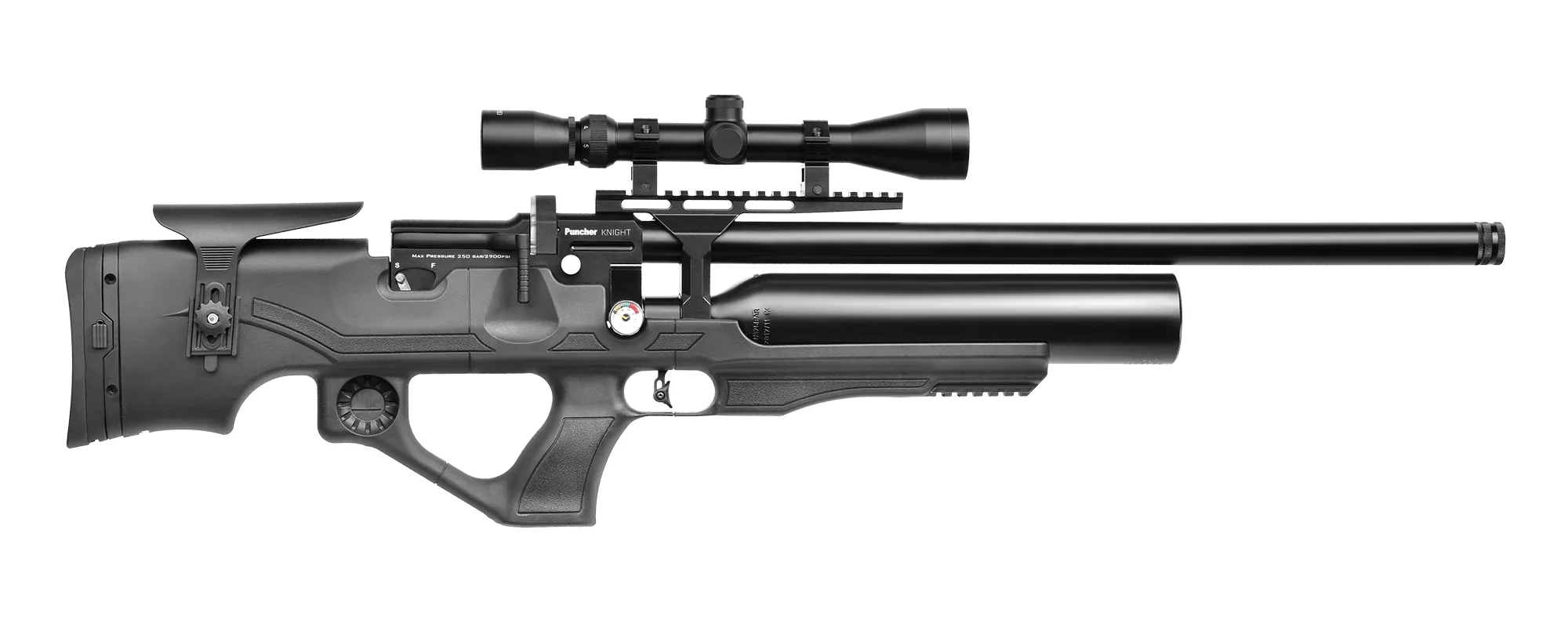
The KRAL KNIGHT SYNTHETIC has been developed as a feature-rich pre-charged pneumatic (PCP) air rifle, combining contemporary engineering, ergonomic construction, and dependable mechanical performance. A distinctive semi-bullpup configuration has been incorporated to provide a compact overall profile while retaining a substantial barrel length. Furthermore, a durable synthetic stock has been selected to accommodate recreational target shooting, supervised range practice, and precision-focused sporting activities.
Outstanding attention has been given to the rifle’s construction, with adjustable components incorporated to accommodate different shooting preferences. Meanwhile, its large-capacity compressed-air reservoir has been designed to support extended shooting sessions between refills. As a result, a balance between air capacity, handling, and everyday practicality has been achieved.
Unlike traditional wooden-stock alternatives, the synthetic configuration has been designed with moisture resistance and straightforward maintenance in mind. Additionally, the rifle’s modern appearance has been complemented by an adjustable cheekpiece, an ergonomic thumbhole stock, and a practical side-lever mechanism.
Consequently, the KRAL KNIGHT SYNTHETIC PCP air rifle represents an interesting combination of established airgun engineering, modular features, and contemporary sporting design.
Key Features and Technical Specifications
The following characteristics have been documented for the Kral Knight Synthetic platform.
- Brand: Kral Arms
- Model: Knight Synthetic (Knight S)
- Airgun Type: Pre-charged pneumatic (PCP) air rifle
- Action: Side-lever operated, magazine-fed
- Available Calibres: .177 (4.5 mm), .22 (5.5 mm), and .25 (6.35 mm)
- Stock Material: High-quality synthetic construction
- Stock Configuration: Semi-bullpup with ergonomic thumbhole design
- Air Reservoir: 500 cc
- Maximum Fill Pressure: 250 bar (approximately 3,600 PSI)
- Barrel Length: 580 mm (22.8 inches)
- Overall Length: 875 mm (34.4 inches), manufacturer’s specification
- Average Weight: 3.7 kg (8.15 lbs)
- Magazine Capacity: 14 rounds (.177), 12 rounds (.22), or 10 rounds (.25)
- Barrel Design: Shrouded, rifled barrel
- Trigger: Adjustable trigger-pull weight and trigger-shoe position
- Safety: Manual safety mechanism
- Optics Mounting: 22 mm Picatinny rail
- Cheekpiece: Adjustable
- Buttpad: Adjustable soft buttpad
- Muzzle Thread: 1/2-inch UNF
- Power Configuration: Market-dependent power ratings
Durable Synthetic Stock and Ergonomic Construction
Weather-Resistant Materials for Everyday Practicality
A high-quality synthetic stock has been incorporated into the KRAL KNIGHT SYNTHETIC to provide a practical alternative to traditional timber construction. Because synthetic materials are generally less sensitive to humidity than untreated wood, routine ownership and maintenance can be simplified.
Furthermore, a modern black finish has been applied to establish a clean and professional appearance. The stock has also been shaped to support comfortable positioning during supervised shooting sessions.
By combining a robust exterior with an ergonomic profile, the rifle has been configured for repeated sporting use in appropriate environments.
Adjustable Cheekpiece and Buttpad
Additional consideration has been given to shooter positioning through the inclusion of an adjustable cheekpiece and buttpad.
The cheekpiece can be positioned according to individual facial dimensions and compatible sighting equipment. Similarly, the buttpad can be adjusted to accommodate different shoulder positions and clothing thicknesses.
These features have been incorporated to improve fit and consistency without requiring permanent modifications to the stock.
Pre-Charged Pneumatic Technology and Air Capacity
500 cc High-Capacity Air Reservoir
The rifle has been equipped with a substantial 500 cc compressed-air reservoir, with a manufacturer-specified maximum filling pressure of 250 bar.
Consequently, a comparatively large volume of compressed air can be stored within the system. This capacity has been intended to accommodate multiple shooting cycles before another fill becomes necessary.
The manufacturer’s published reference figures include approximately 168 shots for .177, 144 shots for .22, and 120 shots for .25 configurations. However, actual figures may differ according to power settings, projectile characteristics, operating pressure, and regional specifications.
Importantly, the maximum pressure must never be exceeded, and only manufacturer-approved filling equipment should be used.
Consistent Mechanical Operation
Pre-charged pneumatic technology has been adopted to eliminate the need for a spring-piston cocking cycle.
Instead, compressed air is stored in the reservoir and released through the rifle’s operating mechanism.
Through this arrangement, spring-piston recoil characteristics are avoided, while the distinctive handling qualities of a PCP system are retained.
Nevertheless, performance remains dependent on maintenance, air pressure, ammunition consistency, and mechanical condition.
Barrel Engineering and Accuracy-Oriented Design
Shrouded Rifled Barrel
A 580 mm rifled barrel has been incorporated into the Knight Synthetic design. Its internal rifling has been manufactured to provide rotational stabilization for compatible pellets.
Additionally, a surrounding barrel shroud has been included as part of the rifle’s construction.
The shrouded arrangement contributes to the rifle’s distinctive exterior profile, although actual sound levels vary according to the configuration and shooting environment.
Precision-Focused Construction
Accuracy-oriented features have been integrated throughout the rifle’s mechanical assembly.
For example, the trigger incorporates adjustable characteristics, while the stock provides multiple points of ergonomic adjustment.
Furthermore, a stable relationship between the barrel, action, and sighting system is supported by the rifle’s structural design.
Actual grouping performance, however, cannot be guaranteed from specifications alone. It must be assessed under controlled conditions using compatible ammunition and appropriate safety procedures.
Side-Lever Action and Magazine System
Practical Magazine Configuration
A side-lever operating mechanism has been selected for the Knight Synthetic.
The rifle is configured around detachable magazines, with the applicable capacity determined by calibre.
For the .177 model, a 14-round magazine is specified. Meanwhile, the .22 version accommodates 12 rounds, whereas the .25 configuration uses a 10-round magazine.
These differences have been established by the manufacturer and should be considered when reviewing model-specific documentation.
Adjustable Trigger Characteristics
A mechanically adjustable trigger assembly has also been included.
Trigger-pull weight and trigger-shoe positioning can be configured within the manufacturer’s approved parameters by qualified personnel.
As with any airgun, adjustments must be carried out in accordance with the official manual, without compromising the safety mechanism.
Optics Compatibility and Accessory Integration
Picatinny Mounting Platform
A 22 mm Picatinny rail has been integrated into the upper assembly to accommodate compatible sighting equipment.
This standardized interface has been adopted across numerous sporting platforms, enabling suitable optics to be fitted according to manufacturer guidance.
However, scope inclusion should not be assumed, because package contents vary between retailers and regional product configurations.
Maintenance and Storage Considerations
Appropriate attention should be given to the rifle’s long-term condition.
The exterior can be cleaned using materials approved for synthetic stocks, while the metal components should be inspected periodically for moisture and corrosion.
Furthermore, the air reservoir, seals, and pressure-related components should be serviced according to Kral Arms’ recommended procedures.
When the rifle is not being used, it should be secured, unloaded, and stored separately from ammunition, in accordance with applicable regulations.
Sporting Applications and Responsible Ownership
Recreational Target Shooting
The KRAL KNIGHT SYNTHETIC has been designed for sporting airgun activities, including recreational target shooting and organized range practice.
Its adjustable stock components may be appreciated where different body dimensions and personal fitting requirements must be considered.
Similarly, its PCP operating system provides a distinct alternative to conventional spring-powered platforms.
Understanding Regional Power Requirements
Different power configurations may be supplied according to the destination market.
For this reason, the rifle’s legal classification must be established before ownership or use. In some jurisdictions, higher-powered versions are subject to licensing or additional restrictions.
Furthermore, supervised operation, suitable protective equipment, and approved shooting facilities should always be prioritized.
Why the KRAL KNIGHT SYNTHETIC Stands Out
Several distinguishing characteristics have been incorporated into this model.
First, a compact semi-bullpup layout has been combined with a full-length rifled barrel. Additionally, a 500 cc reservoir has been integrated to provide substantial compressed-air storage.
Equally importantly, the synthetic stock has been selected for its everyday practicality, while adjustable ergonomic components allow the rifle’s fit to be personalized.
The detachable magazine arrangement and side-lever mechanism further define its mechanical design.
Ultimately, the KRAL KNIGHT SYNTHETIC can be described as a modern PCP sporting air rifle distinguished by its synthetic construction, large air reservoir, adjustable features, and established Kral Arms engineering. Its suitability should be evaluated against individual requirements, verified model specifications, and local regulations.
KRAL KNIGHT SYNTHETIC – Calibres, FAC Power, Scope Compatibility, and Recommended Accessories
The KRAL KNIGHT SYNTHETIC has been engineered as a versatile pre-charged pneumatic (PCP) air rifle, featuring multiple calibre options, a substantial compressed-air reservoir, and compatibility with a variety of sporting accessories. Furthermore, its modern synthetic construction has been combined with an adjustable stock and standardized optics mounting system to accommodate different recreational shooting preferences.
Whether the rifle is being considered for organized target shooting, range practice, or recreational sporting use, its specifications should be reviewed carefully. In particular, calibre availability, FAC classification, power ratings, and accessory compatibility should be confirmed before purchase.
Available Calibres and Technical Characteristics
.177 Calibre (4.5 mm) – Recreational and Target Shooting
The .177 calibre KRAL KNIGHT SYNTHETIC has been offered for recreational shooting and organized target activities.
A 14-round detachable magazine has been specified for this configuration. Additionally, a manufacturer-published velocity of approximately 900 FPS and muzzle energy of 21 joules have been documented for the relevant full-power model.
Because .177 pellets are widely available in several sporting configurations, ammunition selection can be matched to the manufacturer’s recommendations and the requirements of an approved shooting facility.
Furthermore, the relatively small projectile diameter distinguishes this option from the larger calibres within the Knight range.
Published .177 specifications:
- Calibre: 4.5 mm / .177
- Maximum listed velocity: 900 FPS
- Published muzzle energy: 21 joules
- Magazine capacity: 14 pellets
- Advertised shots per fill: Approximately 168
- Air reservoir: 500 cc
- Maximum filling pressure: 250 bar
.22 Calibre (5.5 mm) – Versatile Sporting Configuration
The .22 calibre version has been manufactured as another option within the Knight Synthetic series.
A 12-round rotary magazine has been incorporated into the corresponding configuration. Meanwhile, a manufacturer-listed muzzle energy of 44 joules has been associated with the full-power specification.
Its larger pellet diameter represents a distinct ammunition category, and ammunition should always be selected according to the rifle’s actual calibre marking.
Additionally, performance figures may vary because individual versions can be supplied with different regional power specifications.
Published .22 specifications:
- Calibre: 5.5 mm / .22
- Maximum listed velocity: 900 FPS
- Published muzzle energy: 44 joules
- Magazine capacity: 12 pellets
- Advertised shots per fill: Approximately 144
- Reservoir capacity: 500 cc
.25 Calibre (6.35 mm) – Larger-Calibre PCP Configuration
The .25 calibre KRAL KNIGHT SYNTHETIC represents the largest standard calibre listed for this model.
A 10-round magazine has been specified, while the manufacturer’s published velocity is approximately 820 FPS.
Furthermore, muzzle energy of 52 joules has been documented for the relevant full-power configuration.
Because this variant uses a larger projectile diameter, its ammunition must not be confused with the .177 or .22 versions.
Published .25 specifications:
- Calibre: 6.35 mm / .25
- Maximum listed velocity: 820 FPS
- Published muzzle energy: 52 joules
- Magazine capacity: 10 pellets
- Advertised shots per fill: Approximately 120
- Maximum filling pressure: 250 bar
FAC Classification and Power Regulations
Understanding FAC Air Rifles
In the United Kingdom, FAC (Firearm Certificate) classification is particularly relevant to higher-powered air rifles.
For England and Wales, an air rifle exceeding 12 foot-pounds of muzzle energy generally requires a Firearm Certificate. Consequently, the manufacturer’s published full-power configurations exceed that threshold.
However, different legal frameworks are applied in Scotland, Northern Ireland, and other jurisdictions. Therefore, local licensing requirements must always be verified before acquisition or use.
Power Specifications and Regional Variations
The following figures have been published for the Knight platform:
| Calibre |
Published energy |
Velocity |
| .177 / 4.5 mm |
21 joules |
900 FPS |
| .22 / 5.5 mm |
44 joules |
900 FPS |
| .25 / 6.35 mm |
52 joules |
820 FPS |
These figures represent manufacturer-published reference specifications rather than guaranteed results.
Actual muzzle energy and velocity can be influenced by ammunition characteristics, operating conditions, and regional configuration. Additionally, lower-powered variants may be supplied in certain markets.
A seller should provide the exact power rating and relevant certification details for the rifle being offered.
Recommended Scope Options
3-9×40 Scope – Everyday Sporting Optics
A 3-9×40 telescopic scope can be considered for general recreational range use.
Its adjustable magnification provides several viewing options, while a 40 mm objective lens offers a conventional sporting-optics format.
Furthermore, the relatively straightforward design makes this category accessible to individuals exploring magnified sighting equipment.
4-12×44 Scope – Additional Viewing Magnification
For organized target shooting, a 4-12×44 scope represents another compatible optics category worth considering.
An adjustable magnification range has been incorporated into this style of optic, while the 44 mm objective diameter distinguishes it from smaller conventional models.
However, suitability depends on the specific optic, user requirements, and mounting dimensions.
Scope Mount Compatibility
The Knight Synthetic has been manufactured with a Picatinny mounting interface.
Therefore, any selected scope rings or mounting hardware should be checked for compatibility with the rifle’s rail and the particular optic.
The scope itself is optional under the manufacturer’s standard specifications, so its inclusion should be confirmed with the retailer.
Recommended Accessories for the KRAL KNIGHT SYNTHETIC
Essential Ownership and Maintenance Accessories
Several practical accessories can complement the rifle’s maintenance, storage, and responsible ownership requirements.
- Protective rifle case: Helps protect the exterior during lawful transportation and storage.
- Lockable gun cabinet: Provides secure storage and helps prevent unauthorized access.
- Protective shooting glasses: Supports eye protection at approved ranges.
- Hearing protection: Recommended according to the shooting facility’s safety requirements.
- Manufacturer-approved PCP filling equipment: Provides an appropriate compressed-air supply within specified pressure limits.
- Compatible spare magazine: Should match the rifle’s exact calibre and model.
- Approved cleaning supplies: Help maintain exterior surfaces and designated components.
- Pressure-rated filling accessories: Must be verified against the manufacturer’s requirements.
- Scope covers: Protect optical lenses against dust and accidental scratches.
- Pellet storage containers: Help keep ammunition organized and clearly identified.
Maintenance and Accessory Compatibility
Proper compatibility should be prioritized whenever replacement components or supplementary equipment are selected.
For example, filling connectors must be approved for the rifle’s pressure system, while magazines must correspond to the correct calibre.
Similarly, maintenance should follow the manufacturer’s official instructions rather than unverified modification procedures.
Final Overview
The KRAL KNIGHT SYNTHETIC PCP air rifle combines three available calibres, a 500 cc compressed-air reservoir, adjustable stock components, and a versatile optics mounting interface.
Moreover, full-power specifications have been published for .177, .22, and .25 models, although local FAC requirements and regional restrictions must be considered.
With suitable safety equipment, compatible sporting optics, secure storage, and manufacturer-approved maintenance accessories, the rifle’s intended sporting ownership experience can be supported responsibly.
Diana Air Rifles and Western Airguns: Complete Guide to Precision, Performance, Models, and Airgun Technology
Discovering Diana Air Rifles and Their Reputation for Quality
The world of precision airguns continues to attract enthusiasts who value engineering quality, shooting consistency, and dependable performance. Among established manufacturers, diana air rifles have developed a recognizable identity through traditional craftsmanship, innovative mechanisms, and a diverse product collection. Whether researching a diana air rifle for recreational target shooting or comparing the different models available, understanding the brand’s history provides an excellent starting point.
Throughout the years, the rws diana air rifle category has attracted considerable attention from enthusiasts familiar with the longstanding relationship between Diana products and RWS branding. Consequently, searches for rws diana, diana rws, and air rifle diana often involve comparisons between older models, contemporary releases, and different regional product names.
Additionally, the term diana pellet gun covers several different configurations designed for sporting and recreational applications. Each model offers distinct characteristics, including variations in weight, powerplant design, handling, and sight arrangements.
For customers researching airgun ownership, evaluating mechanical reliability, manufacturer documentation, and intended use remains essential.
Diana 34 Series: Traditional Design and Modern Developments
The diana 34 remains one of the manufacturer’s most recognizable model families. Its longstanding reputation has encouraged continued interest in the diana model 34, particularly among enthusiasts who appreciate conventional spring-piston engineering.
Similarly, the diana 34 air rifle has become a familiar reference in conversations about break-barrel mechanisms and traditional sporting rifles.
Owners of older equipment may encounter the designation diana rws 34, while product listings sometimes use rws diana 34 to describe historically associated versions.
Other searches, including diana r34, frequently reflect abbreviated product naming rather than a completely separate model.
Furthermore, the diana 34 ems introduced a more modular approach to an established platform. Its Easy Modular System provides a distinctive identity within the manufacturer’s product collection.
For enthusiasts evaluating sight configurations, diana 34 ems fiber optic sights represents another important research topic. Nevertheless, specifications should always be checked against the precise model and production version.
Exploring Classic Diana Models and Magnum Air Rifles
Beyond the 34 series, several older and specialist designs maintain a place in airgun history.
The diana 35 represents a traditional model that collectors and experienced owners continue to research. Meanwhile, searches for diana 2 may refer to historic equipment requiring careful model identification.
More powerful spring-piston designs include the diana 350 magnum, widely recognized as part of the company’s performance-oriented product heritage.
The diana 350 magnum air rifle, also searched as 350 magnum diana, demonstrates the manufacturer’s longstanding interest in high-performance spring-powered technology.
Additionally, the diana rws 460 magnum is associated with a different fixed-barrel, underlever design.
The diana mod 48, diana 48, and rws diana model 48 are commonly connected with sidelever-operated air rifles. Such systems offer a different shooting experience from conventional break-barrel platforms.
Another notable model is the diana 54, which became associated with specialized recoil-management technology.
Research into hunting diana models should consider legal requirements, appropriate sporting applications, and the importance of responsible equipment selection.
Modern Diana PCP Rifles and Compact Air Pistols
Pre-charged pneumatic technology has expanded the manufacturer’s portfolio beyond conventional spring-powered equipment.
For example, the diana stormrider has become a recognizable entry in the company’s PCP rifle collection. Its design appeals to enthusiasts interested in compressed-air operation and modern airgun handling.
Similarly, the diana outlaw gen 2 is a useful search phrase for people investigating Outlaw versions and potential generational differences. However, the exact designation should be confirmed with official product documentation.
The diana r22, commonly presented as the diana r22 or R-22, offers another product family to examine when comparing current sporting rifle designs.
Other models include the diana 250, also known as the diana 250 air rifle, and the diana two fifty, providing additional options within the manufacturer’s wider catalog.
For compact shooting equipment, the diana air pistol category introduces different handling characteristics.
Examples include the diana lp8, sometimes searched as lp8 diana, alongside the diana airbug and diana bandit black.
Owners may also research diana chaser accessories and diana chaser parts when identifying compatible replacement components or manufacturer-approved additions.
Meanwhile, broad phrases such as diana r and nerf diana should be interpreted carefully because they do not necessarily identify a specific Diana airgun model.
Western Airguns and American PCP Engineering
Another important part of the sporting airgun industry involves western airguns, a manufacturer associated with American-designed and assembled PCP equipment.
Research into western air guns, western air gun, and airguns usa frequently reflects interest in domestic manufacturing, contemporary designs, and specialist sporting platforms.
Although searches for western arms, western firearm, western firearms, or western arms shotgun may appear alongside PCP terminology, these phrases can refer to different product categories or manufacturers.
Therefore, brand identification is important when comparing american made air rifles and specialist compressed-air equipment.
The company’s catalog includes several distinctive platforms, particularly the western rattler, western sidewinder, and western mordax families.
These products highlight how modern pneumatic engineering can accommodate multiple configurations, calibers, and operating systems.
Western Rattler Bullpup and Big-Bore Models
The western rattler bullpup is associated with a compact rifle layout that places much of the action behind the trigger.
Consequently, the western rattler air gun attracts attention from enthusiasts researching unconventional rifle configurations.
Common variations and search phrases include western rattler 357, 357 rattler, and western rattler 45, which relate to different caliber categories.
Similarly, searches for 357 air rifle and .35 cal air rifle often involve comparing big-bore pneumatic platforms and the practical differences between manufacturer specifications.
Interest in the western rattler bullpup for sale and western rattler bullpup amazon illustrates how customers research distribution channels, although listing availability and seller authorization require independent verification.
Another significant product is the western big bore bushbuck 45.
Research into bushbuck air rifle price often involves questions about configuration, warranty coverage, and included accessories rather than price alone.
Within the wider category, terms such as big bore pellet gun, big game air guns, and bullpup air rifle describe distinct equipment characteristics.
Because these models can produce substantial energy, responsible storage, suitable facilities, and applicable legal restrictions deserve particular attention.
Western Mordax and Mordax Venom Technology
Compact PCP engineering is represented by the western airguns mordax, a platform associated with modern controls and adaptable handling.
The western mordax pcp designation highlights its compressed-air operating system, while mordax airgun and mordax air gun remain common alternative search terms.
The western mordax venom expands this product family with additional design features and a different air-storage arrangement.
Consequently, both mordax venom and western airguns mordax attract interest from people comparing compact pneumatic platforms.
Manufacturer documentation identifies the Mordax Venom as a selectable semi-automatic and fully automatic design, subject to applicable legal restrictions.
Although the phrase desert scorpion pistol is associated with Mordax branding, buyers should distinguish marketing terminology from official model identification.
Likewise, mordax air gun price should be considered alongside configuration, legal classification, support, and warranty information.
Searches involving venom arms and serpent arms may describe unrelated businesses or terminology and should not automatically be treated as official Western product names.
Western Sidewinder and Additional Airgun Technology
The western sidewinder provides another example of contemporary PCP design.
Searches for sidewinder gun, sidewiner, and western sidewinder compact may involve different product references, spelling variations, or configuration questions.
For accurate identification, owners should consult original documentation before relying on marketplace descriptions.
In addition, sidewinder length is an important consideration when comparing dimensions, storage arrangements, and handling comfort.
People searching for a sidewinder k7a-00008 manual should verify that the document genuinely corresponds to their exact equipment, rather than assuming similarly named products share instructions.
Elsewhere, edgun west and edgunwest are additional search expressions encountered in the broader airgun marketplace, but they should not be confused with Western Airguns branding.
Selecting Suitable Airguns and Understanding Caliber Categories
Different sporting applications require different design priorities. An accurate pellet rifle may emphasize consistent grouping, comfortable handling, and repeatable operation rather than maximum advertised velocity.
Similarly, the phrase long range air rifle should encourage realistic evaluation of manufacturer specifications, environmental conditions, and properly supervised target facilities.
A 4.5mm air gun generally refers to the .177-caliber category, commonly encountered in recreational and precision-target contexts.
Meanwhile, pcp guns use stored compressed air, distinguishing them from conventional spring-powered systems.
The broader category of semi automatic pellet gun describes a particular operating arrangement, although availability and legality differ between jurisdictions.
Search terms such as lethal air guns and steel penetrating full auto airgun highlight the importance of treating powerful pneumatic equipment as potentially dangerous rather than harmless recreational devices.
Likewise, anyone investigating air pistols for hunting must understand local restrictions, humane considerations, and the limitations of the equipment involved.
Finding Reliable Airgun Information and Responsible Ownership
Enthusiasts frequently use phrases such as air guns near me, air gun dealers near me, air rifle dealers, air rifle online, and az air guns while researching local retailers, product information, and specialist services.
However, availability should never replace proper consideration of local legislation, age requirements, safe storage, and verified manufacturer support.
Searches for air gun for semi truck may relate to vehicle-carried equipment, making transportation regulations and secure storage particularly important.
Furthermore, the question where do bullets land when shot in air addresses a serious safety issue: projectiles discharged upward eventually return to earth and can cause severe injuries or death. Never fire a projectile into the air.
Ultimately, choosing sporting equipment responsibly involves understanding its design, limitations, and lawful use.
Whether comparing classic Diana engineering with modern Western pneumatic technology, informed research helps enthusiasts appreciate manufacturing quality while prioritizing safety, reliability, and responsible participation in shooting sports.
Frequently Asked Questions (FAQs)
1. What type of air rifle is this model?
This model is classified as a pre-charged pneumatic (PCP) air rifle. Instead of relying on a traditional spring-powered mechanism, compressed air is stored within a dedicated reservoir and released during operation. Consequently, the mechanical characteristics differ from those of conventional spring-piston models.
Furthermore, a magazine-fed side-lever action has been incorporated to support recreational shooting activities. The combination of compressed-air technology, modern stock construction, and adjustable features makes this platform suitable for consideration by experienced sporting enthusiasts.
2. Is this rifle suitable for beginners?
Beginners may consider this model when appropriate instruction, supervision, and safe handling procedures are available. However, its compressed-air system and potentially substantial muzzle energy mean that responsible ownership is particularly important.
Additionally, new users should become familiar with the manufacturer’s operating manual before handling the equipment. Proper instruction should cover secure storage, safe handling, protective equipment, and applicable shooting regulations.
For individuals completely new to airguns, supervised instruction at an approved shooting facility is strongly recommended.
3. What calibres are available?
Three standard calibre configurations have been offered: .177 (4.5 mm), .22 (5.5 mm), and .25 (6.35 mm).
Each version accommodates a different pellet diameter and magazine capacity. Furthermore, manufacturer-published performance figures differ between the available configurations.
The correct ammunition must always match the calibre markings on the particular rifle. Although several pellet designs may be commercially available, compatibility should be established through manufacturer guidance rather than assumptions based on appearance.
4. How much compressed air can the reservoir hold?
A 500 cc compressed-air reservoir has been incorporated into the standard configuration.
This substantial capacity allows compressed air to be stored for multiple shooting cycles. Additionally, a maximum filling pressure of 250 bar has been specified by the manufacturer.
Nevertheless, the indicated pressure limit must never be exceeded. Approved filling equipment, compatible fittings, and regular inspection of pressure-related components are essential for responsible maintenance.
5. How many shots can be expected from one fill?
Manufacturer-published reference figures suggest approximately 168 shots for the .177 version, 144 for the .22 version, and 120 for the .25 configuration.
However, these figures should be treated as approximate rather than guaranteed.
Actual shot counts may differ according to the version, ammunition characteristics, operating pressure, and environmental conditions. Furthermore, the number of shots available does not necessarily indicate how many will maintain identical performance.
For accurate expectations, the documentation supplied with the individual rifle should be consulted.
6. Does the rifle require a firearm certificate?
Licensing requirements depend on the country and jurisdiction where the rifle will be owned or operated.
In England and Wales, air rifles producing more than 12 foot-pounds of muzzle energy generally require a Firearm Certificate.
Meanwhile, Scotland and Northern Ireland have different legal frameworks, and licensing arrangements elsewhere may vary considerably.
Consequently, buyers should verify the actual muzzle energy and legal classification of their specific configuration before acquiring or using it.
7. What is the difference between FAC and non-FAC versions?
An FAC version generally refers to an air rifle whose power exceeds the applicable certificate-free limit in England and Wales.
By comparison, a non-FAC configuration is manufactured or supplied within the relevant legal power threshold.
However, these terms should not be treated as universal legal classifications because regulations vary internationally.
Additionally, power specifications must be verified using the actual manufacturer’s documentation or appropriate seller certification. External similarities between two configurations do not establish identical legal status.
8. Is the synthetic stock durable?
The synthetic stock has been designed to provide a practical alternative to traditional wooden construction.
Compared with natural timber, synthetic materials generally demonstrate greater resistance to humidity-related dimensional changes. Furthermore, routine exterior cleaning can often be completed without specialized wood-conditioning products.
Nevertheless, synthetic construction should not be interpreted as resistance to every form of damage. Excessive heat, aggressive solvents, impacts, and improper storage may affect its appearance or structural condition.
Regular inspection and suitable cleaning materials are therefore recommended.
9. Is the stock adjustable?
Yes. Adjustable ergonomic components have been incorporated into the design, including a cheekpiece and buttpad.
These features allow the rifle’s fit to accommodate different physical dimensions and sporting preferences.
Furthermore, appropriate positioning can contribute to comfort during supervised target sessions.
Any mechanical adjustment should remain within the manufacturer’s specified limits. If an adjustment procedure is unclear, assistance from a qualified airgun technician should be obtained rather than attempting an unsupported modification.
10. Does the rifle come with a scope?
A telescopic scope should not be assumed to be included with every purchase.
Package contents may vary according to the retailer, regional distributor, and promotional configuration.
Although an optics mounting interface has been incorporated into the platform, additional sighting equipment may be supplied separately.
Therefore, the retailer’s product listing should be reviewed carefully. Confirmation should also be requested regarding included magazines, filling connectors, documentation, and other accessories before an order is placed.
11. What type of scope mounting rail is provided?
A 22 mm Picatinny mounting interface has been incorporated into the rifle’s design.
This standardized rail system is compatible with various sporting-optics mounting products when the correct dimensions are selected.
However, not every scope or mounting system can be assumed to fit automatically. Ring dimensions, mounting specifications, and clearance requirements must be checked.
Furthermore, installation should follow the instructions provided by the optic and mounting-hardware manufacturers to prevent accidental damage.
12. How heavy is the rifle?
The manufacturer’s published specification indicates an approximate weight of 3.7 kilograms, equivalent to roughly 8.15 pounds.
This figure describes the standard rifle configuration and may not represent the final weight once optional accessories have been included.
For example, optical equipment, mounting hardware, and other approved attachments can increase the overall mass.
Consequently, buyers should consider both the published weight and their personal comfort requirements when evaluating the product.
13. What is the overall length?
An overall length of approximately 875 mm, or 34.4 inches, has been specified.
The relatively compact dimensions have been achieved through the rifle’s distinctive configuration, which differs from conventional full-length sporting designs.
Furthermore, a 580 mm barrel has been incorporated into the platform.
This combination provides an identifiable physical profile while retaining the functional characteristics of a rifled PCP system.
Actual measurements should be verified against the specific model configuration supplied by the retailer.
14. Does the rifle feature a safety mechanism?
Yes. A manual safety mechanism has been incorporated into the rifle.
Nevertheless, mechanical safety devices must never replace responsible handling practices.
Every air rifle should always be treated as potentially loaded until its condition has been verified through the manufacturer’s approved procedures.
Additionally, the muzzle must remain directed in a safe direction, and unauthorized access must be prevented.
Regular inspection by an appropriately qualified professional is recommended whenever a safety-related component appears damaged or fails to operate as intended.
15. Is the trigger adjustable?
An adjustable trigger assembly has been included in the manufacturer’s design.
The system provides provisions for certain trigger characteristics, including trigger-pull weight and trigger-shoe positioning.
However, these adjustments directly affect a safety-critical component.
For that reason, changes should only be completed according to official manufacturer instructions and, where appropriate, by a qualified airgun technician.
Unauthorized modifications should be avoided because they may compromise reliability, safety, and warranty coverage.
16. What type of ammunition is compatible?
The rifle has been designed for compatible airgun pellets corresponding to its designated calibre.
Different versions require different projectile diameters, making correct identification essential.
Furthermore, ammunition quality and dimensional consistency can influence mechanical compatibility.
Damaged, incorrectly sized, or unidentified projectiles should not be used.
Manufacturer documentation should be consulted for approved ammunition specifications. Where uncertainty exists, a qualified retailer or airgun specialist can help confirm compatibility without relying on trial-and-error methods.
17. Can the rifle be used for target shooting?
Yes. Recreational and organized target shooting are among the sporting activities for which this type of equipment may be considered.
However, shooting should take place only at authorized facilities or other locations where the activity is lawful and appropriate safety arrangements are established.
Furthermore, protective eyewear, adequate backstops, controlled access, and qualified supervision may be necessary.
Facility-specific rules should always be followed, particularly where higher-powered air rifles are involved.
18. Is this model suitable for outdoor environments?
The synthetic exterior has been selected partly for its practical resistance to common environmental conditions.
Nevertheless, outdoor use can expose metal components, seals, optics, and other parts to moisture, dirt, and temperature changes.
Therefore, the rifle should be inspected and maintained after exposure to unfavorable conditions.
Any moisture should be addressed using manufacturer-approved cleaning procedures. Additionally, long-term storage in damp environments should be avoided to reduce the possibility of corrosion and material deterioration.
19. Does the rifle have a detachable magazine?
Yes. Detachable rotary magazines form part of the standard magazine-fed configuration.
The manufacturer’s published capacities are 14 pellets for .177, 12 for .22, and 10 for .25.
These capacities reflect the different projectile dimensions accommodated by each version.
Additionally, replacement magazines should be selected according to the exact model and calibre. Components from visually similar products should never be assumed interchangeable without confirmed manufacturer compatibility.
20. Is the barrel rifled?
Yes. A rifled barrel has been incorporated into the design.
Rifling consists of internal spiral grooves associated with stabilizing compatible projectiles during flight.
Furthermore, the barrel is surrounded by a shroud, contributing to the rifle’s distinctive exterior construction.
Although the barrel’s design is relevant to sporting performance, actual accuracy depends on multiple factors.
Manufacturing tolerances, ammunition compatibility, mechanical condition, and environmental influences can all affect recorded results.
21. How should the rifle be cleaned?
Exterior cleaning should be completed using products approved for the materials involved.
For synthetic surfaces, a soft cloth and suitable cleaning solution may be used according to manufacturer guidance.
Meanwhile, metal components should be inspected for moisture, visible corrosion, and damage.
Internal barrel cleaning and compressed-air system maintenance must follow the official operating manual.
Harsh chemicals, unsuitable lubricants, and unauthorized disassembly should be avoided because these may damage seals, finishes, or safety-related components.
22. Can the compressed-air cylinder be replaced?
Any reservoir replacement must be assessed according to the manufacturer’s approved service procedures.
Compressed-air components operate under substantial pressure and require specialized knowledge, compatible replacement parts, and appropriate inspection practices.
Consequently, reservoir replacement should not be treated as routine owner maintenance.
A manufacturer-authorized service provider or suitably qualified professional should be contacted whenever replacement, inspection, or pressure-system repair is necessary.
23. What accessories are useful for ownership?
Several accessories can support safe storage, maintenance, and recreational sporting participation.
A lockable storage cabinet is particularly important for preventing unauthorized access.
Additionally, a protective carrying case can help safeguard the exterior during lawful transportation.
Approved eye protection, suitable hearing protection, manufacturer-compatible maintenance products, and organized ammunition containers may also be beneficial.
Any compressed-air filling equipment must be correctly pressure-rated and specifically approved for the relevant system.
24. How should the rifle be stored?
Secure storage should be prioritized whenever the rifle is not being used.
It should be kept unloaded in a locked cabinet or another legally compliant security arrangement, with ammunition stored separately.
Furthermore, unauthorized individuals, particularly children, must not be able to access it.
A dry, stable storage environment is preferable because excessive moisture and temperature fluctuations may affect exposed components.
Any requirements concerning reservoir pressure during extended storage should be followed exactly as described in the manufacturer’s manual.
25. Does the rifle require regular professional servicing?
Periodic professional inspection may be beneficial, especially where the rifle receives frequent use.
Seals, pressure-related components, safety mechanisms, and general mechanical condition should be assessed according to manufacturer recommendations.
Additionally, unusual air loss, visible damage, or inconsistent mechanical operation should be investigated by qualified personnel.
Attempting repairs without suitable training can introduce unnecessary hazards.
A documented maintenance history may also help establish the condition of the equipment during future service assessments.
26. Is the rifle covered by a manufacturer’s warranty?
Warranty availability and coverage depend on the applicable retailer, distributor, purchase location, and manufacturer’s terms.
Some components may be subject to particular exclusions or service conditions.
Furthermore, unauthorized modification, misuse, improper maintenance, or damage caused by unsuitable equipment may affect coverage.
Before purchasing, customers should request written confirmation of the warranty duration, approved repair arrangements, and procedures for submitting a claim.
Retaining the purchase receipt and original documentation is also recommended.
27. Can the rifle be transported legally?
Transportation requirements depend on local firearms and airgun regulations.
In many jurisdictions, specific restrictions govern how sporting airguns must be secured and moved between locations.
A suitable protective case, unloaded condition, and prevention of unauthorized access are fundamental precautions.
However, these measures do not automatically establish legal compliance.
Owners should review applicable regulations and any licensing conditions before arranging transportation, particularly across regional or international borders.
28. What makes this model different from traditional spring-powered rifles?
The principal difference is its compressed-air operating system.
Whereas spring-piston rifles rely on the mechanical release of stored spring energy, this platform uses air retained within a pressurized reservoir.
Additionally, the magazine-fed arrangement and adjustable stock contribute to a different overall design.
However, PCP ownership introduces specific maintenance responsibilities, including pressure-system inspection and suitable filling arrangements.
Both technologies have distinct characteristics, and suitability depends on the owner’s circumstances and intended lawful sporting activities.
29. Is the rifle suitable for long-term ownership?
Long-term ownership can be supported through appropriate maintenance, secure storage, and access to compatible replacement components.
The synthetic stock offers practical material characteristics, while the mechanical assembly has been designed around established PCP technology.
Nevertheless, durability cannot be guaranteed without consideration of operating conditions, service history, and maintenance quality.
Routine inspections should therefore be performed, and any deteriorating components should be assessed by qualified professionals.
30. Why should buyers verify specifications before ordering?
Air rifle specifications may differ according to calibre, destination market, production revision, and retailer configuration.
Consequently, published information should not automatically be interpreted as applying to every available unit.
Power ratings, magazine capacity, included equipment, warranty terms, and licensing requirements should all be confirmed before purchase.
Furthermore, documentation supplied by the manufacturer should take precedence over unsupported third-party claims.
By reviewing these details carefully, prospective owners can make informed decisions regarding compatibility, regulatory responsibilities, maintenance requirements, and the suitability of the equipment for their intended lawful activities.

Reviews
There are no reviews yet.