Hi-Lux Malcolm 6X Two Tone Parallax Adjustable BPCR Scope
The Hi-Lux Malcolm 6X Two Tone Parallax Adjustable BPCR Scope combines a historically inspired telescopic-sight configuration with modern optical materials and contemporary machining. Its external appearance follows the traditional Malcolm-style scope format, while features such as adjustable parallax, fully multicoated optics, a micrometer-style mounting system, and modern metal construction distinguish it from period-original equipment.
Hi-Lux traces the Malcolm scope concept to William Malcolm, whose optics business was established in the nineteenth century. The modern Malcolm product line is intended to reproduce the appearance and mechanical character associated with early American telescopic sights while incorporating newer optical manufacturing methods.
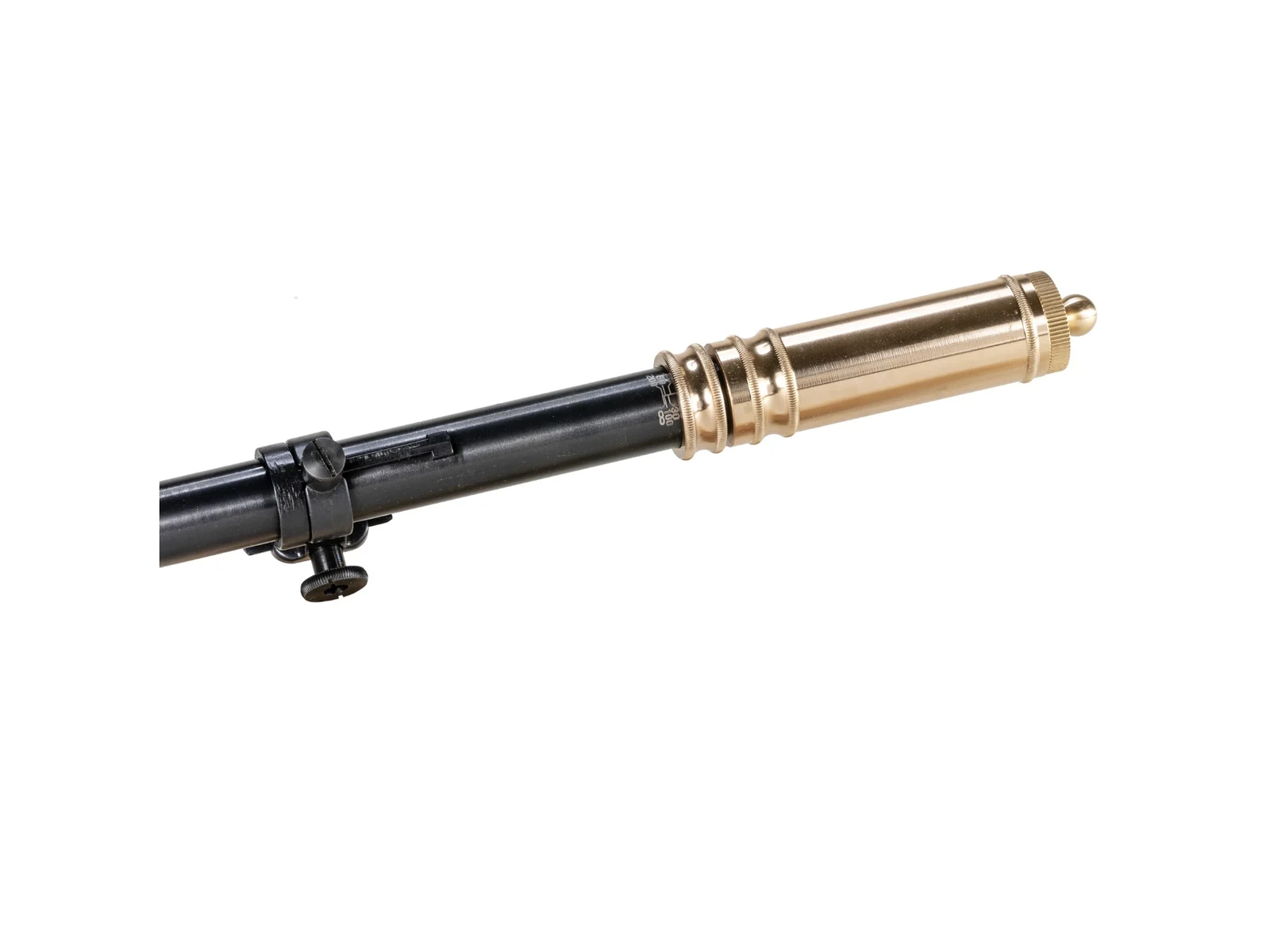
The adjustable-parallax version is configured primarily around fixed 6X magnification, a narrow 3/4-inch tube, a 17 mm objective lens, and an externally adjustable BPCR-style mounting arrangement. Its traditional two-tone appearance combines darker metal surfaces with brass-colored objective and eyepiece components.
Fixed 6X Optical Configuration
A fixed 6X magnification system is used rather than a variable-power mechanism. Consequently, magnification remains constant during observation. This relatively simple optical arrangement is consistent with the traditional character of the Malcolm design while avoiding additional variable-power components.
The objective lens measures 17 mm, while the listed field of view is approximately 12 feet at 100 yards. Eye relief is specified at approximately 4.5 inches for the current adjustable-parallax short model.
Optical Specifications
Key published specifications include:
- Magnification: 6X fixed
- Objective lens diameter: 17 mm
- Tube diameter: 3/4 inch
- Field of view: approximately 12 ft at 100 yards
- Eye relief: approximately 4.5 inches
- Reticle: fine cross / fine crosswire configuration
- Illumination: non-illuminated
- Adjustment system: MOA-based external mounting system
- Nominal adjustment value: approximately 1/4 MOA with the specified mount spacing
- Parallax adjustment: approximately 10 yards to infinity
- Approximate length: 18.5 inches
- Approximate weight: 23 oz
These figures correspond to the current adjustable-parallax two-tone short telescope rather than the separate fixed-parallax 18-inch Malcolm model.
Adjustable Objective and Parallax Control
One of the distinguishing characteristics of this version is its adjustable objective lens.
According to Hi-Lux, parallax can be adjusted from approximately 10 yards to infinity. This differs from the standard fixed-parallax versions of some Malcolm 6X scopes and allows the optical system to be set for different observation distances.
Understanding the Adjustable-Parallax Design
Parallax occurs when the apparent relationship between the reticle and target image changes as the observer’s eye moves away from the optical centerline. An adjustable objective changes the optical focus relationship so that the target image and reticle can be brought closer to the same focal plane at a selected distance.
On this Malcolm model, the adjustable-objective arrangement is incorporated without changing the historically styled external format substantially. As a result, the scope retains its long, narrow profile while providing functionality normally associated with more contemporary optical systems.
BPCR-Style External Adjustment Mounts
Rather than using the large internal elevation and windage turrets typical of many modern scopes, the Malcolm 6X uses an external micrometer-style mount system.
Hi-Lux states that the mount can provide approximately 1/4 MOA adjustment when the front and rear mounting points are positioned 7.250 inches center-to-center. Indexed markings are provided on the adjustment stems so rotational changes can be tracked. A locking screw is also positioned on the rear mounting bracket.
This external adjustment arrangement is central to the historical character of the design.
Mounting Components
The manufacturer lists the supplied components as including:
- Scope body
- Threaded lens covers
- BPCR-style mounts
- Front and rear scope blocks
- Flat-bottom blocks with approximately .860-inch hole spacing
- Sliding lock ring
The adjustable-parallax BPCR configuration uses crescent-style mounting interfaces associated with this version of the Malcolm short telescope.
Sliding Scope and Recoil Management
Another notable mechanical feature is the sliding lock-ring arrangement.
Unlike a completely rigid modern scope installation, this Malcolm-style system allows the optic to move longitudinally under recoil. Hi-Lux describes the sliding lock ring as a mechanism intended to reduce the amount of recoil energy transferred directly through the optic.
After the scope has moved, it must be returned to its starting position, or “battery,” before the next use.
This operating characteristic reflects the external sliding-scope architecture found on certain historical telescopic sights and distinguishes the Malcolm system from conventional fixed-ring installations.
Two-Tone Historical Appearance
The two-tone model uses a visual combination of dark metal and brass-colored components.
Published specifications describe a blued or matte-finished main tube, together with a brass objective housing and brass eyepiece. The narrow 3/4-inch tube and elongated body produce a profile quite different from contemporary large-objective optics.
The design therefore places considerable emphasis on maintaining the appearance associated with older telescopic sight systems.
Modern Materials Behind a Traditional Design
Although the appearance is historically influenced, the current production scope is not constructed as an exact nineteenth-century optical reproduction.
Hi-Lux states that modern Malcolm scopes use improved metallurgy, machining processes, and contemporary optical coatings. Retailer documentation also identifies fully multicoated HD lenses as part of the current optical design.
These changes are intended to provide modern optical performance within a format patterned after early telescopic sights.
Fine Crosswire Reticle
The scope is generally supplied with a fine cross or fine crosswire reticle.
This reticle arrangement consists of thin intersecting reference lines rather than the illuminated, ballistic, Christmas-tree, or digitally enhanced reticle patterns commonly found in newer tactical optics.
Because the scope is non-illuminated, visibility depends on available ambient light and contrast between the reticle and observed background.
Dimensions and Physical Configuration
The adjustable-parallax two-tone short model is listed at approximately 18.5 inches in overall length and around 23 ounces in weight.
Its 3/4-inch tube diameter is substantially narrower than common modern 1-inch, 30 mm, or 34 mm optic tubes. Accordingly, standard contemporary scope rings should not automatically be assumed to be compatible.
Mounting requirements should instead be checked against the specific Malcolm BPCR blocks and mount configuration supplied with the scope.
Included Equipment and Maintenance Considerations
Threaded lens covers are supplied to protect the optical surfaces when the scope is not being used. The external adjustment mechanism and sliding interface should also be kept clean so that their movement is not obstructed by dirt or debris.
Optical surfaces should be cleaned with materials intended for coated lenses rather than abrasive fabric or aggressive solvents.
Because this model uses specialized mounts, users should also verify block spacing, screw dimensions, mounting-surface geometry, and compatibility with the specific equipment on which the telescope will be installed.
Summary
The Hi-Lux Malcolm 6X Two Tone Parallax Adjustable BPCR Scope is a fixed-power telescope built around a historically styled Malcolm configuration. Its principal characteristics include 6X magnification, a 17 mm objective lens, 3/4-inch tube, approximately 4.5 inches of eye relief, adjustable parallax from roughly 10 yards to infinity, a fine crosswire reticle, external BPCR micrometer mounts, and a sliding recoil-management arrangement.
Its two-tone brass-and-dark-metal appearance reflects the design language of early telescopic sights, while modern multicoated optics, improved materials, and contemporary machining are incorporated into the current production version. Consequently, it represents a specialized combination of traditional scope architecture and modern optical manufacturing rather than a conventional contemporary riflescope.
Practical Use Scenario
The Hi-Lux Malcolm 6X Two Tone Parallax Adjustable BPCR Scope is best understood in the context of traditional rifle configurations where historical appearance, fixed magnification, external adjustment, and deliberate observation are important parts of the overall setup. Rather than following the layout of a modern high-magnification optic, this scope uses a long, narrow tube, a fixed 6X optical system, and an externally adjusted mounting arrangement. Consequently, its practical use tends to involve a slower and more methodical approach.
A typical scenario may involve a historically styled black-powder cartridge rifle or another compatible traditional rifle platform equipped with the appropriate mounting blocks. Before use, the scope would generally be checked to confirm that the mounting components are properly seated, the external adjustment mechanism moves correctly, and the sliding scope body is positioned in its normal starting location.
Because the optic uses fixed 6X magnification, the field of view and apparent target size remain consistent. This can simplify the viewing process because the user does not need to decide which magnification setting is appropriate before observation begins. At the same time, the fixed-power configuration requires the user to work within the optical characteristics of the scope rather than changing magnification to compensate for distance or target size.
Initial Setup and Optical Adjustment
A practical session would normally begin with attention being given to the optical setup.
The adjustable objective allows the image and reticle relationship to be refined for the approximate observation distance. If the subject being viewed is relatively close, the objective can be adjusted accordingly. For greater distances, the parallax setting can be moved toward the farther end of its adjustment range.
This process is especially useful because parallax error can become more noticeable when precise reticle alignment is important. By matching the optical adjustment more closely to the intended distance, apparent reticle movement caused by changes in eye position can be reduced.
Once the parallax setting has been established, eye position becomes the next consideration. The listed eye relief of approximately 4.5 inches provides a reference point for positioning the observer’s head behind the eyepiece. A consistent cheek position and viewing angle help produce a full circular image rather than a partially shadowed view.
In practical terms, the user may need several moments to establish a repeatable head position, particularly if they are accustomed to modern optics with larger exit pupils or wider ocular assemblies.
Using Fixed 6X Magnification
The fixed 6X configuration plays a major role in how the scope behaves during normal use.
At moderate distances, 6X magnification can provide enough enlargement to distinguish details more clearly than with an unmagnified sight, while still preserving a reasonably usable field of view. Since there is no magnification ring, the visual relationship between the reticle and the observed subject remains predictable from one session to another.
That consistency can be particularly useful when the optic is used repeatedly on the same rifle and under similar conditions. The user becomes familiar with how much of the visual field is occupied by a particular reference point at a given distance.
However, fixed magnification also means that close observation can feel more restrictive than with a lower-power optic. Conversely, very distant observation will not receive the additional enlargement available from modern variable scopes. Therefore, the 6X system is most naturally suited to users who are comfortable working within a moderate and constant optical scale.
External Elevation and Windage Adjustment
One of the most distinctive practical characteristics is the external adjustment system.
Instead of making corrections through enclosed internal turrets, the optic uses external mechanical mounts. This arrangement changes the physical relationship of the scope tube rather than relying solely on an internally moving optical assembly.
In use, elevation and windage corrections are made through the mount’s adjustment controls. Indexed markings make it possible to record or reproduce changes with greater consistency. Because the mechanism is external and mechanical, users can visually inspect the adjustment system as it is being operated.
A practical approach is to make measured changes rather than large, arbitrary adjustments. After each change, the new setting can be observed and, where appropriate, recorded. This makes it easier to return to a previous position if conditions later change.
The external mounting system also encourages familiarity with the relationship between mount spacing and adjustment value. Since the effective adjustment increment is linked to the physical mounting geometry, correct installation is important before the published adjustment values can be treated as meaningful reference points.
Observation at Different Distances
During a typical day of use, viewing distance may change several times.
For instance, a user may begin by observing a relatively close reference point while checking the optical setup. Later, the scope may be directed toward a more distant point. When this happens, the adjustable objective can be refined so that image sharpness and parallax correction better match the new distance.
Unlike a fixed-parallax optic, the adjustable version gives the user more control over this optical relationship.
The most effective method is generally to treat focus and parallax as separate but related considerations. A visually sharp image is useful, but the user should also check whether the reticle appears to move relative to the observed reference when eye position shifts slightly.
If movement is noticeable, further adjustment may be needed.
This process can become increasingly intuitive with practice. Over time, the user may develop a general sense of where the parallax ring should be positioned for commonly encountered distances.
Working With the Sliding Scope Design
The sliding recoil-management system is another unusual feature when compared with conventional modern optics.
Under recoil, the scope tube is designed to move longitudinally through the mount rather than remaining completely fixed. The purpose of this arrangement is to reduce the amount of recoil force transferred directly through the optic.
After movement has occurred, the scope generally needs to be returned to its starting position before the next use.
This introduces an additional step into the normal operating routine. Rather than immediately continuing, the user must confirm that the scope has returned to the proper battery position. The sliding lock ring provides a reference for this process.
For users who have previously worked only with rigidly mounted optics, the movement can initially seem unusual. However, within the context of this design, the sliding action is an intentional mechanical feature rather than an indication that the mounting system is loose.
Historical-Style Range Sessions
The scope’s appearance and mechanical arrangement make it particularly relevant to historical-style range setups and traditional shooting disciplines where period-inspired equipment is commonly used.
In such a setting, the optic contributes visually as well as mechanically. The long tube, brass-colored components, external mount, and fine reticle produce an experience that differs noticeably from using a modern tactical optic.
A user may begin the session by checking the mounting screws and scope blocks. The scope body can then be inspected to ensure that it slides freely and returns correctly. Lens surfaces should be checked for dust or fingerprints, while the objective adjustment can be positioned near the anticipated observation distance.
Once the optical image is clear, the external mount settings can be confirmed.
Because the reticle is a fine crosswire rather than a thick illuminated pattern, sufficient ambient light is helpful. Against a bright or evenly contrasted background, the fine lines can remain easy to distinguish. Under darker or visually cluttered conditions, however, the thin reticle may require more careful viewing.
This is one reason why the optic’s practical character is often associated with deliberate daytime use rather than low-light observation.
Fine Crosswire Reticle in Use
The fine crosswire reticle provides a relatively uncluttered visual reference.
Rather than covering a large portion of the image with thick markings, the thin intersecting lines leave much of the field of view unobstructed. This is particularly useful when the user wants to observe small details without a complex reticle pattern dominating the image.
At the same time, a fine reticle depends more heavily on contrast.
Against a dark background, shaded area, or visually complex landscape, the lines may not stand out as clearly as a thicker reticle would. Therefore, users should take lighting and background conditions into consideration before relying on the reticle for precise visual reference.
Because the reticle is not illuminated, no batteries or brightness controls are required. This simplifies the optical system and keeps the operating procedure entirely mechanical.
Repeating Known Settings
Another practical advantage of an externally indexed mount is the ability to record known settings.
If a particular combination of elevation and windage adjustment corresponds to a repeatable observation distance, that setting can be written down. Later, the mount can be returned to approximately the same position.
This type of record-keeping is particularly useful for users who regularly work at several known distances.
A notebook or simple reference card can be used to document the position of the external adjustments, the approximate parallax setting, environmental conditions, and any relevant observations. Over multiple sessions, these records can make setup faster and more consistent.
The process is mechanical and straightforward, but it depends on the mount being installed correctly and the scope maintaining consistent positioning.
Transport and Storage
Practical use also includes proper transport.
Because the optic has a long and narrow body, care should be taken to avoid placing heavy pressure on the scope tube or external mounts while the rifle or optic is being transported. Threaded lens covers can help protect the optical surfaces from dust, fingerprints, and accidental contact.
The external adjustment components should also be protected from impacts that could alter their position or interfere with movement.
Before storage, visible moisture should be removed from external metal surfaces. Lens surfaces should only be cleaned when necessary and with suitable optical materials. Excessive wiping can introduce unnecessary wear to coatings, especially if dust has not first been removed.
If the equipment has been used in a dusty environment, the sliding surfaces and exposed mount components should be examined before the next session. Debris around these areas could affect smooth mechanical movement.
Seasonal and Environmental Considerations
Environmental conditions can influence the way any optical system performs.
Temperature changes may produce temporary fogging if equipment is moved rapidly between cold and warm environments. Moisture can also collect on exposed metal components. In dusty locations, fine particles may settle on the objective lens, eyepiece, or sliding interfaces.
For this reason, practical use involves more than simply looking through the optic.
Routine inspection is important. The user should confirm that the objective rotates normally, the external mount controls are not obstructed, and the scope body can move through its intended sliding range.
Direct exposure to rain or heavy moisture should be followed by drying and inspection before extended storage.
Compatibility Checks Before Regular Use
Because the scope does not use a conventional modern ring system, compatibility should be confirmed carefully.
The supplied mounting blocks, their spacing, the rifle’s mounting surface, and screw-hole arrangement all affect installation. Users should avoid assuming that a rifle compatible with modern one-inch or 30 mm rings will automatically accept this system.
A correct mechanical fit is important not only for stability but also for maintaining the intended external adjustment values.
If the mounting block spacing differs significantly from the specified reference arrangement, the relationship between mechanical movement and angular adjustment can also change.
Therefore, dimensions and hardware should be checked before the scope is used regularly.
Routine Practical Inspection
A simple inspection routine can help maintain consistent function.
Before each session, the user can check that the mounting screws remain secure, the external adjustments operate smoothly, and the sliding ring remains in the expected position. Lens surfaces can be examined under indirect light for dust or smudging.
After use, the same areas can be inspected again.
This habit is particularly useful because the design has several exposed mechanical components. Unlike a fully enclosed modern turret system, the external mount makes its moving parts more visible and accessible.
Element Optics Scopes, Rangefinding Technology, Mounts, and Precision Optic Options
For shooters comparing modern precision optics, element theos has become an important search term, especially for people researching the theos scope and premium long-range configurations such as element theos 6-36, 36×56, and element theos 6 36×56. At the same time, more versatile configurations including element optics 2-10, element 2-10 scope, and element 2 10 scope appeal to users who prefer a wider balance between close-range visibility and higher magnification. Across the broader product family, element helix, element scopes, and related models give buyers several magnification, reticle, and mounting configurations to consider.
When researching an optics-focused scopes website, customers often compare element tactical products with equipment from another optic scope manufacturer. Product searches may also include element prism, titan scope, op element, and helix scope, particularly when comparing compact optics with traditional variable-power designs. Higher magnification options such as element optics 6-24×50 can suit users who prioritize a detailed sight picture and substantial adjustment range.
The premium range also includes the nexus scope, element nexus scopes, and broader nexus scopes category. Searches for nexus tactical equipment frequently lead buyers toward the nexus 4-25×50, while the element titan provides another recognizable alternative. Users comparing a 5-25 scope, 25/56, titan 5, or theos 2-10 generally look closely at optical clarity, turret construction, reticle layout, focal-plane configuration, adjustment tracking, and overall build quality. Consequently, search phrases such as element titan 5 25×56 ffp review and titan25 are commonly associated with buyers researching the Titan platform in greater detail.
Another frequently researched configuration is the element helix 6 24×50, particularly alongside the element nexus gen 2. Although these optics occupy different positions within a product range, potential buyers often compare their specifications before choosing an appropriate design. Reticle selection is equally important, which explains continued interest in rifle scope reticles, while electronic tools such as a ballistic rangefinder can complement a modern optic setup. Some search queries also contain unusual specification formats such as 12×4/2, so checking the manufacturer’s exact specifications remains important before interpreting any numerical value.
Versatile magnification searches commonly include 2-12 scope and 2×12 scope. Meanwhile, terms such as element vision, spectrum element, and even prismatic scale of the elements can appear alongside optics-related searches. A prismatic scope differs structurally from a conventional variable-power riflescope because it uses a prism-based optical system rather than the same internal lens arrangement typically associated with traditional scope designs. Searches for element 3.0 may likewise refer to product generations, technical updates, or model-specific terminology, depending on the context.
Technology-focused users may also investigate element rf and element range products. Within the variable-power category, element theos 2-10 and element theos 2 10 provide alternative search formats for the same general magnification class. Similarly, element 2-10, 10 optic, 2-10 optic, and 2-10x scope describe configurations shoppers may encounter while comparing compact and medium-range optics. Buyers interested in first-focal-plane systems may specifically search for a 2-12 scope ffp, while terms such as fffp 2 can appear as alternate or mistyped search variations.
The Helix family attracts additional attention through searches for helix hd 2 16×50 and hdlr, whereas Titan users frequently research element titan 3 18×50 and element titan 3-18×50. These mid-range magnification configurations can provide a useful compromise between field of view and target detail. The Theos family is also represented by theos 2-10×42 ffp, which combines a practical magnification range with first-focal-plane terminology commonly sought by experienced optics buyers.
Search specifications such as 10×40, .10×40, and 14×50 may describe magnification and objective-lens formats, although exact interpretation should always be checked against official product information. People asking what is a prismatic scope are generally trying to understand how prism optics differ from traditional scope architecture. As with the phrase prismatic scale of the elements, search-engine terminology can occasionally mix scientific and optical expressions, so context matters when evaluating results.
Another product-related term is element hyper 7, together with searches for hqp7-rf-2 specifications details. Users researching newer optical or rangefinding systems may encounter these model codes while comparing technical features, dimensions, mounting options, display systems, or rangefinding capability. The terms element ll and 3×18 can also appear in searches associated with optics or magnification specifications.
For users focused specifically on the 3-18 magnification class, search phrases include 3-18 scopes, 3-18, nightforce 3-18, best 3-18 scopes, and 3×18 scope. Even unusual formatting such as 3:18 may be entered when shoppers are trying to locate comparable models. Regardless of brand, important evaluation factors include image resolution, eye relief, turret repeatability, mechanical reliability, reticle visibility, and low-light performance.
Optical quality also involves controlling distortion and color fringing. Therefore, someone researching chromatic aberration scope performance may be evaluating how effectively a particular optic manages unwanted color separation around high-contrast objects. Better glass, coatings, internal design, and manufacturing tolerances can all influence perceived image quality.
Scope Mounts, Rings, Rangefinders, and Accessory Compatibility
A precision optic also depends on a reliable mounting system. Searches for element mount, dovetail scope mount, and dovetail rings usually reflect the need to match an optic to the appropriate rail or receiver interface. Correct ring diameter, mounting height, rail type, and clearance should always be verified against the optic and platform specifications before purchase.
Electronic rangefinding accessories have expanded the number of configurations available. A picatinny mounted rangefinder or picatinny range finder can be mounted on compatible rail systems, while a rifle rangefinder provides distance information separately or as part of an integrated setup. Search phrases such as weapon mounted range finder, laser range finder for rifle, and rifle range finder generally refer to compact ranging technology intended to provide distance measurements.

Integrated technology has also increased interest in scopes with rangefinders built in, a rangefinder scope for rifle, and a rangefinding rifle scope. These products can combine optical magnification with electronic distance measurement in a single system. Buyers may encounter abbreviations such as wmlrf, while searches for a weapon mounted ballistic calculator or arken wmlrf usually indicate interest in systems that combine ranging information with additional electronic calculations or data.
Mounting accessories deserve equal attention because stability and alignment influence the overall optic installation. A 34mm diving board mount can provide an accessory mounting surface above or around a compatible optic. Similarly, a 34mm scope mount with diving board combines the primary scope mounting structure with an additional accessory interface. The broader term diving board scope mount is frequently used when researching this style of configuration.
Smaller tube systems may use a 30mm diving board mount, while scope diving board searches often refer to elevated accessory rails designed to position compatible devices above an optic. Traditional mounting searches also include picatinny scope rings, 30mm scope mount picatinny, 30mm picatinny scope rings, and picatinny scope mounts. Matching the correct ring diameter and rail standard is essential because a 30mm tube, 34mm tube, dovetail rail, and Picatinny interface are not interchangeable without the appropriate hardware.
Protection is another important consideration once an optic has been mounted. tenebraex scope caps and tenebraex scope covers can help protect exposed lenses when compatible with the selected optic. A flexible allen neoprene scope cover provides another style of external protection for storage and transport. Users running dovetail systems may instead be comparing 30mm dovetail scope rings with other dovetail scope mounts.
Ultimately, choosing between Element Optics families requires more than comparing magnification numbers alone. Whether researching Theos, Helix, Titan, Nexus, Prism, RF technology, rangefinding equipment, or mounting accessories, buyers should evaluate optical clarity, reticle design, adjustment range, focal-plane configuration, tube diameter, rail compatibility, physical dimensions, protective accessories, and manufacturer specifications. Doing so makes it easier to identify an optic and mounting system that properly matches the intended application while avoiding compatibility problems caused by relying solely on product names or search terminology.
That visibility can make inspection straightforward.
Overall Practical Character
In practical use, the Hi-Lux Malcolm 6X Two Tone Parallax Adjustable BPCR Scope offers an experience centered on fixed magnification, mechanical adjustment, deliberate setup, and traditional optical styling.
The user works with a constant 6X view, adjusts parallax manually, operates external elevation and windage controls, monitors the sliding scope position, and relies on a fine non-illuminated reticle.
These characteristics create a noticeably different operating routine from that of modern variable-power optics.
Rather than emphasizing electronic functions, illuminated displays, large objectives, or complex reticles, the scope is built around simple optical magnification and externally visible mechanical control.
For users working with compatible traditional rifle configurations, historical reproductions, or BPCR-oriented setups, understanding these mechanical and optical characteristics is essential to using the scope correctly and consistently.
The most effective practical approach is therefore based on careful installation, repeatable positioning, measured external adjustment, appropriate parallax correction, routine inspection, and familiarity with the scope’s sliding operation.
Once these procedures become familiar, the optic’s behavior becomes predictable and its distinctive historical-style operating system is easier to manage during regular range use.



Reviews
There are no reviews yet.