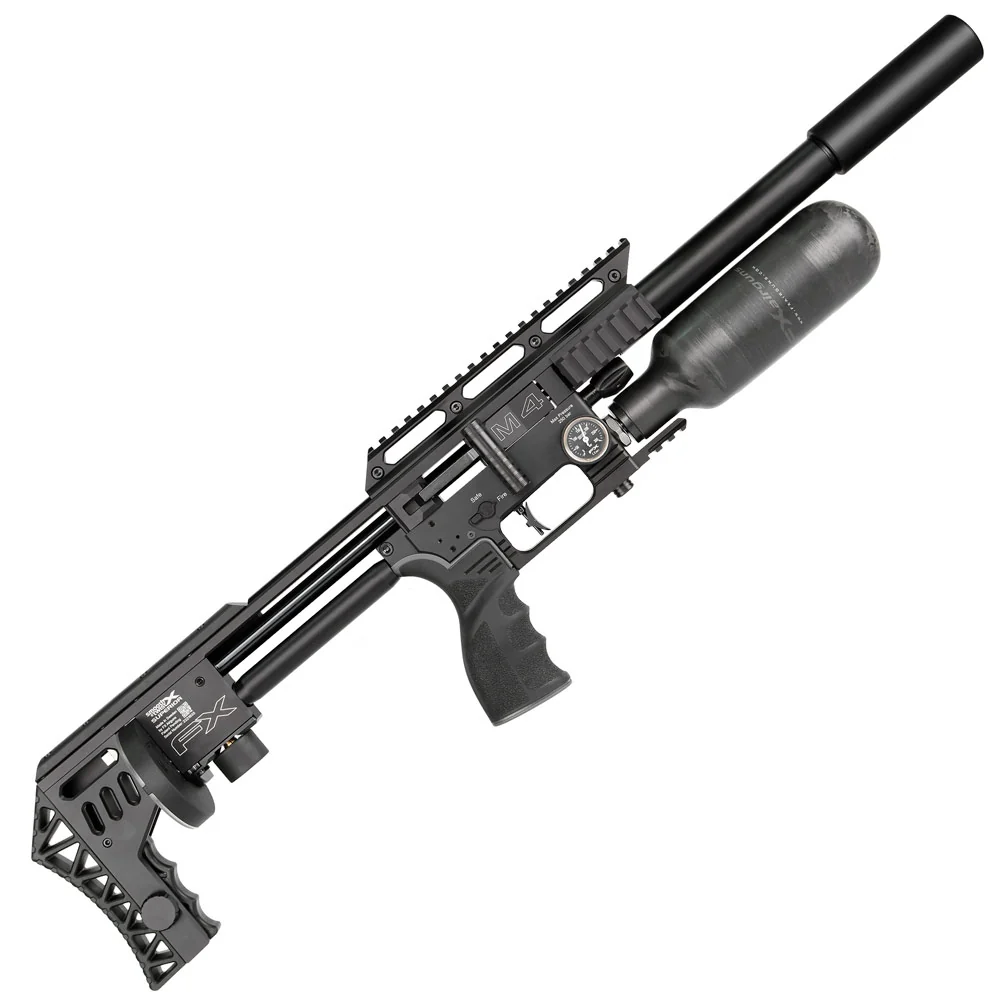
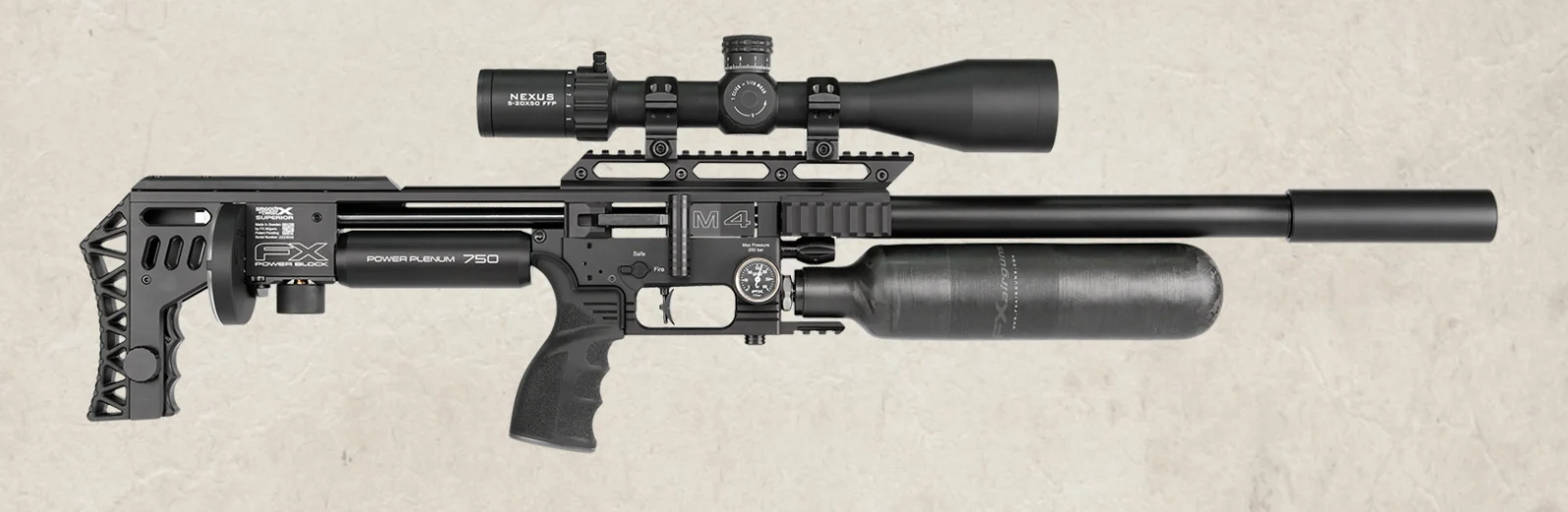
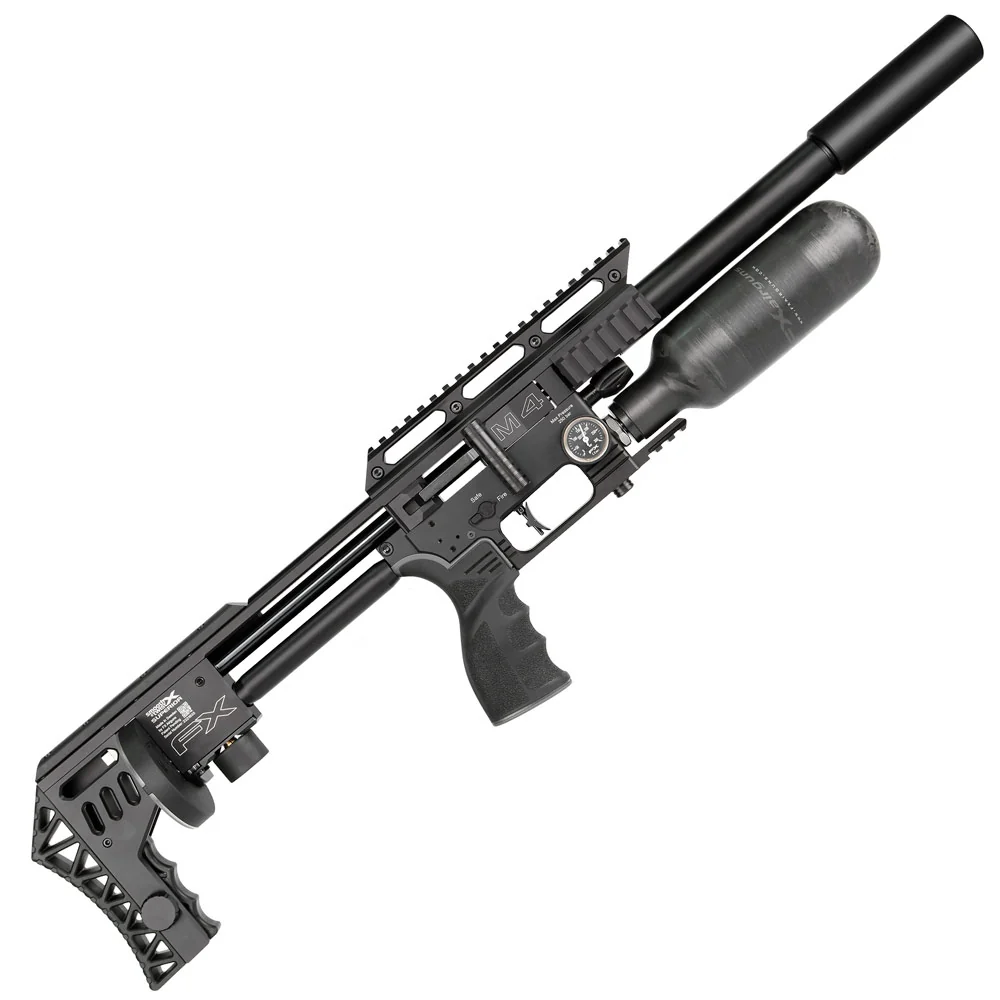
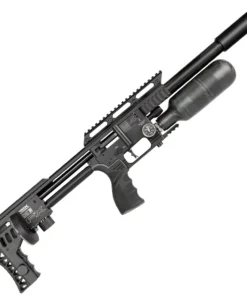
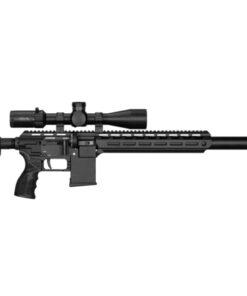
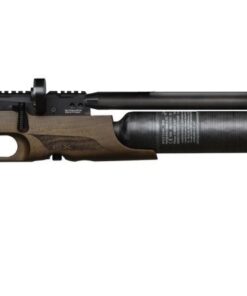
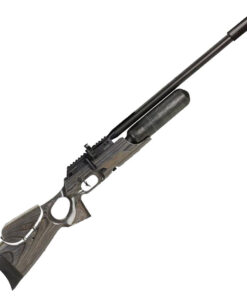
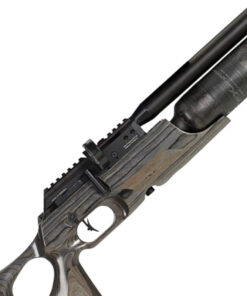
Precision, consistency, and modular performance are delivered by the FX Impact M4 Standard Black
Fourth-generation Swedish PCP platform engineered so that demanding target, hunting, and field applications can be met from a compact bullpup chassis. Consequently, an iconic Impact silhouette is retained while rigidity, magazine reliability, regulation, and trigger versatility are improved throughout. Moreover, a balanced 600 mm Superior STX barrel, 480 cc carbon-fiber reservoir, and externally tunable architecture are combined so that power, shot count, and accuracy can be tailored without the rifle becoming unwieldy.
A Refined Standard Configuration Built for Everyday Dominance
An overall length of approximately 860 mm (34 in) and a weight of about 3.1 kg (6.85 lb) are achieved in the Standard layout. Therefore, a full-length 600 mm Superior STX liner is housed without the extra bulk of Sniper or Extended barrels. In addition, a carbon-fiber-wrapped 480 cc cylinder filled to 250 bar is paired with a Power Plenum 750 so that a substantial regulated air buffer is kept behind the valve. As a result, both pellet and slug ammunition can be driven efficiently across available calibers.
Furthermore, a thicker top plate is incorporated so that chassis stiffness is increased and a long 11 mm dovetail is provided. Subsequently, a 30 MOA Picatinny rail can be slid, clamped, and realigned for ideal eye relief. Meanwhile, side and underside Picatinny sections are offered so that bipods, lights, and other accessories can be mounted by shooters of every discipline.
Trigger, Grip, and Controls Designed for All Hands
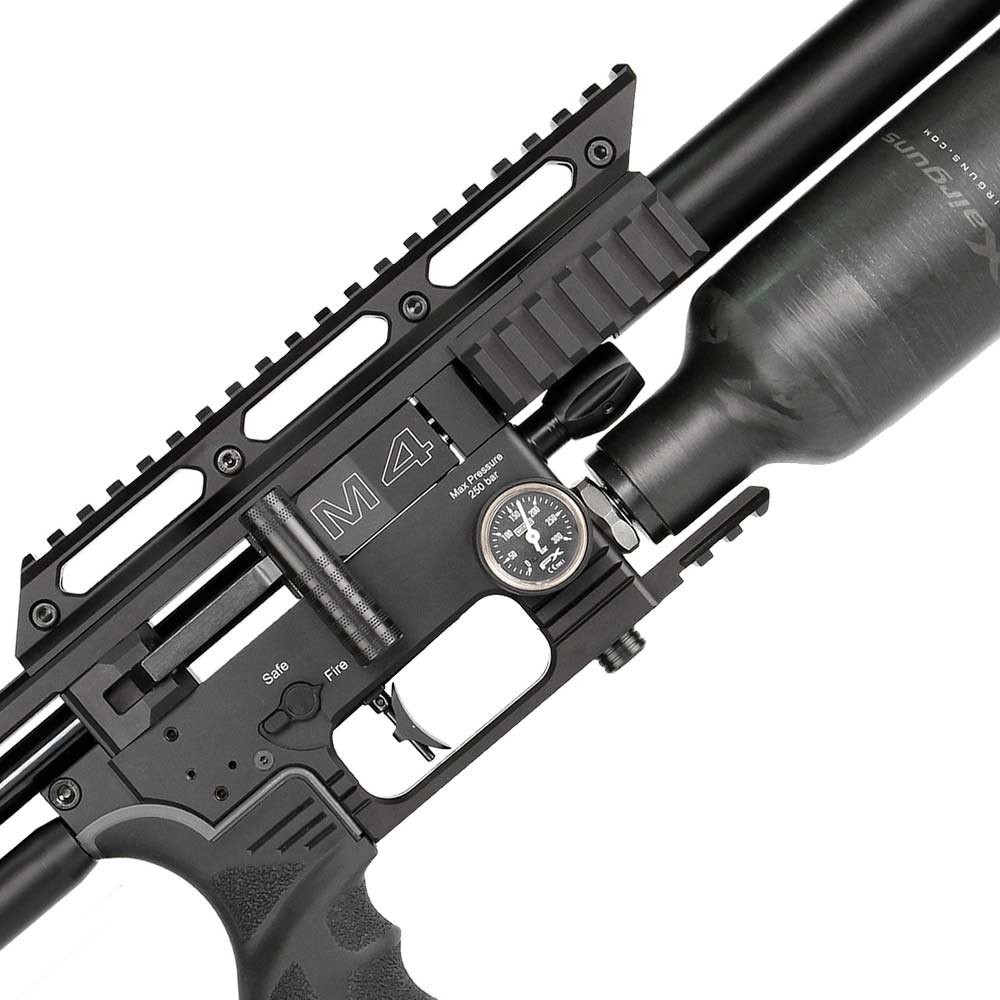
A Quick Set Trigger unit is fitted so that Standard, Hunter, or Match-grade characteristics can be selected with a single screw adjustment. Additionally, blade reach, height, and rotation can be refined. Consequently, a predictable hunting pull or a light, crisp competition break can be obtained without tools beyond that one adjustment.
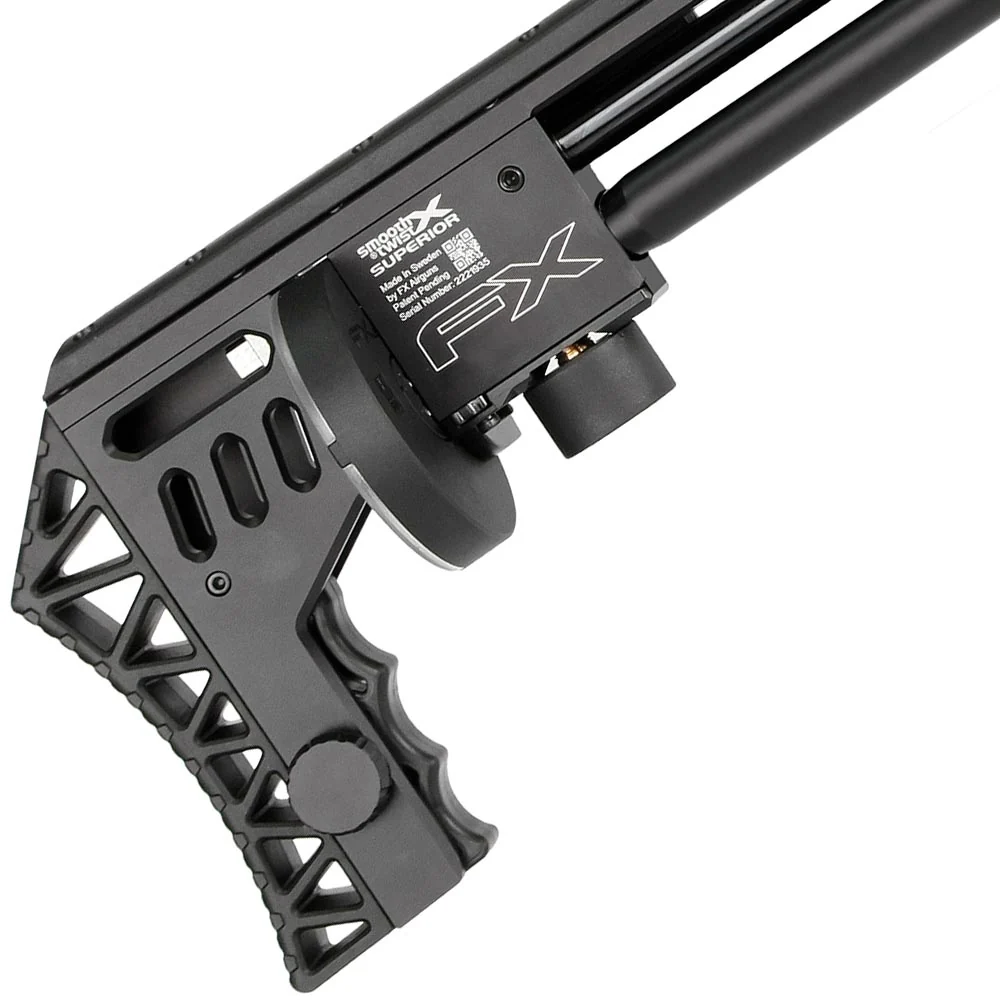
An FX UG1 AR15-style grip and a vertically adjustable recoil pad are supplied so that comfort is improved for a wide range of body types and shooting positions. Likewise, a reversible smooth side lever and switch-style safety are arranged so that left- and right-handed operation is supported. Thus, inclusive handling is built into the chassis rather than added as an afterthought.
Highlight Product Listings
- Barrel & liner: 600 mm Superior STX (interchangeable-caliber system available)
- Overall length / weight: ~860 mm / ~3.1 kg (Standard Black)
- Air system: 480 cc carbon-fiber bottle, 250 bar fill, Foster QD
- Regulator: Brass-piston AMP MkII (working pressure up to ~170 bar)
- Plenum: Power Plenum 750 (~75 cc regulated buffer)
- Trigger: Quick Set — Standard / Hunter / Match via one screw
- Optics: 30 MOA Picatinny on 11 mm dovetail plus accessory rails
- Magazine capacities: 34 (.177), 28 (.22), 25 (.25), 23 (.30), 18 (.35)
- Typical FAC shot counts (approx.): up to ~375 (.177), ~330 (.22), ~160 (.25), ~105 (.30), ~45 (.35)
- Grip & stock: FX UG1 AR15-style grip, adjustable recoil pad
- Cocking: Reversible smooth side lever
- Finish: Standard Black tactical chassis
- Gauges: Dual WIKA-style bottle and regulator readouts
- Muzzle: Shrouded; commonly ½-UNF threaded for a moderator (market-dependent)
Calibers, Power, FAC Options, and Accessories
Multiple chamberings from .177 through .35 are offered on the same modular platform. Therefore, a liner and magazine change (where supported) can be completed so that the same rifle can be adapted from high-count target work to heavier hunting projectiles. Maximum published FAC energies (often quoted with slug kits and longer barrels) reach roughly 35 ft-lbs in .177, 87 ft-lbs in .22, 100 ft-lbs in .25, 125 ft-lbs in .30, and higher in .35; Standard 600 mm setups still deliver serious field performance when legally configured.
Moreover, Quick Tune macro and micro hammer-spring wheels, plus a valve-flow adjuster, are provided so that velocity can be fine-tuned in small steps. In many .22/.25 examples a dual transfer-port arrangement is used so that pellet or slug flow can be selected. Meanwhile, high-capacity POM magazines with a revised drum mechanism are specified so that even heavy slugs can be cycled more smoothly than on earlier generations.
Accessories commonly paired with the FX Impact M4 Standard Black include extra magazines, slug power kits, barrel liners, moderators, 30 MOA rail positions, compressors or hand pumps rated to 250 bar, and quality optics matched to the 30 MOA rail. Legal power limits (including UK sub-12 ft-lbs variants with shorter liners where required) must always be observed; local licensing and FAC rules apply.
Practical Use Across Disciplines
Field hunting and pest control are supported because a compact bullpup balance, high magazine capacity, and regulated consistency are combined. Consequently, follow-up shots can be taken from hides, vehicles, or walking positions without a long conventional action. Likewise, HFT, benchrest practice, and steel or paper targets benefit from the STX liner, rigid top plate, and match-capable trigger.
Furthermore, range sessions of several hundred shots per fill (especially in smaller calibers at moderate settings) can be completed before a refill is required. In addition, the carbon bottle can be swapped or topped via Foster QD so that downtime is reduced. Therefore, both weekend plinking and serious competition preparation can be served by one configurable rifle.
Maintenance is simplified because gauges, external regulator access, and a modular liner system are present. Nonetheless, correct fill pressure, dry air, and periodic inspection of o-rings, magazines, and the regulator are required so that consistency is preserved. Responsible storage, muzzle discipline, and compliance with all airgun laws remain essential for every owner.
Why the FX Impact M4 Standard Black Continues to Convert Serious Shooters
Swedish engineering heritage is expressed through incremental but meaningful upgrades: a stronger magazine, brass-piston regulator with faster refresh, stiffer top plate, and a one-screw Quick Set Trigger. As a result, the platform that already defined modern modular PCP rifles is refined rather than reinvented. Inclusive, ambidextrous controls and a mid-size Standard envelope mean the rifle can be shared, transported, and shot comfortably by a wide community of enthusiasts.
Conversion follows when reliability, shot-to-shot consistency, and future-proof modularity are valued together. Optics, slugs, extra liners, and power kits can be added later; the core chassis is already prepared. Shoppers seeking a black-finished, 600 mm Standard Impact M4 are therefore offered a complete, tunable system rather than a fixed-power sporting rifle.
Ready-to-order packages typically include the rifle, at least one magazine, and a fill adapter; hard cases and moderators vary by retailer and jurisdiction. Verify caliber, power rating, and legal status before purchase so that the FX Impact M4 Standard Black that arrives matches the intended use—and then let regulated Swedish precision do the rest.
FX Airguns, PCP Air Rifles, Hatsan Models and Modern Airgun Platforms
Modern airguns cover a wide range of platforms, from a basic pellet gun or BB gun to sophisticated regulated PCP airguns designed for target shooting, sporting applications, and long-range precision. Buyers researching an air rifle and air pistol collection will often encounter manufacturers such as FX and Hatsan because both companies offer extensive selections of air rifles, accessories, configurations, and caliber choices.
FX Airguns Sweden and the FX PCP Rifle Range
FX Airguns has become strongly associated with Swedish airgun engineering. Searches for fx airguns sweden, fx airguns sverige, fxairguns, and fx usa commonly lead enthusiasts toward the manufacturer’s extensive PCP lineup. In the American market, fx airguns usa is another widely searched phrase when people are researching available models, specifications, support, and accessories.
Among fx air rifles, the Impact family remains particularly recognizable. Searches frequently include fx impact, f x impact, fx impact m4, fx m4, impact m4 air rifle, and impact m4 500mm when comparing current configurations. The modular design philosophy associated with the Impact platform has helped make the fx air rifle range popular among shooters who appreciate adjustability and configurable PCP systems.
Earlier generations remain widely researched as well. The fx impact m3, impact m3, fx impact mk3, fx m3, and fx m3 airgun continue to attract attention from owners comparing generations or researching replacement components.
Caliber-specific searches include fx impact m3 .22cal air rifle, fx impact m3 .22cal air rifle. 600mm barrel, and the more general fx impact m3 air rifle. People comparing international pricing may also search fx impact m3 precio, fx impact m3 precio en usa, or fx impact m3 price before checking local regulations, specifications, and availability.
Beyond the Impact series, the FX catalog includes several distinctive designs. The fx leopard and fx leopard airgun are frequently researched alongside fx leopard .22 pcp specs by users interested in specifications and configuration details.
Other notable searches include fx drs, fx drs tactical, fx drs classic, and fx drs pro. These terms reflect interest in the different DRS configurations and their intended shooting styles.
The wider FX family also includes models such as the fx king, fx wildcat, fx panthera, and fx dreamline. Collectively, these platforms demonstrate the variety available to anyone researching a premium pcp air rifle, pellet rifle, or configurable precision air gun.
Some enthusiasts also search fx outdoors when researching outdoor shooting equipment and related products, while marketplaces and information sources such as guns.com may appear during broader online research.
Understanding Pellet Guns and PCP Air Rifles
A traditional pellet gun uses shaped pellets rather than conventional firearm ammunition. The broader term pellet guns can describe spring-powered, CO₂-powered, pneumatic, and PCP platforms.
A PCP air rifle stores compressed air inside a reservoir. This system can provide consistent pressure across multiple shots depending on the rifle’s regulator, reservoir capacity, caliber, and power configuration.
For shooters comparing ammunition sizes, .177 caliber remains one of the most common options. Larger configurations are also available, including the increasingly searched 30 cal air rifle category.
Some users accidentally search pallet gun when looking for pellet-powered equipment. Regardless of terminology, specifications such as energy output, caliber, barrel length, intended range, and local legal requirements should always be reviewed before use.
The practical range of air rifle platforms varies significantly. Pellet weight, velocity, environmental conditions, barrel design, optics, and shooter technique can all affect useful range and accuracy.
Hatsan Air Rifle and PCP Platforms
The hatsan air rifle lineup covers traditional spring-powered designs as well as modern PCP systems. Searches such as hatsanusa, hatsan usa, hatsan air guns, and hatsan pcp are commonly used by enthusiasts researching the company’s models.
One of the most recognizable platforms is the hatsan blitz. Search variations include hatsun blitz, hatzan blitz, hatsan blitz full automatic, hatsan blitz 30 cal, and hatsan blitz .30 cal. Specifications and legal classifications can vary by market, so owners should verify the rules applicable in their jurisdiction.
Another frequently researched model is the hatsan model 95, also searched as hatsan mod 95 and mod 95. This traditional air rifle platform remains familiar to shooters interested in conventional stock designs.
The hatsan 125 is another established model, while the hatsan 135 family attracts shooters researching powerful spring-piston platforms. Related searches include hatsan 135 vortex air rifle, hatsan 135 carnivore, and hatsan big bore carnivore rifle.
Hatsan Sortie, BullBoss and Bullpup Designs
Compact and semi-automatic PCP designs form another part of Hatsan’s catalog. The hatsan sortie is commonly researched alongside hatsan sortie tact, hatsan sortie tact semi-auto pcp, and hatsan sortie accessories.
Bullpup enthusiasts may encounter the hatsan bullboss, bullmaster, and hatsan hercules bully. Their compact layouts are designed to reduce overall length while maintaining useful barrel dimensions.
Other PCP models include the hatsan flash, hatsan flashpup qe, and hatsan invader. These rifles provide additional choices for people comparing conventional and bullpup PCP configurations.
Hatsan Hercules, Piledriver and Large-Caliber Platforms
For people researching larger airgun platforms, hatsan hercules and hatsan piledriver often appear in search results. Large-bore air rifles differ considerably from standard .177 and .22 pellet rifles in projectile size, power output, air consumption, and intended application.
The hatsan harpoon is associated with specialized projectile launching, while an arrow launcher represents another distinct air-powered category. Such equipment can be subject to different legal rules depending on location, so local regulations should be checked before ownership or use.
Additional Hatsan Models
The Hatsan catalog extends well beyond its best-known rifles. The hatsan airtact and hatsan airtact air rifle provide another entry point into the brand’s conventional rifle selection.
Other searches include hatsan zada, hatsan neutron star, hatsan factor rc, hatsan velox, and hatsan jet 2. Each platform serves a somewhat different role, making specifications such as caliber, reservoir capacity, operating system, barrel configuration, and overall dimensions important comparison points.
Shoppers researching discounted equipment may also encounter hatsan refurbished listings or broader searches for refurbished air rifles. Condition, warranty coverage, seals, regulators, reservoirs, and service history should be checked carefully when evaluating previously used or factory-refurbished equipment.
Airgun Optics, Pellets and Accessories
Accessories can significantly affect how an air rifle is configured. A compact 4×20 optic may suit basic shooting applications, while more advanced PCP rifles are frequently paired with adjustable optics.
Pellet choice also matters. Products such as h&n field target trophy bleifrei provide an option for shooters specifically researching lead-free projectile designs. Pellet diameter, weight, head size, and barrel compatibility should all be considered when evaluating accuracy.
Terms such as econ ii may also appear when researching airgun-related equipment and accessories. Compatibility should always be verified against the exact manufacturer, model, and specification rather than relying solely on a product name.
Comparing FX and Hatsan Air Guns
FX and Hatsan approach the modern air rifle market from different directions. FX is particularly well known for highly configurable PCP platforms such as the Impact, Panthera, Wildcat, Dreamline, Leopard, DRS, and King. Hatsan, meanwhile, maintains an exceptionally broad range spanning spring-powered rifles, PCP systems, bullpups, semi-automatic platforms, and larger-caliber airguns.
Whether researching an FX Impact M3, FX Impact M4, FX DRS, Hatsan Blitz, Hatsan Sortie, Hatsan Hercules, or another platform, specifications should be compared carefully. Caliber, operating pressure, reservoir capacity, barrel length, projectile compatibility, optics mounting, overall dimensions, energy output, and regional legal requirements can all influence which configuration is appropriate for a particular lawful sporting or target-shooting application.
Calibres, FAC, Power, and Accessories for the FX Impact M4 Standard Black
A modular calibre architecture is built into the FX Impact M4 Standard Black so that one chassis can be adapted across pellet and slug disciplines. Consequently, .177, .22, .25, .30, and .35 chamberings are supported on the same Standard platform, with magazine capacity, shot count, and energy output scaled to projectile mass and legal power setting. Moreover, interchangeable Superior STX liners and matching high-capacity magazines are specified so that a change of purpose can be completed without a second rifle being purchased. Therefore, target work, pest control, and hunting applications can all be served from a single 600 mm Standard Black configuration when local law permits.
Available Calibres and Magazine Capacities
Smaller projectiles are favoured when maximum shot count and flatter trajectories are required. Thus, a .177 magazine of 34 rounds is provided so that extended range sessions can be completed with minimal interruption. Likewise, a .22 magazine of 28 rounds is offered so that a widely available hunting and competition calibre can be used with strong efficiency from the 480 cc bottle. In addition, a .25 magazine of 25 rounds is supplied so that a popular mid-bore balance of energy and capacity can be retained. Subsequently, a .30 magazine of approximately 23 rounds and a .35 magazine of 18 rounds are fitted so that heavier slugs can still be fed reliably through the revised drum mechanism.
Furthermore, older Side-Shot magazines are generally described as compatible, while the M4 generation uses stronger POM construction and a smoother internal rotation. As a result, even the heaviest slugs intended for FAC setups can be cycled with fewer binding issues than were reported on earlier Impact magazines. Inclusive use is supported because the same loading method and reversible side lever are retained across every calibre option.
FAC, Legal Power, and Energy Output
Power is not a single fixed figure on the FX Impact M4 Standard Black. Instead, regulator pressure, hammer-spring tension (Quick Tune macro and micro), valve flow, transfer-port selection, ammunition type, and barrel liner are adjusted so that output can be matched to jurisdiction and purpose. In many markets a sub-12 ft-lbs (approximately 16 J) configuration is required; where that limit applies, a shorter liner may be specified so that legal compliance is maintained while the Standard chassis and 480 cc bottle are kept.
Where FAC or equivalent high-power permission is held, published maximum energies are typically quoted as up to about 47 J / 35 ft-lbs in .177, 117 J / 87 ft-lbs in .22, 135 J / 100 ft-lbs in .25, 169 J / 125 ft-lbs in .30, and 211 J / 156 ft-lbs in .35. Importantly, those peak figures are commonly associated with slug ammunition, a slug power kit, and often a longer barrel than the Standard 600 mm tube. Consequently, a Standard Black rifle can still deliver serious field performance, yet the absolute catalogue maxima should be understood as platform potential rather than a guaranteed factory setting on every 600 mm gun.
Additionally, a brass-piston AMP regulator with a working pressure capability around 170 bar is installed so that consistency is preserved as bottle pressure falls. A Power Plenum 750 then stores a regulated buffer of roughly 75 cc behind the valve. Therefore, velocity strings remain usable across a high number of shots when the rifle is tuned conservatively. Approximate FAC-oriented shot counts from a 480 cc fill are often listed near 375 in .177, 330 in .22, 160 in .25, 105 in .30, and 45 in .35; lower power settings increase those totals substantially, which is why UK-style sub-12 examples are sometimes credited with several hundred shots per fill in .177 and .22.
Responsible ownership requires that muzzle energy, licensing, transport, and storage rules be verified before any FAC tune is applied. Inclusive language is used here because every shooter—new or experienced, left- or right-handed—is expected to confirm local law rather than copy a published maximum.
Tuning Features That Shape Power
External adjustability is concentrated so that power can be refined without the action being stripped. Hence, Quick Tune wheels allow hammer-spring tension to be moved in coarse steps and then trimmed in fine increments. Meanwhile, a valve adjuster is provided so that airflow can be matched to pellet or slug. On many .22 and .25 examples a dual transfer port is present so that a pellet-optimised or slug-optimised path can be selected by liner orientation. Dual gauges then display bottle and regulator pressure so that fill decisions can be made with confidence.
Because the Standard 600 mm Superior STX liner already offers an excellent compromise of velocity and handling, many owners leave barrel length unchanged and tune regulator and hammer settings instead. Conversion-focused value is created when that flexibility is understood: one black Standard rifle can be kept mild for club use and later opened up (where legal) for hunting slugs.
Accessories That Complete the Platform
A core accessory list is designed around the modular Impact architecture. Extra magazines in each calibre are recommended so that a second drum can be pre-loaded in the field. Fill adapters and Foster QD fittings are required because the fill port geometry on the M4 is recessed; an extended female adapter is often preferred. Compressors or hand pumps rated to 250 bar, plus water traps and dry-air practices, are essential so that the regulator and valves remain reliable.
Optics are mounted on the sliding 30 MOA Picatinny rail that clamps to the 11 mm dovetail backbone. Therefore, night-vision, thermal, or conventional scopes can be positioned for correct eye relief. Side and underside Picatinny sections accept bipods, slings, lights, and lasers. A shrouded muzzle that is commonly ½-UNF threaded allows a moderator to be fitted where permitted, reducing report for hunting and range courtesy.
Slug power kits, extra STX liners, single-shot trays, hard cases, and spare seals complete a typical owner’s kit. Inclusive shooting is further supported by the ambidextrous lever, AR15-style UG1 grip, and adjustable recoil pad, so accessories need not be “handed” for most users.
When calibre, FAC status, power tune, and accessories are chosen together, the FX Impact M4 Standard Black is transformed from a factory rifle into a purpose-built system. Legal confirmation first, then magazines, air, optics, and ammunition matched to the intended quarry or target, will extract the full modular advantage of this Standard Black platform.
Practical Use Scenarios
Everyday field work, structured practice, and mixed-discipline sessions are supported by a compact regulated bullpup so that precision can be applied without a long conventional action being carried. Consequently, a mid-length shrouded barrel, a high-capacity removable magazine, and an externally tunable air system are combined so that follow-up shots, quiet approaches, and long strings can be completed by shooters of many body types and experience levels. Moreover, ambidextrous cocking, a switch-style safety, and an adjustable recoil pad are arranged so that left- and right-handed use, seated rest work, and standing field positions can all be accommodated. Therefore, practical value is realised when the rifle is matched to terrain, quarry size, legal power, and session length rather than treated as a single-purpose tool.
Pest Control Around Holdings and Field Margins
Short-to-medium opportunities around barns, orchards, and field edges are handled because a bullpup balance keeps the muzzle manageable in doorways, between rows, and from a vehicle window. Additionally, a high-capacity magazine is loaded in advance so that several opportunities can be taken before a drum is swapped. In addition, a regulated plenum is relied upon so that the first and last shots of a string remain close in velocity when the bottle is still within a sensible working band.
Quiet presentation is favoured. Thus, a shrouded muzzle and, where permitted, a moderator are used so that livestock, neighbours, and remaining quarry are less likely to be alerted. Meanwhile, a crisp or slightly heavier trigger setting can be selected so that gloves, cold fingers, or an awkward rest do not produce an unexpected break. Inclusive practice is encouraged: a second person can be briefed on safe backstops, and a left-handed shooter can reverse the side lever so that the same chassis is shared on a family holding.
Typical quarry in this role includes rats, rabbits, pigeons, and similar small pests where local law allows. Consequently, a mid-small calibre with quality pellets is often preferred so that shot count stays high and wound channels remain appropriate. Heavier slugs and higher energy are reserved for larger permitted species and only after licensing and humane range limits have been confirmed. A rest on a fence rail, bean bag, or bipod attached to a lower rail is used so that a hurried unsupported shot is avoided whenever time allows.
Walking Hunts and Still-Sit Ambush
Longer walks across mixed ground are made easier because overall length remains moderate while a full-size liner is still present. Therefore, brush, gates, and steep banks can be negotiated without a muzzle catching as readily as on an extended-barrel layout. Furthermore, a carbon bottle of generous volume is carried so that a morning and afternoon sit can often be completed on one fill when power is not set at the extreme.
A still-sit from a hide or natural cover benefits from the same compact action. The rifle can be rested across a bag or sticks with the optic already zeroed for the expected lane. Subsequently, magazine changes can be performed without a large bolt throw being needed. Because the top rail can be slid on its dovetail backbone, eye relief is set once for the chosen scope and clothing layers, then left alone for the season.
Weather must be respected. Condensation on gauges, a wet magazine, and icy metal can all degrade consistency. Hence, a dry cloth, spare magazine, and covered fill port are packed so that moisture is managed. Inclusive comfort is improved when the recoil pad height is set for the jacket being worn that day, not for a summer T-shirt zero.
Range Practice, Paper, and Steel
Structured range time is where regulation and trigger flexibility are most obvious. A match-oriented trigger setting can be chosen so that group work and holdover drills are not spoiled by a heavy pull. Conversely, a hunter-style setting can be restored before a field weekend so that muscle memory matches the outing. Transition between those modes is intended to be simple so that one rifle can serve club nights and hunting days without a second trigger job.
Paper at known distances is used so that pellet or slug choice is verified rather than assumed. Steel at safe distances then confirms point of impact after a calibre or liner change. Additionally, shot-count planning is practised: a fill is started at a recorded bottle pressure, groups are shot in blocks, and remaining air is noted so that field expectations stay realistic. Dual gauges are read before each block so that regulator pressure is confirmed as stable.
Bipod or front-bag work on a lower rail keeps the chassis consistent from session to session. Side rails accept a barrier stop or extra weight if a particular discipline rewards it. Inclusive coaching is straightforward because the same manual safety location and magazine routine can be taught to new club members regardless of dominant hand.
Competition-Adjacent Disciplines and Skill Building
Hunter Field Target style lanes, positional practice, and timed strings benefit from a short overall package and a high magazine capacity. Kneeling and standing shots are less hindered by a long tube ahead of the support hand. Moreover, a 30 MOA rail inclination is used so that longer targets can still be held on the optic without running out of elevation. Fine hammer-spring and regulator tweaks are recorded in a notebook so that a winning tune is repeatable after travel.
Skill building for newer shooters is supported when power is kept moderate. Recoil remains mild, report can be moderated, and a large magazine reduces the interruption of reloading. An experienced mentor can then introduce holdover, wind reading, and follow-through without the platform fighting the student. Inclusive language and shared equipment matter here: the grip angle and pad height should be set for the person shooting that relay, not left at the last user’s setting.
Transport, Vehicles, and Tight Spaces
Vehicle-based work is a common practical reality. A mid-size bullpup can be cased or sleeved more easily than a full-length sniper layout, then brought to the shoulder quickly at a gateway. Foster-style filling at home, rather than in a muddy gateway, is preferred so that grit is kept out of the port. A recessed fill location makes an extended adapter useful; that small accessory prevents rushed, poorly seated fills in poor light.
Airline and border rules are outside the scope of a use-scenario section, yet local transport law is not. Unloaded condition, separate ammunition, locked cases, and documented permission are observed so that a practical tool does not become a legal problem. Inclusive households should agree a single storage and carry routine so that every authorised user follows the same steps.
Calibre-Led Practical Choices Without a Second Rifle
A small calibre is chosen when volume of shots, low cost per round, and modest quarry are the priority. Medium calibres are selected when a single rifle must cover both pests and small game with one zero and one magazine type. Larger chamberings are reserved for permitted heavier work, accepting that shot count per fill will fall and that slug quality becomes critical.
Because liners and magazines can be exchanged on this style of platform, a weekend of paper in a light calibre can be followed by a mid-week farm visit in a hunting calibre without two complete rifles being owned. Practical discipline is still required: zeros are confirmed after every liner change, and magazines are marked so that a .22 drum is never seated in a .25 action in haste.
Session Flow From Fill to Last Shot
A practical outing is started with a visual inspection: muzzle crown, shroud, magazine teeth, lever function, and gauge glass. A dry air source is then used to fill to the marked working pressure, not beyond the bottle rating. Next, regulator pressure is allowed to settle and is compared with the last known good tune. A fouling shot or two is fired at a safe backstop so that the first hunting or scoring shot is not the first of the day,.
During the session, magazines are rotated rather than run until empty in dust. Afterward, remaining pressure is noted, the bore is protected from damp, and the rifle is stored uncocked with the safety applied. Seals and the regulator are not “adjusted for fun” after a single flyer; instead, ammunition batch, temperature, and rest quality are checked first. Conversion-minded owners treat that routine as part of the product’s value: consistency is maintained by process as much as by hardware.
Environment, Clothing, and Shared Use
Cold reduces apparent velocity and stiffens lubricants; heat raises bottle pressure after a fill. Therefore, a tune established in a warm indoor range is re-checked on a frost morning before it is trusted on live quarry. Gloves change trigger feel, so a slightly more conservative pull weight is often selected for winter. Rain demands covered optics and a wiped magazine well.
Shared use among a household or club is practical because the chassis is not strongly handed. Pad height, rail position, and lever side are the three items that should be reset when the next person takes the rifle. Inclusive shooting culture treats those adjustments as normal, not as a nuisance.
Safety, Law, and Humane Limits in Real Use
Every scenario above assumes a safe backstop, identified target, and legal quarry or target. Power is kept within the licence or unlicensed limit that applies. Distances are chosen so that energy on target remains sufficient for a humane result when hunting is the purpose. Night use, if allowed, still requires identification of what lies beyond the animal.
A practical rifle is only as useful as the judgement behind it. When those limits are respected, a compact regulated bullpup with a mid-length liner, generous air supply, and tunable trigger becomes a flexible companion for pest work, walking hunts, hide sits, club practice, and skill building—without the content needing a model name for the work to be understood.
Is the platform suitable for beginners as well as experts?
A moderate legal tune, a predictable trigger setting, and a large magazine make supervised learning realistic. Recoil stays mild compared with many powder firearms, and a compact length is easier to manage in a classroom lane. Experts then use the same chassis at higher legal power, with slugs, and with match trigger settings.
Inclusive instruction starts with safety, backstops, and fill procedure before any discussion of maximum energy. Confidence is built by process, not by peak joule claims.
What should be checked before a first hunting trip?
Legal status of the rifle and the quarry, a confirmed zero with the ammunition to be used, a safe backstop on every lane, spare magazines, enough air, and weather-appropriate clothing should all be confirmed. A hunting trigger setting and a moderator (if allowed) are then selected. Inclusive parties agree signals, safe directions, and who carries the spare air.
When those points are settled, a compact regulated bullpup with a mid-length liner, generous bottle, and adjustable trigger becomes a flexible tool for pests, small game, range practice, and shared club use—without the answers depending on a printed model name.




Reviews
There are no reviews yet.