Epic Airguns, Hatsan, Bintac and High-Performance PCP Air Rifles
Modern epic airguns continue to attract shooters who want advanced PCP technology, adaptable configurations, precision, and high-capacity air systems. Whether someone searches for epic air, epic 1, epic one, epic1, or the epic one air rifle, the interest generally centers on premium compressed-air platforms built for accurate shooting. The growing Epic lineup also includes searches for epic 2, the epic 2, epic 2.0, epic two lite, and epic two walnut, giving enthusiasts several terms to explore when comparing configurations, materials, and performance.
Shooters researching an air rifle com resource or a specialized pcp air gun shop may also encounter terms such as epicair, airgun one incorporated, 30 epic, epic optics, epic eagle, epic vision, airpne, and pist2 while comparing manufacturers, accessories, optics, and PCP platforms. Other searches, including pellet gun yeeps, kalibrgun snipe 2, air gun makers, and compressed air rifles, reflect how broad the modern airgun market has become.
For larger-caliber and tactical PCP enthusiasts, products associated with bintac aea harpoon, bintac t9 full auto, bintac mcar 457, and aea terminator have generated interest among buyers looking beyond conventional sporting rifles. Shooters researching anti air tanks may instead be looking for filling equipment and high-pressure storage solutions, while searches for bintac t9 price often come from buyers comparing premium PCP platforms before making a purchase.

Interest in a bee bee gun rifle can range from recreational plinking to entry-level target shooting, whereas searches such as zeus 72 cal air rifle price focus on extremely large-bore PCP technology. A suitable air tank for pcp airguns is particularly important for shooters who want convenient refilling away from a compressor or dive shop.
Large-caliber PCP platforms are also reflected in searches such as aea harpoon air gun, airgun shotgun, automatic air gun, air powered 50 cal rifle, and aea megalodon for sale. These terms demonstrate how air-powered technology has expanded far beyond the traditional pellet rifle and into increasingly specialized shooting platforms.
Hatsan Air Rifles, PCP Models and Popular Configurations
Among established manufacturers, hatsan blitz remains one of the most recognizable search terms for shooters interested in rapid-fire PCP designs. The wider hatsan air rifle lineup covers numerous shooting applications, while models such as the hatsan sortie, hatsan model 95, hatsan harpoon, hatsan hercules, and hatsan piledriver appeal to different sections of the airgun market.
Buyers searching hatsanusa or hatsan usa are often looking for Hatsan products, specifications, service information, accessories, or replacement components available within the American market. Meanwhile, the hatsan sortie tact semi-auto pcp offers a semiautomatic-style platform, and interest in hatsan sortie accessories gives owners options for refining their setup.
Traditional spring-powered enthusiasts frequently research the hatsan 135, hatsan 125, hatsan mod 95, and the shorter mod 95 search phrase. PCP shooters may instead consider the hatsan bullboss, hatsan hercules bully, hatsan flash, hatsan invader, or hatsan flashpup qe.
Value-conscious customers can also explore hatsan refurbished products and other refurbished air rifles when available. Models such as the hatsan airtact air rifle, hatsan neutron star, hatsan zada, and hatsan 135 carnivore broaden the selection even further.
Because terminology varies among shoppers, searches may include air rifle, air rifles, airguns, hatsun blitz, hatzan blitz, or the broader phrase hatsan air guns. Likewise, shooters researching PCP-specific options frequently use hatsan pcp when comparing regulated systems, air cylinders, magazines, power levels, and available calibers.
Hatsan Blitz, Big-Bore PCP and Semi-Automatic Options
The hatsan blitz full automatic platform is especially notable among buyers interested in fast cycling and high-capacity PCP technology. Searches such as hatsan blitz 30 cal and hatsan blitz .30 cal commonly focus on the larger-caliber Blitz configuration, while terms such as blitz guns and blitz 777 may appear during broader product research.
For shooters interested in other compact pneumatic platforms, the hatsan velox and hatsan jet 2 offer additional choices. Searches for jet ii may refer to the same general family, while hatsan jet 2 accessories can help owners locate compatible components and upgrades.
Additional Hatsan searches include hatsan sortie tact, hatsan airtact, hatsan factor rc, and hatsan 135 vortex air rifle. Buyers seeking larger projectiles and increased energy may also investigate the hatsan big bore carnivore rifle or related big-bore configurations.
The bullmaster provides another PCP platform for shooters comparing bullpup-style layouts, while invader auto attracts interest from users researching semiautomatic air rifle designs.
Calibers, Pellets, Optics and Shooting Accessories
Choosing the correct caliber remains an important part of selecting an airgun. A 30 cal air rifle can offer considerably more projectile mass than a traditional .177 caliber rifle, although the best choice depends on intended use, legal requirements, shooting distance, and available ammunition.
A quality air pellet gun should be paired with ammunition suited to its barrel and power output. Some users may type pallet gun when searching for pellet-powered equipment, while competitive shooters might research premium ammunition such as h&n field target trophy bleifrei.
Optics are equally important for accurate shooting. A basic 4×20 optic may be sufficient for recreational use at modest distances, whereas more advanced scopes can provide adjustable magnification, parallax correction, and improved reticles for longer-range shooting.
Searches involving econ ii may relate to specific airgun equipment or components, while crow magnum remains another term encountered by enthusiasts researching established airgun products.
PCP Air Supply, Range and Specialized Shooting Equipment
Unlike spring-powered rifles, PCP systems rely on compressed air stored at high pressure. Therefore, shooters comparing compressed air rifles should consider cylinder capacity, regulator performance, fill pressure, shot count, and refill equipment alongside muzzle performance.
A dependable air tank for pcp airguns can simplify field refilling, while suitable fill adapters and rated high-pressure equipment should always be used according to manufacturer specifications.
The practical range of air rifle performance varies considerably according to caliber, projectile design, muzzle energy, weather conditions, optics, and shooter ability. Consequently, there is no single universal air rifle range that applies to every platform.
Some shooters also explore an arrow launcher configuration, which uses air pressure to propel compatible arrows or bolts rather than conventional pellets. This specialized equipment demonstrates the versatility available across today’s airgun market.
From epic one and epic two walnut configurations to hatsan blitz, aea terminator, and large-bore PCP platforms, today’s market includes recreational rifles, precision systems, semiautomatic designs, tactical configurations, and specialized high-powered airguns. Comparing construction quality, caliber, air capacity, ammunition compatibility, intended shooting application, and available accessories can help buyers identify the platform that best matches their needs.
Practical Use in the Field
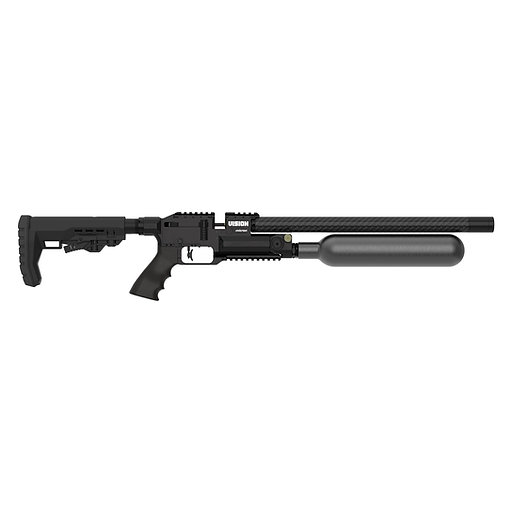
A compact, lightweight pre-charged platform is carried most effectively when the day’s task is understood in advance. Consequently permission land, legal energy limits, quarry species and expected shooting distances are considered before the rifle is taken from the case. Moreover a full 300 BAR fill, a verified zero and a selection of magazines are prepared so that time in the field is spent observing rather than troubleshooting. Inclusive practice means the same chassis can be adjusted for different statures and handedness, therefore a pair of shooters can share one rifle on a joint outing once stocks, grips and trigger settings are confirmed.
Woodland Pest Control at Close to Medium Range
Dense cover and short shooting windows are typical of woodland work. As a result the overall length of approximately 750 mm and a mass near 2,570 g allow the rifle to be brought onto aim without catching on brambles or low branches. Furthermore the reversible side-lever can be operated quietly from either shoulder, so a shot can be taken from an awkward rest against a trunk or from a kneeling position beside a ride. Meanwhile dual side gauges are glanced at without breaking stance, therefore remaining air and regulator pressure are known before the opportunity appears.
A mid-size projectile is frequently selected for this work because a useful balance of energy, magazine capacity and trajectory is obtained. Subsequently several follow-up shots can be delivered from a single magazine if a second animal presents. In addition a moderator on the 1/2″ UNF thread reduces report where local rules permit, so disturbance to the surrounding woodland is limited. Safe backstops of earth or timber are always confirmed; consequently no shot is taken when a public path or livestock lies beyond the target.
Weather changes quickly under a canopy. Moreover drizzle or leaf litter can affect footing, therefore a sling attached to the built-in QD point keeps both hands free while moving. After a string of shots the external hammer-spring indicator can be checked so that consistency is maintained as bottle pressure falls. As a result a morning session of several hours can be completed from a single fill when the restricted-power specification is in use.
Stalking Open Margins and Field Edges
Longer approaches across pasture or along hedgerows demand a rifle that remains steady after a slow crawl. Consequently the balanced layout and modest weight reduce fatigue in the supporting arm and shoulder. Furthermore a bipod on the lower Picatinny rail can be deployed once a firing position is reached, therefore a stable rest is obtained without carrying a separate bag. Meanwhile the 30 MOA top rail accepts a compact optic with enough elevation for the distances typically encountered on field edges.
Higher legal energy, where an FAC is held, may be employed for larger pests or windier conditions. In that case the same 300 cc carbon fiber bottle still supplies a practical shot count because the high-power assisted valve uses air efficiently. Subsequently velocity remains predictable across the usable pressure band when the regulator and hammer-spring have been set for the chosen projectile. Inclusive language applies here as well: left- and right-handed stalks are equally feasible once the side-lever has been reversed and the stock length adjusted.
Movement is kept slow and observation is continuous. Moreover the rifle is carried slung or in the crook of the arm so that it can be mounted in one fluid motion when a target presents. A clear backstop of rising ground or a thick hedge is required before the trigger is pressed. Consequently ethical shot placement and legal compliance remain the first considerations, not the mechanical capability of the platform.
Vehicle-to-Stand and Permission-Land Circuits
Several permissions are often visited in a single evening. As a result a compact overall package that fits easily behind a seat or in a lockable cabinet is valued. Furthermore the carbon fiber bottle keeps mass low, therefore repeated loading and unloading of the vehicle produce less strain. Meanwhile magazines can be pre-loaded at home so that only a final pressure check is needed on arrival.
A short walk from the parked vehicle to a high seat or a field corner is typical. Subsequently the QD sling allows the rifle to be carried securely while gates are opened and closed. In addition the ambidextrous controls mean a companion of opposite handedness can take a turn without tools. After each stand the gauges are read so that the next location is not reached with insufficient air. As a result an entire circuit can be completed from one fill when shot opportunities are moderate.
Legal transport rules are observed at every stage. Therefore the rifle is unloaded, covered and secured according to local requirements before the vehicle is moved. Inclusive responsibility means every person in the party understands the same storage and carriage rules.
Structured Practice and Zero Confirmation
A range session is used to confirm zero after a barrel or calibre change and to verify consistency across a fill. Consequently known-distance targets, a solid rest and a notebook are prepared. Furthermore several magazines are fired so that any change in point of impact as bottle pressure declines can be recorded. Meanwhile the fully adjustable trigger is refined until first- and second-stage weights suit the shooter.
Different projectile weights are tested in the same session when time allows. Moreover the external hammer-spring adjuster is moved in small increments so that the effect on velocity and group size can be observed. Subsequently a reliable combination of pellet, regulator setting and spring tension is established before the next field outing. Inclusive coaching is possible because the same rifle can be handed to another shooter after the stock and trigger are reset.
Weather and lighting are noted. As a result a zero obtained on a still, overcast morning is not assumed to hold in a gusty evening without a check. A clear range safety brief is followed at all times; consequently no one moves forward of the firing line until the action is open and the magazine is removed.
Dawn, Dusk and Changing Light
Low light shortens the time available to identify quarry and to confirm a safe backstop. Therefore a simple, uncluttered optic on the 30 MOA rail is preferred so that the sight picture remains quick to acquire. Furthermore the lightweight chassis can be held on aim for longer while waiting for an animal to step clear of cover. Meanwhile dual gauges remain readable if a small torch is used briefly and then switched off.
Movement is reduced to the minimum. Moreover clothing that does not snag on the side-lever or rails is chosen. After a shot the rifle is recocked smoothly so that a second opportunity is not lost to noise or fumbled controls. Subsequently the session is ended while enough air remains for a safe return to the vehicle rather than being extended until the bottle is empty.
Shared Use and Family or Club Outings
One platform can serve several people when furniture and controls are adjustable. Consequently stock length, grip and trigger weight are reset between users so that each person obtains a consistent hold. Furthermore the reversible side-lever allows left- and right-handed members of a group to shoot the same rifle on the same day. Meanwhile extra magazines and a common zero distance simplify logistics.
Safety briefings are given before anyone handles the rifle. As a result every participant understands the legal energy limit in force, the required backstop and the procedure for a misfire or a hang-fire. Inclusive language and practice ensure that age, stature and experience are accommodated by the equipment rather than by excluding anyone from the outing.
End-of-Session Checks and Storage
Gauges are read before the rifle is cased. Consequently an incomplete fill is not left unnoticed until the next morning. Furthermore the magazine is removed, the action is left uncocked and the rifle is wiped of moisture. Meanwhile the carbon fiber bottle is treated according to the manufacturer’s pressure-vessel guidance and is never stored at a pressure above the marked maximum.
A lockable cabinet that meets local storage rules is used. Therefore unauthorized access is prevented and insurance conditions are more likely to be satisfied. Subsequently a short note of shots fired, regulator setting and any unusual behaviour is kept so that the next outing begins with known information rather than guesswork.
Practical use is successful when the mechanical advantages of the compact carbon-fiber-bottle platform—low mass, high shot count, modular rails and ambidextrous controls—are combined with careful planning, legal compliance and an ethical approach to every shot. Inclusive, responsible fieldcraft remains the factor that turns a well-engineered rifle into a reliable tool on permission land, at the range and on shared outings.



Reviews
There are no reviews yet.