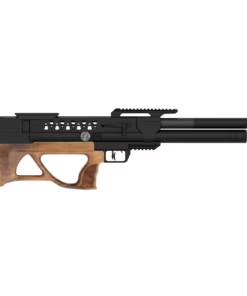
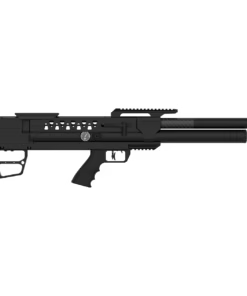
EPIC ONE 420 Alu Orange Laminate PCP Bullpup Air Rifle
Precision, compact handling, and distinctive laminate styling are combined in the EPIC ONE 420 Alu Orange Laminate PCP Bullpup Air Rifle. Consequently, a Czech-engineered pre-charged platform is presented for competition, hunting, and range work. Moreover, a 420 mm CZUB barrel is housed in a short bullpup layout, while an aluminum air tube, a 63 cc power plenum, and a vivid orange laminate stock are integrated so that accuracy, shot consistency, and visual presence are delivered together.
Furthermore, a one-piece CNC monoblock is employed so that rigidity is maintained under high fill pressure. In addition, an externally adjustable regulator, a high-power balanced valve, and an integral silencer are fitted. Therefore, velocity stability and quieter reports are achieved without sacrificing the compact 755–762 mm overall length that is associated with this model.
Design and Construction of the EPIC ONE 420 Alu Orange Laminate PCP Bullpup Air Rifle
A five-axis CNC monoblock is machined from a single metal piece. As a result, alignment of the action, barrel, and air system is preserved. Meanwhile, the Classic aluminum tube is specified at 240 cc and is paired with a 63 cc plenum on the 420 mm version. Subsequently, air is stored at up to 300 BAR / 4,350 PSI, and a detachable-under-pressure tank arrangement is supported so that cylinders can be swapped when extra capacity is required.
Additionally, the orange laminate furniture is finished for durability and contrast against the black action. Likewise, an adjustable cheekpiece and a length-adjustable butt pad with a textured face are provided. Hence, cheek weld and length of pull can be tailored. Moreover, an AR-15-compatible grip is accepted, and four QD sling points are built in so that slings and bags can be attached without extra hardware.
Compact Bullpup Geometry
Because the action is placed behind the trigger, barrel length is retained inside a short overall package. Consequently, balance is shifted toward the shoulder. Furthermore, a bag rider is incorporated on the stock so that rear-bag support is available for bench and field rest work. In the same way, handling in tight hides and vehicles is improved by the reduced length.
Barrel, Regulator, and Power System
A non-choked 420 mm CZUB barrel with 12 grooves and a 17.7-inch twist rate is tensioned inside a carbon shroud. Therefore, harmonic consistency is promoted, and pellet or slug stability is supported. Besides that, a K-baffle integral silencer is housed in the shroud on 420 mm models, while a 1/2″ UNF muzzle thread is retained so that an extra moderator can be added when local rules allow.
Meanwhile, an externally adjustable regulator is set with the supplied key, typically across a 50–190 BAR working window. In addition, dual manometers are fitted: one for reservoir pressure and one for regulated pressure. As a result, fill status and output setting can be read at a glance. Furthermore, the high-power balanced valve is designed so that useful energy is produced with lower hammer-spring preload. Consequently, cocking effort is reduced and air use per shot is improved.
Hammer-spring tension is adjusted by an external screw above the butt. Therefore, power can be tuned without stripping the action. Interchangeable calibers are supported via barrel kits, so .177, .22, and .25 can be configured according to discipline and local energy limits.
Highlighted Product Features
- 420 mm CZUB tensioned barrel — 12 grooves and 17.7″ twist are specified for pellet and slug stability.
- Aluminum air system — 240 cc tube plus 63 cc power plenum is used on the 420 Alu configuration.
- 300 BAR maximum fill — high-pressure charging is accepted through a standard 1/8″ fill probe.
- Externally adjustable regulator — output pressure is set without disassembly.
- Dual pressure gauges — reservoir and regulated values are displayed separately.
- Integral K-baffle silencer — report is reduced inside the carbon shroud; 1/2″ UNF thread remains available.
- 30 MOA adjustable Picatinny rail — optic height and inclination can be moved to suit long-range holds.
- Ambidextrous side lever — the cocking handle is swapped left or right.
- Magnetic magazine — slug lengths up to 14 mm are accepted; capacities are 14 / 12 / 10 shots in .177 / .22 / .25.
- Fully adjustable trigger — break and travel can be refined for competition or hunting.
- Adjustable cheekpiece and butt pad — fit is customized for different shooters and clothing layers.
- AR-15 grip compatibility — aftermarket grips can be fitted for hand size and angle.
- Manual safety — the action is locked when the rifle is carried or stored.
- Orange laminate stock — contrast, weather resistance, and a distinctive field appearance are provided.
- Approx. 3,600 g weight and 755–762 mm length — compact mass is kept for a full-power bullpup.
Calibers, Energy, and Practical Use
Availability in .177, .22, and .25 is offered so that target, pest, and hunting roles can be matched. Factory energy is region-dependent and must be set to local law; higher outputs are possible when the regulator and hammer spring are opened, especially in .25. Nevertheless, consistent strings are favored by the plenum and balanced valve when a moderate regulator setting is chosen.
Moreover, magazines are designed for both diabolo pellets and slugs up to 14 mm. Therefore, longer projectiles can be used for wind resistance and terminal performance where legal. Likewise, the unchoked CZUB profile is intended to treat a wide pellet weight range without a tight choke restriction.
Field, Range, and Competition Roles
For hunting and pest control, the short length is carried through cover more easily than a conventional full-length rifle of equal barrel. Meanwhile, the integral moderator helps keep reports discreet. For HFT-style or club precision work, the 30 MOA rail, adjustable cheekpiece, and two-stage trigger support repeatable holds. Additionally, the side lever can be swapped so that left- and right-handed users are accommodated without a dedicated opposite-hand model.
Handling, Safety, and Ownership Notes
Inclusive fit is supported by the ambidextrous lever, adjustable stock, and AR-pattern grip. Consequently, different body sizes and shooting sides can be set up on the same rifle. Manual safety use, muzzle awareness, and legal power limits remain the shooter’s responsibility. Furthermore, fill pressure must not exceed 300 BAR, and regulator changes should follow the manufacturer’s key and handbook.
Maintenance is straightforward: seals, magazines, and the fill probe are service items, and caliber changes are completed with the appropriate barrel kit. A padded case, spare seals, and an English manual are commonly supplied with new rifles.
Why This Configuration Is Chosen
The EPIC ONE 420 Alu Orange Laminate PCP Bullpup Air Rifle is specified when compact length, a proven CZUB barrel, external tuning, and distinctive laminate furniture are wanted without the extra mass of a carbon bottle. In summary, a CNC monoblock, regulated plenum, integral silencer, and fully adjustable furniture are combined so that precision shooting can be pursued in a short, tunable package. Local regulations on energy, licensing, and moderation should be confirmed before purchase and use.
Epic Airguns, Hatsan, Bintac and High-Performance PCP Air Rifles
Modern epic airguns continue to attract shooters who want advanced PCP technology, adaptable configurations, precision, and high-capacity air systems. Whether someone searches for epic air, epic 1, epic one, epic1, or the epic one air rifle, the interest generally centers on premium compressed-air platforms built for accurate shooting. The growing Epic lineup also includes searches for epic 2, the epic 2, epic 2.0, epic two lite, and epic two walnut, giving enthusiasts several terms to explore when comparing configurations, materials, and performance.
Shooters researching an air rifle com resource or a specialized pcp air gun shop may also encounter terms such as epicair, airgun one incorporated, 30 epic, epic optics, epic eagle, epic vision, airpne, and pist2 while comparing manufacturers, accessories, optics, and PCP platforms. Other searches, including pellet gun yeeps, kalibrgun snipe 2, air gun makers, and compressed air rifles, reflect how broad the modern airgun market has become.
For larger-caliber and tactical PCP enthusiasts, products associated with bintac aea harpoon, bintac t9 full auto, bintac mcar 457, and aea terminator have generated interest among buyers looking beyond conventional sporting rifles. Shooters researching anti air tanks may instead be looking for filling equipment and high-pressure storage solutions, while searches for bintac t9 price often come from buyers comparing premium PCP platforms before making a purchase.
Interest in a bee bee gun rifle can range from recreational plinking to entry-level target shooting, whereas searches such as zeus 72 cal air rifle price focus on extremely large-bore PCP technology. A suitable air tank for pcp airguns is particularly important for shooters who want convenient refilling away from a compressor or dive shop.
Large-caliber PCP platforms are also reflected in searches such as aea harpoon air gun, airgun shotgun, automatic air gun, air powered 50 cal rifle, and aea megalodon for sale. These terms demonstrate how air-powered technology has expanded far beyond the traditional pellet rifle and into increasingly specialized shooting platforms.
Hatsan Air Rifles, PCP Models and Popular Configurations
Among established manufacturers, hatsan blitz remains one of the most recognizable search terms for shooters interested in rapid-fire PCP designs. The wider hatsan air rifle lineup covers numerous shooting applications, while models such as the hatsan sortie, hatsan model 95, hatsan harpoon, hatsan hercules, and hatsan piledriver appeal to different sections of the airgun market.
Buyers searching hatsanusa or hatsan usa are often looking for Hatsan products, specifications, service information, accessories, or replacement components available within the American market. Meanwhile, the hatsan sortie tact semi-auto pcp offers a semiautomatic-style platform, and interest in hatsan sortie accessories gives owners options for refining their setup.
Traditional spring-powered enthusiasts frequently research the hatsan 135, hatsan 125, hatsan mod 95, and the shorter mod 95 search phrase. PCP shooters may instead consider the hatsan bullboss, hatsan hercules bully, hatsan flash, hatsan invader, or hatsan flashpup qe.
Value-conscious customers can also explore hatsan refurbished products and other refurbished air rifles when available. Models such as the hatsan airtact air rifle, hatsan neutron star, hatsan zada, and hatsan 135 carnivore broaden the selection even further.
Because terminology varies among shoppers, searches may include air rifle, air rifles, airguns, hatsun blitz, hatzan blitz, or the broader phrase hatsan air guns. Likewise, shooters researching PCP-specific options frequently use hatsan pcp when comparing regulated systems, air cylinders, magazines, power levels, and available calibers.
Hatsan Blitz, Big-Bore PCP and Semi-Automatic Options
The hatsan blitz full automatic platform is especially notable among buyers interested in fast cycling and high-capacity PCP technology. Searches such as hatsan blitz 30 cal and hatsan blitz .30 cal commonly focus on the larger-caliber Blitz configuration, while terms such as blitz guns and blitz 777 may appear during broader product research.
For shooters interested in other compact pneumatic platforms, the hatsan velox and hatsan jet 2 offer additional choices. Searches for jet ii may refer to the same general family, while hatsan jet 2 accessories can help owners locate compatible components and upgrades.
Additional Hatsan searches include hatsan sortie tact, hatsan airtact, hatsan factor rc, and hatsan 135 vortex air rifle. Buyers seeking larger projectiles and increased energy may also investigate the hatsan big bore carnivore rifle or related big-bore configurations.
The bullmaster provides another PCP platform for shooters comparing bullpup-style layouts, while invader auto attracts interest from users researching semiautomatic air rifle designs.
Calibers, Pellets, Optics and Shooting Accessories
Choosing the correct caliber remains an important part of selecting an airgun. A 30 cal air rifle can offer considerably more projectile mass than a traditional .177 caliber rifle, although the best choice depends on intended use, legal requirements, shooting distance, and available ammunition.
A quality air pellet gun should be paired with ammunition suited to its barrel and power output. Some users may type pallet gun when searching for pellet-powered equipment, while competitive shooters might research premium ammunition such as h&n field target trophy bleifrei.
Optics are equally important for accurate shooting. A basic 4×20 optic may be sufficient for recreational use at modest distances, whereas more advanced scopes can provide adjustable magnification, parallax correction, and improved reticles for longer-range shooting.
Searches involving econ ii may relate to specific airgun equipment or components, while crow magnum remains another term encountered by enthusiasts researching established airgun products.
PCP Air Supply, Range and Specialized Shooting Equipment
Unlike spring-powered rifles, PCP systems rely on compressed air stored at high pressure. Therefore, shooters comparing compressed air rifles should consider cylinder capacity, regulator performance, fill pressure, shot count, and refill equipment alongside muzzle performance.
A dependable air tank for pcp airguns can simplify field refilling, while suitable fill adapters and rated high-pressure equipment should always be used according to manufacturer specifications.
The practical range of air rifle performance varies considerably according to caliber, projectile design, muzzle energy, weather conditions, optics, and shooter ability. Consequently, there is no single universal air rifle range that applies to every platform.
Some shooters also explore an arrow launcher configuration, which uses air pressure to propel compatible arrows or bolts rather than conventional pellets. This specialized equipment demonstrates the versatility available across today’s airgun market.
From epic one and epic two walnut configurations to hatsan blitz, aea terminator, and large-bore PCP platforms, today’s market includes recreational rifles, precision systems, semiautomatic designs, tactical configurations, and specialized high-powered airguns. Comparing construction quality, caliber, air capacity, ammunition compatibility, intended shooting application, and available accessories can help buyers identify the platform that best matches their needs.
Calibres, FAC Ratings, Power Settings, and Accessories for the EPIC ONE 420 Alu Orange Laminate PCP Bullpup Air Rifle
A versatile multi-calibre platform is offered by the EPIC ONE 420 Alu Orange Laminate PCP Bullpup Air Rifle. Consequently, pellet and slug use can be matched to target work, pest control, or hunting. Moreover, power is tuned through an external regulator and hammer-spring adjuster, while legal status is determined by regional energy limits. In addition, a wide accessory ecosystem is supported so that optics, moderation, magazines, and furniture can be adapted to each shooter.
Available Calibres and Projectile Options
Three factory calibres are specified: .177 (4.5 mm), .22 (5.5 mm), and .25 (6.35 mm). Furthermore, calibre conversion is enabled by interchangeable barrel kits, so a single action can be reconfigured when a different discipline is required. Meanwhile, a non-choked 420 mm CZUB barrel with twelve grooves and a 17.7-inch twist rate is used. Therefore, a broad pellet-weight range is tolerated without a tight choke restriction.
Magazine capacity is set by calibre. Accordingly, fourteen shots are provided in .177, twelve shots in .22, and ten shots in .25. Additionally, projectiles up to 14 mm in length are accepted. Hence, both standard diabolo pellets and longer slugs can be fed. As a result, wind-resistant slugs may be chosen for longer ranges where local rules allow their use.
How Each Calibre Is Typically Applied
Light, flat-shooting pellets are favoured in .177 for paper, plinking, and short-range precision. Conversely, a balance of trajectory and impact is usually sought in .22 for general hunting and club use. Meanwhile, heavier .25 pellets and slugs are selected when energy and terminal performance are prioritised. Inclusive practice is supported because left- and right-handed users can run the same magazines after the side lever has been swapped.
FAC Status, Legal Power, and Regional Limits
Legal classification is governed by muzzle energy, not by the rifle’s model name. In the United Kingdom, energy above 12 ft-lb (16.3 J) places an air rifle on a Firearm Certificate (FAC). Therefore, the EPIC ONE 420 Alu Orange Laminate PCP Bullpup Air Rifle may be supplied as a sub-12 ft-lb sporting rifle or as an FAC-rated rifle, depending on the setting that is requested and the dealer’s compliance process.
Elsewhere in Europe and beyond, national limits differ. Consequently, factory energy figures that appear on retailer listings should be treated as examples, not as a global standard. Typical published factory bands on Classic 420 mm rifles include approximately 23.5–25.3 J in .177 with JSB Exact Heavy and approximately 41–44 J in .22 with JSB Jumbo Heavy. Higher outputs are possible when the regulator and hammer spring are opened, especially in .25. Nevertheless, those higher figures must be confirmed against local law before the rifle is filled or fired.
Moreover, fill pressure must not exceed 300 BAR. Likewise, regulator settings are normally adjusted with the supplied key across a working window of about 50–190 BAR (some documentation cites a slightly wider 40–200 BAR range). Dual gauges are fitted so that reservoir pressure and regulated pressure can be read separately. Responsible ownership requires that power be verified with a chronograph after any change to regulator, hammer spring, pellet, or barrel.
Power Tuning Without Guesswork
A high-power balanced valve is employed so that useful energy can be produced with lower hammer-spring preload. Consequently, cocking effort is reduced and air consumption per shot is improved. In addition, a 63 cc power plenum on the 420 mm Alu configuration is used to stabilise the air charge behind the valve. Therefore, string-to-string velocity consistency is supported when a moderate regulator setting is chosen.
External hammer-spring adjustment is provided above the butt. As a result, power can be raised or lowered without the action being stripped. Inclusive setup is possible because the same external controls are used regardless of shooting side. After each change, a chronograph session and a written record of regulator bar, spring turns, and pellet weight are recommended so that legal limits are not exceeded by accident.
Accessories, Optics, and Supporting Equipment
A 30 MOA inclined, movable Picatinny rail is fitted as standard. Hence, scopes, red dots, and night-vision or thermal units can be mounted, and extra elevation is available for longer holds. Furthermore, an integral K-baffle silencer is housed in the carbon shroud on 420 mm models, while a 1/2″ UNF muzzle thread is retained. Additional moderators can therefore be added where local regulations permit extra suppression.
Highlighted Accessory and Fitment List
- Barrel conversion kits — calibre changes between .177, .22, and .25 are completed with matching barrels and magazines.
- Spare magnetic magazines — extra 14 / 12 / 10-shot magazines are carried for rapid reloads and slug testing.
- 1/2″ UNF silencers — secondary moderators are threaded onto the shroud when extra quietness is required.
- Optics on 30 MOA Picatinny — high-magnification scopes and compact dots are accommodated; rail position is movable.
- AR-15 compatible grips — aftermarket grips are fitted to suit hand size and wrist angle.
- QD sling swivels — four built-in points accept slings for hunting carry.
- Spare aluminum tubes — tanks that are detachable under pressure can be swapped in the field.
- Fill probe and 1/8″ coupling — standard PCP charging gear is used up to 300 BAR.
- Regulator adjustment key — output pressure is set without workshop tools.
- Seal kits and padded case — routine service parts and transport protection are commonly supplied.
- Bipods and bag riders — the stock’s bag rider and lower rail space support bench and prone rest work.
- Cheekpiece and butt-pad spacers — length of pull and comb height are refined for different clothing and face shapes.
Additionally, a fully adjustable trigger is provided so that first-stage take-up and break weight can be matched to competition or hunting gloves. Inclusive language and hardware matter here: the ambidextrous lever, adjustable comb, and interchangeable grip allow the same rifle to be shared by different users after a short setup session.
Matching Calibre, Power, and Accessories in Practice
A sub-12 ft-lb .177 or .22 setup with a compact scope is often chosen for club ranges and garden-legal pest work where those limits apply. Conversely, an FAC .22 or .25 configuration with a 30 MOA optic, extra magazine, and optional secondary moderator is typically specified for longer hunting shots. Meanwhile, slug use is reserved for barrels and magazines that have been confirmed to feed 14 mm projectiles reliably.
In every case, energy must be measured after accessories that change barrel harmonics or air flow are added. A new moderator, a different pellet, or a calibre swap can move velocity enough to cross a legal threshold. Therefore, a chronograph check is treated as part of any accessory install, not as an optional extra.
Through interchangeable calibres, external power controls, and a practical accessory set, the EPIC ONE 420 Alu Orange Laminate PCP Bullpup Air Rifle is configured for regulated, documented, and inclusive use. Local licensing, energy caps, and moderation rules remain the final authority and should be confirmed with a qualified dealer before the rifle is purchased or retuned.
Practical Use Scenarios
A compact, regulated pre-charged bullpup with a 420 mm tensioned barrel is most useful when length, balance, and repeatable power matter more than a conventional full-length profile. Consequently, the same platform can be taken from a zeroing bench to a hide, a club lane, or a woodland edge. Moreover, an adjustable cheekpiece, a movable inclined rail, an ambidextrous side lever, and a bag rider are already present, so fit and support can be changed without extra tools. Inclusive use is supported because left- and right-handed shooters can share one rifle after the lever and comb have been set.
Preparing the Rifle Before Any Session
A fill to a safe working pressure below the 300 BAR maximum is completed first. Meanwhile, both gauges are read so that reservoir and regulated values are known before the first shot. Subsequently, the regulator setting and hammer-spring tension that were recorded for the chosen pellet are confirmed. Therefore, velocity surprises on the first string are avoided.
Additionally, the magazine is loaded with a single pellet type and weight. Mixed ammunition in one magazine is avoided because point of impact will shift. Likewise, the optic is checked for a firm mount on the inclined rail, and eye relief is set with the cheekpiece rather than with an awkward neck angle. A manual safety is applied until the firing point is reached. As a result, carry through vehicles, gates, and club houses remains controlled.
Zeroing and Confirmation
A solid rest or bag is used so that the shooter’s hold is isolated from the group. Then a short string is fired at a known distance, typically 25 or 50 metres depending on calibre and local range rules. Consequently, the optic is adjusted until the group sits on the intended aim point. Furthermore, a second distance is shot so that a simple hold-over or turret chart can be written for that pellet.
Because the barrel is unchoked, several pellet shapes can be tested on the same day. However, only one load is zeroed as the “working” ammunition. Inclusive coaching is easier here: a new shooter can be placed behind the same rest while the experienced partner watches the gauges and the safety, rather than fighting a long, muzzle-heavy rifle.
Club Range and Precision Practice
On a formal range, the short overall length keeps the muzzle inside the firing point even when a high-magnification scope is fitted. Meanwhile, the bag rider accepts a rear bag so that the butt can be fine-tuned without the shooter’s support hand being cramped. Therefore, groups can be worked on without the fatigue that often appears with longer, front-heavy air rifles.
A two-stage trigger is adjusted so that first-stage travel is predictable in light gloves. Subsequently, strings of five or ten shots are fired while regulator pressure is watched. If velocity begins to fall, the session is stopped and the cylinder is topped up rather than “shot out” into a steep part of the curve. Consistency is valued over a few extra shots of declining speed.

Positional Work on the Same Lane
Prone, kneeling, and a low bench can all be used in one visit because the bullpup’s balance sits closer to the shoulder. Consequently, the muzzle does not sweep as far when the shooter rises from prone. In addition, a QD sling can be used as a hasty loop for kneeling practice. Left-handed members of a club are not asked to borrow a different rifle; the side lever is swapped and the same zero is retained.
Wind calls are practiced with the same pellet that will be used in the field. Because slugs up to 14 mm can be fed when magazines allow, a separate slug zero can be confirmed on a longer lane if the club permits that ammunition. The rail’s 30 MOA inclination is then used so that elevation is not stacked entirely on the turrets.
Hides, Vehicles, and Tight Approaches
A woodland hide or a farm building doorway is entered more easily when overall length is kept under about 760 mm. Therefore, the rifle can be brought to the shoulder without the muzzle striking lintels or netting. Moreover, an integral moderator inside the shroud reduces the need for a long external can that would add length again.
From a vehicle rest, the window ledge or a door bag is used. The compact action stays inside the cabin while the barrel clears the opening. Safety discipline is unchanged: the muzzle is pointed at safe ground, and the rifle is not loaded until the shooting window is confirmed. Inclusive pairing works well in a vehicle—one person watches livestock and background while the other is on the trigger—because the rifle can be passed across the seat without a long barrel sweeping the cabin.
Pest Control Around Buildings and Yards
Where local law allows air-rifle pest control, short lanes between outbuildings are typical. A .177 or moderated .22 load is often chosen so that over-penetration risk is reduced and neighbours are less disturbed. The rifle is carried slung with the safety on, then presented only when a clear backstop of earth or a solid wall is present.
Shots are taken from a supported position whenever possible. A gatepost, a feed-bin edge, or a kneeling roll is used rather than an offhand guess. After the shot, the magazine is not immediately topped in the open; the rifle is made safe, the result is checked, and only then is a fresh pellet chambered if a follow-up is required. Night work with a lamp or a legal thermal/NV unit is possible because the rail accepts those optics, but lamp discipline and local lighting rules must be followed.
Field Hunting Where Energy and Calibre Are Legal
On land where the rifle is held at a lawful hunting energy, .22 and .25 become the usual choices. A heavier pellet or a magazine-legal slug is selected for wind and for humane impact on the quarry that is permitted. The regulator is left on a setting that has already been chronographed for that ammunition. Changing power “by feel” in the field is avoided.
Stalking is helped by the short profile when gaps in cover are narrow. A sling keeps both hands free for binoculars until the shot is built. Then the bag rider or a kneeling sit is used so that the last seconds are steady. After the shot, the rifle is made safe before any approach. Recovery, tagging, and landowner rules are treated as part of the shot, not as an afterthought.
Weather, Clothing, and Seasonal Fit
Winter coats change length of pull and comb height. Consequently, the adjustable butt pad and cheekpiece are reset at the start of the season rather than fought through a whole day. Wet laminate is wiped and not stored in a sealed case while warm. Condensation inside a scope is reduced if the rifle is allowed to equalise in temperature before the caps are removed.
In heat, the aluminum tube can feel warm after a car journey. The rifle is shaded and not left on a dashboard. Fill pressure is checked again after a large temperature swing because gauge readings and actual density of air can shift. Inclusive groups—youth shooters, older shooters, or mixed-ability club days—benefit from these small fit changes more than from a heavier, longer rifle that cannot be shortened.
Training, Sharing, and Coaching
A new shooter is introduced on a bag, at short range, with a low-recoil pellet and a clear safety brief. The coach stands where the gauges and the muzzle can be seen. Because the side lever can be placed on either side, the same rifle serves a left-handed learner without a second purchase. Trigger weight is left on a forgiving setting until groups tighten.
Drills include loading one pellet at a time, applying the safety between shots, and calling wind before the break. Magazines are treated as tools, not as “full-auto” conveniences; a pause after each shot is coached so that the target is reassessed. When confidence grows, kneeling and a sling-supported standing shot are added. The compact balance makes those positions less intimidating than a long barrel that wobbles at the muzzle.
Maintenance That Happens in Real Use
A small kit is carried: spare seals if they are supplied, a fill probe, an Allen key for the rail, and a dry cloth. After a dusty session the action is wiped and the magazine is emptied. Pellets are not left compressed in the rotor for weeks. The probe O-ring is inspected before every fill so that a cut ring is not forced onto 300 BAR.
If a calibre kit is swapped at home, the new barrel’s zero is treated as unknown. A full confirmation string is fired before the next hunt or match. Accessories that change harmonics—an extra moderator, a heavy thermal, a different grip angle—are followed by the same check. Power is measured, not assumed, after any of those changes.
Building a Repeatable Day Afield
A practical day is planned around one ammunition, one regulator setting, and two distances that have already been written down. The rifle is filled, gauges are photographed or noted, and the sling and bags are fitted before leaving home. On site, a cold-bore shot is fired at a safe backstop if time allows, because first-shot impact can differ from a warm barrel.
Throughout the day the safety is used whenever the rifle is slung or placed on a seat. Magazines are kept clean and pocketed separately from loose pellets so that grit is not fed into the action. At the end, pressure is left at a moderate storage level if the maker recommends that practice, the bore is not oiled heavily, and the case is left unlatched until the rifle has cooled.
Inclusive, lawful use is the thread that runs through every scenario. The platform’s short length, adjustable furniture, interchangeable lever, and regulated power are advantages only when the backstop, the energy limit, and the people nearby have been considered first. When those conditions are met, the same compact bullpup can be used for quiet range work, careful pest control, and supported field shots without a different rifle being required for each task.
Frequently Asked Questions
Clear answers are provided below so that setup, legal power, ammunition, and daily handling can be understood before the first fill. Consequently, guesswork at the range or in the field is reduced. Moreover, inclusive use is assumed throughout: left- and right-handed shooters, shared club rifles, and mixed experience levels are treated as normal. Local law always overrides any general note in this section.
Calibre, Magazines, and Ammunition
Which calibres can be used?
Three common PCP calibres are supported: .177, .22, and .25. Furthermore, barrel kits are offered so that the same action can be converted when a different role is required. Meanwhile, a 420 mm unchoked barrel with a 17.7-inch twist is specified, so a wide pellet-weight range can be tested. A single working load should still be chosen and zeroed; mixed pellets in one magazine are not recommended.
How many shots are held in the magazine?
Capacity is set by calibre. Accordingly, fourteen chambers are provided in .177, twelve in .22, and ten in .25. Additionally, projectiles up to 14 mm long are accepted on magazines designed for that length. Therefore, both standard diabolo pellets and longer slugs can be fed when the magazine and barrel combination has been confirmed.
Can slugs be used as well as pellets?
Slug use is supported where the magazine and local rules allow lengths up to 14 mm. However, a separate zero is required because point of impact will not match a diabolo load. Moreover, not every slug brand will feed smoothly. A short function test on the range is completed before slugs are taken into the field. Inclusive clubs should post a clear rule on whether slugs are permitted on paper lanes.
Does an unchoked barrel change pellet choice?
A non-choked profile is intended to treat more pellet shapes without a tight muzzle restriction. Consequently, several brands can be grouped during testing. Nevertheless, one weight and shape should be adopted as the hunting or match load. Chronograph results and group size, not marketing claims, decide the final choice.
Power, FAC Status, and Legal Limits
Is this rifle automatically an FAC firearm?
Classification is determined by measured muzzle energy, not by barrel length or stock style. In the United Kingdom, energy above 12 ft-lb (16.3 J) requires a Firearm Certificate. Therefore, the same platform may be supplied below that threshold or above it, depending on how the regulator and hammer spring have been set and how the dealer has documented the rifle. Elsewhere, national limits differ and must be checked before purchase.
How is power changed?
An externally adjustable regulator and an external hammer-spring screw are used. Subsequently, output pressure is set with the supplied key, typically across a mid-range window of about 50–190 BAR. Meanwhile, hammer-spring tension is increased or reduced without the action being stripped. After any change, energy is verified with a chronograph and written down with pellet weight and batch.
What factory energy figures are published?
Retail examples for 420 mm Classic-style rifles often show roughly 23–25 J in .177 with a mid-weight exact pellet and roughly 41–44 J in .22 with a heavy jumbo pellet. Higher figures are possible when the valve and spring are opened, especially in .25. Those higher outputs are not a default setting and may be unlawful without the correct certificate or licence. Published numbers are treated as illustrations only.




Reviews
There are no reviews yet.