Frequently Asked Questions (FAQs)
General Information and Product Overview
1. What makes this pre-charged pneumatic air rifle different from traditional air rifles?
A compressed-air operating system is used instead of the spring-piston mechanism found in many traditional air rifles. Consequently, the firing mechanism is powered by air stored in a dedicated onboard reservoir. This distinguishes the design from spring-powered and CO₂-operated alternatives.
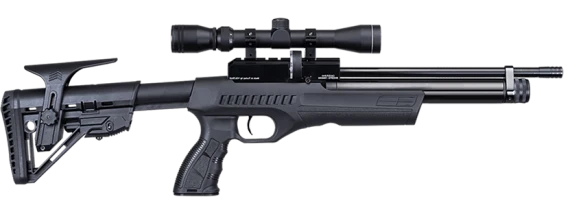
Furthermore, a compact synthetic stock, manual bolt-action mechanism, and adjustable exterior components are incorporated into the overall configuration. These features provide a contemporary sporting design while maintaining a recognisable air rifle layout.
2. Is this air rifle suitable for beginners?
The suitability of this model for beginners depends on local regulations, the user’s previous experience, and the availability of qualified supervision. Although a manual bolt-action mechanism is provided, compressed-air sporting equipment still requires responsible handling.
Additionally, the pressure reservoir and associated components must be maintained according to manufacturer instructions. New users should therefore receive appropriate safety training before participating in supervised target shooting.
3. What is the difference between the two available versions?
The principal distinction is the calibre. One version is chambered for 4.5 mm (.177) pellets, while the other accommodates 5.5 mm (.22) pellets.
Although both versions share similar exterior styling, their ammunition requirements are different. Furthermore, power classifications and certain technical specifications may vary according to the country of distribution.
Consequently, the exact calibre and regulatory configuration should always be verified through the original product documentation.
4. Is this air rifle manufactured in Turkey?
Yes. The product family is associated with a Turkish manufacturer recognised for producing airguns and related sporting equipment.
A combination of contemporary styling, synthetic components, and pneumatic engineering is incorporated into the design. Nevertheless, the country of manufacture should be confirmed using the markings and documentation supplied with the particular unit.
Design, Construction, and Ergonomics
5. What materials are used in the stock?
A synthetic polymer stock is fitted to the rifle. Compared with untreated natural wood, synthetic materials are generally less affected by normal humidity fluctuations.
Furthermore, the exterior construction can be cleaned using suitable manufacturer-approved products. However, excessive heat, aggressive solvents, and unsuitable cleaning agents should be avoided because damage to polymer surfaces may result.
6. Is the stock adjustable?
An adjustable stock configuration is identified in published descriptions of the series. Additionally, an adjustable cheek-rest feature is reported.
These components are intended to provide flexibility in the physical fit of the rifle. However, the available adjustment range may differ between production versions.
Before adjustments are performed, the equipment should be confirmed unloaded and handled according to the manufacturer’s instructions.
7. How heavy is the rifle?
An approximate weight of 2.5 kilograms is frequently stated in published product information.
Nevertheless, the total weight may change when additional equipment is fitted. Accessories, packaging, and variations in manufacturing specifications can also affect the measured weight.
Therefore, the weight listed on the actual product packaging should be regarded as the most relevant reference for the supplied version.
8. What is the overall length?
An approximate overall length of 710 millimetres is commonly reported.
This relatively compact construction is one of the distinguishing exterior characteristics of the design. However, minor dimensional differences may be encountered between configurations.
Additionally, any manufacturer-approved stock adjustments may change the overall physical dimensions.
9. Is the rifle available in different colours?
Colour availability depends on the manufacturer, production period, and distributor.
Black synthetic configurations are commonly associated with this product family. However, additional finishes should not be assumed to be available without confirmation from an authorised supplier.
Product photographs should therefore be checked against the precise version being offered.
Pneumatic System and Technical Specifications
10. How does the compressed-air operating system work?
Compressed air is stored inside a dedicated pressure reservoir. During normal operation, the rifle’s internal pneumatic mechanism controls the release of air.
Unlike conventional spring-piston systems, energy is supplied by compressed air rather than a mechanically compressed mainspring.
Furthermore, the pressure-bearing components are designed to operate within specified manufacturer limits. These limits must never be exceeded.
11. Does the rifle require CO₂ cartridges?
No. The platform uses a pre-charged pneumatic operating system rather than disposable CO₂ cartridges.
Consequently, compressed air is required as the designated energy source. However, the compatibility of individual filling systems must be established through the manufacturer’s official documentation.
Unapproved gases or incompatible filling equipment should never be substituted for the specified system.
12. Is an air compressor necessary?
A dedicated compressor is not necessarily the only possible filling option for all PCP equipment. Depending on the approved system, compatible charging equipment may include specialist manual pumps or compressed-air cylinders.
Nevertheless, filling connections, filtration requirements, pressure ratings, and equipment suitability must be verified before use.
For safety reasons, the manufacturer’s filling instructions should be followed rather than relying on general compatibility assumptions.
13. What is the maximum filling pressure?
The permitted filling pressure is determined by the manufacturer and may vary between specific versions.
Because compressed-air reservoirs operate under substantial pressure, an incorrect specification can create a serious safety hazard.
Therefore, the maximum working pressure must be confirmed from the original reservoir markings or official documentation. An assumed or estimated pressure rating should never be used.
14. How many shots can be obtained from one air fill?
The number of available shots depends on several variables, including reservoir capacity, initial pressure, pellet characteristics, ambient conditions, and the particular power configuration.
Consequently, a single universal shot-count figure cannot be guaranteed for every version.
Manufacturer test conditions should also be considered when reviewing published figures, because laboratory measurements may not represent every operating environment.
15. Is a pressure gauge included?
Pressure-monitoring equipment is reported in descriptions of the platform. However, the exact gauge arrangement should be verified for the individual unit.
A pressure gauge provides information about reservoir pressure but does not replace appropriate inspection and servicing.
Additionally, a damaged or inaccurate gauge should be assessed by a qualified technician before continued use.
Calibres, Ammunition, and Power Classification
16. What pellet calibres are available?
Two principal pellet calibres are associated with the series: 4.5 mm (.177) and 5.5 mm (.22).
Each version is designed around its designated ammunition dimensions. Therefore, pellets from different calibres must never be treated as interchangeable.
The calibre marking on the rifle and the instructions supplied by the manufacturer should be checked before ammunition is acquired.
17. Can both calibres be used in the same rifle?
No. Each rifle is manufactured for a specific calibre.
The internal dimensions of the barrel and associated ammunition-handling components correspond to that designation.
Consequently, attempting to use unsuitable ammunition can damage equipment and create unsafe conditions. Only manufacturer-approved ammunition of the marked calibre should be used.
18. Is the rifle available in an FAC version?
Higher-power configurations may be subject to Firearm Certificate requirements in jurisdictions such as Great Britain.
However, licensing classifications depend on the actual muzzle energy and applicable regional legislation, not simply the model name.
Furthermore, legal thresholds differ internationally. Buyers should therefore verify the specifications of the exact version and obtain any required authorisation before possession or use.
19. Does the rifle have the same power output in every country?
No. Airgun power limits and product configurations can differ considerably between markets.
Some countries impose specific muzzle-energy restrictions, while others apply licensing requirements based on the equipment’s technical classification.
Accordingly, power information published for one country should not automatically be applied to products distributed elsewhere.
20. Are steel BBs compatible with this model?
The platform is described as a pellet-firing air rifle. Therefore, steel BB compatibility should not be assumed.
Its rifled barrel is associated with ammunition specified by the manufacturer. Unsuitable projectiles may damage internal surfaces or create unsafe operating conditions.
Only ammunition explicitly approved for the relevant model and calibre should be considered suitable.
Magazines, Controls, and Accessories
21. Is a magazine included with the rifle?
Magazine inclusion depends on the specific retail package.
Published information identifies multi-shot magazine configurations, but the number of magazines supplied may vary among distributors.
Consequently, the package contents should be confirmed before purchase. Any additional magazine should be checked for exact model and calibre compatibility.
22. What is the magazine capacity?
Published specifications commonly identify a 14-round magazine for the 4.5 mm version and a 12-round magazine for the 5.5 mm version.
However, these figures should be confirmed against the actual equipment.
Magazine designs may be revised between manufacturing batches, and replacement magazines should always match the relevant model designation.
23. Does the rifle include a safety mechanism?
A safety mechanism is reported in product descriptions for the series.
Nevertheless, the exact control arrangement should be verified through the supplied instruction manual.
Importantly, a mechanical safety device cannot replace responsible handling. Every air rifle should always be treated as potentially loaded until its condition has been properly verified.
24. Is an optical sight included?
An optical sight should not be assumed to be included in the standard package.
A mounting interface is reported on the rifle, but retailers may offer different accessory bundles.
Therefore, the listing should clearly distinguish factory-supplied equipment from optional products. Any optical accessory should be confirmed compatible with the mounting interface.
25. Are replacement parts available?
Replacement-part availability depends on the manufacturer, the age of the equipment, and regional distributor support.
Components such as seals, magazines, and certain stock fittings may be listed separately. However, compatibility must be confirmed using the exact model identification.
Pressure-bearing components and internal mechanical parts should be inspected or replaced only by appropriately qualified personnel.
Maintenance, Durability, and Storage
26. How should the rifle be cleaned?
External cleaning should be carried out using suitable materials and manufacturer-approved cleaning products.
Before maintenance, the rifle must be confirmed safe and unloaded in accordance with the instruction manual.
Furthermore, excessive moisture and aggressive chemical cleaners should be avoided. Internal maintenance involving the pressure system should be reserved for qualified technicians.
27. Does the compressed-air reservoir require maintenance?
Yes. Pressurised reservoirs require inspection and maintenance according to the manufacturer’s recommendations.
Seals, fittings, pressure-monitoring equipment, and the reservoir itself may be subject to periodic servicing.
Additionally, any visible damage, unusual leakage, or suspected mechanical fault should be assessed professionally. Unauthorised pressure-system repairs should never be attempted.
28. Can the rifle be stored for long periods?
Long-term storage is possible when the manufacturer’s storage instructions are followed.
The equipment should be kept in a secure, dry environment away from unauthorised users. Moreover, ammunition should be stored separately.
The appropriate reservoir pressure during extended storage must be determined from official guidance rather than assumed.
29. Is the synthetic stock resistant to moisture?
Synthetic stocks are generally more resistant to ordinary humidity-related dimensional changes than unfinished wooden stocks.
Nevertheless, the rifle as a whole contains metal components and seals that still require protection from moisture.
Therefore, exposure to rain, condensation, or damp storage conditions should be followed by appropriate inspection and cleaning.
Premium Rifle Scopes, Rangefinder Binoculars, Hunting Optics, and Precision Optical Equipment
Discover Advanced Optics for Precision, Clarity, and Long-Range Performance
Choosing premium optical equipment requires careful consideration of image clarity, magnification, durability, reticle design, and overall performance. Whether exploring a gun scope, comparing a professional hunting optic, or researching the longest range scope, buyers benefit from understanding how different optical systems support observation, target identification, and recreational shooting activities.
Modern optical technology offers impressive versatility. From leica rangefinder binoculars to precision riflescopes, specialized equipment combines advanced lenses, durable construction, and ergonomic designs. Furthermore, understanding how to buy a rifle scope helps buyers identify suitable magnification ranges, optical coatings, adjustment systems, and configurations.
Different environments demand different optical solutions. Consequently, equipment selection should reflect intended applications, environmental conditions, and individual preferences rather than magnification alone.
Leica Rangefinder Binoculars and Premium Optical Technology
Exploring the Leica Geovid Collection
The leica geovid binoculars collection attracts attention among outdoor enthusiasts who value premium optical engineering and integrated distance-measurement technology. In particular, leica geovid 10×42 rangefinder binoculars combine a 10-power magnification format with 42mm objective lenses, providing a practical combination of viewing capability and portability.
Buyers researching leica binoculars with rangefinder technology frequently compare optical clarity, ranging functionality, handling characteristics, and available connectivity features. The leica geovid pro 10×42 represents a sophisticated option within the manufacturer’s premium range.
Similarly, searches for geovid pro 10×42 often focus on advanced distance measurement, optical refinement, and suitability for extended outdoor observation.
The leica geovid rangefinder concept integrates observation and distance measurement into one optical system. Therefore, leica geovid pro rangefinder binoculars may appeal to users who prefer fewer separate devices during outdoor activities.
Additional product searches include leica geovid rangefinder binoculars, leica geovid 10×42, and leica geovid binos. Although these expressions overlap in meaning, they reflect different ways buyers research the Geovid family.
Compact Leica Binoculars and Everyday Observation
Beyond rangefinding models, traditional leica binoculars offer optical configurations suited to wildlife observation, travel, and nature appreciation.
Portable leica small binoculars can be particularly attractive when lightweight equipment is preferred. Meanwhile, buyers searching binoculars leica, leica bino, or leica binos may be comparing available formats, objective diameters, and carrying convenience.
The phrases leica binocular, leica bino rangefinder, and leica camera binoculars also appear in optical equipment searches, although Leica’s camera and binocular categories should be evaluated separately.
When browsing leica binoculars for sale, consumers should examine warranty coverage, product authenticity, optical condition, and included accessories.
SIG Sauer Binoculars and Image Stabilization
Modern Stabilized Observation Systems
The market for sig sauer binoculars includes optical equipment designed for outdoor observation and demanding field conditions.
Enthusiasts researching sig sauer binos, sig binoculars, and sig binocular configurations may encounter models with different magnification systems and specialized features.
Interest in sig self stabilizing binoculars reflects the growing popularity of technologies designed to reduce perceived image movement. Similarly, sig image stabilizing binoculars and sig auto stabilizing binoculars are common search expressions among people seeking more comfortable handheld viewing.
Buyers also use phrases such as sig sauer self stabilized binoculars and sig sauer image stabilized binoculars when researching stabilized optical equipment.
However, stabilization capabilities vary by model, making manufacturer specifications essential before purchasing.
The term sigma binoculars sometimes appears alongside SIG-related searches, although Sigma and SIG Sauer should not automatically be treated as the same manufacturer.
Nightforce ATACR Precision Riflescopes
Exploring Advanced Magnification Options
The nightforce atacr family is associated with premium riflescope design, precise adjustments, and robust mechanical engineering.
Several configurations attract particular interest, including the nightforce atacr 5-25×56 f2, nightforce atacr 4-20×50, nightforce atacr 5-25×56 f1, and nightforce atacr 4-16×50.
Each specification represents a different combination of magnification and objective size. Additionally, first focal plane and second focal plane reticle designs provide distinct viewing characteristics.
Searches for night force atacr, atacr scope, and nightforce attacker frequently lead buyers toward information about the manufacturer’s premium optics, although the latter is not an official ATACR model designation.
The shorter phrases atacr 4-20 and nightforce atacr 4 20×50 f1 may also be used when comparing configurations. Exact focal-plane specifications should always be verified against the model number.
Complementary optical searches sometimes include zeiss red dot, reflecting interest in different aiming systems rather than directly equivalent riflescopes.
Tangent Theta Scopes and Premium Optical Engineering
Optical Precision and Adjustment Quality
Products associated with tangent theta attract enthusiasts interested in premium optical construction and repeatable mechanical adjustments.
When comparing tangent theta scopes, shoppers often prioritize lens quality, reticle visibility, adjustment feel, and long-term durability.
The expressions tangent scope, tangent scopes, and tangent theta scope may appear throughout product research, although accurate manufacturer identification remains important.
Similarly, tangent optics is used in searches concerning specialized optical equipment.
The separate phrase theta optics may refer to other optical products or brands and should not automatically be confused with Tangent Theta.
A meaningful comparison should consider actual product specifications, available accessories, and manufacturer support rather than brand recognition alone.
Athlon Optics: Midas TAC, Argos BTR, Ares BTR, and Ares ETR
Midas TAC Optical Systems
The athlon midas tac collection offers configurations that appeal to enthusiasts researching precision-oriented optical equipment.
One notable product description is midas tac gen2 hd 6-24×50 aplr15 ffp moa reticle riflescope, which identifies a specific combination of magnification, optical design, and reticle characteristics.
Another frequently researched expression is athlon midas tac 6-24×50. Before choosing a configuration, buyers should verify the generation, reticle, turret units, and other model-specific details.
Argos BTR Magnification and Versatility
The athlon argos btr family also receives considerable attention from optical equipment buyers.
Search terms such as athlon argos btr gen2, athlon argos btr gen 2, and athlon btr gen 2 commonly describe interest in newer generations of the product family.
For higher magnification, athlon argos btr gen2 8-34×56 attracts attention because of its broad zoom range.
Related technical expressions include 34 56 and 34×56, although numerical combinations alone do not identify a particular optical product.
Buyers researching athlon scopes review, athlon reticles, and athalon scopes can benefit from comparing independent assessments and official technical documentation.
The phrase athens scope may also arise through spelling variations, making exact product identification especially important.
Ares BTR and ETR Premium Configurations
The athlon ares btr family provides another category for comparing advanced riflescope designs.
Meanwhile, athlon etr searches often focus on higher-end optical features, mechanical precision, and available reticle configurations.
A detailed example is the ares etr gen2 uhd 4.5-30×56 aprs12 ffp ir mil reticle, a specification that helps distinguish magnification, reticle type, and focal-plane design.
Related expressions include athlon 4.5-30×56, 4.5 30, and 4.5/30. These search variations should be interpreted using complete manufacturer specifications.
LPVO Scopes and Flexible Magnification Systems
Comparing 1-10x and 1-8x Optics
Low-power variable optics offer flexible magnification for recreational range activities.
Buyers frequently research 1 10 scope, 1×10 scope, and 1-10 rifle scope when evaluating variable-magnification equipment.
The broader 1 10 lpvo and 1-10 lpvo categories include products from different manufacturers with varying optical and mechanical designs.
Furthermore, 1-10 ffp lpvo identifies interest in first focal plane configurations, while lpvo 1-10 and lpvo 1-8 represent different zoom ranges.
Searches for ares etr 1 10 should be checked against current model catalogs to establish the exact product configuration.
Other Optical Specifications and Buying Considerations
Understanding Magnification Terminology
Optical searches frequently include formats such as 10×40, 14×44, 2.5×15, 2.5/15, and 2.5-15 scope.
Other expressions include 1/2×42, 12×4.2, 2-12x, and athlon btr 2-12. Their intended meaning should be confirmed before being interpreted as complete specifications.
Additional search terminology such as 11.5ee, 2s14, and athlon 2 may represent incomplete model references or unrelated product identifiers.
Likewise, ao scope commonly indicates interest in adjustable-objective systems, while icarus scope and avalon aries require product-specific clarification.
Fierce Optics and Related Outdoor Equipment
The names fierce firearms, fierce arms, and fierce optics also appear in sporting-equipment research.
Although these searches may involve related outdoor products, buyers should distinguish between manufacturers, product categories, and verified specifications.
Ultimately, choosing optical equipment involves more than identifying an attractive magnification range.
Lens coatings, eye relief, field of view, weight, reticle visibility, warranty terms, and manufacturer reputation all contribute to the overall ownership experience.
For that reason, comparing authentic product information and understanding the intended application remain essential when selecting binoculars, rangefinders, and premium optical systems.




Reviews
There are no reviews yet.