Daystate Delta Wolf Tactical
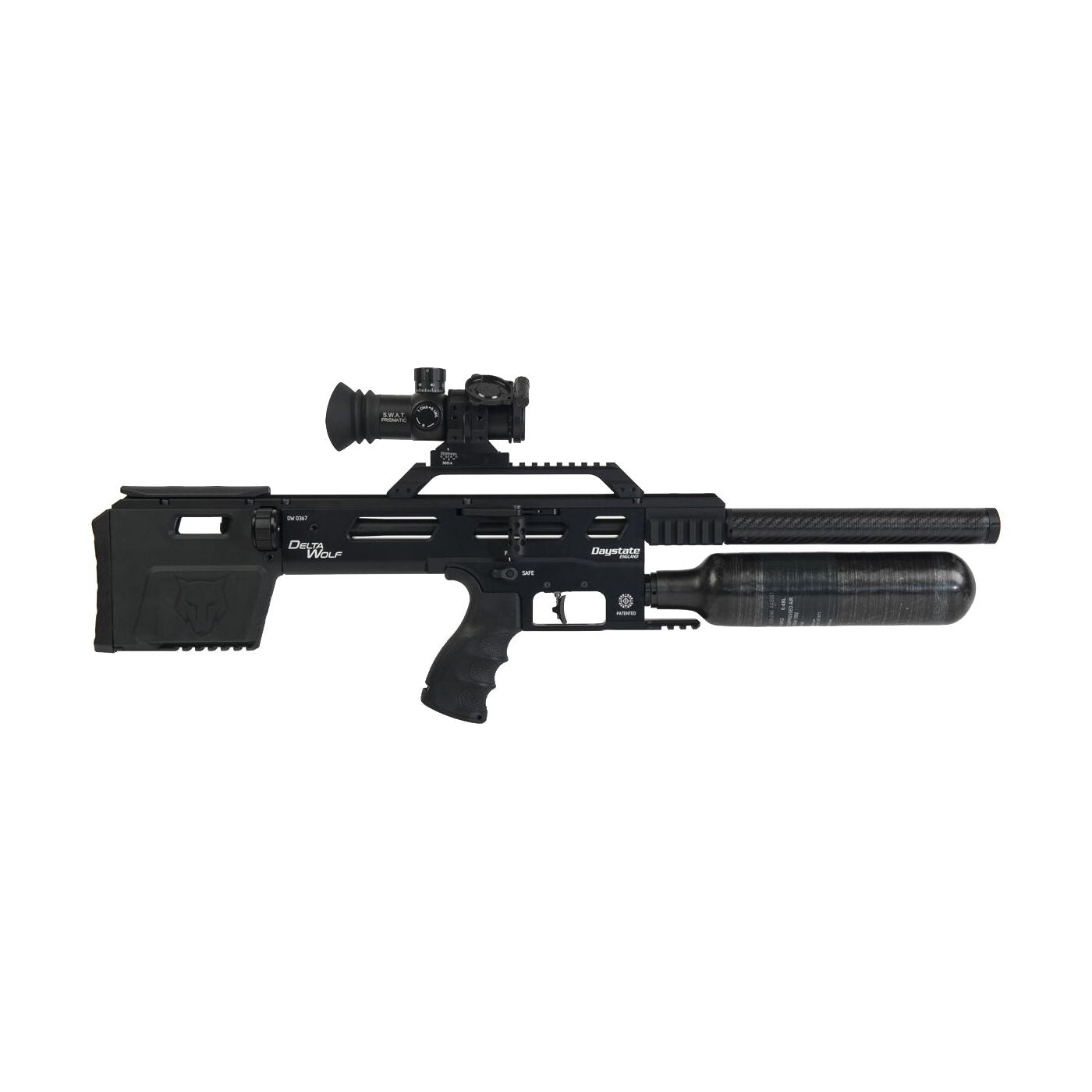
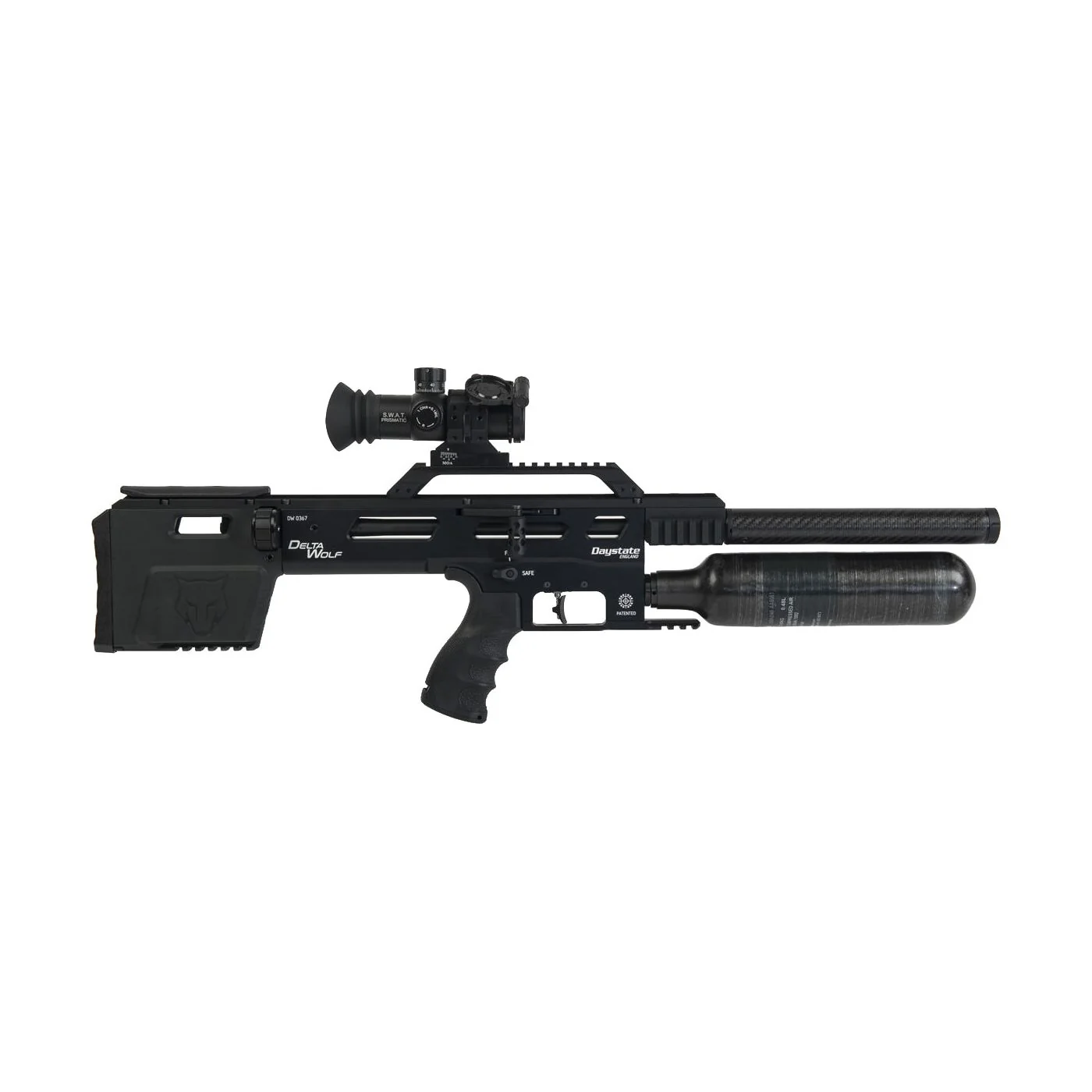
Precision, adaptability, and electronic control are brought together in the Daystate Delta Wolf Tactical so that demanding shooters can be served across target, hunting, and pest-control disciplines. Through a modular tactical platform, consistent power delivery is achieved while fit, calibre, and velocity settings can be refined without a workshop visit. Consequently, the Daystate Delta Wolf Tactical is positioned as a future-ready PCP for shooters who value measurable consistency as much as field handling.
Advanced Velocity Technology and Electronic Control
At the heart of the Daystate Delta Wolf Tactical, touchscreen-controlled Advanced Velocity Technology (AVT) is employed so that calibre-specific power profiles can be selected and stored. Furthermore, an integral chronograph is linked to the onboard electronic system, and shot-to-shot velocity is monitored so that on-the-fly corrections can be applied. As a result, remarkable consistency is maintained even when ammunition or environmental conditions are changed.
Additionally, an 11.1V LiPo battery is housed in the butt, and thousands of shots can typically be delivered from a single charge when responsible charging practice is followed. Meanwhile, menus for magazine count, day/night display, auto power-off, and chronograph on/off are accessed from the butt-mounted screen. Therefore, setup time in the field is reduced, and performance data remains visible without a separate meter.
The electronic two-stage trigger is adjustable for pull weight, stage length, and blade position. Likewise, an AR-style lever is used as a manual electronic isolation safety so that the action can be isolated quickly by left- or right-handed shooters. In addition, firmware updates and deeper mapping can be applied when an optional data-transfer device is connected, so that the platform can be kept current rather than replaced.
Power Mapping, Regulator, and Air System
On high-power configurations of the Daystate Delta Wolf Tactical, pre-set calibre maps are provided, and requested muzzle velocity can be dialled in after regulator pressure is matched to the on-screen prompt. Moreover, a Huma-Air regulator is fitted, and a large secondary plenum (approximately 34 cc) is used so that specific velocities can be exploited with pellets or slugs. Subsequently, a fast-flow valve improves efficiency from the removable 480 cc carbon bottle, which can be filled to 240 bar (3,480 psi).
By contrast, UK-legal sub-12 ft/lb programming is locked so that factory energy limits cannot be exceeded, while 5% power steps can still be applied within that safe envelope. Hence, both FAC and licence-free users can be accommodated on the same electronic architecture, provided local law is observed.
Modular Tactical Stock, Fit, and Handling
A fully modular alloy tactical stock is supplied in black anodised or bronze Cerakote finishes. Meanwhile, an ambidextrous AR-style pistol grip and safety are fitted so that either-hand operation is supported from the box. In the same way, the short-throw side lever can be reversed in minutes, and self-indexing magazines can be inserted from either side of the breech.
Furthermore, two magazines can be staged together so that shot count is effectively doubled between reloads. Typical magazine capacities are:
- 13 shots in .177
- 11 shots in .22
- 10 shots in .25
- 8 shots in .30
Additionally, a sliding Picatinny scope rail (about 150 mm of travel) is mounted on a dovetail so that zero-eye-relief prismatics and high-magnification optics can both be aligned. The cheek piece and height-adjustable butt pad can likewise be moved, and optional PRS accessories can be added when a more specialised fit is required. Consequently, eye alignment and length of pull can be tailored without permanent modification.
Under-bottle, side, and butt Picatinny rails are provided so that bipods, lights, and other accessories can be mounted. A 30 mm carbon shroud is used to reduce muzzle blast, and an optional 0 dB silencer can be added when quieter shooting is needed. Typical compact Tactical dimensions are approximately 722 mm (28.4 in) overall with a 430 mm (17 in) barrel and an unscoped weight near 3.35 kg (7.4 lb). HP configurations extend to about 842 mm with a 600 mm barrel and roughly 3.55 kg.
Calibres, FAC Power, and Accessories
Calibre and barrel swaps can be completed in the field with the matching probe, after which the stored AVT profile is selected on the screen. Therefore, one chassis can serve multiple roles when extra barrel kits are kept on hand.
Typical energy guidance (always confirm locally and on a chronograph):
- .177: up to ~20 ft/lb on compact maps; higher HP maps up to the mid-30s ft/lb
- .22: compact maps up to ~45 ft/lb; HP maps commonly in the 60–78 ft/lb class depending on barrel and tune
- .25: HP maps commonly in the 67–81 ft/lb class
- .30: HP / Performance maps commonly in the 95–115 ft/lb class
Shot count varies with calibre, regulator setting, and requested velocity. At legal-limit energy, several hundred regulated shots per 240 bar fill are commonly reported; high-power tunes trade shot count for energy. Accessories frequently paired with the Daystate Delta Wolf Tactical include:
- Extra calibre barrel and probe kits
- Second 480 cc carbon bottle
- 0 dB silencer and PRS cheek/butt hardware
- Picatinny bipod and high-quality match or hunting optics
- Balanced LiPo charger and spare magazines
Responsible ownership requires that muzzle energy, licensing (FAC where applicable), and transport rules in the shooter’s country are checked before purchase and use.
Practical Use Scenarios
On the range, mapped velocities and the built-in chronograph are used so that pellet or slug choice can be validated without a separate timer. In the field, the compact bullpup layout is carried more easily in cover, while rails accept a bipod for supported pest shots. For hunters who change quarry, a barrel kit and a stored profile are swapped so that a heavier calibre can be brought online without a second rifle being packed. Inclusive design choices—reversible lever, dual-side magazines, sliding rail, and adjustable comb—mean that left-handed, right-handed, and differently proportioned shooters can be fitted with the same platform.
Why the Daystate Delta Wolf Tactical Is Chosen
Consistency is prioritised through AVT, an onboard chronograph, and a regulated high-capacity bottle. Adaptability is delivered through modular rails, reversible controls, and field-swappable barrels. Durability is supported by CNC components, a carbon air source, and an electronic action that can be updated rather than discarded. When these elements are combined, the Daystate Delta Wolf Tactical is offered as a conversion-ready flagship for shooters who want measurable performance and a chassis that can grow with their discipline.
Legal, safe handling and correct charging, filling, and maintenance procedures must always be followed. Once those fundamentals are observed, the Daystate Delta Wolf Tactical can be configured so that precision work, hunting, and high-volume practice are supported from one intelligent tactical PCP.
Daystate, Delta Wolf, Alpha Wolf and Premium PCP Air Rifle Accessories
For shooters researching premium PCP platforms, daystate blackwolf, daystate redwolf, delta wolf, huntsman daystate, and daystate alpha wolf frequently appear among the most searched Daystate-related terms. Whether someone searches for wolf delta, day state, daystate delta wolf, blackwolf, deltaw, daysta, or wants to understand the delta wolf meaning, these rifles are commonly associated with modern PCP engineering, electronic control systems, adjustable configurations, and high-end airgun performance.
People asking what is a delta wolf are generally researching the electronic Daystate platform and how it differs from conventional PCP rifles. Related searches often include electronic wolves, firing cycle, lock time, lock timing, short cocking, cocking ball, index pin, and pin magazine. Searches may also focus on configuration-specific components such as an alpha wolf barrel, stock walnut, safari stock, dima stock, stock replacement, rimfire stocks, or a rifle butt pad.
Daystate Red Wolf, Alpha Wolf and Wolverine Searches
The daystate redwolf family remains closely connected with searches for daystate redwolf price, red alpha wolf, alpha red wolf, and the newer daystate blackwolf platform. Some shoppers may also compare these rifles with the daystate wolverine sapphire, wolverine gun, wolveriner, wolf gun, wolfpack armory wolverine, or even search unusual phrases such as can wolverine go on planes while researching transport rules.
Accessories frequently searched alongside these platforms include a rubber butt, rubber butt pad, butt pad rifle, bradley cheek riser, gecko grips, picatinny bag rider, and buddy bottle cover. Cosmetic or clothing-related search phrases such as red bodywarmer and black snood may also appear alongside broader brand searches.
Magazine-related searches include 177 magazine, mag 177, and 25 magazine, while ammunition research can include 177 pellets types, 5.0 mm pellets, and slug pellet. Because pellet suitability depends on the rifle, barrel, legal power level, and intended range use, compatible ammunition should always be selected according to the manufacturer’s specifications.
PCP Air Systems, Moderators and Thread Accessories
Many enthusiasts researching Daystate rifles also search for air rifle compressed air, compressed air rifle, what are pcp air rifles, and what is a pre charged pneumatic air rifle. These searches relate to the fundamental operating principle of PCP systems, in which stored compressed air is used to power each shot.
Common accessory searches include air gun pc, air gun suppressor, air gun suppressors, airgun moderator, air rifle moderator, 0db, 0db moderator, and 0 db moderator. Buyers may also encounter searches for a hogan decimeater silencer, silencer thread adapter, thread protector rifle, and muzzle thread protector when comparing muzzle accessories and compatible threaded components. Local regulations should always be checked before purchasing or fitting sound-moderating equipment.
Maintenance-related searches often include pcp o ring kit, while tuning-oriented users may look for an ats tuner. Search terms such as unfend can also appear in broad airgun keyword datasets, even when the intended product or meaning is unclear.
M-LOK, Picatinny and Rifle Sling Accessories
Accessory compatibility is another major area of interest. Common searches include mlok to picatinny rail adapter, best m-lok to picatinny rail adapter, m-lok to picatinny adapter, and picatinny m lok adapter. These adapters are often researched by users who want to mount compatible optics, rests, bipods, bags, or other permitted accessories on an appropriate rail system.
Sling-related searches include riffle sling, rigle sling, how to put a gun sling on a rifle, how to put a rifle sling on, how to install a rifle sling, how to put sling on rifle, installing a rifle sling, and attaching a sling to a rifle. Because attachment arrangements differ between stocks, rails, swivels, and chassis systems, the correct mounting points should always be confirmed from the manufacturer’s documentation.
Other general mechanical or unrelated search phrases found within broader keyword datasets include how to put extinguisher call back together, weatherby vanguard trigger adjustment, and 3.55kg in lbs. While these terms may appear in search data, they are not necessarily specific to Daystate PCP rifles.
BRK, Brocock and XR Air Rifle Searches
Alongside Daystate products, many buyers compare models produced under the Brocock and BRK families. Popular searches include brocock ltd, brocock sniper xr, brocock commander xr, pathfinder xr, brk ghost, brocock airguns, brocock commander, brk ghost air rifle, and brk sniper xr.
The brocock sniper xr is often researched by shooters comparing compact PCP platforms, while the brocock commander xr and brocock commander searches generally relate to larger tactical-style PCP configurations. Meanwhile, brk ghost and brk ghost air rifle searches reflect growing interest in BRK-branded PCP systems.
Those comparing local purchasing options may also search fx airgun dealer near me, even when their primary interest is Daystate or Brocock. This reflects the way many airgun shoppers compare several premium manufacturers before deciding which PCP platform, stock configuration, calibre, regulator setup, magazine system, and accessory package best matches their intended sporting use.
Additional Daystate and Airgun Search Terms
Broader searches surrounding these rifles may include model alpha gun, griffin gun, and general comparisons involving a wolf gun or other premium PCP platform. Buyers may also investigate different stock materials, rail systems, moderators, magazines, barrel options, butt pads, cheek risers, thread protectors, and compressed-air accessories before completing a build.
Whether someone begins with daystate redwolf, explores the daystate alpha wolf, compares a daystate delta wolf, investigates the daystate blackwolf, or considers a daystate wolverine sapphire, the most useful approach is to verify model compatibility, calibre, pressure specifications, local regulations, and manufacturer-supported accessories before purchasing replacement components or upgrades.
Calibres, FAC Rating, Power Options, and Accessories for the Daystate Delta Wolf Tactical
Through a modular electronic platform, multiple calibres, power maps, and accessory combinations can be supported on the Daystate Delta Wolf Tactical so that target work, pest control, and FAC hunting can be served from one chassis. Consequently, barrel, probe, and stored velocity profiles can be matched without a second rifle being required. Meanwhile, legal limits must always be respected, and muzzle energy should be confirmed on a chronograph after any change of pellet, slug, or regulator setting.
Available Calibres and Magazine Capacities
On compact Tactical configurations, .177 and .22 are commonly supplied. On HP and Performance variants of the Daystate Delta Wolf Tactical, .25 and .30 are additionally offered so that heavier projectiles can be used where FAC authority has been granted. Furthermore, field-swappable ART / Lothar Walther barrel kits are provided so that a calibre change can be completed in minutes when the matching probe is fitted and the corresponding AVT profile is selected on the touchscreen.
Self-indexing magazines can be inserted from either side of the breech. In addition, two magazines can be staged together so that follow-up capacity is effectively doubled. Typical capacities are listed below:
- .177 (4.5 mm): 13-shot magazine
- .22 (5.5 mm): 11-shot magazine
- .25 (6.35 mm): 10-shot magazine
- .30 (7.62 mm): 8-shot magazine
Because magazine geometry is calibre-specific, the correct cassette must be used after a barrel swap. Likewise, pellet or slug length should remain within the magazine and probe design so that feeding reliability is preserved.
FAC Considerations and Legal Power Envelopes
UK and similar licence-free markets restrict unlicensed air rifles to a maximum of 12 ft/lb. Therefore, a dedicated sub-12 programme is loaded on legal-limit examples of the Daystate Delta Wolf Tactical, and factory safeguards are applied so that that cap cannot be exceeded through menu adjustment. Within that envelope, power can still be reduced in approximately 5% steps, which is useful when quieter indoor or short-range practice is required.
By contrast, FAC-rated examples are programmed with calibre-specific high-power maps. After regulator pressure is set to the on-screen recommendation, requested muzzle velocity can be selected so that ammunition and quarry can be matched. Local licensing, transport, and storage rules remain the shooter’s responsibility; energy figures published by manufacturers are guidance only and must be verified after any tune.
Inclusive practice means that left- and right-handed users, as well as clubs operating mixed legal and FAC ranges, can share the same platform provided the correct programme and documentation are used.
Power, Regulator, and Expected Performance
A Huma-Air regulator and a large secondary plenum (about 34 cc) are employed so that consistent pressure can be delivered to a fast-flow valve. The removable 480 cc carbon bottle can be filled to 240 bar (3,480 psi). Shot count then depends on calibre, requested energy, hammer dwell, and regulator set-point.
Approximate factory energy guidance for the Daystate Delta Wolf Tactical family (always confirm locally) is as follows:
- .177 compact maps: up to about 20 ft/lb (27 J); HP maps typically into the mid-30s ft/lb
- .22 compact maps: up to about 45 ft/lb (61 J); HP / Performance maps commonly 71–78 ft/lb
- .25 HP maps: commonly 75–81 ft/lb
- .30 HP / Performance maps: commonly 105–115 ft/lb on longer barrels
At legal-limit energy, several hundred regulated shots per fill are frequently reported (often 400+ in .177 and 450+ in .22 under favourable tunes). High-power FAC settings trade shot count for energy; fifty usable hunting shots from a 240 bar fill is a realistic planning figure on many .22 and .25 FAC maps, while .30 slug work may reduce that further. Because Advanced Velocity Technology monitors each shot through the integral chronograph, drift can be corrected on the fly, and consistency within a tight fps band is typically maintained until bottle pressure falls below the regulator set-point.
Pellets and slugs should be chosen to match the stored profile. Factory UK test examples often reference Rangemaster Sovereign weights (approximately 8.44 gr in .177 and 15.9 gr in .22) at legal limit; FAC maps are commonly built around JSB and similar match/hunting weights. Heavier slugs on Performance barrels require the correct twist and probe, after which velocity is requested on the screen rather than guessed.
Accessories That Complete the Rifle
Conversion and field use are extended when the following items are added to the Daystate Delta Wolf Tactical:
- Calibre kits: spare barrels, probes, and matching magazines so that .177 practice and .25/.30 hunting can share one stock
- Air system: a second 480 cc carbon bottle and a quality fill probe / whip rated to 240 bar
- Signature control: 0 dB silencer and the factory 30 mm carbon shroud for reduced muzzle blast
- Fit and support: PRS cheek risers, adjustable butt pads, Picatinny bipod, and sling hardware on the under-bottle and butt rails
- Optics: a sliding Picatinny rail that accepts both zero-eye-relief prismatics and high-magnification scopes
- Power and data: balanced LiPo charger, spare 11.1 V pack, and optional data-transfer device for firmware and advanced mapping
- Consumables: extra magazines, O-rings, and a portable chronograph as a backup to the onboard unit
Rails under the bottle, beside the barrel, and under the butt allow lights, lasers (where lawful), and rest bags to be mounted without stock modification. Because the side lever, safety, and magazines are ambidextrous, accessory layout can be mirrored for either-hand use.
When calibre, FAC status, power map, and accessories are specified together, the Daystate Delta Wolf Tactical is configured as a single adaptable system rather than a fixed-energy rifle. Responsible verification of energy, licensing, and safe filling practice remains essential before any of those options is used in the field or on the range.
Practical Use Scenarios
A compact electronic bullpup is carried into the field so that precision work, pest control, and licensed hunting can be completed from one modular chassis. Because fit, calibre, and velocity maps can be adjusted without a workshop visit, a single platform is prepared for a morning on the club range and an evening in cover. Inclusive controls are provided so that left-handed and right-handed shooters, as well as users of different stature, can be fitted on the same rifle. Legal energy limits, safe backstops, and local licensing must always be observed before any of the scenes below is attempted.
Club Range, Zeroing, and Mapped Practice
On a formal range, the rifle is placed on a rest or bipod so that a stored velocity profile can be confirmed. After the battery is charged and the bottle is filled to the recommended pressure, the touchscreen is unlocked and the intended pellet weight is selected. Subsequently, a short string is fired while the integral chronograph is watched, and requested speed is compared with actual speed. When a small discrepancy is seen, regulator pressure is adjusted to the on-screen prompt, and another string is fired until a tight band of velocities is recorded.
Meanwhile, the sliding optic rail is moved so that eye relief is matched to a high-magnification target scope or a short-eye-relief prismatic. The cheek piece and butt pad are then raised or lowered until a repeatable cheek weld is obtained. Consequently, parallax error and inconsistent head position are reduced before a formal zero is taken. After zero is established at the club’s primary distance, additional aiming marks are recorded at further distances so that holdover can be applied later in the field.
Magazine capacity is used so that long strings can be completed without constant handling of loose pellets. Two cassettes can be staged at the breech, and an empty magazine is pushed aside so that a full one is brought into line. Therefore, a fifty-shot practice block can be finished with fewer interruptions. Power can be reduced in small steps on legal-limit programming when indoor or short-range lanes are used, and a quieter report is obtained without a second rifle being packed.
Highlighted practice checklist:
- Battery charge and bottle pressure are verified before the first shot
- Stored profile, pellet weight, and barrel length are confirmed on the display
- Chronograph readings are compared with the requested velocity
- Rail, comb, and pad are locked after a comfortable weld is found
- Spare magazines and a notebook of holdovers are kept at the bench
Because openings of each string are varied in distance and position—prone, sitting, and supported standing—skill is built rather than a single favoured posture being repeated.
Pest Control Around Buildings and Wood Edges
At first light, the compact overall length is used so that the rifle can be carried along hedge lines and through gates without a long barrel catching on wire. A legal-limit map is selected where licensing does not permit higher energy, and a shroud plus optional silencer are fitted so that disturbance to livestock and neighbours is reduced. After a stable rest is found on a gatepost or bipod, a short stalk is completed and a humane shot is taken only when a clear backstop is present.
Additionally, accessory rails accept a lamp where night work is lawful. The display can be switched to a night-friendly mode so that the shooter’s position is not advertised by a bright screen. Auto power-off is lengthened when a long wait is expected, yet the isolation safety is applied whenever the rifle is moved between stands. Inclusive handling remains important in gloves and cold weather: the reversible side lever and ambidextrous safety can be set to the user’s dominant side before the outing begins.
When several species or distances are expected in one permission, a moderate .22 map is often preferred for balance between trajectory and energy. Heavier pellets are chosen for windy edges, while lighter pellets may be reserved for closer, sheltered yards. After each successful or unsuccessful shot, the chronograph reading is glanced at so that a developing pressure drop is noticed before consistency is lost. A spare bottle can be exchanged in seconds if a long day is planned, and the empty bottle is refilled at the vehicle rather than in the field.
Licensed Hunting and Calibre Changes in the Field
Where a firearms certificate or equivalent authority has been granted, higher-energy maps are loaded so that appropriate quarry can be addressed at responsible distances. A longer barrel kit is fitted when extra velocity or slug compatibility is required, and the matching probe is installed before the new profile is selected on the screen. Because the swap can be completed in a few minutes, a morning of close woodland work in one calibre can be followed by an afternoon of longer rides in another, provided the correct magazines travel with the kit.
Supported shots from a bipod or pack are favoured so that the extra energy is delivered with the same care used on the range. Slug profiles, when authorised and correctly barrelled, are reserved for distances and quarry for which they were mapped; pellets remain the default where twist rate and magazine feed are optimised for wadcutters or domes. After a change of projectile, a confirmation string is fired into a safe bank so that the new zero is proven rather than assumed.
Highlighted hunting pack-out:
- Licence documents and energy verification notes are carried
- Primary barrel plus one spare calibre kit and probes
- Two bottles, fill whip, and a portable pressure check
- Silencer, bipod, and weatherproof optic covers
- Spare magazines for each calibre and a basic hex set
Wind calls and range estimation are still required. Electronics regulate velocity; they do not replace fieldcraft. A missed shot is followed by a pause, a safety isolation, and a second approach only when a humane opportunity is again presented.
Shared Club Use, Coaching, and Inclusive Fit
In a club armoury or coaching session, several shooters can be introduced to the same chassis because the grip, lever, rail, and comb are adjustable. A junior or shorter-statured adult is fitted by sliding the optic forward and lowering the pad, while a taller shooter is given more length of pull. Left-handed newcomers are not sent away for a gunsmith visit; the lever is swapped and magazines are inserted from the opposite side. Inclusive language and unhurried briefings are used so that first-time users understand the electronic safety, the unlock sequence, and the need to treat every rifle as if it were loaded.
Coaches can display velocity on the screen after each shot so that flinch or hold error is separated from genuine power variation. When a student struggles with trigger control, pull weight and first-stage length are adjusted until a clean break is felt. Night-mode and reduced power settings are demonstrated for indoor leagues. After the session, the battery is removed for balanced charging, O-rings are checked, and magazines are emptied so that the next member receives a safe, documented rifle.
All-Day Air, Battery, and Weather Management
A full outing is planned around two consumables: high-pressure air and the butt-housed battery. Several hundred legal-limit shots can often be obtained from one 240 bar fill, yet FAC maps consume air faster. Therefore, bottle pressure is watched on the gauge and on the display, and a change is made when the regulator set-point is approached rather than after velocity has already fallen. The magnetic fill-port cover is kept clean so that grit is not introduced during a roadside top-up.
Battery life is typically long, but cold weather reduces output. A spare charged pack is carried in an inside pocket, and the screen is not left awake between stands. Rain covers are fitted over the optic and the display; the action is wiped and dried before the rifle is cased. After returning home, air is not stored at maximum pressure for months without inspection, and firmware is updated only with the official interface when a stable indoor bench is available.
Competition-Style Field Target and Mixed Distances
Although the platform is tactical in outline, mapped consistency is used on field-target and hunter-field-target style courses where allowed by club rules. Distances change rapidly, so holdover cards produced on the range are taped inside the stock or stored on a phone. A stable kneeling or sitting position is adopted, the isolation safety is moved only when the lane officer has given permission, and the short cocking stroke is cycled without breaking the cheek weld. Power is left on a known map rather than being altered mid-course, because a change of velocity would invalidate the card.
When a lane requires a very close target, a lower legal-limit step can be selected in advance during sighting-in days, and that profile is named clearly on the screen so that it is not confused with a hunting map. After the course, data from the chronograph can be reviewed so that a cold barrel or a falling bottle is not blamed on the shooter.
Quiet Permissions, Neighbours, and Night Stands
On permissions near houses, a silencer and reduced power are combined so that reports remain discreet. Lamps are used only as local law and courtesy allow. The rifle is carried muzzle-down in vegetation with the safety isolated, and it is never rested pointing at a building or a path. Two magazines staged at the breech reduce the noise and motion of loose-pellet handling. After the stand, brass-free pellet wads and empty magazines are collected so that the landowner’s trust is kept.
Inclusive night work includes a second person as a spotter when policy requires it, clear verbal signals, and a pre-agreed abort if livestock or public foot traffic appears. Electronics are an aid to consistency, not a substitute for identifying the target beyond doubt.
Travel Between Venues and Vehicle Discipline
The short overall length allows the cased rifle to be placed across a smaller vehicle boot. Bottles are transported empty or at a documented safe pressure according to local rules, and the battery is protected from crush. At a second venue, fill, charge, and profile are checked again because temperature changes affect both air density and indicated speed. A printed or digital note of the last verified energy is kept with the licence so that a club official can be satisfied without argument.
When these scenes are combined—range mapping in the morning, a calibre kit change at midday, and a quiet evening permission—the same modular bullpup is used throughout. Consistency is maintained by the regulator, chronograph, and stored maps. Safety is maintained by isolation, backstops, and verification. Fit is maintained by rails, comb, pad, and reversible controls so that more shooters can be included on one well-understood platform.
Frequently Asked Questions
Answers below are written so that buyers, club members, and licensed hunters can plan a purchase without repeating marketing names. Legal energy caps, licensing, and safe handling remain the user’s responsibility in every country. Inclusive fit is assumed: left-handed and right-handed shooters, as well as users of different stature, can usually be accommodated on the same modular chassis.
General Setup and Who This Platform Suits
Is an electronic bullpup suitable for a first PCP?
A first PCP can be operated successfully when range instruction is taken and the unlock sequence is learned before live firing. Because menus, a chronograph, and an isolation safety are built in, more steps must be understood than on a purely mechanical rifle. Therefore, a supervised zeroing session is recommended. After those habits are formed, consistency and adjustability are often found to be easier rather than harder.
Can both hunting and target work be covered by one rifle?
Multiple roles can be covered when barrel kits, magazines, and stored velocity maps are kept together. A compact legal-limit profile is used on club lanes, while a higher-energy map is selected only where a certificate or equivalent authority has been granted. Consequently, a second complete rifle is not always required, provided local law is followed and energy is verified after every change.
Is left-handed use supported without a gunsmith?
Ambidextrous controls are supplied as standard. The side lever can be reversed in a short workshop-free procedure, magazines can be inserted from either side of the breech, and an AR-style isolation lever can be operated from either hand. Additionally, the sliding optic rail and adjustable comb allow eye alignment to be set for either-shoulder shooting. Inclusive club use is therefore practical on a shared rifle.
Calibres, Magazines, and Barrel Changes
Which calibres can be specified?
Compact programming commonly supports .177 and .22. High-power configurations additionally support .25 and .30 where licensing allows. Barrel and probe kits are sold separately so that a calibre can be changed in the field after the matching magazine is fitted and the correct map is chosen on the screen.
How many shots are held in each magazine?
Typical cassette capacities are listed below:
- .177: 13 shots
- .22: 11 shots
- .25: 10 shots
- .30: 8 shots
Two magazines can be staged at the breech so that an empty cassette is displaced by a full one. Feeding reliability depends on correct pellet or slug length for that cassette and probe.
How long does a barrel swap take?
A calibre change can usually be completed in a few minutes when the correct probe, barrel, and hex tools are carried. After mechanical assembly, the stored profile for that barrel length and projectile weight must be selected. A confirmation string should then be fired into a safe bank because zero and requested velocity cannot be assumed from the previous calibre.
Can slugs be used?
Slug use is intended only on barrels and maps designed for that projectile, typically on longer high-power tubes. Twist rate, probe length, and magazine geometry must match. Where those conditions are not met, pellets remain the appropriate choice. Energy and grouping must be verified after any slug profile is loaded.
FAC, Legal-Limit Power, and Chronograph Control
How is UK-style legal-limit energy handled?
A separate programme is loaded so that factory energy cannot be raised above the licence-free cap. Within that cap, output can still be reduced in small percentage steps for indoor lanes or quieter permissions. Chronograph checks are still required after a pellet brand or weight is changed, because a heavier projectile can alter energy even when velocity looks familiar.
What can be adjusted on a certificated high-power rifle?
Pre-set calibre maps are offered, and a requested muzzle velocity can be entered after regulator pressure is matched to the on-screen prompt. Hammer dwell and related electronic parameters may be refined with official software where provided. Higher energy reduces shot count and increases the need for a solid rest, a certain target, and a safe backstop.
Why is an integral chronograph included?
Each shot can be measured at the muzzle so that the electronic valve is corrected on the fly. Consistency within a narrow speed band is the aim until bottle pressure falls below the regulator set-point. A handheld chronograph can still be used as a second opinion after a tune, a new pellet tin, or a long storage period.
How many shots can be expected from one fill?
A 480 cc bottle filled to 240 bar is the usual air source. Several hundred regulated shots are commonly recorded at legal-limit energy (often in the region of 400+ in .177 and 450+ in .22 under favourable tunes). High-power hunting maps may yield far fewer usable shots—planning around a few dozen on .22/.25 FAC settings is more realistic than expecting a legal-limit count. Display warnings appear when pressure approaches the regulator floor.
Stock, Trigger, Safety, and Optics
How is fit adjusted?
A sliding Picatinny rail of substantial travel is mounted on a dovetail so that prismatic and conventional scopes can both be aligned. The cheek piece and butt pad can be moved independently. Optional precision furniture can be added when a match-style weld is required. Inclusive fitting means a shorter-statured shooter and a taller shooter can share the chassis if those parts are marked after each change.
What kind of trigger is fitted?
An electronic two-stage release is used. Pull weight, first-stage length, and blade position can be adjusted. Once a clean break is set, that feel is generally repeatable, but the isolation safety must be understood before live firing. The trigger should not be treated as a toy menu; dry practice is completed only in accordance with club rules and with the magazine removed.
How does the safety work?
A manual AR-style lever isolates the electronic action. Unlock sequences on the screen may also require the lever and side lever to be in defined positions before maps can be edited. The rifle is isolated whenever it is carried between stands, placed in a vehicle, or handed to another person.
Which rails are provided for accessories?
Picatinny sections are typically found under the bottle, beside the forend, and under the butt, in addition to the moving scope rail. A bipod, sling studs, and a lamp (where lawful) can therefore be mounted without stock inletting. Rail covers are advised when sharp edges contact clothing during a long carry.
Air, Battery, Charging, and Care
What fill pressure is used?
Fills up to 240 bar (3,480 psi) are specified. A compatible probe and a clean magnetic port cover are required. Overfilling is avoided. After a fill, the bottle is seated firmly, and the gauge plus on-screen regulator reading are compared before the first shot.
Can the bottle be swapped in the field?
A removable carbon bottle is used so that a spare can be fitted in seconds. The empty bottle is refilled at the vehicle rather than beside livestock or a public path. O-rings are inspected whenever a bottle is exchanged.
How is the battery treated?
An 11.1 V LiPo pack is housed in the butt and is removed for balanced charging with the specified charger. Several thousand shots per charge are often quoted in mild conditions, yet cold weather shortens that figure. A spare charged pack is carried on winter permissions. The pack is not stored fully depleted, and it is kept away from crush damage in transit.
What routine maintenance is expected?
Highlighted care points include:
- Magazines emptied and inspected after each session
- Fill port and probe kept free of grit
- Battery charged on a proper balance charger
- Threads and O-rings checked when barrels or bottles are swapped
- Action dried after rain and stored with moderate air pressure
- Firmware updated only with official leads on a stable indoor bench
Pacemakers and magnetic-stripe cards should be kept away from the electronic action as advised in the handbook.
Accessories, Quiet Use, and Travel
Which extras are most often added first?
A second bottle, extra magazines, a quality optic on the sliding rail, a bipod, and a silencer are the usual first additions. Calibre kits come next when more than one role is planned. A balanced charger and a data interface for firmware are recommended for owners who intend to keep the rifle for many seasons.
Can the report be quieted for sensitive permissions?
A carbon shroud is fitted as standard on many configurations, and an optional silencer can be added. Legal-limit maps already reduce blast compared with high-power tunes. Courtesy to neighbours and livestock still requires shot selection, not only hardware.
How is the rifle transported?
The short bullpup length eases casing in smaller vehicles. Bottles are moved according to local pressure-vessel rules. The battery is protected from impact. At a new venue, fill, charge, and selected map are checked again because temperature changes affect indicated speed. Documents for any certificated energy level travel with the rifle.
Can firmware be updated later?
An official data device can be connected so that maps and system software are refreshed. Updates are performed indoors with a charged battery and a known-good cable. Experimental unofficial files are not recommended, because valve timing and legal-limit locks can be affected.
Buying Decisions and Responsible Use
What should be confirmed before an order is placed?
Calibre, barrel length, finish, and whether legal-limit or high-power programming is required must be stated. Accessory rails and magazine count should be matched to the intended discipline. Inclusive fit should be tested if possible: lever side, comb height, and rail position. A written note of expected energy for the chosen pellet is requested from the retailer and then verified on a chronograph after delivery.
Is professional inspection needed after purchase?
A qualified technician or experienced club coach should witness first fills and first electronic unlocks if the owner is new to regulated PCPs. Energy must be measured before the rifle is used on a permission. Any transport or storage rule attached to a certificate must be read in full.
What remains the shooter’s duty regardless of electronics?
Target identification, a safe backstop, isolation of the action when moving, and compliance with licence conditions cannot be delegated to a screen. Maps and regulators keep velocity consistent; they do not decide whether a shot is wise. When those duties are accepted, the modular electronic bullpup can be used across range practice, pest control, and licensed hunting with one well-understood set of habits.




Reviews
There are no reviews yet.