Daystate, Delta Wolf, Alpha Wolf and Premium PCP Air Rifle Accessories
For shooters researching premium PCP platforms, daystate blackwolf, daystate redwolf, delta wolf, huntsman daystate, and daystate alpha wolf frequently appear among the most searched Daystate-related terms. Whether someone searches for wolf delta, day state, daystate delta wolf, blackwolf, deltaw, daysta, or wants to understand the delta wolf meaning, these rifles are commonly associated with modern PCP engineering, electronic control systems, adjustable configurations, and high-end airgun performance.
People asking what is a delta wolf are generally researching the electronic Daystate platform and how it differs from conventional PCP rifles. Related searches often include electronic wolves, firing cycle, lock time, lock timing, short cocking, cocking ball, index pin, and pin magazine. Searches may also focus on configuration-specific components such as an alpha wolf barrel, stock walnut, safari stock, dima stock, stock replacement, rimfire stocks, or a rifle butt pad.
Daystate Red Wolf, Alpha Wolf and Wolverine Searches
The daystate redwolf family remains closely connected with searches for daystate redwolf price, red alpha wolf, alpha red wolf, and the newer daystate blackwolf platform. Some shoppers may also compare these rifles with the daystate wolverine sapphire, wolverine gun, wolveriner, wolf gun, wolfpack armory wolverine, or even search unusual phrases such as can wolverine go on planes while researching transport rules.
Accessories frequently searched alongside these platforms include a rubber butt, rubber butt pad, butt pad rifle, bradley cheek riser, gecko grips, picatinny bag rider, and buddy bottle cover. Cosmetic or clothing-related search phrases such as red bodywarmer and black snood may also appear alongside broader brand searches.
Magazine-related searches include 177 magazine, mag 177, and 25 magazine, while ammunition research can include 177 pellets types, 5.0 mm pellets, and slug pellet. Because pellet suitability depends on the rifle, barrel, legal power level, and intended range use, compatible ammunition should always be selected according to the manufacturer’s specifications.
PCP Air Systems, Moderators and Thread Accessories
Many enthusiasts researching Daystate rifles also search for air rifle compressed air, compressed air rifle, what are pcp air rifles, and what is a pre charged pneumatic air rifle. These searches relate to the fundamental operating principle of PCP systems, in which stored compressed air is used to power each shot.
Common accessory searches include air gun pc, air gun suppressor, air gun suppressors, airgun moderator, air rifle moderator, 0db, 0db moderator, and 0 db moderator. Buyers may also encounter searches for a hogan decimeater silencer, silencer thread adapter, thread protector rifle, and muzzle thread protector when comparing muzzle accessories and compatible threaded components. Local regulations should always be checked before purchasing or fitting sound-moderating equipment.
Maintenance-related searches often include pcp o ring kit, while tuning-oriented users may look for an ats tuner. Search terms such as unfend can also appear in broad airgun keyword datasets, even when the intended product or meaning is unclear.
M-LOK, Picatinny and Rifle Sling Accessories
Accessory compatibility is another major area of interest. Common searches include mlok to picatinny rail adapter, best m-lok to picatinny rail adapter, m-lok to picatinny adapter, and picatinny m lok adapter. These adapters are often researched by users who want to mount compatible optics, rests, bipods, bags, or other permitted accessories on an appropriate rail system.
Sling-related searches include riffle sling, rigle sling, how to put a gun sling on a rifle, how to put a rifle sling on, how to install a rifle sling, how to put sling on rifle, installing a rifle sling, and attaching a sling to a rifle. Because attachment arrangements differ between stocks, rails, swivels, and chassis systems, the correct mounting points should always be confirmed from the manufacturer’s documentation.
Other general mechanical or unrelated search phrases found within broader keyword datasets include how to put extinguisher call back together, weatherby vanguard trigger adjustment, and 3.55kg in lbs. While these terms may appear in search data, they are not necessarily specific to Daystate PCP rifles.
BRK, Brocock and XR Air Rifle Searches
Alongside Daystate products, many buyers compare models produced under the Brocock and BRK families. Popular searches include brocock ltd, brocock sniper xr, brocock commander xr, pathfinder xr, brk ghost, brocock airguns, brocock commander, brk ghost air rifle, and brk sniper xr.
The brocock sniper xr is often researched by shooters comparing compact PCP platforms, while the brocock commander xr and brocock commander searches generally relate to larger tactical-style PCP configurations. Meanwhile, brk ghost and brk ghost air rifle searches reflect growing interest in BRK-branded PCP systems.
Those comparing local purchasing options may also search fx airgun dealer near me, even when their primary interest is Daystate or Brocock. This reflects the way many airgun shoppers compare several premium manufacturers before deciding which PCP platform, stock configuration, calibre, regulator setup, magazine system, and accessory package best matches their intended sporting use.
Additional Daystate and Airgun Search Terms
Broader searches surrounding these rifles may include model alpha gun, griffin gun, and general comparisons involving a wolf gun or other premium PCP platform. Buyers may also investigate different stock materials, rail systems, moderators, magazines, barrel options, butt pads, cheek risers, thread protectors, and compressed-air accessories before completing a build.
Whether someone begins with daystate redwolf, explores the daystate alpha wolf, compares a daystate delta wolf, investigates the daystate blackwolf, or considers a daystate wolverine sapphire, the most useful approach is to verify model compatibility, calibre, pressure specifications, local regulations, and manufacturer-supported accessories before purchasing replacement components or upgrades.
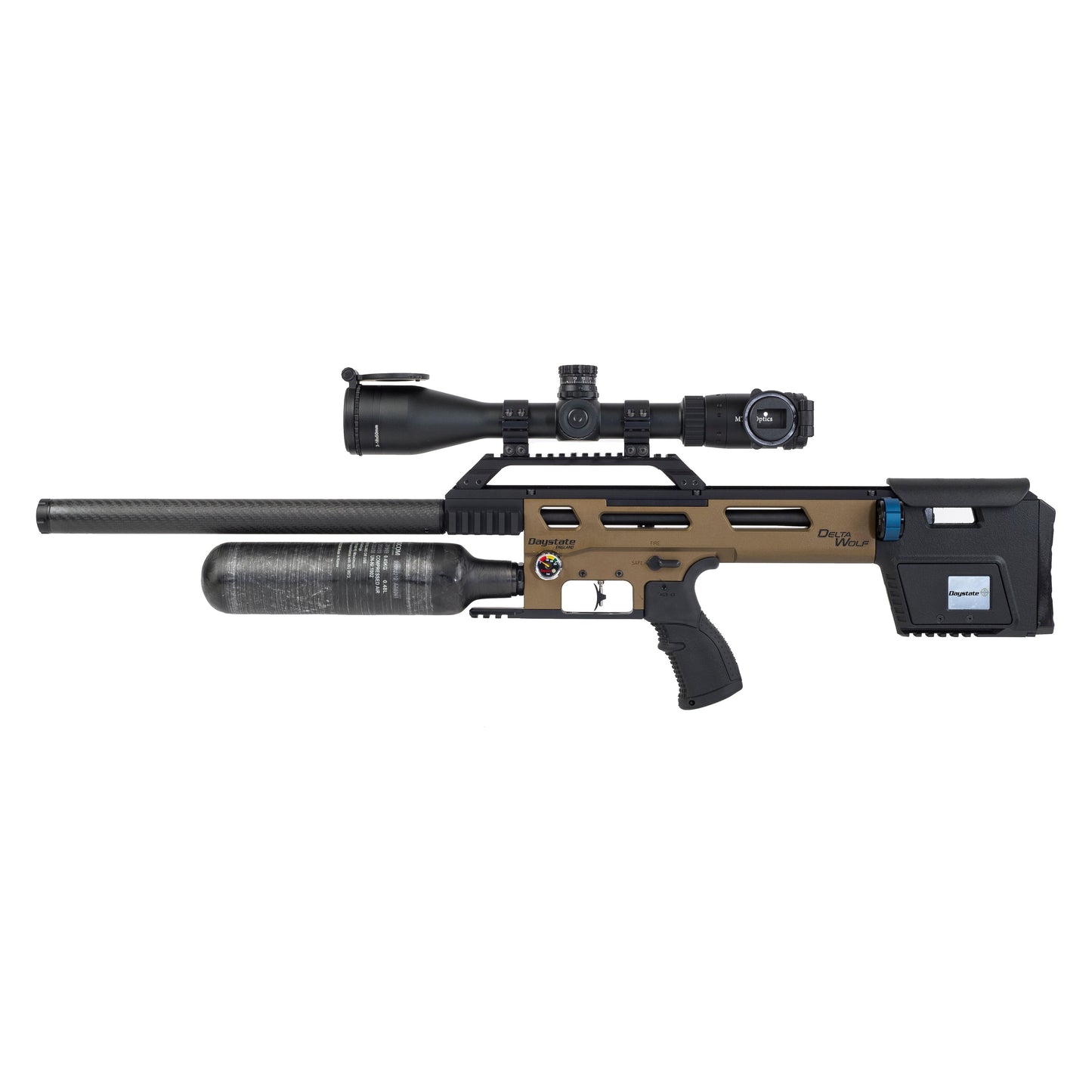
Calibres, FAC Options, Power Maps and Accessories for the Daystate Delta Wolf Bronze
A modular calibre and power architecture is built into the Daystate Delta Wolf Bronze so a single chassis can be configured for legal-limit practice or FAC-level hunting. Consequently, barrels, magazines, regulator settings and electronic profiles can be matched to the ammunition and the licence that is held.
Calibres That Can Be Specified
Four bore sizes are supported across the range, although not every length and energy map is offered on every variant. Standard-length rifles are commonly supplied in .177 and .22, while high-power and FAC models also accept .25 and .30 after the correct barrel, bolt and magazine are fitted.
- .177 (4.5 mm) is selected when flat trajectory, high shot count and paper or HFT-style work are preferred
- .22 (5.5 mm) is chosen when a balance of energy, pellet choice and mid-range hunting is required
- .25 (6.35 mm) is used on FAC / HP builds when heavier pellets or slugs and more terminal energy are needed
- .30 (7.62 mm) is reserved for high-power FAC use where maximum downrange energy is authorised
Magazine capacity is reduced as bore size increases: 13 shots are loaded in .177, 11 in .22, 10 in .25 and 8 in .30. Moreover, two magazines can be staged in the breech at once, so the available string is effectively doubled without the rifle being lowered for a long reload. Meanwhile, self-indexing cassettes can be inserted from either side, which keeps left- and right-handed users equally supported.
Barrel kits are exchanged rather than a second rifle being purchased. ART-developed or Lothar Walther tubes of 430 mm (17 in) or 600 mm (23 in) are typically fitted; longer Performance tubes are listed on some HP packages. After a barrel and bolt change, a stored AVT profile is recalled so zero, requested velocity and power map are restored instead of a full re-tune being started from scratch.
FAC Status, Legal-Limit Use and Power Delivery
Power is not fixed at one figure. Instead, touchscreen-controlled Advanced Velocity Technology is used so pre-set, calibre-specific maps can be selected and, on many models, output can be stepped in small increments. Legal-limit rifles are generally set near 11–12 ft-lb, with published shot counts of roughly 400+ in .177 and 450+ in .22 from a 240 bar fill of the 480 cc carbon bottle. High-power and FAC maps raise muzzle energy substantially; published figures commonly place .177 HP near the low-to-mid 30s ft-lb, .22 and .25 in the 60–75 ft-lb region, and .30 in the 90–105+ ft-lb region depending on barrel length, regulator setting and ammunition. Exact energy must always be confirmed against the licence that is held.
Furthermore, an integral chronograph is housed in the carbon shroud so each shot’s velocity is measured and fed back to the computer. Small deviations are then corrected automatically. On FAC and HP rifles the Huma-Air regulator can also be adjusted by the user, and the large 34 cc plenum plus fast-flow valve are exploited so a chosen fps figure can be dialled in for a given pellet or slug weight. Factory maps for popular Daystate / JSB weights are stored; custom profiles can be added later.
Responsible ownership is required at every power level. Sub-12 use remains subject to local airgun rules; FAC or equivalent certification is mandatory wherever the higher maps are enabled. Electronics manage air and consistency—they do not replace legal checks, safe storage or correct identification of quarry.
Accessories That Complete the Daystate Delta Wolf Bronze
A tactical alloy chassis in bronze Cerakote is supplied with an ambidextrous AR-style grip and safety lever. The grip can be swapped for another AR15-compatible unit if a different shape is preferred. Likewise, the cheek piece is adjustable and reversible, and the butt pad can be exchanged for optional Precision Rifle Services hardware so length of pull and comb height are set for different body sizes and clothing.
A sliding Picatinny scope rail is provided so eye relief can be moved by a substantial amount; prismatic short-eye-relief optics and conventional high-magnification scopes can therefore share the same rifle. Under-barrel and side Picatinny rails accept bipods, lamps, lasers and other field kit. A large-diameter carbon shroud is already fitted to reduce report; a 0 dB-style moderator can be added where local rules allow.
The 480 cc carbon bottle is removable, so a spare charged cylinder can be carried and fitted in seconds. Charging of the Li-Po battery is completed via USB-C. Optional extras that are frequently specified include a second magazine set, barrel-change kits, fill adaptor, hard case, extra o-rings and the Data Transfer Device for firmware updates. Scope, bipod and aftermarket butt hardware are not included as standard and are chosen separately so the package can be built around the shooter’s discipline.
Taken together, calibre kits, FAC or legal-limit maps, regulator and AVT adjustment, dual magazines and a full rail-and-stock accessory suite allow the Daystate Delta Wolf Bronze to be specified once and then adapted as licences, quarry and shooting styles change. Local energy limits and recommended ammunition should be confirmed before the first fill is taken.
Practical Use in the Field, on the Range and After Dark
A compact electronic bullpup is carried most effectively when the session is planned around power maps, ammunition, and the licence that is held. Consequently, a legal-limit profile is selected for quiet practice, while a higher FAC map is reserved for authorised hunting. Meanwhile, dual magazines, a sliding optic rail and reversible controls allow the same chassis to be shared by left- and right-handed shooters without a second rifle being purchased.
Quiet Practice and Zero Confirmation
A back-garden or club range session is started after the bottle is filled to the recommended pressure and the battery is confirmed as charged. Thereafter the touchscreen is woken, the correct calibre profile is loaded, and a modest power step is chosen so report and pellet splash remain neighbour-friendly. Live velocity is displayed after each shot, so a string can be stopped if a flyer is caused by a dirty crown or a mismatched pellet rather than by hold error.
Paper or reactive targets at 20–40 metres are then used while the sliding Picatinny rail is moved until eye relief feels natural. Cheek height and butt-pad position are adjusted until the same sight picture is obtained from a standing, kneeling or bench rest. Because the electronic trigger break is very light, dry-fire familiarisation is completed first so flinch is not introduced when live pellets are used. Groups are recorded only after a consistent hold and follow-through are established.
A second magazine can be staged in the breech before the first is emptied. As a result, a twenty-shot confirmation string in .177 or a twenty-two-shot string in .22 can be fired without the rifle being taken off the bags for a long reload. Empty cassettes are later topped on the bench rather than in the firing line, which keeps the session flowing.
Club Competition and Hunter Field Target Style Work
When a course of reduced-size knock-downs is walked, a lower or mid power map is usually retained so recoil remains negligible and trajectory stays predictable. Wind flags are read between lanes; because velocity is regulated shot to shot, hold-over charts that were built on a calm evening remain useful when a light breeze appears. The compact overall length helps when a kneeling shot must be taken behind a tree or a low barrier.
Furthermore, the ambidextrous lever can be swapped to the support side if a left-handed competitor is using a club rifle that is normally set for the right. Magazines can still be inserted from either side, so no extra parts are required. Side rails accept a small spirit level or a compact rangefinder pouch; an under-rail bipod is fitted only on permitted lanes so the rifle remains legal for the discipline.
Pellet choice is matched to the saved profile. A mid-weight domed pellet is typically favoured for knock-down reliability, while a lighter wadcutter may be reserved for card targets at the zeroing bay. After the course, the same rifle can be returned to a higher map in seconds if an evening pest session is planned—provided the licence allows that energy.
Pest Control Around Buildings and Smallholdings
Legal-limit energy is almost always preferred close to livestock, glass and neighbouring property. A quiet shroud already reduces report; an additional moderator is fitted where rules permit. Approach is made with the safety isolated until the shot is committed. Because the chassis is short, movement through doorways, along hedges and inside outbuildings is easier than with a full-length sporter.
Rats, feral pigeons and similar quarry are engaged only when a safe backstop is confirmed. A .22 profile with a quality hollow-point or polymer-tipped pellet is commonly chosen for humane dispatch at typical farmyard distances. The onboard chronograph is left active so any unexpected drop in speed—caused by a cooling bottle or a partial fill—is noticed before a marginal shot is taken.
Two magazines are carried already loaded. After the first string, the spare is pushed through; the empty cassette is retained by the magnetic interface rather than being dropped in mud or straw. A small LED on a side rail can be used for last-light work, but local light laws and livestock welfare are checked first. After the outing the bottle pressure is noted on the screen, the action is isolated, and the rifle is cased before any vehicle journey.
Authorised FAC Hunting and Longer-Range Work
Where a Firearm Certificate or equivalent permit is held, a higher map and a heavier pellet or slug are selected. The 600 mm barrel is usually preferred for these sessions so dwell time and efficiency are improved. Regulator pressure may be trimmed to match the chosen projectile weight; the large plenum then supplies a stable air dose for each shot.
Quarry is identified positively, range is measured, and a safe backstop is verified before the safety is moved to fire. Because muzzle energy is substantially higher than a legal-limit setup, ricochet risk and travel distance increase; shots across water, hard ground or public paths are refused. A .25 or .30 configuration is used only when the licence lists that calibre and the ammunition is suitable for the species.
Follow-up capability is provided by the dual-magazine system, yet a second shot is taken only if the first was clearly insufficient and a safe angle remains. After a successful retrieve, the profile that was used is left stored so the next outing starts from a known zero rather than from a guess.
Night and Low-Light Sessions
A bronze Cerakote finish does not replace a lamp, but it does reduce shine compared with a bright anodised surface. A compact infrared or white lamp is clamped to a side rail; the sliding top rail still leaves room for a night-rated optic. Night display mode on the screen reduces glare when the rifle is shouldered in darkness.
Battery life is typically generous, yet a spare charged pack or a power bank is packed for long waits. Auto power-off is lengthened so the electronics do not sleep during a freeze. Condensation on the screen is wiped before menus are changed. All other field rules—positive identification, safe backstop, legal hours—remain unchanged after sunset.
Shared Use, Travel and Storage
Inclusive fit is achieved without extra chassis. The lever is reversed in a few minutes, the cheek piece is flipped or raised, and the rail is slid until each user sees a full sight picture. Children or smaller-framed adults are given a shorter length of pull via the adjustable pad; taller users extend the same pad and raise the comb. An aftermarket AR-pattern grip can be fitted if the factory shape does not suit a particular hand.
For travel, the carbon bottle can be unscrewed and carried separately where airline or range rules require an empty cylinder. The action is isolated, magazines are unloaded, and the rifle is locked in a purpose-built case. At a shared club, each shooter loads their own saved profile so one person’s high-power map is not left active for the next person who only holds a legal-limit certificate.
Storage at home follows the same discipline used for any PCP: air is dropped to a safe residual if the rifle will sit unused for a long period, the battery is stored at a mid charge, and keys or combinations are kept away from unauthorised users. Firmware can later be updated at a bench with the optional data lead so maps and fixes are applied before the next season.
Weather, Maintenance Between Sessions and Common Field Checks
Rain is managed by keeping the screen covered when menus are not needed and by drying the magazine well after a wet outing. Extreme cold reduces both battery output and regulator behaviour; a lower power step and a shorter session are chosen until the rifle is warmed. Dusty environments call for more frequent inspection of the fill port and the magnetic magazine faces.
Between outings a simple checklist is followed. Bottle pressure is read from the gauge or screen. The shroud crown is inspected for debris. Magazines are cycled empty to confirm indexing. The trigger shoe position is confirmed after any transport that might have knocked the blade. None of these steps require a workshop visit; they are completed on the kitchen table or tailgate.
When a calibre change is planned for the following weekend, the spare barrel kit is checked for the correct bolt head and the matching magazine. The new profile is loaded at home so the first shots at the range are confirmation rather than discovery. In this way the platform is treated as a system: air, electronics, barrel and ammunition are prepared together rather than hoped for on the day.
Practical success with this electronic tactical PCP is therefore less about a single spectacular group and more about repeatable routines. Power is matched to the law and the quarry. Optics and furniture are set to the shooter who is holding the rifle that day. Magazines are staged before they are needed. Velocity is watched rather than assumed. When those habits are kept, the same compact bronze-finished chassis can move from a quiet zeroing session to a licensed hunt and back again without confusion or unsafe improvisation.
Frequently Asked Questions
Answers below are written for owners and buyers who need clear, practical information before a fill is taken or a profile is changed. Local laws always override any general note. Inclusive fit, shared use and responsible power selection are assumed throughout.
General Setup and First Use
How is the rifle prepared before the first session?
The bottle is filled to the pressure shown on the gauge or screen, and the battery is charged through the USB-C port until a full state is indicated. Thereafter the action is switched on from the butt-mounted screen, the correct calibre profile is selected, and a safe backstop is confirmed before any live pellet is loaded. A light dry-fire cycle is completed so the electronic trigger feel is learned before groups are attempted.
Must the chronograph remain switched on at all times?
Live velocity feedback is useful during zeroing and when a new pellet is tested. However, the module can be disabled from the menu if a silent display is preferred. Consistency is still managed by the regulator and the electronic valve even when the readout is off.
How long does a battery charge typically last?
Several thousand shots are commonly reported from a full Li-Po charge under normal club use. Cold weather shortens that figure, so a spare pack or a power bank is packed for long winter sits. Auto power-off can be lengthened or shortened from the screen so the electronics do not sleep during a wait or drain during storage.
Calibres, Magazines and Barrel Changes
Which bore sizes can be used on the same chassis?
.177 and .22 are the usual legal-limit pair. High-power and FAC packages also accept .25 and .30 once the matching barrel, bolt and magazine are fitted. A stored electronic profile is recalled after the mechanical change so zero and requested speed are restored.
How many shots are held in each magazine?
Capacity falls as calibre rises:
- 13 rounds are loaded in .177
- 11 rounds are loaded in .22
- 10 rounds are loaded in .25
- 8 rounds are loaded in .30
Two cassettes can be staged in the breech at once, so the available string is effectively doubled. Magazines may be inserted from either side, which keeps left- and right-handed users equally supported.
Is a barrel swap something that can be done at the range?
A barrel kit change is designed to be completed without a full workshop. The correct bolt head must travel with the tube. After the swap, the matching profile is loaded on the screen and a short confirmation group is fired before hunting or competition use is resumed. Tools and spare o-rings should be carried whenever a calibre change is planned away from home.
Power, FAC and Legal Limits
Can output be changed without a workshop visit?
On legal-limit rifles, power is usually stepped in small percentage increments from the touchscreen. On FAC and high-power models, pre-set calibre maps are selected, and the Huma-Air regulator can also be adjusted so a chosen velocity is matched to a specific pellet or slug weight. Exact muzzle energy must be measured and kept within the licence that is held.
What shot counts are typically seen from a 240 bar fill?
At legal limit, four hundred or more shots in .177 and about four hundred and fifty in .22 are commonly published for the 480 cc carbon bottle. High-power maps use air faster; the screen and the bottle gauge should be watched rather than a catalogue figure being trusted on a cold day or after a partial fill.
Does a higher map make the rifle unsuitable for club use?
A high-energy profile is isolated before the rifle is shared with anyone who holds only a legal-limit certificate. The same chassis can be returned to a quiet map in seconds. Shared clubs should treat profile selection as part of the handover, just as a magazine is cleared.
Is an FAC automatically granted because electronics are fitted?
No. Certification is a legal process that is completed with the relevant authority. Electronics manage air and consistency; they do not replace paperwork, safe storage or correct identification of quarry.
Handling, Fit and Inclusive Use
Can left-handed shooters use the rifle without extra parts?
The side lever is reversed in a few minutes. Magazines still enter from either side. The cheek piece is adjustable and can be set for the opposite shoulder. An AR-pattern grip may be swapped if a different shape is preferred. No second chassis is required.
How is eye relief set for both prismatic and conventional scopes?
A sliding Picatinny rail is moved along the action until the full sight picture is obtained. Comb height and butt-pad position are then matched so the same weld is repeated from standing, kneeling or prone. Inclusive fit is the goal: smaller-framed and taller users should both reach a comfortable length of pull from the same adjustable pad.
Is the rifle heavy for all-day carry?
Unscoped mass is kept in the mid-three-kilogram range depending on barrel length. The bullpup layout shortens overall length, which helps in hides, vehicles and tight woodland. A sling on the side or under rails spreads the load during long walks.
Accessories, Quiet Use and Night Work
Which rails are already fitted?
A sliding top rail is provided for optics. Under and side Picatinny sections accept bipods, lamps, lasers and rangefinder pouches. Extra hardware is chosen to match the discipline; a hunting lamp is not required on a paper-target evening.
Can report be reduced further?
A large-diameter carbon shroud is already fitted. A 0 dB-style moderator can be added where local rules allow. Legal-limit maps and suitable pellets remain the first tools for neighbour-friendly practice.
How is the rifle used after dark?
Night display mode reduces screen glare. A compact lamp is clamped to a side rail. Positive identification of quarry and a safe backstop are still mandatory. Battery and bottle checks are completed before the wait begins, because cold and long sits drain both faster than a summer range session.
Maintenance, Travel and Storage
Must the bottle stay on the rifle during travel?
The carbon cylinder is removable. Some ranges and carriers require an empty or detached bottle. Local transport rules are followed; the action is isolated and magazines are unloaded before any journey.
What should be checked between outings?
Bottle pressure is read. The crown and shroud are inspected for debris. Magazines are cycled empty to confirm indexing. The trigger shoe is confirmed after transport. The fill port and magnetic magazine faces are kept clean. None of these steps replace a periodic professional service, but they prevent most field surprises.
How is the rifle stored for several weeks?
Air may be dropped to a safe residual if the maker’s guidance allows it. The battery is left at a mid charge rather than empty or full for long periods. Keys and cases are kept away from unauthorised users. Firmware can later be updated at a bench with the optional data lead.
Will rain damage the screen or magazines?
The electronics are designed for field use, yet standing water is wiped promptly. Wet magazines are dried before they are stored so indexing stays smooth. A cover over the butt screen during a downpour keeps menus readable when they are next needed.
Ammunition, Consistency and Troubleshooting
Must a specific pellet be used?
Factory maps are written around popular matched weights. Best groups are usually obtained when the projectile that was used to build the profile is retained. A new slug or pellet is tested with the chronograph on so velocity and spread can be seen before a hunt is booked.



Reviews
There are no reviews yet.