AirMaks Arms Katran-B Standard – Precision, Balance and Refined PCP Engineering
The AirMaks Arms Katran-B Standard has been developed as a bottle-fed version of the Katran platform, combining a high-capacity air system with a compact, adjustable chassis. Because the rifle has been designed around a regulated pre-charged pneumatic system, consistent operation can be maintained across extended target sessions while a balanced handling profile is preserved.
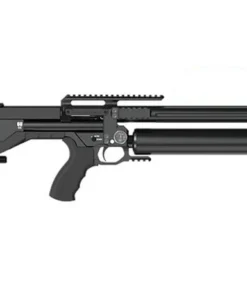
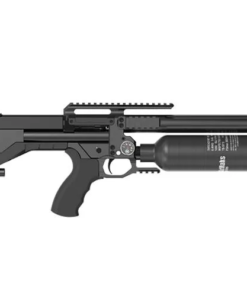
Rather than relying on unnecessary bulk, the AirMaks Arms Katran-B Standard has been engineered around an aluminium chassis, an adjustable folding stock, and a precision CZ barrel. Consequently, a distinctive combination of portability, stability, and mechanical refinement has been achieved.
Its contemporary design is complemented by a rear-mounted bottle configuration, while the adjustable cheekpiece and butt pad allow the fit to be adapted to different users. In addition, left- or right-side operation can be accommodated through the reversible cocking lever and safety system.
Engineered Around a Bottle-Fed PCP Platform
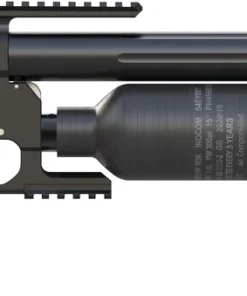
A high-capacity bottle system is incorporated into the AirMaks Arms Katran-B Standard, allowing a substantial air reserve to be carried without compromising the overall proportions of the platform. According to AirMaks, a 580 cc air bottle rated to a maximum fill pressure of 300 bar is fitted.
Because the air supply is regulated, pressure delivery is controlled before each shot. As a result, shot-to-shot behaviour can remain comparatively stable throughout the usable pressure range.
Meanwhile, the bottle layout contributes to the rifle’s distinctive balance. Instead of concentrating unnecessary mass toward the front of the system, weight is distributed through the central and rear portions of the platform.
Precision CZ Barrel System
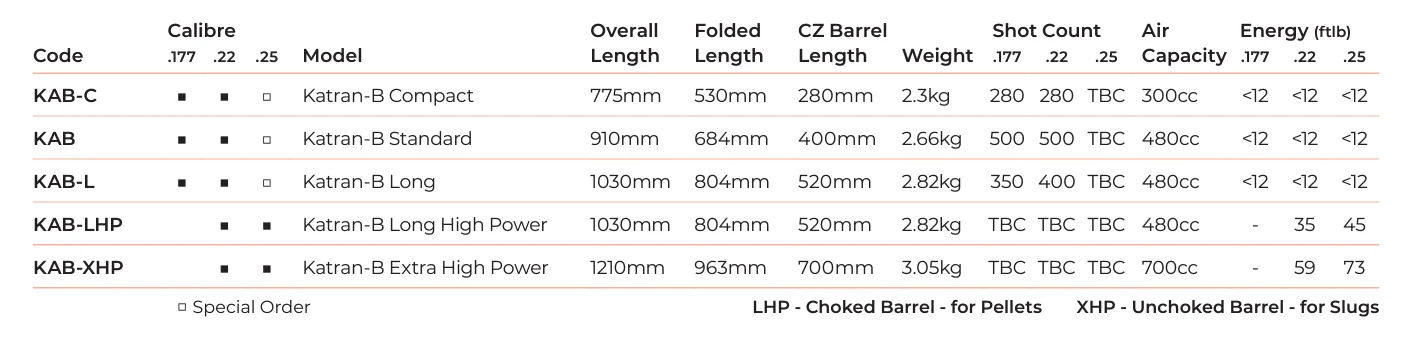
A 400 mm choked CZ barrel is fitted to the standard Katran-B configuration.
CZ barrels have been incorporated into several AirMaks platforms, and here the barrel is integrated into a compact PCP architecture designed primarily around predictable mechanical operation.
Additionally, the barrel assembly is complemented by a shrouded configuration. A 1/2-inch UNF threaded interface is also specified by the manufacturer for compatible muzzle equipment where permitted by local law.
Adjustable Aluminium Folding Stock
Adaptability is one of the defining characteristics of the AirMaks Arms Katran-B Standard.
An aluminium stock has been fitted, and both folding and length adjustment are provided. Moreover, the cheekpiece height and butt-pad height can be adjusted.
Therefore, a more natural head position and shoulder fit can be established for different body types and shooting positions.
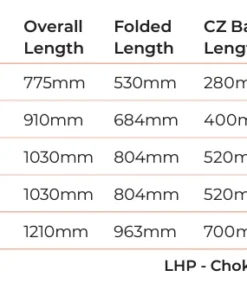
When the stock is extended, the rifle measures approximately 910 mm. Once folded, its length is reduced to approximately 665 mm according to the current AirMaks specification. Overall weight is listed at approximately 2.66 kg before optics or accessories are added.
User-Oriented Control Layout
An AR15-style grip architecture has been incorporated into the platform. At the same time, the side-lever cocking system can be configured on either the right or left side.
Similarly, the safety control can be reversed.
Because those controls can be repositioned, the rifle can be configured more comfortably for a broader range of users rather than forcing every operator into one fixed layout.
Two-Stage Adjustable Trigger
A two-stage trigger system is installed on the AirMaks Arms Katran-B Standard.
External adjustment is provided by the manufacturer, allowing the trigger characteristics to be configured according to the intended sporting application and within the manufacturer’s instructions.
Consequently, a predictable trigger release can be established without disrupting the rifle’s streamlined mechanical layout.
Multi-Shot Magazine System
Different magazine capacities are supplied according to calibre.
Magazine capacities listed by AirMaks include:
- .177 / 4.5 mm – 18 shots
- .22 / 5.5 mm – 16 shots
- .25 / 6.35 mm – 14 shots
These capacities are specified by the manufacturer for the current Katran-B platform.
Because a multi-shot system is used, repeated loading is simplified during sporting target sessions. Nevertheless, safe handling practices should always be maintained whenever the rifle is loaded or handled.
20 MOA Picatinny Optics Rail
Optical equipment can be mounted using the integrated 20 MOA Picatinny rail.
This standardized interface allows compatible sighting equipment to be installed without requiring a proprietary mounting format.
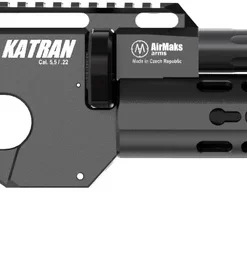
Meanwhile, an aluminium handguard with a nine-slot KeyMod section provides additional accessory-mounting flexibility. Therefore, the rifle can be configured around the requirements of legitimate sporting or target applications without excessive modification of the core chassis.
Key Features of the AirMaks Arms Katran-B Standard
For easier product-page scanning, the principal specifications can be highlighted as follows:
- Regulated PCP operating system
- 580 cc high-capacity air bottle
- Maximum 300-bar bottle pressure
- 400 mm choked CZ barrel
- Approximately 910 mm overall length
- Approximately 665 mm folded length
- Approximately 2.66 kg rifle weight
- Aluminium folding and length-adjustable stock
- Height-adjustable cheekpiece
- Height-adjustable butt pad
- Reversible side-lever cocking system
- Reversible AR-style safety
- Two-stage externally adjustable trigger
- 20 MOA Picatinny optics rail
- Nine-slot KeyMod handguard
- AR15-style grip architecture
- Multi-shot rotary magazine
- .177, .22 and .25 calibre configurations listed by AirMaks
Balanced Standard-Length Configuration
Whereas shorter versions tend to prioritize reduced dimensions, the AirMaks Arms Katran-B Standard occupies the middle ground within the Katran family.
Its 400 mm barrel and standard-length chassis allow the platform to retain a stable shooting position while remaining comparatively compact. Furthermore, the folding stock makes transportation and storage considerably easier than might be expected from a full-featured bottle-fed PCP platform.
Because the rifle weighs around 2.66 kg before accessories are installed, additional optics do not necessarily turn it into an excessively heavy setup.
Designed for Sporting and Target Applications
The Katran-B Standard is particularly well suited to organized target shooting and other lawful sporting airgun disciplines.
Its regulated air delivery, adjustable stock geometry, reversible operating controls, and standardized optics rail all contribute to a platform that can be configured around different shooting styles.
Importantly, calibre, muzzle-energy limits, licensing requirements, transportation rules, and permitted uses vary by jurisdiction. Therefore, applicable local airgun legislation should always be checked before the rifle is acquired, configured, transported, or used.
Modern AirMaks Engineering in a Versatile Platform
Ultimately, the AirMaks Arms Katran-B Standard combines a substantial air reserve with an adjustable aluminium chassis and a compact 400 mm barrel system.
Rather than focusing on a single design element, AirMaks has brought together multiple practical features within one PCP platform. The folding stock improves portability, the regulated system supports consistency, the reversible controls increase adaptability, and the Picatinny and KeyMod interfaces provide standardized equipment compatibility.
For sporting shooters comparing contemporary PCP platforms, the AirMaks Arms Katran-B Standard stands out for its modular layout, adjustable ergonomics, generous bottle capacity, and Czech-manufactured barrel system.
With its combination of a 580 cc bottle, 300-bar maximum pressure rating, adjustable aluminium stock, 20 MOA optics rail, multi-shot magazine and reversible controls, the platform represents a technically refined interpretation of the modern bottle-fed PCP air rifle.
Used responsibly and in accordance with applicable local regulations, it provides a configurable platform for lawful recreational and target-shooting environments.
AirMaks, Umarex, PCP Air Rifles and Modern Airgun Options
The modern airgun market offers an increasingly broad selection of platforms for recreational shooting, target practice, sporting applications, and lawful pest-management duties. Buyers researching premium European PCP rifles frequently encounter names such as airmaks krait, airmaks, airmak, air marks, and air max krait. These search terms are commonly associated with compact, regulated PCP designs that emphasize accuracy, adjustability, handling, and efficient use of compressed air.
Airgun enthusiasts researching European terminology may also encounter komprimiran zrak, a phrase connected with compressed-air equipment in several European-language searches. Other related searches include airrams, airma, arm max, max arms, max air gun, gunmax, mav max, uramax, and even less conventional terms such as airmaxsex. Although these phrases may represent different manufacturers, spelling variations, or exploratory searches, they demonstrate the wide range of terminology people use when researching modern air-powered equipment online.
AirMaks KRAiT and Katran PCP Platforms
Among shooters comparing contemporary Czech PCP designs, the airmaks krait family attracts attention because of its compact configuration and adaptable shooting platform. Searches such as airmaks krait .22 official often come from buyers specifically researching the .22-calibre configuration, manufacturer specifications, or authorized product information.
Another search variation, krayt30, may appear when users are researching particular KRAiT configurations or calibre-related information. Because specifications can differ according to market, configuration, and local legislation, individual product details should always be checked against current manufacturer documentation.
AirMaks is also closely associated with the Katran platform. Searches including airmaks katran, airmaks katran .22, katran, katran air rifle, akatran, and katran llc indicate strong interest in this family of PCP rifles. The Katran line is generally researched by shooters interested in lightweight construction, adjustable features, compact handling, and PCP performance.
The popularity of these platforms also highlights the reputation of czech gun manufacturers, particularly within the European precision-airgun sector. Czech engineering has become increasingly visible among enthusiasts looking for well-machined components, regulated actions, ergonomic stocks, and modern PCP configurations.
What Does PCP Air Rifle Mean?
For newcomers asking what does pcp air rifle mean, PCP stands for pre-charged pneumatic. A PCP air rifle stores compressed air in an onboard reservoir. When the trigger is operated, a measured quantity of stored air is released to propel the pellet.
Unlike spring-powered designs, PCP rifles do not require a large spring or gas ram to be compressed before every shot. Consequently, recoil can be relatively low, while repeatability and shooting comfort can be improved. The exact performance depends heavily on the rifle, calibre, regulator, projectile, pressure settings, and applicable legal restrictions.
Manufacturers and air gun makers now offer PCP equipment ranging from compact recreational platforms to sophisticated sporting rifles. Buyers may also come across air arm in searches while comparing manufacturers and product categories.
Air Rifles for Pest and Vermin Management
One important area of airgun research involves pest control with air rifles. Where local law permits it, an appropriately powered and accurately configured air rifle may be used for certain pest-management applications. However, humane dispatch, a safe backstop, correct projectile selection, suitable energy, landowner authorization, and compliance with local hunting or pest-control regulations remain essential.
People searching for an air rifle for pest control often prioritize accuracy and consistency rather than power alone. Similarly, searches for air rifle pest control typically focus on equipment that can deliver predictable shot placement at appropriate distances.
Choosing the best air rifle for pest control therefore depends on the intended quarry, legal power limits, shooting distance, calibre, environment, and shooter competence. The same principle applies when comparing vermin control guns. There is no universally ideal configuration because legal and practical requirements vary significantly between jurisdictions.
A pellet gun for pest control should be selected only when its power and accuracy are suitable for the lawful intended application. Buyers searching for the best pellet gun for pest control should place particular emphasis on reliable precision, appropriate ammunition, and responsible shot selection rather than simply choosing the highest available muzzle energy.
Umarex Airguns and Popular Platforms
Beyond AirMaks, umarex airguns represent one of the most extensively searched categories in recreational and sporting airguns. American buyers frequently search umarex usa or umarexusa when looking for product information, support, specifications, and locally available models.
The broader range of umarex air rifles includes PCP, CO2, spring-powered, and other air-powered platforms. One popular compact PCP search is umarex notos, while umarex notos carbine and the shorter search term notos are regularly used by people comparing compact PCP configurations.
Larger PCP platforms generate searches such as umarex gauntlet, umarex gauntlet 2, and umarex gauntlet 30. Other PCP-related searches include umarex origin, umarex zelos, and the cartridge-based umarex komplete. More specifically, buyers researching its .22 configuration may search umarex komplete ncr .22.
At the higher-energy end of the airgun market, search terms include umarex hammer, umarex hammer .50 caliber, umarex hammer carbine, and the general category 50 cal air rifle. Another specialized search is umarex primal 20, which relates to large-calibre airgun equipment intended for markets where such equipment is legally permitted.
Umarex Pistols, BB Guns, and Replica Platforms
Umarex is equally well known for replica pistols and CO2-powered recreational equipment. General phrases such as umarex bb gun, bb gun, bbgun, bb gun pistol, metal bb gun, pellet pistol, and co2 pellet pistols are frequently used by buyers comparing different recreational shooting formats.
Glock-licensed models produce particularly strong search interest. Examples include umarex glock, umarex glock 17, umarex glock 17 gen 5, umarex glock 19, and the highly specific umarex glock 19 gen3 .177 caliber bb gun air pistol. Related searches include glock 19 bb gun and glock 19x bb gun, while umarex glock 19x is often searched by enthusiasts wanting a replica inspired by the crossover Glock configuration.
Airsoft users employ similar terminology, including airsoft glock, airsoft glock 19, glock 17 airsoft, airsoft glock 17, glock airsoft gun, glock airsoft gas, and the unusual combined search phrase airsoft pistol.umarex dx17. Although BB and airsoft platforms can look similar externally, their ammunition, operating systems, intended uses, and performance characteristics can differ substantially.
T4E and Training-Oriented Airgun Searches
The umarex t4e family represents another significant product category. Searches such as umarex tr50, umarex hdr 50, and umarex t4e smith are frequently associated with training-oriented or recreational marker platforms, depending on local classification and regulations.
Technical searches can become very specific. For example, umarex p2p dr50 how many joules reflects buyers attempting to determine the muzzle-energy rating of a particular platform. Energy specifications should always be confirmed for the exact regional version because manufacturers may offer different configurations for different legal markets.
Another search phrase, umarex smith, may be used by customers researching Smith & Wesson-licensed replicas distributed through Umarex.
Break-Barrel and Sporting Airguns
Traditional break-barrel designs remain popular because they do not require a separate high-pressure filling system. The umarex trevox is one example frequently researched by pistol enthusiasts. Searches for loading umarex trevox break barrel .177 generally come from owners wanting to understand the basic loading process and calibre configuration.
A related category is umarex pistol break barrel, which helps shoppers distinguish manually cocked designs from CO2 and PCP pistols. Another product appearing in searches is amazon umarex browning 800 express, commonly associated with buyers comparing Browning-branded break-barrel air pistols and retailer availability.
The umarex fusion 2 is another airgun searched by recreational shooters, while umarex synergis elite attracts attention among buyers researching repeating pellet-rifle systems.
Specialty Umarex Models and Replica Equipment
Umarex’s catalog extends well beyond conventional pellet rifles. Historical-style replica searches include umarex mp40 and umarex legends, while modern firearm-inspired replicas generate searches such as umarex mp5 and umarex hk heckler.
Other categories include the umarex shotgun, although the exact meaning can differ according to the model and regional catalog. Likewise, searches for umarex h may be incomplete or exploratory searches entered by customers looking for a particular H-series or Hammer-related product.
Specialized arrow-launching platforms are commonly searched under both umarex airsaber and umarex air saber. These are distinct from ordinary pellet rifles and should always be evaluated according to their intended sporting application and applicable regulations.
Understanding Buyer Search Terms
Not every search phrase represents an established product. Terms such as hamster with gun may represent novelty searches, memes, images, or unrelated content rather than a recognized airgun model. Consequently, shoppers should verify product names before assuming every search result refers to genuine equipment.
Likewise, variations in spelling are common throughout the airgun industry. Whether someone searches for AirMaks products, Umarex equipment, PCP systems, replicas, or traditional pellet guns, reliable manufacturer information remains more valuable than relying solely on loosely matched search terms.
Ultimately, choosing the right airgun should involve examining intended use, calibre, ergonomics, accuracy, legal classification, available power level, ammunition compatibility, servicing, and manufacturer support. Whether the search begins with a premium Czech PCP rifle or a recreational Umarex platform, an informed comparison provides a much stronger foundation for selecting equipment that fits the shooter’s lawful needs.
Frequently Asked Questions About the AirMaks Arms Katran-B Standard
What is the AirMaks Arms Katran-B Standard?
The AirMaks Arms Katran-B Standard is a regulated pre-charged pneumatic air rifle built around a bottle-fed air system, an aluminium chassis, an adjustable folding stock, and a precision barrel. It belongs to the Katran family produced by AirMaks Arms in the Czech Republic.
The Standard configuration is positioned between more compact and longer variants in the wider Katran range. Because a 400 mm barrel is incorporated, a useful balance between overall dimensions, handling, and sporting accuracy is achieved.
Moreover, the rifle is designed with modularity in mind. Adjustable stock components, reversible operating controls, a Picatinny optics rail, and accessory-mounting provisions are incorporated into the platform.
Which calibres are available?
Several common airgun calibres are offered for the platform. Depending on configuration and market availability, versions are generally produced in:
- .177 / 4.5 mm
- .22 / 5.5 mm
- .25 / 6.35 mm
Each calibre provides different characteristics for lawful sporting applications.
For example, .177 is commonly associated with target disciplines because of its relatively flat trajectory at typical airgun distances. Meanwhile, .22 is widely used as an all-round sporting calibre where permitted. The larger .25 configuration may be selected where additional pellet mass is appropriate and legally permitted.
Local regulations should always be checked because permitted power levels, licensing requirements, and lawful applications can differ considerably between countries and regions.
Is the rifle regulated?
Yes. A regulated pneumatic system is incorporated into the design.
A regulator helps control the air pressure delivered to the firing system. Therefore, a more consistent pressure level can be supplied over a useful portion of the bottle’s fill range.
As a result, shot-to-shot behaviour can remain more predictable than it typically would with a basic unregulated system.
However, the exact number of consistent shots will depend on several factors, including calibre, configured energy level, environmental conditions, pellet choice, bottle pressure, and the individual rifle setup.
What type of air bottle is fitted?
A high-capacity compressed-air bottle is fitted behind the action.
The current manufacturer specification lists a bottle capacity of approximately 580 cc with a maximum rated fill pressure of 300 bar.
Because a comparatively large bottle is incorporated, extended recreational or target sessions can be supported without constant refilling.
Nevertheless, only correctly rated filling equipment should be used. Filling procedures should always follow the manufacturer’s instructions, and the stated maximum working pressure must never be exceeded.
How long is the rifle?
With the stock extended, the Standard version measures approximately 910 mm overall.
When the folding stock is folded, the overall length is reduced considerably to around 665 mm, depending on the precise factory configuration.
Consequently, storage and transport can be simplified when compared with many traditionally stocked rifles.
The folding mechanism should primarily be regarded as a transport and storage feature. Before use, the stock should be fully deployed and securely locked according to the manufacturer’s operating instructions.
How much does it weigh?
The rifle itself is approximately 2.66 kg before additional equipment is installed.
Final weight will naturally increase after a scope, mounts, bipod, sling, or other compatible accessories have been fitted.
Even so, the aluminium construction helps keep unnecessary weight under control.
Balance is also influenced by the bottle placement, barrel length, optic choice, and accessories attached to the front section of the chassis.
What barrel does the Standard model use?
A 400 mm choked CZ barrel is used in the Standard configuration.
CZ-produced barrels have developed a strong reputation within sporting airgun applications, and their use complements the precision-oriented design of the platform.
A choked barrel is manufactured with a subtle dimensional change toward the muzzle end. In a properly engineered airgun barrel, this feature can contribute to consistent pellet guidance as the projectile exits.
Actual accuracy, however, depends on much more than the barrel alone. Pellet compatibility, sighting equipment, environmental conditions, shooter technique, rifle condition, and setup can all influence practical results.
Does it have a folding stock?
Yes. An aluminium folding stock is incorporated into the rifle.
More importantly, the stock is not simply foldable. Multiple adjustments are provided so that the fit can be tailored more effectively to the user.
Depending on configuration, adjustments include:
- Stock length
- Cheekpiece height
- Butt-pad height
- Overall shoulder position
Because people have different body proportions and shooting positions, these adjustments can be particularly useful.
A correctly adjusted stock can support a more repeatable head position behind the optic while reducing the need for an uncomfortable shooting posture.
Can it be configured for left-handed users?
The design provides useful adaptability for both right- and left-handed operation.
The side-lever cocking system can be repositioned, while the safety arrangement is also reversible on the relevant configuration.
Therefore, the operating controls can be set up more conveniently for different users.
Nevertheless, any change to control orientation should be completed in accordance with the manufacturer’s instructions. If a procedure is not covered by the owner’s documentation, an appropriately qualified technician should be consulted.
What type of trigger is fitted?
A two-stage adjustable trigger is incorporated into the platform.
A two-stage system provides an initial movement followed by a more defined release stage.
This layout is widely used in precision sporting rifles because it allows the shooter to establish a predictable trigger sequence.
Adjustment possibilities can vary by version and market. Consequently, trigger settings should always remain within manufacturer-specified limits.
Unsafe trigger modifications should never be attempted.
What type of magazine does it use?
A rotary multi-shot magazine system is used.
Magazine capacity varies according to calibre. Typical capacities include:
- 18 pellets in .177 / 4.5 mm
- 16 pellets in .22 / 5.5 mm
- 14 pellets in .25 / 6.35 mm
The multi-shot magazine allows repeated sporting shots to be prepared without manually inserting an individual pellet before every cycle.
Even when a magazine has been removed, safe handling procedures should still be followed because the state of the chamber must always be confirmed independently.
Can a scope be fitted?
Yes. An integrated 20 MOA Picatinny rail is provided for compatible optical equipment.
Picatinny mounting systems are widely standardized, so many suitable scope mounts can be matched to the rail dimensions.
When choosing an optic, factors such as eye relief, overall weight, magnification range, objective diameter, and mounting height should be considered.
The highest magnification available is not automatically the best option. A well-balanced optic that suits the intended lawful target discipline is usually more practical than an oversized scope that makes the rifle unnecessarily heavy.
Why does the optics rail have 20 MOA built into it?
A 20 MOA rail incorporates a slight angular inclination into the mounting platform.
This design can provide additional optical adjustment range, particularly when a scope is being configured for longer-distance target disciplines.
However, the practical benefit depends on the scope, mounts, shooting distance, and individual setup.
For ordinary sporting use, the system should simply be treated as part of the rifle’s integrated optics architecture.
Does the rifle have an accessory rail?
Accessory mounting provisions are incorporated into the fore-end.
The handguard includes a KeyMod-style mounting section, while the upper receiver carries the Picatinny optics rail.
Compatible accessories should always be installed according to the manufacturer’s instructions.
Adding excessive equipment can negatively affect balance, increase weight, and make the rifle less comfortable to handle. Therefore, accessories are best selected according to genuine practical requirements rather than simply filling every available mounting position.
Is the rifle suitable for target shooting?
Yes. The platform contains several features that make it well suited to lawful recreational and organized target shooting.
These include its regulated air system, adjustable stock, two-stage trigger, precision barrel, optics rail, and multi-shot magazine.
The adjustable cheekpiece can help establish a consistent sight picture, while the stock-length adjustment can improve shoulder positioning.
At the same time, the regulated air supply contributes to consistent operation across a substantial part of the available fill.
For these reasons, the rifle can be adapted to a variety of sporting target environments where its power level and configuration are permitted.
Is it considered a compact rifle?
The Standard model is relatively compact compared with many conventionally stocked PCP rifles, although it is not the smallest configuration within the Katran family.
Its 400 mm barrel gives it a middle-ground profile.
Once the stock is folded, its storage dimensions become considerably smaller.
Therefore, the Standard version can suit users who want a balanced platform without moving all the way toward an ultra-compact configuration.
What does PCP mean?
PCP stands for pre-charged pneumatic.
Instead of using a spring or gas ram to provide firing energy, compressed air is stored in a cylinder or bottle.
When the rifle is operated, a controlled quantity of stored air is released through the firing system.
PCP designs can provide several advantages for sporting shooters, including low recoil, multi-shot capability, regulated operation, and comparatively consistent behaviour.
However, specialized filling equipment is required, and all pressure-bearing components must be treated as high-pressure equipment.
Does a PCP air rifle have much recoil?
Traditional firearm-style recoil is greatly reduced because no combustion process occurs and no heavy spring piston is driven forward during the shot cycle.
Consequently, the firing behaviour of a regulated PCP system is generally smooth.
This characteristic can make it easier to maintain a stable sight picture during target shooting.
Nevertheless, movement can still occur as the firing valve operates and compressed air is released. Good shooting technique therefore remains important.
How should the air system be filled?
The rifle should be filled only with appropriate clean, dry compressed air and suitable pressure-rated equipment.
The precise filling procedure should be taken from the official owner’s manual because fittings and recommended processes can vary.
A properly rated cylinder, compressor, or other approved airgun filling source may be required.
The bottle’s maximum rated pressure must never be exceeded. Additionally, compressed oxygen or unsuitable industrial gases must never be substituted for breathing-quality or airgun-compatible compressed air.
How often should maintenance be carried out?
Routine maintenance should focus primarily on cleanliness, inspection, proper storage, and compliance with the service intervals specified by the manufacturer.
External metal surfaces can be kept clean and dry, while seals and high-pressure components should be monitored for signs of leakage or deterioration.
Internal disassembly should not be undertaken casually because a PCP air rifle contains high-pressure components.
If regulator, valve, bottle, or pressure-system servicing is required, work should be performed according to AirMaks guidance or by an appropriately trained technician.
Should the barrel be cleaned frequently?
Excessive cleaning is not normally required simply because the rifle has been used.
Many airgun barrels can perform consistently for substantial periods without intensive cleaning.
Cleaning may become appropriate if accuracy noticeably changes, contamination is suspected, or the manufacturer recommends it.
Whenever the barrel is cleaned, only equipment suitable for airgun barrels should be used, and damage to the crown or internal surface should be avoided.
What pellets should be used?
Quality pellets that match the rifle’s calibre should be used.
Different barrels can show preferences for different pellet designs, weights, and manufacturing tolerances.
Consequently, target testing with several reputable pellet types is often used to identify which option groups most consistently in a particular rifle.
Pellets should also be clean, correctly sized, and undamaged.
Using the wrong calibre or unsuitable ammunition can damage equipment and create a serious safety risk.
Can the rifle’s power be adjusted?
Some PCP platforms are produced in different factory power configurations to comply with regional legislation.
Availability therefore depends on the country, calibre, model configuration, and legal classification.
Any power-related configuration should remain within manufacturer specifications and local law.
Where licensing thresholds apply, altering a rifle’s energy output can change its legal classification. Therefore, unauthorized modifications should not be undertaken.
Is an FAC version available?
Higher-energy configurations may be supplied in markets where they are legally permitted.
In jurisdictions such as the United Kingdom, the term FAC commonly refers to a firearm-certificate-required configuration above the statutory air-rifle energy threshold.
Requirements vary internationally.
Consequently, anyone considering a higher-energy version should confirm the exact legal requirements applicable to their location before possession or use.
How should the rifle be stored?
Storage should comply with local legislation and sensible safety practices.
The rifle should be unloaded, securely stored, and inaccessible to unauthorized people, particularly children.
Pellets and filling equipment should also be managed responsibly.
Additionally, prolonged exposure to excessive moisture, heat, dust, or corrosive environments should be avoided.
Before long-term storage, the manufacturer’s recommendations concerning residual bottle pressure should be followed rather than completely depressurizing the system without guidance.
What makes the Standard configuration different from other Katran models?
The Standard version primarily distinguishes itself through its middle-length barrel and overall chassis proportions.
Shorter configurations prioritize compact dimensions, whereas longer versions may provide different handling characteristics and air-use profiles.
The Standard model occupies a versatile middle position.
Its 400 mm barrel, folding aluminium stock, bottle system, and adjustable ergonomics provide a balanced configuration suitable for a broad range of lawful recreational and target applications.
Is the AirMaks Arms Katran-B Standard suitable for beginners?
That depends on the individual user’s experience, local legal requirements, and access to appropriate supervision.
The controls are relatively straightforward, but a PCP system introduces high-pressure air equipment, fill procedures, adjustable components, and specific maintenance requirements.
For that reason, new users should become familiar with the owner’s manual and receive competent instruction where appropriate.
Safe handling habits are more important than experience level alone.
What should be checked before each shooting session?
Before use, the rifle should be inspected for obvious damage, loose fittings, abnormal air loss, or improperly mounted accessories.
The optic and mounts should be secure, while the air pressure should remain within the operating range specified by the manufacturer.
The magazine and pellets should also match the rifle’s calibre.
Most importantly, normal airgun safety principles should always be followed: the muzzle should remain pointed in a safe direction, the trigger should remain untouched until appropriate, and the status of the rifle should never be assumed.
Who is the AirMaks Arms Katran-B Standard designed for?
The platform is primarily suited to users seeking a modern, adjustable PCP rifle for legitimate sporting and recreational target disciplines.
Its combination of a regulated action, folding aluminium stock, multi-shot magazine, reversible controls, precision barrel, and standardized optics interface makes it adaptable to a range of shooting positions and user preferences.
Ultimately, its suitability depends on local laws, the intended sporting discipline, preferred calibre, desired dimensions, and personal ergonomics.
When correctly maintained and responsibly used, the platform provides a technically sophisticated example of contemporary Czech PCP air-rifle engineering.glock bb gun.co2 pistol replica
Practical Use Scenarios for the AirMaks Arms Katran-B Standard
The AirMaks Arms Katran-B Standard is designed around a balance of compact handling, regulated pneumatic performance, adjustable ergonomics, and practical portability. Because of that combination, it can fit a range of lawful sporting and recreational environments rather than being limited to one type of shooting activity.
Its bottle-fed PCP system, folding aluminium stock, 400 mm barrel, reversible controls, and integrated optics rail allow the rifle to be configured around different users and different range conditions. At the same time, its relatively moderate overall dimensions make it easier to transport and handle than many longer traditional platforms.
The following practical scenarios illustrate where the rifle’s design can be particularly useful.
Recreational Target Shooting at a Local Range
One of the most natural uses for the AirMaks Arms Katran-B Standard is recreational target shooting.
For informal range sessions, consistency is usually more important than extreme complexity. Because the rifle uses a regulated PCP system, its firing cycle is designed to remain predictable across a useful portion of the air fill.
That consistency can make practice more enjoyable because the shooter can focus on technique rather than constantly compensating for major changes in pressure behaviour.
Additionally, the multi-shot magazine supports convenient target sessions. Instead of manually loading an individual pellet before every shot, several pellets can be prepared in advance within the magazine.
This arrangement can be especially convenient during structured practice sessions involving multiple target cards.
The adjustable stock can also be useful at a range where different shooting positions may be used. A user can configure cheekpiece height and stock length to establish a comfortable position behind the optic.
As a result, the rifle can feel more natural during longer sessions.
Benchrest and Supported Target Practice
Bench-supported shooting is another environment where the platform can be well suited.
When the rifle is rested securely on an appropriate support, the user can concentrate on trigger control, sight alignment, breathing, and consistency.
The 400 mm barrel and balanced chassis provide a stable overall configuration without creating the excessive length associated with some larger PCP platforms.
Moreover, the 20 MOA Picatinny rail makes it possible to install a compatible optic suited to target work.
For range users interested in comparing pellet performance, bench shooting can also provide a controlled environment for evaluating different pellet types.
Instead of changing several variables at once, a shooter can keep the same position, distance, and rest while observing how different pellets group on paper.
This can help determine which ammunition performs consistently in a particular rifle.
Because every barrel may show slightly different preferences, this kind of testing is generally more useful than assuming that one pellet design will perform identically in every rifle.
Indoor Range Practice
Where local facilities permit air rifles, the Standard configuration can also be used for indoor target shooting.
Indoor environments eliminate many external variables such as wind and changing weather conditions.
Consequently, they can be useful for developing shooting fundamentals.
The relatively compact dimensions of the rifle can be advantageous in a confined range environment.
Once a suitable optic is installed and the stock is properly adjusted, the platform can be configured around shorter target distances commonly used indoors.
The smooth firing behaviour associated with PCP rifles can also contribute to a controlled practice experience.
However, the energy level of the rifle must always match the specifications and rules of the range.
Different facilities may impose limits on calibre, muzzle energy, target type, and backstop requirements.
Therefore, users should confirm facility regulations before using any air rifle indoors.
Developing Consistent Shooting Technique
The rifle can serve as a practical training platform for developing fundamental marksmanship habits.
Because PCP rifles generally produce relatively little recoil compared with spring-powered platforms, shooter input becomes easier to observe.
For example, inconsistent trigger technique, poor head positioning, and unstable support can still affect group size even when heavy recoil is absent.
This makes a regulated PCP platform useful for focusing on fundamentals.
A shooter can work on maintaining the same cheek position, shoulder contact, trigger-finger placement, and breathing sequence from shot to shot.
The adjustable cheekpiece can be particularly useful here because it allows the head position to be aligned more naturally with the optic.
Likewise, the adjustable stock length can help prevent an excessively stretched or cramped shooting posture.
Over time, these adjustments can help establish a more repeatable setup.
Standing, Kneeling, and Seated Target Practice
Not every recreational shooting session takes place from a bench.
The AirMaks Arms Katran-B Standard can also be configured for unsupported or partially supported target positions.
Its weight of approximately 2.66 kg before accessories means that the basic rifle remains manageable compared with heavier precision-oriented setups.
For standing practice, that can be valuable because unnecessary front weight quickly becomes tiring.
Meanwhile, a seated or kneeling position can provide additional stability while still requiring the shooter to control the rifle naturally.
The stock adjustments can again play an important role.
A shooter who primarily uses a bench setup may prefer one length-of-pull setting, while a more compact position may benefit from another.
Because the platform allows adjustment, the user is not forced into one fixed stock geometry for every type of practice.
Use by Different Shooters in the Same Household or Club
Another practical advantage of an adjustable PCP rifle is that it can be shared more easily between users of different body sizes.
A fixed-stock rifle may feel comfortable to one person but awkward to another.
By contrast, the adjustable stock allows the setup to be changed when necessary.
For example, one user may prefer a slightly shorter stock position and a higher cheekpiece, while another may require additional length.
The reversible control layout may also benefit left-handed and right-handed users.
This can make the rifle more adaptable in a supervised club environment where several people may use the same equipment.
Naturally, all users should receive appropriate safety instruction before handling the rifle.
Any adjustment should also be completed while the rifle is in a safe, unloaded condition.
Recreational Shooting on Private Property Where Legal
Where local law permits, the rifle may also be used for controlled recreational target shooting on suitable private property.
In such a setting, safe range design is essential.
A proper backstop, clearly defined shooting direction, secure target placement, and control of the surrounding area are more important than the rifle itself.
The compact design can make the platform relatively easy to carry between a secure storage area and a designated shooting location.
Furthermore, the folding stock simplifies storage and transport when the rifle is not in use.
The air bottle capacity can also reduce the need for frequent refilling during a casual session.
However, users should never assume that private property automatically allows airgun use.
Noise regulations, local ordinances, minimum-distance rules, licensing requirements, and projectile-discharge laws may still apply.
Therefore, the legal position should always be confirmed first.
Precision-Oriented Paper Target Sessions
Paper target shooting remains one of the best ways to evaluate consistency.
With clearly marked aiming points, a shooter can observe group size, point-of-impact shifts, and changes caused by technique.
The Standard model is well suited to this kind of systematic practice because its regulated action and adjustable stock support repeatability.
For example, a shooter might begin with a short warm-up group and then move to a sequence of five-shot groups using the same pellet type.
The purpose is not to maximize firing speed but to maintain a repeatable process.
Using the same hold, sight picture, and trigger technique helps reveal whether changes in group size are being caused by the rifle, ammunition, or the shooter.
This type of structured practice can be useful for both new and experienced users.
Pellet Compatibility Testing
PCP owners often test several pellet types to determine which works best with a specific barrel.
The AirMaks platform can be used for this type of controlled evaluation.
A useful approach is to compare pellets of the correct calibre under identical conditions.
Each type can be tested on a separate target, while distance and support remain unchanged.
The shooter can then compare consistency rather than simply judging one or two shots.
Because manufacturing tolerances, head sizes, pellet weights, and shapes vary, different ammunition can behave differently even in rifles of the same model.
For that reason, practical testing is generally more informative than relying entirely on another user’s experience.
Only ammunition of the correct calibre and type should be used.
Optic Setup and Zero Confirmation
The integrated Picatinny rail makes the rifle suitable for users who want to configure a scope for target use.
Once a compatible optic and mounts have been installed correctly, the range can be used to confirm alignment and establish the desired target zero.
This process should be performed in accordance with the optic manufacturer’s instructions.
After the initial setup, periodic confirmation can be useful, particularly after the rifle has been transported or accessories have been changed.
The folding stock can simplify transport, but any rifle that has been moved should still be inspected before use.
Loose mounts, altered accessory positions, or accidental impact can affect alignment.
Therefore, checking that the system remains secure is a sensible part of routine range preparation.
Longer Recreational Shooting Sessions
The relatively large bottle capacity can make the Standard model suitable for longer recreational sessions.
A user who spends several hours at a range may prefer a platform that does not require constant attention to the air supply.
The regulated system and 580 cc bottle are designed to provide a substantial usable air reserve.
However, actual shot count varies according to calibre, configured power level, fill pressure, regulator setup, and environmental conditions.
Therefore, no single shot-count figure should be assumed for every configuration.
A pressure gauge should be checked regularly, and the rifle should never be operated outside the pressure range recommended by the manufacturer.
Transport Between Home and Shooting Range
Portability is another area where the folding stock becomes useful.
With the stock folded, the overall length is reduced considerably, which can make it easier to place the rifle into a suitable protective case.
This is particularly helpful for users who travel to a range and do not want an unnecessarily long storage case.
Nevertheless, transportation laws vary significantly between locations.
The rifle should be unloaded and secured appropriately during transport.
Where legislation requires a locked case, certificate, separate ammunition storage, or other precautions, those requirements should be followed.
The folding stock should therefore be treated as a practical transport feature rather than as a substitute for lawful storage procedures.
Club and Training Environments
The AirMaks Arms Katran-B Standard can also fit well into structured club or instructional environments.
Its adjustable ergonomics allow instructors to demonstrate how stock fit influences head position and overall shooting stability.
At the same time, the regulated pneumatic system provides a relatively predictable platform for repetitive target drills.
For beginners, this can make it easier to concentrate on safe handling and correct technique.
For experienced shooters, the same platform can be configured more precisely around personal preferences.
Because the rifle accommodates different calibres and optic configurations, clubs should clearly identify each rifle and ensure that correct ammunition is used.
Supervision and range discipline remain essential regardless of experience level.
Recreational Competition Preparation
Users who participate in lawful airgun target competitions may also use the rifle for structured practice.
The purpose of training in this context is usually consistency.
A shooter can establish a repeatable routine involving stance, breathing, sight picture, trigger release, and follow-through.
The adjustable stock makes it possible to refine the rifle’s fit over time.
However, any competition-specific configuration should comply with the rules of the relevant discipline.
Some competitions impose restrictions on rifle dimensions, power, accessories, or equipment classes.
Therefore, users should check current rules before making competition-oriented changes.
A Versatile Everyday Sporting PCP Platform
Ultimately, the practical strength of the AirMaks Arms Katran-B Standard lies in its versatility.
It can function as a recreational range rifle, a bench-target platform, a technique-development tool, a shared club rifle, or a compact sporting PCP for lawful private-range use.
The combination of a regulated action, high-capacity air bottle, 400 mm barrel, folding stock, adjustable ergonomics, and multi-shot magazine gives the rifle a flexible character.
Rather than being built around one highly specialized role, the platform can be adapted to different target-shooting environments.
That adaptability is especially useful for shooters who want one PCP rifle that can be configured for indoor practice, outdoor range sessions, bench-supported shooting, or general recreational use.
When paired with suitable pellets, an appropriate optic, safe filling equipment, and responsible handling, the AirMaks Arms Katran-B Standard can serve as a practical and refined platform for a wide range of lawful sporting and target-shooting scenarios.








Reviews
There are no reviews yet.