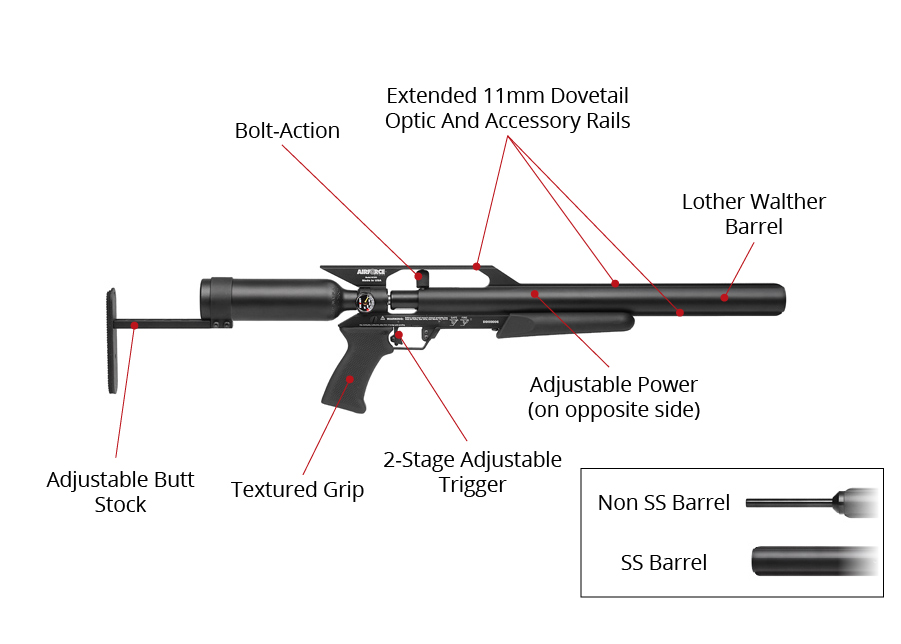
Moreover, versatility is built into every major control. Power is tuned by the user-adjustable wheel, fill status is monitored through the onboard gauge on the Spin-Loc tank, and fit is customized by the sliding buttstock. Therefore, the same rifle can be shortened for pack travel or extended for a full length of pull. Importantly, lead pellets are recommended by the manufacturer so consistent accuracy and barrel life are preserved.
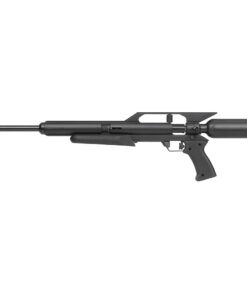
A survival-oriented layout is combined with hunting-class energy in the AirForce Escape Spin-Loc. Lightweight carry is achieved at approximately 5.3 lb without optics, while overall length is adjusted between about 34.5 and 39 inches. In addition, length of pull is set from roughly 9.75 to 14.25 inches so a wide range of shooters can be fitted comfortably.
Furthermore, a 213 cc Spin-Loc air cylinder is retained on the rifle and is filled through a Foster-style nipple. As a result, the tank does not have to be unscrewed for every charge. Meanwhile, remaining pressure is displayed on the integral gauge, and a pressure-relief device is included for added safety. Shot count is influenced by caliber, pellet weight, and power setting; typically, about 5–15 useful shots per fill are obtained.
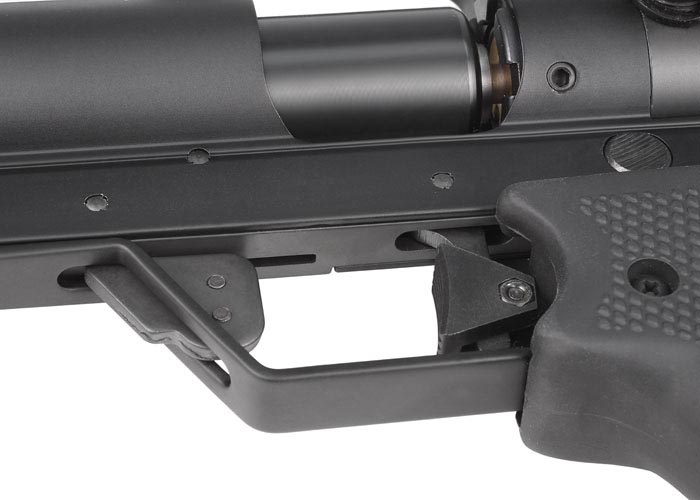
Notably, the action remains a simple single-shot bolt design. An automatic safety is engaged when the rifle is cocked, and a two-stage trigger—adjustable for position—is provided for a clean, predictable break. Likewise, an extended 11 mm dovetail rail is integrated so optics can be mounted with proper eye relief. Open sights may also be installed if a bare-bones configuration is preferred.
Air management is simplified by the Spin-Loc system that is fitted to the AirForce Escape Spin-Loc. The reservoir stays mounted, the refill fitting remains accessible, and the Ring-Loc valve architecture is compatible with optional orifice kits. Consequently, shot count and energy can be balanced for hunting, training, or extended range sessions.
Additionally, a maximum fill pressure of 3,000 psi / 200 bar is specified. Compressed air or dry nitrogen only should be used. Hand pumps, scuba tanks with the correct adapter, or dedicated PCP compressors can be employed. Because the 213 cc vessel is relatively small, fill effort is kept reasonable compared with larger hunting bottles.
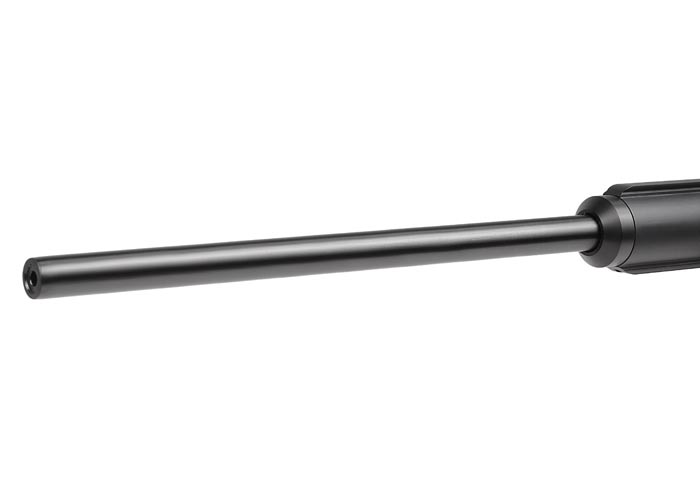
Accuracy potential is supported by the 24-inch Lothar Walther barrel that is fitted to the standard AirForce Escape Spin-Loc. Calibers commonly offered are .22 and .25. Velocity and energy vary with pellet mass and the selected power setting. Published figures for the platform include velocities approaching about 1,300 fps with lighter .22 ammunition and hunting-class energy that can approach the mid-to-high double-digit foot-pound range with heavy .25 pellets under favorable conditions.
Power is raised or lowered by the side-mounted adjustment wheel. Therefore, backyard practice at reduced output can be followed by a field setting when more energy is required. Recoil is not felt in the conventional spring-piston sense, so follow-through is easier to maintain. The report is not suppressed on the standard Escape; no baffles are fitted, so hearing protection and local regulations should always be respected.
Key capabilities of the AirForce Escape Spin-Loc are summarized below for quick comparison on a product page:
Ethical small-game hunting and responsible pest control are the primary roles for which the AirForce Escape Spin-Loc was conceived. Because the rifle is light, it can be carried for long walks without the fatigue associated with heavier big-bore PCPs. Meanwhile, the 24-inch barrel helps heavier pellets retain energy at typical airgun hunting distances when the power wheel is set appropriately.
In addition, survival and “grab-and-go” kits benefit from the compact air volume. A hand pump can be used to top off the 213 cc tank in the field, so a large scuba bottle is not mandatory for a short outing. Training sessions can be conducted at reduced power so pellet cost and air consumption are kept in check. Subsequently, the same rifle can be turned up when a heavier projectile and more energy are required.
Inclusive fit is supported by the sliding stock. Youth-to-adult length-of-pull ranges can be accommodated, and left- or right-handed shooters can operate the simple bolt and safety without a dedicated opposite-hand model. Optics choice remains open: compact hunting scopes, red dots, or iron sights can be mounted on the extended rail so eye relief is not compromised.
Responsible ownership remains essential. Local airgun laws, hunting seasons, and land-access rules must be confirmed before any live-fire use. Hearing and eye protection should be worn. The muzzle must be kept pointed in a safe direction at all times. Only compressed air or dry nitrogen should be introduced into the tank, and the pressure-relief device should never be defeated.
Consistent groups are produced when quality lead pellets that match the barrel’s preference are selected. AirForce Airguns advises against non-lead projectiles in this platform. Heavy .22 and .25 hunting pellets are commonly chosen when energy is prioritized; lighter match-style pellets may be preferred when flatter trajectory at moderate power is desired.
Velocity declines as tank pressure falls, which is normal for an unregulated high-output valve. Therefore, the most uniform strings are typically obtained in the upper portion of the fill. After several high-power shots, impact point may drop; a brief chrono check or a known-distance zero confirmation is recommended when a hunt is planned.
Maintenance is straightforward. The exterior can be wiped after use, the fill probe should be kept clean and lightly lubricated as directed in the owner’s manual, and the tank should be stored with some residual pressure according to manufacturer guidance. Periodic inspection of o-rings and the refill fitting is advised.
A rare mix of packable weight, adjustable energy, and American-made construction is offered by the AirForce Escape Spin-Loc. Hunters who want rimfire-adjacent performance without powder, preppers who value a pump-friendly tank, and recreational shooters who appreciate a recoilless trigger can all find a role for this rifle.
Pair the AirForce Escape Spin-Loc with a reliable fill source, a durable hunting optic, and a selection of proven lead pellets. Then confirm zero, verify local regulations, and take the platform into the field with the same care that any high-power air rifle deserves. When lightweight authority and Spin-Loc convenience are required in one package, this Escape configuration remains a focused, purpose-built choice.
Explore the Hatsan Air Rifle Range: PCP, Spring-Piston, Bullpup, and Semi-Auto Airguns
For shooters comparing a hatsan air rifle, the Hatsan lineup covers everything from traditional spring-powered platforms to modern hatsan pcp designs, compact bullpups, semi-automatic systems, and specialized large-bore models. Whether someone is researching an entry-level air rifle, premium PCP equipment, target-oriented air rifles, or replacement components, the broader range of air rifle options associated with hatsanusa and hatsan usa provides many configurations to compare.
Hatsan Blitz and Semi-Automatic PCP Platforms
The hatsan blitz remains one of the most recognizable names among Hatsan PCP platforms. Searches for hatsan blitz full automatic, hatsan blitz bullpup, hatsan blitz 30 cal, and hatsan blitz .30 cal commonly come from enthusiasts comparing high-capacity PCP designs and different caliber configurations. Alternative searches such as hatsun blitz and hatzan blitz may also appear when shoppers are looking for the same product family.
The term blitz guns is sometimes used more broadly when discussing this platform, while phrases such as blitz 777 may appear in related product searches. Buyers comparing a 30 cal air rifle with smaller-caliber platforms should always review the model specifications, local regulations, intended sporting application, and compatible ammunition before choosing an air gun.
Another notable semi-auto platform is the hatsan sortie. The hatsan sortie tact semi-auto pcp configuration combines compact handling with PCP operation, while hatsan sortie tact searches are frequently associated with tactical-style variants. Owners may additionally look for hatsan sortie accessories when configuring optics, magazines, maintenance components, or other compatible equipment. Likewise, buyers searching for a semi auto pellet gun may compare the Sortie with the invader auto and other semi-automatic PCP designs.
Hatsan Bullpup and PCP Air Rifles
Hatsan produces several PCP configurations for shooters who prefer compact ergonomics without giving up barrel length. The hatsan bullboss is one example, while the bullmaster represents another recognizable bullpup-style platform. The hatsan hercules family is associated with higher-capacity PCP configurations, and the hatsan hercules bully provides a compact bullpup alternative within that broader design category.
The hatsan flash is another widely recognized PCP platform. Because hatsan flash configurations can vary, buyers should compare caliber, stock style, barrel arrangement, pressure system, and included equipment before purchase. The hatsan flashpup qe offers a bullpup-inspired format and is often considered by customers wanting a shorter overall rifle.
Other PCP-related searches include the hatsan invader, hatsan factor rc, and hatsan neutron star. Each platform serves a somewhat different purpose, which means specifications rather than appearance alone should determine which airguns are most appropriate for a particular type of sporting or recreational shooting.
Hatsan Jet 2 and Compact PCP Options
The hatsan jet 2 has attracted attention among customers looking for compact PCP versatility. Because the hatsan jet 2 may be configured differently depending on market and package, shoppers should verify the exact specifications supplied by the retailer. Searches for jet ii generally refer to the same Jet-series concept, while hatsan jet 2 accessories may include compatible magazines, optics solutions, carrying equipment, seals, and manufacturer-approved replacement components.
The hatsan velox is another compact platform that may appeal to customers researching modern PCP systems. However, compatible equipment should always be verified against the precise model designation rather than assuming accessories interchange across different Hatsan products.
Classic Hatsan Spring and Gas-Ram Air Rifles
Not every Hatsan buyer wants PCP equipment. Traditional spring-piston and gas-ram designs remain an important part of the catalog. The hatsan model 95 is among the best-known examples, while searches for hatsan mod 95 and simply mod 95 usually refer to the same established platform.
The hatsan 125 is another familiar full-size option. Meanwhile, the hatsan 135 is commonly researched by shooters interested in larger, more substantial break-barrel platforms. The hatsan 135 vortex air rifle incorporates Hatsan’s Vortex gas-piston concept, while the hatsan 135 carnivore is associated with larger-caliber configurations. Searches for a hatsan big bore carnivore rifle are similarly connected with users comparing large-bore air-powered platforms.
Additional traditional models include the hatsan mod 65, which appears in searches from buyers interested in full-size sporting configurations. The hatsan airtact air rifle, commonly shortened to hatsan airtact, represents another accessible platform. The hatsan zada also broadens the selection for customers comparing break-barrel designs.
Big-Bore Hatsan Models and Specialty Platforms
For customers researching large-bore PCP technology, the hatsan piledriver is one of Hatsan’s best-known specialized platforms. Large-bore air rifles occupy a different category from a conventional .177 caliber air pellet gun, so caliber, projectile compatibility, operating pressure, legal restrictions, and intended sporting use should all be carefully reviewed.
The hatsan harpoon is another specialized product name associated with Hatsan’s air-powered lineup. Because it functions differently from a conventional pellet rifle, buyers may encounter the phrase arrow launcher while researching this category.
These specialized products should not automatically be compared with a traditional pallet gun or standard pellet rifle because their operating systems, projectiles, dimensions, and intended uses can be substantially different.
Refurbished Hatsan Air Rifles and Replacement Parts
Budget-conscious customers sometimes search for hatsan refurbished equipment or refurbished air rifles. A refurbished product can offer good value when its condition, inspection history, seals, pressure system, warranty coverage, and included accessories are clearly disclosed.
Existing owners may instead require hatsan aftermarket parts. When replacing magazines, seals, fill probes, stocks, mounts, or other components, compatibility should always be matched to the precise rifle generation and caliber. Similar-looking parts should never automatically be assumed to fit every Hatsan platform.
Product names such as 1000x.25 may also appear when shoppers compare model or caliber-specific configurations, so confirming the manufacturer’s exact designation is particularly important.
Scopes, Pellets, and Air Rifle Accessories
Optics are another major consideration when configuring an air rifle. A basic 4×20 optic may be encountered in entry-level packages, and the term 4×20 is therefore frequently seen alongside airgun searches. However, optic selection should ultimately reflect the rifle’s mounting system, recoil characteristics, shooting distance, and intended use.
Pellet selection also matters. Products such as h&n field target trophy are widely recognized among airgun enthusiasts, while h&n field target trophy bleifrei refers to a lead-free option within that product family. Individual rifles may prefer different pellet weights and shapes, so consistency and accuracy should be evaluated with the manufacturer’s recommendations in mind.
The term crow magnum may also appear when users research heavier hunting-oriented pellet designs or related airgun ammunition. Ammunition compatibility must always be checked against the specific caliber and manufacturer’s specifications.
Choosing Between PCP, CO2, and Spring-Powered Airguns
A modern air pellet gun can use several different power systems. A PCP system stores compressed air inside a reservoir, while a spring-piston rifle relies on mechanical energy generated during cocking. A co2 pellet rifle, by contrast, uses carbon dioxide cartridges or a compatible CO2 supply.
Each system offers different advantages. PCP rifles may provide low recoil and repeatable operation, while spring-powered rifles avoid the need for external filling equipment. CO2 systems can offer convenient operation in compatible platforms, although performance may vary with temperature.
Customers researching the air rifle range should therefore consider much more than velocity figures. Ergonomics, caliber, overall length, weight, filling equipment, magazine design, maintenance requirements, noise level, available service support, and local regulations can all affect long-term ownership.
Hatsan Models for Different Airgun Preferences
With platforms such as the hatsan blitz, hatsan sortie, hatsan hercules, hatsan bullboss, hatsan flash, hatsan invader, hatsan piledriver, hatsan jet 2, hatsan velox, hatsan factor rc, hatsan airtact, and hatsan model 95, Hatsan covers a broad spectrum of airgun categories.
Some customers may prioritize a traditional sporting rifle, whereas others may prefer a compact PCP or bullpup. Shooters interested in sniper long style configurations may focus more strongly on stock ergonomics, optics mounting, stability, and longer-range target capability rather than simply choosing the most powerful model.
Meanwhile, terms such as econ ii may appear in accessory or product-related searches depending on the equipment being compared. Compatibility should always be established using the exact manufacturer and model specification.
Ultimately, selecting among hatsan air guns should begin with the intended application. A lightweight .177 caliber rifle may suit recreational target shooting, while a larger PCP platform can serve a very different sporting role. Models such as the hatsan blitz .30 cal, hatsan blitz 30 cal, or other 30 cal air rifle configurations should therefore be evaluated according to their specifications, local law, appropriate shooting environment, and intended lawful use.
From the compact jet ii and hatsan jet 2 to the established hatsan mod 95, powerful hatsan 135, specialized hatsan harpoon, and modern semi-auto PCP platforms, the Hatsan catalog gives airgun enthusiasts an extensive selection. Comparing specifications carefully helps buyers identify the right air rifle while ensuring that pellets, optics, filling equipment, magazines, and accessories remain correctly matched to the chosen platform.
Practical Use Scenarios in the Field
Real-world value is revealed only after the rifle leaves the bench. Consequently, the following scenarios are written so hunters, pest-control volunteers, backpackers, and supervised new shooters can picture how a light, recoilless, high-output PCP is actually carried, filled, zeroed, and fired. Inclusive language is used throughout. Legal limits, land permission, and ethical ranges must be confirmed before any live shot is taken.
Dawn Patrol for Small Game
Cool air and low wind are typically found in the first hour after legal shooting light. Therefore, a compact hunting PCP is often staged the night before: optics are checked, a modest fill is verified on the tank gauge, and a tin of proven lead pellets is sealed against moisture. At first light the rifle is carried slung or in hand along hedge lines, woodlot edges, and crop margins where rabbits, squirrels, and similar lawful quarry are expected.
Because overall length can be shortened on the sliding butt, brush is negotiated without the muzzle being driven into limbs. Recoil is absent, so the sight picture is held after the shot and a follow-up can be considered only if a clean miss is certain and a safe backstop remains. Heavy hunting pellets are generally selected when energy and penetration are required; mid-weight pellets may be preferred when a flatter mid-range path is needed.
A typical sequence is followed. The bolt is cycled, a single pellet is seated, the automatic safety is felt as the action is cocked, and a supported position is taken against a tree, fence post, or kneeling roll. Power is left at a previously chrono-checked hunting setting rather than at maximum, so air is conserved for a second or third ethical opportunity. After the outing, moisture is wiped from metal, the remaining pressure is noted, and the rifle is stored according to local safe-storage rules.
Highlighted field habits for this scenario include:
- Permission and seasons are confirmed before the walk begins
- A known-distance zero is trusted only after the same pellet and power setting are used
- Shots are declined when brush, angle, or animal orientation would produce a wounding hit
- Hearing and eye protection are worn even on a “quiet” morning
Property and Farm Pest Control
Repeated, precise shots at modest distance are required when rodents, pigeons, or other legally designated pests must be reduced around barns, grain stores, and outbuildings. A loud report is produced by the unbaffled barrel, so neighbours, livestock, and local discharge bylaws must be considered first. Where lawful, early or late sessions are scheduled so disturbance is limited.
Adjustable output becomes useful here. Power is lowered for close, contained shots so over-penetration through thin shed walls is reduced, then raised again when a longer lane across a yard is used. The two-stage trigger, adjustable for position, is set so a gloved finger still finds a consistent break. A compact scope or a robust red-dot sight is mounted on the extended rail so rapid target acquisition is possible in mixed light.
Single-shot discipline is an advantage around buildings. Each pellet is loaded only when a safe shot is imminent, so an unattended loaded chamber is avoided while gates are opened or animals are moved. Ricochet risk from concrete, stone, and metal is treated as high; earth banks and dense timber backstops are chosen instead.
Inclusive team use is common on working farms. Different lengths of pull are set for each authorised user so the same rifle can be shared without a poor mount. After each session the fill nipple is capped, lead debris is collected where regulations require it, and a brief note of pellet type and power setting is left in the gun cabinet for the next authorised person.
Backpack Hunts and All-Day Carry
Weight is the limiting factor on long approaches. At roughly five and a third pounds without glass, this platform can be packed with water, a light seat, and a small game bag without the fatigue associated with heavy big-bore rifles. The 213 cc reservoir is small enough that a hand pump can be strapped beside it; a full scuba bottle is unnecessary for a short wilderness loop.
Terrain changes how the rifle is carried. On steep ground the stock is collapsed so the muzzle stays clear of the slope. In open country the stock is extended for a full cheek weld behind a hunting optic. A simple sling is attached only if studs or an aftermarket adapter have been fitted securely; otherwise the rifle is carried at the balance point so the tank gauge is not struck against rock.
Shot opportunities in mountain or forest country are often brief. Therefore, a hunting zero at a realistic distance—commonly the far edge of ethical airgun range for the chosen pellet—is established at home. Hold-over marks in the reticle are confirmed on paper, not guessed in the field. Wind is read on grass and cobwebs because light pellets drift more than centre-fire bullets.
After a successful, lawful retrieve, the carcass is handled with the same care given any harvested game. The rifle is unloaded, the safety condition is verified, and the pack is rearranged so blood and moisture stay off the action. A partial top-off with the hand pump can be completed at camp if more hunting is planned the next morning.
Grab-and-Go and Preparedness Roles
A survival-oriented layout was part of the original design brief: light weight, a pump-friendly tank, and enough energy for small game when other systems fail. That role is still valid only where possession, transport, and hunting remain legal. The rifle is not a substitute for a licensed firearm where the law requires one, nor is it a toy for unsupervised use.
Preparedness kits are assembled calmly, not in panic. A hard or padded case cut for the adjustable length, a hand pump with hose and gauge, two tins of a single proven pellet, a compact optic already zeroed, spare o-rings specified by the maker, and printed local regulations are stored together. The tank is kept with residual pressure as directed in the manual rather than stored bone-dry or overfilled.
Practice under kit conditions is more valuable than unused gear. A quarterly session is scheduled in which the pump is used from a mid fill to the working pressure, five shots are fired at a life-sized small-game target, and the rifle is returned to the case without workshop tools. Failures—leaks, forgotten pellets, fogged glass—are discovered at home, not after a storm.
Inclusive preparedness includes every authorised adult in the household. Each person should be able to fit the stock, read the tank gauge, and state the legal limits that apply. Children are taught only within the law and under direct supervision; the automatic safety is never treated as a substitute for muzzle control.
Range Sessions, Zeroing, and Power Mapping
Field accuracy is built on the range. A solid rest, a chronograph, and a large paper target at a measured distance are used before any hunt. Because velocity falls as pressure falls, a string is fired from a fresh fill down through the useful shot window. Impact shift is marked on the target so the shooter knows when a refill is required.
Power-wheel positions are mapped rather than guessed. A notebook line might record: setting, pellet, average velocity, group size, and number of shots before the group drops. That map is unique to each rifle and each tin. After a barrel is cleaned or a new tank is fitted, the map is rebuilt.
Trigger position is adjusted so the pad of the finger meets the blade without crowding the guard, including when gloves are worn. The extended rail allows the scope to be slid until eye relief is correct for the chosen stock length. High rings are selected only when the objective bell clears the tube; excess height makes a consistent cheek weld harder.
Highlighted range goals include:
- One hunting pellet and one practice pellet are standardised
- Groups are measured at the distances that will actually be used afield
- Hearing protection is worn; the unshrouded muzzle is not quiet
- Neighbours and range rules regarding high-power airguns are respected
Fitting Different Shooters and Shooting Positions
Length of pull is moved along the tank so youth-to-adult dimensions can be accommodated on one chassis. A short setting is used for a smaller-framed shooter or for thick winter clothing; a longer setting is used when a full-size optic and a stretched-out prone position are combined. After each change, screws are tightened and the zero is confirmed, because comb height and eye alignment can shift slightly.
Prone, kneeling, sitting, and offhand positions are all realistic. Recoilless operation helps offhand work, yet the light weight also means a sloppy hold is not masked by mass. A shooting stick or a light bipod can be added for supported pest work; on a true stalk the sticks stay on the pack until the last twenty metres.
Left- and right-handed shooters can operate the simple bolt and the automatic safety without a dedicated opposite-hand model. Inclusive coaching focuses on the same fundamentals for every user: muzzle direction, finger off the trigger until the sight picture is accepted, and a pause after the shot to call the hit.
Filling in Camp, at the Truck, and at Home
Three fill methods are commonly used. A three-stage hand pump is packed for remote camps; eighty-odd strokes from a mid fill to working pressure are typical for this small vessel, though exact effort varies with starting pressure and pump quality. A scuba bottle and Foster adapter are preferred at the truck when many strings will be fired in one afternoon. An electric compressor is reserved for the workshop so heat and moisture can be managed.
Water and oil must be kept out of the reservoir. Only dry compressed air or dry nitrogen is introduced. The pressure-relief device is never bypassed. After a fill, the probe is bled as directed, the nipple is capped, and the gauge is read before the first shot so a false “full” reading is not trusted.
In freezing weather, seals stiffen and gauges lag. The rifle is warmed gradually, not with open flame. In high heat, a charged tank is not left on a dark dashboard. Seasonal hunts are planned around those limits so a cracked o-ring does not end the day.
Weather, Seasons, and Ethical Limits
Autumn woods and winter farms change both the shot and the shooter. Gloves reduce trigger feel, so the adjustable blade position is rechecked. Snow glare and rain on an objective lens are managed with a simple cap, not with improvised tape that leaves residue. Pellets are kept in an inner pocket so they stay closer to the temperature of the barrel.
Ethical range is shorter than maximum velocity suggests. A pellet that prints impressive energy on a calculator still requires a high-probability aiming mark, a still animal, and a backstop that will stop a miss. If those three conditions are not present, the shot is passed. Inclusive hunting culture treats a passed shot as skill, not failure.
After the season, a deeper wipe-down is completed, remaining pressure is set to the storage level recommended by the maker, and accessories—pump, spare tank, rings, sling—are inspected for cracks and leaks. The next practical use scenario begins with that quiet maintenance, not with a rushed dawn and an unknown zero.
When these scenarios are rehearsed, the rifle becomes a known tool: light enough to carry, powerful enough for lawful small game, and simple enough to fill far from a compressor. Performance is earned by preparation. The field only confirms what the range and the notebook have already measured.










 Click here for California’s Proposition 65 warning.


Reviews
There are no reviews yet.