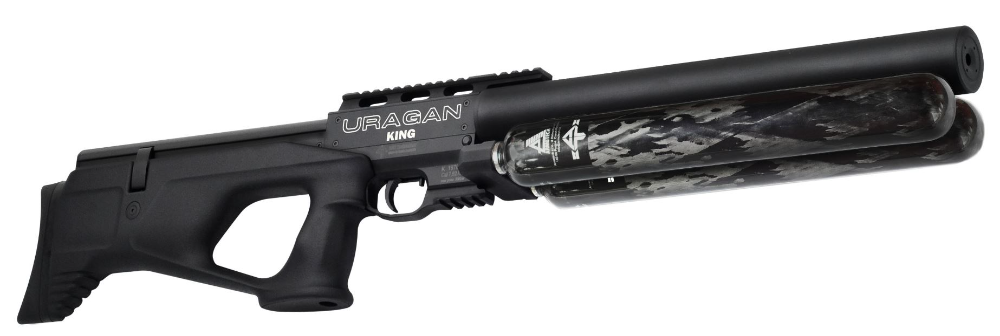
A durable synthetic stock has been fitted so that demanding outdoor conditions can be accommodated without the additional care commonly associated with traditional wood furniture. Meanwhile, a distinctive bullpup-inspired configuration has been used so that a full-length 570 mm barrel can be incorporated without excessive overall rifle length.
Because precision, ergonomics, and air efficiency have all been considered, the AGT Uragan King Synthetic is positioned as an impressive choice for experienced PCP enthusiasts, recreational target shooters, and other lawful sporting applications.
A maximum fill pressure of approximately 300 bar is supported. As a result, an exceptionally generous air supply can be carried directly on the rifle. Long shooting sessions can consequently be completed with fewer interruptions for refilling.
Furthermore, pressure regulation has been integrated so that compressed air can be delivered more consistently during the usable pressure range. Because a carefully regulated air supply is provided, velocity consistency can be improved and predictable performance can be maintained throughout extended shot strings.
One of the most recognizable characteristics of the AGT Uragan King Synthetic is its dual-cylinder configuration.
Instead of a conventional single reservoir being relied upon, two substantial carbon-fibre cylinders are installed. Their lightweight composite construction allows significant compressed-air capacity to be carried without the weight that would normally be associated with equally large traditional steel reservoirs.
Actual shot count will naturally be influenced by calibre, power configuration, regulator setup, ammunition, environmental conditions, and regional specification.
A high-quality 570 mm barrel is incorporated into the AGT Uragan King Synthetic. Through this generous barrel length, compressed air can be used efficiently while stable pellet acceleration is encouraged.
At the same time, the barrel is supported within a carefully engineered rifle platform so that repeatability can be prioritized. When suitable ammunition is selected and the rifle is correctly set up, excellent accuracy potential can therefore be achieved.
Because different pellets can behave differently from one barrel to another, ammunition testing should always be completed before a preferred pellet is chosen. Once a suitable combination has been identified, consistent grouping can be pursued more confidently.
Despite its large air capacity and 570 mm barrel, an overall length of approximately 830 mm has been maintained.
Consequently, the rifle remains relatively compact for a platform carrying twin large-capacity reservoirs. Movement between shooting positions can therefore be made more manageable, while the rifle can still be supported comfortably from a bench, bag, rest, or bipod.
Its distinctive configuration also allows much of the rifle’s mechanical system to be positioned efficiently around the shooter. Accordingly, overall dimensions are controlled without the barrel being unnecessarily shortened.
Smooth cycling has been prioritized through the inclusion of a biathlon-style side-lever action.
Additionally, the operating lever can be configured for left- or right-handed use. Therefore, the rifle is not unnecessarily restricted to one dominant shooting hand.
Fast follow-up loading can be completed without excessive movement from the firing position. Meanwhile, positive mechanical feedback can be provided as the action is cycled.
For shooters who spend extended periods behind an optic, this arrangement can be particularly convenient because sight alignment can be recovered quickly after the magazine has been indexed.
Unlike untreated natural materials, synthetic stock construction is less affected by everyday moisture and changing environmental conditions. Therefore, the rifle can be particularly appealing when regular outdoor use is expected.
At the rear, an adjustable butt pad has also been incorporated. Shoulder contact can consequently be refined according to individual preferences, shooting position, clothing, and optic height.
Comfort has therefore been considered alongside mechanical performance rather than being treated as an afterthought.
A multi-shot rotary magazine arrangement is used so that repeated manual pellet insertion is not required after every discharge.
Magazine capacity varies according to calibre. Common configurations may include:
Availability can vary by country and distributor, so the exact calibre and magazine specification should be confirmed before ordering.
Two magazines are commonly supplied with the rifle, thereby allowing an additional loaded magazine to be prepared for lawful range or sporting use.
Modern optics can easily be accommodated through the integrated Weaver/Picatinny-style mounting system.
Consequently, compatible telescopic sights can be installed according to the intended application. Furthermore, additional mounting provisions are provided around the forward section for suitable accessories.
A bipod can therefore be fitted when greater stability from supported shooting positions is required. Other compatible accessories can also be incorporated where legally permitted and appropriate.
Because different shooters have different physical dimensions and equipment preferences, adaptability has been incorporated throughout the platform.
The adjustable rear pad can be repositioned, the operating lever can be changed between sides, and optics can be mounted according to individual eye relief requirements.
As a result, the rifle can be configured around the shooter instead of the shooter being forced to accommodate a completely fixed layout.
The AGT Uragan King Synthetic combines several premium specifications within one distinctive PCP platform:
Where the AGT Uragan King Synthetic particularly distinguishes itself is through the combination of compact dimensions and extremely generous compressed-air storage.
Rather than a high-capacity rifle necessarily becoming excessively long, the available space has been used intelligently. Equally, instead of air capacity being sacrificed for handling, dual lightweight cylinders have been incorporated.
Consequently, balance between endurance, consistency, precision, and usability has been created.
For range sessions, fewer filling interruptions can be required. For recreational shooting, more time can be spent concentrating on technique. Meanwhile, shooters who appreciate advanced PCP engineering can benefit from the regulated action, adjustable ergonomics, reversible lever, and considerable accessory flexibility.
A premium PCP rifle should provide more than attractive specifications. Reliability, adaptability, repeatability, and practical usability should also be delivered.
Its twin carbon-fibre cylinders provide exceptional air capacity. Its regulated system supports consistent operation. Its 570 mm barrel provides a strong foundation for precision. Meanwhile, the ambidextrous side lever and adjustable furniture allow the platform to be personalized around different shooters.
Most importantly, the rifle has been developed as a complete shooting platform rather than merely a high-capacity air reservoir attached to an action.
For shooters searching for a distinctive PCP rifle with premium construction, enormous air capacity, practical synthetic furniture, multi-shot convenience, and refined AGT engineering, the AGT Uragan King Synthetic represents a compelling option.
Calibre, power level, included accessories, and legal classification can differ between markets. Therefore, the specification supplied by the retailer should always be checked before purchase, and all applicable licensing, ownership, transport, storage, and use requirements should be followed.
AGT Uragan King Synthetic Calibres, FAC Power and Accessories
The AGT Uragan King Synthetic has been developed as a versatile high-capacity PCP platform, and that versatility is especially noticeable when calibre, power specification and accessory compatibility are considered. Different configurations can be selected according to local regulations, intended shooting discipline and individual preferences. Because regional laws vary substantially, exact power output and FAC classification should always be confirmed for the version being purchased.
Available Calibres for the AGT Uragan King Synthetic
Several popular PCP calibres can be offered within the Uragan platform. Common options include .177 (4.5 mm), .22 (5.5 mm), .25 (6.35 mm) and .30 (7.62 mm). Each calibre provides its own balance of projectile weight, trajectory characteristics, energy potential and air consumption.
.177 / 4.5 mm
The .177 calibre is commonly selected for precision-oriented target shooting and situations where a comparatively flat trajectory is valued. Because lighter pellets are normally used, respectable velocity can be generated while air consumption is generally kept relatively efficient.
A magazine capacity of approximately 15 pellets is commonly associated with .177 Uragan configurations.
For shooters who enjoy paper targets, metallic targets and general recreational shooting, the smaller calibre can provide an enjoyable combination of accuracy potential and economical pellet use.
.22 / 5.5 mm
The .22 version offers an excellent middle ground between manageable pellet weight and increased downrange energy. Heavier projectiles can be used than with .177, while trajectory characteristics can still remain practical when suitable ammunition and optics are selected.
Magazine capacity is commonly around 12 rounds in this calibre.
For this reason, .22 is frequently chosen by shooters wanting a versatile PCP rifle for general sporting use, recreational shooting and legally permitted pest-control applications.
.25 / 6.35 mm
When additional projectile mass and energy retention are desired, the .25 calibre provides another attractive option.
Approximately 10 pellets are normally carried in the corresponding magazine. Because heavier ammunition is fired, noticeably greater energy can be produced in full-power versions. However, increased air consumption should also be expected.
The enormous air reserve of the King configuration becomes especially useful here because the larger reservoir system allows high-power shooting to be sustained for longer periods before refilling becomes necessary.
.30 / 7.62 mm
At the larger end of the commonly available range, the .30 calibre is intended for shooters seeking substantial projectile mass and high-energy performance.
A typical magazine can accommodate approximately 9 rounds.
Compared with smaller calibres, more compressed air is generally consumed with every shot. Nevertheless, the considerable reservoir capacity offered by the King platform helps compensate for this requirement.
FAC and Full-Power Configurations
The term FAC is commonly used in markets such as the United Kingdom to describe air rifles producing energy above the local non-FAC threshold. Depending on the jurisdiction, additional licensing, registration, storage or transportation requirements may therefore apply.
The AGT Uragan King Synthetic can be supplied in different power specifications according to the destination market.
Rather than one universal output being applied to every rifle, energy depends on factors including:
- Calibre selected
- Factory configuration
- Regulator setting
- Valve specification
- Barrel configuration
- Pellet weight
- Regional legal limits
- Distributor specification
Accordingly, buyers should never assume that every Uragan King produces identical muzzle energy.
For reference, current Uragan-family listings illustrate how significantly factory energy can vary by calibre, with published examples ranging from approximately 25 joules in .177 to 126 joules in .30 on certain full-power configurations. Those figures should be treated as model/configuration examples rather than guaranteed King output.
Regulated PCP Power Delivery
A regulated pneumatic system is used so that controlled quantities of compressed air can be delivered to the firing valve.
This arrangement helps improve velocity consistency across the usable pressure range. Consequently, vertical point-of-impact variation caused by changing reservoir pressure can be reduced when the rifle is correctly maintained and matched with suitable ammunition.
Furthermore, a working pressure of up to approximately 300 bar / 4,351 psi is commonly specified across Uragan platforms. Therefore, substantial compressed-air storage is available for extended sessions.air pellet pistol
Actual usable shot count will still vary according to calibre, energy level and regulator configuration.
Scope and Optics Accessories
The AGT Uragan King Synthetic is designed primarily around optical sights rather than traditional open sights.
A Weaver/Picatinny-style mounting rail allows compatible riflescopes to be installed.
Depending on the intended application, compatible accessories may include:
- Variable-magnification riflescopes
- Fixed-power scopes
- Scope rings
- Digital day/night optics where legally permitted
- Rangefinding optics
- Bubble levels
- Rail-mounted accessories
Correct ring height should be selected so that comfortable head positioning and appropriate objective-lens clearance are maintained.
Bipods and Support Accessories
Supported shooting can be improved considerably through the use of a suitable bipod.
Compatible mounting arrangements can allow a shooting rest or bipod to be attached to the forward section. Consequently, greater stability can be achieved from benches, prone positions or other supported shooting locations.co2 air pistols
A shooting bag may also be used when a softer rest is preferred.
Magazines and Loading Accessories
Multi-shot magazines represent an important part of the Uragan shooting system.
Having additional magazines available can make extended range sessions more convenient because spare magazines can be prepared before shooting begins.
Common capacities include:
- .177 – approximately 15 rounds
- .22 – approximately 12 rounds
- .25 – approximately 10 rounds
- .30 – approximately 9 rounds
Current Uragan packages are commonly listed with two magazines as standard equipment.
Magazine specification should nevertheless be checked against the exact generation and calibre before replacements or spares are ordered.10m rifle
Filling Equipment and PCP Accessories
Because this is a high-pressure PCP rifle, suitable filling equipment is essential.
Compatible equipment can include:
- High-pressure carbon-fibre air cylinders
- Diving cylinders with suitable valves
- PCP compressors
- High-pressure hand pumps rated appropriately for the rifle
- Filling hoses
- Pressure-rated fittings
- Compatible fill probes
- Moisture filters
A compatible fill probe is commonly included with Uragan packages.
Only filling equipment rated for the required working pressure should be used, and the manufacturer’s filling procedure should always be followed.brake barrel bb gun.gamo 10x
Useful Accessories for a Complete Setup
A carefully selected accessory package can make the AGT Uragan King Synthetic considerably more practical.
Alongside a quality optic, owners may consider spare magazines, a stable bipod, a suitable gun case, pellet storage equipment, cleaning materials and reliable high-pressure filling equipment.shotgun pellet gun
Current Uragan packages can also include a soft case and basic tools, although package contents may differ between dealers and regions.pellet guns that can kill
Ultimately, the combination of multiple calibre options, regulated PCP operation, high available power, generous air capacity and extensive accessory compatibility allows the AGT Uragan King Synthetic to be configured around a wide variety of lawful sporting and recreational applications. Buyers should select the calibre and power specification that best matches their intended use while ensuring complete compliance with local airgun legislation.pellet gun pistols
Practical Use Scenarios
A premium PCP platform becomes most valuable when its design can be appreciated during real shooting sessions rather than simply through technical specifications. In practical use, this rifle is especially well suited to shooters who want extended range time, dependable handling, adaptable ergonomics, and a large compressed-air reserve that reduces the number of interruptions required during a session.
Because its twin-cylinder configuration provides substantial onboard air capacity, the rifle can be prepared before a session and then used for an extended period without constant attention being given to refilling equipment. That characteristic can be particularly useful at outdoor ranges, private shooting facilities, club grounds, and other lawful sporting environments where a compressor or charging cylinder may not always be positioned directly beside the firing point.
Extended Target-Shooting Sessions
One of the most obvious practical applications is recreational and precision-oriented target shooting.
During a typical range visit, a shooter may work through several different exercises. Paper groups may first be used to check zero and consistency. Reactive targets may then be used for general practice, while longer-distance targets may be introduced later in the session.
In this type of environment, a large onboard air supply can make a noticeable difference. Instead of repeatedly stopping to refill the rifle, more time can be spent concentrating on trigger control, breathing, sight alignment, follow-through, and consistent body positioning.
This uninterrupted rhythm can be especially valuable when a shooter is attempting to improve technique. Every unnecessary interruption can change concentration and body position. Therefore, being able to continue through a longer sequence of shots can support more structured practice.
The regulated operating system also becomes useful during these sessions. As reservoir pressure gradually decreases, consistent air delivery is intended to be maintained throughout the usable pressure range. Consequently, the shooter can focus more confidently on technique rather than wondering whether every small change in point of impact has been caused by rapidly changing pressure.
Naturally, ammunition selection, weather, rifle setup, optic quality, and the shooter’s own consistency will still influence results. Nevertheless, a stable regulated platform provides an excellent foundation for repeatable range work.
Bench-Rest Practice and Group Testing
A second highly practical scenario involves shooting from a bench.
When supported on a suitable front rest, shooting bag, or compatible bipod, the rifle can be used to evaluate pellets, confirm optic settings, and assess grouping performance under controlled conditions.
Bench shooting is particularly useful whenever a new batch or type of ammunition is being tested. Even pellets produced in the same calibre can differ in weight, head dimensions, shape, and manufacturing characteristics. Therefore, testing several suitable options can help identify the ammunition that performs most consistently with an individual barrel.
A shooter might begin at a shorter distance and fire several controlled groups. Once a consistent combination has been identified, the distance can gradually be increased.
The rifle’s substantial air supply is advantageous here because pellet testing can require a relatively high number of shots. Multiple groups may need to be completed before a meaningful comparison can be made. If frequent refilling were required throughout the process, testing could become unnecessarily slow.
Its adjustable rear section can also help the rifle feel more comfortable when used from a fixed bench position. Shoulder contact can be refined, while compatible optics can be positioned according to the user’s preferred eye relief.
For shooters who enjoy documenting group size, velocity consistency, pellet choice, and environmental conditions, the rifle can therefore become an effective platform for methodical accuracy testing.
Informal Recreational Shooting
Not every shooting session needs to be highly technical.
Many owners simply enjoy spending time at a legal range or approved private shooting location engaging suitable recreational targets.
Within such settings, the rifle’s multi-shot magazine system allows a relaxed shooting session to continue without manually loading one pellet after every discharge. A prepared magazine can be inserted, the action cycled, and subsequent shots taken while maintaining a relatively consistent shooting position.
Spare magazines can make the experience even more convenient. Several can be prepared before beginning so that less time is spent handling individual pellets at the firing point.
This can be particularly useful when shooting with gloves during cooler weather or when small pellets would otherwise be inconvenient to handle repeatedly.
At the same time, the synthetic stock is well suited to recreational outdoor use. Compared with highly finished wooden furniture, synthetic material generally requires less concern about minor moisture, routine handling marks, or changing weather conditions.
That does not mean the rifle should be treated carelessly. Proper storage, drying, inspection, and routine maintenance remain important. However, the practical characteristics of synthetic furniture can provide additional confidence during regular outdoor ownership.
Club Range Use
For shooters who attend organised airgun clubs, adaptability can become particularly important.
Different club ranges may use different shooting positions, target arrangements, benches, and distances. A rifle that performs comfortably in only one highly specific setup can sometimes feel limiting.
Here, adjustable ergonomics and an optics-ready rail system provide useful flexibility.
The shooter can select an optic appropriate for the type of club shooting being performed. A moderate-magnification scope may be chosen for general use, while another owner may prefer higher magnification for precision work.
At some clubs, a bipod may be useful. At others, bags or dedicated rests may be preferred. Because compatible accessories can be selected according to individual requirements, the rifle can be adapted rather than forcing one fixed configuration on every user.
The reversible side-lever arrangement can also be particularly beneficial in a shared sporting environment. Left-handed shooters are not automatically excluded from achieving a comfortable cycling position.
While every individual’s preferred setup will differ, a platform that accommodates multiple configurations can remain useful even as the shooter’s interests evolve.

Outdoor Range Sessions
Outdoor shooting introduces factors that are often absent indoors.
Wind can move pellets laterally. Temperature may influence equipment and air pressure. Changing light can affect target visibility. Uneven ground can make stable positioning more difficult.
Consequently, outdoor range use often provides a more demanding test of both equipment and technique.
A suitable scope can help the shooter identify targets clearly, while a bipod or supported rest can provide additional stability. Meanwhile, the rifle’s large air capacity means that long sessions can continue without constant attention being redirected toward charging.
The synthetic furniture also makes practical sense when the rifle is used in environments where damp grass, dust, light rain, and temperature changes may occasionally be encountered.
After outdoor use, the rifle should still be inspected and cleaned appropriately. Moisture should be removed before storage, and the equipment should be kept in a dry environment according to the manufacturer’s recommendations.
Good equipment care remains especially important for high-pressure pneumatic systems.
Zeroing a New Scope
Another common real-world use scenario involves installing and zeroing an optic.
After suitable mounts have been fitted and checked, initial zeroing can begin at a relatively controlled distance. Several shots can be fired to establish the initial point of impact. Adjustments can then be made gradually until the desired zero is achieved.
Once the initial zero has been established, confirmation groups can be completed.
The large air reserve is useful during this process because scope setup can involve considerably more shooting than expected. The shooter may need to confirm mount positioning, eye relief, turret adjustments, reticle orientation, and consistency at more than one distance.
Rather than attempting to save air by rushing through the process, the owner can work more methodically.
The adjustable butt section can also be useful when a new optic is fitted. Changes in scope height can alter the preferred head and shoulder position. By refining the rifle’s setup, a more natural sight picture may be achieved.
Pellet Comparison and Chronograph Testing
Enthusiasts often enjoy understanding how their equipment performs with different ammunition.
A chronograph can be used to measure projectile velocity while various compatible pellets are tested. From this data, consistency can be assessed and suitable ammunition can be identified.
This type of testing can involve substantial shot counts, especially when several pellet types or weights are compared.
The large compressed-air reservoir therefore becomes highly practical.
A structured testing session might involve firing a consistent number of shots with one pellet type, recording the results, allowing the rifle and shooter to remain settled, and then repeating the process with another suitable pellet.
Environmental conditions should also be recorded where relevant.
Importantly, such testing should always remain within the rifle’s intended specification and local legal requirements. Factory settings and approved service procedures should be respected rather than attempting unsafe or unauthorised modifications.
Shooting From a Bipod
For shooters who prefer supported positions, a compatible bipod can transform the practical feel of the rifle.
From a stable bench or approved shooting position, the bipod can carry much of the rifle’s forward weight. This allows the shooter to focus on rear support, trigger technique, breathing, and sight picture.
Because the platform carries large air cylinders, supported shooting can be especially comfortable during longer sessions.
A bipod can also provide consistency from shot to shot because the front support position remains relatively fixed.
However, the shooter should still avoid placing excessive pressure on the rifle or forcing an unnatural position. The most stable setup is usually one in which the rifle is supported securely while the shooter remains relaxed.
Different Calibre Applications
Practical behaviour can also change according to the calibre selected.
A smaller-calibre configuration may be particularly appealing to target shooters who value economical ammunition, higher magazine capacity, and relatively efficient air use.
Medium-calibre options can offer a balanced combination of projectile weight, trajectory, and general sporting versatility.
Larger-calibre configurations generally use heavier projectiles and consume more compressed air per shot. In those versions, the twin-cylinder air system becomes especially valuable because the generous capacity helps offset higher air demand.
The best choice depends on local law, intended use, available ammunition, shooting distance, and personal preference.
Rather than assuming that the largest calibre is automatically the most suitable, buyers should consider how they genuinely intend to use the rifle.
Long Practice Days Away From Filling Equipment
One of the strongest real-world advantages appears when shooting takes place away from convenient charging facilities.
At some ranges, a compressor or large air cylinder may be immediately available. At other locations, the shooter may need to bring all required equipment from home.
A high-capacity reservoir can simplify preparation.
The rifle can be correctly filled using approved equipment before the session, while suitable backup charging equipment can be carried where necessary.
Because fewer refills may be required compared with smaller-reservoir platforms, additional equipment handling can be reduced.
This can make the rifle particularly attractive to shooters who prefer long organised practice days and want to spend more time behind the optic.
Left- and Right-Handed Shooting
Practical ergonomics matter considerably during repeated use.
The ability to configure the operating lever for either side can help accommodate different shooting preferences.
A left-handed owner can configure the action so that cycling feels more natural. Likewise, right-handed shooters can retain a conventional arrangement.
This adaptability can also be useful when equipment is shared between family members or club shooters, provided all users are legally permitted and properly supervised where required.
Comfort should never be underestimated. A rifle that naturally fits the user is easier to handle consistently than one that requires awkward movement after every shot.
Storage, Transport and Routine Ownership
Practical use does not end when shooting finishes.
A premium PCP rifle should also be manageable during transport, storage, cleaning, and routine inspection.
Its relatively compact architecture helps when a suitable padded case is being selected. Before transportation, the rifle should be made safe and handled according to applicable local laws.
After use, external surfaces can be checked for dirt or moisture. The optic, mounts, magazines, filling connections, and stock should also be inspected periodically.
High-pressure components should never be dismantled casually. Servicing of pressure-bearing parts should be completed in accordance with manufacturer guidance and, where required, by a qualified technician.
Magazines should also be kept clean and protected from grit that could interfere with reliable indexing.
By combining responsible care with correct operating procedures, long-term reliability can be supported.
A Practical Platform for Serious Recreational Shooting
In everyday use, the greatest advantage of this platform is not created by one specification alone.
Instead, several features work together.
Large air capacity reduces charging interruptions. Regulation supports consistency. Multi-shot magazines simplify repeated shooting. The synthetic stock provides practical durability. Adjustable ergonomics allow the setup to be refined, while accessory compatibility gives owners considerable freedom when configuring optics and supports.
For someone who regularly spends several hours at a range, those details can have a greater impact than impressive specification numbers on paper.
A well-designed PCP should allow the shooter to concentrate on safe handling, technique, accuracy, and enjoyment rather than constantly working around equipment limitations.
Whether the session involves careful group testing, scope zeroing, chronograph work, recreational targets, club practice, or extended outdoor range use, this platform can be configured to support a broad variety of lawful sporting scenarios.
Ultimately, its practical value is defined by versatility. Different calibres can be selected, various optics can be mounted, supported shooting positions can be adopted, and extended sessions can be completed with fewer charging interruptions.
That combination makes the rifle particularly suitable for shooters who want one premium PCP platform capable of adapting to changing recreational and sporting requirements while still delivering the substantial air capacity and refined engineering expected from a high-end air rifle.
Frequently Asked Questions
What type of air rifle is this?
This is a pre-charged pneumatic air rifle designed around a regulated high-pressure air system. Instead of using a spring or gas ram, compressed air is stored inside onboard cylinders and released in controlled amounts when the rifle is fired.
The platform is particularly notable for its large air capacity, synthetic furniture, multi-shot magazine system, compact overall architecture, and side-lever operation. Because the system is regulated, more consistent shot-to-shot performance can generally be maintained across the usable pressure range.
It is intended for lawful recreational, sporting, and target-shooting use, subject to the rules that apply in the owner’s jurisdiction.
What calibres are available?
Common calibre options include .177, .22, .25, and .30, although exact availability can vary by distributor and market.
Each calibre provides a different balance of pellet weight, air consumption, trajectory, magazine capacity, and potential muzzle energy. Smaller calibres are often selected for target-oriented applications and efficient air use, while larger calibres generally accommodate heavier projectiles and higher energy levels.
Before purchasing, the exact calibre offered by the seller should be confirmed.
Which calibre is best for target shooting?
For many target shooters, .177 is attractive because lighter pellets are commonly used and the trajectory can be relatively flat at normal airgun distances.
However, .22 can also be an excellent choice for recreational range use because it provides a useful balance between projectile weight and manageable trajectory.
The best choice depends on the shooting distance, local regulations, preferred ammunition, and the type of target discipline being practiced.
Rather than relying only on calibre size, buyers should also consider ammunition availability and how frequently they intend to shoot.
Is the rifle available in FAC or full-power form?
Yes, higher-power configurations can be available depending on the country and distributor.
The term FAC is particularly associated with markets where air rifles above a defined energy threshold require additional licensing. Because regulations differ by jurisdiction, the exact legal classification of a particular rifle cannot be determined simply from the model name.
Power output may also differ according to calibre, regulator configuration, valve setup, and factory specification.
The buyer should always confirm the listed energy output and legal requirements before purchase or use.
How powerful is it?
There is no single universal power figure for every version.
Different calibres and market configurations can produce substantially different energy levels. Full-power versions generally produce more energy than restricted versions, while larger calibres may also be configured for heavier projectiles.
For this reason, advertised power should always be checked against the exact rifle being purchased rather than assumed from another calibre or regional variant.
Is the rifle regulated?
Yes, the platform uses a regulated PCP system.
A regulator helps control the pressure delivered to the firing valve so that each shot receives a more consistent quantity of air throughout much of the usable pressure range.
This can help reduce velocity variation and support more predictable point of impact during a shooting session.
As with any regulated PCP rifle, performance will still be influenced by pellet selection, temperature, maintenance, fill pressure, and the condition of the pneumatic system.
What is the maximum fill pressure?
The system is commonly associated with a maximum fill pressure of around 300 bar.
Only filling equipment rated for the required pressure should be used. Suitable PCP compressors, high-pressure cylinders, hoses, connectors, and filling probes must all be pressure-compatible.
Users should follow the manufacturer’s specified filling procedure and should never exceed the recommended pressure.
How much air does it hold?
The King configuration is known for its twin-cylinder setup, with approximately 530 cc available in each cylinder.
That provides around 1,060 cc of combined air capacity.
This unusually large reservoir volume is one of the main advantages of the platform because it can reduce the frequency of refilling during long shooting sessions.
Actual usable shot count still depends heavily on calibre and power level.

Reviews
There are no reviews yet.