KRAL ARMS PUNCHER WALNUT
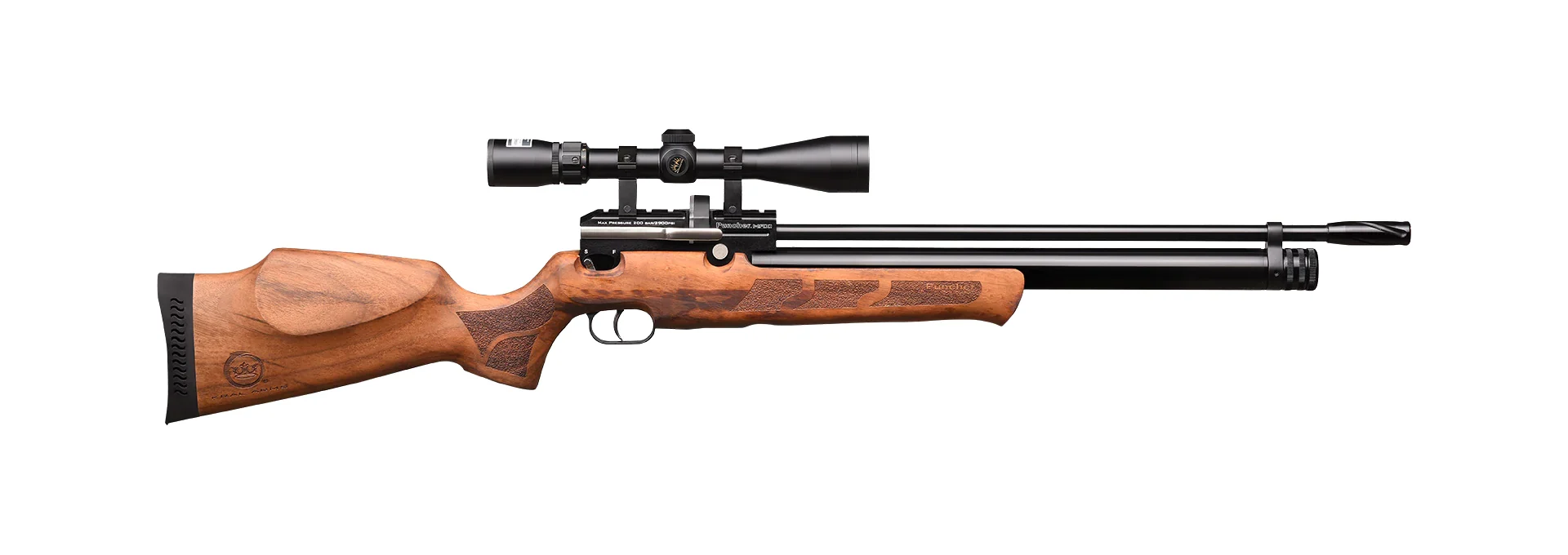
The KRAL ARMS PUNCHER WALNUT is a sporting air rifle distinguished by its traditional walnut-stock appearance and classic styling. A combination of traditional design and modern manufacturing influences has been incorporated into its overall presentation. Furthermore, its wooden finish provides an elegant alternative to contemporary synthetic-stock designs.
The walnut furniture is a defining visual feature of this model. Natural wood grain gives each stock its own distinctive appearance. Consequently, variations in grain patterns, colour tones, and surface characteristics may be observed between individual examples.
Traditional Walnut Stock Design
A carefully finished walnut stock contributes to the traditional appearance of the rifle. Moreover, the natural wood aesthetic complements its overall sporting design.
The wooden exterior should be inspected regularly, particularly around exposed surfaces and contact areas. Appropriate wood-care products may also be used according to the manufacturer’s recommendations.
Construction and General Features
The product should be assessed according to its original manufacturer documentation and individual specification.
Important product-identification considerations include:
- Manufacturer and model identification.
- Original walnut-stock configuration.
- Overall external condition.
- Manufacturer markings and serial identification.
- Included original components and documentation.
- Any visible signs of wear or previous maintenance.
Furthermore, the exact configuration should be confirmed before purchasing, as specifications can differ between production versions and regional markets.
Condition and Product Inspection
Before any purchase, the individual item should be examined for visible damage, unusual wear, and missing components.
Particular attention should be given to the stock finish, external surfaces, manufacturer markings, and the completeness of the supplied package.
Any discrepancies between the advertised configuration and the actual product should be disclosed clearly.
Responsible Ownership and Maintenance
Responsible ownership should always be prioritised. The applicable laws and licensing requirements must be checked before acquiring, possessing, transporting, or storing this product.
The manufacturer’s maintenance instructions should be followed, and inspections should be entrusted to a suitably qualified professional whenever mechanical concerns are identified.
Secure storage, restricted access, and compliance with local regulations are essential considerations.
Frequently Considered Product Information
Is the walnut stock made from natural wood?
The model is identified by its walnut-stock configuration. The precise wood specification and finish should be confirmed against the manufacturer’s documentation.
Does every example have identical wood grain?
No. Natural wood characteristics can vary, meaning individual examples may display different grain patterns and colour variations.
Does the product include original accessories?
Included accessories depend on the particular listing and package. All supplied components should therefore be itemised before purchase.
Are specifications identical across all versions?
Not necessarily. Regional configurations and production revisions may differ. Manufacturer documentation should be consulted for verified specifications.
What should be checked before acquisition?
Product identification, condition, completeness, applicable legal requirements, and original manufacturer documentation should all be reviewed.
Final Product Overview
The KRAL ARMS PUNCHER WALNUT represents a traditional walnut-stock sporting design. Its natural wood appearance distinguishes it visually, while its manufacturer-specific configuration should be verified against the documentation supplied with the individual example.
Accurate product information, transparent condition reporting, and responsible ownership should remain central to every product listing.
Frequently Asked Questions – KRAL ARMS PUNCHER WALNUT
1. What Makes the Walnut Version Visually Distinctive?
The most noticeable characteristic is its traditional walnut-stock appearance. Natural wood provides a different visual character from synthetic materials. Furthermore, variations in grain, colour, and surface texture give individual stocks their own appearance.
2. What Is Special About a Walnut Stock?
Walnut is valued in traditional sporting equipment for its natural appearance and distinctive grain patterns. Additionally, its finish can complement traditional manufacturing styles. However, the exact wood grade and finishing treatment should be confirmed through the manufacturer’s documentation.
3. Does Every Stock Have the Same Appearance?
No. Natural wood is not completely uniform. Differences in grain direction, colour, and texture are normal characteristics of wooden materials. Consequently, two examples of the same model may look slightly different.
4. How Should the Wooden Exterior Be Maintained?
The manufacturer’s recommended care instructions should always be followed. Generally, wooden exterior surfaces should be kept clean and dry. Furthermore, unsuitable cleaning chemicals and excessive moisture should be avoided because they may affect the finish.
5. Can the Stock Develop Scratches?
Yes. Like other finished wooden surfaces, walnut can develop superficial marks through ordinary handling and contact. The visibility of these marks depends on their depth, location, and the condition of the original finish.
6. How Can Buyers Assess the Overall Condition?
A proper inspection should include the exterior finish, visible markings, stock condition, and completeness of the supplied package. Additionally, any previous repairs or modifications should be disclosed. A qualified professional should assess any suspected mechanical damage.
7. Are There Different Production Versions?
Product configurations can vary according to production periods and regional distribution. Therefore, the exact model designation, serial identification, and manufacturer’s documentation should be checked before relying on specifications found in older product listings.
8. Is the Product Supplied With Original Documentation?
Documentation availability depends on the individual example and its original packaging. Buyers should establish whether manufacturer paperwork, ownership documents, and relevant compliance information are included.
9. How Important Is the Manufacturer’s Identification?
Manufacturer identification is important for establishing product authenticity and determining the applicable documentation. Original markings should be inspected and recorded accurately. Any uncertainty should be referred to an authorised manufacturer representative.
10. Can the Exterior Finish Change Over Time?
Yes. Exposure to environmental conditions, handling, and unsuitable cleaning products can affect the appearance of wooden finishes. Nevertheless, appropriate care and compliance with manufacturer recommendations can help preserve the original appearance.
11. What Should Be Included in a Complete Product Listing?
A transparent listing should identify the manufacturer, exact model, visible condition, included components, and available documentation. In addition, photographs should represent the actual item rather than a different production example.
12. How Should the Product Be Stored?
Secure storage should be prioritised. The item should be kept inaccessible to unauthorised individuals, particularly children. Environmental conditions should also be considered, with excessive moisture and extreme temperature fluctuations avoided.
13. Does Walnut Require Special Cleaning Products?
The appropriate cleaning products depend on the original finish. Therefore, manufacturer-approved materials should be preferred. Abrasive cleaners and unverified chemicals should not be applied to the wooden exterior.
14. Can the Stock Be Repaired?
Some cosmetic imperfections in wooden furniture may be professionally assessed. However, structural damage should never be treated as an ordinary cosmetic issue. A qualified professional should determine whether any repair is appropriate.
15. How Can Buyers Identify Cosmetic Wear?
Cosmetic wear may appear as minor surface marks, changes in finish appearance, or small imperfections. Nevertheless, cosmetic observations should be distinguished from structural concerns. Any uncertainty should be professionally evaluated.
16. Are Replacement Components Universally Compatible?
Compatibility should never be assumed. Different production versions may have different component specifications. Manufacturer documentation and authorised technical support should be consulted before identifying replacement parts.
17. What Is the Importance of Original Packaging?
Original packaging may help preserve the supplied components and documentation. However, its absence does not independently establish whether an item is genuine or complete. Product identification and documentation should be assessed separately.
18. Can Product Specifications Differ Between Countries?
Yes. Products distributed in different jurisdictions may be subject to different configurations and regulatory requirements. Consequently, specifications should be verified for the exact regional version rather than copied from an unrelated international listing.
19. What Legal Considerations Should Be Reviewed?
Applicable laws may regulate possession, licensing, transportation, importation, and storage. Requirements differ considerably between countries and sometimes between individual regions. Buyers should consult the relevant government authorities before proceeding.
20. Is Professional Inspection Recommended?
Yes. Professional inspection provides an opportunity to identify concerns that may not be apparent during a visual examination. Furthermore, it can help establish whether the item’s documented condition accurately reflects its actual condition.
21. How Should Previous Repairs Be Disclosed?
Any known repair, replacement, or modification should be described accurately. Transparency is important because undisclosed alterations can create uncertainty about originality, condition, and documentation.
22. What Is the Difference Between Original and Modified Furniture?
Original furniture refers to the configuration supplied by the manufacturer. Modified furniture may have undergone subsequent cosmetic or structural changes. Documentation and professional assessment can help establish whether the existing configuration is original.
23. How Should Photographs Be Prepared for a Product Listing?
Photographs should represent the actual item faithfully. Clear images of its exterior, markings, wooden finish, and included components can help prospective buyers understand its condition. Any imperfections should also be represented honestly.
24. Can the Natural Wood Colour Change?
Wooden surfaces can experience colour variations over time due to environmental exposure and ageing. However, the extent of any change depends on the original finish and storage conditions.
25. Why Is Accurate Model Identification Important?
Accurate identification helps prevent confusion between different manufacturer products and production versions. It also makes it easier to obtain the correct documentation, confirm regulatory requirements, and communicate clearly with professional service providers.
26. How Should Missing Components Be Addressed?
Missing components should be disclosed in the product description. A complete inventory should be prepared, and any uncertainty about the original package contents should be checked against the manufacturer’s documentation.
27. Is a Used Example Necessarily in Poor Condition?
No. Previous ownership does not automatically indicate poor condition. Nevertheless, the item’s actual condition should be assessed independently, with particular attention given to visible wear, documentation, and professional inspection.
28. What Information Should Accompany a Warranty Claim?
Warranty conditions depend on the manufacturer and the applicable regional distribution agreement. Original purchase documentation, product identification, and a description of the reported issue may be required. Buyers should consult the relevant warranty provider.
29. How Should Transportation Be Handled?
Transportation must comply with the applicable laws and carrier requirements. Relevant documentation, packaging standards, and any necessary authorisations should be confirmed before transportation is arranged.
30. What Is the Most Important Consideration Before Ownership?
Responsible and lawful ownership should remain the primary consideration. Product identification, accurate documentation, secure storage, professional inspection, and compliance with local regulations should all be established before possession.
Final Frequently Asked Questions Summary
The traditional wooden appearance is the defining visual characteristic of this sporting model. Natural grain variations, exterior condition, and finishing details should be considered when assessing an individual example.
Moreover, accurate manufacturer documentation should be used to establish the precise configuration. Product descriptions should remain transparent, particularly regarding included components, previous repairs, and visible imperfections.
Finally, appropriate maintenance, secure storage, professional inspection, and compliance with applicable regulations should always be prioritised.
Calibres, FAC Classification, Power, Optics and Accessories – KRAL ARMS PUNCHER WALNUT
1. Understanding Calibre Configurations
Calibre is an important part of identifying the exact configuration of an air rifle. Different regional versions may be offered with different specifications, depending on the manufacturer’s production arrangements and local regulations.
When documenting this model, the following information should be verified against the manufacturer’s original specification sheet:
-
Exact calibre designation.
-
Manufacturer’s model and production version.
-
-
Original factory documentation.
-
Applicable legal classification.
Calibre information should not be assumed from photographs or descriptions of similar models. This is particularly important when different versions share the same external appearance.
2. FAC Classification and Legal Requirements
FAC refers to Firearms Certificate in jurisdictions such as the United Kingdom. It is a regulatory classification rather than a universal technical specification.
The legal classification of an air rifle depends on its documented configuration and the laws of the country where it is possessed.
For UK-related listings, the distinction between non-FAC and FAC-regulated air rifles must be accurately established using current official guidance. Other countries, including Cameroon, may apply different definitions and licensing requirements.
Before listing or transferring this product, its legal status should be confirmed with the relevant authorities.
3. Power Specifications and Verification
Power ratings may differ between versions and regional configurations. Therefore, a single power figure should not be applied to every product carrying the same general model name.
The manufacturer’s official catalogue and the documentation supplied with the individual rifle should be treated as the authoritative references.
For accurate product documentation, the following should be recorded:
-
Manufacturer-declared power rating.
-
Regional factory configuration.
-
Applicable legal power limit.
-
Original product identification.
-
Professional verification where required.
4. Scope and Optical Equipment
The scope configuration should be documented using the manufacturer’s compatibility information and applicable safety requirements.
For a product listing, distinguish between equipment supplied with the rifle and optional equipment. Do not imply that an optical accessory is included unless it has been verified.
Optical equipment should be professionally checked for compatibility and secure installation. Any accessories should be used in accordance with their manufacturers’ instructions.
5. General Accessories and Product Care
Accessories should be selected with particular attention to safe storage, product protection, and manufacturer compatibility.
The following non-performance accessories can be documented:
-
Protective storage case: Helps protect the exterior and walnut finish during secure storage.
-
Cleaning materials: Manufacturer-approved materials for maintaining exterior surfaces.
-
Moisture-control storage products: Help protect wooden furniture from unsuitable environmental conditions.
-
Protective covers: Help prevent dust accumulation during storage.
-
Documentation folder: Keeps ownership paperwork, manuals, and inspection records together.
-
Safety equipment: Appropriate protective eyewear and secure storage arrangements.
6. Important Buyer Information
Before purchasing or listing this product, confirm the precise model variant. The KRAL Puncher range includes several visually related models, and specifications should not be transferred between them.
The official manufacturer’s documentation should be consulted for the exact version.
Hatsan Air Rifles, Bintac Airguns, AEA Harpoon and PCP Airgun Technology: Complete Guide to Models, Features and Performance
Exploring Hatsan Air Rifles, Bintac Airguns and Modern PCP Technology
The modern air rifle industry has developed into a diverse market featuring precision engineering, innovative pneumatic systems, advanced ergonomics and increasingly specialized sporting equipment. Consequently, enthusiasts researching air rifles, airguns and different types of air gun technology can explore numerous platforms designed for recreational target shooting, controlled range activities and technical collecting.
Among frequently researched manufacturers, hatsan air guns, aea airguns and bintac platforms attract attention for their different operating systems, configurations and design philosophies. Furthermore, searches involving air pellet gun, pallet gun and bee bee gun rifle terminology often reflect interest in understanding the distinctions between pellet-firing rifles, BB airguns and other pneumatic platforms.
Understanding these differences is important because operating mechanisms, ammunition compatibility, maintenance requirements and applicable regulations vary considerably between products.
Hatsan USA: Brand Recognition and Airgun Engineering
The hatsan usa brand is associated with an extensive selection of sporting airguns. Likewise, searches for hatsanusa commonly lead enthusiasts toward information about Hatsan product families, manufacturer documentation and regional specifications.
Throughout its product lineup, hatsan air rifle designs include spring-piston, gas-piston and pre-charged pneumatic systems. Each technology offers distinct characteristics relating to recoil behavior, charging requirements, operating consistency and maintenance.
Additionally, hatsan pcp platforms use compressed air stored in pressure-rated reservoirs. Unlike conventional spring-powered designs, these systems require compatible filling equipment and careful monitoring of operating pressures.
For collectors researching older generations or alternative configurations, hatsan refurbished products and refurbished air rifles are additional topics of interest. However, their condition, service history, pressure-system integrity and manufacturer support should always be established through qualified inspection.
Hatsan Blitz, Semi-Automatic Platforms and Bullpup Designs
Hatsan Blitz and Automatic Airgun Systems
Among recognizable models, the hatsan blitz receives attention for its distinctive pneumatic operating system. Searches for hatsan blitz full automatic, hatsan blitz 30 cal and hatsan blitz .30 cal frequently involve discussions of model configurations, manufacturer specifications and legal classifications.
Alternative searches, including hatsun blitz, hatzan blitz, blitz guns and blitz 777, sometimes appear in online research. Nevertheless, these expressions should not automatically be treated as separate, verified models.
Similarly, hatsan blitz bullpup describes a commonly searched configuration topic. Bullpup airguns position major operating components farther rearward, producing a distinctive overall layout.
Because an automatic air gun may be subject to additional restrictions depending on its operating mechanism and jurisdiction, accurate classification is essential.
Hatsan Sortie, Velox and Other Repeating Platforms
The hatsan sortie is another frequently discussed name within Hatsan’s airgun catalog. Searches for hatsan sortie tact, hatsan sortie tact semi-auto pcp and hatsan sortie accessories reflect interest in model identification, compatibility and manufacturer-supported configurations.
Alongside these products, hatsan velox appears in discussions about compact pneumatic sporting platforms.
Research concerning a semi auto pellet gun often emphasizes how a semiautomatic operating mechanism differs from manually cycled airguns. However, product-specific operating characteristics must be verified rather than assumed.
Other relevant search expressions include invader auto, bullmaster and hatsan invader. Although these names may appear together in comparisons, their mechanisms, dimensions and specifications should be considered individually.
Hatsan Spring-Powered Air Rifles and Traditional Sporting Models
Hatsan Model 95 and Break-Barrel Engineering
The hatsan model 95 is a recognized name among conventional sporting airguns. Additionally, the variations hatsan mod 95 and mod 95 are frequently used in product discussions.
For enthusiasts exploring traditional break-barrel technology, these searches provide an opportunity to learn about spring-piston designs, gas-piston alternatives, stock configurations and safe handling procedures.
Meanwhile, hatsan airtact, hatsan airtact air rifle and hatsan zada are associated with accessible sporting airgun discussions.
Other commonly researched models include hatsan 125, hatsan 135, hatsan 135 vortex air rifle and hatsan 135 carnivore. Their individual configurations should be confirmed using the relevant model and production-year documentation.
Furthermore, hatsan mod 65 is another model-specific search term found in conversations about traditional sporting airguns.
Understanding Model Families and Design Differences
Although multiple models may share a manufacturer’s name, their internal systems and intended applications can differ substantially.
For example, comparing a manually cocked design with a compressed-air platform involves understanding distinct operating procedures, maintenance schedules and storage precautions.
Similarly, generic online expressions such as sniper long, 1000x.25 and 4×20 can appear in equipment descriptions. However, these terms are not sufficient to establish a particular rifle’s specifications.
Consequently, reliable product identification should be based on the exact model designation, manufacturer markings and documented configuration.
Hatsan PCP Airguns, Flash Models and Specialized Platforms
Hatsan Flash, FlashPup and BullBoss
Within the pneumatic category, hatsan flash is a frequently researched model name. Its relevance is often linked to discussions of compressed-air operation, sporting ergonomics and model variations.
Similarly, hatsan flashpup qe is associated with a compact bullpup-style configuration. The hatsan bullboss is another recognizable name in Hatsan’s PCP family.
These designs illustrate how stock geometry and mechanical layout can influence portability, balance and user ergonomics.
Other relevant searches include hatsan hercules, hatsan hercules bully and hatsan factor rc, which belong to discussions surrounding different pneumatic product categories.
Hatsan Jet 2 and Compact PCP Designs
Interest in hatsan jet 2, alternatively searched as jet ii, highlights the growing visibility of compact PCP platforms.
Moreover, hatsan jet 2 accessories is a common research phrase associated with manufacturer-approved components, storage solutions and equipment compatibility.
Additional models appearing in enthusiast research include hatsan neutron star, hatsan piledriver and hatsan big bore carnivore rifle.
Although these products may share brand recognition, their dimensions, pressure requirements, controls and legal classifications should never be assumed to be interchangeable.
Bintac Airguns, AEA Harpoon and Alternative Pneumatic Platforms
Understanding the Bintac Product Family
The terms bintac, bin tac, bintac llc and bintacllc frequently appear in online searches concerning specialty airgun platforms.
Within this category, model-related searches include bintac t9, bintac t9 full auto, bintac t 50, bintac t50, bintac m50 and bintac s45.
Additional terminology includes bintac mcar, bintac mcar 457 and bintac mcar air rifle. These expressions highlight the importance of confirming exact product names, operating mechanisms and model specifications before comparing equipment.
When researching bintac t9 price or bintac m50 for sale, readers should distinguish general market information from verified manufacturer specifications and applicable legal requirements.
Furthermore, the existence of similar model identifiers does not establish identical mechanical designs or compatible components.
AEA Harpoon, Megalodon and Terminator
Among other specialist airgun discussions, aea harpoon is a recognizable product-related search.
The terms aea harpoon air gun, bintac aea harpoon and aea harpoon for sale frequently appear in related online research. Likewise, aea harpoon price represents general interest in the product’s market positioning.
Separately, aea megalodon, aea megalodon for sale and aea terminator are model-related terms appearing in discussions of specialized pneumatic products.
Because manufacturers can offer different generations and configurations, every product should be evaluated according to its actual designation and official specifications.
Large-Caliber Airguns, Pneumatic Tanks and Specialized Equipment
Big-Bore Airgun Categories
The modern industry also includes specialized products described through search phrases such as 30 cal air rifle, air powered 50 cal rifle and zeus 72 cal air rifle price.
These expressions refer to substantially different categories from conventional small-caliber sporting airguns.
Similarly, airgun shotgun, arrow launcher and hatsan harpoon may arise in discussions about specialized pneumatic projectiles and launcher configurations.
Importantly, such systems should not be treated as interchangeable with standard pellet rifles.
The phrase anti air tanks also appears in broader searches, although military anti-aircraft equipment is unrelated to ordinary recreational PCP charging cylinders.
Compressed-Air Systems and Equipment Maintenance
An air tank for pcp airguns is a central component of many pneumatic systems. Nevertheless, compatibility depends on pressure ratings, connector standards and manufacturer requirements.
Regular inspection of cylinders, seals and fittings is important for safe operation.
For this reason, third-party modifications and unverified pressure components should be avoided.
Searches for hatsan aftermarket parts may include replacement seals, external fittings and other model-dependent components. Installation and compatibility should be determined using manufacturer instructions or qualified technicians.
Pellets, Calibers and Air Rifle Range Considerations
Understanding Ammunition Terminology
The term .177 caliber commonly appears in sporting-airgun discussions because it identifies a widely recognized pellet diameter.
Other frequently encountered terms include h&n field target trophy, h&n field target trophy bleifrei and crow magnum.
These names are associated with pellet product lines or ammunition-related discussions, but suitability depends on a particular airgun’s specifications.
Likewise, co2 pellet rifle describes a separate pneumatic technology using carbon dioxide rather than the high-pressure air system associated with typical PCP equipment.
Terms such as econ ii can also appear in equipment searches, although the product identity and manufacturer should be verified before any technical comparison.
Air Rifle Range and Recreational Shooting
The range of air rifle equipment cannot be accurately summarized by one universal distance.
Instead, projectile characteristics, operating configuration, environmental conditions and shooting-range safety rules all influence practical use.
Similarly, air rifle range can refer either to performance discussions or to a designated shooting facility.
For responsible recreational use, a properly supervised facility, suitable pellet trap, secure backstop and appropriate protective equipment are essential.
Conclusion: Understanding Hatsan, Bintac and AEA Airgun Technology
From traditional break-barrel designs to specialist pneumatic platforms, the airgun industry includes an extensive variety of mechanisms, configurations and technical approaches.
Models associated with Hatsan, Bintac and AEA illustrate the diversity of contemporary airgun engineering, while terminology surrounding calibers, accessories and compressed-air systems reflects the importance of accurate product identification.
Ultimately, informed research should prioritize manufacturer documentation, verified specifications, suitable training, qualified servicing and compliance with local laws. Such an approach supports responsible participation in recreational shooting while helping readers distinguish genuine product information from ambiguous online terminology.
Practical Use Scenarios – KRAL ARMS PUNCHER WALNUT
1. Traditional Sporting Equipment and Design Appreciation
Traditional sporting equipment is often appreciated for its combination of craftsmanship, material selection, and distinctive appearance. The walnut-stock design is particularly notable because natural wood introduces visual characteristics that cannot be perfectly duplicated between individual examples.
The exterior finish, grain patterns, and overall presentation contribute to the product’s traditional identity. Furthermore, the wooden furniture provides an opportunity for owners to appreciate the material craftsmanship associated with classic sporting equipment.
For collectors and enthusiasts, the appearance of the stock can be an important part of evaluating an individual example. Natural variations should therefore be understood as characteristics of the material rather than automatically interpreted as manufacturing defects.
2. Product Inspection and Condition Assessment
A practical ownership scenario begins with a thorough assessment of the individual product. Before accepting an item, its identification, external condition, and accompanying documentation should be reviewed.
Particular attention should be given to the wooden furniture. Surface marks, finish variations, and visible imperfections should be recorded accurately.
Additionally, the original manufacturer markings should be documented. Any uncertainty about authenticity, mechanical condition, or previous modifications should be referred to a qualified professional.
This approach encourages responsible product assessment and helps maintain accurate ownership records.
3. Walnut Furniture Care
Natural wood requires appropriate environmental care. Unlike synthetic materials, wooden furniture can be affected by prolonged exposure to moisture, unsuitable cleaning chemicals, and significant environmental fluctuations.
Consequently, the manufacturer’s recommended maintenance instructions should be followed.
A suitable care routine should prioritise:
- Keeping exterior surfaces clean.
- Avoiding excessive moisture.
- Using manufacturer-approved cleaning materials.
- Preventing unnecessary abrasion.
- Inspecting the finish periodically.
- Addressing suspected structural damage professionally.
Moreover, any cleaning product should be checked for compatibility with the original finish before application.
4. Secure Storage at Home
Secure storage is an essential consideration for every responsible owner. A suitable storage arrangement should prevent unauthorised access while protecting the product from environmental damage.
Children and other unauthorised individuals should never have access to the stored item.
Where applicable, legal storage requirements must be followed. A suitable protective case or approved storage arrangement can also help prevent accidental cosmetic damage.
Furthermore, documentation should be stored separately in a secure location where it can be accessed when legally required.
5. Long-Term Ownership and Documentation
Long-term ownership involves more than preserving the external appearance. Accurate documentation should also be maintained.
Original manuals, purchase records, manufacturer identification, and professional inspection records can provide useful information about an individual example.
For instance, a future owner may need to establish the original configuration or determine whether any previous modifications have been made.
Therefore, maintaining an organised documentation folder is a useful ownership practice.
6. Understanding Natural Wood Variations
One of the distinguishing characteristics of wooden sporting equipment is the individuality of its material.
Some examples may display darker grain patterns, while others may have lighter tones or more pronounced natural markings. These differences are normal characteristics of natural wood.
Consequently, product photographs should represent the actual item accurately. A photograph of another example should not be presented as though it shows the precise condition of the item being documented.
7. Professional Inspection and Maintenance Records
Professional inspection is an important part of responsible ownership.
A qualified technician can assess concerns that may not be identifiable through ordinary external examination. This is particularly relevant when an item has been stored for an extended period or has an uncertain maintenance history.
Any suspected mechanical defect should be assessed professionally rather than addressed through improvised repairs.
Inspection dates, findings, and relevant maintenance documentation should be retained for future reference.
8. Transportation and Environmental Protection
Transportation introduces additional considerations, particularly when wooden furniture is involved.
The applicable carrier requirements and local regulations should be established before transportation. Protective packaging should also be appropriate for the item and its documented contents.
Environmental conditions should be considered during storage and transportation. Excessive moisture and extreme temperature fluctuations may affect natural wooden surfaces.
International transportation may involve additional documentation, licensing, customs declarations, and carrier restrictions.
9. Collecting and Product Comparison
Collectors may evaluate different examples according to their external condition, originality, documentation, and overall presentation.
The walnut furniture can be an important visual distinction when comparing traditional and contemporary designs.
However, product comparisons should be based on verified specifications rather than assumptions derived from appearance alone.
A useful comparison record should include:
- Exact manufacturer designation.
- Production identification.
- External condition.
- Originality of components.
- Available documentation.
- Regional compliance information.
These details can make product records more reliable and easier to understand.
10. Responsible Ownership and Legal Awareness
Responsible ownership must remain a priority throughout the product’s life cycle.
Regulations concerning possession, licensing, transportation, importation, and storage can vary between jurisdictions. Consequently, an item that is subject to one classification in a particular country may be treated differently elsewhere.
Before possession or transportation, owners should consult the relevant government authorities and obtain any required authorisations.
Manufacturer documentation should also be retained to support accurate product identification.
11. Preserving the Original Appearance
The walnut-stock finish contributes significantly to the product’s traditional presentation.
Preservation should therefore focus on preventing unnecessary wear and following appropriate manufacturer care recommendations.
Direct exposure to unsuitable chemicals, abrasive materials, and prolonged damp conditions should be avoided.
Additionally, any restoration work should be entrusted to an appropriately qualified professional. This helps reduce the possibility of altering the original finish or damaging the natural wood.
12. Product Presentation for Retail and Documentation
Accurate product presentation is important when creating an online catalogue or inventory record.
Photographs should show the actual item’s condition, including any visible cosmetic imperfections. Product descriptions should also distinguish between included components and optional accessories.
Furthermore, the exact manufacturer designation should be used consistently throughout the listing.
Where specifications are unavailable, they should be identified as unverified rather than estimated.
13. Conclusion
The walnut-stock sporting model can be appreciated for its traditional appearance, natural material characteristics, and distinctive presentation.
Its long-term care should be centred on appropriate storage, accurate documentation, professional inspection, and compliance with applicable regulations.
Ultimately, responsible ownership is supported by transparency, manufacturer-approved maintenance, and careful preservation of the original product condition.
Design Qualities and Important Considerations – KRAL ARMS PUNCHER WALNUT
1. Traditional Walnut Appearance
One of the most recognisable characteristics of this model is its traditional walnut-stock appearance. Natural wood has long been appreciated in sporting equipment because of its distinctive grain, texture, and finish.
Unlike synthetic materials, walnut presents natural variations that make individual examples visually distinctive. Consequently, the overall appearance can appeal to people who appreciate traditional woodworking and classic sporting designs.
The finish also contributes to the product’s visual identity. However, the exact wood grade and finishing treatment should always be verified against the manufacturer’s documentation.
2. Attention to Material Quality
Material selection is an important consideration when evaluating sporting equipment. Wooden furniture requires appropriate finishing and environmental care to maintain its appearance over time.
The walnut exterior should be examined for visible imperfections, surface damage, and signs of previous repairs. Furthermore, the condition of the finish should be documented accurately.
Natural variations in colour and grain should also be considered when comparing individual examples.
3. Distinctive Traditional Styling
Traditional styling remains an important characteristic of many sporting products. The walnut exterior provides a classic visual alternative to modern synthetic finishes.
This design approach combines the appearance of natural wood with a contemporary manufactured product.
For people interested in traditional materials, the distinction between wooden and synthetic furniture is an important consideration when evaluating product design.
4. Manufacturer Identification and Documentation
Reliable manufacturer documentation is essential when identifying a particular product.
Different versions within the same product family may have different specifications, regional configurations, or production details. Therefore, the exact designation should be established before any technical information is published.
Original documentation can also help clarify the supplied configuration and identify any differences between production versions.
5. Long-Term Appearance and Care
Natural wooden furniture requires appropriate maintenance. Excessive moisture, unsuitable chemicals, and significant environmental changes may affect the finish.
A sensible preservation approach should include:
- Following manufacturer-approved cleaning recommendations.
- Avoiding abrasive cleaning materials.
- Keeping the wooden exterior in suitable storage conditions.
- Inspecting the finish periodically.
- Seeking professional assessment when damage is suspected.
These practices help preserve the original appearance without relying on unverified restoration methods.
6. Product Condition and Transparency
The condition of an individual example is more important than general descriptions of a model.
A transparent product assessment should identify visible wear, cosmetic imperfections, previous repairs, and missing components.
Photographs should represent the actual item accurately. Additionally, any uncertainty regarding mechanical condition should be referred to a qualified professional.
7. Understanding Regional Specifications
Specifications should not be assumed to be identical across every market.
Regional requirements can influence product classification, documentation, and permitted configurations. Consequently, official manufacturer information and applicable government guidance should be consulted.
This is particularly important when products are being documented for international audiences.
8. Responsible Ownership
Responsible ownership involves appropriate storage, secure access arrangements, and compliance with applicable legislation.
Licensing, possession, transportation, and importation requirements differ between countries. These obligations should be established before any acquisition or transfer.
Manufacturer safety instructions should also be followed, and professional assistance should be sought whenever technical concerns arise.
9. Overall Design Assessment
The walnut-stock configuration provides a distinctive traditional appearance. Its natural material characteristics, classic styling, and individual wood-grain variations are important elements of its identity.
Nevertheless, a complete product assessment should consider more than appearance. Originality, documentation, condition, and verified specifications should all be taken into account.
10. Final Considerations
The most meaningful qualities to document are the traditional walnut finish, natural wood characteristics, manufacturer identification, and overall condition.
Rather than relying on unsupported performance claims, an accurate description should distinguish verified specifications from assumptions.
Ultimately, good product documentation is built on transparency, reliable manufacturer information, appropriate maintenance, and responsible ownership.



Reviews
There are no reviews yet.