CROSMAN AG2300 SILHOUETTE 2300S CO2 PISTOL – Precision Target Shooting and Competition Performance
CROSMAN AG2300 SILHOUETTE 2300S CO2 PISTOL – Product Overview
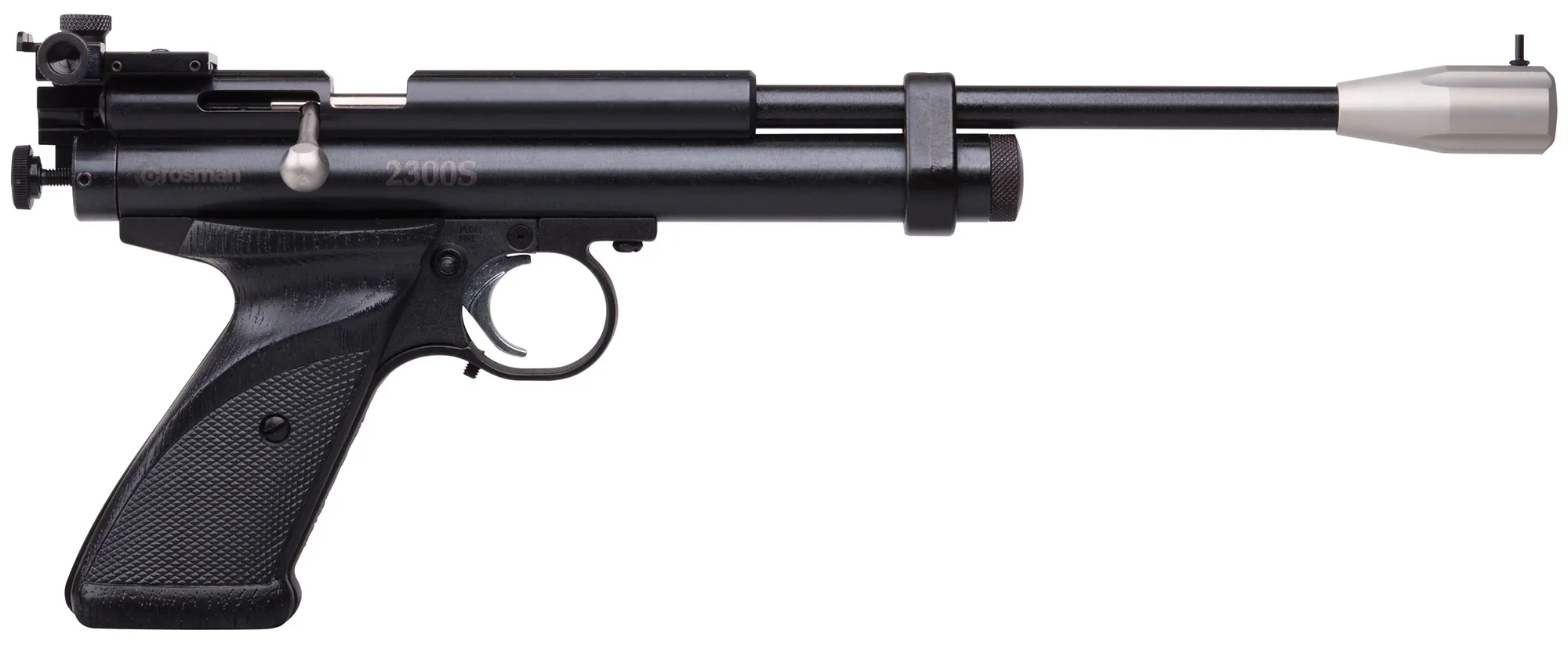
The CROSMAN AG2300 SILHOUETTE 2300S CO2 PISTOL is a competition-oriented .177 caliber air pistol developed for precision target shooting, silhouette competitions, and controlled recreational marksmanship. Designed around a single-shot bolt-action mechanism, this CO2-powered pistol combines a match-grade barrel, adjustable trigger, and precision sighting system in a distinctive target-shooting platform.
Unlike conventional recreational air pistols, the Crosman 2300S was engineered with competitive shooting requirements in mind. Consequently, its construction emphasizes predictable operation, consistent pellet placement, and mechanical adjustability.
Furthermore, the pistol incorporates a Lothar Walther choked match barrel, which distinguishes it from more basic models in the Crosman range. The extended barrel, combined with its single-shot configuration, provides a purpose-built foundation for deliberate target shooting.
Meanwhile, the Williams adjustable rear sight allows precise sight alignment during organized shooting activities. Because different shooting disciplines impose different equipment requirements, the model was also designed to meet International Handgun Metallic Silhouette Association (IHMSA) Production Class requirements.
Designed for Precision Target Shooting
Precision target shooting depends on consistent equipment, stable handling, and repeatable mechanical performance. Therefore, the Crosman 2300S incorporates several features associated with dedicated competition air pistols.
Its adjustable single-stage trigger provides control over trigger characteristics. Additionally, the precision-machined barrel and manually operated bolt contribute to the pistol’s straightforward mechanical arrangement.
For target shooters, these characteristics are relevant when evaluating equipment for supervised range sessions, marksmanship development, and formal shooting disciplines.
Key Features and Technical Specifications
The CROSMAN AG2300 SILHOUETTE 2300S CO2 PISTOL incorporates the following manufacturer-documented specifications:
- Manufacturer: Crosman Corporation
- Model: 2300S Silhouette
- Product Type: CO2-powered competition air pistol
- Caliber: .177 (4.5 mm)
- Power Source: 12-gram CO2 Powerlet cartridge
- Action: Single-shot bolt action
- Maximum Advertised Velocity: Up to 520 FPS
- Barrel: 10.1-inch Lothar Walther choked match barrel
- Barrel Construction: Rifled steel
- Trigger: Adjustable single-stage trigger
- Trigger Adjustment: Overtravel adjustment
- Velocity Adjustment: Adjustable hammer spring
- Rear Sight: Williams micrometer-adjustable notch sight
- Front Sight: Fixed
- Optics Interface: Dovetail mounting grooves
- Bolt: Stainless steel with extended handle
- Safety: Crossbolt safety
- Approximate Weight: 2.7 lbs
- Overall Length: 16 inches
- Advertised Shot Count: Approximately 60 consistent shots per CO2 cartridge under suitable conditions
- Competition Classification: Designed to meet IHMSA Production Class requirements
Actual velocity and shot count depend on temperature, pellet characteristics, and operating conditions.
Match-Grade Lothar Walther Barrel Construction
Precision Engineering and Barrel Characteristics
One of the defining characteristics of the Crosman 2300S is its 10.1-inch Lothar Walther choked match barrel.
Manufactured for precision shooting applications, this barrel features 12 lands and grooves, together with a choked muzzle design. Accordingly, its construction reflects the pistol’s competition-focused origins.
Furthermore, the extended barrel represents an important distinction between the 2300S and shorter recreational CO2 pistols.
The barrel is constructed from steel, while its rifling is intended for compatible .177 caliber lead airgun pellets. However, actual accuracy is influenced by ammunition consistency, environmental conditions, and the shooter’s technique.
Because barrel condition affects performance, regular inspection and manufacturer-approved maintenance remain important.
CO2 Power System and Consistent Operation
Convenient 12-Gram CO2 Cartridge Design
The Crosman 2300S uses standard 12-gram CO2 Powerlet cartridges rather than a pre-charged pneumatic air reservoir.
As a result, its operating system differs from PCP target pistols, which normally require additional compressed-air filling equipment.
Under appropriate conditions, the manufacturer advertises approximately 60 shots at relatively consistent velocity from a single cartridge.
Nevertheless, CO2 performance varies with ambient temperature and the rate at which shots are taken. Consequently, advertised shot counts should be interpreted as performance estimates rather than guarantees.
Adjustable Hammer Spring System
An adjustable hammer spring is included as part of the original engineering design.
According to manufacturer specifications, the pistol’s nominal adjustable velocity range is approximately 440–520 FPS.
Additionally, Crosman explains that this adjustment system primarily supports fine-tuning CO2 usage and velocity consistency. Therefore, its characteristics should be understood in the context of the manufacturer’s operating specifications and safety instructions.
Adjustable Single-Stage Trigger System
Trigger Characteristics for Competition Shooting
The CROSMAN AG2300 SILHOUETTE 2300S CO2 PISTOL features a single-stage adjustable trigger intended for target shooting.
Its construction incorporates an overtravel adjustment mechanism, while the manufacturer’s documentation describes an adjustable trigger-pull specification.
Unlike a conventional fixed-trigger design, this arrangement provides manufacturer-defined adjustment capability.
Moreover, trigger characteristics contribute to the overall handling experience of a target pistol. For this reason, trigger design is frequently considered when comparing competition-oriented airguns.
Any adjustments should remain within the manufacturer’s instructions. In particular, unsafe trigger settings may increase the risk of accidental discharge.
Williams Micrometer Adjustable Rear Sight
Precision Sight Alignment
An important component of the 2300S is its Williams notch-style rear sight.
This sight incorporates micrometer adjustments and positive internal locking features. Additionally, its target-style adjustment knobs form part of the pistol’s competition-oriented design.
The fixed front sight works alongside the adjustable rear sight to create a traditional open-sight arrangement.
Furthermore, the receiver includes dovetail mounting grooves that provide an interface for compatible optical equipment.
However, any optical accessories should be evaluated for mounting compatibility, shooting-discipline regulations, and manufacturer recommendations before use.
Stainless Steel Bolt and Single-Shot Action
Traditional Bolt-Action Engineering
The Crosman 2300S features a manually operated stainless steel bolt with an extended handle.
This configuration supports the pistol’s single-shot operating system, which differs from magazine-fed or semiautomatic CO2 designs.
Additionally, the bolt incorporates an extended probe as part of the manufacturer’s original construction.
Because each shot is handled individually, the system is particularly associated with deliberate target shooting rather than rapid-fire operation.
The bolt-action mechanism also contributes to the pistol’s recognizable appearance and straightforward mechanical layout.
Competition Heritage and Shooting Applications
IHMSA Silhouette Competition Background
The model was originally developed with silhouette competition requirements in mind.
In particular, Crosman designed the pistol to satisfy IHMSA Production Class rules applicable to its original configuration.
Consequently, the 2300S has historical relevance within competition air-pistol shooting, especially among enthusiasts interested in traditional CO2-powered target platforms.
Nevertheless, prospective competition participants should confirm current event rules, permitted equipment configurations, and eligibility requirements with the relevant organizing body.
Recreational Target Shooting and Training
Beyond its competition heritage, the pistol is associated with controlled paper-target practice and structured marksmanship activities.
Furthermore, its single-shot configuration offers a traditional shooting experience that differs from modern multishot air pistols.
For responsible use, appropriate eye protection, a suitable pellet trap or backstop, and a legally authorized shooting environment are essential.
Construction, Handling, and Maintenance
The Crosman 2300S combines a rifled steel barrel, stainless steel bolt, and synthetic grip components.
Its approximately 2.7-pound weight and 16-inch overall length distinguish it from compact recreational air pistols.
Additionally, the relatively long barrel influences the pistol’s dimensions and overall balance.
Like other CO2-powered airguns, the 2300S requires appropriate storage and routine inspection.
Manufacturer-approved cleaning procedures should be followed, while incompatible lubricants or unauthorized modifications should be avoided.
Furthermore, CO2 cartridges should be handled according to the owner’s manual, and the pistol should always be stored securely and unloaded.
Final Product Overview
The CROSMAN AG2300 SILHOUETTE 2300S CO2 PISTOL represents a distinctive example of competition-focused CO2 air-pistol engineering.
Its defining features include a Lothar Walther choked match barrel, Williams adjustable rear sight, single-stage adjustable trigger, stainless steel bolt, and 12-gram CO2 operating system.
Additionally, its IHMSA competition heritage separates the model from standard recreational air pistols.
For collectors, target-shooting enthusiasts, and those researching traditional competition equipment, the Crosman 2300S offers a documented combination of specialized engineering, adjustable mechanical components, and established target-pistol design.
Product availability note: Crosman’s official product listing identifies the 2300S as discontinued. Any current listing should therefore clearly indicate actual stock availability, condition, included accessories, and applicable legal requirements.
Crosman AG2300 Silhouette 2300S CO2 Pistol – Calibres, FAC Power, Recommended Scopes and Essential Accessories
Available Calibres and Ammunition Compatibility
The CROSMAN AG2300 SILHOUETTE 2300S CO2 PISTOL is a precision-oriented target air pistol manufactured in .177 calibre (4.5mm). Designed specifically for competition-style shooting, this calibre complements the pistol’s single-shot bolt-action mechanism and Lothar Walther choked match barrel.
Unlike airguns produced in multiple calibre configurations, the standard Crosman 2300S was manufactured exclusively in .177 calibre. Consequently, .22 and .25 calibre versions should not be advertised as original factory configurations.
The .177 calibre has long been associated with target shooting because standardized ammunition is widely available. Furthermore, its relatively small pellet diameter suits traditional paper targets and organized air-pistol competitions.
.177 Calibre (4.5mm) – Factory Configuration
The standard .177 configuration incorporates several characteristics:
- Calibre: .177 / 4.5mm
- Ammunition: Compatible lead airgun pellets
- Barrel: 10.1-inch rifled Lothar Walther choked match barrel
- Loading System: Single-shot bolt action
- Primary Application: Paper-target shooting and regulated silhouette competition
- Pellet Selection: Manufacturer-compatible .177 calibre lead pellets
Additionally, pellet dimensions, manufacturing consistency, and barrel condition may affect actual performance. Therefore, ammunition should always be selected according to the manufacturer’s specifications.
FAC Classification and Legal Requirements
FAC stands for Firearm Certificate, a term commonly used in the United Kingdom to describe the licensing system applicable to certain firearms.
However, legal classifications differ significantly between air rifles and air pistols. Consequently, the Crosman 2300S should not automatically be described as an FAC-rated air rifle.
UK Sub-6 ft-lb Air Pistol Classification
In England and Wales, air pistols with muzzle energy not exceeding 6 foot-pounds generally fall below the threshold for classification as specially dangerous air weapons.
Meanwhile, air pistols exceeding this limit are generally prohibited firearms, rather than ordinary FAC air rifles.
The standard Crosman 2300S operates below the 6 ft-lb threshold under its published factory specifications. Nevertheless, the legal status of an individual pistol depends on its actual condition, configuration, and applicable legislation.
Furthermore, Scotland operates a separate Air Weapon Certificate system, while Northern Ireland has different firearm certification requirements.
For this reason, prospective owners should verify current local laws before purchasing, possessing, transporting, or using the pistol.
CO2 Power System and Muzzle Velocity
The Crosman 2300S uses a 12-gram CO2 cartridge to power its single-shot mechanism.
Unlike pre-charged pneumatic airguns, the pistol does not require an external high-pressure air cylinder or dedicated PCP charging pump.
Instead, the factory CO2 system provides a compact and straightforward power source.
Factory Velocity Specifications
The manufacturer’s published specifications identify the following characteristics:
- Maximum Advertised Velocity: Up to 520 FPS
- Metric Velocity: Approximately 158 metres per second
- Published Adjustable Velocity Range: 440–520 FPS
- Power Source: 12-gram CO2 Powerlet
- Advertised Shot Count: Approximately 60 shots at relatively consistent velocity
- Operating Mechanism: Single-shot CO2 bolt action
Actual muzzle energy depends on pellet mass and measured velocity. Therefore, a single fixed joule rating cannot accurately represent every operating condition.
Furthermore, CO2 pressure is influenced by temperature, while ammunition variations and maintenance condition can affect measured performance.
For accurate product information, the manufacturer’s figures should be presented as advertised specifications rather than guaranteed results.
Recommended Scopes and Optical Accessories
The CROSMAN AG2300 SILHOUETTE 2300S CO2 PISTOL features a grooved receiver designed to accommodate compatible optical mounting equipment.
Additionally, the original configuration includes a Williams micrometer-adjustable rear sight and fixed front sight.
Therefore, buyers can evaluate either the traditional open-sight arrangement or a suitable optical system, subject to manufacturer guidance and competition rules.
Compact Red Dot Sights
A lightweight red dot sight is one optical category commonly associated with recreational target pistols.
When assessing compatibility, buyers should consider the mounting interface, overall optic weight, eye relief requirements, and applicable shooting regulations.
Moreover, a compatible mounting adapter may be necessary because not every optic is designed for the receiver’s dovetail grooves.
Long-Eye-Relief Pistol Scopes
Long-eye-relief optics are specifically designed for applications where the shooter’s eye is positioned farther from the sight than with a conventional rifle scope.
Consequently, prospective buyers should distinguish pistol-rated scopes from standard short-eye-relief rifle optics.
Before purchasing, verify the manufacturer’s eye-relief specifications, mounting compatibility, and any competition restrictions.
Factory Williams Rear Sight
The Williams adjustable rear sight remains a defining feature of the original 2300S.
Its micrometer adjustments and target-style controls reflect the pistol’s precision-shooting design.
Furthermore, retaining the factory sighting arrangement may be preferable when originality or competition eligibility is important.
Essential Accessories for the Crosman 2300S
Several accessories support safe ownership, maintenance, and organized target shooting.
Recommended Equipment
- 12-Gram CO2 Powerlets: Manufacturer-compatible cartridges for the factory power system.
- .177 Lead Airgun Pellets: Correct-calibre ammunition that meets Crosman’s recommendations.
- Protective Shooting Glasses: Impact-rated eye protection for shooting activities.
- Suitable Pellet Trap: A properly rated target-catching system for controlled shooting areas.
- Paper Targets: Standardized targets for recreational or organized range sessions.
- Lockable Storage Case: Secure storage that helps prevent unauthorized access.
- Manufacturer-Approved Maintenance Supplies: Appropriate products for routine care.
- Protective Carrying Case: Suitable for lawful and secure transportation.
- Owner’s Manual: Essential reference material for safe operation and maintenance.
Choosing Compatible Accessories
Compatibility should always be confirmed before purchasing additional equipment.
For instance, not all optical mounts fit every dovetail receiver. Similarly, ammunition must match the pistol’s specified calibre and projectile requirements.
Furthermore, competition participants should check equipment eligibility before fitting additional accessories.
Unauthorized modifications may compromise reliability, safety, warranty coverage, or legal compliance.
Why the Original Configuration Matters
The Crosman 2300S was designed as a dedicated silhouette competition pistol rather than a general-purpose hunting airgun.
Its match-grade barrel, adjustable trigger, traditional sighting arrangement, and single-shot operating system reflect that purpose.
Consequently, maintaining the original factory configuration helps preserve the model’s intended characteristics.
Additionally, responsible maintenance, suitable protective equipment, and secure storage contribute to long-term ownership.
Final Overview
The CROSMAN AG2300 SILHOUETTE 2300S CO2 PISTOL combines .177 calibre engineering, CO2 operation, an adjustable trigger, and specialized target-pistol sights.
Its advertised 520 FPS maximum velocity and Lothar Walther match barrel form part of its original factory specification.
Meanwhile, compatible protective equipment, correct ammunition, and appropriate storage accessories support responsible use.
For collectors and target-shooting enthusiasts, understanding the pistol’s calibre, power system, legal classification, and optical compatibility provides an informed foundation for evaluating this established Crosman competition model.
Diana Air Rifles and Western Airguns: Complete Guide to Precision, Performance, Models, and Airgun Technology
Discovering Diana Air Rifles and Their Reputation for Quality
The world of precision airguns continues to attract enthusiasts who value engineering quality, shooting consistency, and dependable performance. Among established manufacturers, diana air rifles have developed a recognizable identity through traditional craftsmanship, innovative mechanisms, and a diverse product collection. Whether researching a diana air rifle for recreational target shooting or comparing the different models available, understanding the brand’s history provides an excellent starting point.
Throughout the years, the rws diana air rifle category has attracted considerable attention from enthusiasts familiar with the longstanding relationship between Diana products and RWS branding. Consequently, searches for rws diana, diana rws, and air rifle diana often involve comparisons between older models, contemporary releases, and different regional product names.
Additionally, the term diana pellet gun covers several different configurations designed for sporting and recreational applications. Each model offers distinct characteristics, including variations in weight, powerplant design, handling, and sight arrangements.
For customers researching airgun ownership, evaluating mechanical reliability, manufacturer documentation, and intended use remains essential.
Diana 34 Series: Traditional Design and Modern Developments
The diana 34 remains one of the manufacturer’s most recognizable model families. Its longstanding reputation has encouraged continued interest in the diana model 34, particularly among enthusiasts who appreciate conventional spring-piston engineering.
Similarly, the diana 34 air rifle has become a familiar reference in conversations about break-barrel mechanisms and traditional sporting rifles.
Owners of older equipment may encounter the designation diana rws 34, while product listings sometimes use rws diana 34 to describe historically associated versions.
Other searches, including diana r34, frequently reflect abbreviated product naming rather than a completely separate model.
Furthermore, the diana 34 ems introduced a more modular approach to an established platform. Its Easy Modular System provides a distinctive identity within the manufacturer’s product collection.
For enthusiasts evaluating sight configurations, diana 34 ems fiber optic sights represents another important research topic. Nevertheless, specifications should always be checked against the precise model and production version.
Exploring Classic Diana Models and Magnum Air Rifles
Beyond the 34 series, several older and specialist designs maintain a place in airgun history.
The diana 35 represents a traditional model that collectors and experienced owners continue to research. Meanwhile, searches for diana 2 may refer to historic equipment requiring careful model identification.
More powerful spring-piston designs include the diana 350 magnum, widely recognized as part of the company’s performance-oriented product heritage.
The diana 350 magnum air rifle, also searched as 350 magnum diana, demonstrates the manufacturer’s longstanding interest in high-performance spring-powered technology.
Additionally, the diana rws 460 magnum is associated with a different fixed-barrel, underlever design.
The diana mod 48, diana 48, and rws diana model 48 are commonly connected with sidelever-operated air rifles. Such systems offer a different shooting experience from conventional break-barrel platforms.
Another notable model is the diana 54, which became associated with specialized recoil-management technology.
Research into hunting diana models should consider legal requirements, appropriate sporting applications, and the importance of responsible equipment selection.
Modern Diana PCP Rifles and Compact Air Pistols
Pre-charged pneumatic technology has expanded the manufacturer’s portfolio beyond conventional spring-powered equipment.
For example, the diana stormrider has become a recognizable entry in the company’s PCP rifle collection. Its design appeals to enthusiasts interested in compressed-air operation and modern airgun handling.
Similarly, the diana outlaw gen 2 is a useful search phrase for people investigating Outlaw versions and potential generational differences. However, the exact designation should be confirmed with official product documentation.
The diana r22, commonly presented as the diana r22 or R-22, offers another product family to examine when comparing current sporting rifle designs.
Other models include the diana 250, also known as the diana 250 air rifle, and the diana two fifty, providing additional options within the manufacturer’s wider catalog.
For compact shooting equipment, the diana air pistol category introduces different handling characteristics.
Examples include the diana lp8, sometimes searched as lp8 diana, alongside the diana airbug and diana bandit black.
Owners may also research diana chaser accessories and diana chaser parts when identifying compatible replacement components or manufacturer-approved additions.
Meanwhile, broad phrases such as diana r and nerf diana should be interpreted carefully because they do not necessarily identify a specific Diana airgun model.
Western Airguns and American PCP Engineering
Another important part of the sporting airgun industry involves western airguns, a manufacturer associated with American-designed and assembled PCP equipment.
Research into western air guns, western air gun, and airguns usa frequently reflects interest in domestic manufacturing, contemporary designs, and specialist sporting platforms.
Although searches for western arms, western firearm, western firearms, or western arms shotgun may appear alongside PCP terminology, these phrases can refer to different product categories or manufacturers.
Therefore, brand identification is important when comparing american made air rifles and specialist compressed-air equipment.
The company’s catalog includes several distinctive platforms, particularly the western rattler, western sidewinder, and western mordax families.
These products highlight how modern pneumatic engineering can accommodate multiple configurations, calibers, and operating systems.
Western Rattler Bullpup and Big-Bore Models
The western rattler bullpup is associated with a compact rifle layout that places much of the action behind the trigger.
Consequently, the western rattler air gun attracts attention from enthusiasts researching unconventional rifle configurations.
Common variations and search phrases include western rattler 357, 357 rattler, and western rattler 45, which relate to different caliber categories.
Similarly, searches for 357 air rifle and .35 cal air rifle often involve comparing big-bore pneumatic platforms and the practical differences between manufacturer specifications.
Interest in the western rattler bullpup for sale and western rattler bullpup amazon illustrates how customers research distribution channels, although listing availability and seller authorization require independent verification.
Another significant product is the western big bore bushbuck 45.
Research into bushbuck air rifle price often involves questions about configuration, warranty coverage, and included accessories rather than price alone.
Within the wider category, terms such as big bore pellet gun, big game air guns, and bullpup air rifle describe distinct equipment characteristics.
Because these models can produce substantial energy, responsible storage, suitable facilities, and applicable legal restrictions deserve particular attention.
Western Mordax and Mordax Venom Technology
Compact PCP engineering is represented by the western airguns mordax, a platform associated with modern controls and adaptable handling.
The western mordax pcp designation highlights its compressed-air operating system, while mordax airgun and mordax air gun remain common alternative search terms.
The western mordax venom expands this product family with additional design features and a different air-storage arrangement.
Consequently, both mordax venom and western airguns mordax attract interest from people comparing compact pneumatic platforms.
Manufacturer documentation identifies the Mordax Venom as a selectable semi-automatic and fully automatic design, subject to applicable legal restrictions.
Although the phrase desert scorpion pistol is associated with Mordax branding, buyers should distinguish marketing terminology from official model identification.
Likewise, mordax air gun price should be considered alongside configuration, legal classification, support, and warranty information.
Searches involving venom arms and serpent arms may describe unrelated businesses or terminology and should not automatically be treated as official Western product names.
Western Sidewinder and Additional Airgun Technology
The western sidewinder provides another example of contemporary PCP design.
Searches for sidewinder gun, sidewiner, and western sidewinder compact may involve different product references, spelling variations, or configuration questions.
For accurate identification, owners should consult original documentation before relying on marketplace descriptions.
In addition, sidewinder length is an important consideration when comparing dimensions, storage arrangements, and handling comfort.
People searching for a sidewinder k7a-00008 manual should verify that the document genuinely corresponds to their exact equipment, rather than assuming similarly named products share instructions.
Elsewhere, edgun west and edgunwest are additional search expressions encountered in the broader airgun marketplace, but they should not be confused with Western Airguns branding.
Selecting Suitable Airguns and Understanding Caliber Categories
Different sporting applications require different design priorities. An accurate pellet rifle may emphasize consistent grouping, comfortable handling, and repeatable operation rather than maximum advertised velocity.
Similarly, the phrase long range air rifle should encourage realistic evaluation of manufacturer specifications, environmental conditions, and properly supervised target facilities.
A 4.5mm air gun generally refers to the .177-caliber category, commonly encountered in recreational and precision-target contexts.
Meanwhile, pcp guns use stored compressed air, distinguishing them from conventional spring-powered systems.
The broader category of semi automatic pellet gun describes a particular operating arrangement, although availability and legality differ between jurisdictions.
Search terms such as lethal air guns and steel penetrating full auto airgun highlight the importance of treating powerful pneumatic equipment as potentially dangerous rather than harmless recreational devices.
Likewise, anyone investigating air pistols for hunting must understand local restrictions, humane considerations, and the limitations of the equipment involved.
Finding Reliable Airgun Information and Responsible Ownership
Enthusiasts frequently use phrases such as air guns near me, air gun dealers near me, air rifle dealers, air rifle online, and az air guns while researching local retailers, product information, and specialist services.
However, availability should never replace proper consideration of local legislation, age requirements, safe storage, and verified manufacturer support.
Searches for air gun for semi truck may relate to vehicle-carried equipment, making transportation regulations and secure storage particularly important.
Furthermore, the question where do bullets land when shot in air addresses a serious safety issue: projectiles discharged upward eventually return to earth and can cause severe injuries or death. Never fire a projectile into the air.
Ultimately, choosing sporting equipment responsibly involves understanding its design, limitations, and lawful use.
Whether comparing classic Diana engineering with modern Western pneumatic technology, informed research helps enthusiasts appreciate manufacturing quality while prioritizing safety, reliability, and responsible participation in shooting sports.
14. What is the overall length and weight of the pistol?
The original model measures approximately 16 inches in overall length and weighs around 2.7 pounds.
These dimensions distinguish it from compact recreational air pistols.
Furthermore, the extended barrel contributes significantly to its recognizable silhouette and competition-oriented appearance.
However, handling comfort varies between individuals because hand size, experience, and personal preferences differ.
Therefore, prospective owners should consider the manufacturer’s published dimensions when evaluating suitability.
15. Does this pistol use a magazine?
No. The factory configuration incorporates a single-shot bolt-action mechanism rather than a detachable multishot magazine.
This traditional arrangement reflects its precision-target-shooting heritage.
Additionally, the stainless steel bolt and extended handle are distinctive components of the original mechanism.
Unlike magazine-fed systems, the single-shot design does not provide semiautomatic operation.
Consequently, the pistol should be accurately identified as a manually operated, single-shot model in product specifications and descriptions.
16. Is the pistol suitable for hunting?
The model was primarily developed for organized silhouette competition and recreational target shooting.
Therefore, it should not be advertised as a dedicated hunting airgun.
Furthermore, hunting legislation varies significantly between jurisdictions, and some locations prohibit hunting with air pistols entirely.
Its competition-oriented specifications do not establish suitability for humane wildlife dispatch.
For responsible ownership, users should follow local wildlife regulations and restrict the pistol to lawful activities appropriate to its original design.
17. How does temperature affect CO2 performance?
CO2 pressure changes in response to temperature.
Consequently, colder conditions may reduce pressure and affect projectile velocity.
Conversely, excessively high temperatures may create unsafe pressure conditions, making appropriate cartridge storage particularly important.
Additionally, repeated shooting can temporarily cool the system through the expansion of gas.
Therefore, manufacturer-approved environmental and storage conditions should always be respected.
Cartridges must never be exposed to excessive heat or handled contrary to the manufacturer’s safety instructions.
18. What maintenance does the pistol require?
Routine maintenance includes inspecting external components, checking for visible damage, and following the manufacturer’s prescribed cleaning procedures.
Furthermore, the condition of the barrel, seals, and CO2 system can influence long-term reliability.
Only approved lubricants and compatible maintenance materials should be used.
Additionally, inappropriate cleaning equipment may damage precision barrel surfaces.
Before any maintenance, the pistol should be made safe in accordance with the owner’s manual.
For internal repairs or suspected mechanical faults, assistance from a qualified airgun technician is recommended.
19. What safety accessories should accompany the pistol?
Appropriate protective and storage equipment is essential for responsible ownership.
Recommended items include impact-rated shooting glasses, a suitably rated pellet trap, appropriate paper targets, and secure lockable storage.
Furthermore, shooting activities should take place only in legally authorized environments with a suitable backstop.
Protective eyewear should also be worn by nearby participants and observers.
Additionally, secure storage helps prevent unauthorized access, especially where children or inexperienced individuals may be present.
Every air pistol should be treated as potentially loaded until its condition has been properly verified.
20. Is this model still manufactured?
The manufacturer has identified the original model as discontinued.
Consequently, availability may depend on remaining dealer inventory, private collections, or the secondhand market.
However, discontinued status does not automatically mean replacement components or maintenance resources are unavailable.
Prospective buyers should verify the condition, authenticity, included accessories, and applicable warranty before purchase.
Furthermore, any website advertising new inventory should confirm its actual stock rather than implying that regular factory production continues.
21. What should buyers check when purchasing a pre-owned example?
A pre-owned pistol should be evaluated for external damage, corrosion, missing factory components, and signs of unauthorized modification.
Additionally, the condition of the original sights, grip, bolt, barrel, and CO2 system should be considered.
Buyers should request clear photographs, accurate condition descriptions, and confirmation of the included accessories.
Furthermore, identification markings and documentation may assist with verifying the product’s authenticity.
Whenever possible, inspection by a qualified technician can help identify potential maintenance concerns before purchase.
22. Why is this model valued by target-shooting enthusiasts?
Its distinctive combination of competition heritage, match-grade barrel construction, adjustable mechanical features, and traditional CO2 operation gives the pistol an identifiable place among precision-oriented airguns.
Furthermore, its original factory specifications provide a useful reference for collectors interested in established Crosman engineering.
The Williams rear sight, stainless steel bolt, and extended barrel contribute to its recognizable design.
Ultimately, its appeal rests on its specialized sporting purpose, documented technical characteristics, and connection to traditional metallic silhouette competition.
Practical Use Scenarios and Real-World Applications
1. Precision Target Shooting at an Indoor Range
Indoor target shooting provides a controlled environment where consistency, concentration, and safe handling can be developed. Consequently, a precision-oriented CO2-powered air pistol can form part of an organized shooting experience.
Within a properly supervised facility, participants can practice established marksmanship fundamentals using approved paper targets and suitable pellet-catching equipment.
Furthermore, indoor ranges often offer predictable lighting and reduced exposure to changing weather conditions. These characteristics make them particularly useful for structured training sessions.
Additionally, appropriate eye protection, range supervision, and compliance with facility regulations remain essential throughout every activity.
2. Outdoor Metallic Silhouette Competitions
Metallic silhouette shooting represents one of the traditional sporting applications associated with specialized target air pistols.
During organized competitions, approved metallic targets are positioned according to the rules established by the relevant governing body.
Moreover, participants must follow specific equipment classifications, safety requirements, and competition procedures.
A purpose-built competition platform may therefore be evaluated for eligibility within an applicable category.
However, organizers should always confirm whether the equipment satisfies current competition regulations, particularly when modifications or aftermarket accessories are present.
3. Recreational Shooting at Licensed Facilities
For recreational shooting enthusiasts, organized range visits provide opportunities to enjoy a traditional single-shot sporting experience.
Unlike semiautomatic recreational platforms, a manually operated system offers a distinctive mechanical arrangement.
Additionally, the adjustable sighting components and competition-inspired construction contribute to its specialized character.
Range activities may include supervised paper-target sessions, familiarization with equipment, and participation in recreational shooting clubs.
Nevertheless, shooting should take place only where permission has been granted and appropriate safety infrastructure is available.
4. Marksmanship Education and Supervised Training
Structured shooting education emphasizes safety awareness, responsible equipment handling, and familiarity with established range procedures.
Therefore, an appropriately maintained target pistol may be used within supervised educational programs where local laws and instructor qualifications permit.
Participants can learn the importance of safe storage, suitable protective equipment, and adherence to range commands.
Furthermore, instructors may discuss the differences between CO2, spring-powered, and pre-charged pneumatic systems as part of general airgun education.
Before participating, learners should receive appropriate safety instruction and understand their responsibilities.
5. Sporting Equipment Collection and Historical Appreciation
Collectors often appreciate equipment that reflects a particular period of sporting engineering.
A discontinued competition-oriented design can therefore hold interest because of its original mechanical configuration, specialized components, and manufacturer history.
Additionally, original sights, factory markings, documentation, and preserved accessories may contribute to an item’s collectible appeal.
Enthusiasts may also examine the development of traditional CO2 operating systems and the evolution of precision air-pistol design.
Importantly, collectible equipment should remain securely stored and maintained according to manufacturer recommendations.
6. Equipment Evaluation and Product Familiarization
Authorized sporting-goods demonstrations provide another practical context for examining precision air-pistol construction.
For example, prospective owners may compare overall dimensions, grip characteristics, weight, and factory sight configurations under appropriate supervision.
Furthermore, technical demonstrations can explain the differences between single-shot mechanisms and other sporting airgun designs.
Buyers can also review accessory compatibility, maintenance requirements, and regional ownership regulations before making purchasing decisions.
Consequently, informed equipment evaluation supports responsible ownership and realistic expectations.
Conclusion
From supervised indoor target shooting to organized silhouette competitions, this specialized sporting platform reflects a traditional approach to precision air-pistol engineering.
Its competition heritage, adjustable components, and distinctive mechanical construction provide relevance across several legitimate sporting and collecting activities.
Ultimately, appropriate supervision, approved shooting environments, suitable protective equipment, and compliance with local legislation remain fundamental to every practical application.



Reviews
There are no reviews yet.