Remington Vought PCP Air Rifle – Precision Engineering, Modern Design, and Exceptional Shooting Performance
The Remington Vought PCP Air Rifle combines distinctive styling, advanced pre-charged pneumatic technology, and practical features in a versatile shooting platform. Designed for recreational target shooting, field sports, and precision enthusiasts, this impressive air rifle offers an appealing balance of accuracy, comfort, and dependable mechanical performance.
Furthermore, its bold exterior, multi-shot bolt-action mechanism, and integrated sound moderator distinguish it from many conventional air rifles. Thanks to its thoughtfully engineered construction, users can enjoy a refined shooting experience while benefiting from modern functionality.
Whether you prefer carefully controlled target practice or lawful field applications, the Remington Vought PCP Air Rifle provides an attractive combination of traditional rifle handling and contemporary pneumatic engineering.
Advanced PCP Technology for Consistent Shooting Performance
Efficient Pre-Charged Pneumatic Power System
At the heart of the Remington Vought PCP Air Rifle lies a pre-charged pneumatic system designed to deliver compressed air efficiently during each firing cycle.
Unlike traditional spring-powered air rifles, compressed air supplies the energy required to propel pellets. Consequently, the shooting experience involves significantly less mechanical vibration and minimal spring-related movement.
Moreover, this pneumatic operating system supports repeatable shooting characteristics, making it suitable for enthusiasts who appreciate consistency.
Because pellet performance depends on several factors, including ammunition selection, air pressure, and environmental conditions, proper equipment maintenance remains important.
Regulated Air Delivery and Pressure Monitoring
An integrated pressure-regulation system is featured on reviewed configurations of the Remington Vought. Accordingly, compressed air delivery can remain more consistent across a useful portion of the available fill.
Furthermore, pressure gauges provide important information about the rifle’s pneumatic system.
With suitable pressure monitoring, users can maintain awareness of the remaining compressed-air supply and follow the manufacturer’s recommended operating limits.
The result is a platform designed around controlled pneumatic operation, convenience, and practical shooting performance.
Distinctive Rifle Design and Durable Construction
Modern Styling with a Streamlined Air Cylinder
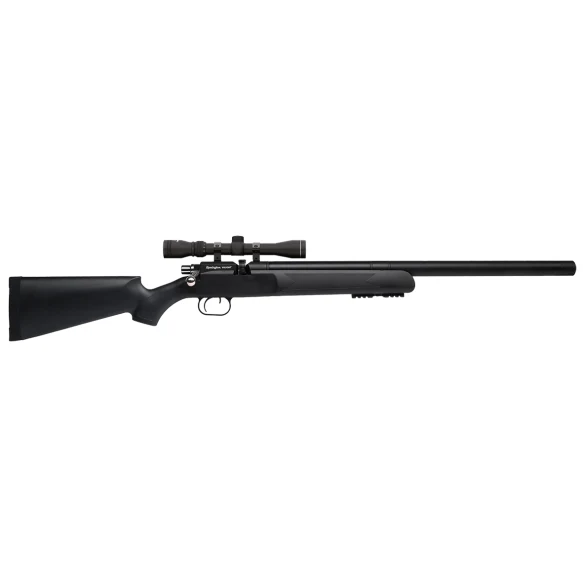
One of the most recognizable characteristics of the Remington Vought PCP Air Rifle is its unconventional exterior.
Rather than displaying a conventional air cylinder beneath the barrel, the design incorporates its compressed-air storage within the main forward assembly. Consequently, a distinctive profile reminiscent of a traditional sporting rifle is achieved.
Additionally, the substantial fore-end gives the rifle a purposeful appearance.
Its robust metal components complement the overall construction, while the carefully shaped stock contributes to comfortable handling.
Ergonomic Stock and Comfortable Shoulder Support
Comfort remains an important consideration for shooting enthusiasts.
Therefore, the Remington Vought incorporates a practical stock design intended to support stable handling during recreational and sporting use.
Depending on the selected configuration, buyers can choose between attractive hardwood and durable synthetic stock options.
Hardwood versions provide a traditional sporting appearance, whereas synthetic configurations offer practical resistance to ordinary outdoor moisture and surface wear.
Furthermore, a fitted rubber recoil pad enhances shoulder contact and contributes to a comfortable shooting position.
As a result, both stock options offer distinct advantages for different ownership preferences.
Key Features and Product Highlights
The Remington Vought PCP Air Rifle includes several noteworthy features that contribute to its versatility and everyday convenience.
- PCP power system: Compressed-air operation with low mechanical vibration.
- Multi-shot bolt action: Traditional manual cycling with magazine-fed convenience.
- Distinctive air-cylinder design: Integrated compressed-air storage within the rifle’s forward assembly.
- Available calibres: .177 (4.5mm) and .22 (5.5mm), depending on configuration.
- Stock options: Hardwood and black synthetic models.
- Integrated sound moderator: Designed to reduce the report associated with firing.
- Manual safety mechanism: Provides an additional user-operated safety feature.
- Rubber recoil pad: Supports comfortable shoulder positioning.
- Optics mounting provision: Grooved receiver for compatible telescopic sight mounts.
- Picatinny accessory rails: Provide mounting compatibility for suitable accessories.
- Overall length: Approximately 111cm on commonly listed configurations.
- Weight: Approximately 3.1kg, depending on the model.
- Scope package: A 3-9×40 telescopic sight and mounts are included with certain retail packages.
Magazine quantities, supplied accessories, power ratings, and individual specifications may vary by product version or market.
Precision-Oriented Barrel and Multi-Shot Operation
Rifled Barrel for Consistent Pellet Guidance
The barrel plays an important role in the performance of any precision air rifle.
For this reason, the Remington Vought features a rifled barrel intended to stabilize compatible pellets during their travel toward the target.
Additionally, the barrel assembly complements the rifle’s distinctive external design.
Consistent shooting results depend on suitable ammunition, correct maintenance, and properly functioning equipment. Therefore, responsible owners should follow the manufacturer’s instructions and use ammunition approved for their particular calibre.
Independent testing has demonstrated encouraging accuracy potential with compatible pellets, although results naturally vary between individual rifles and shooting conditions.
Traditional Bolt-Action Functionality
A manually operated bolt-action system gives the rifle a recognizable sporting character.
Furthermore, its magazine-fed configuration provides convenient sequential pellet loading without requiring a separate single-shot procedure for every firing cycle.
The prominent bolt handle also contributes to the rifle’s distinctive visual identity.
Importantly, the precise magazine capacity varies between versions, so buyers should confirm the specifications of their selected model.
Integrated Sound Moderator and Practical Outdoor Design
Reduced Shooting Report
Noise management represents another noteworthy feature of the Remington Vought PCP Air Rifle.
An integrated sound moderator is incorporated into the barrel assembly to help reduce the audible report produced during firing.
Consequently, the rifle offers a quieter shooting experience than an otherwise comparable unmoderated configuration.
However, the moderator does not make the rifle silent, and local rules governing moderated airguns must always be observed.
Designed for Sporting Versatility
Equally important, the rifle combines a substantial sporting profile with familiar ergonomic features.
Its stock, manual controls, and mounting provisions create a versatile foundation for appropriately supervised target activities.
Additionally, the availability of different finishes allows buyers to select a version that suits their preferences.
For outdoor environments, the synthetic configuration provides a practical alternative to natural wood, especially where exposure to changing weather conditions is expected.
Optical Compatibility and Accessory Options
Telescopic Sight Mounting
Accurate target observation often depends on clear, suitable optics.
Therefore, the rifle includes mounting provisions compatible with appropriate telescopic sight systems.
Certain packages feature a 3-9×40 scope with mounting accessories, providing a convenient starting point for recreational shooting.
Nevertheless, the exact scope package should be confirmed before purchasing because retail bundles differ.
Convenient Accessory Rail Configuration
Additional Picatinny rails expand compatibility with approved accessories.
As a result, owners can select suitable equipment based on their particular sporting requirements.
Furthermore, using manufacturer-approved components helps preserve the rifle’s intended functionality and mechanical condition.
All accessories should be securely fitted in accordance with the applicable instructions.
Reliable Ownership, Maintenance, and Long-Term Value
Routine Care for Lasting Performance
Proper maintenance supports the operational condition of any compressed-air rifle.
Accordingly, the manufacturer’s recommended inspection and cleaning procedures should be followed.
External surfaces should be kept free from excessive dirt and moisture, while seals and pneumatic components should only be serviced according to approved instructions.
Moreover, storing the rifle securely and separately from ammunition helps promote responsible ownership.
Why the Remington Vought Stands Out
Beyond its attractive appearance, the Remington Vought PCP Air Rifle presents a combination of distinctive engineering, conventional bolt-action handling, and practical accessory compatibility.
Its integrated pneumatic design delivers an unusual appearance, while the range of stock options accommodates different aesthetic and ownership preferences.
Similarly, the inclusion of a sound moderator, manual safety, and optical mounting provisions contributes to its versatile design.
For enthusiasts seeking a recognizable sporting air rifle with contemporary PCP technology, the Vought offers several compelling characteristics.
Conclusion – A Distinctive PCP Air Rifle for Sporting Enthusiasts
The Remington Vought PCP Air Rifle brings together a bold exterior, modern compressed-air engineering, and familiar sporting-rifle features.
From its integrated air-cylinder arrangement to its multi-shot action, rifled barrel, and available scope packages, its design emphasizes practicality alongside visual appeal.
Furthermore, the choice of hardwood or synthetic stocks provides welcome flexibility for different preferences.
Ultimately, this model deserves consideration from experienced enthusiasts and appropriately supervised recreational shooters who value distinctive construction, comfortable handling, and precision-oriented pneumatic technology.
Explore the available configurations, compare their specifications, and select the version that meets your sporting requirements and applicable local regulations.
Hatsan Air Rifles, Bintac Airguns, AEA Harpoon and PCP Airgun Technology: Complete Guide to Models, Features and Performance
Exploring Hatsan Air Rifles, Bintac Airguns and Modern PCP Technology
The modern air rifle industry has developed into a diverse market featuring precision engineering, innovative pneumatic systems, advanced ergonomics and increasingly specialized sporting equipment. Consequently, enthusiasts researching air rifles, airguns and different types of air gun technology can explore numerous platforms designed for recreational target shooting, controlled range activities and technical collecting.
Among frequently researched manufacturers, hatsan air guns, aea airguns and bintac platforms attract attention for their different operating systems, configurations and design philosophies. Furthermore, searches involving air pellet gun, pallet gun and bee bee gun rifle terminology often reflect interest in understanding the distinctions between pellet-firing rifles, BB airguns and other pneumatic platforms.
Understanding these differences is important because operating mechanisms, ammunition compatibility, maintenance requirements and applicable regulations vary considerably between products.
Hatsan USA: Brand Recognition and Airgun Engineering
The hatsan usa brand is associated with an extensive selection of sporting airguns. Likewise, searches for hatsanusa commonly lead enthusiasts toward information about Hatsan product families, manufacturer documentation and regional specifications.
Throughout its product lineup, hatsan air rifle designs include spring-piston, gas-piston and pre-charged pneumatic systems. Each technology offers distinct characteristics relating to recoil behavior, charging requirements, operating consistency and maintenance.
Additionally, hatsan pcp platforms use compressed air stored in pressure-rated reservoirs. Unlike conventional spring-powered designs, these systems require compatible filling equipment and careful monitoring of operating pressures.
For collectors researching older generations or alternative configurations, hatsan refurbished products and refurbished air rifles are additional topics of interest. However, their condition, service history, pressure-system integrity and manufacturer support should always be established through qualified inspection.
Hatsan Blitz, Semi-Automatic Platforms and Bullpup Designs
Hatsan Blitz and Automatic Airgun Systems
Among recognizable models, the hatsan blitz receives attention for its distinctive pneumatic operating system. Searches for hatsan blitz full automatic, hatsan blitz 30 cal and hatsan blitz .30 cal frequently involve discussions of model configurations, manufacturer specifications and legal classifications.
Alternative searches, including hatsun blitz, hatzan blitz, blitz guns and blitz 777, sometimes appear in online research. Nevertheless, these expressions should not automatically be treated as separate, verified models.
Similarly, hatsan blitz bullpup describes a commonly searched configuration topic. Bullpup airguns position major operating components farther rearward, producing a distinctive overall layout.
Because an automatic air gun may be subject to additional restrictions depending on its operating mechanism and jurisdiction, accurate classification is essential.
Hatsan Sortie, Velox and Other Repeating Platforms
The hatsan sortie is another frequently discussed name within Hatsan’s airgun catalog. Searches for hatsan sortie tact, hatsan sortie tact semi-auto pcp and hatsan sortie accessories reflect interest in model identification, compatibility and manufacturer-supported configurations.
Alongside these products, hatsan velox appears in discussions about compact pneumatic sporting platforms.
Research concerning a semi auto pellet gun often emphasizes how a semiautomatic operating mechanism differs from manually cycled airguns. However, product-specific operating characteristics must be verified rather than assumed.
Other relevant search expressions include invader auto, bullmaster and hatsan invader. Although these names may appear together in comparisons, their mechanisms, dimensions and specifications should be considered individually.
Hatsan Spring-Powered Air Rifles and Traditional Sporting Models
Hatsan Model 95 and Break-Barrel Engineering
The hatsan model 95 is a recognized name among conventional sporting airguns. Additionally, the variations hatsan mod 95 and mod 95 are frequently used in product discussions.
For enthusiasts exploring traditional break-barrel technology, these searches provide an opportunity to learn about spring-piston designs, gas-piston alternatives, stock configurations and safe handling procedures.
Meanwhile, hatsan airtact, hatsan airtact air rifle and hatsan zada are associated with accessible sporting airgun discussions.
Other commonly researched models include hatsan 125, hatsan 135, hatsan 135 vortex air rifle and hatsan 135 carnivore. Their individual configurations should be confirmed using the relevant model and production-year documentation.
Furthermore, hatsan mod 65 is another model-specific search term found in conversations about traditional sporting airguns.
Understanding Model Families and Design Differences
Although multiple models may share a manufacturer’s name, their internal systems and intended applications can differ substantially.
For example, comparing a manually cocked design with a compressed-air platform involves understanding distinct operating procedures, maintenance schedules and storage precautions.
Similarly, generic online expressions such as sniper long, 1000x.25 and 4×20 can appear in equipment descriptions. However, these terms are not sufficient to establish a particular rifle’s specifications.
Consequently, reliable product identification should be based on the exact model designation, manufacturer markings and documented configuration.
Hatsan PCP Airguns, Flash Models and Specialized Platforms
Hatsan Flash, FlashPup and BullBoss
Within the pneumatic category, hatsan flash is a frequently researched model name. Its relevance is often linked to discussions of compressed-air operation, sporting ergonomics and model variations.
Similarly, hatsan flashpup qe is associated with a compact bullpup-style configuration. The hatsan bullboss is another recognizable name in Hatsan’s PCP family.
These designs illustrate how stock geometry and mechanical layout can influence portability, balance and user ergonomics.
Other relevant searches include hatsan hercules, hatsan hercules bully and hatsan factor rc, which belong to discussions surrounding different pneumatic product categories.
Hatsan Jet 2 and Compact PCP Designs
Interest in hatsan jet 2, alternatively searched as jet ii, highlights the growing visibility of compact PCP platforms.
Moreover, hatsan jet 2 accessories is a common research phrase associated with manufacturer-approved components, storage solutions and equipment compatibility.
Additional models appearing in enthusiast research include hatsan neutron star, hatsan piledriver and hatsan big bore carnivore rifle.
Although these products may share brand recognition, their dimensions, pressure requirements, controls and legal classifications should never be assumed to be interchangeable.
Bintac Airguns, AEA Harpoon and Alternative Pneumatic Platforms
Understanding the Bintac Product Family
The terms bintac, bin tac, bintac llc and bintacllc frequently appear in online searches concerning specialty airgun platforms.
Within this category, model-related searches include bintac t9, bintac t9 full auto, bintac t 50, bintac t50, bintac m50 and bintac s45.
Additional terminology includes bintac mcar, bintac mcar 457 and bintac mcar air rifle. These expressions highlight the importance of confirming exact product names, operating mechanisms and model specifications before comparing equipment.
When researching bintac t9 price or bintac m50 for sale, readers should distinguish general market information from verified manufacturer specifications and applicable legal requirements.
Furthermore, the existence of similar model identifiers does not establish identical mechanical designs or compatible components.
AEA Harpoon, Megalodon and Terminator
Among other specialist airgun discussions, aea harpoon is a recognizable product-related search.
The terms aea harpoon air gun, bintac aea harpoon and aea harpoon for sale frequently appear in related online research. Likewise, aea harpoon price represents general interest in the product’s market positioning.
Separately, aea megalodon, aea megalodon for sale and aea terminator are model-related terms appearing in discussions of specialized pneumatic products.
Because manufacturers can offer different generations and configurations, every product should be evaluated according to its actual designation and official specifications.
Large-Caliber Airguns, Pneumatic Tanks and Specialized Equipment
Big-Bore Airgun Categories
The modern industry also includes specialized products described through search phrases such as 30 cal air rifle, air powered 50 cal rifle and zeus 72 cal air rifle price.
These expressions refer to substantially different categories from conventional small-caliber sporting airguns.
Similarly, airgun shotgun, arrow launcher and hatsan harpoon may arise in discussions about specialized pneumatic projectiles and launcher configurations.
Importantly, such systems should not be treated as interchangeable with standard pellet rifles.
The phrase anti air tanks also appears in broader searches, although military anti-aircraft equipment is unrelated to ordinary recreational PCP charging cylinders.
Compressed-Air Systems and Equipment Maintenance
An air tank for pcp airguns is a central component of many pneumatic systems. Nevertheless, compatibility depends on pressure ratings, connector standards and manufacturer requirements.
Regular inspection of cylinders, seals and fittings is important for safe operation.
For this reason, third-party modifications and unverified pressure components should be avoided.
Searches for hatsan aftermarket parts may include replacement seals, external fittings and other model-dependent components. Installation and compatibility should be determined using manufacturer instructions or qualified technicians.
Pellets, Calibers and Air Rifle Range Considerations
Understanding Ammunition Terminology
The term .177 caliber commonly appears in sporting-airgun discussions because it identifies a widely recognized pellet diameter.
Other frequently encountered terms include h&n field target trophy, h&n field target trophy bleifrei and crow magnum.
These names are associated with pellet product lines or ammunition-related discussions, but suitability depends on a particular airgun’s specifications.
Likewise, co2 pellet rifle describes a separate pneumatic technology using carbon dioxide rather than the high-pressure air system associated with typical PCP equipment.
Terms such as econ ii can also appear in equipment searches, although the product identity and manufacturer should be verified before any technical comparison.
Air Rifle Range and Recreational Shooting
The range of air rifle equipment cannot be accurately summarized by one universal distance.
Instead, projectile characteristics, operating configuration, environmental conditions and shooting-range safety rules all influence practical use.
Similarly, air rifle range can refer either to performance discussions or to a designated shooting facility.
For responsible recreational use, a properly supervised facility, suitable pellet trap, secure backstop and appropriate protective equipment are essential.
Conclusion: Understanding Hatsan, Bintac and AEA Airgun Technology
From traditional break-barrel designs to specialist pneumatic platforms, the airgun industry includes an extensive variety of mechanisms, configurations and technical approaches.
Models associated with Hatsan, Bintac and AEA illustrate the diversity of contemporary airgun engineering, while terminology surrounding calibers, accessories and compressed-air systems reflects the importance of accurate product identification.
Ultimately, informed research should prioritize manufacturer documentation, verified specifications, suitable training, qualified servicing and compliance with local laws. Such an approach supports responsible participation in recreational shooting while helping readers distinguish genuine product information from ambiguous online terminology.
Remington Vought PCP Air Rifle – Calibres, FAC Power, Recommended Scopes and Essential Accessories
The Remington Vought PCP Air Rifle combines modern compressed-air technology, a regulated pneumatic system, and practical sporting features. Furthermore, its available calibre options, consistent power delivery, and optical compatibility make it an appealing choice for recreational target shooting and lawful sporting applications.
Whether buyers prioritize precision, manageable shooting characteristics, or reliable pneumatic performance, understanding the rifle’s specifications helps them select the appropriate configuration.
Available Calibres and Shooting Characteristics
.177 Calibre (4.5mm) – Precision Target Shooting
The .177 calibre Remington Vought PCP Air Rifle is particularly well suited to recreational target shooting and precision practice.
Because .177 pellets generally have smaller diameters and lighter weights than .22 alternatives, they can deliver relatively flat trajectories at comparable muzzle-energy levels.
Furthermore, the smaller pellet diameter makes this calibre popular among enthusiasts who enjoy paper-target shooting and structured accuracy exercises.
Its advantages include:
- Popular calibre for recreational target shooting.
- Wide selection of compatible sporting pellets.
- Relatively flat trajectory characteristics.
- Suitable for supervised range practice.
- Commonly available in sub-12 ft-lb configurations.
Moreover, the controlled recoil characteristics of a PCP system support a comfortable shooting experience.
.22 Calibre (5.5mm) – Versatile Sporting Performance
For enthusiasts who prefer a larger pellet diameter, the .22 calibre Remington Vought PCP Air Rifle provides an alternative.
Compared with .177 ammunition, .22 pellets are generally heavier and may retain momentum differently during flight. Nevertheless, actual performance depends on pellet design, muzzle velocity, and the particular rifle.
Additionally, the calibre is popular for recreational shooting and lawful field sporting activities.
Key characteristics include:
- Larger pellet diameter than .177.
- Broad compatibility with commercially available .22 airgun pellets.
- Traditional choice among sporting air-rifle enthusiasts.
- Suitable for target shooting at appropriately equipped ranges.
- Available in UK sub-12 ft-lb configurations.
Although some retailers also advertise .25 calibre versions, buyers should confirm their availability and technical specifications before ordering.
FAC Requirements and Legal Power Classifications
Understanding Sub-12 ft-lb Air Rifles
The Remington Vought is commonly supplied in the United Kingdom with muzzle energy below 12 foot-pounds, equivalent to approximately 16.3 joules.
Consequently, these versions fall within the ordinary air-rifle power category used in England and Wales, where an individual firearms certificate is generally not required solely because of the rifle’s power.
However, age restrictions, possession rules, purchasing procedures, and other firearms laws still apply.
Scotland has a separate air-weapon certification system, while Northern Ireland maintains different licensing requirements.
Therefore, buyers must review the laws applicable to their location before purchasing or possessing an air rifle.
FAC-Rated Power and Higher-Energy Versions
An FAC, or Firearm Certificate, becomes relevant in England and Wales when an air rifle exceeds the applicable 12 ft-lb muzzle-energy threshold.
Although higher-powered PCP rifles are available across the airgun market, a verified FAC-rated production specification for the Remington Vought should not be assumed without manufacturer or distributor confirmation.
Importantly, buyers should never assume that the standard model is designed for unrestricted power adjustment.
Any modifications must comply with local legislation and manufacturer requirements.
Power Output and Regulated PCP Performance
Consistent Muzzle Energy
The Remington Vought PCP Air Rifle uses compressed air rather than a conventional spring-piston operating mechanism.
As a result, comparatively low mechanical vibration is experienced during firing.
A published independent review recorded approximately 11.3 ft-lb of muzzle energy from a tested .177 version. Meanwhile, retail listings commonly describe UK models as producing less than 12 ft-lb.
Actual energy varies according to the individual rifle, pellet characteristics, and operating conditions.
Furthermore, the regulated pneumatic system is intended to improve consistency throughout the rifle’s useful air-pressure range.
Compressed-Air Capacity and Pressure Monitoring
Pressure gauges provide convenient information about the rifle’s compressed-air system.
In one independent test, approximately 55 shots were recorded, with a recommended filling pressure of 190 bar for the tested example.
However, published retail specifications differ, so the instruction manual and markings for the exact rifle must take precedence.
Only manufacturer-approved filling equipment and suitable compressed breathing air should be used.
Recommended Scopes for the Remington Vought PCP Air Rifle
3-9×40 Scope – Balanced Everyday Optics
A 3-9×40 telescopic sight represents an appropriate general-purpose optical configuration.
Indeed, several Remington Vought packages already include a 3-9×40 scope and compatible mounts.
Its variable magnification provides flexibility for recreational range sessions, while the 40mm objective offers a practical balance between size and light transmission.
4-12×40 or 4-16×44 Scope – Detailed Target Observation
For enthusiasts who prefer greater magnification when viewing stationary targets, a 4-12×40 or 4-16×44 scope may offer additional versatility.
Nevertheless, optical clarity, eye relief, parallax characteristics, and mounting compatibility deserve greater consideration than magnification alone.
Recommended sporting-optics brands worth comparing include Hawke, Nikko Stirling, and Vortex, subject to model compatibility and budget.
Additionally, the rifle’s commonly listed 11mm dovetail mounting provision should be checked before purchasing scope rings.
Essential Accessories and Maintenance Equipment
Recommended Product Accessories
A carefully selected collection of compatible accessories can improve ownership convenience and support responsible maintenance.
- Approved PCP filling equipment: A compatible hand pump or regulated compressed-air filling system.
- Manufacturer-compatible fill probe: Required for connecting appropriate charging equipment.
- Pellet storage containers: Protect compatible ammunition from dirt and physical damage.
- Protective rifle case: Provides suitable protection during lawful transportation.
- Scope mounts: Correctly sized rings for the rifle’s optical rail.
- Approved cleaning equipment: Supports routine barrel and external-surface maintenance.
- Replacement seals: Manufacturer-approved components for qualified servicing.
- Trigger lock or secure storage cabinet: Supports safe storage and restricted access.
- Safety glasses: Essential protective equipment for designated shooting environments.
- Instruction manual: Provides model-specific operating limits and maintenance guidance.
Long-Term Ownership and Equipment Care
Regular maintenance helps preserve the condition of the Remington Vought and its pneumatic components.
Furthermore, proper storage reduces unnecessary exposure to moisture, dust, and accidental damage.
Users should inspect equipment according to manufacturer guidance and arrange professional servicing when faults are identified.
Final Considerations
The Remington Vought PCP Air Rifle offers an attractive combination of .177 and .22 calibre options, UK sub-12 ft-lb power configurations, regulated pneumatic operation, and versatile scope compatibility.
Additionally, its distinctive sporting design and selection of practical accessories make it a noteworthy option for enthusiasts seeking a modern PCP platform.
Ultimately, selecting the correct calibre, verifying the exact power classification, and choosing compatible equipment will help buyers make an informed and responsible purchasing decision.
Frequently Asked Questions (FAQs)
1. What makes this pre-charged pneumatic rifle different from traditional air rifles?
This model features a distinctive design that combines compressed-air technology with familiar sporting-rifle characteristics. Unlike conventional spring-piston systems, compressed air supplies the energy required to propel pellets. Consequently, less mechanical vibration is produced during firing.
Furthermore, its integrated air-storage arrangement creates a streamlined appearance, while the manually operated bolt provides a traditional shooting experience.
The combination of regulated pneumatic operation, ergonomic construction, and practical mounting provisions makes this platform attractive to recreational shooting enthusiasts.
2. Which calibres are available?
Commonly advertised configurations include .177 (4.5mm) and .22 (5.5mm).
The .177 version appeals to enthusiasts who appreciate a smaller pellet diameter and relatively flat trajectory characteristics. Meanwhile, the .22 option provides a larger projectile diameter and is widely used for recreational sporting applications.
However, individual configurations may differ by country and distributor. Therefore, buyers should verify the available calibre options before ordering.
3. Is this model suitable for beginners?
Yes, it may be suitable for adult beginners when proper instruction, supervision, and safe handling procedures are provided.
Its pneumatic operation produces relatively little mechanical recoil, making the shooting experience comfortable compared with some spring-powered designs.
Nevertheless, beginners must understand compressed-air equipment, basic firearm safety, and local regulations before use.
Professional instruction at an established shooting range is recommended. Additionally, appropriate protective equipment and secure storage arrangements should be considered essential.
4. Does the rifle require a firearms certificate?
Licensing requirements depend on the rifle’s muzzle energy and the jurisdiction where it is possessed.
In England and Wales, air rifles with muzzle energy not exceeding 12 foot-pounds are generally outside the Firearm Certificate requirement applicable to higher-powered air rifles.
However, Scotland operates a separate air-weapon certification system, while Northern Ireland has additional licensing requirements.
Other countries may apply different power limits, registration procedures, and possession restrictions. Consequently, buyers must confirm their local legal obligations.
5. What is the typical power output?
Common UK-market versions are advertised with muzzle energy below 12 foot-pounds, equivalent to approximately 16.3 joules.
Nevertheless, actual performance varies according to the individual configuration, pellet characteristics, and operating conditions.
Some independent testing has recorded muzzle energy around 11.3 foot-pounds from a particular example.
For accurate product information, the manufacturer’s documentation and specifications for the exact version should always be consulted.
6. Does the rifle feature a regulated air system?
A regulated compressed-air system is associated with commonly reviewed versions of this platform.
Its purpose is to support more consistent air delivery during the useful portion of the filling range.
Consequently, variations in muzzle velocity can be reduced when compared with certain unregulated arrangements.
However, consistency still depends on mechanical condition, ammunition quality, and operating pressure.
A regulator does not guarantee identical performance from every shot, and pressure limits must always follow manufacturer instructions.
7. How many shots can be expected from one air fill?
The number of available shots depends on calibre, power configuration, air pressure, and the condition of the pneumatic system.
An independent test reported approximately 55 shots from a particular example under its test conditions.
Nevertheless, this result should not be interpreted as a guaranteed capacity for every configuration.
Additionally, environmental conditions and ammunition characteristics can influence practical performance.
Owners should consult the instruction manual for guidance concerning filling limits, pressure monitoring, and expected operating characteristics.
8. What type of ammunition is compatible?
This platform is intended for suitable airgun pellets in the calibre specified for the individual rifle.
Lead pellets and other manufacturer-approved ammunition may be available, depending on local regulations and the rifle’s technical requirements.
However, ammunition with the wrong diameter, inappropriate construction, or unsuitable specifications should never be used.
Because pellet dimensions and manufacturing tolerances vary, reputable ammunition manufacturers are generally preferable.
Always verify compatibility with the instruction manual before selecting ammunition.
9. Is a telescopic sight included with the rifle?
Certain retail packages include a 3-9×40 telescopic sight together with appropriate mounting accessories.
However, the supplied equipment may differ between distributors, countries, and individual product listings.
Therefore, buyers should review the package contents carefully rather than assuming a scope is automatically included.
For packages supplied without optics, compatible sporting scopes can usually be purchased separately.
Proper mounting compatibility remains important, particularly regarding the dimensions of the receiver’s scope rail.
10. Which scope magnification is suitable?
A 3-9×40 telescopic sight provides a versatile optical arrangement for general recreational target shooting.
Alternatively, 4-12×40 and 4-16×44 configurations may appeal to enthusiasts who prefer greater magnification when observing stationary targets.
Nevertheless, magnification is only one factor in optical selection.
Eye relief, image clarity, adjustable parallax, durability, and mounting compatibility also deserve careful consideration.
Ultimately, buyers should select equipment suitable for their intended range activities and personal visual preferences.
11. Does the barrel include a sound moderator?
Commonly reviewed configurations feature an integrated moderator designed to reduce the audible report produced during firing.
As a result, the rifle may produce a more subdued sound than a comparable unmoderated configuration.
However, sound moderation does not eliminate all noise, and the exact sound level depends on several operating conditions.
Furthermore, legislation governing moderated airguns differs between jurisdictions.
Buyers should verify local requirements before purchasing or possessing any regulated sound-reduction equipment.
12. Is the stock available in different materials?
Yes. Hardwood and synthetic stock versions have been advertised for this model.
The hardwood configuration offers a classic appearance with natural grain patterns and traditional sporting styling.
Conversely, the synthetic version provides a practical exterior that is generally easier to maintain during routine outdoor use.
Both options offer different aesthetic and ownership advantages.
The final choice depends on personal preference, available configurations, and the conditions in which the equipment will be stored and maintained.
13. How heavy is the rifle?
Published specifications commonly place its weight at approximately 3.1 kilograms, although individual configurations and accessories may affect the total.
For example, a fitted telescopic sight and mounting hardware increase the overall carrying weight.
Consequently, prospective buyers should consider the complete equipment weight rather than the bare rifle alone.
The stock shape, balance, and distribution of mass also influence perceived handling comfort.
Verifying the manufacturer’s stated dimensions remains advisable before purchase.
14. What is the approximate overall length?
Common retail specifications describe an overall length of approximately 111 centimetres.
Nevertheless, variations between configurations or measurement methods may produce slightly different figures.
The overall dimensions are particularly relevant when selecting a protective storage case or transportation container.
Furthermore, buyers should consider whether their preferred storage arrangement accommodates the rifle and its fitted accessories.
For precise measurements, the technical documentation for the selected model should take precedence over general advertising information.
15. Is the magazine removable?
Commonly described versions feature a detachable rotary magazine operated in conjunction with a manual bolt-action mechanism.
This arrangement provides a convenient method of accommodating multiple pellets.
However, magazine capacity varies by calibre and configuration.
Therefore, buyers should check the specifications of the supplied magazine before purchasing replacements.
Only magazines specifically approved for the individual model should be used, as visually similar components are not necessarily interchangeable.
16. Can the rifle be used for target practice?
Yes. Recreational target shooting represents one of the principal applications of this type of pneumatic sporting equipment.
Its comparatively low mechanical vibration, conventional shoulder stock, and optical mounting provisions make it suitable for supervised range activities.
Moreover, properly maintained equipment can provide an enjoyable platform for learning accuracy fundamentals.
However, shooting should take place only in authorized locations equipped with suitable pellet traps and safe backstops.
Appropriate eye protection, clear range rules, and responsible supervision remain essential.
17. Is it suitable for outdoor sporting activities?
The platform is designed with several features associated with sporting use, including a conventional stock, manual action, and durable external components.
Nevertheless, the legality of outdoor applications depends on local regulations, permitted locations, and the specific activity.
Additionally, environmental conditions can affect equipment maintenance and handling.
Owners should avoid unnecessary exposure to moisture, dust, and extreme temperatures.
When lawful outdoor activities are planned, proper protective storage and compliance with applicable safety requirements are particularly important.
18. Can the air cylinder be filled with a hand pump?
A compatible PCP hand pump may be suitable, provided it meets the manufacturer’s pressure, connector, and air-quality requirements.
However, not every filling system is compatible with every pneumatic rifle.
Consequently, owners must confirm the correct filling equipment and operating limits before attempting to charge the air system.
Compressed breathing air should be used, and unsuitable gases must never be substituted.
If the filling procedure is unfamiliar, guidance from a qualified retailer or technician is recommended.
19. What pressure should be used when filling the air system?
The correct charging pressure must be determined from the manufacturer’s instructions for the exact configuration.
Although an independent review has referenced a 190-bar filling pressure for one tested example, this figure should not automatically be applied to every version.
Overfilling a pneumatic cylinder can create serious safety hazards.
Therefore, the maximum permitted pressure must never be exceeded.
Any uncertainty concerning the cylinder, gauge, filling connector, or pressure rating should be resolved by qualified personnel before use.
20. Does the rifle have a manual safety mechanism?
Yes. Commonly advertised configurations include a manually operated safety mechanism.
This feature provides an additional control intended to help reduce unintended operation.
Nevertheless, mechanical safety devices cannot replace responsible handling.
The rifle should always be treated as capable of firing, regardless of the position of its safety control.
Furthermore, safe muzzle direction, secure storage, and careful attention to the manufacturer’s instructions remain fundamental requirements.
21. What maintenance is required?
Regular maintenance helps preserve the condition and functionality of the equipment.
External surfaces should be inspected for dirt, moisture, corrosion, and visible damage.
Additionally, the manufacturer’s recommended cleaning products and procedures should be followed.
Pneumatic seals, regulators, and pressurized components should only be serviced by suitably qualified individuals.
Aggressive cleaning materials and unauthorized modifications may damage essential parts or invalidate warranty coverage.
Proper storage and scheduled inspection can contribute to reliable long-term ownership.
22. How should the rifle be stored?
Secure storage is essential for responsible ownership.
A locked cabinet, approved rifle safe, or another legally compliant secure-storage arrangement should be considered.
Moreover, ammunition should be stored according to applicable regulations and kept inaccessible to unauthorized individuals.
The equipment should also be protected from excessive humidity, direct heat, and accidental impact.
Before storage, users should follow the manufacturer’s instructions concerning the condition of the air reservoir and safe handling of the rifle.
23. Are replacement parts and accessories available?
Availability depends on the distributor, manufacturer support network, and age of the particular configuration.
Common replacement categories may include compatible magazines, seals, filling connectors, scope mounts, and approved maintenance components.
However, not every component offered for similar pneumatic equipment will be suitable.
Therefore, compatibility should be confirmed using the exact model identification and relevant part numbers.
Qualified technical support is especially important when servicing pressurized components or mechanical safety systems.
24. What should buyers inspect before purchasing?
Prospective buyers should verify the calibre, power classification, stock material, package contents, and warranty arrangements.
Additionally, the condition of the air system, regulator, safety mechanism, and external components deserves careful attention when evaluating pre-owned equipment.
Retailers should provide clear information regarding product specifications and applicable legal restrictions.
Furthermore, buyers should confirm that compatible filling equipment and replacement parts are accessible.
A transparent product listing and appropriate after-sales support contribute to a more informed purchasing decision.
25. Why is this model worth considering?
Its distinctive styling, regulated pneumatic technology, and familiar sporting features create an attractive combination.
Furthermore, the availability of different stock materials offers flexibility for buyers with varying aesthetic preferences.
The manual bolt action, integrated moderator, and optical mounting provisions contribute to its practical character.
For appropriately trained enthusiasts, the platform offers a modern alternative to conventional spring-powered sporting equipment.
Ultimately, its suitability depends on verified specifications, intended lawful use, maintenance requirements, and individual preferences. Careful comparison with other reputable air-rifle models helps ensure an informed purchase.

Reviews
There are no reviews yet.