REXIMEX PRETENSIS AMBUSH CERAKOTE – PCP Air Rifle Specifications, Features and Technical Overview
REXIMEX PRETENSIS AMBUSH CERAKOTE – Product Overview
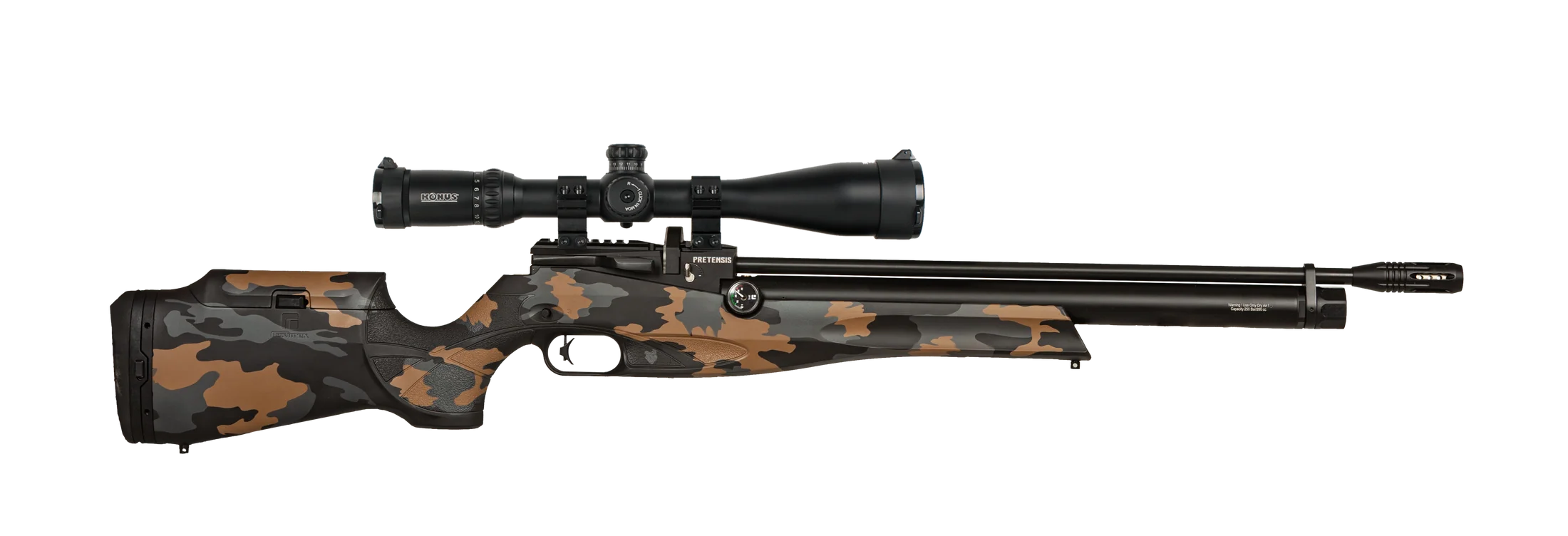
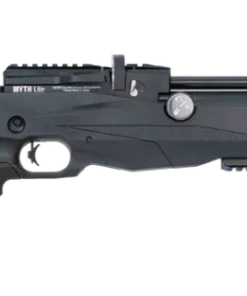
The REXIMEX PRETENSIS AMBUSH CERAKOTE is classified as a pre-charged pneumatic (PCP) air rifle featuring a full-length sporter configuration, a synthetic stock and a distinctive Cerakote finish. Its construction has been developed around a conventional rifle profile, while several adjustable components have been incorporated into the overall design.
Furthermore, a 260cc compressed-air reservoir is fitted beneath the barrel assembly. A manually operated sidelever mechanism is provided for cycling the action, while a detachable rotary magazine is used for pellet feeding.
The exterior design is distinguished by its Ambush Cerakote styling. In addition, a soft-touch synthetic stock is fitted with an adjustable cheekpiece and butt pad. These components allow the rifle’s fit to be adapted to different users.
Several calibres are associated with the Pretensis product range, including .177, .22 and .25. However, the precise specifications, power configuration and availability should be confirmed for the individual model and intended market.
Technical Construction and Main Features
1. Cerakote Finish and Exterior Materials
A Cerakote surface treatment is associated with this particular variant. The coating is intended to provide an additional protective layer on the treated components, although its actual performance depends on application, maintenance and exposure conditions.
Moreover, the Ambush colour scheme gives the model a distinctive exterior appearance. The finish should be distinguished from the underlying stock material, since Cerakote treatments and synthetic furniture serve different purposes.
A synthetic stock is incorporated into the rifle’s construction. Consequently, routine stock maintenance differs from the procedures normally associated with traditional wooden furniture.
2. Pre-Charged Pneumatic Air System
Compressed air is used as the energy source for the REXIMEX PRETENSIS AMBUSH CERAKOTE. Unlike a spring-powered mechanism, the PCP operating system depends on an external compressed-air filling source.
A 260cc air cylinder is specified for the model. Additionally, a pressure gauge is provided for observing the air supply within the rifle.
The filling pressure must be checked against the markings and operating instructions supplied with the actual rifle. Retailer specifications have reported different operating-pressure figures, so a single universal pressure limit should not be assumed.
Likewise, the number of shots available from a filled cylinder varies according to calibre, power configuration and operating conditions. Published shot-count figures should therefore be treated as configuration-dependent estimates rather than guaranteed results.
3. Sidelever Action and Magazine Configuration
A right-side cocking lever is identified in published descriptions of the Pretensis Cerakote series. Through this mechanically operated arrangement, the magazine-fed action is cycled between shots.
Furthermore, detachable rotary magazines are associated with the rifle. The magazine capacity differs according to calibre, with the following configurations commonly listed:
- .177 calibre (4.5mm): 14-round magazine
- .22 calibre (5.5mm): 12-round magazine
- .25 calibre (6.35mm): 10-round magazine
Magazine compatibility should always be checked against the individual rifle’s calibre and production specification.
Calibres, FAC Regulations, Power Output, Recommended Scopes and Accessories
Available Calibres and Their Technical Characteristics
The REXIMEX PRETENSIS AMBUSH CERAKOTE is available in several calibre configurations designed around its pre-charged pneumatic operating system. Each version is manufactured for a specific pellet diameter and magazine arrangement. Furthermore, variations in calibre can influence the rifle’s published specifications, including magazine capacity, power classification and estimated shot count.
.177 Calibre (4.5mm)
The .177 configuration is characterized by its 4.5mm bore diameter and 14-round rotary magazine. This version is commonly listed among the available UK-market configurations.
Moreover, the smaller pellet diameter distinguishes it from the other available versions. Its operating characteristics depend on the factory power setting, ammunition specifications and condition of the compressed-air system.
A matching magazine and manufacturer-approved ammunition must always be used. Additionally, actual muzzle velocity cannot be established from calibre alone.
.22 Calibre (5.5mm)
The .22 configuration incorporates a 5.5mm bore and a detachable 12-round rotary magazine. It is another commonly documented version of the Pretensis series.
Furthermore, published retailer information identifies approximately 210 shots per fill for certain configurations, although this figure should not be interpreted as a guaranteed result.
Operating characteristics depend on the factory settings and the applicable pressure range. Consequently, specifications should be checked against the documentation accompanying the individual rifle.
.25 Calibre (6.35mm)
The .25 version is associated with a 6.35mm bore diameter and a 10-round detachable magazine.
Although this configuration appears in retailer listings, availability may be more restricted in some markets. Additionally, its legal classification may differ from lower-powered versions.
For accurate identification, the barrel markings, serial-number information and manufacturer’s documentation should be examined before use.
FAC Regulations and Legal Power Classifications
Understanding FAC Requirements
In England and Wales, the term FAC (Firearms Certificate) is particularly important when discussing higher-powered air rifles.
Air rifles exceeding 12 foot-pounds of muzzle energy generally require a Firearms Certificate under the applicable legislation. However, the rules differ in Scotland and Northern Ireland, where additional licensing requirements apply.
Therefore, a rifle’s legal classification should never be determined solely by its product name or external appearance.
Sub-12 ft-lb Configurations
Several UK retailers advertise factory configurations with muzzle energy below the 12 ft-lb threshold.
A listed power range of approximately 10.8–11.8 ft-lb is associated with the Cerakote series. Furthermore, another retailer specifies approximately 11.3 ft-lb for the Ambush configuration.
These figures describe particular advertised versions and should not be treated as universal specifications.
FAC-Rated Versions
Where a higher-powered factory version is supplied, its certificate requirements must be confirmed before possession or use.
Importantly, an ordinary lower-powered configuration should not be assumed to be mechanically identical to an FAC-rated version.
Any changes affecting muzzle energy must comply with local legislation and manufacturer requirements. Unauthorized power modifications may create safety, warranty and legal problems.
Power Output and Compressed-Air System
Reservoir Capacity and Operating Pressure
A 260cc compressed-air cylinder is listed among the principal specifications.
Additionally, the Cerakote series has been advertised with a maximum filling pressure of 250 bar by one UK distributor. Other published figures refer to performance at 200 bar.
Because specifications may differ between production versions, the maximum permitted pressure must always be established from the individual cylinder markings and manufacturer’s instructions.
Published Shot Counts
Estimated shot counts for the Cerakote range include:
- .177: Approximately 180 shots per fill
- .22: Approximately 210 shots per fill
- .25: Approximately 140 shots per fill
These are retailer-published estimates for particular configurations. Actual results may differ according to the specific model, factory settings and operating conditions.
Recommended Scope Compatibility
Understanding the Optical Mounting Interface
The rifle is listed with a Picatinny scope rail, which provides a standardized interface for compatible optical equipment.
However, a telescopic sight is not necessarily included with the rifle. Before selecting an optic, owners should verify the mounting system, manufacturer’s specifications and any applicable local restrictions.
Scope Models Listed by Retailers
Published retail packages have included optional optics from the Hawke range, such as:
- Hawke 3-12×50 AO IR
- Hawke 4-16×50 AO IR
- Hawke Airmax FFP 4-16×50 SF
- Hawke Airmax Compact 4-16×44
- Hawke Vantage FFP 6-24×50 SF IR
These examples are documented retailer options rather than independently tested performance recommendations.
Furthermore, compatible mounting rings are ordinarily required. Their specifications should be checked against the scope tube diameter and rail interface.
Professional installation and inspection are advisable where compatibility is uncertain.
Compatible Accessories and Essential Maintenance Equipment
Compressed-Air Filling Accessories
As a PCP design, the rifle requires equipment capable of supplying clean, appropriately pressurized air.
Manufacturer-approved filling accessories may include a compatible filling probe, pressure-rated hoses and a suitable compressed-air source.
Additionally, an accurate pressure gauge is important for monitoring the filling system.
Any reservoir, connector or hose must be rated for the intended application. Damaged pressure equipment should never be used.
Maintenance and Storage Accessories
The following items are relevant to routine ownership and safe storage:
- Lockable protective case: For secure transportation and storage
- Manufacturer-approved cleaning kit: For routine barrel and exterior maintenance
- Compatible replacement seals: For authorized maintenance
- Pressure-rated filling equipment: For safe compressed-air supply
- Instruction manual: For operating limits and service procedures
- Protective eyewear: For use at authorized shooting facilities
- Lockable storage cabinet: For preventing unauthorized access
Factory-Supplied Components
Some documented packages include two rotary magazines, a single-shot tray, a filling probe, spare seals, basic tools and an accessory rail component.
Nevertheless, package contents may differ by distributor. Every accessory should therefore be checked against the supplied inventory before the product description is finalized.
Final Technical Considerations
The REXIMEX PRETENSIS AMBUSH CERAKOTE combines multiple calibre options with a compressed-air operating system, magazine-fed action and adjustable stock components.
Its published specifications provide a useful overview of factory configurations. However, actual power output, filling limits, optical compatibility and included accessories must be confirmed for the individual product.
Above all, responsible ownership requires correct maintenance, authorized servicing, secure storage and compliance with applicable legislation.
REXIMEX PRETENSIS AMBUSH CERAKOTE – Technical Specifications
4. Highlighted Product Specifications
- Manufacturer: Reximex
- Model: Pretensis Ambush Cerakote
- Product classification: PCP air rifle
- Power source: Compressed air
- Action mechanism: Manual sidelever
- Listed calibres: .177 / .22 / .25
- Air cylinder capacity: 260cc
- Stock material: Synthetic, soft-touch design
- Cheekpiece: Adjustable
- Butt pad: Adjustable
- Trigger: Adjustable two-stage mechanism
- Safety mechanism: Manual safety
- Magazine system: Detachable rotary magazine
- Listed overall length: Approximately 1,050mm
- Listed barrel length: Approximately 580mm
- Listed weight: Approximately 2.8kg
- Optics interface: Picatinny rail
- Muzzle thread: 1/2-inch UNF on listed versions
- Power output: Market-dependent; UK sub-12 ft-lb configurations are documented
These figures are based on published retailer specifications. Individual versions may differ, and the manufacturer’s documentation for the exact product should take precedence.
5. Adjustable Stock and Ergonomic Components
A soft-touch synthetic stock is supplied with the Pretensis Ambush Cerakote configuration. The stock is designed around a conventional full-length profile.
In addition, an adjustable cheekpiece has been incorporated to accommodate different cheek positions. The butt pad can also be adjusted according to the configuration supplied.
Pre-fitted sling swivel studs are listed among the stock’s external features. Meanwhile, the approximate 2.8kg weight places the rifle within a relatively manageable weight category for a full-length PCP design, before optional equipment is added.
Although the stock offers adjustment options, its suitability for an individual user depends on physical fit and personal handling preferences.
Mechanical Controls and Configuration
6. Two-Stage Trigger Assembly
A two-stage adjustable trigger is fitted to the Pretensis series. This arrangement provides two distinct stages of trigger movement.
The mechanism should be maintained according to the manufacturer’s instructions. Any adjustments should be performed only within the manufacturer’s stated limits and by appropriately qualified personnel where required.
Furthermore, changes to the trigger assembly should not be confused with adjustments to the rifle’s air-pressure or power system. These are separate mechanical functions.
7. Manual Safety Mechanism
A manually operated safety is included in the design. Published product descriptions locate the safety control toward the rear of the stock or action area.
However, the presence of a safety mechanism does not replace safe handling procedures. The rifle should always be treated as capable of discharging a pellet, regardless of the safety-control position.
Additionally, safe storage, transport and use must comply with the laws applicable in the owner’s location.
Air Reservoir, Maintenance and Accessories
8. Compressed-Air Reservoir Inspection
The 260cc reservoir forms an essential part of the PCP operating system. Consequently, its physical condition and pressure rating require attention during routine ownership.
The cylinder, pressure gauge, seals and filling connection should be inspected according to the manufacturer’s recommended maintenance schedule.
Moreover, only compatible filling equipment rated for the required pressure should be used. Damaged reservoirs, leaking components and unidentified fittings should be assessed by qualified service personnel.
The pressure vessel should never be modified or exposed to operating pressures beyond its approved rating.
9. Optical Mounting and External Interfaces
A Picatinny rail is listed among the model’s features. This rail provides a standardized mounting interface for compatible equipment.
Furthermore, a 1/2-inch UNF threaded muzzle is specified on published versions. Thread configuration and local regulations should be checked before considering any muzzle-mounted accessory.
A telescopic sight is not necessarily included in the standard package. Therefore, the contents of the specific retail configuration should be verified against its packing list.
Other components may include magazines, a filling probe, documentation and maintenance accessories, depending on the distributor and product bundle.
Product Identification and Ownership Information
10. Model Verification and Technical Documentation
The REXIMEX PRETENSIS AMBUSH CERAKOTE can be distinguished from other Pretensis variants by its Ambush finish and associated model designation.
Nevertheless, variations in power, calibre, equipment and regulatory classification may be found across different markets.
For accurate identification, the model markings, serial number, calibre and manufacturer’s documentation should be compared with the information supplied by the distributor.
Likewise, warranty coverage and service requirements should be checked through the relevant manufacturer or authorized service network.
Final Technical Summary
The REXIMEX PRETENSIS AMBUSH CERAKOTE combines a full-length PCP rifle configuration with a 260cc air reservoir, manually operated sidelever action, detachable magazine system and adjustable synthetic stock.
Its documented features also include an adjustable two-stage trigger, manual safety, Picatinny interface and Cerakote exterior treatment.
Overall, the model’s specifications should be interpreted according to its particular calibre and market configuration. Manufacturer-approved maintenance, correct pressure handling and compliance with applicable airgun regulations remain essential aspects of ownership.
JTS Airguns, Airacuda, Kral Arms, Reximex and PCP Air Rifle Guide
The modern PCP market covers a broad range of platforms, calibers, accessories, and shooting styles, with JTS airguns becoming increasingly visible among enthusiasts searching for performance-focused pneumatic rifles. Popular searches include JTS Airacuda, JTS Airacuda Max, Airacuda, JTS Aircuda, Airacuda Max, and JTS Aircuda Max, reflecting strong interest in this family of regulated PCP rifles. Shooters researching ammunition also commonly look for JTS pellets, while those comparing compact or alternative platforms may search for the JTS Airstryke, JTS Airstryke Carbine, and other JTS guns.
Caliber-specific searches are equally important. Terms such as JTS Airacuda 25 and JTS Airacuda Max 30 cal are frequently used by buyers comparing configurations and specifications. Other searches connected with the wider brand ecosystem include JTS firearms, JTS Group, JT guns blog, field supply airguns, Trenier Outdoors, TSC air, QTS 11, JPC 100, lindstradt air gun, tom air gun, and even broader or less directly related searches such as JROTC air rifle and jschlatt gun.
JTS Airacuda and Airstryke Searches
The JTS Airacuda platform attracts attention because many shooters compare it with other PCP rifles in similar price and performance categories. Search variations such as JTS Aircuda, JTS Aircuda Max, Airacuda, and Airacuda Max are commonly entered by users who may spell or abbreviate the product name differently. Meanwhile, the JTS Airstryke and JTS Airstryke Carbine expand the range of search intent toward compact PCP configurations.
Ammunition research often accompanies rifle research, which explains searches for JTS pellets alongside rifle model queries. Buyers may compare pellet weights, caliber compatibility, accuracy characteristics, and intended target use before selecting ammunition appropriate for their particular air rifle.
Hatsan PCP and Semi-Auto Searches
Another major group of related search terms concerns Hatsan products. These include Hatsan Sortie Tact semi-auto PCP, Hatsan Sortie, Hatsan Sortie Tact, Hatsan Jet, and Hatsan Jet 3. These searches often appear when enthusiasts compare compact PCP systems, semi-automatic platforms, and portable airgun designs.
Because buyers frequently research several brands during the same shopping session, JTS products may be compared with Hatsan, Kral Arms, Reximex, and other manufacturers before a final model is selected.
Kral Arms and Kral Puncher PCP Air Rifles
Kral Arms has a substantial presence in airgun searches, particularly among users researching PCP rifles. Search variations include KRQL, Kral NP 02, Kral Puncher, Kral Breaker Puncher, Kral Puncher K, Puncher Mega, Shadow Puncher, and Puncher Auto. These terms represent different model families as well as spelling variations entered by customers searching online.
Other Kral-related search phrases include Kral pump, Kral airguns, Krale airguns, Krale wholesale, KR9, KR9 rifle, KR-101, NP500, Bigmax, Raptor S, Dazzle S, EmpireX, TacticalX, Tactical Tundra, Rutundra, ST 500, and ST-500.
Search behavior does not always follow official product naming. As a result, visitors may also enter variants such as kr al, kiral, kroll firearms, kar gun, k gun, kora gun, aram gun, and akr gun while looking for rifles, parts, manufacturers, or related shooting equipment.
International searches can introduce additional terminology. Examples include الكرال, av tüfeği, and tabancalar, which may appear alongside English-language product and category searches.
PCP Air Rifles and Related Search Terms
Broad-category phrases remain important for users who have not yet selected a specific brand. These include PCP air rifles, PCP rifles, PCP air gun, air rifle PCP, rifle PCP, and rifles PCP 5.5. These phrases can lead shoppers toward a wider selection before they narrow their choice to a particular manufacturer or model.
Users comparing platforms may also search for terms such as muskrat gun, kalibre pistol, kahr firearms, and king arms FAL. Because several of these phrases refer to different product categories or manufacturers, specifications and legal classifications should always be checked individually rather than assuming that similarly worded searches describe the same type of equipment.
Reximex Airguns and PCP Models
Reximex airguns represent another important category within PCP search traffic. Common product searches include Reximex RP, Reximex Throne Gen 2, Reximex Mito, Reximex Mitos, Reximex RPA, and Reximex Lieva. These searches often come from shooters comparing configurations, ergonomics, caliber choices, air-cylinder capacity, and other factory specifications.
Reximex products may be compared directly with JTS, Kral, Hatsan, and other PCP manufacturers. Consequently, a shopper researching the JTS Airacuda Max may also investigate a Reximex Throne Gen 2, Kral Puncher, Kral NP 02, or another PCP rifle before deciding which configuration best suits their intended lawful sporting or target use.
Shotgun and Firearm-Related Search Variations
Some search phrases in this wider keyword group refer to firearm platforms rather than PCP airguns. Examples include 223 rifle, 223 guns, 223 arma, 410 shotgun semi auto magazine fed, inertia shotguns, K12 shotgun, KP12, A12 shotgun, XM shotgun, shotgun XM, Krieg shotgun, and SBS12.
Accessory-oriented searches include JTS X12PT shotgun accessories and JTS shotgun accessories. Users entering these terms may be looking for product compatibility information, replacement components, or manufacturer-specific accessories.
Other broader firearm-related search phrases include rifle cal 22 semiautomatico and Kahr firearms. Because legal definitions, licensing requirements, permitted calibers, magazine rules, and ownership regulations differ by jurisdiction, users should verify the rules applicable in their location before purchasing or possessing regulated equipment.
Additional Model and Brand Searches
The wider search ecosystem includes terms such as Ekinoks, King Arms FAL, Raptor S, EmpireX, Bigmax, and TacticalX. Although some searches overlap semantically, each unique term can represent a distinct user query and should therefore be handled with product-specific information where appropriate.
For customers specifically researching PCP equipment, the strongest relevance remains around JTS Airguns, JTS Airacuda, JTS Airacuda Max, JTS Airstryke, Kral Arms, Kral Puncher, Kral Breaker Puncher, Kral NP 02, Reximex Airguns, Reximex Throne Gen 2, Reximex Mito, and related PCP air rifles. Clear specifications, accurate model identification, compatible ammunition information, and transparent product descriptions help visitors distinguish among these different platforms without confusing unrelated product categories.
Frequently Asked Questions (FAQs)
General Information and Product Features
1. What type of air rifle is this?
This model is classified as a pre-charged pneumatic (PCP) air rifle. Compressed air is stored in a dedicated reservoir and used to propel pellets through the barrel. Unlike traditional spring-powered designs, a PCP system does not depend on a mainspring being compressed before each shot. Furthermore, its operation is supported by a manually cycled sidelever mechanism and a detachable magazine. The design combines conventional rifle proportions with several adjustable external components. As a result, prospective owners should understand both its mechanical features and the additional compressed-air equipment required for ownership.
2. What distinguishes this model from a conventional air rifle?
Several construction details distinguish this configuration from simpler air-powered designs. A factory-applied protective finish is associated with its exterior styling, while a synthetic stock is incorporated for durability and routine maintenance convenience. Additionally, an adjustable cheekpiece and butt pad are provided to accommodate different physical preferences. The compressed-air reservoir, magazine-fed action and two-stage trigger contribute to its overall mechanical configuration. However, differences in appearance and equipment should not be interpreted as guarantees of accuracy, durability or performance, since those characteristics depend on numerous operating conditions.
3. What is the purpose of the special exterior coating?
The exterior coating is intended to provide a protective surface treatment for selected components. In particular, ceramic-based firearm coatings are commonly associated with resistance to abrasion, corrosion and environmental exposure. Nevertheless, protective performance depends on the preparation process, coating application and actual service conditions. Scratches and wear may still occur over time. Therefore, regular cleaning and appropriate storage remain important. Additionally, the coating should not be confused with the composition of the underlying component, since a surface treatment does not necessarily change the base material’s structural properties.
4. Is the stock manufactured from wood or synthetic material?
A synthetic stock is associated with this configuration. Compared with traditional wooden furniture, synthetic materials generally require less attention to moisture-related swelling and changes in surface finish. Furthermore, the stock incorporates a soft-touch exterior intended to provide a textured contact surface. An adjustable cheekpiece and butt pad are also included in published specifications. However, synthetic materials are not immune to damage. Prolonged heat exposure, incompatible cleaning chemicals and mechanical impacts may affect their appearance or condition. Manufacturer-approved cleaning methods should therefore be followed.
5. Is the rifle suitable for left-handed users?
Suitability depends on the individual user’s handling preferences and the mechanical arrangement of the particular version. A right-side sidelever is described in commonly published specifications, which may influence how conveniently the action can be operated by left-handed users. Additionally, the stock geometry, safety-control location and cheekpiece shape should be considered. Although some external adjustments may accommodate different users, a fully ambidextrous mechanism should not be assumed. Before use, the exact configuration should be assessed for comfortable control access and safe handling.
Calibres, Power and Operating Characteristics
6. Which calibres are associated with this series?
Published configurations commonly include .177 (4.5mm), .22 (5.5mm) and .25 (6.35mm). However, not every calibre is necessarily distributed in every country. Local legislation, distributor arrangements and manufacturing variations may determine availability. Furthermore, ammunition dimensions and magazine capacities differ between configurations. The exact calibre should always be confirmed using the manufacturer’s markings on the individual rifle. Only ammunition matching that designation should be considered appropriate. Substituting an incompatible calibre can create serious mechanical and safety hazards.
7. Does every version produce the same power output?
No. Power ratings may differ according to the intended market and factory configuration. Some versions are supplied within specific legal energy limits, while other jurisdictions permit different classifications. Consequently, a power figure quoted for one model should not automatically be applied to another. Furthermore, muzzle energy and muzzle velocity are different measurements, even though they are mathematically related. For reliable identification, consult the specifications supplied for the exact serial-numbered product and the relevant regulatory requirements.
8. What is the capacity of the compressed-air reservoir?
A reservoir capacity of approximately 260cc is listed for the model. This figure represents the internal volume of the air-storage component rather than its pressure rating. Importantly, cylinder capacity should not be confused with the quantity of usable shots available from a filling cycle. Performance varies according to the factory configuration and operating conditions. Additionally, pressure vessels require appropriate inspection and handling. The cylinder’s rated working pressure and manufacturer’s instructions must always take priority over generalized online descriptions.
9. How many shots can be obtained from one air fill?
No universal shot count can be guaranteed across every configuration. The total depends on calibre, factory power setting, reservoir pressure, ambient conditions and other operating characteristics. Although published estimates may be useful for general comparisons, they should not be interpreted as exact performance promises. Furthermore, a reservoir’s pressure changes during use, and different designs manage that pressure differently. Therefore, the applicable manufacturer’s specifications should be consulted whenever a representative performance figure is required.
10. Is a compressed-air supply required?
Yes. A PCP system requires an appropriate source of clean, high-pressure compressed air. Depending on the manufacturer’s approved equipment, this may involve compatible filling hardware and a suitable compressed-air supply. However, not every filling connector or pressure source is interchangeable. Incorrectly rated equipment may introduce significant safety hazards. Consequently, all fittings, hoses, gauges and pressure vessels should be compatible with the manufacturer’s requirements. Filling equipment should be inspected periodically, and any damaged or unidentified component should be assessed by qualified personnel.
Magazine, Trigger and Mechanical Components
11. Does this model use a detachable magazine?
Yes. A detachable rotary magazine is incorporated into the feeding system. The number of pellets accommodated by the magazine depends on its designated calibre. Published configurations identify capacities of 14, 12 and 10 pellets for the respective sizes. Furthermore, certain retail packages include two magazines, although package contents may vary between distributors. Each magazine should be inspected for visible damage and maintained according to the manufacturer’s recommendations. Incompatible or damaged magazines should not be used, since feeding problems or mechanical interference may occur.
12. Is a single-shot loading accessory included?
A single-shot tray is listed among the accessories supplied with certain retail configurations. This component provides an alternative to the detachable rotary magazine. However, inclusion should not be assumed for every package, especially where equipment has been repackaged or supplied through different distribution channels. Additionally, the accessory must correspond to the correct model and calibre. The packaging checklist and manufacturer’s documentation should be consulted to establish which components were originally supplied.
13. What type of trigger mechanism is fitted?
An adjustable two-stage trigger is included in the published specifications. A two-stage design divides trigger movement into two recognizable phases. Furthermore, several external adjustment provisions are associated with the mechanism. Nevertheless, the precise range of permissible adjustment depends on the manufactured configuration. Trigger-related maintenance should follow the manufacturer’s instructions, and any suspected malfunction should be assessed by qualified personnel. Unauthorized modifications can compromise safe operation and may affect warranty coverage.
14. Does the rifle have a manual safety?
Yes. A manually operated safety mechanism is provided. Its purpose is to supplement safe handling by controlling part of the firing mechanism. However, no mechanical safety device should be regarded as infallible. Additionally, the muzzle must always be directed in a safe direction, and unauthorized handling should be prevented. The safety should never be used as a substitute for correct storage procedures, appropriate supervision or adherence to established range rules.
15. What is the purpose of the sidelever mechanism?
The sidelever forms part of the manually operated action. It is used to cycle the mechanical components associated with the rifle’s loading and cocking system. Unlike a traditional break-barrel airgun, the barrel assembly is not hinged downward during normal cycling. Furthermore, the lever is positioned on the right side in published descriptions. Any unusual resistance, sticking or mechanical damage should be investigated rather than overcome through excessive force. Qualified servicing may be required where normal mechanical operation is affected.
Dimensions, Accessories and Storage
16. What are the approximate dimensions and weight?
Published specifications identify an overall length of approximately 1,050mm, a barrel length of approximately 580mm and a weight of approximately 2.8kg. However, dimensional figures may differ between product revisions or distributor descriptions. Additional mounted equipment can also increase the total carrying weight. Consequently, the manufacturer’s specifications for the exact configuration should be regarded as authoritative. The physical dimensions are particularly relevant when evaluating suitable locked storage equipment and protective transportation cases.
17. Are optical sights included in the standard package?
Not necessarily. Several retail configurations are advertised without a telescopic sight or mounting rings. A Picatinny interface is provided for compatible equipment, but the existence of that interface does not mean additional accessories are included. Furthermore, promotional photographs may show optional equipment for illustration. The supplied inventory should therefore be checked carefully. Any optical device must be compatible with the mounting interface and installed in accordance with its manufacturer’s instructions.
18. What accessories may be supplied with the rifle?
Package contents vary according to retailer and distribution arrangements. Published listings mention two rotary magazines, a single-shot tray, filling accessories, spare seals, basic tools and an instruction manual. Some configurations also include a front accessory rail component. However, a protective case, compressed-air source and telescopic sight may be excluded. Accordingly, the official packing list should be used to identify included equipment. Missing parts should be reported to the supplier without attempting to substitute unidentified components.
19. Does the rifle require a special carrying case?
A purpose-designed, lockable protective case is recommended for secure storage and lawful transportation. The case should accommodate the rifle’s overall dimensions without placing excessive pressure on sensitive mechanical components. Furthermore, padded internal surfaces may help reduce damage caused by movement during transportation. Applicable laws may require additional security measures, including separate ammunition storage or restrictions on public transport. Therefore, legal requirements should be checked before moving the rifle between locations.
20. How should the rifle be stored when not in use?
Secure storage should prevent access by children, unauthorized individuals and anyone unfamiliar with airgun safety. A locked cabinet or appropriately secured storage system is generally recommended. Additionally, the rifle should be protected against excessive moisture, direct heat and corrosive environmental conditions. Its condition should be assessed before storage, following the manufacturer’s instructions. The manufacturer’s guidance should also be consulted regarding long-term reservoir pressure and maintenance intervals.
Maintenance, Reliability and Safety
21. Does the exterior finish require regular maintenance?
Yes. Although protective coatings are intended to reduce certain forms of surface deterioration, routine care remains necessary. Dust, fingerprints, moisture and environmental contaminants should be removed using manufacturer-approved materials. Furthermore, abrasive cleaners and aggressive solvents should be avoided unless specifically authorized. A soft cloth is generally preferable for routine exterior cleaning. Any visible peeling, cracking or unusual corrosion should be documented and assessed before further use.
22. What routine maintenance is recommended?
Maintenance requirements include periodic inspection of external surfaces, accessible fittings, seals and mechanical controls. In addition, the compressed-air reservoir and gauge should be monitored for visible deterioration or irregular behaviour. The manufacturer’s servicing schedule should determine when components require inspection or replacement. Internal repairs should not be attempted without suitable qualifications. High-pressure systems can retain hazardous stored energy, even when the rifle is not being actively used. Therefore, specialist assessment is recommended whenever pressure-related defects are suspected.
23. What should be done if an air leak is suspected?
A suspected leak should be treated as a potential safety issue. The rifle should be taken out of service and kept away from unauthorized users. Furthermore, damaged seals, pressure fittings or reservoir components should not be modified using improvised materials. Qualified servicing should be arranged according to the manufacturer’s instructions. Unusual pressure loss, audible leakage or physical damage may indicate a problem requiring professional attention. Continued use before assessment could create additional mechanical risks.
24. Can the compressed-air cylinder be replaced?
Reservoir replacement is a specialist maintenance operation. Compatibility must be established using the exact manufacturer-approved replacement component and applicable technical documentation. Although two reservoirs may appear similar, their pressure ratings, fittings and structural specifications can differ. Furthermore, incorrect installation may create serious hazards involving stored high-pressure air. Accordingly, reservoir replacement should be carried out by authorized or appropriately qualified service personnel rather than through improvised repairs.
25. What should be checked when examining a previously owned example?
A previously owned rifle should be assessed for its overall condition, authenticity, documentation and maintenance history. Visible corrosion, damaged stock components, missing accessories and unusual wear should be recorded. Additionally, the condition of the pressure vessel and any evidence of unauthorized modifications deserve particular attention. A qualified inspection is advisable before the rifle is put into service. The serial number and regulatory classification should also be verified to establish lawful ownership and transfer requirements.
Ownership, Regulations and Documentation
26. Is a licence required to own this air rifle?
Licensing requirements depend on the country, region and power classification of the individual rifle. In some jurisdictions, certain lower-powered airguns may be subject to fewer licensing requirements, while higher-powered configurations are regulated more strictly. Additionally, age restrictions, registration rules and transport conditions may apply independently of muzzle energy. Therefore, the relevant legislation should be reviewed before acquisition, possession or transportation. Product descriptions alone cannot establish whether a particular individual is legally permitted to own the rifle.
27. Are the same specifications supplied in every country?
No. Regional variations may exist because of legal power limits, distributor preferences, manufacturing changes and different product configurations. Consequently, specifications published for one country may not accurately represent a version supplied elsewhere. Furthermore, supplied accessories, warranty arrangements and documentation can differ. The individual model markings, manufacturer’s technical data and authorized distributor information should be used to confirm the exact configuration. This approach also helps distinguish genuine variations from incorrect or outdated retail descriptions.
28. Does ownership require special safety training?
The appropriate level of training depends on local requirements and the owner’s experience. Regardless of legal obligations, recognized safety instruction is strongly recommended. Such instruction typically covers safe handling, secure storage, awareness of surroundings and emergency procedures. Furthermore, familiarity with high-pressure air systems is important because compressed-air equipment introduces hazards that differ from those of simple spring-powered designs. Where available, accredited courses and supervised facilities provide structured opportunities for developing responsible handling practices.
29. How can the authenticity of the product be verified?
Authenticity should be assessed through manufacturer markings, serial-number information, packaging documentation and the credibility of the supplying business. Moreover, the finish, accessories and technical specifications should correspond with the documented model configuration. A serial-number verification request may be directed to the manufacturer or authorized distributor where such services are available. Missing identification marks, inconsistent documentation or unexplained alterations should be treated as reasons for further investigation rather than ignored.
30. What information should be retained for future servicing?
Owners should retain the instruction manual, proof of lawful acquisition, warranty documents, applicable compliance records and details of any authorized servicing. Furthermore, maintaining a record of inspections and component replacements can help establish the rifle’s maintenance history. The correct model designation, calibre and serial number should also be recorded securely. When professional repairs are required, accurate documentation can assist qualified technicians in identifying approved components and relevant service procedures.
Final Frequently Asked Questions Summary
Understanding the operating system, external components, maintenance requirements and regulatory classification is essential for responsible ownership. Although the model incorporates a modern synthetic stock, adjustable features and a compressed-air mechanism, its service requirements should not be overlooked.
Furthermore, technical figures should always be matched to the exact production variant. Correct documentation, secure storage, qualified servicing and compliance with local legislation remain important throughout the product’s service life.
Practical Use Scenarios: Real-World Applications, Handling, Maintenance, and Everyday Performance
1. Recreational Target Shooting at an Authorized Range
Controlled Shooting Environments and Practical Experience
One of the most common recreational applications for a pre-charged pneumatic air rifle is supervised target shooting at an authorized shooting facility. In such environments, clearly marked shooting positions, established safety procedures, and designated target areas are provided to support responsible participation.
Furthermore, a controlled range allows participants to become familiar with the equipment’s physical dimensions, mechanical controls, and general handling characteristics. Appropriate supervision is particularly important for individuals who are unfamiliar with compressed-air systems.
During organized recreational sessions, eye protection, safe muzzle direction, and adherence to range commands are essential. Additionally, equipment should be inspected before participation to ensure that no visible damage or mechanical irregularities are present.
A stable shooting environment also helps participants understand how different external factors, including lighting, weather, and physical comfort, can influence their overall experience.
Consequently, authorized facilities provide a structured setting for recreational participation while maintaining clearly defined safety standards.
2. Organized Shooting Club Activities
Participation in Recreational Shooting Communities
Shooting clubs offer an organized environment where equipment knowledge, safety awareness, and responsible ownership practices can be developed.
Unlike unsupervised recreational environments, established clubs commonly operate under written safety rules and provide designated facilities for authorized activities.
Moreover, club participation creates opportunities to learn about equipment classifications, maintenance requirements, and applicable regulations.
For example, a supervised club orientation may introduce participants to the distinctions between spring-powered and pre-charged pneumatic systems. Likewise, discussions may address the importance of properly rated compressed-air equipment and secure transportation.
Some clubs also provide access to qualified instructors and technical personnel who can answer questions about equipment condition and safe handling.
As a result, organized shooting communities can provide useful educational support without requiring inexperienced owners to undertake mechanical modifications independently.
3. Understanding Physical Comfort and Ergonomic Adjustability
Evaluating Stock Design and Handling Characteristics
An adjustable synthetic stock can be particularly relevant during equipment familiarization sessions.
Different individuals have different physical dimensions, including arm length, shoulder position, and facial structure. Consequently, a single fixed stock arrangement may not offer the same degree of comfort to every user.
An adjustable cheekpiece allows the stock’s contact position to be evaluated, while an adjustable butt pad provides another point of ergonomic flexibility.
Furthermore, the synthetic stock offers a practical alternative to traditional wooden furniture in environments where humidity and temperature may fluctuate.
During supervised equipment assessment, attention should be given to overall comfort, control accessibility, and the position of external components.
Importantly, ergonomic adjustments should be distinguished from unauthorized changes to the rifle’s internal operating mechanism.
Ultimately, a comfortable physical fit contributes to a more manageable ownership experience, particularly during extended periods of supervised recreational activity.

Reviews
There are no reviews yet.