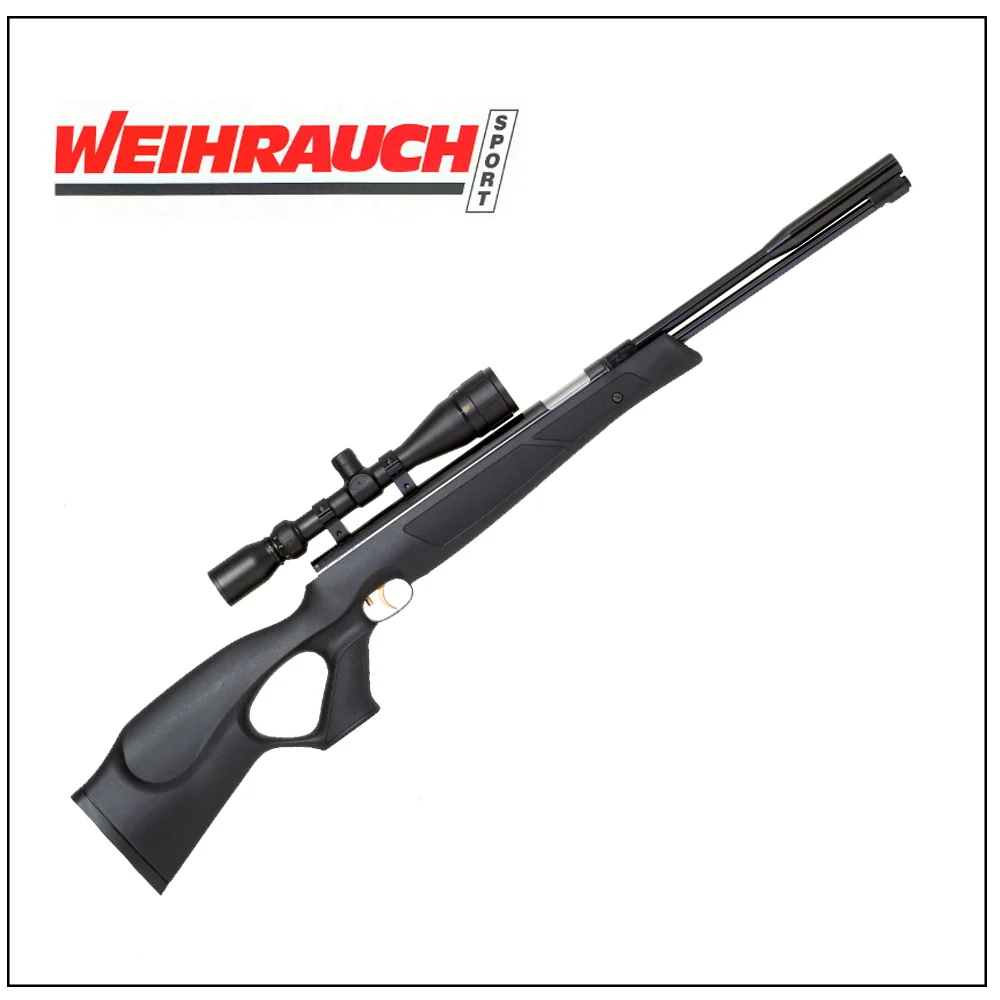
Weihrauch HW97KT Synthetic Blackline – Premium Fixed-Barrel Spring Air Rifle
The Weihrauch HW97KT Synthetic Blackline delivers the traditional feel of a high-quality spring-powered air rifle while adding a durable, modern synthetic thumbhole stock. Built around Weihrauch’s proven fixed-barrel underlever system, this rifle has been designed for shooters who value consistency, balance, mechanical refinement, and dependable accuracy.
Instead of relying on compressed-air cylinders, external pumps, or charging bottles, the rifle is powered by a self-contained spring-piston action. Therefore, a straightforward shooting experience is provided while the precision-focused characteristics associated with the HW97 platform are retained.
Furthermore, the distinctive black synthetic stock gives the rifle a purposeful appearance while also offering practical advantages for regular range use. Because the stock is resistant to many of the cosmetic concerns associated with traditional timber, the Weihrauch HW97KT Synthetic Blackline can be particularly appealing to shooters who want performance without constant attention to stock maintenance.
Weihrauch HW97KT Synthetic Blackline Built for Precision
Accuracy begins with consistency, and the fixed-barrel architecture plays an important role in the HW97 platform.
Unlike a conventional break-barrel design, the barrel remains permanently aligned with the action while the rifle is cocked through an underlever. Consequently, unnecessary barrel movement between shots is avoided. This configuration has helped make the HW97 family particularly popular for target shooting and other precision-focused disciplines.
A 300 mm barrel is used on the Black Line configuration, while the rifle measures approximately 1,015 mm overall. Meanwhile, its substantial approximately 4.2 kg weight without a scope contributes to the solid, planted handling expected from a precision-oriented spring rifle.
Once shouldered, the rifle feels deliberate rather than lightweight or disposable. Therefore, shooters who appreciate stability during unsupported or rested shooting are given a platform that feels reassuringly substantial.
Fixed-Barrel Underlever Design
The underlever cocking system is one of the defining characteristics of the Weihrauch HW97KT Synthetic Blackline.
The barrel itself remains fixed while the separate lever underneath the barrel is used to cock the spring-piston mechanism. As a result, the optical setup remains aligned with the fixed action and barrel assembly.
Moreover, the cocking motion has been engineered around the smooth operating characteristics traditionally associated with Weihrauch underlever rifles. A controlled loading sequence can therefore be established, allowing the shooter to concentrate on position, breathing, trigger control, and follow-through.
Synthetic Thumbhole Stock
A major visual and practical feature is provided by the black synthetic thumbhole stock.
Because the thumbhole layout supports a natural hand position, improved control can be achieved around the pistol grip. At the same time, the elevated comb supports scope-oriented shooting, which is particularly important because the HW97 platform has been developed primarily for use with optical sights.
The synthetic construction also offers a functional alternative to wood. While many shooters appreciate walnut, beech, or laminate furniture, synthetic material can be better suited to frequent handling and demanding everyday environments.
Practical Stock Benefits
Key advantages include:
- Black synthetic thumbhole stock for modern styling
- Comfortable pistol-grip positioning
- High comb designed around scoped shooting
- Durable surface suited to frequent handling
- Balanced configuration for target shooting
- Rubber-style butt support for secure shoulder placement
- Ambidextrous-friendly stock architecture
- Stable platform for supported and unsupported shooting
Consequently, the rifle combines traditional German spring-rifle engineering with a more contemporary exterior.
Famous Weihrauch Rekord Trigger System
Precision is not produced by the barrel alone. Trigger quality can dramatically influence shot placement, particularly when a spring-powered rifle is being used.
For that reason, the HW97 family is equipped with Weihrauch’s well-known Rekord match trigger system.
The trigger has earned an excellent reputation among experienced airgun shooters because a controlled, predictable release can be achieved. In addition, adjustment allows the trigger characteristics to be tailored more closely to individual preference.
Rather than forcing the shooter to fight against a heavy or inconsistent release, the mechanism is designed to encourage deliberate trigger control. Therefore, the potential for disturbance immediately before the shot is reduced.
Why Trigger Control Matters
When precision shooting is attempted, even a small unwanted movement can affect the point of impact.
Because of this, a refined trigger can become particularly valuable when:
- paper targets are being shot;
- field-target-style courses are being practiced;
- groups are being tested from a bench;
- shooting technique is being developed;
- consistent repeatability is required.
The Rekord system therefore complements the rifle’s fixed-barrel construction rather than simply serving as another specification on the product sheet.
Designed for Scope Use
The Weihrauch HW97KT Synthetic Blackline is fundamentally a scope-oriented air rifle.
Traditional open sights are not the central focus of the platform. Instead, the stock geometry, receiver arrangement, fixed-barrel configuration, and overall handling have been developed around optical aiming.
Therefore, a suitable spring-airgun-rated riflescope can be paired with the platform for target and sporting use.
Careful scope installation remains important because spring-piston rifles generate a different recoil impulse from PCP air rifles. Consequently, mounts and optics intended to tolerate spring-rifle recoil should be selected.
Once a compatible optic has been fitted and properly zeroed, the rifle becomes an exceptionally composed platform for deliberate precision shooting.
Multiple Calibre Choices
Another strength of the platform is its calibre flexibility.
Depending on regional availability and legal requirements, the HW 97 Black Line platform has been offered in:
- 4.5 mm / .177
- 5.0 mm / .20
- 5.5 mm / .22
- 6.3 mm / .25
This selection allows buyers to choose a configuration that better matches their preferred style of recreational or competitive shooting.
For example, .177 is widely associated with target shooting because of its relatively flat trajectory, while larger calibres may be selected by shooters who prefer heavier projectiles where legally appropriate.
Local power limits and ownership regulations should always be checked before ordering because available energy levels can differ significantly between countries.
Excellent Balance and Shooting Stability
The relatively substantial construction of the rifle should not automatically be viewed as a disadvantage.
In fact, additional mass can improve stability when precision is the primary objective. Movement can be reduced during the aiming process, while the rifle can feel more settled against the shoulder.
Furthermore, good balance helps prevent the platform from feeling excessively muzzle-heavy despite its fixed-barrel underlever architecture.
For shooters who enjoy deliberate shooting rather than an ultralight carrying rifle, the result is a composed and confidence-inspiring platform.
Self-Contained Spring-Piston Performance
One of the greatest practical advantages is simplicity.
No diving bottle needs to be purchased. Likewise, an external PCP compressor is not required, and air reservoirs do not need to be periodically filled.
Instead, the rifle is cocked manually before each shot.
This makes the Weihrauch HW97KT Synthetic Blackline especially attractive to shooters who prefer mechanical independence.
Once suitable pellets, a compatible scope, and appropriate mounts have been obtained, a complete shooting setup can be created without a separate compressed-air infrastructure.
Premium German Engineering
Weihrauch has developed a long-standing reputation in the airgun industry, and the HW97 platform reflects the company’s focus on precision manufacturing and traditional mechanical design.
Metal components are given a substantial, high-quality feel, while the blued action on the Black Line version provides the dark appearance that complements the synthetic stock.
Meanwhile, the action is designed around repeatable operation rather than unnecessary complexity.
Consequently, the rifle appeals not only to newer shooters seeking a premium spring rifle but also to experienced enthusiasts who appreciate finely engineered mechanical airguns.
Why Choose the Weihrauch HW97KT Synthetic Blackline?
Several characteristics distinguish this platform:
- Proven fixed-barrel underlever action
- Durable black synthetic thumbhole stock
- Renowned Weihrauch Rekord trigger
- Purpose-built configuration for scoped shooting
- Approximately 300 mm barrel
- Stable 4.2 kg platform
- Approximately 1,015 mm overall length
- Multiple calibre options
- No external air bottle or compressor required
- Excellent platform for precision target shooting
- Premium Weihrauch manufacturing quality
- Distinctive Blackline styling
Ultimately, the Weihrauch HW97KT Synthetic Blackline combines the simplicity of spring-piston power with the sophistication expected from a premium fixed-barrel rifle.
A Serious Air Rifle for Serious Precision
Whether the rifle is being selected for recreational target shooting, structured practice, field-target-style use, or simply the enjoyment of owning a refined mechanical airgun, the Weihrauch HW97KT Synthetic Blackline offers an exceptionally capable foundation.
Its fixed barrel promotes consistency. Meanwhile, the underlever system preserves the classic spring-rifle experience. The synthetic thumbhole stock provides modern durability, while the Rekord trigger gives the shooter the controlled release required for accurate shooting.
Most importantly, the rifle does not depend on charging equipment or complicated supporting hardware. Everything needed to generate the next shot is contained within the rifle itself.
For shooters who value craftsmanship, mechanical simplicity, stability, scope-focused ergonomics, and proven Weihrauch engineering, the Weihrauch HW97KT Synthetic Blackline remains a compelling premium choice.
Brocock BRK and Benjamin Air Rifles: Complete Guide to PCP Technology, Precision, Calibres and Accessories
Discover the Engineering Behind Brocock Airguns and Benjamin Air Rifles
Modern airgun technology has transformed recreational target shooting, competitive marksmanship, and precision air-powered sporting equipment. Today, manufacturers combine advanced pneumatic systems, ergonomic construction, and innovative engineering to produce dependable shooting platforms. Among the established names in this industry, brocock ltd and Benjamin continue to attract attention from enthusiasts seeking technical sophistication and reliable performance.
The evolution of brocock airguns reflects a strong emphasis on compact designs, efficient compressed-air systems, and consistent shot delivery. Similarly, the Benjamin product range offers numerous configurations, from traditional pellet rifles to specialized pneumatic platforms.
Whether researching a compressed air rifle, comparing a conventional pellet gun, or exploring advanced sporting equipment, understanding the available technologies helps buyers make informed decisions.
Brocock BRK Air Rifles: Innovation and Precision Engineering
Brocock Sniper XR and BRK Sniper XR
The brocock sniper xr represents an important development in regulated pneumatic rifle engineering. Featuring a semi-bullpup configuration, adjustable ergonomics, and a sidelever operating system, this model emphasizes handling convenience and mechanical consistency.
Additionally, the brk sniper xr incorporates a regulated air-delivery system designed to reduce variations between successive shots. Its adjustable stock components provide flexibility for different shooting positions.
For enthusiasts researching the .25 caliber brocock sniper xr, calibre selection deserves particular attention. The larger pellet diameter offers different projectile characteristics compared with smaller calibres, while energy output and shot capacity depend on the specific configuration.
The sniper xr also offers an example of how modern engineering combines compact dimensions with adjustable controls.
Brocock Commander XR and BRK Commander
Another noteworthy platform is the brocock commander xr, which combines a tactical-inspired stock configuration with pneumatic engineering.
The brocock commander has attracted interest from enthusiasts who appreciate adjustable furniture, modular features, and consistent operation.
Similarly, buyers researching brk ghost and Commander models often compare ergonomics, overall dimensions, available calibres, and compatible accessories.
Searches for brocock commander xr price should be evaluated using current retailer listings because pricing varies according to country, configuration, condition, and included equipment.
BRK Ghost Air Rifle: Modern Design and Customization
The brk ghost air rifle represents a distinctive approach to modern PCP rifle design. Its bullpup layout places major operating components within a compact overall configuration while retaining a full-length barrel arrangement appropriate to the model.
Furthermore, the BRK Ghost offers adjustable ergonomic components and a mechanical design intended to support controlled operation.
Owners researching ghost accessories should pay attention to manufacturer compatibility, factory specifications, and approved replacement components.
A replacement ghost handle, for example, should be checked against the exact model and production variant before purchase.
Likewise, a magpul sl k buttpad is a product-specific accessory reference rather than a guarantee of compatibility with every rifle stock.
Pathfinder XR and Compact BRK Models
The pathfinder xr offers another example of the manufacturer’s emphasis on compact pneumatic platforms.
Buyers researching the brk pathfinder, brk pathfinder xr, or general pathfinder air rifle specifications should compare verified product dimensions, stock arrangements, and applicable power ratings.
The brk concept xr is another model worth examining when comparing compact sporting rifles.
While these designs share elements of the manufacturer’s engineering philosophy, each has its own configuration and intended handling characteristics.
For anyone comparing several platforms, factors such as overall weight, trigger characteristics, stock adjustment, and service support are more useful than appearance alone.
What Are PCP Air Rifles and How Do They Work?
New enthusiasts frequently ask, what are pcp air rifles?
The abbreviation PCP means precharged pneumatic, referring to an air-powered system that stores compressed air in a pressurized cylinder or reservoir.
Consequently, understanding pcp rifle meaning helps explain the operating principles behind modern pneumatic sporting rifles.
Other common searches include what does pcp mean in air rifles, what is pcp air rifle, what is a pcp air rifle, and what is a pre charged pneumatic air rifle.
All describe the same general operating technology.
Likewise, what is a pcp air gun and pcp air rifle meaning refer to compressed-air propulsion rather than spring-powered or carbon-dioxide systems.
A pcp rifle stores energy before firing, whereas a break barrel pellet gun typically compresses a spring or gas ram through a cocking action.
This distinction also explains why a pneumatic gun, gun pneumatic, and pneumatic weapons may refer to several different mechanisms, depending on the context.
Modern pcp air rifles often feature pressure regulators, adjustable triggers, and specialized magazines. Nevertheless, operating pressure, energy output, and maintenance requirements vary substantially between models.
Essential Accessories and Equipment Compatibility
Properly selected accessories contribute to equipment suitability and long-term maintenance.
For example, the 0db moderator and 0 db moderator are search variations referring to a sound-moderating accessory. Actual sound reduction depends on the individual device, rifle configuration, and applicable legal requirements.
Meanwhile, a pcp o ring kit may contain replacement seals for specified components. Seal dimensions, materials, and pressure ratings must match the manufacturer’s requirements.
Optics are another consideration. A buyer researching how to connect scope equipment should first confirm the mounting-rail standard and the compatibility of the selected mounting system.
The mtc copperhead 4 16×44 is one example of an optical sight that may appear in airgun accessory searches.
Separately, what does prc stand for in guns is a terminology question commonly encountered during broader firearm research. PRC often refers to Precision Rifle Cartridge, which is distinct from PCP pneumatic technology.
Some searches also include bro air, a broad term that may appear alongside BRK and Brocock product research without identifying a specific manufacturer model.
Benjamin Air Rifles: Traditional Performance and Modern Pneumatic Technology
Benjamin Marauder and Popular PCP Models
The benjamin air rifle range encompasses numerous designs developed for different shooting preferences. From conventional air pellet gun platforms to specialized pneumatic systems, the manufacturer offers equipment for recreational and sporting applications.
Among its recognized products, the benjamin marauder has established a strong presence in PCP airgun discussions.
The benjamin marauder pcp and benjamin marauder pcp air rifle are associated with regulated or unregulated configurations, depending on model and generation. Similarly, the benjamin marauder air rifle is frequently considered by enthusiasts researching accurate pneumatic equipment.
Buyers comparing the benjamin marauder .25, benjamin marauder 22, and benjamin marauder regulated variants should verify the exact specifications rather than assume identical performance.
The benjamin marauder pistol provides another distinct option for enthusiasts interested in compact air-powered platforms.
Additionally, searches for benjamin pellet, benjamin pellet gun, and benjamin air pistol reflect the manufacturer’s broader presence in the sporting airgun market.
For owners of older equipment, benjamin air rifle repair should involve model identification, manufacturer-approved parts, and qualified servicing of pressurized components.
Benjamin Bulldog and Big-Bore Airguns
The benjamin bulldog is associated with the development of larger-calibre PCP platforms.
In particular, the benjamin bulldog 457 belongs to the big-bore category, while the bulldog 357 represents another calibre designation within the family.
Those researching benjamin bulldog 457 20 joules should distinguish search terminology from verified factory specifications, since this phrase does not establish an official 20-joule configuration.
More broadly, big bore air guns differ from conventional small-calibre pellet rifles in projectile dimensions, pressure-system requirements, and applicable regulations.
A hunting air rifle or hunting pellet gun must also be evaluated according to local laws, permitted activities, and the manufacturer’s intended application.
Benjamin Trail, Prowler and Break-Barrel Models
Traditional spring and gas-piston airguns remain popular alongside pneumatic equipment.
The benjamin prowler and benjamin trail np are examples associated with conventional sporting air-rifle designs.
Likewise, the benjamin np trail xl and benjamin air rifle 22 break barrel appear frequently in searches involving gas-piston technology.
The phrase benjamin break may also describe general interest in the manufacturer’s break-barrel products.
Enthusiasts comparing a benjamin 22 caliber pellet rifle with PCP alternatives should consider the differences in cocking mechanism, maintenance, recoil behavior, and operating requirements.
Benjamin Airbow Technology and Arrow-Launching Systems
The benjamin airbow belongs to a specialized category that uses compressed air to propel compatible arrows rather than conventional pellets.
Also called an air bow, airbow, arrow gun, air bow rifle, or air bow gun, this equipment differs substantially from standard pellet platforms.
The benjamin pioneer airbow helped establish the manufacturer’s presence in this category.
More recent searches for benjamin airbow m600, benjamin m600 airbow, and the general benjamin bow category reflect interest in advanced arrow-launching technology.
An airbow rifle may also be compared with an air powered crossbow, although their propulsion mechanisms and equipment requirements are different.
The M600 is a distinct PCP-powered arrow launcher with manufacturer-specific arrows and components.
Understanding Pellet Gun Calibres and Power Ratings
Airgun buyers frequently compare .177 pellet guns, 177 pellet guns, a 22 pellet gun, and a .25 pcp air rifle.
Each calibre has its own projectile characteristics, compatible ammunition, and model-specific performance limits.
Similarly, searches for a high powered pellet gun, high power pellet gun, or pellet rifle 1500 fps should be assessed carefully. Advertised velocity alone does not establish accuracy, suitability, or energy output.
A bolt action pellet gun describes a particular loading or cycling arrangement rather than a specific power system.
Other familiar categories include the bb gun rifle, air gun rifle, airrifle, and the broader grouping of air rifle and air pistol equipment.
In comparison, co2 pellet guns use carbon dioxide cartridges, while PCP platforms rely on stored high-pressure air.
The search term m357 may refer to different products and requires model confirmation before any technical comparison.
Choosing the Right Airgun and Understanding Online Availability
Buyers asking can i buy air rifles online should first investigate local restrictions, age requirements, licensing obligations, and shipping regulations.
Rules vary significantly by jurisdiction, especially for higher-powered equipment and specialized arrow-launching platforms.
Whether comparing benjamin air rifles or modern BRK sporting platforms, reliable model specifications, lawful ownership, and qualified maintenance remain essential considerations.
The Brocock product family includes established Sniper XR, Commander XR, Pathfinder XR, Concept XR, and Ghost designs, while the manufacturer’s newer range includes updated XR2 variants.
Ultimately, selecting appropriate air-powered sporting equipment involves balancing ergonomics, engineering quality, compatible accessories, and long-term support. Understanding the distinctions between compressed-air systems, gas-piston mechanisms, and specialized arrow platforms makes product comparisons clearer and more informative.
A well-informed buying decision begins with accurate technical information, clearly identified models, and responsible equipment ownership.
Frequently Asked Questions
What type of air rifle is this?
This is a fixed-barrel, underlever, spring-piston air rifle designed primarily for precision shooting. Instead of breaking the barrel to cock the action, a separate lever located underneath the barrel is used. Because the barrel remains fixed, a stable relationship between the barrel, receiver, and mounted optic is maintained. This arrangement is especially popular among shooters who value consistency, traditional mechanical operation, and dependable shot placement.
Does this rifle require a compressor or air bottle?
No. A compressor, hand pump, scuba cylinder, or charging bottle is not required. The internal spring-piston system is manually cocked before each shot. Therefore, the rifle remains completely self-contained during normal use. This can make ownership simpler because additional charging equipment does not have to be transported, stored, or maintained.
Is this rifle suitable for beginners?
It can be used by beginners, although its substantial weight and traditional spring-powered firing cycle may require some practice. New shooters should spend time learning safe handling, correct cocking technique, trigger control, and consistent shooting posture.
Because spring-powered rifles react differently from PCP systems, proper technique becomes particularly important. However, shooters who learn the platform carefully can develop strong fundamentals that transfer well to other precision air rifles.
What makes the fixed-barrel design important?
A fixed barrel remains in the same position throughout the cocking and firing process. Because the barrel does not pivot between shots, mechanical consistency can be improved.
This is one reason underlever designs have traditionally been associated with accurate spring-powered air rifles. A stable barrel arrangement also works particularly well with a mounted riflescope because the optical system remains attached to the receiver while the barrel stays permanently aligned.
What calibres are normally available?
Different calibre options may be available depending on the market, importer, and regional regulations. Common configurations include .177, .20, .22, and .25.
The best calibre depends on how the rifle will be used. For example, .177 is often preferred for target shooting because of its flatter trajectory. Meanwhile, larger calibres generally use heavier pellets and may be preferred for other lawful sporting applications.
Buyers should always confirm the exact calibre and legal power level before purchasing.
Is .177 a good choice for target shooting?
Yes. The .177 calibre is widely used for recreational and competitive target shooting. Pellets are generally lighter, and their trajectory can be relatively flat compared with heavier projectiles.
As a result, estimating holdover at typical air-rifle distances can become easier. Pellet choice, power output, shooting conditions, and individual barrel preference will still influence performance.
Is .22 suitable for this platform?
Yes. The .22 calibre is commonly chosen by shooters who prefer a heavier pellet and a different ballistic profile.
Because a heavier projectile is used, the trajectory may become more curved than with .177 at equivalent power levels. Nevertheless, excellent accuracy can still be obtained when a suitable pellet is matched to the rifle and the shooter understands the trajectory.
Does it come with open sights?
This platform has been designed predominantly around scope use. Traditional open sights are not the primary aiming system associated with the configuration.
Therefore, most owners will install a suitable riflescope. The stock comb, receiver arrangement, and overall shooting geometry are particularly well suited to optical aiming.
What type of scope should be used?
A scope that is suitable for spring-piston air rifles should be selected. Spring-powered air rifles can generate a distinctive forward-and-rearward recoil impulse, which may place different stresses on an optic compared with many PCP systems.
A quality airgun-rated scope with secure mounts is therefore recommended. Magnification should be selected according to shooting distance and intended use rather than simply choosing the highest power available.
What magnification is recommended?
For general recreational target shooting, moderate magnification is often sufficient. A scope in the approximate 3-12x, 4-16x, or similar range can provide a useful balance between field of view and target detail.
Higher magnification may be preferred for benchrest-style shooting or small targets at longer distances. However, excessive magnification can make movement appear exaggerated and may narrow the field of view unnecessarily.
Does this rifle have noticeable recoil?
Yes. As a spring-piston air rifle, it produces a mechanical recoil cycle when fired. The sensation is different from the relatively mild firing behaviour of many PCP rifles.
The internal piston moves rapidly during the shot cycle, producing movement in more than one direction. Consequently, shooting technique, grip pressure, follow-through, and scope selection become important.
How accurate can it be?
Very good accuracy can be achieved when the rifle is properly set up and matched with suitable pellets. Actual grouping performance will depend on several factors, including ammunition quality, shooting distance, power level, wind, scope setup, shooting technique, and individual rifle characteristics.
Consistent hold and follow-through are especially important with spring-powered rifles because movement during the firing cycle can influence point of impact.
What shooting technique works best?
A consistent, relatively relaxed hold is usually recommended. Excessive grip pressure can affect how the rifle moves during the firing cycle.
Many experienced spring-rifle shooters allow the rifle to recoil naturally while maintaining a repeatable shoulder position and trigger technique. The exact method can vary between shooters, so practice is essential.
Is the trigger adjustable?
The rifle is equipped with a refined match-style trigger system that offers adjustment. This allows the trigger characteristics to be tailored within the manufacturer’s recommended range.
A predictable trigger release can help reduce unwanted movement at the moment of firing. However, adjustments should always be made carefully and according to the manufacturer’s instructions.
Why is trigger quality important?
Trigger quality has a direct influence on shooting consistency. A trigger that releases predictably allows the shooter to concentrate on sight alignment and follow-through.
If excessive force is required to release the shot, the rifle may be disturbed just before firing. A refined trigger mechanism therefore becomes especially useful for precision-oriented shooting.
Is the synthetic stock durable?
Yes. Synthetic stocks are generally resistant to many of the cosmetic issues associated with traditional wood. They are well suited to frequent handling and changing environmental conditions.
While normal care is still recommended, the material does not require the same level of attention to moisture or surface finish as a wooden stock.
What advantage does the thumbhole stock provide?
A thumbhole stock allows the shooting hand to adopt a more vertical and controlled position. Many shooters find this arrangement comfortable when using a scope.
The design can also improve contact between the hand and stock while providing a stable platform for controlled trigger operation.
Is the stock suitable for left-handed shooters?
The design can be comfortable for many left-handed shooters because the stock layout is relatively accommodating. However, personal ergonomics vary considerably.
A buyer who primarily shoots left-handed should examine the stock shape, cheek position, trigger reach, and thumbhole dimensions before purchasing whenever possible.
Is the rifle heavy?
It is relatively substantial compared with lightweight hunting or recreational air rifles. That weight is intentional and contributes to the stable feel of the platform.
For target shooting, additional mass can help reduce unwanted movement and provide a steadier aiming position. However, shooters who intend to carry the rifle for long periods should consider the overall weight once a scope and mounts are installed.
Does the weight help accuracy?
It can. A heavier rifle tends to move less easily during aiming, especially when supported from a rest or stable shooting position.
However, weight alone does not guarantee accuracy. Trigger control, pellet selection, sight setup, shooting technique, and mechanical consistency remain equally important.
Can it be used for field target shooting?
Yes, the fixed-barrel underlever design, adjustable trigger, scope-oriented configuration, and solid construction make it well suited to field-target-style shooting where local rules permit.
Power limits, calibre restrictions, and competition requirements should always be checked before participating in organised events.
How should pellets be selected?
Pellet testing is recommended because individual barrels can show preferences for particular pellet designs and weights.
Start with several reputable match or domed pellets in the correct calibre. Groups should then be tested at a consistent distance under controlled conditions.
The pellet producing the smallest, most repeatable groups should normally be preferred over one chosen purely because of brand reputation or advertised velocity.
Are heavier pellets always more accurate?
No. Pellet weight alone does not determine accuracy.
A heavier pellet may perform exceptionally well in one rifle but poorly in another. Barrel dimensions, power level, pellet head size, shape, and shooting distance all influence results.
Accuracy testing should therefore be based on group consistency rather than pellet weight alone.
Does pellet quality matter?
Yes. Consistent pellet dimensions and weight can contribute to tighter grouping.
Damaged skirts, irregular shapes, or significant weight variations can affect flight characteristics. For serious target shooting, many shooters use high-quality pellets produced with tight manufacturing tolerances.
How often should the barrel be cleaned?
Air-rifle barrels generally do not require aggressive or frequent cleaning. Cleaning should normally be performed when accuracy noticeably changes, contamination is suspected, or the manufacturer recommends it.
Excessive cleaning can be unnecessary and may risk damaging the bore if unsuitable tools are used. Only appropriate airgun-safe cleaning equipment should be selected.
Is much maintenance required?
Routine maintenance is relatively straightforward. Exterior metal surfaces should be kept clean and protected from moisture, while screws and scope mounts should periodically be checked for security.
Internal servicing should normally be completed by a competent technician when required. Owners should avoid unnecessary disassembly of the spring mechanism because considerable stored energy may be present.
Should the rifle be stored cocked?
No. A spring-powered rifle should generally be stored uncocked and unloaded.
Leaving the spring compressed for extended periods is unnecessary and may place additional stress on components. The rifle should be returned to a safe, unloaded condition after shooting.
Can the rifle be dry-fired?
Dry-firing should be avoided unless the manufacturer specifically states otherwise. Spring-piston air rifles are designed to operate with a pellet providing resistance during the firing cycle.
Firing without a pellet may place unnecessary stress on internal components.
What accessories are useful?
Useful accessories may include a spring-rated riflescope, quality mounts, protective rifle case, suitable pellets, target holder, cleaning equipment, and a shooting rest.
A stable pellet trap is also recommended for target practice. Accessories should be selected according to local laws and the shooter’s intended use.
Is a bipod recommended?
A bipod can sometimes be used, but spring-powered rifles often respond differently when rigidly supported.
Because the firing cycle creates movement through the stock, some rifles produce better groups when rested on a soft bag or held consistently rather than being clamped firmly.
Testing different support methods is often the best way to determine what produces the most consistent results.
Can the power be adjusted?
Power configurations differ according to market and local legislation. Some versions may be supplied within specific legal limits, while others may be offered in higher-output configurations where permitted.
Any adjustment or servicing affecting power should comply with local law and manufacturer guidance.
Does temperature affect performance?
Temperature can influence lubricants, seals, pellet behaviour, and shooter comfort, although spring-powered rifles are generally less dependent on air-pressure changes than PCP systems.
Extreme conditions can still affect consistency, so allowing the rifle and ammunition to acclimatise before precision shooting can be beneficial.
How long can this rifle last?
A well-maintained, high-quality spring rifle can provide many years of service. Springs, seals, and other wear components may eventually require replacement, but the basic action is designed for long-term use.
Regular inspection, proper storage, sensible lubrication, and professional servicing when needed can significantly extend service life.
Who is this rifle best suited for?
It is particularly suitable for shooters who appreciate mechanical air rifles, precision shooting, substantial build quality, scope-based aiming, and the independence of a self-contained power system.
It can also appeal to experienced enthusiasts who enjoy refining their technique and learning how to obtain maximum consistency from a spring-powered platform.
What are the biggest advantages of choosing this type of rifle?
The main advantages include a fixed barrel, self-contained power source, durable stock, refined trigger, stable weight, scope-oriented ergonomics, and proven spring-piston technology.
No external charging system is required, making the platform straightforward to operate once appropriate pellets and optics have been selected.
Is it a good choice for long-term ownership?
Yes. Shooters who want a durable mechanical platform that can be maintained and serviced over many years may find this type of rifle especially attractive.
Its appeal is based less on electronic features or complex charging systems and more on traditional engineering, repeatable operation, and the satisfaction of developing precision through consistent shooting technique.




Reviews
There are no reviews yet.