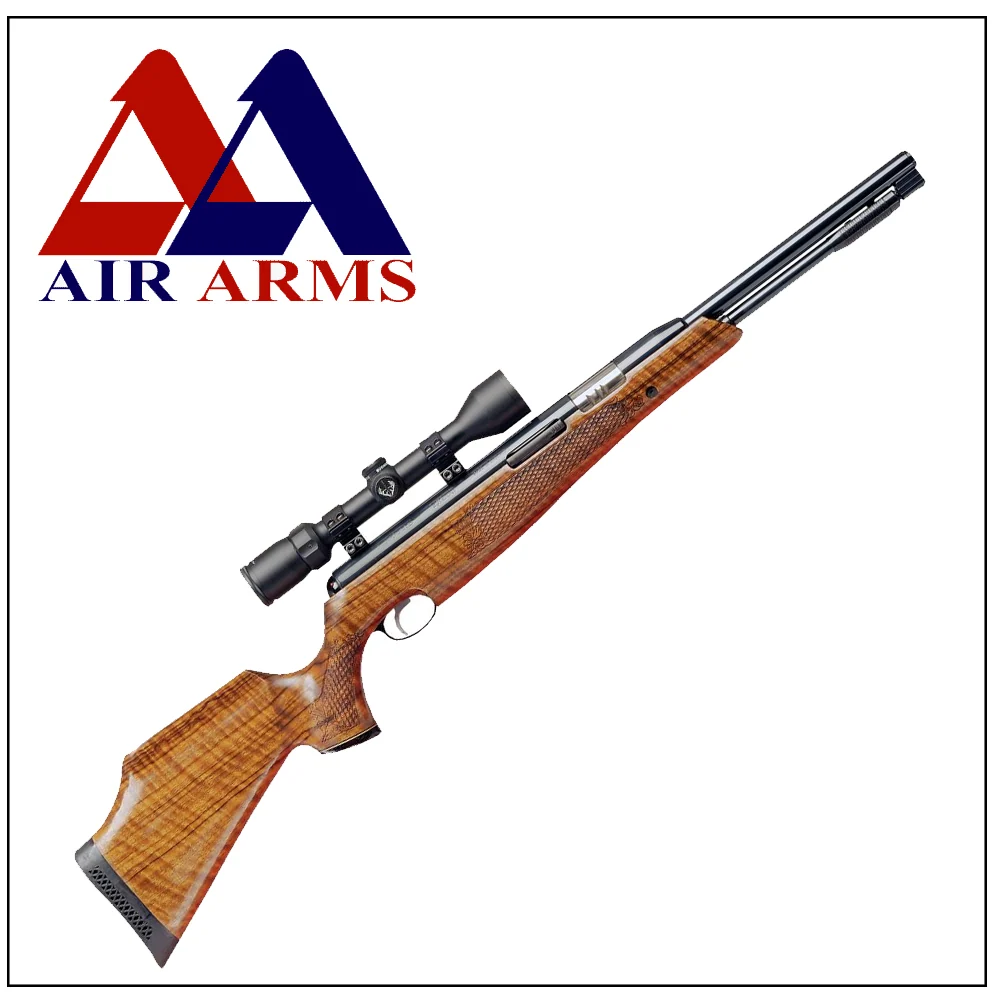
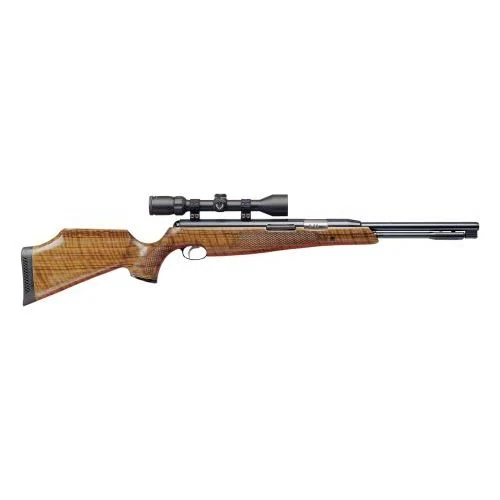
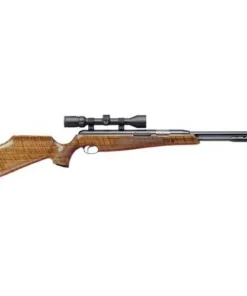
Air Arms TX200 Hunter Carbine Walnut – Calibres, FAC Power, Recommended Scopes and Essential Accessories
Available Calibres for the Air Arms TX200 Hunter Carbine Walnut
The Air Arms TX200 Hunter Carbine Walnut is available in two established air rifle calibres: .177 (4.5 mm) and .22 (5.5 mm). Both configurations are designed around the manufacturer’s precision-engineered, fixed-barrel spring-piston platform.
Although the same fundamental mechanical design is shared, each calibre offers different ballistic characteristics, pellet weight options, and sporting applications.
.177 Calibre (4.5 mm) – Precision and Target Shooting
The .177 version is particularly well regarded among enthusiasts interested in recreational target shooting and organised air rifle competitions.
Generally, lighter pellets are used in this calibre. As a result, a comparatively flatter trajectory is often achieved when muzzle energy and other relevant conditions are comparable.
Furthermore, the smaller pellet diameter is compatible with numerous established target shooting disciplines.
Key .177 calibre characteristics:
-
-
Pellet type: Lead or other manufacturer-approved airgun pellets
-
Trajectory: Generally flatter than comparable .22 configurations
-
Common applications: Paper targets, field target competitions and recreational range activities
-
Power options: Sub-12 ft-lb, with higher-power versions available in selected markets
.22 Calibre (5.5 mm) – Traditional Sporting Versatility
Alternatively, the .22 configuration provides a larger pellet diameter and access to heavier projectile weights.
Because pellet mass differs, its trajectory and retained energy characteristics are not identical to those of the .177 version.
Moreover, the .22 calibre remains popular among traditional British sporting air rifle enthusiasts.
However, neither calibre guarantees superior accuracy in every situation. Pellet quality, shooting conditions and the individual rifle’s characteristics can all influence results.
Key .22 calibre characteristics:
-
-
Pellet selection: Wide variety of compatible sporting pellets
-
Pellet weight: Generally heavier than equivalent .177 ammunition
-
Common applications: Recreational target practice and lawful sporting activities
-
Power availability: Standard and selected FAC-rated configurations
FAC Versions, Muzzle Energy and Power Performance
Standard Sub-12 ft-lb Power Configuration
The standard British-market Air Arms TX200 Hunter Carbine Walnut is commonly supplied with muzzle energy below 12 foot-pounds.
This configuration is particularly established within traditional spring-powered target shooting.
Its self-contained mechanical power system eliminates the need for external compressed-air charging equipment.
Additionally, the fixed-barrel assembly and manufacturer-developed internal components contribute to the rifle’s established reputation for consistency.
In England and Wales, adult possession of a qualifying sub-12 ft-lb air rifle generally does not require a firearm certificate, although other legal restrictions apply. Scotland has a separate air weapon licensing system.
FAC-Rated Higher-Power Configurations
FAC refers to a Firearm Certificate within the British licensing framework. Air rifles exceeding the applicable legal power threshold require the appropriate authorisation.
Higher-power versions of the Hunter Carbine have also been offered through specialist dealers.
| Configuration |
Reported muzzle energy |
| .177 standard |
Below 12 ft-lb |
| .22 standard |
Below 12 ft-lb |
| .177 FAC |
Approximately 14 ft-lb |
| .22 FAC |
Approximately 17 ft-lb |
These FAC figures are published by a UK specialist retailer and should not be interpreted as guaranteed specifications for every production version.
Before purchasing, the exact model, regional certification requirements and manufacturer-approved power rating should always be confirmed.
Similarly, actual muzzle energy should be assessed using appropriate testing equipment rather than relying exclusively on advertised figures.
Recommended Scopes for the Air Arms TX200 Hunter Carbine Walnut
Hawke Vantage AO – Practical Everyday Optical Performance
The Hawke Vantage 3-9×40 AO provides an accessible optical option for recreational target shooting.
Its adjustable objective system is useful for achieving clear focus at typical air rifle target distances.
Furthermore, the variable magnification range offers flexibility across different supervised sporting environments.
A version explicitly approved for spring-piston recoil should be selected.
Hawke Airmax – Premium Sporting Optics
For enthusiasts seeking more advanced optical features, the Hawke Airmax 4-12×40 AO is another suitable option to consider.
Its airgun-focused design, adjustable objective and variable magnification range make it an appealing match for precision-oriented sporting use.
Additionally, the manufacturer’s recoil compatibility guidance supports the consideration of Hawke optics for spring-powered air rifles.
Scope Mount Compatibility
The rifle incorporates a dovetail mounting system rather than an integral Picatinny rail.
Consequently, compatible 9–11 mm dovetail mounts should be selected according to the optic’s tube diameter and objective size.
Quality mounts from Sportsmatch or Hawke may be considered. Final compatibility should be confirmed by a qualified retailer or technician.
Recommended Accessories and Essential Equipment
Protective Equipment and Maintenance Accessories
The following accessories can complement the Air Arms TX200 Hunter Carbine Walnut, supporting responsible ownership, equipment protection and routine maintenance.
-
Padded rifle case: Protects the walnut stock and external metal surfaces during authorised transportation.
-
Lockable gun cabinet: Provides secure storage and helps prevent unauthorised access.
-
Airgun cleaning kit: Supports manufacturer-approved barrel maintenance.
-
Silicone-treated cleaning cloth: Helps remove fingerprints and moisture from suitable exterior surfaces.
-
Walnut stock care products: Preserve the appearance of the natural wooden furniture when compatible with the stock finish.
-
Protective shooting glasses: Provide essential eye protection during supervised shooting activities.
-
Pellet-rated target backstop: Helps contain projectiles during lawful recreational target practice.
-
Chronograph: Allows muzzle velocity and energy measurements to be checked for legal compliance.
-
Range bag: Provides organised storage for approved equipment and shooting accessories.
Compatible Pellets and Additional Considerations
Manufacturer-approved, correctly sized pellets should always be selected for the rifle’s stated calibre.
Damaged, unsuitable or incorrectly sized ammunition should never be used.
Moreover, the owner’s handbook should be consulted before purchasing maintenance equipment or replacement components.
Because this model operates through a traditional spring-piston mechanism, PCP-specific accessories such as charging cylinders, compressors and filling probes are unnecessary.
Why Quality Accessories Matter
Carefully selected accessories contribute to the long-term ownership experience.
For example, suitable storage products help protect the natural walnut finish, while approved cleaning materials support routine exterior maintenance.
Similarly, compatible optical equipment provides a practical option for recreational target observation.
Nevertheless, expensive accessories are not automatically necessary. Compatibility, reliability, safety and intended sporting use should be prioritised over unnecessary additions.
Above all, the Air Arms TX200 Hunter Carbine Walnut offers a compelling combination of .177 and .22 calibre availability, established spring-piston engineering, selected FAC power options and traditional British craftsmanship.
When complemented by responsible maintenance, appropriate protective equipment and compatible accessories, this premium sporting air rifle can provide an enduring ownership experience for enthusiasts who appreciate mechanical quality and timeless walnut styling.
FX Airguns, PCP Air Rifles, Hatsan Models and Modern Airgun Platforms
Modern airguns cover a wide range of platforms, from a basic pellet gun or BB gun to sophisticated regulated PCP airguns designed for target shooting, sporting applications, and long-range precision. Buyers researching an air rifle and air pistol collection will often encounter manufacturers such as FX and Hatsan because both companies offer extensive selections of air rifles, accessories, configurations, and caliber choices.
FX Airguns Sweden and the FX PCP Rifle Range
FX Airguns has become strongly associated with Swedish airgun engineering. Searches for fx airguns sweden, fx airguns sverige, fxairguns, and fx usa commonly lead enthusiasts toward the manufacturer’s extensive PCP lineup. In the American market, fx airguns usa is another widely searched phrase when people are researching available models, specifications, support, and accessories.
Among fx air rifles, the Impact family remains particularly recognizable. Searches frequently include fx impact, f x impact, fx impact m4, fx m4, impact m4 air rifle, and impact m4 500mm when comparing current configurations. The modular design philosophy associated with the Impact platform has helped make the fx air rifle range popular among shooters who appreciate adjustability and configurable PCP systems.
Earlier generations remain widely researched as well. The fx impact m3, impact m3, fx impact mk3, fx m3, and fx m3 airgun continue to attract attention from owners comparing generations or researching replacement components.
Caliber-specific searches include fx impact m3 .22cal air rifle, fx impact m3 .22cal air rifle. 600mm barrel, and the more general fx impact m3 air rifle. People comparing international pricing may also search fx impact m3 precio, fx impact m3 precio en usa, or fx impact m3 price before checking local regulations, specifications, and availability.
Beyond the Impact series, the FX catalog includes several distinctive designs. The fx leopard and fx leopard airgun are frequently researched alongside fx leopard .22 pcp specs by users interested in specifications and configuration details.
Other notable searches include fx drs, fx drs tactical, fx drs classic, and fx drs pro. These terms reflect interest in the different DRS configurations and their intended shooting styles.
The wider FX family also includes models such as the fx king, fx wildcat, fx panthera, and fx dreamline. Collectively, these platforms demonstrate the variety available to anyone researching a premium pcp air rifle, pellet rifle, or configurable precision air gun.
Some enthusiasts also search fx outdoors when researching outdoor shooting equipment and related products, while marketplaces and information sources such as guns.com may appear during broader online research.
Understanding Pellet Guns and PCP Air Rifles
A traditional pellet gun uses shaped pellets rather than conventional firearm ammunition. The broader term pellet guns can describe spring-powered, CO₂-powered, pneumatic, and PCP platforms.
A PCP air rifle stores compressed air inside a reservoir. This system can provide consistent pressure across multiple shots depending on the rifle’s regulator, reservoir capacity, caliber, and power configuration.
For shooters comparing ammunition sizes, .177 caliber remains one of the most common options. Larger configurations are also available, including the increasingly searched 30 cal air rifle category.
Some users accidentally search pallet gun when looking for pellet-powered equipment. Regardless of terminology, specifications such as energy output, caliber, barrel length, intended range, and local legal requirements should always be reviewed before use.
The practical range of air rifle platforms varies significantly. Pellet weight, velocity, environmental conditions, barrel design, optics, and shooter technique can all affect useful range and accuracy.
Hatsan Air Rifle and PCP Platforms
The hatsan air rifle lineup covers traditional spring-powered designs as well as modern PCP systems. Searches such as hatsanusa, hatsan usa, hatsan air guns, and hatsan pcp are commonly used by enthusiasts researching the company’s models.
One of the most recognizable platforms is the hatsan blitz. Search variations include hatsun blitz, hatzan blitz, hatsan blitz full automatic, hatsan blitz 30 cal, and hatsan blitz .30 cal. Specifications and legal classifications can vary by market, so owners should verify the rules applicable in their jurisdiction.
Another frequently researched model is the hatsan model 95, also searched as hatsan mod 95 and mod 95. This traditional air rifle platform remains familiar to shooters interested in conventional stock designs.
The hatsan 125 is another established model, while the hatsan 135 family attracts shooters researching powerful spring-piston platforms. Related searches include hatsan 135 vortex air rifle, hatsan 135 carnivore, and hatsan big bore carnivore rifle.
Hatsan Sortie, BullBoss and Bullpup Designs
Compact and semi-automatic PCP designs form another part of Hatsan’s catalog. The hatsan sortie is commonly researched alongside hatsan sortie tact, hatsan sortie tact semi-auto pcp, and hatsan sortie accessories.
Bullpup enthusiasts may encounter the hatsan bullboss, bullmaster, and hatsan hercules bully. Their compact layouts are designed to reduce overall length while maintaining useful barrel dimensions.
Other PCP models include the hatsan flash, hatsan flashpup qe, and hatsan invader. These rifles provide additional choices for people comparing conventional and bullpup PCP configurations.
Hatsan Hercules, Piledriver and Large-Caliber Platforms
For people researching larger airgun platforms, hatsan hercules and hatsan piledriver often appear in search results. Large-bore air rifles differ considerably from standard .177 and .22 pellet rifles in projectile size, power output, air consumption, and intended application.
The hatsan harpoon is associated with specialized projectile launching, while an arrow launcher represents another distinct air-powered category. Such equipment can be subject to different legal rules depending on location, so local regulations should be checked before ownership or use.
Additional Hatsan Models
The Hatsan catalog extends well beyond its best-known rifles. The hatsan airtact and hatsan airtact air rifle provide another entry point into the brand’s conventional rifle selection.
Other searches include hatsan zada, hatsan neutron star, hatsan factor rc, hatsan velox, and hatsan jet 2. Each platform serves a somewhat different role, making specifications such as caliber, reservoir capacity, operating system, barrel configuration, and overall dimensions important comparison points.
Shoppers researching discounted equipment may also encounter hatsan refurbished listings or broader searches for refurbished air rifles. Condition, warranty coverage, seals, regulators, reservoirs, and service history should be checked carefully when evaluating previously used or factory-refurbished equipment.
Airgun Optics, Pellets and Accessories
Accessories can significantly affect how an air rifle is configured. A compact 4×20 optic may suit basic shooting applications, while more advanced PCP rifles are frequently paired with adjustable optics.
Pellet choice also matters. Products such as h&n field target trophy bleifrei provide an option for shooters specifically researching lead-free projectile designs. Pellet diameter, weight, head size, and barrel compatibility should all be considered when evaluating accuracy.
Terms such as econ ii may also appear when researching airgun-related equipment and accessories. Compatibility should always be verified against the exact manufacturer, model, and specification rather than relying solely on a product name.
Comparing FX and Hatsan Air Guns
FX and Hatsan approach the modern air rifle market from different directions. FX is particularly well known for highly configurable PCP platforms such as the Impact, Panthera, Wildcat, Dreamline, Leopard, DRS, and King. Hatsan, meanwhile, maintains an exceptionally broad range spanning spring-powered rifles, PCP systems, bullpups, semi-automatic platforms, and larger-caliber airguns.
Whether researching an FX Impact M3, FX Impact M4, FX DRS, Hatsan Blitz, Hatsan Sortie, Hatsan Hercules, or another platform, specifications should be compared carefully. Caliber, operating pressure, reservoir capacity, barrel length, projectile compatibility, optics mounting, overall dimensions, energy output, and regional legal requirements can all influence which configuration is appropriate for a particular lawful sporting or target-shooting application.
Frequently Asked Questions (FAQs)
1. What makes this spring-powered air rifle different from other traditional models?
A distinctive combination of British engineering, premium materials, and advanced mechanical construction is offered by this sporting rifle. Unlike conventional break-barrel alternatives, a fixed-barrel system is incorporated to preserve the relationship between the barrel and the action.
Furthermore, an underlever cocking mechanism is provided, allowing the spring-piston system to operate independently of external compressed-air equipment.
Its precision-rifled barrel, adjustable two-stage trigger, and carefully manufactured internal components contribute to its established reputation among enthusiasts.
Additionally, the genuine walnut stock provides a traditional appearance that distinguishes it from synthetic-stocked alternatives.
Overall, the design combines mechanical simplicity with refined construction, making it particularly appealing to individuals who appreciate traditional airgun engineering.
2. Is this model suitable for beginners and experienced shooters?
Yes, the rifle can be appreciated by both developing enthusiasts and experienced recreational target shooters. However, its substantial weight, spring-piston operating characteristics, and underlever mechanism should be considered before selection.
For beginners, supervised instruction is recommended so that safe handling procedures and basic mechanical operation can be understood.
Meanwhile, experienced enthusiasts may appreciate the refined trigger design, fixed-barrel construction, and traditional sporting characteristics.
Because spring-powered rifles behave differently from PCP systems, a period of familiarisation may be beneficial.
Ultimately, suitability depends on individual experience, physical comfort, local regulations, and the availability of appropriate training.
3. Is a compressed-air cylinder required for operation?
No external compressed-air cylinder is required because a self-contained spring-piston operating system is incorporated.
Unlike pre-charged pneumatic rifles, compressed air does not need to be stored in a separate reservoir before use.
Instead, mechanical energy is stored through the spring assembly during the cocking process.
Consequently, equipment such as high-pressure compressors, filling probes, charging adapters, and scuba cylinders is unnecessary.
This arrangement is particularly appreciated by enthusiasts seeking a traditional mechanical experience without additional charging infrastructure.
Nevertheless, the spring-powered mechanism should always be operated according to the official manufacturer’s instructions.
4. What is the difference between .177 and .22 calibre versions?
The principal difference concerns projectile diameter, typical pellet weight, and associated ballistic characteristics.
The .177 calibre measures approximately 4.5 mm, while the .22 calibre measures approximately 5.5 mm.
Generally, lighter pellets are associated with the smaller calibre. Therefore, a comparatively flatter trajectory may be achieved under equivalent conditions.
Conversely, heavier pellets are commonly available for the larger calibre, producing different momentum and trajectory characteristics.
Both calibres are widely represented within established airgun sporting disciplines.
However, actual performance depends on the particular ammunition, muzzle energy, environmental conditions, and equipment configuration.
Neither calibre should automatically be considered universally superior.
5. How accurate is the fixed-barrel design?
The fixed-barrel arrangement is widely appreciated for its contribution to mechanical consistency.
Because the barrel remains secured within the action, repeated barrel movement associated with conventional break-barrel systems is avoided.
Furthermore, a precision-rifled barrel is incorporated to support stable projectile flight.
The adjustable trigger mechanism and carefully engineered internal components also contribute to the rifle’s precision-focused design.
However, accuracy cannot be guaranteed through construction quality alone.
Individual technique, ammunition manufacturing tolerances, maintenance condition, and environmental influences must also be considered.
When the equipment is properly maintained and operated under suitable conditions, its precision-oriented construction can be fully appreciated.
6. Does the rifle include an adjustable trigger?
Yes, a two-stage adjustable trigger mechanism is included as part of the standard design.
The system is intended to provide a refined and predictable trigger feel during recreational and competitive target activities.
Unlike basic single-stage mechanisms, two distinct stages are incorporated into the trigger’s operating characteristics.
Nevertheless, adjustment should be undertaken only according to the official manufacturer’s guidance.
Improper modifications can compromise safe operation and may invalidate warranty protection.
Where uncertainty exists, inspection and adjustment by an appropriately qualified airgun technician are recommended.
The original factory configuration should be preserved unless an authorised adjustment is necessary.
7. Is the walnut stock made from genuine natural wood?
Yes, genuine walnut is used for the traditional sporting stock.
Consequently, natural variations in wood grain, colour, and figuring should be expected between individual examples.
These variations are normal characteristics of natural timber rather than manufacturing defects.
Furthermore, decorative chequering and carefully shaped contours contribute to both appearance and comfortable handling.
The finished wood also complements the external metalwork, creating a traditional sporting presentation.
However, natural walnut requires appropriate care.
Prolonged exposure to excessive moisture, unsuitable cleaning chemicals, and extreme storage conditions should be avoided.
With proper maintenance, the stock’s visual characteristics can be preserved over many years.
8. Is the shorter configuration more comfortable than a full-length rifle?
The reduced overall length can provide a different balance and handling experience compared with a longer configuration.
However, a shorter rifle is not automatically lighter or more comfortable for every individual.
The substantial steel action and traditional wooden stock remain important contributors to overall weight.
Furthermore, factors such as arm length, shoulder position, stock geometry, and personal preference influence comfort.
The shorter configuration may appeal to individuals who prefer a more compact sporting platform.
Nevertheless, prospective owners should assess physical suitability through lawful, supervised handling whenever possible.
Comfort should be evaluated independently of appearance or advertised dimensions.
9. Does the rifle require frequent professional servicing?
Routine professional servicing is not necessarily required after every shooting session.
Nevertheless, regular external inspection, appropriate storage, and manufacturer-approved maintenance are important.
Mechanical components should be examined periodically for unusual wear, damage, or changes in operating characteristics.
Furthermore, internal servicing should be performed only by qualified personnel familiar with spring-piston systems.
High-tension springs and other internal components can present significant hazards when improperly handled.
For this reason, unauthorised dismantling should be avoided.
Following the manufacturer’s recommended maintenance schedule can help preserve reliable operation and reduce the likelihood of preventable mechanical problems.
10. Can this model be used for organised target competitions?
Yes, the rifle’s precision-focused construction makes it relevant to several traditional airgun target shooting disciplines.
However, eligibility depends on the rules established by the relevant competition organiser.
Different sporting organisations may specify particular calibre, energy, equipment, or sighting requirements.
Consequently, the applicable competition rules should be checked before participation.
Its fixed-barrel design, two-stage trigger, and traditional spring-powered mechanism are characteristics appreciated in recreational and organised sporting environments.
Nevertheless, competition results cannot be guaranteed by equipment selection alone.
Training, consistency, and familiarity with the relevant sporting discipline remain important contributors to individual performance.
11. What type of ammunition is compatible?
Only correctly sized ammunition approved for the specific calibre and equipment configuration should be used.
For example, pellets intended for a 4.5 mm barrel must not be confused with those manufactured for a 5.5 mm barrel.
Furthermore, ammunition should be inspected for obvious damage before use.
Deformed or unsuitable projectiles can cause mechanical problems or inconsistent performance.
Pellet materials and manufacturing tolerances may also vary between brands.
Therefore, compatibility information supplied by the manufacturer should be prioritised over assumptions based solely on calibre markings.
If uncertainty exists, advice should be obtained from a qualified airgun specialist.
12. How loud is the spring-piston operating system?
The operating sound consists of several mechanical and acoustic elements.
During firing, movement within the spring-piston assembly produces an audible mechanical report.
Additionally, compressed air leaving the barrel contributes to the overall sound.
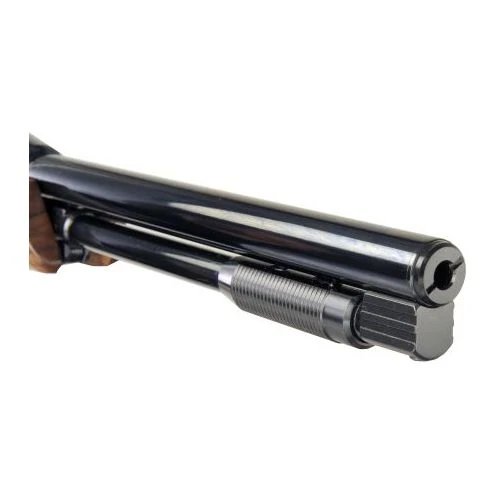
An integrated moderated barrel arrangement is provided on the Hunter Carbine configuration, helping manage muzzle report.
However, mechanical sound from the action is not completely eliminated.
Perceived loudness may vary according to the environment, ammunition, and individual equipment condition.
Hearing protection should be considered according to the shooting environment and applicable range guidance.
Local regulations governing sound-reducing equipment must also be respected.
13. Is an optical sight included as standard?
An optical sight should not be assumed to be included unless it is expressly identified within the retailer’s product listing.
Many sporting rifles are supplied without a scope, allowing buyers to select compatible optical equipment separately.
Similarly, scope mounts may be sold independently.
Because package configurations can vary between retailers and markets, the complete contents should be verified before purchase.
Furthermore, any optical equipment should be confirmed as suitable for the recoil characteristics of a spring-piston system.
Incorrectly specified equipment may suffer damage or performance problems.
Professional fitting is recommended where compatibility or installation requirements remain uncertain.
14. What is the difference between standard and FAC-rated versions?
The distinction primarily concerns the rifle’s certified muzzle energy and the legal framework governing possession.
In England and Wales, air rifles exceeding 12 foot-pounds of muzzle energy generally require a Firearm Certificate.
Standard versions are commonly produced below this threshold.
However, higher-energy configurations may be offered in certain markets.
The availability of such versions depends on manufacturing specifications, national legislation, and authorised distribution arrangements.
Importantly, firearm licensing requirements differ between jurisdictions.
Scotland, for example, operates a separate licensing framework for air weapons.
Therefore, prospective owners should verify local requirements before purchasing, possessing, transporting, or using any configuration.
15. Can the rifle be stored for extended periods without being used?
Yes, extended storage is possible when the equipment is maintained and secured appropriately.
Before storage, the rifle should be confirmed as unloaded and uncocked according to the manufacturer’s instructions.
Furthermore, external metal surfaces should be protected against corrosion using suitable cleaning products.
The walnut stock should also be kept away from excessive humidity and extreme temperatures.
A secure cabinet or other legally compliant storage arrangement is recommended.
Additionally, unauthorised access must be prevented.
Periodic visual inspections can help identify moisture exposure or deterioration.
Following these precautions supports the preservation of both the mechanical components and decorative finish.
16. How does this spring-powered platform compare with PCP alternatives?
Both spring-piston and pre-charged pneumatic designs offer distinct characteristics.
The principal advantage of a spring-powered system is its independence from external charging equipment.
In contrast, PCP rifles rely on compressed air stored within an onboard reservoir.
Furthermore, the mechanical firing cycle of a spring-piston rifle differs substantially from the comparatively low-recoil behaviour of many PCP designs.
The maintenance requirements and associated ownership equipment can also differ.
While PCP systems may offer certain conveniences, traditional spring-powered rifles are appreciated for their self-contained operation.
Ultimately, individual preference, intended sporting activities, maintenance expectations, and legal considerations determine which design is more appropriate.
17. Does the wooden stock require special maintenance products?
Natural walnut should be maintained using cleaning and conditioning products compatible with its existing factory finish.
Harsh solvents, abrasive materials, and excessive quantities of moisture should be avoided.
Instead, a soft cloth may be used to remove ordinary dust and fingerprints.
Furthermore, specialist wood-care products should be applied only when recommended for the relevant finish.
The manufacturer’s instructions should always take precedence over general maintenance advice.
Proper care helps preserve the natural grain appearance and reduces avoidable deterioration.
However, scratches, dents, and other physical damage cannot always be prevented through surface treatments alone.
Careful handling and suitable protective storage remain important.
18. What safety mechanisms are incorporated?
The rifle incorporates an automatic safety mechanism and an anti-beartrap arrangement.
These systems are intended to support safer operation when the equipment is used according to the manufacturer’s guidance.
However, mechanical safety devices should never be regarded as substitutes for responsible handling.
Every rifle must be treated as loaded until its condition has been properly verified.
Furthermore, the muzzle must always be directed toward a safe area.
Appropriate eye protection, authorised shooting locations, and suitable pellet-rated backstops are also essential.
Any suspected malfunction should be evaluated by a qualified professional rather than ignored.
19. Is this model considered a long-term sporting investment?
The rifle’s British manufacturing heritage, traditional walnut construction, and established mechanical design can contribute to its long-term ownership appeal.
Furthermore, precision-focused components and recognised engineering characteristics distinguish it from basic entry-level alternatives.
However, future resale value cannot be guaranteed.
Condition, servicing history, market demand, originality, and regional legislation can influence second-hand valuations.
Proper maintenance may help preserve the rifle’s appearance and functional condition over time.
Additionally, retaining the original documentation and purchase records may be beneficial.
Rather than being regarded primarily as a financial investment, the rifle is best appreciated as a durable piece of sporting equipment.
20. Why is this model highly regarded among traditional airgun enthusiasts?
Its reputation is closely associated with a combination of established engineering principles, quality materials, and distinctive British sporting design.
A precision-rifled barrel, fixed-barrel action, adjustable trigger, and refined spring-piston assembly are incorporated within a carefully manufactured platform.
Meanwhile, genuine walnut furniture adds natural character and traditional visual appeal.
The shorter sporting configuration provides an alternative to the conventional full-length design without abandoning the underlying mechanical architecture.
Furthermore, the absence of external charging requirements preserves the independence associated with traditional spring-powered airguns.
For enthusiasts who value mechanical craftsmanship, dependable construction, and established sporting heritage, these characteristics contribute to its continuing recognition within the premium air rifle market.



Reviews
There are no reviews yet.