We Deliver Airguns Directly To Your Door
SKU N/A Category

Air Arms MPR Biathlon

€1,070.00

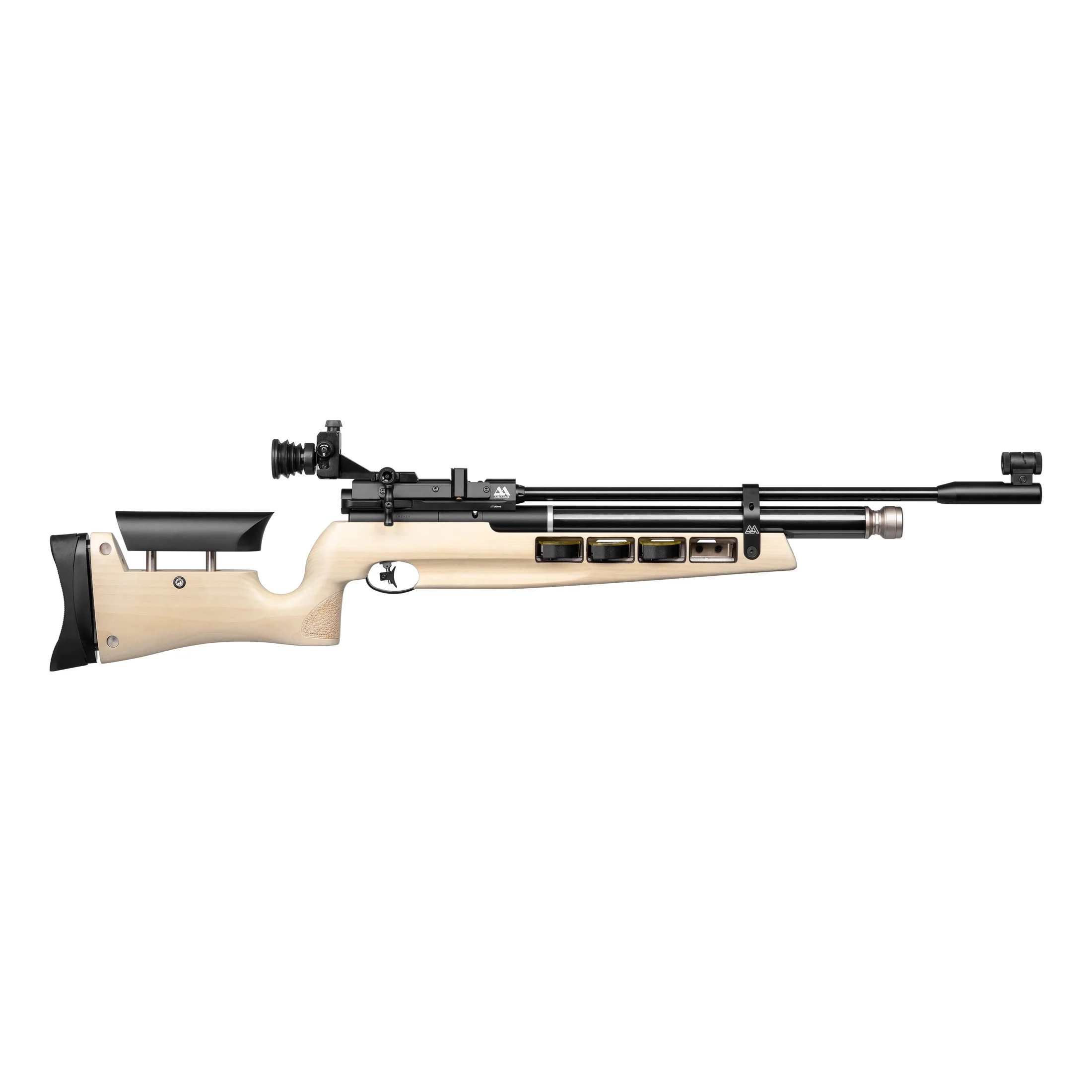
Built around the solid MPR foundation of a recoilless, fast-fire, autoload, sidelever action in an adjustable, match-style stock, the Biathlon is designed to translate every well-aimed shot into a perfect hit. With its requirement for speed and precision, biathlon target shooting demands the best of both worlds and this is just the rifle to deliver it.

The Biathlon is fitted with a fast-cycling, sidelever action, complete with a ‘speed bar’ handle which can be cycled in a split-second, even when wearing gloves. Then there’s the rifle’s built-in magazine store, which keeps the Biathlon’s four supplied 5-shot pellet magazines secure and immediately to hand within the fore end. The sport of biathlon target shooting may require a combination of opposites, but where the rifle is concerned, quality of design, manufacture and performance will always be the deciding factor. The MPR Biathlon has that factor – and it’s the best of the best of both worlds.


Air Arms MPR Biathlon – Precision PCP Air Rifle for Competitive Target Shooting

Air Arms MPR Biathlon – Exceptional Accuracy, Speed, and Competition-Ready Performance

The Air Arms MPR Biathlon has been expertly developed to provide exceptional precision, comfortable handling, and dependable performance for competitive target shooting. Designed around the demanding requirements of biathlon-style competitions, this premium pre-charged pneumatic (PCP) air rifle combines British engineering excellence with advanced shooting technology.

Whether competitive shooting is being explored for the first time or established skills are being refined, a carefully balanced shooting experience is provided by this purpose-built rifle. Furthermore, exceptional attention has been given to ergonomic comfort, smooth operation, and consistent accuracy.

Through its distinctive biathlon-style side-lever action, rapid cycling is supported without unnecessary disruption to the shooter’s position. Meanwhile, the precision-engineered barrel, adjustable match stock, and refined trigger system contribute to a controlled and responsive shooting experience.

Unlike conventional recreational air rifles, the Air Arms MPR Biathlon has been specifically designed around accuracy, repeatability, and competitive efficiency. Consequently, it represents an excellent choice for shooting clubs, dedicated target enthusiasts, and athletes seeking a specialised competition air rifle.

Key Features and Product Highlights

  • Manufacturer: Air Arms – renowned British air rifle manufacturer.

  • Model: Air Arms MPR Biathlon.

  • Air Rifle Type: Pre-charged pneumatic (PCP).

  • Calibre: .177 (4.5mm).

  • Action: Fast-cycling biathlon-style side lever.

  • Magazine Capacity: Five-shot rotary magazine system.

  • Barrel: Precision-engineered Lothar Walther match-grade barrel.

  • Power Output: Approximately 5.15 ft-lb, according to manufacturer specifications.

  • Air Cylinder: Removable compressed-air reservoir.

  • Maximum Filling Pressure: 200 bar.

  • Shot Capacity: Approximately 120 shots per fill under specified conditions.

  • Stock: Adjustable, ambidextrous white poplar match-style stock.

  • Trigger: Five-way adjustable competition trigger.

  • Overall Length: Approximately 975mm.

  • Barrel Length: Approximately 486mm.

  • Weight: Approximately 3.3kg.

  • Sight Mounting: 11mm dovetail rail.

  • Primary Applications: Biathlon-style target shooting, competitive training, and precision shooting practice.

These specifications reflect the manufacturer’s published product information; supplied configurations and accessories should be confirmed before purchase.

Air Arms

Precision Engineering Designed for Competitive Excellence

Match-Grade Lothar Walther Barrel for Consistent Accuracy

Exceptional accuracy is supported by the precision-manufactured Lothar Walther barrel, which has been incorporated to satisfy the demanding requirements of competitive target shooting.

Every aspect of the barrel’s construction has been carefully considered to promote consistent pellet performance. As a result, predictable grouping and dependable target accuracy can be achieved when suitable ammunition and correct shooting techniques are employed.

Additionally, the carefully engineered barrel assembly complements the rifle’s balanced construction, allowing accurate target engagement to be maintained during extended practice sessions.

Because consistency is essential in competitive disciplines, the combination of a match-grade barrel and refined pneumatic system creates a dependable platform for developing shooting skills.

Furthermore, the .177 calibre configuration has been selected to accommodate precision target shooting requirements, where controlled performance and repeatable results are particularly important.

Self-Regulating Valve System for Dependable Performance

Consistent power delivery is supported by the rifle’s self-regulating firing valve system. Rather than relying on an externally adjustable regulator, the pneumatic mechanism has been engineered to maintain useful shot-to-shot consistency throughout its operating pressure range.

With a maximum filling pressure of 200 bar, the removable air reservoir provides convenient access to compressed-air charging.

Approximately 120 shots can be obtained from a full charge under the manufacturer’s stated conditions. Nevertheless, actual shot counts may vary according to operating conditions and individual equipment characteristics.

Equally important, the PCP system produces minimal recoil compared with many spring-powered alternatives. Therefore, a stable sight picture and comfortable shooting experience can be maintained throughout demanding target sessions.

Fast-Cycling Biathlon Action for Smooth Operation

Specially Designed Side-Lever Mechanism

Speed and convenience have been prioritised through the integration of a dedicated biathlon-style side-lever action.

The distinctive speed-bar handle has been developed to accommodate quick, comfortable operation, including situations where shooting gloves are worn.

Moreover, efficient mechanical cycling is supported by the carefully engineered action, allowing shooting rhythm to be maintained during competition.

Because rapid target sequences are commonly encountered in biathlon-style disciplines, particular attention has been given to operational convenience and repeatability.

In contrast with traditional bolt-action target rifles, the specialised side-lever mechanism provides a distinctive shooting experience suited to the demands of timed sporting events.

Five-Shot Magazine System with Convenient Storage

Practical ammunition management is supported by the rifle’s five-shot rotary magazine system.

Additionally, four magazine-storage positions have been incorporated into the fore-end, providing accessible storage for spare magazines during organised shooting activities.

This thoughtful arrangement allows the overall equipment layout to remain compact and organised.

Furthermore, the magazine system has been designed to complement the rifle’s rapid-cycling action, making the platform particularly suitable for competitive formats requiring multiple target engagements.

Adjustable Match Stock for Superior Comfort and Balance

Ergonomic Design for Different Shooting Positions

Comfort, stability, and personal fit have been carefully considered during the development of the Air Arms MPR Biathlon.

The attractive white poplar stock has been shaped to provide an effective combination of durability, visual appeal, and functional ergonomics.

Moreover, its ambidextrous configuration accommodates both right-handed and left-handed shooters, making the rifle suitable for a wider range of users.

During extended practice sessions, unnecessary discomfort can be reduced through an appropriately adjusted shooting position.

Consequently, greater attention can be directed toward target alignment, concentration, and technique.

Adjustable Cheekpiece and Buttpad

Personalised stock fitting is supported through an adjustable cheekpiece and buttpad assembly.

The cheekpiece can be adjusted vertically and horizontally to accommodate individual shooting preferences. Meanwhile, the buttpad provides additional fitting flexibility.

Because physical proportions and shooting preferences differ between individuals, these adjustments allow a more comfortable and consistent fit to be established.

Furthermore, the rifle’s approximately 3.3kg weight contributes to a balanced shooting platform without compromising the substantial feel expected from precision sporting equipment.

Five-Way Adjustable Match Trigger

Refined Trigger Control for Precision Shooting

A sophisticated five-way adjustable match trigger has been incorporated to complement the rifle’s competition-focused construction.

Through its adjustable configuration, trigger characteristics can be tailored to accommodate individual preferences and the requirements of different target shooting disciplines.

Moreover, the trigger assembly has been engineered to provide a controlled and predictable release.

This refined system is particularly valuable during precision training, where consistency is essential for evaluating technique and tracking improvements.

For additional confidence, trigger adjustments should be undertaken in accordance with the manufacturer’s instructions or by a qualified professional.

Versatile Sight Mounting and Competition Accessories

Compatible with Precision Target Sighting Systems

A practical sight-mounting arrangement has been provided to accommodate different target shooting preferences.

The integrated 11mm dovetail rail supports compatible sighting equipment, while the front globe sight system accommodates suitable aperture inserts.

Depending on the shooting discipline, compatible diopter sights or approved optical accessories may be selected.

However, a scope and rear diopter sight should not be assumed to be included unless they are specifically identified in the retailer’s package description.

Additionally, the accessory rail offers further flexibility for suitable competition equipment.

As a result, the rifle can be configured around the requirements of organised target shooting activities while maintaining its distinctive match-oriented character.

Why Choose the Air Arms MPR Biathlon?

A Premium Choice for Serious Target Shooting Enthusiasts

The Air Arms MPR Biathlon represents an impressive combination of traditional British craftsmanship and specialised competition engineering.

Unlike general-purpose sporting air rifles, its construction has been developed with particular attention to biathlon-style target disciplines.

From the precision barrel and self-regulating pneumatic mechanism to the refined trigger and adjustable stock, every major component contributes to a coordinated shooting platform.

Additionally, practical details such as glove-friendly side-lever operation and integrated magazine storage distinguish the rifle from conventional precision PCP models.

For shooting clubs, the adaptable stock configuration provides useful flexibility. Equally, experienced competitors can appreciate the purpose-built operating mechanism and match-grade components.

Furthermore, Air Arms’ established reputation for producing high-quality British air rifles adds considerable appeal for enthusiasts seeking dependable equipment.

Buy Air Arms MPR Biathlon – Experience British Precision Engineering

The Air Arms MPR Biathlon PCP Air Rifle delivers a specialised combination of precision engineering, ergonomic comfort, rapid-cycling convenience, and dependable performance.

Whether the next objective involves structured target practice, club-level competition, or developing advanced marksmanship skills, this distinctive rifle offers a refined sporting platform.

Through its carefully developed design, confidence can be supported, comfort can be improved, and consistent training experiences can be enjoyed.

Choose the Air Arms MPR Biathlon for precision-focused engineering, premium craftsmanship, and competition-oriented performance. Explore the available configuration and confirm the included accessories before purchasing.

Air Arms MPR Biathlon – Calibres, FAC, Power, Recommended Scopes and Essential Accessories

Air Arms MPR Biathlon Calibre Options – Precision-Focused .177 Performance

The Air Arms MPR Biathlon has been specifically engineered around the .177 calibre (4.5mm), which is recognised for its suitability in precision target shooting and competitive biathlon disciplines. Unlike multipurpose air rifles offered in several calibres, this specialised competition model is manufactured exclusively in .177 calibre.

Through its precision-engineered Lothar Walther barrel, consistent pellet performance is supported, while the rifle’s carefully developed pneumatic mechanism provides excellent control during competitive shooting sessions.

Moreover, the relatively small pellet diameter makes this calibre particularly suitable for paper targets, where accurate shot placement and clearly defined scoring are essential.

Why .177 Calibre Is Recommended

Several practical advantages are offered by the .177 calibre configuration:

  • Precision Target Shooting: Excellent compatibility with competition-grade target pellets.

  • Flat Trajectory: Relatively predictable pellet flight across typical target-shooting distances.

  • Minimal Recoil: A stable shooting position is supported by the PCP operating system.

  • Competition Compatibility: The calibre is commonly specified for 10-metre air rifle disciplines.

  • Pellet Availability: A wide range of quality match-grade pellets can be sourced.

  • Consistent Performance: Repeatable results are encouraged when suitable ammunition is selected.

Furthermore, premium ammunition from established manufacturers, including JSB, RWS, and H&N, may be considered for precision training. However, pellet selection should be guided by the rifle manufacturer’s recommendations and applicable competition rules.

FAC and Legal Power Classification

The Air Arms MPR Biathlon is supplied as a low-powered precision target rifle rather than a high-powered sporting or hunting platform.

In the United Kingdom, an air rifle producing no more than 12 ft-lb of muzzle energy generally falls below the power threshold requiring a Firearm Certificate in England and Wales, subject to other applicable legal restrictions.

Because the manufacturer’s specified output is approximately 5.15 ft-lb, the standard model falls comfortably below this threshold.

Nevertheless, regulations differ between jurisdictions. Scotland has a separate air-weapon licensing system, while Northern Ireland and other countries impose their own requirements.

Is an FAC Version Available?

An official high-powered FAC configuration is not listed among the manufacturer’s current specifications for this particular model.

Instead, the rifle has been optimised for controlled target performance, dependable shot consistency, and competition-oriented handling.

Consequently, buyers seeking substantially higher muzzle energy should consider another factory-designed model appropriate to their intended discipline and local legal requirements.

Any modifications affecting power, pressure, or operating characteristics should be assessed by an appropriately qualified professional and must comply with applicable legislation.

Air Arms MPR Biathlon Power and PCP Performance

Power consistency is particularly important when performance is evaluated through accuracy and repeatability rather than maximum muzzle energy.

According to Air Arms, the rifle produces approximately 5.15 ft-lb (7 joules) of muzzle energy. This output complements its lightweight .177 calibre pellets and specialised target-shooting application.

Furthermore, approximately 120 shots per fill are specified by the manufacturer, although actual results can vary according to operating conditions.

A removable compressed-air cylinder has been incorporated, with a maximum filling pressure of 200 bar.

The manufacturer also confirms that a self-regulating firing valve is used rather than a conventional factory-fitted regulator. As a result, relatively consistent performance can be maintained throughout the intended operating pressure range.

Key Power Specifications

  • Muzzle Energy: Approximately 5.15 ft-lb.

  • Equivalent Energy: Approximately 7 joules.

  • Calibre: .177 / 4.5mm.

  • Maximum Fill Pressure: 200 bar.

  • Approximate Shot Count: 120 shots per fill.

  • Power System: Pre-charged pneumatic.

  • Regulation: Self-regulating firing valve; no factory-installed regulator.

  • Primary Purpose: Precision target and biathlon competition.

These figures reflect the manufacturer’s published specifications.

Air Arms

Recommended Scopes and Sighting Systems

Best Sighting Options for Precision Target Shooting

The Air Arms MPR Biathlon features an 11mm dovetail mounting system, allowing compatible optical and mechanical sighting equipment to be installed.

For traditional biathlon-style competitions, diopter aperture sights are generally the most appropriate choice, provided they satisfy the event’s equipment rules.

The rifle incorporates a globe-style front sight, while compatible rear diopter sights can be fitted separately.

Alternatively, an optical riflescope may be considered for recreational target shooting or disciplines permitting magnified optics.

Recommended sighting options include:

  • Air Arms Compatible Diopter Sight: Suitable for conventional precision target shooting and specialised match applications.

  • Hawke Vantage 2–7×32: A compact option for recreational target shooting, subject to mounting compatibility.

  • Hawke Airmax 3–9×40: Designed with airgun shooting applications in mind.

  • Element Optics Helix 4–16×44: An option for precision-focused recreational shooting where additional magnification is permitted.

Before selecting a scope, the required mounting height, 11mm dovetail compatibility, eye relief, and shooting-discipline restrictions should be checked.

Importantly, scopes should not be assumed to be included with the rifle unless the individual product listing explicitly confirms their inclusion.

Essential Accessories for the Air Arms MPR Biathlon

A carefully selected range of accessories can help maintain equipment condition, improve transport convenience, and support consistent target practice.

Recommended Accessories

  • Five-Shot Spare Magazines: Compatible rotary magazines help maintain organised ammunition handling during training.

  • PCP Filling Equipment: A suitable compressed-air cylinder or PCP-rated hand pump can support convenient charging.

  • Manufacturer-Approved Filling Adapter: Ensures compatibility with the removable air reservoir.

  • 11mm Scope Mounts: Required when installing a compatible optical sight.

  • Precision Target Pellets: Quality .177 match pellets support consistent target performance.

  • Padded Rifle Case: Helps protect the rifle and sighting equipment during transportation.

  • Target Shooting Mat: Offers additional comfort during approved prone-position practice.

  • Pellet Storage Case: Keeps ammunition organised and protected from damage.

  • Airgun Cleaning Kit: Appropriate cleaning materials assist with regular maintenance.

  • Protective Safety Glasses: Suitable eye protection is recommended during shooting activities.

Additionally, compatible replacement sight inserts and manufacturer-approved stock accessories may provide further convenience.

Choosing the Right Configuration for Your Shooting Needs

A Complete Precision Shooting Experience

The ideal configuration should be selected according to the shooter’s intended discipline, experience, and equipment preferences.

For organised biathlon-style competitions, priority should be given to approved aperture sights, comfortable stock adjustment, suitable target pellets, and reliable magazine availability.

Meanwhile, recreational target enthusiasts may prefer a compact optical sight when permitted by their chosen range.

By combining precision engineering with carefully selected accessories, the rifle’s practical versatility can be appreciated without compromising its specialised design.

Ultimately, the Air Arms MPR Biathlon offers a compelling balance of dependable PCP performance, .177 calibre precision, adjustable ergonomics, and competition-focused handling.

With its British engineering heritage and purpose-built features, this exceptional air rifle represents an attractive investment for enthusiasts seeking a refined and reliable target-shooting platform.

Gamo Air Rifles, PCP Airguns, Pellet Pistols and Modern Airgun Systems

Choosing the right gamo air rifle depends on how the rifle will be used, the preferred caliber, the powerplant, and the shooter’s experience level. Gamo produces a broad range of recreational, target, and sporting airguns, so buyers searching for a gamo pellet gun, gamo air rifles, or a traditional gamo pellet rifle can compare several operating systems before deciding which configuration best fits their needs.

One of the most familiar designs is the break barrel air rifle. This platform remains popular because it combines straightforward operation with a self-contained powerplant. Shooters comparing high powered air rifles or a high power air rifle should consider much more than headline velocity. Pellet weight, caliber, barrel length, trigger quality, consistency, and shooting conditions all affect practical performance.

Models chambered as a gamo 177 configuration are frequently selected for target shooting and recreational use because .177 pellets generally offer a flatter trajectory than heavier calibers. Likewise, a gamo break barrel rifle provides the simplicity many shooters want without the need for a separate compressed-air charging system.

Break-Barrel Rifles and Pistols

People researching the best air rifles frequently encounter spring-powered and gas-piston break-barrel platforms. Search terms such as brake barrel bb gun are also common, although pellet rifles and BB guns are technically different categories and may use different ammunition and barrel designs.

Compact airguns include the break barrel pellet pistol, break barrel air pistol, and break barrel pistol. Larger-caliber searches may include a 22 caliber break barrel air pistol, while buyers may also look for a break action pellet pistol, the best break barrel pellet pistol, or a 22 pellet pistol for recreational shooting.

Power-oriented shoppers sometimes search for the most powerful break barrel pellet gun. However, raw velocity should never be the only specification considered. Accuracy, appropriate ammunition, safe handling, and local laws are equally important. A phrase such as bee bee gun pistol may be used informally by shoppers, but users should confirm whether a particular handgun actually fires steel BBs, lead pellets, or another compatible projectile.

Gamo Swarm Multi-Shot Air Rifles

Gamo’s magazine-fed break-barrel systems have helped popularize multi-shot operation in a category that historically required a pellet to be loaded manually after every shot.

The gamo swarm magnum 10x gen3i is closely associated with this concept, while searches for the gamo swarm magnum, gamo swarm maxxim gen 3, and swarm magnum gen3i reflect interest in different Swarm generations and configurations. Another commonly researched model is the gamo swarm magnum pro 10x gen3i.

The broader gamo magnum gen3i category appeals to shooters who want high-energy break-barrel performance together with magazine-fed convenience. Gamo’s multi-shot technology is also frequently found through searches for gamo 10x, multi shot pellet gun, gamo swarm, gamo swarm 10x, and pellet gun with magazine.

A magazine system can make repeated target sessions more convenient because pellets can be prepared before shooting begins. Nevertheless, users should always verify magazine compatibility, pellet length, pellet diameter, and model generation before ordering replacements.

Gamo Arrow PCP Air Rifles

Shooters interested in pre-charged pneumatic technology may encounter the gamo arrow range. The gamo arrow pcp combines a PCP powerplant with a lightweight sporting format, while the full term gamo arrow pcp air rifle is commonly used when comparing it with conventional spring or gas-piston rifles.

Related searches include pcp arrow guns, arrow rifle, pcp arrow gun, arrow rifles, and arrow air rifle. These phrases generally reflect interest in compact PCP-style sporting rifles rather than traditional break-barrel platforms.

Caliber-specific buyers may search for a gamo arrow .22, while the gamo arrow classic may appeal to shooters looking for another Arrow-series configuration.

PCP technology uses stored compressed air rather than relying on a spring or piston being compressed for each shot. This can produce a smooth firing cycle, reduced mechanical movement, and consistent shot-to-shot performance when the rifle is properly filled and maintained.

Understanding PCP Airguns

A pcp air rifle uses a reservoir filled with high-pressure air. PCP stands for precharged pneumatic, and the technology is widely used in modern sporting and precision airguns.

Searches for pcp air rifles, pcp rifle, pcp guns, pcp rifles, and pcp air gun generally refer to this same basic operating principle. Some buyers describe the platform as an air rifle compressed air system, while others search for a pcp pellet rifle or use the reversed phrase rifle pcp.

PCP rifles usually require additional filling equipment such as a suitable hand pump, compressor, or certified high-pressure cylinder. Users should follow the manufacturer’s recommended fill pressure because overfilling a reservoir can be unsafe and may also reduce performance.

Gas-Piston and Lever-Operated Airguns

A common beginner question is what is a gas piston air rifle. Instead of using a traditional coiled steel spring, a gas-piston system compresses gas inside a sealed cylinder. When the trigger is released, the piston moves rapidly and compresses air behind the pellet.

Other mechanical airgun designs include under lever air rifles, the singular underlever air rifle, and the alternative spelling under lever air rifle. In these designs, a separate lever positioned beneath the barrel is used to cock the mechanism.

Shooters may also research a side lever air gun or side lever air rifle, where the cocking lever operates from the side of the receiver. These fixed-barrel layouts can provide a different shooting experience compared with conventional break-barrel systems.

Search terms such as lever action pellet gun, air gun thumb lever, and lever action air rifle can refer to several different mechanisms, so buyers should check the specific manufacturer’s action type rather than assuming every lever-operated airgun works identically.

Gamo Shadow and High-Velocity Searches

Long-running Gamo product lines continue to generate searches including gamo shadow 1000, shadow 1000 gamo, and gamo 1000 shadow. Another associated search phrase is 1000/4.5, which is often used by shoppers researching 4.5 mm or .177-class air rifles.

Velocity-focused buyers may also search for a gamo 1800 fps air rifle. Advertised velocity can vary according to pellet composition and weight, so actual shooting performance may differ when standard lead pellets are used.

Likewise, shoppers researching gamo 1800 fps air rifle price should compare the exact model number, caliber, powerplant, bundled optic, warranty, and regional specification rather than relying solely on a velocity figure.

Other unusual search terms such as shotgun pellet gun may describe an airgun with styling inspired by a shotgun rather than a conventional pellet rifle. Searches for pellet guns that can kill should be approached from a safety perspective: airguns are not toys, and even relatively modest-powered models can cause severe or fatal injuries. Every airgun should therefore be handled with the same disciplined muzzle and trigger control expected of potentially dangerous sporting equipment.

Air Pistols, Pellet Pistols and CO2 Systems

The air pistol category includes many different operating systems, and modern air pistols may use springs, gas pistons, CO2 cartridges, or pre-charged pneumatic reservoirs.

For pellet-firing handguns, common searches include pellet pistols, pellet pistol, pistol pellet gun, pellet handgun, pellet gun pistol, pellet gun pistols, pistol air, and air pellet pistol.

CO2-powered handguns form another major category. A co2 pistol typically uses a disposable carbon-dioxide cartridge to propel BBs or pellets. Buyers may also search for pistol co2, co2 pistols, or the commonly mistyped c02 pistol.

Related searches include co2 air pistols, co2 gun, c02 guns, guns co2, and co 2 gen. Regardless of spelling, the key consideration is ammunition compatibility and the correct cartridge type specified by the manufacturer.

CO2 performance can be affected by ambient temperature because pressure changes as the cartridge becomes warmer or colder. For that reason, shooters should expect some variation in velocity during different environmental conditions.

Target Shooting and 10-Meter Airgun Use

Precision shooting requires appropriate targets and a safe backstop. A 10m rifle is generally associated with structured 10-meter air-rifle shooting, where accuracy, repeatability, shooting position, and trigger control are emphasized.

Recreational shooters may use pellet gun targets, while rifle users commonly search for air rifle targets, targets for air rifle, and airgun targets. The term air gun targets is another broad variation covering both rifle and pistol applications.

Dedicated practice setups can include air rifle shooting targets and airgun shooting targets designed to provide clear aiming points and easy scoring. Depending on the shooting discipline, an air rifle target may use small scoring rings intended for precision practice.

Handgun shooters may choose air pistol targets, whereas a pellet rifle target should be paired with a backstop capable of safely containing the pellets used by the particular rifle.

Airgun Cleaning and Maintenance

Regular airgun maintenance helps preserve reliability, accuracy, and safe function. Although airguns generally require less bore cleaning than many powder-burning firearms, seals, external metalwork, fasteners, magazines, and moving components still need periodic inspection.

A pellet rifle cleaning kit can contain cleaning rods, pull-through systems, suitable patches, and other airgun-safe tools. Likewise, a pellet gun cleaning kit can help remove accumulated debris when cleaning is genuinely required.

Proper air gun maintenance also involves checking stock screws, inspecting seals, keeping optics securely mounted, and following the manufacturer’s lubrication guidance. Excessive oil should be avoided because unsuitable lubricants can damage seals or cause unwanted combustion inside some spring-piston airguns.

For PCP equipment, reservoir condition, fill fittings, O-rings, and pressure gauges should also be inspected periodically. Magazine-fed models should be kept clean so pellets feed smoothly without deformation.

Ultimately, the best choice depends on the intended use. A traditional break-barrel rifle offers simplicity, a Gamo Swarm platform adds multi-shot convenience, and a PCP system provides a smoother firing cycle with an external filling requirement. Comparing caliber, powerplant, ergonomics, ammunition, maintenance demands, and safe target equipment makes it much easier to select an airgun that delivers dependable performance for responsible recreational or target shooting.
Frequently Asked Questions (FAQs)

1. What makes this precision air rifle suitable for competitive target shooting?

Exceptional precision, dependable handling, and consistent performance have been prioritised throughout the development of this specialised target shooting platform. Unlike conventional recreational models, its design has been focused on meeting the demanding requirements of competitive shooting disciplines.

Furthermore, a match-grade barrel, refined trigger mechanism, and adjustable stock have been incorporated to support accuracy and comfort. The pre-charged pneumatic operating system also produces minimal recoil, allowing a stable shooting position to be maintained.

Additionally, the distinctive side-lever mechanism supports convenient operation during timed shooting activities. Consequently, the equipment can be appreciated by experienced competitors and developing shooting enthusiasts alike.

2. Is this rifle suitable for beginners learning precision shooting?

Yes, the rifle can be suitable for beginners who are interested in developing disciplined target shooting skills under appropriate supervision.

Although its specialised construction has been developed primarily for competitive applications, several features can benefit individuals entering organised shooting sports. For example, the adjustable stock allows different physical proportions to be accommodated, while the manageable recoil makes controlled target practice more comfortable.

Moreover, the predictable trigger system supports the development of consistent shooting habits. Beginners should receive proper instruction in safe handling, range procedures, and equipment operation.

However, its specialised design and premium construction may be more appropriate for individuals committed to regular target shooting rather than occasional recreational use.

3. What calibre is available for this model?

The rifle has been manufactured in .177 calibre, equivalent to 4.5mm. This configuration has been selected specifically for precision target shooting applications.

Within organised competitions, smaller-calibre pellets are commonly used because precise scoring and consistent shot placement are required.

Furthermore, .177 ammunition is widely available from established airgun pellet manufacturers, providing users with numerous match-grade options.

Although some sporting air rifles are supplied in .22 calibre or larger, alternative calibres are not listed as standard factory configurations for this particular competition model.

For accurate product selection, the calibre should always be verified against the manufacturer’s specifications and the retailer’s product listing.

4. How much power does the rifle produce?

Approximately 5.15 foot-pounds of muzzle energy, equivalent to around 7 joules, are specified by the manufacturer.

This relatively modest energy output has been selected to complement the rifle’s precision target shooting purpose.

Instead of maximum impact energy, consistency and controlled pellet performance have been prioritised.

Additionally, the pneumatic operating system supports a smooth firing experience with minimal mechanical disturbance.

Actual projectile velocity depends on pellet weight and other operating conditions. Therefore, a single velocity figure should not be assumed for every ammunition type.

For competition purposes, the equipment’s specifications should be checked against the power and eligibility requirements of the relevant shooting organisation.

5. Does this model require a Firearm Certificate?

Certification requirements depend on the country and region in which the rifle is possessed or used.

In England and Wales, air rifles producing no more than 12 foot-pounds of muzzle energy generally fall below the power threshold requiring a Firearm Certificate, although additional legal restrictions still apply.

Since the standard configuration produces approximately 5.15 foot-pounds, its specified output is below that threshold.

Nevertheless, different requirements apply in Scotland and Northern Ireland, and separate regulations may govern ownership in other jurisdictions.

Furthermore, minimum-age restrictions, transportation conditions, safe storage requirements, and permitted shooting locations should all be considered.

Current local legislation should always be checked before purchase or use.

6. Can the rifle be converted into a higher-powered version?

The standard configuration has been developed specifically for controlled competitive target shooting rather than high-powered sporting applications.

An official factory high-powered version is not identified within the published specifications for this model.

Although some pneumatic air rifles are offered in different power configurations, this should not be interpreted as confirmation that such options are available here.

Additionally, unauthorised changes to pneumatic systems may affect mechanical reliability, safety, legal classification, and manufacturer warranty coverage.

For these reasons, the rifle should be maintained within its approved factory specifications.

Users requiring a different power classification should consider a suitable factory-manufactured alternative that complies with the laws of their location.

7. How many shots can be obtained from one air fill?

Approximately 120 shots per fill have been specified under the manufacturer’s stated operating conditions.

This capacity provides useful convenience during organised shooting practice because repeated interruptions for charging may be reduced.

However, actual shot counts can vary depending on reservoir pressure, ambient temperature, individual equipment condition, and other operational factors.

Furthermore, the amount of usable air remaining should be monitored through the appropriate pressure indication.

A suitable filling system and the manufacturer’s approved procedures should always be followed.

For reliable performance, charging pressure limits must never be exceeded, and only properly maintained compressed-air equipment should be used.

8. What is the maximum filling pressure?

A maximum filling pressure of 200 bar has been specified for the removable compressed-air reservoir.

This pressure rating forms an important part of the equipment’s operating requirements and should always be respected.

Before refilling, the condition of the cylinder, filling connectors, and associated equipment should be inspected.

Additionally, only clean, dry compressed air from equipment rated for the intended application should be used.

Oxygen or unsuitable industrial gases must never be substituted.

Because high-pressure systems require careful handling, filling procedures should be learned through the manufacturer’s instructions or qualified range personnel.

The cylinder’s inspection and service requirements should also be followed throughout its usable life.

Air Arms MPR Biathlon

9. Does the rifle feature a regulated air system?

A self-regulating firing valve system has been incorporated into the standard design.

This mechanism should not be confused with a separate externally adjustable pressure regulator.

Instead, the valve arrangement has been engineered to provide useful consistency across the intended operating pressure range.

For competitive shooting, repeatable power delivery helps support predictable projectile performance and dependable results.

Furthermore, consistent maintenance and appropriate filling practices can contribute to reliable operation.

Any concerns involving unexpected pressure loss, irregular discharge, or inconsistent performance should be assessed by a suitably qualified airgun technician.

Internal pneumatic components should not be altered without proper technical knowledge and manufacturer guidance.

10. What type of barrel is fitted?

A precision-engineered Lothar Walther barrel has been incorporated into the rifle’s construction.

Lothar Walther barrels are widely recognised within precision shooting applications, where manufacturing consistency and dependable accuracy are valued.

The barrel has been selected to complement the specialised pneumatic action and competition-focused design.

Moreover, its approximately 486mm length contributes to the overall configuration of the rifle.

Nevertheless, accuracy is influenced by several factors beyond barrel construction, including pellet quality, shooting technique, environmental conditions, and equipment maintenance.

For best results, ammunition compatibility and barrel care should be considered as part of regular shooting preparation.

11. Is the stock adjustable for different shooters?

Yes. Several adjustments have been incorporated to accommodate individual shooting preferences and physical proportions.

The cheekpiece can be adjusted vertically and horizontally, while the buttpad provides additional fitting flexibility.

Through these features, a comfortable relationship between the shooter’s position and the installed sighting system can be established.

Moreover, the stock has been developed with an ambidextrous configuration, allowing right-handed and left-handed users to be accommodated.

Caliber

.177

Reviews

There are no reviews yet.

Be the first to review “Air Arms MPR Biathlon”

Related Products

FAQ

  • Spring-Piston (Break-Barrel or Underlever): Cock by compressing a spring. Reliable, no external air source needed, but can have more recoil (“spring twang”) and require technique to shoot accurately.
  • Pre-Charged Pneumatic (PCP): Filled from a scuba tank, compressor, or pump. High power, low recoil, multiple shots per fill. Popular for precision and hunting.
  • CO₂: Powered by disposable cartridges. Good for pistols and semi-auto/repeaters, but performance drops in cold weather.
  • Multi-Pump Pneumatic: Hand-pumped to build pressure. Versatile but requires effort.
  • Gas Ram (Nitro Piston): Uses compressed gas instead of a metal spring. Smoother than traditional springers.

Calibers: Most common are .177 (4.5mm) for speed/flat trajectory and general use, and .22 (5.5mm) for better hunting knockdown power. Larger “big bore” (.25, .30, .357+) exist for hunting bigger game where legal.

Yes, many modern PCP and springers deliver enough energy for small game (rabbits, squirrels, birds) and even larger game in some areas. Muzzle energy (in ft-lbs or joules) matters more than velocity alone. Always match caliber, pellet weight, and energy to the game and check local hunting regs.

Treat every airgun as if it is loaded.

  • Always point the muzzle in a safe direction.
  • Keep your finger off the trigger until ready to shoot.
  • Know your target and what is beyond it (pellets can ricochet or travel far).
  • Wear eye protection.
  • Store unloaded, out of reach of children/untrained users, and ideally locked.
  • Never shoot at hard surfaces or in areas where pellets could escape your property.

Follow these rules strictly—airguns cause real injuries.

Laws differ dramatically by country, state/province, and even city. Always verify current local laws before buying, owning, transporting, or using an airgun. Age restrictions (often 18+) are common.

Examples (summaries only; check official sources):

  • UK: Air rifles ≤12 ft-lbs (16.3 joules) and pistols ≤6 ft-lbs generally do not require a license (FAC needed above that).
  • USA: Varies by state. Some treat powerful airguns as firearms; others do not. Many states now allow big-game hunting with air rifles.
  • Canada: Some airguns classified as firearms if they exceed velocity/energy thresholds.
  • Australia: Often treated as firearms; licensing/registration required in most states.
  • EU/France/Belgium/etc.: Varies; many allow low-power (<20J) guns freely to adults, with higher power needing permits. Germany has strict ~7.5J limits in some contexts.
  • Other countries: Some have no restrictions below certain energies; others ban or heavily regulate them.

Resources: Wikipedia “Air gun laws”, airgun forums, or official government sites. For travel, research transit laws carefully.

Consider:

  • Purpose: Plinking/backyard → lower power springer or CO₂. Hunting/precision → PCP.
  • Budget: Entry-level springers are affordable; PCPs need a fill system (extra cost).
  • .177 vs .22: .177 easier for beginners/targets; .22 better for hunting.
  • Power source: Convenience vs performance.
  • Test pellets in your gun—accuracy varies.

Buy from reputable dealers and consider warranties.

  • Clean barrel periodically (especially if accuracy drops) with patches and appropriate tools/solvents. Avoid over-oiling.
  • Lubricate moving parts and seals with airgun-specific oil (not general gun oil). Springers need piston seal oil occasionally.
  • Check screws, seals for leaks (PCP), and safety mechanisms regularly.
  • Store in a cool, dry place, ideally in a case. Avoid leaving cocked for long periods.

Follow your model’s manual. Basic care extends life significantly.

International shipping may be available for select products. Customers are responsible for understanding and complying with their local import laws and regulations before ordering.

Yes. Customers are required to confirm their order number through WhatsApp or Live Chat before orders are processed and shipped.

If local laws prevent shipment to your area, your order may be canceled and refunded according to our store policy.

Processing typically takes 1–3 business days after payment confirmation. Delivery times vary depending on destination, carrier, and product availability.


  • Wrong pellets for your barrel/caliber.
  • “Death grip” or poor shooting form (especially with springers—let the gun recoil naturally).
  • Loose scopes or mounts.
  • Ignoring safety or local laws.
  • Over-oiling or shooting with obstructions.


Pellets are the most common projectile (lead or lead-free). Match them to your gun, caliber, and purpose—test several brands as accuracy varies by barrel.

  • Domed (Round-Head): Best all-rounder. Excellent accuracy, ballistic coefficient, and energy retention. Ideal for target shooting, field target, and general hunting (e.g., JSB Exact, Air Arms Diabolo Field, H&N Field Target Trophy).
  • Wadcutter (Flat-Head): Clean holes in paper. Best for close-range target/plinking (under 20-25 yards).
  • Hollow Point: Expands on impact for better energy dump. Good for small game hunting (e.g., Predator Polymag, H&N Terminator).
  • Pointed: More penetration, but often less accurate than domed.
  • Slugs: Heavier, more aerodynamic for high-power PCPs at longer ranges (better for big game where legal).

Tips: Heavier pellets in .22/.25 for hunting (better momentum). Lighter in .177 for speed/flat trajectory. Always check head size fit (e.g., 4.51-4.53mm variants).

Muzzle energy (ft-lbs or joules) matters more than velocity. Ethical shots require precise placement (head/heart-lung) within effective range.

Rough Guidelines (adjust for distance, pellet, and local laws):

  • Small game (squirrels, rabbits, birds): 9-20+ FPE, .177/.22.
  • Medium (raccoons, etc.): 25+ FPE, .22/.25 recommended.
  • Larger game: 40-100+ FPE in .30+ calibers (up to big bore for deer/hogs where permitted).

PCPs dominate serious hunting due to power and shot count. Springers/gas rams work well for small game but require skill. Always prioritize clean kills and check seasons/species rules.

  • Barrel Cleaning: Use a pull-through kit or rod with patches. Avoid brushes that could damage rifling. Clean when accuracy drops or after 500-1000 shots.
  • Lubrication: Airgun-specific silicone oil for seals/O-rings (sparingly—excess causes dieseling in springers). Springers may need piston lube periodically.
  • PCP Specific: Check for leaks (soapy water test), monitor regulator/hammer settings, and keep fill systems clean. Don’t exceed rated pressure.
  • General: Tighten stock screws, inspect for wear, store properly. Chronograph shots to track consistency.

Common Issues:

  • Inconsistent velocity → dirty barrel, bad pellets, or seal problems.
  • Spring “twang” → tuning or proper hold.
  • Low power → worn seals or under/over-pumping.

Toggle Content

  • Scopes: Airgun-rated (hold zero under recoil). 3-9x or 4-12x common.
  • Fill Systems: Hand pumps, compressors, or tanks for PCPs.
  • Safety Gear: Eye/ear protection, targets with backstops.
  • Noise: Airguns quieter than firearms, but moderators help further.

Budget Tip: Start with a quality springer (~$150-400) before investing in PCP setup.

Airgunning offers endless depth—from backyard plinking to precision competition and ethical hunting. Prioritize safety, legality, and practice. If you want specifics (e.g., recommendations for a country, budget, hunting small game, or a particular type like PCP vs springer), let me know for more targeted info! Shoot responsibly.

Tuning improves accuracy, reduces noise/recoil, or increases power (within legal limits).

  • Springers: Lighter springs, guides, seals, or custom tuning kits for smoother shot cycle. “V-Mach” or similar professional tunes popular.
  • PCPs: Regulator tuning, hammer spring adjustments, valve work for efficiency and shot count. Some add electronic systems.
  • Accessories: Suppressors (often unregulated on airguns), better triggers, stocks, and scopes.

Caution: Check laws—power increases may reclassify your gun. DIY only if experienced; professional tuners recommended.

You must be at least 18 years old to purchase any airgun or related accessories from our store. By placing an order, you confirm that you meet the legal age requirements in your state or country.

Yes. Orders may require age verification before processing and shipping. In some cases, we may request a valid government-issued ID to confirm eligibility.


Translate »