AirMaks Arms Katran Long – Regulated Long-Barrel PCP Air Rifle
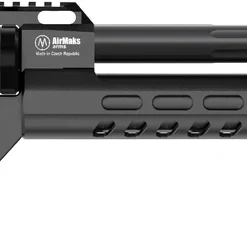
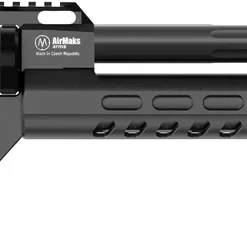
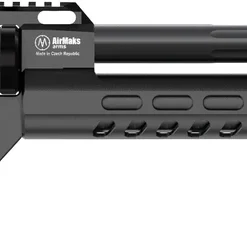
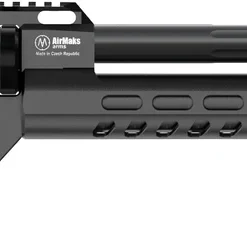
The AirMaks Arms Katran Long, officially identified as the Katran L, is a long-format regulated PCP air rifle designed around a lightweight aluminium chassis, an extended barrel system, adjustable ergonomics, and a modular accessory layout. It sits within the wider AirMaks Katran family and provides a longer configuration than the compact and standard models while retaining the platform’s recognizable folding-stock design.
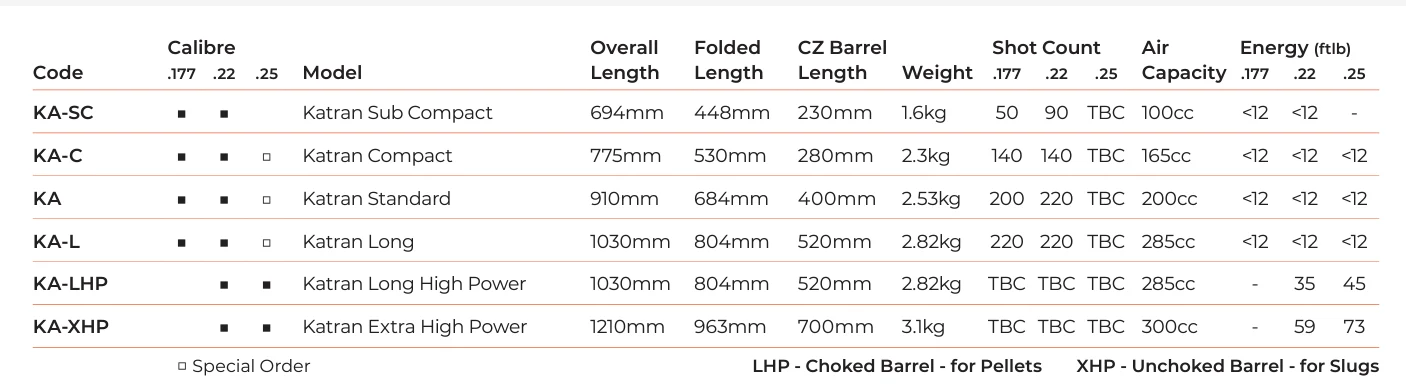
A 520 mm choked CZ barrel is incorporated into the AirMaks Arms Katran Long. As a result, a longer barrel configuration is provided while the overall platform remains relatively lightweight. The rifle is offered by the manufacturer in 4.5 mm (.177), 5.5 mm (.22), and 6.35 mm (.25) calibres.
Furthermore, a regulated pneumatic system is incorporated into the design. Therefore, pressure management and shot-to-shot operation are supported by an internal regulator rather than relying exclusively on declining cylinder pressure.
AirMaks Arms Katran Long Design
A modern aluminium chassis is used throughout the AirMaks Arms Katran Long. Instead of a traditional full-length wooden stock, an adjustable folding aluminium stock is fitted. Consequently, the rifle can be configured around different shooting positions and user preferences.
The stock can be adjusted for length. In addition, the cheekpiece can be adjusted vertically, while the butt-pad can also be repositioned for height. These adjustments allow a more repeatable head and shoulder position to be established when an optic is installed.
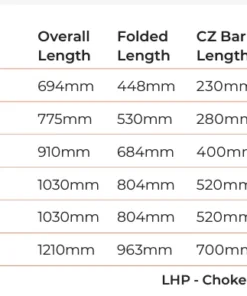
When unfolded, the rifle measures approximately 1030 mm in overall length. When the stock is folded, the manufacturer specifies a length of approximately 785 mm.
Despite the extended barrel, the rifle has a listed weight of approximately 2.82 kg. Actual configured weight will naturally increase once an optic and other permitted accessories are installed.
Adjustable Folding Stock
One of the defining features of the Katran platform is its folding stock.
The stock is manufactured from aluminium and can be adjusted for length. A height-adjustable cheekpiece and butt-pad are also provided. Accordingly, the stock can be configured around individual shooting posture, eye position, and optic height.
The folding arrangement also reduces the rifle’s storage dimensions. However, safe storage requirements and applicable local regulations should always be followed regardless of whether the stock is folded or extended.
520 mm CZ Barrel
At the centre of the AirMaks Arms Katran Long is a 520 mm choked CZ barrel.
Compared with shorter Katran configurations, the longer barrel distinguishes this model as the Long variant. The standard Katran L should also be distinguished from the separate Katran L HP model. The standard Katran L uses the choked barrel configuration and is available in .177, .22, and .25, whereas AirMaks lists separate high-power versions for different applications.
A threaded muzzle arrangement is also incorporated into the platform. Any muzzle device or moderator must only be possessed or installed where permitted under the laws applicable to the owner.
Regulated PCP System
Compressed air is stored inside a 285 cc duralumin air cylinder.
The manufacturer specifies a maximum cylinder pressure of 300 bar. Because PCP equipment operates under extremely high pressure, filling should only be performed with compatible, pressure-rated equipment and in accordance with the manufacturer’s operating instructions.
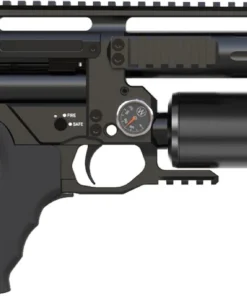
A pressure regulator is integrated into the rifle. Additionally, an external velocity-adjustment system is incorporated through the hammer-spring mechanism.
Any adjustments should remain within manufacturer guidance and applicable legal energy limits. In many jurisdictions, the legal classification of an air rifle can change according to calibre, muzzle energy, licensing status, or configuration.
Magazine System
Different magazine capacities are supplied according to calibre.
Manufacturer-listed magazine capacities include:
- .177 / 4.5 mm – 18 rounds
- .22 / 5.5 mm – 16 rounds
- .25 / 6.35 mm – 14 rounds
A side-lever action is used to operate the system. Moreover, the cocking arrangement can be configured for right- or left-side operation, improving adaptability for different users.
Adjustable Two-Stage Trigger
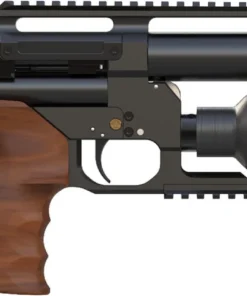
A two-stage externally adjustable trigger is fitted to the AirMaks Arms Katran Long.
Through an adjustable trigger system, the interface can be configured according to the parameters permitted by the manufacturer. Nevertheless, trigger work should be approached cautiously because inappropriate adjustment can affect safe operation.
A functional safety mechanism is also incorporated into the platform and uses an AR-style arrangement that can be configured for right- or left-side accessibility.
Ambidextrous Configuration
Several controls have been designed with ambidextrous use in mind.
The side lever can be repositioned, while the safety arrangement can also be configured for either side. An AR15-style grip is used, adding another familiar ergonomic element to the chassis.
For users comparing different Katran configurations, this adaptability can be an important technical distinction.
20 MOA Picatinny Optics Rail
A 20 MOA Picatinny rail is integrated into the upper portion of the rifle.
Therefore, compatible optical equipment can be mounted without requiring a proprietary mounting interface. Optic selection should be based on intended lawful sporting use, mounting dimensions, eye relief, and the applicable regulations governing the rifle.
The handguard is manufactured from aluminium and incorporates a 15-slot KeyMod interface for compatible permitted accessories.
Key Technical Features
The AirMaks Arms Katran Long combines several characteristic features of the Katran platform:
- 520 mm choked CZ barrel
- 4.5 mm (.177), 5.5 mm (.22), and 6.35 mm (.25) calibre options
- 285 cc duralumin air cylinder
- Maximum manufacturer-listed fill pressure of 300 bar
- Integrated pressure regulator
- Adjustable aluminium folding stock
- Height-adjustable cheekpiece
- Height-adjustable butt-pad
- Two-stage externally adjustable trigger
- Right/left configurable side-lever action
- Ambidextrous AR-style safety arrangement
- 20 MOA Picatinny optics rail
- 15-slot KeyMod aluminium handguard
- Approximately 2.82 kg rifle weight
- Approximately 1030 mm overall length
- Approximately 785 mm folded length
AirMaks Arms Katran Long Platform Overview
Within the Katran series, the AirMaks Arms Katran Long occupies the extended-barrel position between shorter standard configurations and the manufacturer’s specialized high-power models.
Its technical identity is defined primarily by the 520 mm choked barrel, regulated pneumatic action, lightweight aluminium chassis, folding adjustable stock, and 285 cc cylinder.
Consequently, shoppers researching the Katran family should pay close attention to the exact model designation. Katran L, Katran L HP, Katran LB, Katran WL, and other related models have different cylinder capacities, barrel configurations, stock materials, and calibre availability.
Safety and Legal Considerations
The AirMaks Arms Katran Long is a compressed-air rifle and should always be handled as a weapon.
Before acquisition, possession, transport, modification, or use, owners should verify all applicable national, regional, and local requirements. Licensing rules and legal muzzle-energy limits vary significantly between jurisdictions.
Furthermore, only manufacturer-compatible filling equipment should be connected to the high-pressure cylinder. Eye protection, secure storage, an appropriate backstop, and established firearm or airgun safety procedures should always be used.
The manufacturer’s manual should be consulted before operating, adjusting, maintaining, filling, or disassembling the rifle.
Overall, the AirMaks Arms Katran Long can be distinguished within the Katran range by its extended 520 mm barrel, regulated PCP architecture, adjustable folding chassis, ambidextrous controls, 285 cc air supply, and compatibility with standard optics mounting systems. These characteristics make it an important long-format configuration within AirMaks Arms’ modular Katran series.
Air Rifles, PCP Systems, Calibers, Target Shooting and Popular Models
The world of air arms, air guns, and precision shooting equipment covers everything from recreational target shooting to sporting applications. For newcomers asking what is an air gun, what is an air rifle, what is air rifle, what is a air rifle, what is a airgun, what is an airgun, or what are airguns, the basic principle is straightforward. An air gun uses compressed gas or air to propel a projectile rather than relying on the combustion system associated with conventional firearms.
Understanding how does an air gun work, how does air gun work, how do air guns work, how does an air rifle work, how does air rifle work, and how do air rifle work can help buyers distinguish between the different operating systems available. Depending on the design, power can be supplied by a spring piston, compressed air cylinder, CO2 cartridge, or another pneumatic mechanism.
PCP Air Rifles and Compressed-Air Systems
One of the most popular categories is the pre-charged pneumatic platform. Searches such as what is a pcp air rifle, what is a pcp airgun, what is pcp air rifle, what is a pcp air gun, what is a pcp rifle, what is pcp rifle, what are pcp air rifles, and what is a pre charged pneumatic air rifle all relate to the same fundamental technology. A PCP rifle stores compressed air inside a reservoir and releases a controlled quantity each time the rifle is fired.
For shoppers researching pcp gun meaning, pcp rifle meaning, or pcp air rifle meaning, PCP simply refers to a pre-charged pneumatic system. Air is normally added using a pcp hand pump, dive cylinder, or pcp air compressor. Consequently, an air compressed gun or air compressor rifle can deliver consistent performance without requiring the shooter to manually compress a spring before every shot.
Some searches also include pcp bb gun, although many PCP platforms are primarily designed around pellets rather than traditional BB ammunition. Understanding the intended ammunition is therefore important before selecting accessories, magazines, or loading equipment.
.177 Caliber, .22 Caliber and Pellet Selection
Caliber choice is one of the most frequently researched subjects among airgun buyers. The .177 caliber remains extremely popular for recreational shooting and precision target applications. Products described as a 177 air rifle, 177 bullet, or even 177 cal darts may appear during searches, although ammunition compatibility always needs to be checked against the manufacturer’s specifications.
Questions including 177 or 22, 177 cal vs 22, 177 caliber vs 22, .177 caliber vs .22, .177 pellet vs .22 pellet, and .22 vs .177 pellet generally focus on differences in projectile size, trajectory, energy, and intended use. A smaller .177 pellet is commonly chosen for paper targets and precision shooting, whereas larger calibers may be selected for applications where additional projectile mass is desired.
Understanding bb gun pellet sizes is equally important because BBs and pellets are not automatically interchangeable. Before purchasing ammunition, shooters should confirm the caliber and projectile type specified for their particular pellet rifle, pellet pistol, or bb gun.
Air Arms Rifles and Popular Models
Among established manufacturers, air arms products remain widely searched by enthusiasts interested in precision PCP and spring-powered platforms. Well-known searches include air arms s510, s510, air arms s410, aa s400, pro sport air arms, prosport air arms, tx 200, and tx200.
Variations such as air arm and airarm are also commonly entered by shoppers searching for the brand. Buyers looking specifically for regulated sporting configurations may encounter the air arms s510 ultimate sporter .177 sub 12, a phrase frequently associated with UK-oriented searches for the S510 platform.
Each Air Arms model has its own action, stock design, power configuration, caliber options, and intended shooting environment. Therefore, specifications should always be checked against the exact version being considered rather than assumed from another model in the same family.
FX Impact M3, FX Maverick and Modern PCP Platforms
Premium PCP research frequently includes the fx maverick and the fx impact m3. Buyers may also search for fx impact mk3, fx m3 airgun, fx m3, impact m3, or fx impact m3 air rifle while comparing generations and configurations.
More specific searches such as fx impact m3 .22cal air rifle. 600mm barrel focus on caliber and barrel-length combinations. Meanwhile, international shoppers may search fx impact m3 precio, fx impact m3 precio en usa, or fx impact m3 price when researching current market pricing.
Because FX platforms can be produced in multiple barrel lengths, calibers, power settings, and regional configurations, buyers should verify the exact specification offered in their country before ordering.
Break-Barrel Air Rifles
Another major category is the break barrel air rifle. Anyone asking what is a break barrel air rifle or what is a break barrel pellet gun is usually referring to a rifle in which the barrel is hinged downward to cock the internal powerplant and expose the breech for loading.
Break-barrel designs remain popular because they can provide a self-contained shooting system without an external compressor or air bottle. Models such as a gamo pellet gun are frequently encountered by buyers exploring this category.
Learning how to load pellet gun equipment properly is particularly important. Pellets should match the manufacturer’s recommended caliber and should be loaded in accordance with the owner’s manual while the rifle is pointed in a safe direction and handled under normal shooting-range safety procedures.
CO2, Pellet Pistols and Other Airgun Types
Not every airgun uses PCP or spring power. A co2 powered pellet rifle, for example, uses replaceable CO2 cartridges as its propellant source. CO2 systems can be found in rifles and handguns intended for recreational shooting, training, and target use.
People researching air pistol uses or general pellet gun uses will encounter equipment intended for target practice, recreational plinking, skills training, competition, and other lawful sporting activities. A pellet pistol can offer a compact platform, while rifles generally provide a longer sight radius and additional stability.
Search terms such as pelet guns are also common misspellings of pellet guns and can still represent useful search intent when website content is designed to answer frequently asked buyer questions naturally.
Target Shooting and Airgun Practice
One of the most established uses of airguns is target shooting with air rifles. Dedicated air guns for target shooting may emphasize accuracy, adjustable stocks, match triggers, regulated air delivery, and compatibility with precision optics.
Likewise, airgun target practice and airgun for target practice are common search topics among people looking for an accessible way to develop shooting fundamentals. Proper backstops, eye protection, safe handling practices, and suitable ranges should always be used.
The practical range of air rifle equipment varies considerably according to caliber, muzzle energy, projectile selection, environmental conditions, and the rifle itself. As a result, buyers should use manufacturer specifications and local range rules rather than assuming that every air rifle performs identically.
Hunting Air Rifles and Appropriate Use
Some shooters research air rifles for hunting, hunting air rifles, best air rifle for hunting, pellet gun for rabbits, or even the informal phrase rats gun when looking for equipment designed for lawful pest-control or hunting applications.
Suitability depends heavily on local law, caliber, projectile energy, quarry species, shot placement requirements, and humane hunting standards. Questions such as can a bb gun kill a fox should therefore not be treated simply as equipment-selection questions. Legal restrictions and animal-welfare requirements should be checked first, and low-powered BB guns are not appropriate substitutes for equipment legally and ethically suitable for a particular species.
Similarly, searches for air rifles for deer hunting and big game hunting with air rifle involve specialized legal and ballistic requirements. Large-bore systems such as a 72 caliber air rifle or products associated with bluegrass big bore illustrate how different big-bore pneumatic platforms can be from conventional small-caliber pellet rifles. Local hunting regulations must determine whether such equipment may legally be used.
Licensing and UK Airgun Regulations
Legal requirements differ considerably by jurisdiction. UK-oriented searches frequently include do you need a licence for air rifle, air rifle certificate uk, and 22 rifle uk license. However, the rules governing air rifles, conventional .22 firearms, certificates, age restrictions, possession, transportation, and power limits are not identical.
Consequently, buyers should confirm current legislation with the relevant licensing authority before purchasing or using any regulated equipment. Particular attention should also be paid to whether a rifle is configured below or above applicable power thresholds.
Sportsman, Gamo and Other Popular Searches
Beyond specialist PCP manufacturers, buyers may encounter products such as the sportsman 900 while comparing recreational air rifles. Searches for a gamo pellet gun are also common because Gamo offers numerous spring-powered and pneumatic models across different price points and configurations.
The broader search for best air guns can include everything from affordable recreational platforms to sophisticated regulated PCP rifles. Rather than treating one design as universally superior, buyers should compare caliber, intended application, weight, stock ergonomics, power source, shot capacity, charging equipment, availability of spare parts, and local legal requirements.
Airgun Safety, Home Use and Responsible Ownership
Searches for air guns for home defense do appear online, but an airgun should not automatically be assumed to be suitable for defensive use. Laws vary significantly, and airguns can cause serious injury. Secure storage, lawful ownership, training, safe handling, and avoidance of unnecessary confrontation remain essential.
Whether someone owns an air rifle, pellet rifle, bb gun, or PCP platform, the equipment should always be treated as capable of causing injury. A secure backstop should be used for recreational shooting, the muzzle should remain pointed in a safe direction, and manufacturer instructions should be followed carefully.
Ultimately, understanding the differences between PCP rifles, break-barrel systems, CO2 equipment, caliber choices, and individual models makes it easier to compare the extensive range of modern airguns. From Air Arms platforms to FX rifles and recreational pellet guns, careful specification checking, responsible handling, lawful use, and suitable ammunition selection remain central to getting the right equipment for the intended purpose.
Practical Use Scenarios
The AirMaks Arms Katran Long is built around a versatile PCP platform that can suit several lawful recreational and sporting environments. Its regulated action, extended barrel, adjustable stock, lightweight aluminium chassis, and flexible control layout allow the rifle to be adapted to different shooting positions and user preferences. Consequently, it can serve as a practical option for structured target shooting, club-range sessions, informal recreational shooting on suitable private property, and other permitted airgun activities.
Rather than being limited to one specific type of use, the platform has been designed around adjustability and consistency. That makes it especially relevant for users who value repeatable handling, comfortable ergonomics, and a modular setup that can be configured around their preferred optic and shooting position.
Target Shooting at an Approved Range
One of the most natural environments for the rifle is an approved airgun or shooting range.
Range shooting allows users to work on consistency, breathing control, trigger discipline, sight alignment, and general shooting technique in a controlled environment. Because the platform uses a regulated PCP system, shot delivery can be kept comparatively consistent throughout the usable pressure range.
That consistency can be useful during longer practice sessions where the shooter wants similar handling characteristics from one shot to the next.
The adjustable cheekpiece can also help establish a repeatable head position behind an optic. When the shooter mounts the rifle in the same way each time, visual alignment can become more consistent. Likewise, the adjustable butt-pad can help the stock sit more naturally against the shoulder.
For seated or bench-supported shooting, the extended configuration can feel stable and predictable. A suitable front rest or shooting bag may also be used where range rules permit.
Because the top rail accepts compatible optics, users can configure the rifle around the type of approved target shooting they intend to practice. Any optic should be mounted correctly and checked before use.
Calibres, FAC, Power, Recommended Scope and Accessories
The AirMaks Arms Katran Long is designed as a regulated PCP platform with multiple calibre options, adjustable ergonomics, and a long 520 mm barrel configuration. Choosing the right calibre and accessory setup should be based on intended lawful use, local regulations, shooting environment, and the type of target work being undertaken.
According to AirMaks Arms specifications for the standard Katran Long configuration, the rifle is offered in 4.5 mm (.177), 5.5 mm (.22), and 6.35 mm (.25). These calibres provide different characteristics in terms of pellet weight, air consumption, trajectory, and magazine capacity.
.177 Calibre – 4.5 mm
The .177 version is particularly well suited to paper-target shooting, recreational range practice, and other applications where a lighter projectile and comparatively flat trajectory are preferred.
Because .177 pellets are generally lighter than .22 or .25 alternatives, less pellet drop may be experienced across typical airgun target distances when comparable legal power levels are used. For this reason, the calibre is commonly associated with target-oriented shooting.
The manufacturer lists an 18-shot magazine capacity for the .177 configuration.
For users working within lower legal power limits, .177 can also provide a practical combination of efficiency and manageable air consumption.
.22 Calibre – 5.5 mm
The .22 configuration provides a middle ground between the smaller .177 and larger .25 versions.
Pellets in this calibre are generally heavier than equivalent .177 projectiles, while magazine capacity remains relatively high. AirMaks Arms lists a 16-shot magazine for the .22 Katran configuration.
For general recreational shooting and range use, .22 remains a widely used PCP calibre because it provides a balance between projectile mass, trajectory, and air consumption.
Actual performance will depend on pellet selection, regulator setup, rifle configuration, and the legal power level at which the rifle is supplied.
.25 Calibre – 6.35 mm
The .25 version uses a larger and heavier projectile.
AirMaks Arms specifies a 14-shot magazine capacity for this calibre. Because projectile mass is greater, air consumption can also increase depending on the rifle’s power configuration.
A .25-calibre setup should therefore be selected with particular attention to local muzzle-energy restrictions and the rifle’s factory specification.
The standard Katran Long should also be distinguished from AirMaks Arms’ dedicated HP variants. High-power models may use different barrel designs, calibre options, pneumatic configurations, and intended applications. The exact model designation should always be confirmed before specifications are published or compared.
FAC and Legal Power Considerations
“FAC” is commonly used in the UK airgun market to describe an air rifle that requires a Firearm Certificate because its muzzle energy exceeds the applicable non-FAC threshold.
In England and Wales, current government firearms guidance states that an air rifle exceeding 12 foot-pounds of muzzle energy requires a Firearm Certificate. Air pistols are subject to a lower 6 ft-lb threshold.
Therefore, the term “FAC version” does not refer to a separate calibre by itself. Instead, it relates to the rifle’s legal muzzle-energy classification.
A .177, .22, or .25 rifle may be supplied at different power levels depending on the market, legislation, and manufacturer or distributor configuration.
Buyers should never assume that two examples of the same model produce exactly the same energy. UK government guidance specifically notes that individual air weapons of the same model can vary in measured muzzle energy.
Local regulations should therefore be checked before purchase, possession, transport, adjustment, or use.
Power and Regulated PCP System
The Katran Long uses a regulated PCP system.
A regulator helps manage the pressure delivered from the high-pressure air reservoir to the firing system. As a result, the rifle can provide more consistent operation across a usable portion of the cylinder’s pressure range.
AirMaks Arms also incorporates external velocity adjustment through the hammer-spring system on Katran models. However, adjustment should only be carried out within manufacturer guidance and applicable legal limits.
Changing regulator settings, hammer-spring tension, valve operation, or other internal parameters can alter muzzle energy.
For that reason, users should not attempt to increase output beyond the rifle’s lawful classification.
Where legal compliance is important, muzzle energy should be checked using appropriate equipment and, where necessary, by a qualified dealer, gunsmith, or testing facility.
Recommended Scope Type
Because the rifle incorporates a 20 MOA Picatinny rail, a wide range of compatible optics can be mounted.
For general paper-target and recreational range shooting, a variable-power scope in approximately the 3–12x, 4–16x, or similar class can provide a versatile setup.
A scope with adjustable parallax can be particularly useful for airgun shooting because target distances may be considerably shorter than those typically associated with centrefire rifles.
Useful scope features include:
- Adjustable parallax or side focus
- Clear reticle
- Repeatable elevation and windage adjustment
- Compatible Picatinny mounting rings
- Suitable eye relief
- Good low-light clarity
- Sensible overall weight
- Appropriate magnification for the intended shooting distance
Extremely high magnification is not automatically necessary. For many recreational shooters, moderate magnification provides a wider field of view and a simpler shooting experience.
Recommended Accessories
A practical Katran Long setup can be completed with accessories that improve storage, maintenance, range organisation, and user comfort.
A quality padded rifle case is one of the most useful additions. The case should protect the rifle and optic during lawful storage and transportation.
A PCP-rated filling system is also essential. Depending on the owner’s setup, this may include a compatible high-pressure hand pump, diving cylinder, or compressor rated for the required working pressure.
Only pressure-rated equipment should be used.
Other useful accessories include:
- Compatible Picatinny scope rings
- Protective lens caps
- Shooting bags or a bench rest
- Spare manufacturer-compatible magazines
- Pellet storage containers
- Cleaning patches and suitable airgun cleaning equipment
- Protective eyewear
- Secure gun storage
- Pressure-rated filling hose and fittings
- Manufacturer-compatible fill probe
- Basic maintenance tools
- Target holders and appropriate backstops
Where permitted, shooters may also use compatible sling hardware or support accessories suited to structured range use.
Choosing the Right Configuration
The best setup depends largely on how the rifle will be used.
For paper-target and precision-oriented recreational shooting, .177 may be attractive because of its lighter projectile and relatively flat trajectory.
For a balanced general-purpose configuration, .22 provides a useful middle option.
Meanwhile, .25 offers a heavier projectile but may require greater attention to air consumption, energy classification, and local restrictions.
Regardless of calibre, the most important considerations remain legal compliance, safe handling, correct pressure management, suitable optics, and compatible accessories.
When these elements are selected carefully, the Katran Long can be configured as a flexible PCP platform for lawful sporting and recreational shooting.
Benchrest Practice
Benchrest shooting is another practical application.
In this environment, the shooter normally concentrates heavily on repeatability. Small changes in grip, head position, support pressure, trigger contact, or optic alignment can affect results. Therefore, a rifle that offers multiple ergonomic adjustments can be useful when developing a consistent position.
The adjustable stock can be configured so that the shooter does not need to stretch excessively toward the optic. Meanwhile, cheekpiece height can be matched more closely to the mounted scope.
The longer barrel format can also provide the balanced feel that some shooters prefer when using a supported position.
During bench practice, the rifle can be rested securely while the user evaluates different pellets permitted by the manufacturer. Pellet compatibility can vary between individual barrels, so testing several suitable products on paper targets can help identify which option performs most consistently in a particular rifle.
This type of testing should be done in a safe environment with an adequate backstop.
Recreational Plinking
Recreational plinking is another common use for PCP air rifles.
Where local law allows it, shooting suitable reactive or paper targets on private property can provide a relaxed way to practise basic marksmanship. Safe target placement is essential, and a reliable backstop should always be positioned behind the target area.
Metal targets should only be used if they are specifically designed for airgun use and positioned according to the manufacturer’s safety instructions.
For recreational sessions, the multi-shot magazine system can reduce interruptions between shots. Magazine capacity varies according to calibre, so the exact configuration should be checked before use.
The side-lever action also provides a straightforward operating layout. Because the lever can be configured for different users, the rifle can be adapted more comfortably for right- or left-handed operation.
This can make recreational shooting more accessible to people who prefer different control arrangements.
Club Shooting
The rifle can also be considered for organised airgun club activities.
Club environments can be particularly useful because shooters often gain access to established safety procedures, structured firing lines, experienced supervision, and properly designed target areas.
For newer PCP users, this environment can provide a useful introduction to filling procedures, safe handling, optic setup, storage practices, and routine maintenance.
The platform’s adjustable stock may also help when several shooting positions are used during a club session.
A shooter might begin from a supported bench before progressing to seated, kneeling, or standing practice where those positions are permitted. Each position places different demands on balance and ergonomics, so stock adjustment can be valuable.
The relatively light chassis may also reduce fatigue compared with substantially heavier target-oriented rifles, although the final configured weight depends on the optic and accessories installed.
Standing Target Practice
Standing shooting requires more physical control than bench-supported shooting.
Because the rifle is supported primarily by the shooter’s body, overall balance becomes particularly noticeable. The user must manage posture, shoulder placement, cheek contact, grip pressure, and trigger control simultaneously.
The aluminium chassis and adjustable stock can help the user refine the rifle’s fit.
For example, stock length can be adjusted so that the firing hand reaches the grip naturally. The cheekpiece can then be positioned to align the eye more comfortably with the optic.
A natural shooting position can help reduce unnecessary muscular tension.
Standing practice is commonly used to improve general handling skills, but it should always be performed on a controlled firing line or another legally permitted shooting area.
Seated Shooting
A seated position can offer a useful compromise between bench shooting and unsupported standing practice.
The body provides more support than in the standing position while still requiring the shooter to manage the rifle directly. This makes seated shooting suitable for practicing breathing, body alignment, and stable rifle support.
The adjustable stock can again be useful because body position changes significantly when sitting.
Some users may prefer a shorter stock position when seated, while others may need a slightly different cheekpiece height depending on their optic and posture.
The goal should always be a repeatable, relaxed position rather than forcing the rifle into alignment through muscle tension.
Kneeling Practice
Kneeling practice is sometimes included in structured airgun or field-target style training.
This position requires balance and flexibility while still allowing one knee and part of the body to provide support.
The rifle’s relatively manageable weight can be beneficial during repeated position changes. However, the shooter should always prioritise safe muzzle direction and trigger discipline while entering or leaving the kneeling position.
Adjustment of the butt-pad may also help the stock sit naturally when the shoulder angle changes.
Users should practise changing positions only in a safe environment and preferably under experienced supervision if they are unfamiliar with positional shooting.
Informal Accuracy Testing
Another practical scenario involves controlled accuracy testing.
Instead of simply shooting casually, the user can record group sizes on paper targets and compare results between different sessions.
Environmental conditions, pellet selection, pressure level, optic setup, shooting support, and technique can all affect results. Therefore, proper testing should be methodical.
One variable should ideally be changed at a time.
For example, a shooter might compare two compatible pellet types while keeping the shooting distance, rest position, and optic settings unchanged. This makes it easier to understand whether any observed difference is actually linked to ammunition choice.
Such testing can be useful for learning how a particular rifle behaves without modifying the rifle itself.
Optic Setup and Zero Confirmation
The integrated Picatinny rail makes optic installation an important part of the rifle’s practical setup.
Once a compatible optic has been mounted correctly, the user can confirm alignment on a suitable paper target. Zeroing should be carried out only in a safe shooting area with an appropriate backstop.
The process should begin conservatively and follow the optic manufacturer’s instructions.
After initial alignment has been established, several groups can be fired to confirm consistency.
The adjustable cheekpiece can then be fine-tuned so that the shooter’s eye naturally aligns with the centre of the optic when the rifle is shouldered.
This can improve comfort and repeatability without requiring the shooter to lift or lower the head unnaturally.
Training New Shooters
Under appropriate supervision, the rifle can also be used as part of structured airgun training.
New shooters should first learn fundamental safety rules before handling the rifle.
They should understand safe muzzle direction, trigger discipline, correct loading procedures, safe target identification, and the importance of a reliable backstop.
Because PCP rifles use high-pressure compressed air, filling should initially be handled by an experienced adult or qualified range officer.
Once basic safety has been established, the adjustable stock can be configured to suit the trainee’s body size.
A more comfortable fit can make it easier to focus on correct technique.
Training should progress gradually, beginning with supported shooting before introducing more demanding positions.









Reviews
There are no reviews yet.