Air Arms Ultimate Sporter R Carbine Walnut – Premium Regulated PCP Air Rifle
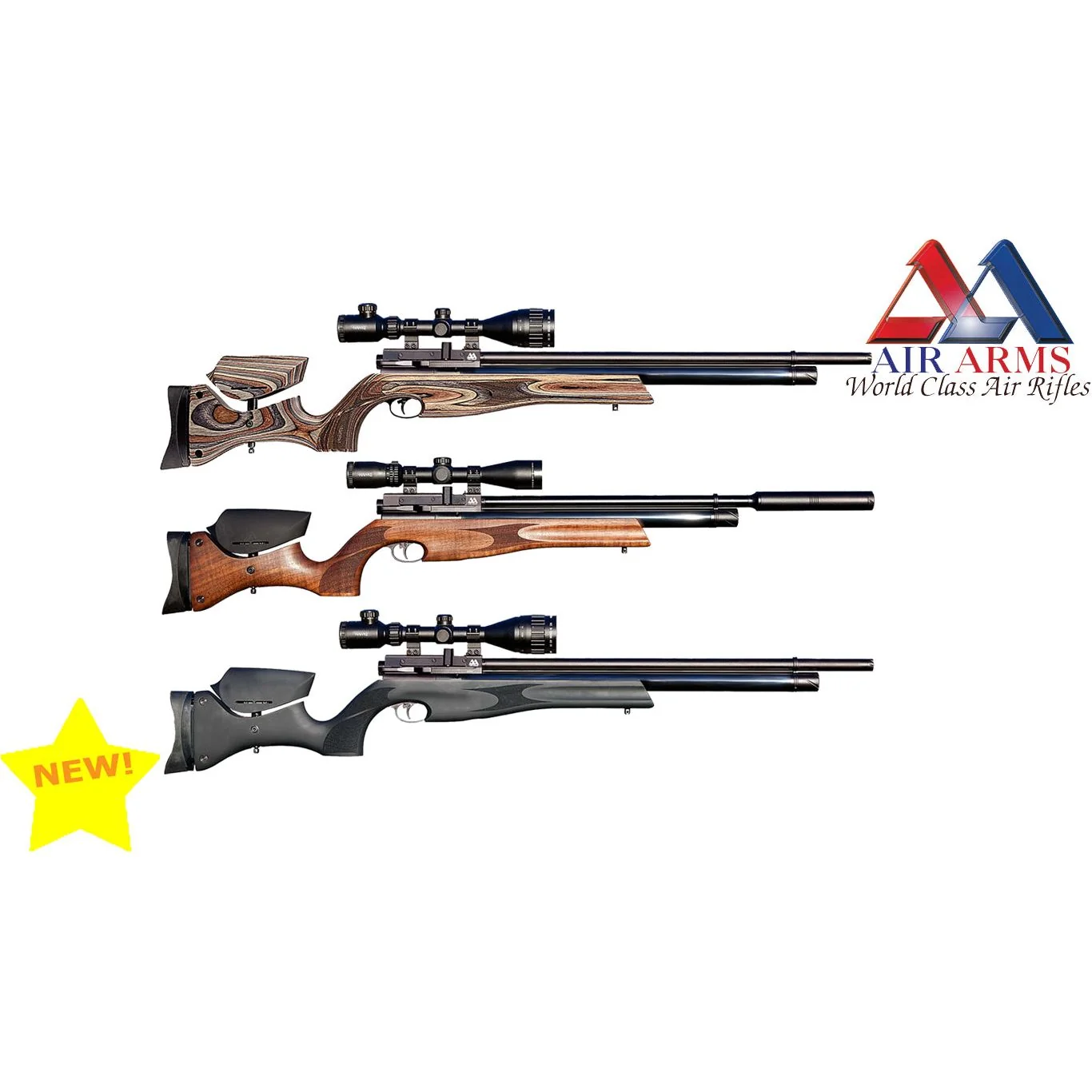
The Air Arms Ultimate Sporter R Carbine Walnut brings together refined British engineering, elegant walnut craftsmanship, regulated PCP performance, and highly adjustable ergonomics in one sophisticated sporting platform. Designed around the proven Air Arms S510 action, this regulated carbine has been developed for shooters who appreciate consistency, smooth operation, balanced handling, and a traditional premium finish.
Immediately, the natural walnut stock gives the rifle a distinctive appearance. However, its appeal extends well beyond aesthetics. An adjustable cheekpiece and butt pad allow the shooting position to be adapted around the individual user. Consequently, scope alignment, shoulder placement, and overall comfort can be made more consistent.
At the heart of the rifle, the Air Arms Series 7 regulator and valve system manages the compressed-air supply. As a result, greater consistency can be maintained throughout the usable portion of each fill. Meanwhile, the compact carbine configuration offers a practical balance between full-size stability and manageable dimensions.
Refined Walnut Stock and Adjustable Ergonomics
Premium walnut has been used to create a traditional sporting appearance while maintaining the functional characteristics expected from the Ultimate Sporter platform.
Rather than requiring the shooter to adapt completely to a fixed stock configuration, several important contact points can be adjusted. The cheekpiece can be positioned to improve head placement, while the butt pad can be altered to produce a more natural shoulder position.
Furthermore, the stock has been designed with ambidextrous usability in mind. Therefore, a wider range of shooters can obtain a comfortable and repeatable hold.
Comfort Designed Around the Shooter
Consistent shooting begins with a stable position. For this reason, the Air Arms Ultimate Sporter R Carbine Walnut combines its adjustable furniture with a carefully shaped sporting stock.
The rifle can consequently be configured to support:
- Improved eye-to-scope alignment
- More repeatable cheek placement
- Comfortable shoulder positioning
- Stable supported shooting
- Balanced standing and kneeling positions
- Left- or right-handed use
- Longer shooting sessions with reduced positional strain
Because these adjustments can be tailored to the individual, the rifle provides considerably more flexibility than a conventional fixed-stock sporter.
Air Arms Series 7 Regulated PCP System
A major feature of the Air Arms Ultimate Sporter R Carbine Walnut is its regulated pre-charged pneumatic action.
Compressed air is managed through the Series 7 regulator and valve system. Consequently, the pressure delivered through the firing cycle is controlled more consistently rather than simply following the gradual pressure reduction inside the main cylinder.
Greater consistency can therefore be achieved across the usable shot string.
Additionally, the regulated configuration provides an increased shot count compared with the corresponding non-regulated Ultimate Sporter carbine. Depending on calibre, the manufacturer specification lists approximately 90+ shots in .177 and 120+ shots in .22.
Smooth Side-Lever Operation
Loading is handled through Air Arms’ familiar side-lever action.
Instead of relying on a heavy or awkward cocking movement, the mechanism has been engineered to operate smoothly and efficiently. Therefore, follow-up loading can feel natural while the shooter’s position is maintained.
A 10-shot rotary magazine is used, providing convenient multi-shot operation. Two colour-coded magazines are commonly supplied with the regulated model, making magazine management straightforward.
Match-Grade Lothar Walther Barrel
Accuracy potential is supported by a 395 mm match-grade Lothar Walther barrel.
The barrel is fully shrouded, while the overall system has been engineered around the precision expected from Air Arms’ premium sporting rifles. Combined with the regulated action, this barrel arrangement provides an excellent foundation for repeatable pellet delivery.
Nevertheless, practical accuracy will always depend on appropriate ammunition selection, environmental conditions, optic setup, maintenance, and the shooter’s technique.
Compact Carbine Dimensions
Although substantial enough to remain stable, the rifle retains the practical proportions expected from a carbine.
The regulated walnut version measures approximately 1,010 mm overall and weighs around 3.4 kg, giving it a reassuring yet manageable feel.
Its dimensions create a useful middle ground. The rifle does not feel excessively compact, yet it remains easier to handle than many longer full-length PCP configurations.
Adjustable Two-Stage Trigger
Fine control has also been considered within the trigger system.
An adjustable two-stage trigger is fitted, allowing the firing interface to be configured according to the shooter’s preferences and the limits specified by the manufacturer.
Because predictable trigger operation contributes significantly to repeatable technique, the adjustment capability complements the rifle’s regulated action and ergonomic stock.
A manual safety is incorporated into the system as well. Safe handling practices should, of course, always be followed regardless of mechanical safety features.
Air Arms Ultimate Sporter R Carbine Walnut Key Features
Highlights of the platform include:
- Air Arms Series 7 regulator and valve system
- Premium walnut sporting stock
- Ambidextrous stock configuration
- Fully adjustable cheekpiece
- Adjustable butt pad
- Fast, smooth side-lever action
- Match-grade Lothar Walther barrel
- Fully shrouded barrel design
- 10-shot rotary magazine system
- Two colour-coded magazines
- Adjustable two-stage trigger
- Manual safety system
- Built-in pressure gauge/manometer
- Integrated accessory rail
- Sling mounting provisions
- Compact 1,010 mm overall length
- Approximately 3.4 kg walnut-stock weight
- Available in .177 and .22 configurations
.177 and .22 Calibre Options
Two popular calibre choices are available for the Air Arms Ultimate Sporter R Carbine Walnut: .177 and .22.
The .177 configuration will often appeal to shooters who prefer the characteristics traditionally associated with the smaller calibre, particularly for paper-target and sporting disciplines.
Alternatively, .22 offers the familiar characteristics of a larger, heavier pellet.
Local legislation, permitted energy limits, intended sporting discipline, ammunition compatibility, and range rules should always be considered before selecting a configuration.
Built for Consistency and Refined Handling
Perhaps the strongest quality of the Ultimate Sporter R is the way its individual systems have been integrated.
The regulator supports consistent operation. Likewise, the adjustable stock supports consistent positioning. A smooth side lever simplifies loading, while the two-stage trigger provides a controlled interface between shooter and rifle.
Meanwhile, premium walnut adds the traditional character expected from a high-end sporting air rifle.
Instead of focusing on one headline feature, the Air Arms Ultimate Sporter R Carbine Walnut has been developed as a complete system in which ergonomics, compressed-air management, mechanical operation, barrel quality, and craftsmanship complement one another.
A Premium Addition to the Air Arms S510 Family
Within the celebrated S510 family, the Air Arms Ultimate Sporter R Carbine Walnut occupies a distinctive position. It combines the familiar side-lever action with a regulated powerplant, compact carbine proportions, sophisticated stock adjustment, and classic walnut styling.
For enthusiasts who value precision engineering and traditional presentation equally, this configuration offers an especially attractive combination.
Every major element has been designed around controlled, repeatable operation. From the adjustable cheekpiece and butt pad to the Series 7 regulator, match-grade barrel, rotary magazine system, and refined trigger, each component contributes to the overall shooting experience.
Ultimately, the Air Arms Ultimate Sporter R Carbine Walnut represents a premium interpretation of the modern regulated PCP sporter: compact enough for practical handling, adjustable enough for individual fit, and beautifully finished for shooters who appreciate genuine walnut craftsmanship.
Important: Airgun ownership, power limits, transport, storage, hunting, and use are regulated differently between jurisdictions. Always verify applicable local laws, age requirements, licensing conditions, and approved shooting locations before acquiring or using any air rifle.
Air Rifles, PCP Systems, Calibers, Target Shooting and Popular Models
The world of air arms, air guns, and precision shooting equipment covers everything from recreational target shooting to sporting applications. For newcomers asking what is an air gun, what is an air rifle, what is air rifle, what is a air rifle, what is a airgun, what is an airgun, or what are airguns, the basic principle is straightforward. An air gun uses compressed gas or air to propel a projectile rather than relying on the combustion system associated with conventional firearms.
Understanding how does an air gun work, how does air gun work, how do air guns work, how does an air rifle work, how does air rifle work, and how do air rifle work can help buyers distinguish between the different operating systems available. Depending on the design, power can be supplied by a spring piston, compressed air cylinder, CO2 cartridge, or another pneumatic mechanism.
PCP Air Rifles and Compressed-Air Systems
One of the most popular categories is the pre-charged pneumatic platform. Searches such as what is a pcp air rifle, what is a pcp airgun, what is pcp air rifle, what is a pcp air gun, what is a pcp rifle, what is pcp rifle, what are pcp air rifles, and what is a pre charged pneumatic air rifle all relate to the same fundamental technology. A PCP rifle stores compressed air inside a reservoir and releases a controlled quantity each time the rifle is fired.
For shoppers researching pcp gun meaning, pcp rifle meaning, or pcp air rifle meaning, PCP simply refers to a pre-charged pneumatic system. Air is normally added using a pcp hand pump, dive cylinder, or pcp air compressor. Consequently, an air compressed gun or air compressor rifle can deliver consistent performance without requiring the shooter to manually compress a spring before every shot.
Some searches also include pcp bb gun, although many PCP platforms are primarily designed around pellets rather than traditional BB ammunition. Understanding the intended ammunition is therefore important before selecting accessories, magazines, or loading equipment.
.177 Caliber, .22 Caliber and Pellet Selection
Caliber choice is one of the most frequently researched subjects among airgun buyers. The .177 caliber remains extremely popular for recreational shooting and precision target applications. Products described as a 177 air rifle, 177 bullet, or even 177 cal darts may appear during searches, although ammunition compatibility always needs to be checked against the manufacturer’s specifications.
Questions including 177 or 22, 177 cal vs 22, 177 caliber vs 22, .177 caliber vs .22, .177 pellet vs .22 pellet, and .22 vs .177 pellet generally focus on differences in projectile size, trajectory, energy, and intended use. A smaller .177 pellet is commonly chosen for paper targets and precision shooting, whereas larger calibers may be selected for applications where additional projectile mass is desired.
Understanding bb gun pellet sizes is equally important because BBs and pellets are not automatically interchangeable. Before purchasing ammunition, shooters should confirm the caliber and projectile type specified for their particular pellet rifle, pellet pistol, or bb gun.
Air Arms Rifles and Popular Models
Among established manufacturers, air arms products remain widely searched by enthusiasts interested in precision PCP and spring-powered platforms. Well-known searches include air arms s510, s510, air arms s410, aa s400, pro sport air arms, prosport air arms, tx 200, and tx200.
Variations such as air arm and airarm are also commonly entered by shoppers searching for the brand. Buyers looking specifically for regulated sporting configurations may encounter the air arms s510 ultimate sporter .177 sub 12, a phrase frequently associated with UK-oriented searches for the S510 platform.
Each Air Arms model has its own action, stock design, power configuration, caliber options, and intended shooting environment. Therefore, specifications should always be checked against the exact version being considered rather than assumed from another model in the same family.
FX Impact M3, FX Maverick and Modern PCP Platforms
Premium PCP research frequently includes the fx maverick and the fx impact m3. Buyers may also search for fx impact mk3, fx m3 airgun, fx m3, impact m3, or fx impact m3 air rifle while comparing generations and configurations.
More specific searches such as fx impact m3 .22cal air rifle. 600mm barrel focus on caliber and barrel-length combinations. Meanwhile, international shoppers may search fx impact m3 precio, fx impact m3 precio en usa, or fx impact m3 price when researching current market pricing.
Because FX platforms can be produced in multiple barrel lengths, calibers, power settings, and regional configurations, buyers should verify the exact specification offered in their country before ordering.
Break-Barrel Air Rifles
Another major category is the break barrel air rifle. Anyone asking what is a break barrel air rifle or what is a break barrel pellet gun is usually referring to a rifle in which the barrel is hinged downward to cock the internal powerplant and expose the breech for loading.
Break-barrel designs remain popular because they can provide a self-contained shooting system without an external compressor or air bottle. Models such as a gamo pellet gun are frequently encountered by buyers exploring this category.
Learning how to load pellet gun equipment properly is particularly important. Pellets should match the manufacturer’s recommended caliber and should be loaded in accordance with the owner’s manual while the rifle is pointed in a safe direction and handled under normal shooting-range safety procedures.
CO2, Pellet Pistols and Other Airgun Types
Not every airgun uses PCP or spring power. A co2 powered pellet rifle, for example, uses replaceable CO2 cartridges as its propellant source. CO2 systems can be found in rifles and handguns intended for recreational shooting, training, and target use.
People researching air pistol uses or general pellet gun uses will encounter equipment intended for target practice, recreational plinking, skills training, competition, and other lawful sporting activities. A pellet pistol can offer a compact platform, while rifles generally provide a longer sight radius and additional stability.
Search terms such as pelet guns are also common misspellings of pellet guns and can still represent useful search intent when website content is designed to answer frequently asked buyer questions naturally.
Target Shooting and Airgun Practice
One of the most established uses of airguns is target shooting with air rifles. Dedicated air guns for target shooting may emphasize accuracy, adjustable stocks, match triggers, regulated air delivery, and compatibility with precision optics.
Likewise, airgun target practice and airgun for target practice are common search topics among people looking for an accessible way to develop shooting fundamentals. Proper backstops, eye protection, safe handling practices, and suitable ranges should always be used.
The practical range of air rifle equipment varies considerably according to caliber, muzzle energy, projectile selection, environmental conditions, and the rifle itself. As a result, buyers should use manufacturer specifications and local range rules rather than assuming that every air rifle performs identically.
Hunting Air Rifles and Appropriate Use
Some shooters research air rifles for hunting, hunting air rifles, best air rifle for hunting, pellet gun for rabbits, or even the informal phrase rats gun when looking for equipment designed for lawful pest-control or hunting applications.
Suitability depends heavily on local law, caliber, projectile energy, quarry species, shot placement requirements, and humane hunting standards. Questions such as can a bb gun kill a fox should therefore not be treated simply as equipment-selection questions. Legal restrictions and animal-welfare requirements should be checked first, and low-powered BB guns are not appropriate substitutes for equipment legally and ethically suitable for a particular species.
Similarly, searches for air rifles for deer hunting and big game hunting with air rifle involve specialized legal and ballistic requirements. Large-bore systems such as a 72 caliber air rifle or products associated with bluegrass big bore illustrate how different big-bore pneumatic platforms can be from conventional small-caliber pellet rifles. Local hunting regulations must determine whether such equipment may legally be used.
Licensing and UK Airgun Regulations
Legal requirements differ considerably by jurisdiction. UK-oriented searches frequently include do you need a licence for air rifle, air rifle certificate uk, and 22 rifle uk license. However, the rules governing air rifles, conventional .22 firearms, certificates, age restrictions, possession, transportation, and power limits are not identical.
Consequently, buyers should confirm current legislation with the relevant licensing authority before purchasing or using any regulated equipment. Particular attention should also be paid to whether a rifle is configured below or above applicable power thresholds.
Sportsman, Gamo and Other Popular Searches
Beyond specialist PCP manufacturers, buyers may encounter products such as the sportsman 900 while comparing recreational air rifles. Searches for a gamo pellet gun are also common because Gamo offers numerous spring-powered and pneumatic models across different price points and configurations.
The broader search for best air guns can include everything from affordable recreational platforms to sophisticated regulated PCP rifles. Rather than treating one design as universally superior, buyers should compare caliber, intended application, weight, stock ergonomics, power source, shot capacity, charging equipment, availability of spare parts, and local legal requirements.
Airgun Safety, Home Use and Responsible Ownership
Searches for air guns for home defense do appear online, but an airgun should not automatically be assumed to be suitable for defensive use. Laws vary significantly, and airguns can cause serious injury. Secure storage, lawful ownership, training, safe handling, and avoidance of unnecessary confrontation remain essential.
Whether someone owns an air rifle, pellet rifle, bb gun, or PCP platform, the equipment should always be treated as capable of causing injury. A secure backstop should be used for recreational shooting, the muzzle should remain pointed in a safe direction, and manufacturer instructions should be followed carefully.
Ultimately, understanding the differences between PCP rifles, break-barrel systems, CO2 equipment, caliber choices, and individual models makes it easier to compare the extensive range of modern airguns. From Air Arms platforms to FX rifles and recreational pellet guns, careful specification checking, responsible handling, lawful use, and suitable ammunition selection remain central to getting the right equipment for the intended purpose.
Practical Use Scenarios
A premium regulated PCP rifle becomes most valuable when its design translates effectively into real-world shooting conditions. Rather than being judged only by specifications, performance is better understood through handling, balance, consistency, comfort, and adaptability across different shooting environments. With a compact carbine layout, adjustable walnut stock, regulated pneumatic system, multi-shot magazine, and refined side-lever action, this platform is well suited to a wide range of recreational and sporting situations.
Precision Target Shooting at the Range
One of the most natural environments for this type of rifle is a controlled shooting range. Here, consistency becomes especially important because small variations in shooting position, trigger control, pellet selection, or air pressure can influence group size.
The regulated action helps maintain a more uniform firing cycle throughout the usable portion of the air fill. Consequently, shooters can concentrate on technique rather than constantly compensating for major changes in performance.
A stable bench-rest position also allows the adjustable stock to be appreciated fully. The cheekpiece can be positioned so that the shooter’s eye naturally aligns with the optic, while the adjustable butt pad helps establish a repeatable shoulder position.
Because the overall shooting position can be refined, less effort is required to force the head or neck into alignment with the scope. As a result, extended range sessions may feel more natural and controlled.
The smooth side-lever action also becomes useful during repeated target strings. After each shot, the rifle can be cycled efficiently without dramatically disturbing the firing position. When several groups are being tested with different pellet types, this ease of operation can make the process more organised and enjoyable.
Pellet Testing and Accuracy Evaluation
Serious airgun enthusiasts often test several pellet designs before deciding which performs best through a particular barrel. In this situation, consistency is extremely valuable.
Rather than evaluating ammunition while the rifle is experiencing significant power fluctuations, a regulated PCP system provides a more stable platform for comparison.
Different pellet weights, head sizes, and designs can therefore be tested under controlled conditions. Group size, point of impact, loading feel, and overall consistency can then be compared more effectively.
The multi-shot magazine system is particularly convenient during this process. Multiple groups can be fired efficiently while maintaining a structured testing routine.
For even more careful evaluation, shooters may choose to fire several magazines with one pellet type before moving to another. Notes can then be recorded regarding grouping, consistency, handling characteristics, and perceived smoothness.
This methodical approach allows the rifle to be set up around the ammunition it performs with most consistently.

Recreational Garden or Private-Range Shooting
Where local laws and property conditions permit, recreational target shooting on an appropriately designed private range can provide an enjoyable way to practise basic marksmanship.
Paper targets, reactive targets specifically designed for airgun use, and purpose-built pellet-catching systems can all be incorporated into a controlled setup.
The compact proportions of a carbine can be particularly useful in these environments because the rifle is easier to manoeuvre around benches, shooting lanes, and storage areas than some longer configurations.
At the same time, enough weight and stability are retained to give the rifle a composed feel when supported.
A quality optic can further improve the experience by making small targets easier to observe. Depending on the intended distance, moderate magnification is often sufficient for recreational target shooting.
Regardless of the location, a secure backstop and safe shooting direction remain essential. Appropriate eye protection, responsible storage, and compliance with local regulations should always be prioritised.
Bench-Rest and Supported Shooting
Bench shooting places emphasis on repeatability.
When a rifle is supported on bags or a purpose-built rest, small inconsistencies in body position become easier to identify. This makes a regulated PCP platform especially suitable for shooters who enjoy measuring accuracy and refining their technique.
The walnut stock offers a solid contact point, while the adjustable cheekpiece improves the relationship between the shooter and the optic.
Once a comfortable position has been found, it can be recreated from one shooting session to another.
This repeatability can be helpful when zeroing a scope, checking pellet performance, evaluating accessory changes, or simply practising controlled trigger technique.
Because the firing cycle of a PCP rifle produces relatively little disturbance compared with many spring-powered designs, attention can be focused on breathing, sight picture, trigger control, and follow-through.
Standing, Kneeling, and Positional Practice
Not every shooting session takes place from a bench.
Standing and kneeling practice can provide a useful challenge while improving stability, posture, and familiarity with the rifle.
In these situations, the carbine configuration becomes especially valuable. Reduced overall length helps the rifle feel more manageable during positional changes.
The adjustable stock also allows the shooter to experiment with different setups depending on body position. A configuration that feels ideal from a bench may not be perfect when shooting from a standing position.
For this reason, some shooters choose a compromise setting that works comfortably across several common positions.
The rifle’s balance can also influence how quickly fatigue develops during unsupported shooting. A well-balanced carbine generally feels easier to control than a platform that is excessively front-heavy.
With regular practice, shooters can become more familiar with their natural point of aim and improve consistency without relying entirely on external support.
Scope Zeroing and Optical Setup
A quality PCP platform provides an excellent foundation for setting up and evaluating optics.
When mounting a scope, the first priority is achieving comfortable eye relief and natural alignment. The adjustable cheekpiece helps considerably because the shooter’s head position can be matched more precisely to the optic.
Once the mounting position has been established, the rifle can be zeroed from a stable rest.
Several groups should normally be fired before major adjustments are made so that individual shot variation is not mistaken for an incorrect scope setting.
After a consistent group has been achieved, windage and elevation adjustments can be made gradually.
The regulated firing cycle helps simplify this process because a stable velocity profile supports more predictable point-of-impact behaviour.
After zeroing, the shooter can confirm the setup at additional distances within the range’s permitted limits.
Extended Shooting Sessions
Comfort becomes increasingly important during long shooting sessions.
A rifle may feel excellent for a few minutes yet become tiring if the stock position, scope height, or overall balance does not suit the individual.
Adjustable ergonomics help reduce this problem.
By modifying the cheekpiece and butt pad, the rifle can be configured to support a more natural posture. Consequently, unnecessary tension in the shoulders, neck, and upper back may be reduced.
The generous shot count available from a regulated PCP system also benefits longer sessions because fewer interruptions may be required for refilling.
A shooter can therefore spend more time concentrating on technique, target evaluation, and consistent firing routines.
Magazine-fed operation further contributes to convenience. Instead of handling a loose pellet before every shot, several shots can be prepared in advance within the magazine.
Informal Competition and Club Shooting
Airgun clubs often provide a structured environment in which shooters can improve their abilities alongside others.
A refined regulated PCP rifle fits naturally into this setting because it combines consistency with adjustable ergonomics.
During informal competitions, repeatability becomes particularly important. The rifle should feel familiar every time it is mounted to the shoulder.
Stock adjustments can therefore be fine-tuned during practice sessions before competition use.
The side-lever action allows the rifle to be cycled smoothly between shots, while the magazine system supports efficient operation during timed or structured shooting formats where permitted by the rules.
Because competition requirements vary considerably, shooters should always confirm calibre, power, optic, magazine, and equipment regulations before entering an event.
Training New or Developing Shooters
Under appropriate supervision and where legally permitted, an adjustable PCP rifle can also be useful for helping developing shooters learn fundamental marksmanship principles.
Because the stock can be adapted, different users may find it easier to establish proper eye alignment and shoulder position.
The relatively smooth firing behaviour of a PCP platform can also help learners concentrate on sight picture, breathing, trigger control, and follow-through.
However, supervision remains essential.
Before shooting begins, safe muzzle direction, trigger discipline, loading procedures, range commands, and safe storage practices should be clearly understood.
A controlled range environment provides the most appropriate setting for structured learning.
Shooting from a Portable Rest
Portable rests can be useful when a permanent bench is unavailable.
A compact carbine is comparatively easy to position on a portable support, and the rifle’s moderate overall length helps keep the setup manageable.
When using a rest, care should be taken to support the rifle consistently from shot to shot.
The same contact points should be used whenever possible because variations in support can influence point of impact.
The adjustable cheekpiece again contributes to comfort by helping maintain consistent eye alignment with the optic.
This type of setup can be particularly useful during outdoor target sessions where shooters want the stability of a supported position without transporting a full bench system.
Equipment Setup and Accessory Testing
Another practical use involves evaluating accessories.
Scopes, mounts, bipods, slings, moderators where legally permitted, and other compatible equipment can all influence the way a rifle feels and handles.
Because the platform already provides a stable regulated firing system, changes in balance or comfort can be assessed more easily.
For example, installing a larger optic may shift the rifle’s centre of gravity upward. A bipod may add weight toward the front. Different mounts may alter scope height.
After each change, the stock can be adjusted so that comfortable alignment is restored.
Accessory testing should be approached methodically. Changing several components at once makes it difficult to determine which modification produced a particular result.
Testing one item at a time provides clearer feedback.
Seasonal and Outdoor Target Practice
Outdoor target shooting introduces conditions that may not be experienced indoors.
Wind, changing light, temperature variation, and uneven terrain can all influence the shooting experience.
A stable PCP platform allows the shooter to focus on understanding these environmental variables rather than dealing with excessive mechanical inconsistency.
Wind is particularly important because lightweight pellets can be affected significantly even over moderate distances.
Outdoor practice therefore helps develop a better understanding of how conditions influence trajectory and point of impact.
The compact carbine format also makes transportation between designated shooting positions more convenient.
Nevertheless, the rifle should always be transported safely, securely, and in accordance with local laws.
Calibres, FAC, Power, Recommended Scope and Accessories
Choosing the correct calibre, power configuration, optic, and supporting equipment can make a substantial difference to the overall shooting experience. Because this rifle has been developed around a regulated PCP system and an adjustable sporting platform, it can be configured for different styles of target shooting and sporting use while maintaining smooth handling and consistent operation.
Available Calibres
The rifle is commonly offered in .177 and .22 calibre, giving shooters two widely used options with different ballistic characteristics.
.177 Calibre
The .177 calibre version is often selected by shooters who prefer a comparatively flatter trajectory and smaller pellet diameter.
Because .177 pellets are generally lighter, they can provide a useful combination of velocity and predictable trajectory within suitable distances. For this reason, the calibre is frequently chosen for paper-target shooting, club shooting, recreational plinking, and applications where precise pellet placement is especially important.
Another advantage of .177 is that the smaller pellet can make trajectory management easier at typical airgun distances. However, pellet weight, pellet design, power output, atmospheric conditions, and range will still influence the final point of impact.
For target-focused users, .177 therefore remains a particularly attractive configuration.
.22 Calibre
The .22 calibre option uses a larger and generally heavier pellet.
Because of its greater pellet mass, .22 tends to retain momentum differently from .177 and may provide a more substantial impact on approved reactive targets.
Many shooters also appreciate the slightly more deliberate character of a .22 PCP rifle, especially when using medium- or heavier-weight pellets matched carefully to the barrel.
Trajectory is usually more curved than with .177 when similar power levels are compared, so accurate distance estimation becomes increasingly important.
Nevertheless, when the rifle is correctly zeroed and paired with suitable ammunition, .22 can deliver excellent consistency and enjoyable sporting performance.
FAC and Power Configurations
Power specifications vary according to market, local legislation, and the exact version being supplied.
In some jurisdictions, lower-powered configurations are available for ownership or use without the same licensing requirements applied to higher-output versions. In other markets, higher-powered models may be classified as FAC, firearm-equivalent, or otherwise licence-controlled products.
What FAC Means
In the United Kingdom, FAC commonly refers to a configuration that exceeds the power threshold permitted for a standard non-FAC air rifle.
An FAC-rated rifle therefore falls under additional legal controls and generally requires the appropriate firearms certificate.
The specific legal threshold, ownership requirements, storage standards, transportation rules, and permitted uses should always be verified through the applicable authority before purchase.
Outside the UK, terminology and limits may be completely different. Consequently, the term FAC should not be treated as a universal classification.
Regulated Power Delivery
A major advantage of the rifle’s regulated PCP system is the way air pressure is managed between the cylinder and firing valve.
Rather than allowing performance to follow the cylinder pressure directly throughout the fill, the regulator helps provide a more controlled pressure supply.
As a result, velocity consistency can be improved across the usable portion of the shot string.
This consistency is especially valuable when zeroing an optic, evaluating pellets, or shooting repeated groups from a supported position.
Actual muzzle energy will depend on the factory configuration, calibre, pellet weight, market specification, and applicable legal restrictions.
Users should therefore rely on the specification supplied with the exact rifle rather than assuming that every version produces identical power.
Recommended Scope
A high-quality regulated PCP rifle benefits from an optic that provides clear glass, dependable adjustment, and magnification suited to the intended shooting distance.
For general use, a 3-12×44, 4-16×44, or 4-16×50 scope can provide an excellent balance between field of view, magnification, and overall size.
Shooters primarily interested in closer-range recreational target work may find a 3-12x optic more than sufficient.
Meanwhile, users who regularly shoot small paper targets or want additional magnification for precise group evaluation may prefer a 4-16x model.
Hawke Airmax
The Hawke Airmax 4-12×40 or 4-16×50 is a strong pairing for a premium PCP rifle.
Airmax scopes are designed with airgun use in mind and are available with reticles that can assist with holdover reference points.
A 4-16×50 configuration provides useful magnification for target work without moving into an unnecessarily large or heavy optic.
Hawke Sidewinder
Shooters wanting more advanced adjustment and magnification may consider the Hawke Sidewinder range.
These scopes are particularly suitable for users who enjoy detailed target shooting, range work, and fine point-of-impact evaluation.
Side-focus adjustment can also help improve parallax correction at different distances.
Element Optics Helix
The Element Optics Helix 4-16×44 is another suitable option.
Its moderate objective size helps maintain a practical overall profile, while the magnification range suits a wide variety of airgun distances.
For shooters who want a balanced setup rather than an oversized optic, this type of scope can complement the carbine format particularly well.
Mount Selection
Good scope mounts are just as important as the optic itself.
Mount height should allow a comfortable head position while leaving sufficient clearance between the objective lens and the rifle.
Because an adjustable cheekpiece is provided, the shooting position can then be fine-tuned around the installed scope.
Quality one-piece or two-piece mounts from established manufacturers such as Sportsmatch, Hawke, or BKL can provide reliable support when correctly fitted.
Recommended Accessories
The right accessories can improve convenience, protection, comfort, and equipment management.
Spare Magazines
Additional 10-shot magazines are one of the most practical upgrades.
Having several magazines preloaded can reduce interruptions during longer range sessions and makes ammunition organisation easier.
Filling Equipment
Because the rifle operates on compressed air, suitable filling equipment is required.
Depending on the user’s setup, this may include:
- PCP hand pump
- High-pressure diving or carbon-fibre cylinder
- Correct fill adaptor
- Compatible hose assembly
- Pressure-rated fittings
Only equipment rated for the required working pressure should be used.
Rifle Case
A padded rifle case or hard protective case helps protect the walnut stock, barrel, optic, and action during transport and storage.
A hard case may offer greater impact protection, while a quality padded slip can be convenient for regular range visits.
Bipod
A suitable bipod can provide additional stability during supported target shooting.
For shooters who frequently practise from a bench or prone position, a lightweight adjustable bipod can be a useful addition.
However, balance should be considered because heavier accessories mounted toward the front of the rifle can alter its handling characteristics.
Sling
A comfortable sling can make transportation easier and reduce fatigue when carrying the rifle between approved shooting positions.
Quick-adjust or padded designs are particularly useful when the rifle is equipped with an optic and other accessories.
Pellet Selection
High-quality ammunition is essential for extracting consistent performance from any precision PCP rifle.
Popular choices from manufacturers such as JSB, Air Arms, H&N, and RWS are often tested because different barrels can show preferences for particular pellet designs and weights.
Rather than selecting ammunition purely by brand, several suitable pellets should ideally be tested through the individual rifle.
Cleaning and Maintenance Equipment
A basic maintenance kit can include a pull-through barrel cleaning system, suitable patches, approved lubricant, soft cloths, and stock-care products intended for walnut.
Excessive cleaning is generally unnecessary, but sensible maintenance can help preserve both mechanical condition and appearance.
Building a Balanced Setup
The most effective configuration is usually the one that matches the shooter’s actual use.
A lightweight scope and minimal accessories may suit users who prioritise handling and portability. Conversely, a higher-magnification optic, bipod, and range-focused equipment may be preferred for supported accuracy work.
Ultimately, calibre, power level, optic choice, and accessories should all be selected as part of one complete system.
When these elements are matched correctly, the rifle can offer a refined combination of consistency, comfort, precision, and practical versatility across a wide range of controlled sporting environments.
Always verify local laws relating to airgun power, licensing, transportation, storage, ownership, and approved shooting locations before selecting an FAC or higher-output configuration.
Developing Repeatable Shooting Technique
Perhaps the most valuable practical application of a premium PCP rifle is simply consistent practice.
Improvement in marksmanship usually comes from repeating the same fundamental process: stable position, controlled breathing, clear sight picture, smooth trigger release, and proper follow-through.
A predictable rifle allows the shooter to identify mistakes more easily.
When equipment behaves consistently, poor groups are less likely to be blamed on unexplained mechanical changes. Instead, attention can be directed toward technique.
Over time, this can help shooters develop greater confidence and a more disciplined approach to target shooting.
A Versatile Platform for Sporting Use
Ultimately, the value of this carbine lies in its adaptability.
It can be used for relaxed recreational sessions, careful bench-rest testing, club shooting, optic setup, positional practice, ammunition evaluation, and structured marksmanship training.
Rather than being limited to one specific shooting style, the combination of regulated performance, adjustable ergonomics, smooth side-lever operation, and compact proportions allows the rifle to perform effectively across many controlled sporting environments.
For shooters who appreciate precision, comfort, and traditional walnut styling, it provides a versatile platform that can be configured around individual preferences.
With appropriate maintenance, suitable ammunition, proper storage, and responsible use, the rifle can support many years of enjoyable target and sporting practice while maintaining the refined handling expected from a premium regulated PCP system.
Always follow applicable laws, range rules, safe-storage requirements, and responsible shooting practices in your jurisdiction.




Reviews
There are no reviews yet.