AirMaks Arms Katran-B Long – Precision PCP Air Rifle with Long-Barrel Performance
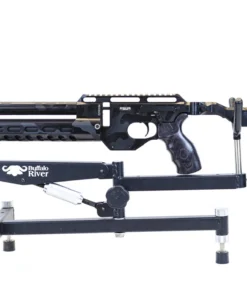
The AirMaks Arms Katran-B Long has been developed as a refined long-format PCP air rifle for shooters who value consistency, adjustability, efficient handling, and carefully engineered construction. Throughout the platform, a combination of a long barrel, substantial air capacity, regulated operation, and configurable ergonomics has been incorporated. Consequently, a highly adaptable shooting platform has been created for recreational target shooting and other lawful sporting applications.
Rather than unnecessary bulk being added, the rifle has been designed around a streamlined aluminium-based architecture. At the same time, a large-capacity bottle has been integrated so that longer shooting sessions can be supported. Moreover, the familiar Katran side-lever system has been retained, allowing smooth cycling to be achieved from a comfortable shooting position.
Because individual shooting preferences can differ considerably, several important controls have been made adjustable. As a result, the AirMaks Arms Katran-B Long can be configured more naturally around different users, optics, shooting positions, and sporting environments.
AirMaks Arms Katran-B Long Design and Construction
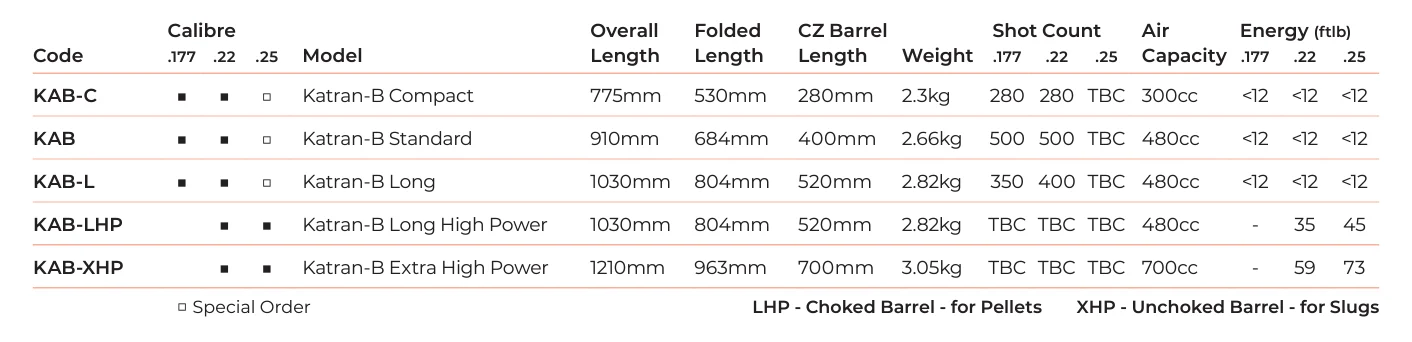
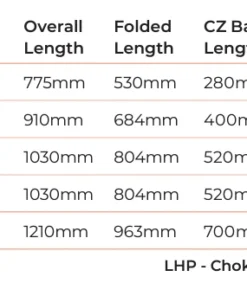
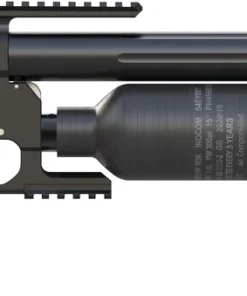
Precision engineering can be seen throughout the rifle. A long 520 mm barrel is associated with the Katran long configuration, while a 480 cc bottle has traditionally been fitted to the Katran LB/Katran-B Long platform. Together, these components provide the foundation for an extended PCP configuration.
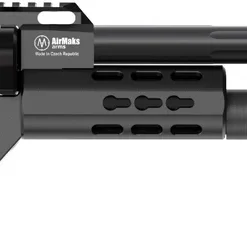
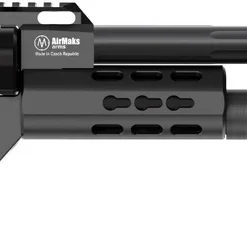
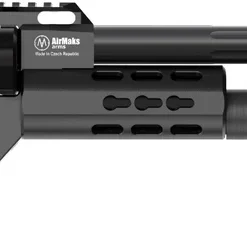
Meanwhile, the chassis has been constructed to provide rigidity without excessive weight. An aluminium handguard has also been incorporated, and KeyMod attachment slots have been provided for compatible sporting accessories.
In addition, an upper Picatinny optics rail has been fitted. Therefore, compatible scopes and other lawful sighting equipment can be mounted according to user preference.
Adjustable Stock and Shooting Position
Comfort has not been treated as an afterthought. Instead, an adjustable stock system has been incorporated into the platform so that the shooting position can be refined.
The cheekpiece can be adjusted to support more consistent eye alignment with a mounted optic. Likewise, adjustment at the butt section allows the rifle to be configured around different shooting positions.
Furthermore, the folding-stock design found on aluminium-stock Katran configurations allows overall storage length to be reduced. Consequently, transportation and secure storage can be made more convenient where local law permits.
Smooth Side-Lever PCP Operation
One of the defining characteristics of the AirMaks Arms Katran-B Long is its side-lever action. The mechanism has been positioned so that cycling can be completed with minimal unnecessary movement.
Additionally, the lever can be configured for right- or left-side operation. Therefore, a broader range of shooters can be accommodated without the entire platform being redesigned.
A magazine-fed system is also provided. Depending on calibre, magazine capacity varies, allowing the rifle to be adapted to different sporting preferences.
Regulated Air Delivery
Consistency is an important part of PCP performance. For that reason, regulated air delivery has been incorporated into the Katran platform.
Instead of pressure being allowed to influence each shot unpredictably as the bottle is depleted, the regulated system is intended to provide a more controlled supply of air to the firing cycle. Consequently, greater shot-to-shot consistency can be supported across the useful pressure range.
A maximum fill pressure of up to 300 bar has been specified for the Katran platform. Nevertheless, filling procedures, pressure limitations, maintenance instructions, and regional requirements should always be followed exactly as stated by the manufacturer.
Key Features of the AirMaks Arms Katran-B Long
For quick product-page scanning, the main characteristics can be highlighted as follows:
- Long-format PCP air rifle architecture
- Approximately 520 mm barrel configuration
- Large 480 cc air bottle on traditional Katran-B Long/LB versions
- Regulated PCP operating system
- Smooth side-lever action
- Side lever can be configured for right- or left-side operation
- Magazine-fed design
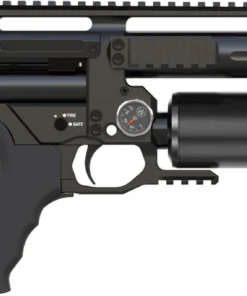
- Adjustable two-stage trigger
- Adjustable cheekpiece
- Adjustable butt section
- Folding aluminium stock on corresponding configurations
- Picatinny optics mounting rail
- KeyMod accessory mounting points
- Maximum fill pressure rated up to 300 bar
- Multiple calibre configurations depending on market
- Designed and manufactured around AirMaks Arms’ modular Katran platform
Adjustable Two-Stage Trigger
Trigger characteristics can have a considerable influence on the overall shooting experience. Accordingly, a two-stage adjustable trigger has been included.
Rather than one fixed factory feel being imposed on every shooter, external adjustment has been provided so that the trigger can be configured within the manufacturer’s permitted parameters.
As a result, a more predictable trigger release can be established for sporting and target applications. Nevertheless, adjustments should always be performed according to the official AirMaks instructions, and safety-function checks should be completed afterward.
Ambidextrous-Friendly Controls
Versatility has also been incorporated into several control points. For example, the side-lever arrangement can be changed from one side to the other. Similarly, the safety arrangement has been designed around accessible operation.
Consequently, the rifle can be adapted more readily for different users. This flexibility can be particularly valuable when a single platform is being configured for different shooting positions or equipment setups.
Optics and Accessory Compatibility
Modern PCP rifles are frequently configured with optics and support accessories. Therefore, mounting flexibility has been built into the AirMaks Arms Katran-B Long.
A Picatinny rail is positioned along the upper receiver area for compatible optics. Meanwhile, KeyMod mounting locations are provided along the handguard.
Because accessory requirements vary, the rifle can be kept relatively minimal or configured with compatible sporting equipment according to the user’s lawful requirements.
Importantly, every accessory should be checked for correct fitment before use. Excessive weight, improper installation, or incompatible mounting hardware should be avoided.
Large Air Capacity for Extended Sessions
A bottle-equipped configuration provides one of the principal differences between the Katran-B Long and smaller-cylinder variants.
With a larger compressed-air reserve available, repeated refilling can be reduced during a normal shooting session. Consequently, more time can be devoted to target practice rather than equipment preparation.
However, actual usable shot count can vary significantly according to calibre, power setting, projectile selection, regulator configuration, environmental conditions, and regional power restrictions. For that reason, fixed shot-count promises should not be treated as universal across every market configuration.
Built for Different Sporting Preferences
The AirMaks Arms Katran-B Long has been designed as a configurable platform rather than a one-size-fits-all rifle. Depending on regional availability, different calibre and power configurations may be supplied.
Accordingly, local legislation should always be checked before ownership, purchase, transport, modification, or use. Power limits, licensing requirements, permissible calibres, moderator rules, and hunting regulations can vary considerably between jurisdictions.
For sporting users who prioritize adjustability, regulated performance, ergonomic controls, and generous air capacity, the platform provides a technically sophisticated configuration.
Why the AirMaks Arms Katran-B Long Stands Out
Several engineering elements have been brought together in one streamlined PCP platform. A long barrel has been combined with substantial air capacity; adjustable ergonomics have been paired with a folding aluminium architecture; and a regulated action has been supported by a smooth side-lever system.
Furthermore, modern accessory compatibility has been included without abandoning the lightweight character associated with the Katran family.
Ultimately, the AirMaks Arms Katran-B Long represents a versatile long-format PCP air rifle designed around precision manufacture, modular adjustment, controlled air delivery, and comfortable handling. When it is configured and operated in accordance with the manufacturer’s instructions and applicable local laws, it offers a refined platform for lawful recreational and sporting shooting.
AirMaks Arms Katran-B Long Calibres, FAC Power and Accessories
The AirMaks Arms Katran-B Long has been designed around flexibility, allowing different calibre configurations, power levels, and accessories to be selected according to the intended sporting application and applicable local regulations. Because regional specifications can differ, the exact supplied power level should always be confirmed before purchase.
Available Calibres
For the standard long bottle configuration, three principal calibres are currently associated with the Katran LB platform: .177 (4.5 mm), .22 (5.5 mm), and .25 (6.35 mm). The standard Katran LB uses a 520 mm choked CZ barrel and is supplied with calibre-specific magazines. Magazine capacity is listed at 18 shots in .177, 16 shots in .22, and 14 shots in .25.
Each calibre provides a different balance of projectile weight, trajectory, air consumption, and intended use.
.177 calibre is commonly selected for target shooting and other applications where a flatter trajectory and lighter projectile are preferred. Because the pellet is relatively light, velocity can be maintained efficiently while air consumption is generally kept moderate.
.22 calibre provides a versatile middle ground. A heavier projectile can be used while trajectory remains manageable, making the calibre suitable for a broad range of lawful sporting applications.
.25 calibre has been designed around heavier projectiles and greater energy potential. Consequently, more compressed air may be consumed per shot, but increased projectile mass can be supported.
For users looking specifically for the high-power version, the present Katran LB HP platform is chambered in .22, .25, and .30 calibre, and its 520 mm barrel is non-choked rather than choked.
FAC and Full-Power Configuration
The term FAC is commonly used in markets such as the United Kingdom to describe air rifles operating above the country’s non-FAC legal energy threshold. Therefore, an AirMaks Arms Katran-B Long may be supplied in restricted or higher-power specification depending on jurisdiction, dealer configuration, and licensing requirements.
Power should never be assumed solely from the model name. Instead, the specification supplied by the retailer should be checked, because Katran rifles can be configured differently for different markets.
A dealer listing for the Katran LB records approximately 40 joules / 30 ft-lb for .22 and 60 joules / 44 ft-lb for .25 configurations. However, these figures should be treated as configuration-dependent rather than universal factory guarantees.
Additionally, the platform incorporates an external velocity regulation system through hammer-spring adjustment. AirMaks confirms that the Katran LB is regulated and fitted with an external velocity-adjustment screw.
Because altering power can affect legality, efficiency, projectile compatibility, and rifle setup, adjustment should only be carried out within the manufacturer’s instructions and applicable legislation.
Air Capacity and Pressure System
A major benefit of the AirMaks Arms Katran-B Long is the substantial compressed-air reserve provided by its bottle configuration.
The current Katran LB is specified with a 580 cc bottle rated to 300 bar, while earlier Katran LB versions were commonly listed with 480 cc or approximately 500 cc bottles. Therefore, bottle capacity should be matched to the exact generation being sold.
Regulated operation is used so that controlled air pressure can be delivered during the firing cycle. Consequently, greater shot-to-shot consistency can be supported across the usable fill range.
Compatible Accessories
The Katran platform has been built around extensive accessory compatibility. Consequently, the rifle can be configured for different target, bench, field, and recreational setups.
Key accessories include:
- Rifle scopes compatible with the 20 MOA Picatinny optics rail
- Picatinny-compatible scope mounts and rings
- KeyMod accessory rails
- Bipods and shooting supports
- Additional calibre-specific magazines
- Pellet trays where compatible
- Fill probes and PCP charging equipment
- High-pressure hand pumps, compressors, or charging bottles rated appropriately
- Protective rifle cases
- Replacement O-ring kits
- Cleaning equipment
- Cheekpiece and butt-pad adjustment components
- Compatible AR-style grip options
- Manufacturer-approved muzzle accessories where legal
- Spare magazine holders
- Maintenance and servicing components
The current Katran LB includes a 20 MOA Picatinny rail, a nine-slot KeyMod handguard, an adjustable aluminium stock, an adjustable cheekpiece, and an adjustable butt-pad. Therefore, optical and ergonomic accessories can be incorporated without fundamentally changing the rifle’s architecture.
Optics and Mounting Equipment
A suitable riflescope is one of the most commonly selected accessories for the AirMaks Arms Katran-B Long. Since a 20 MOA Picatinny rail is supplied, compatible mounts can be positioned securely along the receiver.
For target-oriented configurations, higher magnification optics may be selected. Conversely, a lighter and more compact optic may be preferred when reduced overall weight is prioritized.
The KeyMod handguard also allows compatible accessories to be positioned around the front section. For example, an appropriate bipod or support system can be fitted for stable bench or prone shooting.
Magazines, Charging and Maintenance Accessories
Additional magazines can be particularly useful during extended shooting sessions. Because magazine capacity changes according to calibre, the correct magazine must always be selected. Current factory specifications list capacities of 18 rounds for .177, 16 for .22, and 14 for .25 on the standard Katran LB.
A compatible fill probe is also required for compressed-air charging. Furthermore, all charging equipment must be rated for the rifle’s maximum operating pressure of 300 bar.
Finally, routine maintenance can be supported with suitable cleaning materials, replacement seals, approved lubricants, and AirMaks service parts. By combining the correct calibre, lawful FAC or restricted power specification, suitable charging equipment, and compatible accessories, the AirMaks Arms Katran-B Long can be configured as a highly adaptable PCP platform for a wide variety of lawful sporting applications.
Frequently Asked Questions
What type of air rifle is this model?
This model is a pre-charged pneumatic air rifle that uses compressed air stored within an onboard bottle to power each shot. Instead of relying on a spring or gas ram, a regulated pneumatic system is used so that a controlled amount of air can be released during the firing cycle.
Because compressed air is stored in advance, recoil is generally kept very low. Consequently, comfortable shooting characteristics, repeatable handling, and consistent accuracy can be supported. The platform is also designed around a magazine-fed side-lever action, allowing follow-up shots to be prepared efficiently.
Which calibres are available?
Availability can vary according to country, dealer, and production specification. Common configurations include .177, .22, and .25 calibre, while certain high-power versions may also be offered in .30 calibre.
Each calibre provides different characteristics. For example, .177 is frequently chosen for target shooting and flatter trajectories, while .22 provides a versatile balance between projectile weight and velocity. Meanwhile, .25 and larger configurations can accommodate heavier projectiles and increased energy where legally permitted.
Before ordering, the exact calibre supplied by the retailer should always be confirmed.
Is the rifle regulated?
Yes. A regulated pneumatic system is incorporated into the platform.
A regulator helps control the pressure supplied to the firing valve. Therefore, instead of progressively changing pressure being delivered directly from the air bottle, a more consistent working pressure can be maintained throughout much of the useful fill range.
As a result, improved shot-to-shot consistency can be supported. However, actual velocity consistency will also depend on ammunition, setup, maintenance condition, power specification, and environmental factors.
What is the advantage of a regulated PCP system?
A regulated design can provide several practical advantages. Most importantly, controlled air pressure can be delivered more consistently between shots.
Consequently, velocity variation may be reduced compared with an unregulated system operating directly from changing reservoir pressure. In addition, air can often be used more efficiently because the firing system is supplied with an appropriate working pressure rather than the full pressure contained in the bottle.
For target shooters, this consistency can contribute to more predictable performance when suitable ammunition is used.
How is the air reservoir filled?
The air reservoir is filled with clean, dry, high-pressure air through the rifle’s approved charging connection.
A compatible PCP compressor, hand pump, or certified diving cylinder can be used, provided the charging system is suitable for the rifle’s pressure rating. Before filling, all hoses, connectors, gauges, and adapters should be checked carefully.
The manufacturer’s recommended filling procedure should always be followed. Oxygen, industrial gases, or unsuitable compressed gases must never be substituted for clean breathing-quality compressed air.
What pressure can the air system handle?
The maximum permitted fill pressure depends on the specific version and air bottle fitted to the rifle. Current configurations may be rated for high-pressure filling, but the exact figure stamped on the reservoir and specified by the manufacturer should always take priority.
The bottle should never be filled above its approved working pressure. Furthermore, damaged, expired, modified, or incorrectly certified pressure vessels should not be used.
How many shots can be taken from one fill?
Shot count cannot be represented by one universal figure because several variables influence air consumption.
Calibre, projectile weight, regulator setting, power output, bottle capacity, fill pressure, environmental conditions, and mechanical setup can all influence the number of useful shots obtained.
A lower-power configuration may provide considerably more shots from a fill than a high-power version. Therefore, customers should refer to the specification of the exact rifle being purchased rather than relying on a generic shot-count estimate.
Does the rifle use a magazine?
Yes. A removable rotary magazine system is used on typical configurations.
Magazine capacity varies by calibre because larger projectiles occupy more space. Consequently, smaller calibres generally accommodate more rounds than larger calibres.
Additional magazines can be useful during target sessions because one magazine can be prepared while another is being used. However, only magazines designed for the correct calibre and model should be fitted.
Can the rifle be used with a single-shot tray?
A compatible single-shot loading system may be available depending on the version and accessory package.
Single-shot loading is often preferred by shooters who want each pellet to be loaded individually, particularly during deliberate target shooting or ammunition testing. Compatibility should be verified with the manufacturer or retailer before purchasing an aftermarket tray.
Is the side lever suitable for left-handed shooters?
The operating system has been developed with configurable ergonomics in mind. On compatible configurations, the side lever can be arranged for operation from either side.
Therefore, both right-handed and left-handed users can potentially configure the rifle to suit their preferred shooting position. Any conversion should be completed according to the manufacturer’s instructions so that correct function and safety are maintained.
Is the trigger adjustable?
An adjustable two-stage trigger is incorporated into the platform.
This allows certain trigger characteristics to be refined within the manufacturer’s approved adjustment range. A predictable first stage and clearly defined release can therefore be established according to individual preference.
Trigger adjustments should always be carried out carefully. Excessively light or incorrect settings can affect safe operation, so the rifle should be function-tested after adjustment.
What type of scope can be fitted?
A wide variety of compatible rifle scopes can be installed using suitable mounts.
A Picatinny-style optics rail is provided on the platform, allowing compatible rings and mounts to be positioned securely. The appropriate optic will depend on intended use, preferred magnification, shooting distance, weight requirements, and budget.
For general target shooting, moderate magnification may be sufficient. Conversely, higher magnification may be selected when precise target observation at longer ranges is required.
Can a bipod be attached?
Yes, compatible support accessories can be fitted when the correct mounting hardware is used.
Depending on the handguard specification, accessory interfaces can be adapted for a bipod, shooting rest, or other lawful support equipment. Care should be taken to ensure that the accessory does not interfere with the air bottle, barrel, magazine, or operating controls.
A correctly installed bipod can provide improved stability during supported shooting.
Does the stock fold?
Certain configurations are equipped with a folding stock mechanism.
When folded, the overall package can become more compact for secure storage and transportation. Nevertheless, the stock should be completely locked into its shooting position before the rifle is used.
Local regulations regarding transportation, storage, overall dimensions, and airgun classification should also be followed.
Can the cheekpiece be adjusted?
Yes, adjustable ergonomics are one of the notable features of the platform.
The cheekpiece can be positioned so that eye alignment with the optic can be improved. This can be particularly useful when different scope mounts or optics are installed.
A consistent cheek position can contribute to repeatable sight alignment and more comfortable shooting.
Is the butt pad adjustable?
An adjustable butt section is included on compatible versions.
By changing its position, the rifle can be configured more comfortably for different body proportions, shooting positions, and clothing thicknesses. This flexibility can make the rifle suitable for a wider range of users.
Adjustments should be tightened correctly before shooting so that unwanted movement is prevented.
Can the power level be adjusted?
Certain power-related settings may be adjustable depending on the exact configuration. However, any adjustment must remain within the manufacturer’s technical limits and the law of the country where the rifle is possessed or used.
Changing power can affect air consumption, regulator behavior, projectile suitability, accuracy, and legal classification. Therefore, users should avoid altering factory settings unless they understand the manufacturer’s procedures and applicable regulations.
Where licensing thresholds apply, professional adjustment and chronograph verification may also be advisable.
What does FAC mean?
FAC is a term commonly encountered in the United Kingdom and certain related markets. It generally refers to an air rifle that exceeds the energy threshold permitted without a firearm certificate.
The meaning and legal requirements can differ between jurisdictions. Consequently, buyers should verify local legislation before purchasing a higher-power configuration.
No assumption should be made that a rifle permitted in one country can automatically be possessed or used under the same conditions elsewhere.
Is this rifle suitable for target shooting?
Yes, target shooting is one of the applications for which a regulated PCP platform can be well suited.
Low recoil, adjustable ergonomics, scope compatibility, and a consistent pneumatic firing system can all support precise recreational target shooting.
Performance will still depend heavily on pellet selection, shooter technique, weather conditions, equipment setup, and proper maintenance.
Can different pellet brands be used?
Compatible pellets from reputable manufacturers can be tested, provided the correct calibre is selected.
Different barrels can show preferences for particular pellet designs, head sizes, and weights. Consequently, accuracy testing with several suitable pellet types is often useful.
The most expensive ammunition will not automatically produce the smallest groups. Instead, performance should be evaluated systematically using safe target-shooting procedures.
Can slugs be used?
Slug compatibility depends on calibre, barrel specification, power level, and the exact rifle version.
Some configurations may perform effectively with suitable airgun slugs, while others may be optimized primarily for conventional diabolo pellets. Because projectile diameter, weight, and barrel design matter considerably, manufacturer recommendations should be checked before use.
Improper projectile selection can reduce accuracy or cause mechanical problems.
Does a longer barrel automatically make the rifle more accurate?
Not necessarily.
Accuracy is influenced by barrel quality, projectile consistency, regulator performance, trigger control, optic setup, environmental conditions, and shooter technique. Barrel length alone does not guarantee superior precision.
A longer barrel can influence air efficiency and projectile acceleration, but overall accuracy still depends on how effectively the entire system works together.
How should the barrel be cleaned?
Cleaning should be performed only when necessary and with equipment designed for airgun barrels.
A suitable pull-through system, soft patches, and manufacturer-approved cleaning products are generally preferred. Aggressive metal brushes or inappropriate solvents should be avoided unless specifically approved.
Because excessive cleaning can sometimes disturb an already stable barrel condition, routine inspection is usually more appropriate than unnecessary repeated cleaning.
What maintenance is required?
Routine maintenance is relatively straightforward when the rifle is handled correctly.
External metal surfaces should be kept clean and dry. O-rings, seals, the filling system, magazine, side lever, and pressure components should be inspected periodically.
Only lubricants recommended for PCP air rifles should be used. Petroleum-based oils should never be introduced into high-pressure air systems unless specifically approved by the manufacturer.
Professional servicing should be arranged when regulator, valve, pressure-vessel, or internal mechanical work is required.
How should the rifle be stored?
The rifle should be stored securely, unloaded, and inaccessible to unauthorized users.
A protective gun case or secure cabinet can help prevent accidental damage. Extremely humid locations should be avoided because moisture can contribute to corrosion.
The storage pressure recommended by the manufacturer should also be followed instead of automatically leaving the reservoir completely full or empty for extended periods.
Is dry firing recommended?
Repeated dry firing should not be assumed to be safe unless the manufacturer specifically approves it.
PCP firing systems are designed around controlled air release and normal mechanical operation. Therefore, unnecessary dry firing should be avoided if the manual does not explicitly permit it.
For trigger practice or maintenance testing, manufacturer instructions should be consulted first.
Can accessories from other rifles be used?
Some accessories can be transferred between platforms when standard interfaces are used.
For example, Picatinny-compatible scope mounts may fit multiple rifles. However, model-specific components such as magazines, fill probes, internal parts, stocks, barrel assemblies, and seals should only be used when compatibility has been confirmed.
Incorrect components can affect function, reliability, or safety.
Is the rifle suitable for beginners?
A PCP rifle can be approachable for responsible new shooters because recoil is low and the operating system can be smooth. However, high-pressure air systems require proper instruction and disciplined handling.
New users should learn safe gun handling, correct filling procedures, local legal requirements, range etiquette, and appropriate maintenance before regular use.
Supervision should be provided whenever required by age or local law.
What should be checked before each shooting session?
Several basic checks should be completed before use.
The rifle should first be confirmed to be in safe mechanical condition. The barrel should be unobstructed, the optic and mounts should be secure, and the air system should show no obvious signs of damage or leakage.
The magazine should be correctly loaded with compatible ammunition, while the backstop and target area should be confirmed safe before firing begins.
Why choose this type of PCP platform?
A combination of regulated performance, large air capacity, adjustable ergonomics, low recoil, magazine operation, and modern accessory compatibility makes this style of PCP rifle appealing to many sporting shooters.
Rather than being designed around only one shooting position or one accessory setup, the platform can be configured around individual requirements. Consequently, it can serve as a versatile option for recreational target shooting, range practice, and other lawful sporting uses.
As with every compressed-air rifle, the best performance will be achieved when the correct ammunition is selected, the rifle is maintained properly, and all manufacturer instructions and local regulations are followed.
AirMaks Krait, Katran PCP Air Rifles, Umarex Airguns, Pest Control and Shooting Systems
The world of AirMaks Krait, AirMaks Katran, PCP air rifles, and modern airgun systems continues to attract shooters interested in precision, hunting, target practice, and pest control applications. Buyers searching for what is a PCP air rifle, what does PCP air rifle mean, what is a PCP airgun, what is a PCP air gun, or what are PCP air rifles are generally looking for information about pre-charged pneumatic technology. A PCP air rifle uses stored compressed air to deliver consistent power, accuracy, and repeatable shot performance compared with traditional spring-powered systems.
AirMaks Krait PCP Air Rifle and Katran Air Rifle Platforms
The AirMaks Krait is a modern PCP platform designed for shooters who want accuracy, compact handling, and adjustable performance. Searches such as AirMaks Krait, Air Max Krait, AirMaks Krait .22, AirMaks Krait .22 official, AirMaks Krait PCP, AirMaks Krait air rifle, and Krayt30 are commonly associated with this rifle family.
The AirMaks Katran represents another popular PCP air rifle platform from AirMaks. Search terms including AirMaks Katran, AirMaks Katran .22, Katran air rifle, Katran PCP rifle, and Katran LLC relate to shooters researching compact and high-performance pneumatic rifles. These platforms are often compared by buyers looking for precision shooting, hunting capability, and reliable air delivery systems.
PCP Air Rifles, Compressed Air Systems and Technology
A PCP rifle works by storing compressed air inside an onboard reservoir before releasing controlled air pressure to propel a pellet. Searches such as PCP rifle meaning, PCP air rifle meaning, PCP guns, PCP rifle, compressed air rifle, compressed air guns, air powered rifle, and komprimiran zrak all relate to pneumatic shooting technology.
Charging equipment is also an important part of PCP ownership. Many shooters search for PCP hand pump, PCP air compressor, air compressor rifle, and accessories designed to refill PCP reservoirs safely and efficiently.
Air Rifle Pest Control and Vermin Control Applications
Many shooters research air rifle for pest control, air rifle pest control, pest control with air rifles, best air rifle for pest control, pellet gun for pest control, and best pellet gun for pest control when looking for suitable equipment for lawful pest management.
Products such as AirMaks Krait and AirMaks Katran may appear in searches related to vermin control guns, vermin control air rifles, and accurate pellet shooting platforms because PCP rifles can offer consistent velocity, adjustable power settings, and precision accuracy when used responsibly.
Umarex Airguns, Air Rifles and CO2 Platforms
The Umarex brand is widely searched by enthusiasts looking for recreational airguns, training platforms, and replica-style products. Popular searches include Umarex USA, UmarexUSA, Umarex airguns, Umarex air rifles, Umarex Notos, Umarex Gauntlet, Umarex Gauntlet 2, Umarex Gauntlet 30, Umarex Hammer, Umarex Hammer .50 caliber, and Umarex Hammer Carbine.
Other frequently searched Umarex models include Umarex Origin, Umarex Primal 20, Umarex Zelos, Umarex Fusion 2, Umarex Komplete, Umarex Komplete NCR .22, Umarex Air Saber, Umarex Airsaber, Umarex Trevox, Umarex MP40, Umarex MP5, Umarex Legends, Umarex T4E, Umarex HDR 50, and Umarex TR50.
BB Guns, Pellet Pistols and Airsoft Replica Searches
Alongside rifles, many customers search for compact air-powered platforms including BB guns, BB gun pistols, pellet pistols, and CO2 pellet pistols. Related searches include metal BB gun, CO2 pistol replica, airsoft pistol, airsoft Glock, airsoft Glock 17, airsoft Glock 19, Glock BB gun, Glock airsoft gun, and Glock air pistol.
Umarex replica searches frequently include Umarex Glock, Umarex Glock 17, Umarex Glock 17 Gen 5, Umarex Glock 19, Umarex Glock 19X, Glock 19 BB gun, and Glock 19X BB gun.
Air Rifle Shooting, Accuracy and Performance
Modern shooters compare airguns based on accuracy, power delivery, ammunition compatibility, and intended use. Searches for accurate pellet rifle, powerful air rifle, air rifle online, air rifle dealers, air gun makers, air gun manufacturers, and best airguns reflect the growing interest in precision pneumatic systems.
Whether researching an AirMaks Krait, AirMaks Katran, Umarex air rifle, or another PCP platform, buyers should consider caliber selection, air capacity, regulator performance, barrel quality, available accessories, maintenance requirements, and local regulations before choosing a system.
Practical Use Scenarios
Precision Target Shooting at the Range
One of the most natural environments for this rifle is a controlled target range, where consistency, stability, and repeatability can be appreciated. Because a regulated PCP system is used, a predictable firing cycle can be maintained across a long shooting session. As a result, attention can be placed on breathing, trigger control, sight alignment, and follow-through rather than excessive recoil management.
For paper-target shooting, a suitable scope can be mounted to the upper rail and adjusted according to the preferred distance. Once the optic has been correctly zeroed, groups can be evaluated with different pellet weights and designs. Because individual barrels can respond differently to different ammunition, several compatible pellet types may be tested under the same conditions.
Furthermore, the adjustable cheekpiece and butt section can be positioned to produce a repeatable head position. Consequently, eye alignment with the optic can become more consistent from shot to shot.
A supported bench position can also be used when ammunition testing is being carried out. With an appropriate rest or compatible bipod fitted, unnecessary movement can be reduced. Therefore, the mechanical consistency of the rifle and the suitability of individual pellets can be evaluated more effectively.
For shooters interested in improving technique, this type of range session can be particularly useful. Rather than focusing only on score, each group can be analyzed for changes in point of impact, vertical spread, horizontal movement, and consistency.
Benchrest Shooting and Accuracy Testing
Benchrest shooting represents another practical scenario in which the rifle’s PCP configuration can be used effectively.
Because the rifle can be supported at the front and rear, much of the movement created by the shooter’s body can be minimized. As a result, a clearer understanding of the rifle-and-ammunition combination can be developed.
During a benchrest session, several five-shot or ten-shot groups can be fired at identical distances. Different ammunition options can then be compared under similar conditions. Additionally, the same scope magnification, shooting rest, and fill-pressure range can be retained so that unnecessary variables are reduced.
A chronograph may also be used where lawful and appropriate. By recording velocity data, the consistency of a selected pellet can be assessed alongside group size. However, velocity alone should not be treated as a guarantee of accuracy. Instead, both target results and consistency data should be considered together.
Longer sessions can also be supported by the rifle’s bottle-style air system. Consequently, repeated interruptions for charging may be reduced compared with smaller-reservoir configurations, depending on the power level and calibre being used.
For recreational benchrest shooters, this combination of adjustability, pneumatic consistency, and scope compatibility can create a comfortable environment for progressive accuracy testing.
Indoor Target Practice
Where suitable facilities are available, the rifle can also be used for controlled indoor target shooting.
Indoor conditions offer an important advantage because wind and changing weather conditions are largely removed. Therefore, ammunition performance, trigger technique, and sight alignment can be examined with fewer environmental variables.
A suitable low- to medium-power configuration may be particularly convenient for authorized indoor facilities, provided all range rules and local regulations are satisfied.
Because lighting conditions remain comparatively stable indoors, scope settings can be refined more easily. Likewise, changes in point of impact can be observed without wind-related deviation being introduced.
A properly designed pellet trap and safe backstop must always be used. Additionally, the available distance should be sufficient for the specific setup being operated.
For users learning how a PCP system behaves, indoor target practice can provide a structured environment in which loading, aiming, trigger operation, and follow-through can be practiced repeatedly.
Outdoor Recreational Shooting
Outdoor recreational shooting can provide a different set of challenges.
Once changing wind, temperature, light, and distance are introduced, greater attention must be paid to environmental conditions. As a result, the rifle can be used not only for accuracy practice but also for developing better understanding of external ballistic effects within responsible sporting use.
At an authorized outdoor range, targets may be positioned at several approved distances. A shooter can therefore observe how point of impact changes as range increases.
Wind also becomes an important consideration. Even relatively light projectiles can be affected by crosswinds. Therefore, careful observation and responsible adjustment may be required.
The adjustable stock can prove useful when shooting positions are changed throughout a session. For example, a position that feels comfortable from a bench may require minor adjustment when standing, kneeling, or shooting from a supported field position.
Because the rifle can accept compatible support accessories, a practical setup can be created without permanently changing the platform.
Field Target and Hunter-Style Target Courses
Structured field target disciplines provide another practical setting for a regulated PCP rifle.
These activities normally involve shooting at designated reactive targets from different distances and positions under controlled competition or club conditions. Consequently, accurate range estimation, stable shooting technique, and consistent equipment setup become particularly important.
A suitable scope can be configured for the rules of the discipline being entered. Meanwhile, the adjustable cheekpiece can help establish a repeatable shooting position when the optic is being used from different angles.
The relatively low recoil associated with a PCP platform can also make precise follow-through easier to maintain. Therefore, movement caused by the firing cycle can be minimized.
Throughout a course, shooters may encounter targets positioned at varying heights or angles. In these situations, comfortable stock adjustment and consistent trigger operation can contribute to better control.
As always, competition rules should be checked before accessories or equipment modifications are selected.
Practicing Different Shooting Positions
Not every shooting session needs to be conducted from a bench.
Standing, kneeling, seated, and supported positions can all be practiced in appropriate environments. By changing positions, the shooter can develop greater familiarity with balance, stock placement, trigger control, and optic alignment.
In the standing position, overall balance becomes especially important. The rifle should be supported naturally without excessive muscular tension.
From a kneeling position, body structure can be used to create greater stability. Likewise, a seated or supported position may provide an intermediate level of control between standing and benchrest shooting.
Because the cheekpiece and butt section can be adjusted, the rifle can be configured around the shooter’s preferred technique.
However, adjustments should not be changed unnecessarily between every few shots. A stable baseline configuration is generally more useful when technique is being evaluated.
Ammunition Comparison Sessions
Pellet testing represents one of the most useful practical exercises that can be performed with a quality PCP rifle.
Several pellet weights and designs can be selected within the correct calibre. Then, identical groups can be fired under controlled conditions.
For example, one ammunition type may produce excellent groups at a shorter distance but become less consistent farther away. Another projectile may provide slightly different velocity yet produce better overall precision.
Therefore, pellet selection should be based on observed results rather than assumptions.
During testing, the barrel condition should remain reasonably consistent. Cleaning between every pellet type can introduce another variable and may prevent a meaningful comparison.
Likewise, the rifle should be filled within a consistent pressure range before each test series. By reducing unnecessary differences, a more reliable comparison can be made.
Once a suitable pellet has been identified, several additional groups can be fired to confirm the result.
Scope Zeroing and Optic Setup
Installing a scope is only the beginning of a proper optic setup.
First, the scope should be mounted securely with compatible rings. Eye relief should then be adjusted so that a full image is obtained without forcing the head forward or backward.
Next, the cheekpiece can be positioned to provide natural alignment behind the optic. Once a comfortable position has been established, the scope can be zeroed at an appropriate distance.
Initial adjustments should be made carefully, with group placement being evaluated rather than individual shots.
For instance, several shots can be fired before elevation or windage is corrected. Consequently, one unusual shot is less likely to cause unnecessary adjustment.
After zeroing, confirmation groups can be fired. The optic’s settings should then remain unchanged unless a deliberate change in zero distance or ammunition is being made.
This process can help create a more repeatable shooting setup.
Longer Range Target Practice
Where range facilities permit, longer-distance target shooting can provide an additional challenge.
As distance increases, small inconsistencies become more visible. Wind influence becomes greater, projectile drop becomes more noticeable, and stable technique becomes increasingly important.
Therefore, longer-range practice can be used to evaluate equipment and shooter consistency under more demanding conditions.
A stable rest can be used initially. Once satisfactory groups have been achieved, the same distance can be attempted from other approved shooting positions.
This progressive approach allows difficulty to be increased gradually.
Importantly, safe backstops and clear range boundaries become even more critical as distance increases.
Club Shooting Sessions
A shooting club can provide a structured environment for regular practice.
Under club rules, shooters can compare techniques, participate in organized target events, and receive guidance on safe equipment handling.
A multi-shot PCP platform can be especially convenient for organized target sessions because repeated manual cocking of a spring mechanism is not required.
The side-lever action can also allow the shooting position to be maintained more easily between shots.
However, the rifle should always be made safe when the firing line is closed. Range officer instructions should take priority at all times.
For newer shooters, club environments may also provide access to experienced members who can explain equipment maintenance, range procedures, and competition formats.
Informal Competition and Score-Based Practice
Score-based target sessions can make practice more structured.
Instead of simply shooting groups, a defined number of shots can be fired at scoring targets. Results can then be recorded over several weeks.
This approach allows progress to be evaluated objectively.
For example, ten-shot cards can be completed from the same distance and position. Scores can then be compared with previous sessions.
Because equipment setup remains relatively consistent, improvements in trigger control, breathing, and stability may become easier to identify.
Furthermore, controlled competition with friends or club members can make practice more engaging without sacrificing safety.
Training for Trigger Control
Trigger technique has a major influence on accuracy.
Because an adjustable two-stage system is provided, a predictable release can be established within manufacturer-approved limits.
During training, the first stage can be taken up smoothly while the sights remain aligned. The final release should then occur without sudden movement of the rifle.
If the trigger is pulled aggressively, the point of aim can be disturbed immediately before the pellet leaves the barrel.
Therefore, slow and controlled practice can be beneficial.
A stable bench position can initially be used. Once consistent trigger operation has been developed, the same technique can be transferred to standing or kneeling positions.
Training for Breath Control
Breathing is another important part of precision shooting.
Rather than holding the breath for an extended period, a natural breathing cycle can be used. The shot can then be released during a comfortable pause.
This technique reduces unnecessary muscle tension.
Because the rifle’s recoil is minimal compared with many other shooting systems, small errors in breathing and body position can become easier to observe on the target.umarex bb gun
Consequently, deliberate breathing practice can contribute to tighter groups.
Use During Extended Range Sessions
A large air bottle can be particularly convenient when longer sessions are planned.
Instead of stopping frequently to recharge the rifle, more time can potentially be spent shooting, depending on calibre, power level, and setup.
Extra magazines can also be prepared before the session begins. As a result, pauses between strings can be reduced.
Nevertheless, speed should never replace safe handling. Every magazine change should be completed with the muzzle maintained in a safe direction and the rifle handled according to range rules.umarex smith
Pressure should also be monitored throughout the session so that the rifle is not operated below or above manufacturer recommendations.
Travelling to an Approved Shooting Location
The folding-stock design found on compatible configurations can make secure transportation more convenient.
When the rifle is being transported, it should be unloaded and placed inside an appropriate protective case.
Pellets, magazines, charging equipment, and accessories can be organized separately so that sensitive components are protected.
A padded case can help prevent knocks to the scope and receiver. Similarly, lens covers can protect the optic during transport.
Local transportation and storage laws should always be followed. Where locks, certificates, permits, or separate ammunition storage are required, those requirements must be respected.
Seasonal Shooting Practice
Environmental conditions can change substantially throughout the year.
During warm weather, temperature, sunlight, and air density may differ from conditions experienced during cooler months. Although PCP rifles are generally consistent, seals, lubrication, ammunition, and optics can still be influenced by environmental changes.
Therefore, zero should occasionally be confirmed when conditions change significantly.max air gun
Cold conditions can also affect the shooter’s clothing and position. A stock setting that feels ideal while wearing light clothing may feel different when a heavy jacket is used.umarex notos carbine
Adjustable ergonomics can therefore be useful throughout different seasons.
Equipment Familiarization
A new rifle should be learned gradually.umarex p2p dr50 how many joules
Before serious accuracy testing begins, the controls, magazine system, safety, fill connection, stock adjustments, and scope setup should all be understood.loading umarex trevox break barrel .177.umarex t4e smith.mav max.umarex synergis elite.air marks
The manufacturer’s manual should be read before operation.
Initial sessions can be kept relatively simple. A moderate shooting distance, one known pellet type, and a stable shooting position can be used.umarex shotgun
Once reliable operation and safe handling have become familiar, other ammunition, shooting positions, and accessories can be introduced gradually.
This methodical approach can prevent too many variables from being changed at once.
Responsible Sporting Use
Regardless of the shooting scenario, responsible use remains essential.
The rifle should only be discharged where doing so is legal and where an appropriate backstop is present. Targets should always be clearly identified, and the area beyond the target must be considered.uramax.hamster with gun
Eye protection may also be required or recommended depending on the shooting facility.akatran
Additionally, compressed-air equipment should be inspected regularly. Fill hoses, connectors, gauges, and bottles should never be used if damage is visible.umarex glock 19 gen3 .177 caliber bb gun air pistol.amazon umarex browning 800 express.umarex hk heckler.air arm
With careful handling, suitable ammunition, proper maintenance, and appropriate range procedures, this type of regulated PCP platform can support a wide variety of recreational target-shooting activities.airsoft pistol.umarex dx17
Ultimately, its practical value is found in versatility. Benchrest practice, indoor target sessions, outdoor range shooting, field-target courses, ammunition testing, position training, scope setup, and longer shooting sessions can all be accommodated within one adaptable platform. When the rifle is configured responsibly and used within applicable laws, it can provide a consistent and enjoyable foundation for developing shooting skills over time.airrams.czech gun manufacturers.umarex hk heckler.umarex pistol break barrel.airmaxsex








Reviews
There are no reviews yet.