Daystate, Delta Wolf, Alpha Wolf and Premium PCP Air Rifle Accessories
For shooters researching premium PCP platforms, daystate blackwolf, daystate redwolf, delta wolf, huntsman daystate, and daystate alpha wolf frequently appear among the most searched Daystate-related terms. Whether someone searches for wolf delta, day state, daystate delta wolf, blackwolf, deltaw, daysta, or wants to understand the delta wolf meaning, these rifles are commonly associated with modern PCP engineering, electronic control systems, adjustable configurations, and high-end airgun performance.
People asking what is a delta wolf are generally researching the electronic Daystate platform and how it differs from conventional PCP rifles. Related searches often include electronic wolves, firing cycle, lock time, lock timing, short cocking, cocking ball, index pin, and pin magazine. Searches may also focus on configuration-specific components such as an alpha wolf barrel, stock walnut, safari stock, dima stock, stock replacement, rimfire stocks, or a rifle butt pad.
Daystate Red Wolf, Alpha Wolf and Wolverine Searches
The daystate redwolf family remains closely connected with searches for daystate redwolf price, red alpha wolf, alpha red wolf, and the newer daystate blackwolf platform. Some shoppers may also compare these rifles with the daystate wolverine sapphire, wolverine gun, wolveriner, wolf gun, wolfpack armory wolverine, or even search unusual phrases such as can wolverine go on planes while researching transport rules.
Accessories frequently searched alongside these platforms include a rubber butt, rubber butt pad, butt pad rifle, bradley cheek riser, gecko grips, picatinny bag rider, and buddy bottle cover. Cosmetic or clothing-related search phrases such as red bodywarmer and black snood may also appear alongside broader brand searches.
Magazine-related searches include 177 magazine, mag 177, and 25 magazine, while ammunition research can include 177 pellets types, 5.0 mm pellets, and slug pellet. Because pellet suitability depends on the rifle, barrel, legal power level, and intended range use, compatible ammunition should always be selected according to the manufacturer’s specifications.
PCP Air Systems, Moderators and Thread Accessories
Many enthusiasts researching Daystate rifles also search for air rifle compressed air, compressed air rifle, what are pcp air rifles, and what is a pre charged pneumatic air rifle. These searches relate to the fundamental operating principle of PCP systems, in which stored compressed air is used to power each shot.
Common accessory searches include air gun pc, air gun suppressor, air gun suppressors, airgun moderator, air rifle moderator, 0db, 0db moderator, and 0 db moderator. Buyers may also encounter searches for a hogan decimeater silencer, silencer thread adapter, thread protector rifle, and muzzle thread protector when comparing muzzle accessories and compatible threaded components. Local regulations should always be checked before purchasing or fitting sound-moderating equipment.
Maintenance-related searches often include pcp o ring kit, while tuning-oriented users may look for an ats tuner. Search terms such as unfend can also appear in broad airgun keyword datasets, even when the intended product or meaning is unclear.

M-LOK, Picatinny and Rifle Sling Accessories
Accessory compatibility is another major area of interest. Common searches include mlok to picatinny rail adapter, best m-lok to picatinny rail adapter, m-lok to picatinny adapter, and picatinny m lok adapter. These adapters are often researched by users who want to mount compatible optics, rests, bipods, bags, or other permitted accessories on an appropriate rail system.
Sling-related searches include riffle sling, rigle sling, how to put a gun sling on a rifle, how to put a rifle sling on, how to install a rifle sling, how to put sling on rifle, installing a rifle sling, and attaching a sling to a rifle. Because attachment arrangements differ between stocks, rails, swivels, and chassis systems, the correct mounting points should always be confirmed from the manufacturer’s documentation.
Other general mechanical or unrelated search phrases found within broader keyword datasets include how to put extinguisher call back together, weatherby vanguard trigger adjustment, and 3.55kg in lbs. While these terms may appear in search data, they are not necessarily specific to Daystate PCP rifles.
BRK, Brocock and XR Air Rifle Searches
Alongside Daystate products, many buyers compare models produced under the Brocock and BRK families. Popular searches include brocock ltd, brocock sniper xr, brocock commander xr, pathfinder xr, brk ghost, brocock airguns, brocock commander, brk ghost air rifle, and brk sniper xr.
The brocock sniper xr is often researched by shooters comparing compact PCP platforms, while the brocock commander xr and brocock commander searches generally relate to larger tactical-style PCP configurations. Meanwhile, brk ghost and brk ghost air rifle searches reflect growing interest in BRK-branded PCP systems.
Those comparing local purchasing options may also search fx airgun dealer near me, even when their primary interest is Daystate or Brocock. This reflects the way many airgun shoppers compare several premium manufacturers before deciding which PCP platform, stock configuration, calibre, regulator setup, magazine system, and accessory package best matches their intended sporting use.
Additional Daystate and Airgun Search Terms
Broader searches surrounding these rifles may include model alpha gun, griffin gun, and general comparisons involving a wolf gun or other premium PCP platform. Buyers may also investigate different stock materials, rail systems, moderators, magazines, barrel options, butt pads, cheek risers, thread protectors, and compressed-air accessories before completing a build.
Whether someone begins with daystate redwolf, explores the daystate alpha wolf, compares a daystate delta wolf, investigates the daystate blackwolf, or considers a daystate wolverine sapphire, the most useful approach is to verify model compatibility, calibre, pressure specifications, local regulations, and manufacturer-supported accessories before purchasing replacement components or upgrades.
Calibres, FAC Ratings, Power Levels and Accessories
Calibre choice on the Daystate Wolverine R B-Type Regulated Walnut is arranged so that different shooting disciplines and legal environments can be accommodated. Consequently, .177 (4.5 mm) and .22 (5.5 mm) are offered as the core options, while .25 (6.35 mm) is listed on many B-Type configurations. Magazine capacity is therefore matched to each bore: thirteen pellets are typically held in .177, eleven in .22 and ten in .25. A magnetic single-shot tray is supplied in addition, so that both rapid magazine fire and deliberate single loading can be practised.
Calibre Selection and Typical Applications
Fine trajectory and high pellet counts are associated with .177. Target work, HFT-style courses and close-to-medium pest control are therefore frequently assigned to this calibre when legal power limits are observed. Meanwhile, .22 is widely regarded as the most versatile sporting choice; energy transfer on small game is improved and wind drift remains manageable. Furthermore, .25 is selected when extra knockdown is required at FAC levels, provided local licensing permits that output.
Pellet compatibility is broad because a Lothar Walther match-grade barrel is fitted. Quality domed and hollow-point designs from established makers are therefore recommended so that the regulator’s consistency can be fully exploited. Barrel cleaning after several hundred shots is advised; an air-rifle-safe solvent and pellet lubricant are used so that grouping is preserved.
Power Settings, Sub-12 Compliance and FAC Configurations
Legal energy limits vary by jurisdiction. In the United Kingdom a sub-12 ft/lbs setting is supplied as standard on many examples, and an anti-tamper device is fitted so that that limit cannot be exceeded by the owner. Factory output may be set slightly below the quoted maximum so that accuracy with current ammunition is optimised. Consequently, approximately 500 shots in .177 and up to 600 shots in .22 are commonly quoted from a 500 cc bottle at 12 ft/lbs.
Where a Firearms Certificate is held, higher-power B-Type versions are available. Typical FAC figures published for the platform include around 18 ft/lbs in .177 (approximately 180 regulated shots), 30 ft/lbs in .22 (approximately 150 shots) and 35 ft/lbs in .25 (approximately 110 shots). Because air is metered by the Huma-Air regulator, the steep velocity drop seen on unregulated rifles is avoided; usable shot strings therefore remain longer even at elevated energy. Fill pressure on B-Type models is permitted up to 250 bar (3,625 psi). Dual gauges allow cylinder pressure and regulator pressure to be monitored independently.
Responsible ownership is essential. Local licensing, storage and transport rules must be followed before any FAC configuration is purchased or used. Inclusive language applies here: shooters of every experience level are expected to verify legal status rather than assume a particular power band is permitted.
Accessories That Complete the Package
A ½ UNF muzzle thread is provided so that a silencer can be fitted. The Daystate Airstream or a 0 dB moderator is commonly specified; report is thereby reduced for field use and neighbour-friendly range sessions. Sling studs can be added so that the rifle is carried comfortably during long walks. An upgraded or replacement walnut stock is offered for owners who wish to refresh cosmetics or correct minor wear; the replacement woodwork is cut for the twin-gauge B-Type action.
Additional magazines and spare single-shot trays are useful when mixed pellet types are tested. Scope and mounts are not included with the rifle; a quality optic matched to the intended discipline is therefore selected separately so that the regulated consistency is visible on target. Charging equipment—a suitable pump or bottle with the correct probe—is required; condensation from hand pumps should be avoided so that internal corrosion is minimised.
Aftermarket items such as bipods, spirit levels and case systems can be added provided they do not interfere with the ambidextrous thumbhole stock or reversible side lever. Because the stock already features an adjustable rubber butt pad and raised comb, many shooters find extra length-of-pull kits unnecessary. Inclusive fit is already addressed by the factory woodwork and the factory-reversible lever, so left- and right-handed users can share the same rifle without major modification.
Matching Calibre, Power and Accessories to Use
When the intended role is club-level precision or high-volume practice, the .177 sub-12 combination plus a compact silencer is frequently chosen. When mixed hunting and target work is planned, .22 at either legal limit plus spare magazines and a sling is often specified. When FAC authority has been granted and extra terminal performance is needed, .25 at the published 35 ft/lbs setting, together with a robust moderator and quality hollow-points, is considered. In every case the Huma regulator keeps velocity stable, so accessory choices can focus on comfort, concealment of report and optical clarity rather than on compensating for inconsistent power.
Before any configuration is finalised, current local legislation should be confirmed and the rifle’s gauges checked after each fill. When calibre, legal power band and complementary accessories are aligned, the Daystate Wolverine R B-Type Regulated Walnut is positioned to deliver the consistency and capacity for which the regulated Wolverine platform is known.
Practical Use in the Field and on the Range
Extended shooting days are supported when a large regulated air reserve is combined with a consistent mechanical action. Consequently, a full morning of pest control can be completed before a refill is required. Moreover, velocity remains stable as reservoir pressure declines, so hold-over and hold-under stay predictable from the first magazine to the last usable shots. In addition, an ambidextrous thumbhole stock and a reversible side lever allow the same rifle to be used comfortably by left- and right-handed shooters, so club and family sharing is simplified.
Dawn Pest Control Around Buildings and Hedgerows
Quiet movement at first light is assisted by a shrouded barrel and an optional moderator. Report is thereby reduced, and disturbance to livestock or neighbours is limited. A .22 pellet at a legal sub-12 setting is frequently chosen for rabbits and similar quarry at typical farmyard distances; energy transfer is adequate while trajectory remains flat enough for instinctive shooting. When FAC authority has been granted, a higher-energy .22 or .25 load can be selected so that slightly longer shots remain humane.
The rifle is carried slung across the back or in the crook of the arm while gates and fences are negotiated. Balance is kept practical despite the alloy bottle, so fatigue is delayed during long walks along field margins. Dual gauges are checked before leaving the vehicle; cylinder pressure and regulator pressure are confirmed so that a full session can be planned. Magazines are pre-loaded with a consistent pellet type, and a spare magazine plus the magnetic single-shot tray are carried in a pocket. Should a magazine fail to index, single loading can be performed without returning to the truck.
Shots are taken from standing, kneeling and improvised rests against posts or gateposts. The two-stage trigger is adjusted beforehand so that the break is crisp and repeatable; first-stage travel is set to a length that suits gloved or ungloved hands. After each successful shot the side lever is cycled smoothly; because the lever is reversible, the same motion is used regardless of which shoulder is presented. Spent air is used efficiently, so a 500 cc bottle at 12 ft/lbs can support several hours of intermittent shooting before pressure approaches the lower usable limit.
Hedgerow and Woodland Hunting Later in the Day
Wind is more noticeable once the sun is up. Consequently, pellet choice and range estimation become more important. Domed pellets of known ballistic coefficient are preferred so that drift can be estimated. The regulated output keeps muzzle velocity within a narrow band; therefore the same hold that was used at dawn remains valid at midday provided distance is judged correctly. When a squirrel or pigeon presents at the edge of cover, the rifle is brought up from the sling, the safety is disengaged, and the shot is taken from a supported standing or kneeling position.
A raised comb and adjustable butt pad help eye alignment with a modest-magnification scope. Inclusive fit is already built in: shooters of different statures can refine length of pull and cheek height without aftermarket kits in most cases. After a successful retrieve the rifle is made safe, the lever is left open if local practice requires it, and the next approach is planned. Because shot count is high, a second or third opportunity later in the same outing is rarely lost to an empty reservoir.
Club Range Practice and Informal Zeroing
Zeroing and group testing are completed efficiently when velocity is consistent. A rest or bipod is used on the bench so that the rifle’s inherent accuracy can be isolated from shooter error. Ten-shot strings are fired and chronographed if a meter is available; spreads of only a few feet per second are commonly recorded across a magazine when quality pellets are used. Consequently, scope adjustments can be trusted rather than constantly second-guessed.
HFT-style targets at unknown distances benefit from the same stability. Hold-over marks that were established on a calm morning remain valid later in the session because power does not decay rapidly. Magazines are swapped quickly; the rotary design is loaded from either side according to preference. When a shooter wishes to test a new pellet, the single-shot tray is substituted so that each round can be seated identically. Inclusive club use is straightforward: the lever is swapped once if a left-handed member is next on the line, and the same zero is shared because the action itself has not been altered.
Field Target and Competition-Style Courses
Longer strings and multiple targets are supported by the large bottle and the regulator. A 500 cc charge at 12 ft/lbs can easily cover a full course plus sighters. Trigger weight is set light enough for precision yet heavy enough to remain safe when gloves are worn in cold weather. The walnut stock’s stippled panels maintain grip when hands are damp. After each lane the rifle is made safe and carried muzzle-down or slung according to club rules.
Wind flags are read, and the consistent muzzle velocity reduces one variable. Therefore more attention can be given to range estimation and cant. A compact moderator keeps the firing point quieter for neighbouring competitors. Between details the gauges are glanced at; because air is used efficiently, a mid-course refill is seldom required. When the course is finished the rifle is discharged of remaining pressure only if storage rules demand it; otherwise the residual charge is left for the next practice day.
All-Day Mixed Use: Farm Permission Plus Evening Range
A single fill can cover a morning permission followed by an evening club session. Pest shots in the morning consume part of the charge; the remainder is still sufficient for several magazines of paper or knockdowns after work. The same pellet and the same zero are used throughout, so no re-zeroing is needed when the location changes. A sling keeps hands free while tools or game are carried. Inclusive language applies to shared permissions: any authorised adult on the land can use the rifle after a brief safety brief because the controls are conventional and the stock fits a wide range of users.
Weather changes are managed by wiping the walnut and metalwork at the end of the day. Condensation from a hand pump is avoided at the next fill so that internal moisture is not introduced. Barrel cleaning is scheduled after several hundred shots rather than after every outing; an air-rifle-safe solvent and a light pellet lubricant keep leading under control without aggressive brushing.
Carry, Transport and Temporary Storage in the Field
A padded slip or hard case is used between the vehicle and the shooting ground. Once on site the rifle is uncased, gauges are checked, and a magazine is inserted only when shooting is about to begin. The cross-bolt safety plus lever-open deactivation provide two independent methods of rendering the action inert. When crossing obstacles the muzzle is kept in a safe direction and the lever is left open if that is the local habit.
Weight in the 7–8 lb class unscoped is manageable for most adults over a full day when a sling is used. The bottle sits forward enough that the rifle does not feel muzzle-heavy once a modest scope is fitted. Inclusive consideration is given to smaller-statured shooters: the adjustable pad and the thumbhole geometry allow a secure hold without excessive reach.
Accessory Choices That Support Real-World Sessions
A ½ UNF moderator is fitted when permission or club rules favour reduced report. Sling swivels are added so that both hands remain free during long walks. Spare magazines and a small tin of the chosen pellet are carried in a pocket or pouch. A simple bipod can be attached for prone or bench work, provided it does not foul the forend stippling. None of these items is required for basic function; they merely extend comfort and versatility.
Charging is performed at the vehicle or at home with a clean probe and a bottle or pump that matches the 250 bar capability of the B-Type reservoir. After filling, both gauges are observed for a few minutes so that any slow leak is noticed before the rifle is taken afield. Overnight storage follows local law: the rifle is locked, ammunition is stored separately, and residual pressure is handled according to the owner’s risk assessment.
End-of-Day Routine and Preparation for the Next Outing
The action is cleared, the magazine is removed, and the lever is left open while the rifle is wiped down. Walnut is treated with a light oil only when the surface looks dry. Metalwork is checked for moisture, especially around the gauges and the fill port. A note is made of remaining cylinder pressure so that the next fill volume can be estimated. Pellets that performed well are reserved for the following session; those that printed poorly are set aside for informal plinking.
Because regulation keeps each shot similar to the last, the same hold-over card or ballistic app remains valid from one weekend to the next provided temperature extremes are not extreme. Inclusive practice continues: any authorised user who picks up the rifle the following week finds the same trigger setting, the same lever side and the same zero, so a long briefing is unnecessary.
Practical use is therefore defined by predictability, capacity and shared accessibility. When the rifle is zeroed once, fed consistent ammunition and kept within its legal power band, dawn pest control, midday woodland stalks, afternoon club details and evening paper punching can all be completed from a single well-planned fill. The combination of a large regulated bottle, a reversible side lever and an ambidextrous walnut stock is intended to keep the shooter focused on the quarry or the target rather than on the equipment.
Frequently Asked Questions
Answers below are written so that common practical, legal and technical points can be clarified before a purchase or a first outing. Inclusive language is used throughout: the information is intended for shooters of every experience level and for both left- and right-handed users.
Which calibres are normally available and how are magazines sized?
.177 and .22 are supplied as the principal options; .25 is listed on many B-Type configurations. Magazine capacity is therefore matched to bore diameter. Thirteen pellets are typically held in .177, eleven in .22 and ten in .25. A magnetic single-shot tray is included so that individual rounds can be loaded when a new pellet is being tested or when magazine capacity is not required. Consequently, both high-volume practice and precise single-shot work can be performed with the same action.
Pellet selection remains the shooter’s responsibility. Quality domed designs are generally preferred for consistency; hollow-points may be chosen when extra expansion is wanted at FAC energy. Barrel cleaning after several hundred shots is recommended so that leading does not degrade grouping.
How does the regulator affect shot count and consistency?
Air is metered at a factory-set pressure by a Huma-Air unit. Velocity variation across a usable charge is therefore reduced compared with an unregulated mechanical action. In addition, air is consumed more efficiently. As a result, published figures of approximately 500 shots in .177 and up to 600 shots in .22 from a 500 cc bottle at 12 ft/lbs are commonly quoted. Higher-energy FAC settings still return useful strings—typically around 180 shots at 18 ft/lbs in .177, 150 shots at 30 ft/lbs in .22 and 110 shots at 35 ft/lbs in .25—because the steep drop-off associated with unregulated rifles is avoided..25 caliber brocock sniper xr
Dual gauges are fitted. Cylinder pressure is shown on one dial; regulator pressure is indicated on the second. Both should be observed after every fill so that a session can be planned with confidence.
What power levels are offered and what does FAC mean here?
Legal energy limits differ by country and by licence type. In the United Kingdom a sub-12 ft/lbs setting is supplied on many examples, and an anti-tamper device is fitted so that that limit cannot be altered by the owner. Factory output may be set slightly below the quoted maximum so that accuracy with current ammunition is optimised.
Where a Firearms Certificate is held, elevated outputs are available. Typical published FAC figures for this platform include approximately 18 ft/lbs in .177, 30 ft/lbs in .22 and 35 ft/lbs in .25. Local licensing, storage and transport rules must be confirmed before any FAC configuration is ordered or used. Inclusive advice applies equally to new and experienced certificate holders: verification of current law is required rather than assumed.
Can the side lever be used by left-handed shooters?
Reversibility is provided at the factory. The lever can be swapped from the right side of the action to the left so that the same cycling motion is used from either shoulder. Combined with an ambidextrous walnut thumbhole stock, the arrangement allows the rifle to be shared by left- and right-handed users without a second dedicated gun. Consequently, clubs and families find the layout practical.
How is the walnut stock designed for comfort and shared use?
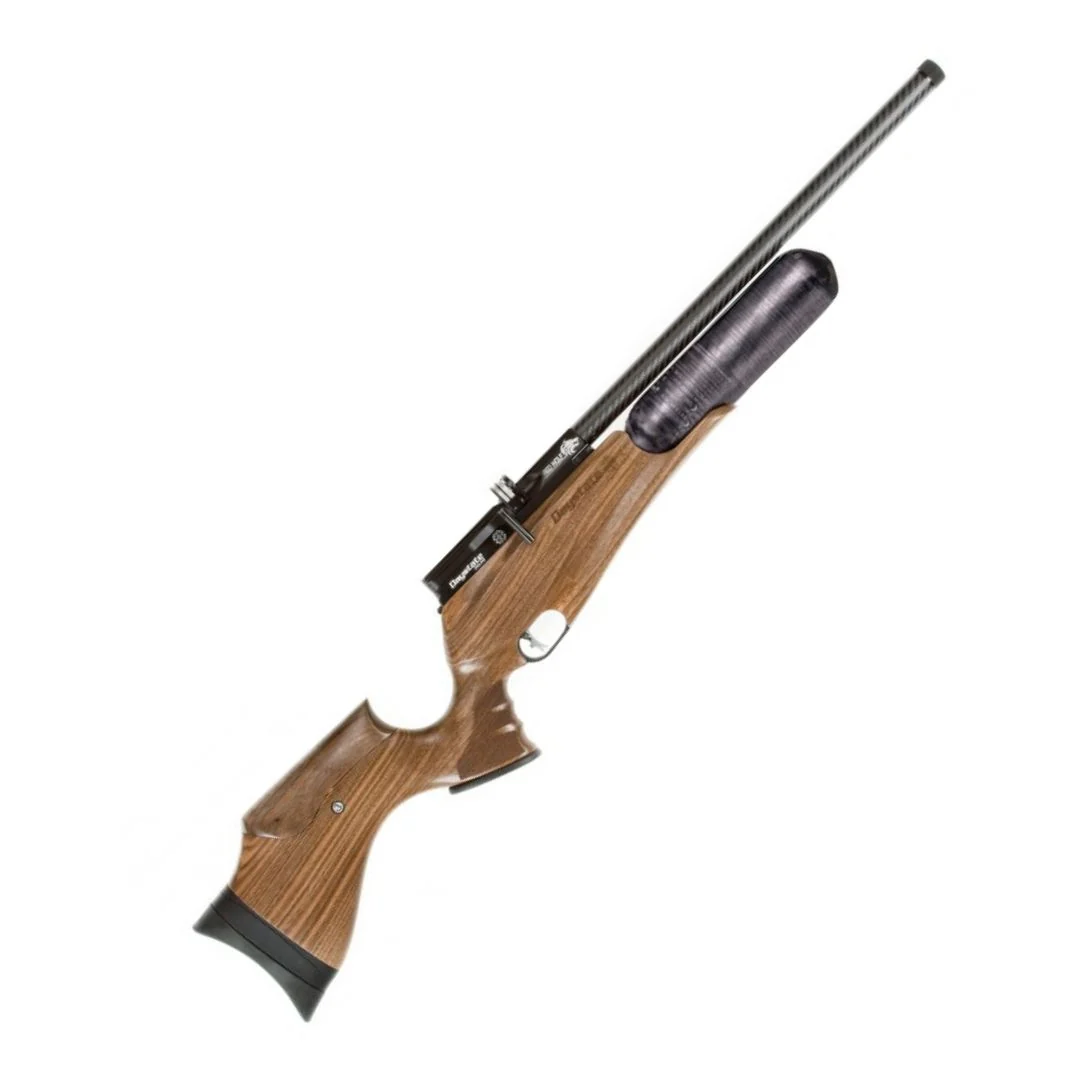
An oiled Grade 2 walnut thumbhole stock is carved with a gentle rake on the pistol grip and stippled panels on grip and forend. A raised comb assists eye alignment with a scope. Length of pull and comb height can be refined via an adjustable rubber butt pad. Inclusive fit is therefore already addressed for a wide range of statures. Replacement or upgraded woodwork cut for the twin-gauge B-Type action is available if cosmetics need refreshing.



Reviews
There are no reviews yet.