Snowpeak M22 PCP Air Rifle – Detailed Product Overview
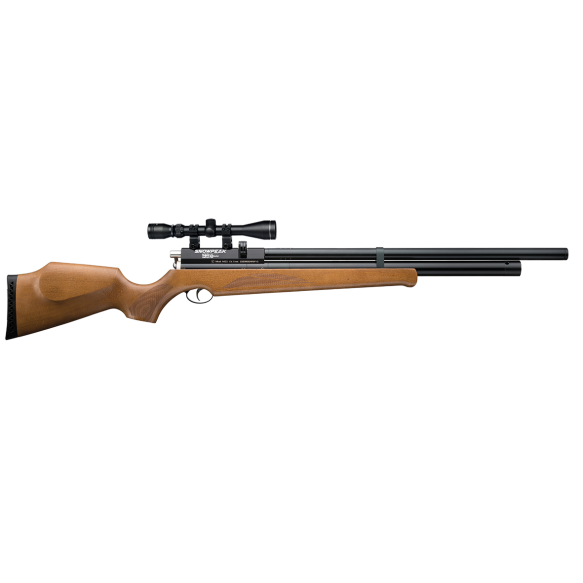
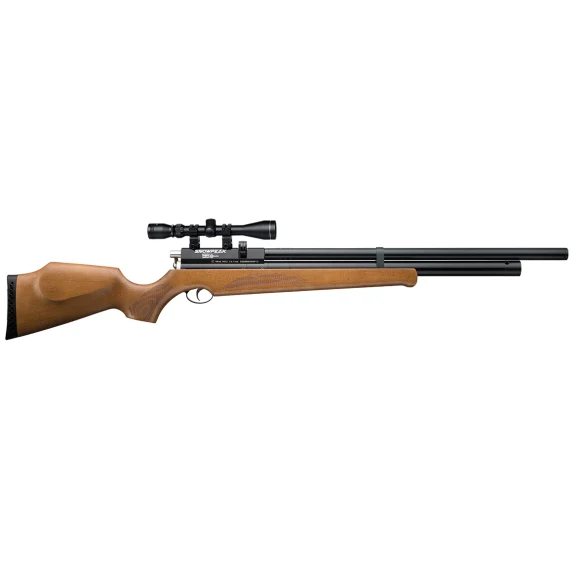
The Snowpeak M22 PCP Air Rifle has been developed as a full-length pre-charged pneumatic platform intended for recreational target shooting, range practice, and other lawful sporting applications. A traditional rifle configuration has been combined with a regulated PCP system, multi-shot magazine arrangement, substantial air capacity, and adjustable trigger mechanism. As a result, a straightforward platform has been created for shooters who value repeatable operation and conventional handling.
Rather than being powered by a spring or gas ram, compressed air is stored within the rifle’s onboard reservoir. Therefore, recoil associated with a conventional spring-piston mechanism is largely avoided. A smoother firing cycle can consequently be experienced, while sight alignment can be maintained more easily during target practice.
The Snowpeak M22 PCP Air Rifle is manufactured in several common pellet calibres, although availability and legal power limits can differ between countries. Consequently, the exact configuration supplied should always be confirmed before use.
Snowpeak M22 PCP Air Rifle Design and Construction
A conventional full-size layout has been used for the M22. According to published specifications, an overall length of approximately 1,240 mm is provided, while weight is listed at approximately 3.7 kg. A 550 mm barrel is identified in Snowpeak PCP documentation.
Because the rifle has been built around a longer platform, a substantial and stable shoulder-mounted shooting position can be achieved. Meanwhile, the overall proportions remain familiar to people accustomed to traditionally shaped sporting rifles.
A European beech stock is specified in Snowpeak documentation. Because wood density naturally varies, slight differences in finished rifle weight may be encountered.
Furthermore, an integrated sound-moderating structure is listed for current M22 configurations. However, the legality of sound moderators and similar components differs considerably between jurisdictions. Local regulations should therefore be checked before the rifle is possessed, modified, transported, or used.
PCP Air System and Regulated Operation
Compressed air is stored within a 250 cc reservoir, while a maximum fill pressure of 25 MPa is specified. A regulator is also fitted according to published Snowpeak specifications.
Through regulated operation, pressure delivered to the firing valve can be controlled more consistently across part of the usable air charge. Consequently, changes in velocity caused by declining reservoir pressure can be reduced compared with an unregulated system.
Nevertheless, actual shot consistency will still be influenced by several factors. Pellet mass, pellet fit, ambient temperature, regulator condition, reservoir pressure, barrel cleanliness, and individual rifle tolerances can all affect performance.
For safety, only charging equipment specifically rated for high-pressure PCP systems should be used. Likewise, the maximum working pressure specified by the manufacturer should never be exceeded.
Snowpeak M22 PCP Air Rifle Key Specifications
Published specifications for the M22 include the following features:
- Platform: Pre-charged pneumatic air rifle
- Available calibres: 4.5 mm (.177), 5.5 mm (.22), and 6.35 mm (.25)
- Air reservoir: Approximately 250 cc
- Maximum fill pressure: 25 MPa
- Regulator: Fitted
- Barrel length: Approximately 550 mm
- Overall dimensions: Approximately 1240 × 170 × 60 mm
- Weight: Approximately 3.7 kg
- Stock: European beech on documented configurations
- Safety: Manual safety
- Trigger: Adjustable two-stage system
- Sound moderation: Integrated on listed configurations
- Magazine: Multi-shot system, with capacity dependent on calibre and production version
Because several generations of Snowpeak documentation are circulating, magazine figures should be verified against the specific rifle supplied. Snowpeak documentation has listed approximately 13 rounds in .177, 11 rounds in .22, and 9 rounds in .25 for certain versions.
Calibre Options and Published Velocity
Several calibre options have been associated with the Snowpeak M22 PCP Air Rifle, allowing different sporting configurations to be offered.
.177 / 4.5 mm
The .177 version has commonly been associated with target shooting because relatively lightweight pellets are normally used. Published Snowpeak documentation lists velocities of up to approximately 1,000 fps for certain configurations.
Actual velocity, however, should not be assumed from the catalogue figure alone. Local power restrictions, pellet selection, rifle setup, and individual production variations may result in considerably different figures.
.22 / 5.5 mm
A 5.5 mm (.22) configuration is also offered. Older Snowpeak documentation lists approximately 900 fps for certain M22 versions, although specifications can differ according to production period and market.
Because heavier pellets are generally used in this calibre, a different balance of projectile mass and velocity is produced.
.25 / 6.35 mm
A larger 6.35 mm (.25) version has additionally been documented. Published manuals have listed approximately 800 fps for some configurations. Again, these figures should be treated as manufacturer reference figures rather than guaranteed real-world performance.
Adjustable Two-Stage Trigger
A two-stage adjustable trigger system is specified for the M22. Therefore, aspects of the trigger feel can be configured within the limits established by the manufacturer.
A two-stage design allows initial movement to be separated from the final release stage. Consequently, a more predictable trigger sequence can be established once the rifle has been correctly adjusted and the shooter has become familiar with its characteristics.
Any adjustment should be completed carefully and according to the manufacturer’s instructions. The safety function should always be checked afterward, and excessively light or unsafe settings should be avoided.
Handling and Range Use
Because approximately 3.7 kg of weight is distributed through a full-length platform, a planted shooting position can be achieved from a suitable supported stance. The longer configuration can also provide a traditional balance that some users prefer during deliberate target shooting.
Meanwhile, the regulated PCP mechanism allows repeated shots to be taken without the spring movement associated with conventional spring-powered rifles.
A suitable pellet catcher or rated backstop should always be positioned behind the target. Eye protection should also be worn, while every person around the shooting area should remain behind the firing line.
Maintenance and Storage
Routine care should be carried out so that the Snowpeak M22 PCP Air Rifle can remain in appropriate operating condition.
External metal surfaces should be kept clean and dry. Likewise, the wooden stock should be protected from prolonged exposure to excessive moisture. Only manufacturer-compatible lubricants should be used around seals and high-pressure components.
Before storage, local safety requirements should be followed. The rifle should be secured against unauthorized access, pellets should be stored separately where required, and the muzzle should always be treated as if the rifle were capable of firing.
Professional servicing should be considered whenever leaks, regulator problems, damaged seals, unusual firing behaviour, or high-pressure system faults are detected.
A Practical Full-Length PCP Platform
Overall, the Snowpeak M22 PCP Air Rifle has been configured around a regulated 250 cc PCP system, full-length wooden stock, multi-shot magazine arrangement, adjustable two-stage trigger, and several calibre choices.
Its specifications place it within the traditional full-size PCP category rather than the compact carbine category. Consequently, it can be considered primarily as a recreational and sporting air-rifle platform for controlled target environments and other lawful applications.
Because airgun classifications, permitted power levels, licensing requirements, transportation rules, and permitted uses differ significantly between countries, the version supplied should always be checked against applicable local law before possession or use.
Finally, specifications can be revised between production batches. Therefore, calibre, magazine capacity, muzzle velocity, power level, accessories, and other configuration details should be verified against the individual rifle and current manufacturer documentation.
Snowpeak M22 PCP Air Rifle Calibres, FAC, Power and Accessories
The Snowpeak M22 is produced in several calibre configurations, allowing the same regulated PCP platform to be adapted to different lawful sporting and recreational uses. Current Snowpeak specifications list the rifle in 4.5 mm (.177), 5.5 mm (.22), and 6.35 mm (.25). Each calibre changes pellet diameter, typical pellet weight, magazine capacity, trajectory characteristics, and published velocity, so the exact version should always be confirmed before compatible pellets or magazines are selected.
.177 / 4.5 mm Calibre
The 4.5 mm (.177) version uses the smallest pellet diameter offered for the platform. Current manufacturer information lists a muzzle velocity of approximately 1,000 fps, although actual performance can vary depending on pellet weight, individual rifle configuration, environmental conditions, and local power restrictions.
Because .177 pellets are normally lighter than pellets used in larger calibres, this version is commonly associated with paper-target practice, recreational range shooting, and other controlled sporting activities where a relatively flat trajectory is useful.
Current Snowpeak documentation lists a 13-shot magazine capacity for the .177 version. Older documentation has shown slightly different figures, so replacement magazines should always be matched to the specific production version of the rifle.
.22 / 5.5 mm Calibre
The 5.5 mm (.22) version offers a larger pellet diameter and typically uses heavier projectiles than the .177 configuration.
Current Snowpeak product information lists approximately 1,000 fps for the .22 M22, while some older operating manuals have listed approximately 900 fps. This difference demonstrates why catalogue velocity should be treated as a reference figure rather than an absolute specification for every production batch.
Magazine capacity has likewise varied between documentation. Current manuals identify an 11-shot magazine for certain .22 versions, while earlier documentation has listed 10 shots. Consequently, owners should verify the supplied magazine rather than assuming universal compatibility between production generations.
.25 / 6.35 mm Calibre
The largest calibre currently listed for the M22 is 6.35 mm (.25).
Snowpeak’s current product page publishes approximately 900 fps, while previous operating manuals have listed approximately 800 fps for some versions. The difference may reflect changes in production specification, test conditions, or market-specific configuration.
A 9-shot magazine is identified for the .25 configuration in Snowpeak documentation. Because .25 pellets are generally heavier, velocity alone should not be used to compare this version with smaller calibres. Pellet mass must also be considered whenever muzzle energy is evaluated.
FAC and Legal Power Classification
The term FAC generally refers to a legal licensing classification rather than a separate mechanical feature of the rifle.
For example, in jurisdictions where air rifles exceeding a specified muzzle-energy threshold require firearm certification, a higher-output version may fall into an FAC or equivalent licensing category. A lower-powered version supplied for another jurisdiction may not.
Therefore, the appearance of two M22 rifles does not necessarily indicate that they share the same legal power classification.
Factory output can be configured according to the destination market, and Snowpeak itself notes that final specifications depend on the shipped version and local compliance requirements.
For this reason, the rifle’s actual muzzle energy and local regulations should be checked before possession or use. Unauthorised alterations that increase power can also affect legality, safety, and warranty coverage.
PCP Power System
The rifle is powered through a regulated pre-charged pneumatic system.
A 250 cc air reservoir is fitted, while the maximum published filling pressure is 25 MPa, equivalent to approximately 250 bar. A regulator is also incorporated into the system.
Instead of relying on a compressed spring, energy is supplied from high-pressure air stored inside the reservoir. The regulator helps control the pressure delivered to the firing system as reservoir pressure gradually falls.
This regulated design can support more consistent shot-to-shot behaviour throughout the useful portion of the air charge.
However, actual muzzle energy depends on several factors, including:
- Calibre
- Pellet weight
- Pellet design
- Production version
- Reservoir pressure
- Regulator condition
- Temperature
- Local market configuration
Published velocity should therefore not be treated as a guaranteed energy value.
Compatible Accessories and Supporting Equipment
Several accessories may be used with the rifle for normal charging, storage, maintenance, and lawful range use.
PCP Charging Equipment
Because a high-pressure reservoir is used, suitable PCP-rated charging equipment is required.
Common options include a PCP hand pump, appropriately rated high-pressure compressor, or certified compressed-air cylinder. Snowpeak itself lists pumps, compressors, and high-pressure tanks among common supporting equipment for its PCP rifles.
All hoses, fittings, gauges, and adaptors must be rated for the required pressure. The specified 25 MPa maximum pressure must never be exceeded.
Pellets
The pellet must correspond exactly with the rifle’s calibre:
- 4.5 mm pellets for .177
- 5.5 mm pellets for .22
- 6.35 mm pellets for .25
Different pellet weights and designs may produce different accuracy and velocity characteristics. Only properly formed pellets of the correct calibre should be used.
Replacement Magazines
Calibre-specific replacement magazines can be useful for organized range sessions.
However, magazine specifications have changed slightly across Snowpeak documentation, especially for .177 and .22 versions. Consequently, replacement magazines should be confirmed for both the correct calibre and exact M22 production version before use.
Optical Sights
A compatible air-rifle scope can be used where the mounting interface and optic are suitable.
Scopes are commonly used during paper-target shooting or other controlled range activities because they provide an enlarged aiming reference. Correct mounting hardware should always be selected for the rifle and optic.
Gun Bag and Storage Equipment
A padded gun bag or suitable hard case can protect the rifle during lawful transport and storage.
Secure storage should also prevent access by unauthorized users, particularly children or people unfamiliar with airgun safety.
Cleaning and Maintenance Accessories
Routine maintenance equipment can include soft cleaning patches, an airgun-compatible cleaning system, protective cloths, and manufacturer-approved lubricants.
Aggressive solvents or unsuitable oils should not be introduced into high-pressure components.
Snowpeak additionally identifies cleaning kits, target equipment, scopes, gun bags, pellets, pumps, compressors, and high-pressure tanks as common supporting accessories for its PCP range.
Overall, the platform combines three calibre choices, a regulated 250 cc air reservoir, a maximum 25 MPa fill pressure, and multi-shot magazine operation. Exact velocity, magazine capacity, legal classification, and permitted power level should always be verified against the individual rifle because published specifications have varied between production documentation and regional versions.
Snowpeak Airguns, PCP Rifles, Air Pistols and Umarex Airguns
For shooters researching Snowpeak airguns, Snowpeak Sports, and the wider Snowpeaks product range, there are many PCP rifles, air pistols, and shooting accessories to consider. Popular searches include the Snowpeak AP900, Snowpeak AP900B PCP air rifle, Snowpeak MAX 1, Snowpeak MAX 1 price, Snowpeak PP750, PP750, Snow Peak PP750, and PP750 air pistol. Buyers also regularly compare models such as the Snowpeak P35, P35, P 35, PCP P 35, Snowpeak P35X, P35X, P35X PCP, and Snowpeak P35 vs P35X.
Other Snowpeak models attracting attention include the Snow Peak PP20, Snowpeak PP20, Snowpeak M25, M25 rifle, M-25, M25 weapon, Snowpeak M60, Snowpeak M60B, M 60B, rifle M60, rifle M50, and M50 rifle. Searches such as Snow Peak brand origin are also common among buyers who want to understand the manufacturer before choosing a rifle or pistol.
Snowpeak PCP Models and Related Airgun Searches
The PCP category covers everything from compact pistols to full-size hunting and target rifles. Searches frequently include PR900 Gen 3, CR650, SR 1000X, T Rex 6000, and pistolet PCP Arcea-Snowpeak Onix Sport. People comparing pneumatic platforms may also search what is a PCP airgun, air gun, air rifle, pellet pistol, air gun accessories, 9mm pellet, and pellet 9mm.
Some search phrases overlap with firearm terminology even when shoppers are researching airgun products. These include rifle M60, how much did the M60 weigh, rifle M50, M50 rifle, M25 weapon, and snowfall gun. Therefore, model specifications should always be checked carefully so that a historical firearm search is not confused with a modern sporting airgun product.
Umarex Airguns, Air Rifles, Pistols and PCP Platforms
Alongside Snowpeak products, Umarex USA, UmarexUSA, Umarex airguns, and Umarex air rifles are widely searched by recreational shooters, target shooters, and PCP enthusiasts. The Umarex range includes PCP rifles, CO₂-powered platforms, break-barrel pistols, BB guns, airsoft replicas, and large-caliber airgun systems.
Popular PCP searches include Umarex Notos, Umarex Notos Carbine, Umarex Gauntlet, Umarex Gauntlet 2, Umarex Gauntlet 30, Umarex Zelos, Umarex Origin, Umarex Komplete, and Umarex Komplete NCR .22. Hunters researching larger airgun platforms may also encounter the Umarex Hammer, Umarex Hammer .50 caliber, Umarex Hammer Carbine, Umarex Primal 20, and Umarex AirSaber.
Umarex Pistols, BB Guns and T4E Models
For handgun-style platforms, popular searches include Umarex BB gun, BBgun, BB gun pistol, metal BB gun, Umarex TR50, Umarex HDR 50, Umarex T4E, Umarex T4E Smith, Umarex Smith, and Umarex P2P DR50 how many joules.
Glock-style replicas remain another major category. Search terms include Glock BB gun, Glock 19 BB gun, Umarex Glock 19, Umarex Glock 19X, Umarex Glock 19 Gen3 .177 caliber BB gun air pistol, Umarex Glock 17, Umarex Glock 17 Gen 5, Umarex Glock, airsoft Glock, airsoft Glock 19, Glock 17 airsoft, and Glock airsoft gun.
Other replica and recreational searches include Umarex MP40, Umarex MP5, Umarex Legends, Umarex HK Heckler, Umarex shotgun, and airsoft pistol.Umarex DX17.
Break-Barrel and Sporting Umarex Airguns
Shooters looking for spring or gas-piston platforms frequently research the Umarex Trevox, loading Umarex Trevox break barrel .177, Umarex pistol break barrel, Umarex Fusion 2, Umarex Synergis Elite, and Amazon Umarex Browning 800 Express. These platforms provide alternatives for people who want an airgun without relying on a high-pressure PCP charging system.
Additional searches across the Umarex catalog include Umarex H, while broader terms such as air rifle, pellet pistol, air gun, and air gun accessories help buyers compare platforms, ammunition, optics, filling equipment, targets, cases, and other shooting equipment.
Whether the focus is a Snowpeak M60, Snowpeak M25, Snowpeak P35X, Snowpeak PP750, Snowpeak MAX 1, Umarex Notos, Umarex Gauntlet 2, Umarex Origin, or Umarex Hammer Carbine, buyers should compare caliber, operating system, power level, dimensions, intended use, and local regulations before selecting an airgun.
Practical Use Scenarios
A full-length regulated PCP air rifle can serve several practical roles for people who use air-powered sporting equipment responsibly and within local law. Its relatively stable firing cycle, multi-shot capability, conventional rifle dimensions, and pre-charged pneumatic operation make it suitable for controlled environments where consistency, repeatability, and manageable handling are important.
Rather than being limited to one type of activity, the rifle can be used across recreational target sessions, supervised range practice, accuracy development, informal competition, equipment familiarization, and structured shooting exercises. However, every use should take place in a legally permitted area with a secure backstop, a clear firing line, appropriate eye protection, and careful muzzle discipline.
Recreational Target Shooting
One of the most practical uses for this type of PCP rifle is recreational target shooting. Paper targets, reactive targets specifically designed for airgun use, and approved range systems can all provide a controlled environment for developing repeatable shooting habits.
Because the firing cycle of a PCP system is typically smoother than that of a traditional spring-powered rifle, the shooter can concentrate more easily on sight alignment, trigger control, and follow-through. Less mechanical movement is produced when the shot is released, so errors in technique may become easier to identify.
For example, a shooter may place several paper targets at a lawful and appropriate range distance and work through controlled groups of shots. Each group can then be reviewed for consistency. Instead of focusing only on whether the target has been hit, attention can be given to group size, vertical spread, horizontal movement, and overall repeatability.
This type of exercise can be particularly useful for learning how body position, breathing, grip pressure, and trigger control influence results.
Developing Basic Marksmanship Skills
Structured marksmanship practice is another realistic scenario.
A shooter can begin from a supported position so that the rifle remains stable. Once a consistent technique has been established, different lawful shooting positions can be practiced gradually.
The objective is not speed. Instead, attention can be placed on repeating the same physical process before every shot.
Breathing can be controlled. The sight picture can be checked. Trigger pressure can be applied smoothly. Afterward, the shooter can maintain position briefly rather than immediately moving the rifle.
When these habits are repeated carefully, consistency can be improved over time.
The relatively predictable firing behaviour of a regulated PCP system can assist with this learning process because the shooter is not required to compensate for the pronounced spring movement found in some conventional air rifles.
Backyard Target Practice Where Legally Permitted
In some locations, private-property target shooting may be legally permitted when appropriate safety requirements are met.
Where this is allowed, the rifle can be used for controlled backyard practice provided that a suitable shooting lane and a correctly rated pellet trap or backstop are installed.
The area behind the target should be considered before every session. A pellet should never be fired toward an area where people, animals, buildings, vehicles, roads, or neighboring property may be exposed.
For this reason, a safe backstop should be designed to stop projectiles reliably rather than simply conceal the target.
Local ordinances can vary considerably. Some places prohibit the discharge of airguns even on private property, while others impose minimum-distance, noise, storage, or supervision requirements.
Therefore, legality should always be checked first.
Indoor Airgun Range Practice
An indoor range can provide one of the most controlled environments for air-rifle use.
Weather conditions are removed from the equation, lighting is generally more predictable, and the firing distance can remain consistent throughout the session.
These characteristics make indoor shooting especially useful for evaluating technique.
For example, if a shooter repeatedly places shots slightly to one side, the cause may be easier to identify because wind is not affecting the pellet.
Indoor practice also allows equipment changes to be evaluated more systematically. A shooter may compare different approved target types, shooting positions, or sight settings without having to account for sudden changes in weather.
Range rules must still be followed precisely. Rifles should remain pointed in the designated safe direction, actions should be opened when required, and commands issued by range personnel should be observed immediately.
Outdoor Range Use
Outdoor shooting introduces additional environmental factors.
Wind, temperature, changing light, and variable shooting conditions can affect how pellets behave. Consequently, outdoor practice can provide a useful progression after basic technique has been developed in a more controlled environment.
Rather than attempting to compensate aggressively, shooters can begin by observing conditions.
For instance, groups fired during calm weather can be compared with groups fired in moderate crosswinds. The difference helps illustrate how relatively light airgun pellets can be influenced by environmental conditions.
Such practice can improve general understanding of external ballistics without requiring unsafe experimentation.
A formal outdoor range is particularly useful because distances, firing points, and impact areas are already established.
Supported Bench Shooting
Bench-rest style practice is especially useful when a shooter wants to evaluate the rifle itself rather than their ability to hold it unsupported.
A suitable front rest or shooting bag can provide stability while the rear of the rifle remains comfortably supported.
The purpose is to reduce unnecessary movement.
When the rifle is stable, several factors can be assessed more clearly. These can include shot consistency, sight alignment, pellet compatibility, trigger feel, and group repeatability.
Bench shooting can also be useful after basic maintenance or when an optical sight has been removed and reinstalled.
Any sight adjustment should be performed cautiously on a proper range or another lawful controlled area with a reliable backstop.
Learning Consistent Trigger Control
Trigger technique has a major influence on target shooting.
An adjustable two-stage trigger can allow the shooter to become familiar with a distinct first stage followed by the final release stage.
During practice, the trigger finger should move smoothly rather than pulling suddenly.
A useful training exercise involves concentrating on completing the trigger movement without disturbing the sight picture.
If the rifle shifts noticeably at the moment the trigger is pressed, the shooter can adjust technique on the following shot.
Over time, this makes the firing process more predictable.
Any trigger adjustment should remain within manufacturer guidance, and the rifle’s safety system should be checked afterward.
Practicing With Different Shooting Positions
Target practice does not need to be limited to a bench.
Where range rules permit, shooters can practice stable standing, seated, kneeling, or supported positions.
Each position introduces different challenges.
Standing generally requires more muscular control because fewer external supports are available. Seated shooting may offer greater stability. A supported position may be useful when the purpose is to evaluate precision rather than physical steadiness.
Moving between these positions can also help a shooter understand how rifle weight and balance affect comfort.
However, all position changes should be performed safely, with the muzzle kept in a designated safe direction.
Familiarization for New PCP Users
People transitioning from spring-powered air rifles to PCP equipment may find familiarization sessions especially valuable.
The charging system, reservoir pressure, regulator, magazine, and operating sequence differ from those of many traditional air rifles.
Consequently, the first sessions should be focused on understanding the equipment rather than achieving maximum performance.
The user can learn how the pressure gauge is read, how the rifle is handled between shooting strings, how the magazine is removed, and how the rifle is safely stored after use.
Only properly rated PCP charging equipment should be used.
High-pressure air systems should never be improvised, modified, or connected to components that are not designed for the manufacturer’s stated operating pressure.
Pellet Evaluation at the Range
Different pellets can behave differently even when their nominal calibre is identical.
Manufacturing tolerances, pellet weight, skirt design, and shape can all influence performance.
A controlled target session can therefore be used to determine which manufacturer-approved pellets produce the most consistent groups in a particular rifle.
The process should remain systematic.
A shooter might fire several groups with one pellet type before changing to another. Results can then be recorded and compared.
This approach is more useful than switching repeatedly between different pellets during a single group.
Only ammunition of the correct calibre should be used.
Sight Familiarization
Whether the rifle is equipped with an appropriate optic or another compatible sighting system, practice is necessary before consistent target results can be expected.
The first objective is simply to establish a repeatable sight picture.
Eye position should remain similar from shot to shot. Head position should also remain comfortable rather than being forced unnaturally.
Once repeatability has been achieved, small sight corrections may be made according to the manufacturer’s instructions.
Adjustments should always be verified with additional groups rather than being based on a single shot.
Recreational Precision Challenges
Informal precision challenges can make practice more structured without turning the session into high-pressure competition.
For example, a shooter can use a sheet containing several small paper targets and fire a predetermined number of pellets at each target.
Scores can then be recorded over several sessions.
Instead of comparing with other people, the shooter can compare current results with previous personal results.
This provides a measurable way to observe improvement in stability and consistency.
Safe shooting practices should remain unchanged regardless of whether the session is casual or competitive.
Club and Organized Range Activities
Airgun clubs often provide a structured environment for shooters who prefer organized practice.
Depending on the facility, activities may include paper-target shooting, precision disciplines, informal competitions, or supervised training.
Club environments also provide established safety procedures.
Range officers can control when shooting begins and ends, while designated firing lines help prevent people from entering unsafe areas.
Beginners may benefit from this structure because safe habits can be learned from the start.
Rules concerning allowable calibre, muzzle energy, sighting systems, and equipment may differ between clubs, so the relevant regulations should be checked before attending.
Equipment Familiarization and Routine Checks
A target session can also serve as an opportunity to check whether equipment is functioning normally.
Before shooting, the rifle can be inspected for obvious damage, loose components, damaged seals, or unusual air loss.
Afterward, external surfaces can be wiped down and the equipment can be stored appropriately.
Pressure behaviour should also remain predictable.
Unexpected pressure loss, abnormal firing behaviour, or unusual mechanical sounds should not be ignored.
If a fault is suspected, use should be discontinued until the rifle has been inspected by a competent technician.
Training Consistency Over Multiple Sessions
Improvement in recreational shooting usually comes from repeatable practice rather than attempting to make large changes during one session.
A simple shooting log can be useful.
The shooter can record the date, location, approximate conditions, pellet type, shooting position, number of shots, and general observations.
Over time, patterns may become visible.
For example, a shooter may discover that groups are tighter from a particular supported position or that concentration decreases during excessively long sessions.
This type of information can be used to plan more effective practice.
Supervised Introduction for Responsible New Shooters
Where legally permitted, a responsible adult or qualified instructor may introduce another person to target shooting under close supervision.
The session should begin with safety procedures before any pellet is loaded.
Muzzle direction, trigger discipline, safe handling, target identification, and range commands should all be explained clearly.
Only after these principles are understood should live firing begin.
A stable supported position is usually easier for a new shooter because less effort is required to hold the rifle steady.
The session should remain controlled, short, and focused on correct habits.
Responsible Use in Controlled Environments
Regardless of the specific activity, responsible use remains the most important practical consideration.
The rifle should never be handled casually simply because it is powered by compressed air rather than conventional ammunition.
A suitable backstop should always be present. The firing area should remain clear. Eye protection should be used when appropriate, and the rifle should be stored securely when it is not in use.
Transport rules should also be observed.
In some jurisdictions, air rifles must be transported unloaded, enclosed in a case, or secured separately from pellets. Other regions may require licences, permits, age restrictions, or specific storage arrangements.
A Versatile Platform for Structured Target Use
Taken together, these practical scenarios demonstrate how a regulated PCP rifle can be incorporated into recreational and sporting target activities.
It can be used for basic marksmanship development, supported bench shooting, indoor range practice, outdoor range sessions, supervised training, pellet evaluation, sight familiarization, club activities, and personal accuracy exercises.
Its usefulness ultimately depends less on any single specification and more on how responsibly and consistently it is used.
When safe handling, appropriate supervision, suitable range facilities, proper equipment, and local legal requirements are respected, the platform can provide a structured way to develop shooting discipline and equipment familiarity over time.
Frequently Asked Questions About the Snowpeak M22 PCP Air Rifle
What is the Snowpeak M22 PCP Air Rifle?
The Snowpeak M22 PCP Air Rifle is a pre-charged pneumatic air rifle built around a full-length sporting configuration. Instead of using a spring-piston system, it stores compressed air in an onboard reservoir and uses that air to propel the pellet.
A regulated air system is incorporated into the platform, helping provide more stable pressure during a shooting session. The rifle is also available in several calibres, including .177, .22, and .25, depending on the market and production version.
Its layout makes it suitable primarily for lawful recreational target shooting, range practice, structured marksmanship training, and other permitted sporting uses.
What calibres are available for the Snowpeak M22?
The M22 is commonly offered in three calibres:
- 4.5 mm / .177
- 5.5 mm / .22
- 6.35 mm / .25
Each calibre produces different handling and ballistic characteristics.
The .177 version generally uses lighter pellets and is widely associated with target shooting. The .22 version uses larger and typically heavier pellets, while the .25 configuration uses the largest pellet diameter offered for this platform.
Availability can vary by region, so the calibre marking on the rifle should always be checked before pellets or magazines are selected.
Is the Snowpeak M22 regulated?
Yes. Current Snowpeak specifications identify the M22 as a regulated PCP air rifle.
A regulator helps control the pressure supplied from the main air reservoir to the firing system. Because reservoir pressure gradually decreases as shots are fired, regulation can help reduce variations in pressure during the useful portion of an air fill.
However, consistent performance still depends on additional factors such as pellet weight, temperature, rifle condition, reservoir pressure, and individual production tolerances.
What size air reservoir does the M22 use?
The M22 is listed with an approximately 250 cc air reservoir.
This reservoir stores the compressed air required for operation. The actual number of usable shots from a fill can vary according to calibre, power configuration, regulator behavior, pellet weight, ambient temperature, and how far the reservoir pressure is allowed to fall before refilling.
For that reason, a single universal shot-count figure should not be assumed for every version.
What is the maximum fill pressure?
Published specifications list a maximum filling pressure of approximately 25 MPa, which is equivalent to about 250 bar.
Only PCP charging equipment rated for the required pressure should be used.
The manufacturer’s stated maximum pressure should never be exceeded. High-pressure pneumatic equipment must be treated carefully because unsuitable hoses, fittings, compressors, or cylinders can create serious safety hazards.
How is the rifle filled with air?
A PCP rifle is normally filled using compatible high-pressure charging equipment.
Depending on the equipment available, this may include a PCP-rated hand pump, certified compressed-air cylinder, or purpose-built PCP compressor.
All charging equipment must be suitable for the rifle’s operating pressure.
Connections should be inspected before use, and the manufacturer’s filling instructions should be followed. Improvised high-pressure fittings or components should not be used.
Does the Snowpeak M22 use a magazine?
Yes. The M22 uses a multi-shot magazine system.
Magazine capacity depends on calibre and, in some cases, production version.
Published Snowpeak documentation has listed capacities such as approximately 13 shots for .177, 11 shots for .22, and 9 shots for .25 on certain versions.
Because specifications have changed across documentation, replacement magazines should be selected specifically for the rifle’s calibre and production configuration.
Can the rifle also be used as a single-shot air rifle?
Whether a dedicated single-shot loading tray is supplied or compatible depends on the exact package and production version.
Some PCP platforms support both magazine-fed and single-shot use, particularly for precision target practice. However, compatibility should be confirmed against the specific M22 supplied rather than assumed.
A magazine or loading accessory designed for another model should not automatically be considered compatible.
What type of pellets should be used?
Only pellets matching the rifle’s marked calibre should be used.
A .177 rifle requires 4.5 mm pellets, a .22 version requires 5.5 mm pellets, and a .25 version requires 6.35 mm pellets.
Pellet weight and design can influence velocity, consistency, and accuracy. Therefore, shooters often compare several suitable airgun pellets during controlled target sessions to determine which type performs consistently in their individual rifle.
Damaged, deformed, or incorrectly sized pellets should not be used.
How powerful is the Snowpeak M22?
Power depends on the calibre, pellet weight, market configuration, and legal restrictions that apply to the rifle.
Published manufacturer information has included relatively high velocity figures for some versions, although older manuals and regional configurations may show different values.
Velocity alone should not be used as a complete measure of power. Muzzle energy depends on both projectile velocity and pellet mass.
For legal purposes, the actual muzzle-energy classification of the rifle is more important than a catalogue velocity figure.
Is there an FAC version?
Higher-output configurations may fall under an FAC or equivalent licensing category in jurisdictions where air rifles above a specified energy level are treated differently under firearms law.
FAC is therefore a legal classification rather than simply a model designation.
Two externally identical rifles can potentially have different legal status if their power outputs differ.
Anyone considering ownership or use should check the applicable regulations in their jurisdiction, including licensing, storage, transport, and permitted-use requirements.
Can the power be adjusted?
Internal power-related components should only be serviced or adjusted in accordance with manufacturer guidance and applicable law.
Changing the output of an air rifle can affect reliability, regulator behavior, safety, warranty coverage, and legal classification.
In some jurisdictions, increasing muzzle energy beyond a defined threshold can change the rifle’s legal status.
For those reasons, unauthorized power modification should be avoided.
Is the Snowpeak M22 suitable for target shooting?
Yes. Controlled target shooting is one of the practical applications of a regulated PCP platform.
The relatively smooth firing cycle can help shooters concentrate on sight picture, breathing, trigger control, and follow-through.
Indoor and outdoor ranges can both be suitable, provided the facility permits the rifle’s calibre and power level.
A secure backstop and appropriate eye protection should always be used.
Is it suitable for beginners?
A beginner can use a PCP air rifle under appropriate supervision and after learning the relevant safety procedures.
However, PCP rifles introduce additional considerations that are not present with some simpler airgun systems.
These include high-pressure charging, reservoir monitoring, magazine operation, regulator behavior, and secure storage.
For a new user, supervised instruction at a recognized range or club can provide a safer introduction to the equipment.
Does it have much recoil?
PCP air rifles generally produce much less mechanical movement than spring-piston rifles.
Because there is no large spring and piston moving rapidly during the shot, the firing cycle tends to feel smoother.
There can still be some movement and sound when the rifle is fired, but it is different from the pronounced forward and rearward movement associated with many spring-powered air rifles.
This characteristic can make PCP platforms useful for controlled target practice.
Does the M22 have an adjustable trigger?
Published specifications identify an adjustable two-stage trigger system.
A two-stage trigger separates initial trigger movement from the final release stage.
This arrangement can provide a more predictable feel once the user becomes familiar with it.
Any trigger adjustment should remain within manufacturer instructions. After adjustment, the safety and trigger function should be checked carefully before the rifle is returned to normal use.
What type of safety does it use?
The M22 is listed with a manual safety.
A manual safety should be treated as an additional mechanical safeguard rather than a replacement for correct handling.
The muzzle should always remain pointed in a safe direction, and the trigger should not be touched until the shooter is ready to fire.
Mechanical safety devices can fail or be operated incorrectly, so standard firearm and airgun safety principles remain essential.
Can a scope be fitted?
A compatible optic can be installed where the rifle’s mounting interface and the chosen scope rings are suitable.
A properly mounted scope can provide a clearer aiming reference for range and target use.
Mounting hardware should correspond with the rifle’s rail configuration.
After an optic is installed, it should be checked for secure attachment and then sighted in at a suitable controlled range.
What accessories are commonly used with the rifle?
Typical supporting equipment may include:
- PCP hand pump, compressor, or certified air cylinder
- Calibre-correct pellets
- Compatible replacement magazines
- Suitable scope and mounting rings
- Padded gun case or hard case
- Cleaning equipment designed for air rifles
- Manufacturer-compatible lubricants
- Protective eyewear
- Paper targets or approved airgun targets
- Correctly rated pellet trap or backstop
Accessories should always be chosen according to the exact rifle configuration.

Reviews
There are no reviews yet.